

Pet insurance is property-and-casualty insurance in a health-insurance costume. Unlike human health coverage, no U.S. law requires it to cover pre-existing conditions; you typically pay any licensed vet up front and get reimbursed afterward; and whether a claim is paid is decided by the policy form — not the brochure.
Owners learn this on exact dates. One dog tore a knee ligament five days before the orthopedic waiting period ended — turning a covered surgery into roughly $3,000 out of pocket.
The Fine-Print Index is our audit of those clauses — waiting periods, the second-knee rule, curable pre-existing windows, and exam fees — across the 22 U.S. carriers actively writing new policies. Every cell below carries a verdict label: CONFIRMED values are quoted from a binding policy document, and the few we could trace only to marketing pages are flagged † and excluded from every count.
The three findings worth quoting: across the 22 U.S. carriers actively writing policies, the special orthopedic/cruciate wait runs from zero days to a full 12 months for a single condition; 2 carriers' audited binding forms provide no cure pathway for pre-existing conditions (Trupanion, Odie), while Pets Best's audited form sets no fixed cure period and its current guidance describes individualized cured-condition eligibility; and — despite the reputation — no binding form we read bars a healthy second knee because the first tore while you were covered. Every second-knee rule looks back to before coverage or a waiting period; what differs is its reach. At the 5 carriers that share one form family (Spot, Pumpkin, ASPCA, Hartville, Wagmo), any earlier knee or ligament problem, in either knee, excludes both knees for the life of the policy; most others exclude only the same condition on the other side.
Table of Contents
- How we built this index (and how to read it)
- The Fine-Print Index: all 22 carriers at a glance
- Waiting periods by company
- The orthopedic wait: the separate clock that catches everyone
- Will they cover the other knee? The bilateral rule, decoded
- "Curable" pre-existing conditions: who lets them come back
- Exam fees: the loophole on every single claim
- What restarts the clock: switching, exits, and underwriter changes
- What the comparison sites (and Google's AI) get wrong
- The rules are changing: NAIC Model Act #633 and state law
- Frequently Asked Questions
- Cite or embed this Index
- Methodology & sources
- Sources
How we built this index (and how to read it)
We audited 24 U.S. pet insurance brands and read the current binding paperwork for each — sample policies, certificates of insurance, and state insurer disclosures — not marketing pages or FAQ answers. Twenty-two of those brands are actively writing new policies, and every count in this article uses those 22 as its base.
Each cell in the Index carries a verdict label that tells you what kind of document backs it:
| Label | What it means | How we treat it |
|---|---|---|
| CONFIRMED | Quoted from a binding policy form, with the form number | Counts toward every headline stat |
| VARIES | The binding value differs by state, product tier, or form edition | Shown as a range or split out — never silently collapsed to one number |
| SOFT † | Found only in the carrier's marketing or help pages, not in a binding form we could reach | Marked with a dagger (†) and excluded from every count |
Two brands that still show up on "best pet insurance" lists have quietly stopped writing new policies — 24PetWatch (its book folded into Hartville) and Bivvy (its members moved to Spot). They appear in a separate flagged block below and are not counted; the switching section covers what happened to their policyholders.
Everything here reflects the documents as of July 1, 2026. Policy forms change, and where the newest form a carrier publishes is more than about two years old, we say so in the methodology notes at the end.
The Fine-Print Index: all 22 carriers at a glance
Here is the whole audit in one table: what each of the 22 active U.S. carriers' binding paperwork actually says about the six clauses that decide claims — from Trupanion's state- and channel-dependent timing structures to Nationwide's 12-month cruciate clock.
How to read it: unlabeled cells are CONFIRMED from a binding policy form. "Varies" means the binding value differs by state, product tier, or form edition. † marks SOFT cells — found only in marketing or help pages — which are excluded from every count in this article. Form numbers and source links for every cell are in the Methodology & sources section.
| Carrier | Underwriter | Accident wait | Illness wait | Orthopedic / cruciate wait | Bilateral (second-knee) rule | Curable window | Exam fees |
|---|---|---|---|---|---|---|---|
| Trupanion | American Pet Insurance Co. or ZPIC Insurance Co.; declarations control | 5 days / no formal wait with ~12-day delayed start (varies by state/channel) | 30 days / delayed-start structure (varies by state/channel) | None | Same condition (listed conditions) | Never | Never |
| Nationwide | National Casualty Co. (VPI in CA) | 0 days after policy effectiveness (VS-G-15/16 3-26; product/state/channel may vary) | 14 days on the named forms | 12 months — cruciate/meniscus only, not waivable | Same condition | 180 days; chronic never | Base |
| Embrace | American Modern Home; American Southern Home in FL | 0 days after policy effectiveness (current materials; state/form scope) | 14 days | 180 days, dogs, 4 named conditions; reducible to 14 days via exam | Same condition | 365 days; ortho/cancer/renal carved out | Add-on |
| Healthy Paws | ACE/Chubb issuing entity shown on declarations | 15 days (varies) | 15 days | 12 months — hip dysplasia only (varies); no hip coverage if enrolled at 6+; other ortho 15 days | Own variant — a cruciate problem before coverage bars the other legs | 365 days † | Never |
| Lemonade | Lemonade Ins. Co. (Metromile, some states) | 0 days | 14 days | 30 days, all orthopedic, waivable via exam | Same condition | 365 days; chronic/joint never | Add-on |
| Pets Best | APIC / IAIC / IPIC / MS Transverse; declarations control | 3 days | 14 days | 180 days — cruciate only; reducible/waivable through pre-approved channels only | Same condition | No fixed period in audited form; cured-condition guidance † | Add-on |
| Figo | Independence American (IAIC) | 1 day / 0 days (varies by form) | 14 days | 180 days, dogs, waivable ≤30 days / 30 days on newer forms (varies) | None in default form / knee-wide on newer forms (varies) | 365 days; knee/ligament never | Add-on |
| AKC Pet Insurance | IAIC / IPIC; PetPartners-administered; declarations control | 2 days | 14 days | 180 days cruciate + 180 days IVDD | Same condition / knee-wide on newest form, lapsing after 365 days (varies) | 365 days of continuous coverage (varies; absent in FL form) | Add-on |
| PetPartners | Independence American (IAIC) | 2 days | 14 days | 180 days cruciate + 180 days IVDD; waivable on newest form | Same condition / knee-wide on newest form, lapsing after 365 days (varies) | 365 days of continuous coverage; IVDD/knee carved out | Add-on |
| Wagmo | IAIC (US Fire in NY/WA) | 14 days | 14 days | None — rides the 14-day wait | Knee-wide — any knee/ligament problem before coverage bars both knees | 180 days; knee never; chronic never on most state forms, congenital/hereditary/orthopedic on some (varies) | Base |
| ASPCA Pet Health | IAIC / US Fire by state | 14 days | 14 days | None on current form (12-month knee on legacy CA product — varies) | Knee-wide — any knee/ligament problem before coverage bars both knees | 180 days; knee never; chronic never on most state forms, congenital/hereditary/orthopedic on some (varies) | Base |
| Spot | IAIC / US Fire; declarations control | 14 days | 14 days | None — rides the 14-day wait | Knee-wide — any knee/ligament problem before coverage bars both knees | 180 days; knee never; chronic never on most state forms, congenital/hereditary/orthopedic on some (varies) | Base |
| Pumpkin | US Fire (CA) / IAIC (TX) | 14 days | 14 days | None — rides the 14-day wait | Knee-wide — any knee/ligament problem before coverage bars both knees | 180 days; knee never; chronic never on most state forms, congenital/hereditary/orthopedic on some (varies) | Base |
| Hartville | IAIC / US Fire | 14 days | 14 days (varies) | 14 days (12-month knee in CA — varies) | Knee-wide — any knee/ligament problem before coverage bars both knees | 180 days | Base |
| MetLife Pet | Metropolitan General; older IAIC paper may vary by state | 0 days (current MetGen) / 1 day (older IAIC PFI POL 1217) | 14 days | None (current MetGen) / 6 months dogs, all ortho (older IAIC PFI POL 1217; current availability unverified) | Not specified † | None (current MetGen) / 6 months, temporary conditions (older IAIC form; current availability unverified) | Base |
| Fetch by The Dodo | AXIS Insurance Co. | 0 days (accidents exempt) | 15 days | 180 days, all orthopedic; knees waivable; 30 days in FL (varies) | Same condition | 365 days, annual-exam conditioned | Base |
| Prudent Pet | Markel Insurance / Markel American | 5 days | 14 days | 180 days — knee conditions; waivable ≤30 days | Own variant — knee-wide, lapsing 12 months after treatment | 365 days † (not in binding form); knee never | Add-on † |
| Kanguro | Cimarron Insurance Co. | 2 days | 14 days | 180 days — cruciate/knee; reducible to 14 days | Same condition | 365 days; knee/ligament never | Base |
| Odie | Trisura / Trisura Specialty (ME) / Accredited; state availability varies | 3 days | 14 days | 180 days — cruciate only; waivable | Same condition | Never | Add-on |
| USAA Pet | American Modern Home / American Southern Home (FL); Embrace-administered | 0 days | 14 days | 180 days, dogs, 4 named conditions; exam-reducible in eligible states | Same condition | 365 days; the 4 ortho conditions never | Add-on |
| Companion Protect | CSAA General Ins. Co. (AAA-branded) | 0 days | 15 days | 30 days, all orthopedic | Not specified † | Never † | Base † |
| Chewy CarePlus | APIC (Trupanion tiers) / Lemonade–Metromile tier | 0 days | 12 days (Trupanion) / 14 days (Lemonade) | None (Trupanion) / 30 days (Lemonade) — varies | None stated (Trupanion) / same condition (Lemonade) | Never (Trupanion) / 365 days (Lemonade) | Varies by tier |
Exited carriers (flagged, not counted)
| Carrier | Underwriter | Accident | Illness | Ortho | Bilateral | Curable | Status |
|---|---|---|---|---|---|---|---|
| 24PetWatch | North River (Crum & Forster) | 0 days | 14 days / 30 days (Essential) | None | Conditional | 24 months, discretionary | Discontinued 2025 → Hartville |
| Bivvy | CUMIS Insurance Society | 14 days † | 30 days † | 180 days, dogs (varies) | Not specified | 12 months † | Discontinued 2023 → Spot |
One warning before you use the underwriter column as a shortcut: the same underwriter does not mean the same policy. USAA's affinity product and direct Embrace coverage both use the American Modern PET50 chassis, but state, channel, declarations, and endorsements can change the operative terms. The underwriter tells you who pays claims; it does not tell you your terms.
How to use the Index before you buy
- Enroll before any symptoms. Every restrictive clause keys off what your vet noted before coverage begins — including during the waiting period. A "slight limp" in the chart can exclude a knee surgery years later.
- If your breed is prone to knee or hip problems, read the orthopedic column first. A 12-month, non-waivable wait is a different product from a 14-day one — even at the same premium.
- Check the exam-fee column. On frequent small claims, a base-included exam fee is worth more than a slightly higher reimbursement percentage. When you're ready to weigh price and coverage together, start with our best pet insurance picks.
Each column is decoded in its own section below — what the clause means in plain language, who sits in which bucket, and the exact policy wording that decides it.
Waiting periods by company
A waiting period is the stretch of time after your pet insurance policy starts during which claims are not yet covered. Anything that shows signs during it is treated as pre-existing — at most carriers, permanently. Nearly every policy runs separate clocks: one for accidents (0–15 days), one for illnesses (usually 14 days), and often a much longer one for orthopedic conditions.
One protection worth knowing up front: under the NAIC model definition — law in the states that have adopted the Model Act, and how the forms we read are written — waiting periods "may not be applied to renewals of existing coverage." The clock runs when your coverage starts, not every year; switching carriers is a different story, covered below.
The accident clock is where carriers differ most:
| Accident wait | Carriers (binding forms) |
|---|---|
| 0 days after policy effectiveness | Nationwide, Embrace, Lemonade, Fetch, USAA, Companion Protect, Chewy CarePlus |
| 1–5 days | Figo (1), AKC (2), PetPartners (2), Kanguro (2), Pets Best (3), Odie (3), Prudent Pet (5) |
| 14–15 days | Wagmo, ASPCA, Spot, Pumpkin, Hartville (14); Healthy Paws (15) |
| Varies | MetLife (0 days on current MetGen; 1 day on older IAIC paper), Figo (0 or 1 day by form), Trupanion (5-day injury wait or no formal wait with a delayed effective date, depending on state/channel) |
Illness waits cluster tightly around two weeks: 14 days at most carriers, 15 at Healthy Paws, Fetch, and Companion Protect, and 12 on Chewy CarePlus's Trupanion tiers. Trupanion's current national FAQ publishes a 30-day illness wait while warning that timing varies by location; some state forms use a delayed effective date instead of a formal illness wait.
Trupanion has more than one timing structure. Its current FAQ states a 5-day injury wait and a 30-day illness wait, with location-specific variation. A Maine-filed disclosure instead says there are no formal waiting periods and the policy becomes effective about 12 days after enrollment. An eligible Exam Day Offer can make coverage immediate. Enrollment date, effective date, coverage start, formal wait, state, and channel are separate facts.
Which carriers cover accidents from day one?
Seven carriers' current named forms or materials apply no additional accident waiting period once the policy is effective: Nationwide ("Accident coverage is not subject to a waiting period"), Embrace, Lemonade, Fetch, USAA, Companion Protect, and Chewy CarePlus. Current MetGen and newer Figo forms can also be 0 days, while older IAIC/Figo forms differ. Trupanion must be checked by state and channel rather than placed in one universal bucket.
Ordinary online enrollment generally does not provide immediate illness coverage. Trupanion's current FAQ states a 30-day illness wait, while some filed forms delay the entire effective date instead of imposing a formal wait. Its in-clinic Exam Day Offer is a special channel that can start coverage immediately. Treat any "no waiting period" claim as incomplete unless it identifies the state, form, channel, enrollment date, and effective date.
What to do with this: enroll before you need the coverage, because a symptom noted during the wait becomes pre-existing (more on that in the curable-conditions section). And if you're changing carriers mid-year, remember that every clock restarts with the new policy — don't cancel the old one until the new waits have run. If you're still weighing plan types, our accident-only and accident & illness guides cover what each actually pays for.
The orthopedic wait: the separate clock that catches everyone
Most carriers run a second, much longer waiting period for orthopedic problems — torn cruciate ligaments (the classic dog knee injury), luxating patellas, sometimes hips and spines. It ranges from no special wait at all to a full 12 months, and the scope differs so much between carriers that a single "cruciate wait" number is meaningless. Here are the real tiers:
| Tier | Scope | Carriers |
|---|---|---|
| No special wait | Knee and other orthopedic conditions ride the standard wait | Trupanion, Wagmo, Spot, Pumpkin; also true on the current or default forms at ASPCA, Hartville, MetLife (MetGen), and Chewy's Trupanion tiers — all state- or form-dependent (varies) |
| 30 days | All orthopedic conditions | Lemonade (waivable via exam); Companion Protect (not waivable); Figo's newer state forms (varies) |
| 180 days | Cruciate/knee only | Pets Best (reducible/waivable only through pre-approved channels), Odie, Kanguro, Prudent Pet; AKC and PetPartners add a second 180-day clock for IVDD |
| 180 days | Dogs, broader orthopedic list | Embrace and USAA (4 named conditions, reducible to 14 days via exam); Fetch (all orthopedic, knees waivable) |
| 12 months | One single condition — not waivable | Nationwide (cruciate/meniscus); Healthy Paws (hip dysplasia; 30 days and exam-waivable in 16 states) |
Two details in the fine print do most of the damage. First, an accident doesn't necessarily rescue you: Pets Best's form defines a "Cruciate Ligament Event" as "always treated as a medical condition" — an injury reclassified as an illness so the longer clock applies. A Lemonade owner learned the same lesson when a dog fractured a femur slipping on ice during the 30-day orthopedic wait: support chat said accident-related orthopedic care was covered; the claim was denied anyway.
Second, the longest clocks cannot be waived. Nationwide's cruciate coverage "may only be available for enrollment 12 months after the initial policy inception date" — its exam waiver touches the illness wait, not this. Healthy Paws' base form runs a 12-month wait for hip dysplasia specifically, and adds that hip dysplasia isn't covered at all for pets enrolled at age six or older. In 16 states — CA, DE, FL, HI, LA, MD, ME, MS, MT, NE, NH, OH, PA, RI, VT and WA, which is every state that has adopted the NAIC Model Act except New Jersey (its act takes effect January 1, 2027) — the hip wait drops to 30 days, and Healthy Paws' FAQ says it is waived after a complete clinical exam; the age-six exclusion still applies there. If a torn ACL is what you're insuring against, the surgery routinely runs $4,000–$7,000 — this clause is the whole ballgame.
How to waive it (who offers an exam waiver, and the deadline)
Several carriers waive or shrink the orthopedic wait if a vet examines your pet early and finds no pre-existing knee trouble — but every offer has a deadline:
- Embrace / USAA: an Orthopedic Report Card exam after the start date cuts the 180-day wait to 14 days (eligible states).
- Lemonade: a comprehensive exam plus its Waiting Period Waiver Form, submitted within 2 days of the exam.
- Figo: an Orthopedic Waiver Form within 30 days of the effective date (default form).
- Prudent Pet: a vet exam in the first 30 days whose record notes no pre-existing knee conditions.
- Pets Best: reduced or waived only for coverage acquired through a pre-approved channel when a participating vet certifies your pet's health before purchase; the declarations page shows the actual wait.
- Kanguro: reduced to 14 days if you submit a complete medical history showing no prior knee problems.
Do it in the first week. The waiver exam is the cheapest insurance move available — and in the denial threads, the owners who skipped it say the same thing: they never thought they'd need it for a young, healthy pet.
Will they cover the other knee? The bilateral rule, decoded
Usually, yes: if the first knee problem starts while your pet is covered and past the waiting periods, no bilateral clause we read bars the other knee. Insurers call conditions that can affect both sides of the body — knees, hips, eyes, ears — bilateral conditions, and most policies carry a bilateral exclusion. Every one we read looks backward: it reaches the second side only when the first showed signs before coverage began or during a waiting period. What differs is how far it reaches.
The knee-wide version counts any knee or ligament problem against both knees. Spot's form says knee and ligament conditions "are considered bilateral conditions and related, regardless of cause; meaning an occurrence on one side of the body affects both sides of the body," then excludes them all "if any ligament and knee condition occurred prior to the first effective date of the applicable coverage or during a waiting period." A slipping kneecap charted in the left knee before you enrolled can therefore bar a cruciate tear in the right knee years later — yet a first tear after the 14-day wait is covered, and the other knee stays covered with it. The same-condition version is narrower: Embrace's form applies when the pet "has had Clinical Signs, prior to being insured, of a Bilateral Condition on one side of the body," and then bars only "future occurrences of the same condition."
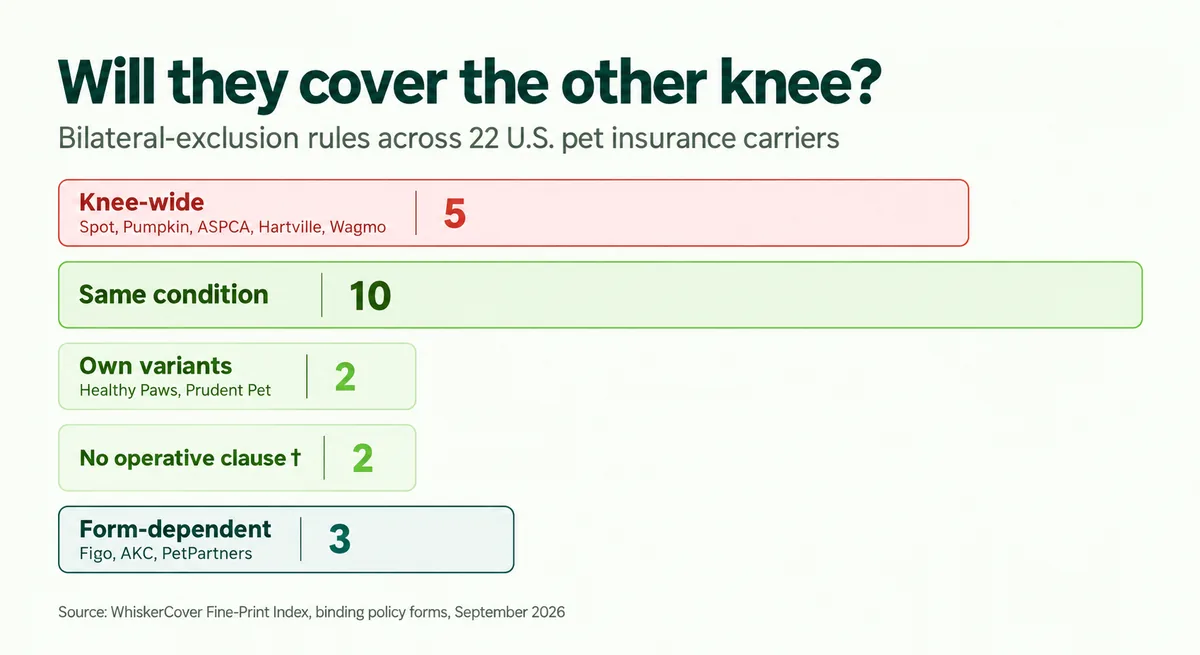
Across the 22 active carriers, the split looks like this: 5 use the knee-wide version — Spot, Pumpkin, ASPCA, Hartville and Wagmo, all five on the same PET-P-20000 policy-form family; 10 use the same-condition version; 2 write their own variants (Healthy Paws, Prudent Pet); 2 have no operative bilateral clause in any binding form we could reach (MetLife†, Companion Protect†); and 3 depend on which form edition your state gets (Figo, AKC, PetPartners).
| Rule flavor | What it means for the second knee | Carriers |
|---|---|---|
| Knee-wide (5) | Any knee or ligament problem — either knee, any cause — before coverage or during the 14-day wait excludes every knee and ligament condition on both sides, for the life of the policy. A first tear after the wait is covered, and so is the other knee | Spot, Pumpkin, ASPCA, Hartville, Wagmo (one shared form family) |
| Same condition (10) | Excluded only for the same (or a listed) condition, and only if the first side showed signs before coverage or during a waiting period | Trupanion, Nationwide, Embrace, Lemonade, Pets Best, Fetch, Kanguro, Odie, USAA, Chewy CarePlus (Lemonade tier) |
| Own variants (2) | Healthy Paws: a cruciate problem in one leg before coverage excludes future injuries and conditions of the other legs, related or not. Prudent Pet: a knee injury before coverage or in the first 6 months (without its 30-day knee exam) excludes the other knee until it is treated and for 12 months after the last treatment | Healthy Paws, Prudent Pet |
| No operative clause † (2) | Only the ordinary pre-existing rule applies | MetLife†, Companion Protect† |
| Form-dependent (3) | Figo: no bilateral clause on the default form, knee-wide on newer state forms (e.g. Ohio 0824). AKC and PetPartners: same condition on the 007-1120 form; knee-wide on the 007-0124 edition, where the exclusion lapses after 365 days of continuous coverage | Figo, AKC, PetPartners |
Two details decide how hard the knee-wide version bites. It never ages out: those five carriers' forms leave ligament and knee conditions out of their 180-day cure-back on every state edition, so a knee problem on file at enrollment stays excluded for the life of the policy. And the trigger is broad — "a ligament, patella, meniscus or soft tissue disorder of the knee," whatever the cause — so a vet's note about a slipping kneecap counts, not just a torn cruciate. The per-carrier rows in the matrix above carry each carrier's exact flavor.
This clause produces the most predictable denial in pet insurance. One Lemonade owner put it plainly: "I submitted a claim to Lemonade and was denied due to a 'Pre-existing Bilateral Condition.' But that leg was always fine" — the first tear pre-dated the policy by three years, which is exactly what these clauses key on. And the number owners trade in the forums — that roughly 60% of dogs who blow one cruciate eventually blow the other — comes without a source, but the published research lands close to it. In a 2011 PLoS ONE study of 380 dogs treated surgically for a non-contact cruciate tear in one knee, 204 (54%) tore the opposite ligament during the study period, and the median time to a second tear was 947 days, about 2.6 years. That is a rate across a clinical population, not an actuarial statistic and not a prediction for your own dog.
So the familiar warning that nearly every carrier has a bilateral exclusion is true — and still misleading. None of the forms we read lets a knee that first fails on your watch cost you the other one; what these clauses punish is history from before coverage, and at five carriers any knee history at all. Read your form's "Bilateral Condition" and knee definitions, then find the exclusion that uses them: "regardless of cause" next to "any ligament and knee condition" is the combination that should give you pause if your pet has a knee note on file.
"Curable" pre-existing conditions: who lets them come back
A curable pre-existing condition is one your policy may cover again after your pet stays symptom-free and treatment-free, subject to the issued form and each policy's exclusions. Two audited binding forms offer no cure pathway: Trupanion and Odie. Pets Best's audited form states no fixed cure period, while its current guidance says some fully healed conditions may cease to be pre-existing. And nearly every fixed window that does exist carves out knees.
| Window | Carriers | What never comes back |
|---|---|---|
| Never in audited form | Trupanion, Odie | Everything pre-existing stays excluded |
| No fixed period / individualized † | Pets Best | The audited form has no general cure window; current carrier guidance says fully healed curable conditions may cease to be pre-existing. Chronic conditions remain excluded; issued form and written determination control. |
| 180 days | Spot, Pumpkin, ASPCA, Hartville, Wagmo; Nationwide (by written reconsideration request) | Knee/ligament conditions at all of them; chronic conditions on most forms, and congenital, hereditary and orthopedic conditions on some Spot, Pumpkin, ASPCA, Hartville and Wagmo state forms |
| 365 days | Embrace, USAA, Lemonade, Figo, Kanguro, Fetch (annual-exam conditioned); AKC via a continuous-coverage pathway (varies) | The named orthopedic conditions, chronic/joint disease, knee/ligament — carrier by carrier |
| Marketing-only † | Healthy Paws (365d †), Prudent Pet (365d †), Companion Protect (Never †); MetLife varies by underwriter | Not in a binding form we could reach — excluded from the counts above |
The carve-outs are the real story: "curable" has a knee-shaped hole. An ear infection that clears up can be covered again after the window; a torn cruciate cannot. Spot's countrywide form says it directly — the 180-day rule "does not apply to chronic conditions or ligament and knee conditions" — and Embrace's marks its four orthopedic conditions as pre-existing "for the life of the policy."
Pets Best needs its own category. Its current guidance says healed conditions such as broken bones or kennel cough may no longer be considered pre-existing and may be covered if they recur. The audited IAIC form uses an 18-month lookback but supplies no universal symptom-free cure period. That supports neither automatic recurrence coverage nor a universal "Never" label; obtain the issued form and a written coverage determination.
The second trap is how "pre-existing" gets decided in the first place. Under the NAIC model definition, a condition is pre-existing if your pet had "signs or symptoms directly related to the condition" before coverage begins — including during any waiting period — no diagnosis required. Your vet's notes are the contract: a Spot policyholder had a $380 dermatitis-and-ear-infection claim denied off a single prior-year ear infection in the chart. If a symptom sits in the chart, assume the carrier will count the symptom-free window from that note — diagnosis or not.
Two reputations deserve correcting. Healthy Paws is widely believed to be a fourth "Never" — in fact its binding form shows a permanent pre-existing exclusion, while a 365-day cure window appears only in its help pages†, so it is neither a confirmed Never nor a confirmed window. And AKC's current forms are the one broad exception in the market: pre-existing conditions become eligible again after 365 days of continuous coverage — but the pathway is form- and state-dependent (it's absent from the Florida sample), so verify it exists in your state's paperwork before counting on it.
One thing that is not a workaround: hiding a symptom by switching vets. Concealing records or answering application and claim questions falsely is misrepresentation that can rise to insurance fraud — and carriers request full histories from every clinic your pet has visited when the first significant claim arrives. For the fundamentals, our pre-existing conditions guide covers what counts, what doesn't, and what to do if your pet already has a chart.
Exam fees: the loophole on every single claim
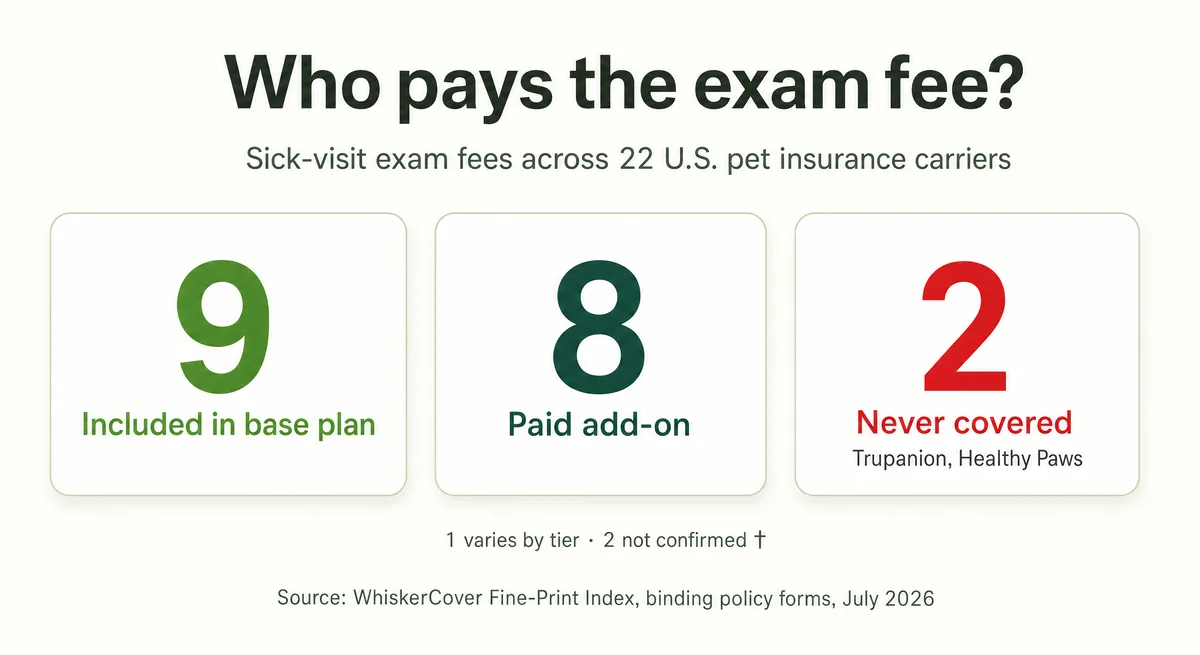
Almost every claim starts the same way: a vet examines your pet, and that exam — the office-visit or consultation charge — lands on the invoice before any treatment does. Whether your policy reimburses it is a three-way split. Of the 22 active carriers, 9 include exam fees in the base plan (Nationwide, Wagmo, ASPCA, Spot, Pumpkin, Hartville, MetLife, Fetch, Kanguro), 8 sell them back as a paid add-on (Embrace, Lemonade, Pets Best, Figo, AKC, PetPartners, Odie, USAA), and 2 never cover them at all — Trupanion and Healthy Paws. Chewy CarePlus varies by tier, and two cells are marketing-only (Companion Protect base†, Prudent Pet add-on†).
Trupanion's binding form doesn't hide the position: "We do not cover Examination fees of any kind… We consider Examination fees to be Your Share of Your Pet's medical needs."
On a routine claim that's an annoyance. On a long treatment protocol it compounds into a toll: one Trupanion policyholder running a 26-week lymphoma chemo protocol found that every weekly infusion carried a "recheck" exam line the policy never covers — "around $400 a week" out of pocket, on a plan that pays 90% of covered costs. (Owners in that thread note a quirk our matrix confirms: Trupanion bought through Chewy's CarePlus Complete tier does cover exam fees.)
Here's the arithmetic — illustrative math, not a claims statistic. Take a $600 sick visit where $150 is the exam fee. A "90%" plan that excludes exam fees reimburses 90% of $450, or $405 — which is 67.5% of the real bill. That is how a 90% plan quietly pays about 70% in practice, before deductibles.
Two clarifications so this lands fairly. First, the sick-visit exam fee is not the annual wellness checkup — routine wellness exams are a separate rider at essentially every carrier, and bundling them in would just move the cost into premiums. Second, terms predict outcomes in both directions: the same Trupanion structure that never pays exam fees also has no orthopedic wait and no payout caps, and its satisfied customers are just as specific — one owner reports "$54,400 paid for 4 TPLOs + cancer across 3 dogs." Read the cell, not the brand reputation.
What restarts the clock: switching, exits, and underwriter changes
Switching carriers restarts the clocks. Unless the new carrier credits continuous prior coverage or grants a waiver exam (a few do — see the orthopedic section above), the new policy re-runs its waiting periods, re-opens the pre-existing look-back, and — this is the part that stings — turns conditions your old carrier covered into pre-existing conditions at the new one. The NAIC model rule that waiting periods "may not be applied to renewals" — where enacted — protects renewals with the same insurer; a new carrier is a new clock.
And you don't always choose the switch. 24PetWatch stopped writing its own-brand policies and its book was folded into Hartville; in one thread from that migration, two Colorado owners report TPLO knee surgeries denied because a 2023 CCL claim "was excluded from rollover when they switched companies" — a $4,000 surgery, covered history and all, reclassified in the move. Bivvy's exit in 2023 moved its members to Spot the same way. Underwriters can also vary beneath one brand: Pets Best's current disclosed panel includes American Pet, Independence American, Independence Pet, and MS Transverse. The declarations page identifies the insurer for an individual policy, and the operative terms live in that policy's paper.
None of this means never switch — premium hikes are real, and staying locked into a bad plan has its own cost. It means switch informed:
- Pull your pet's full records first and read every note — the new carrier will. A stray symptom line is tomorrow's pre-existing condition.
- Overlap the policies: keep the old one active until the new policy's waiting periods — including the orthopedic clock — have fully run.
- Sign the new carrier's waiver exam on day one, where offered (see the orthopedic section above for who offers one and the deadlines).
- Price the lock-in, not just the premium: a condition covered today may never be covered again after the move.
We walk through the full decision — when switching pays off, when it's financially dangerous, and the records checklist — in our switching pet insurance guide and its companion on how pet insurance works if you switch.
What the comparison sites (and Google's AI) get wrong
Most of the waiting-period numbers circulating online trace to marketing pages and to other comparison sites — not to policy forms. Google's AI Overviews then quote those aggregators, and the wrong figure becomes the figure everyone "knows." We checked the most-repeated claims against the binding documents; here is where they part ways:
| The claim in circulation | What the binding form says |
|---|---|
| "Trupanion always has 5-day injury and 30-day illness waits" — or the opposite claim that it never has formal waits | Both are overgeneralized. Trupanion's current FAQ states 5/30 and warns that timing varies by location; a Maine-filed disclosure uses no formal waits plus an approximately 12-day delayed effective date. Eligible Exam Day Offers can start immediately. State, form, and channel control. |
| "Lemonade: 2-day accident wait" | 0 days — the form's waiting-period schedule lists only illness (14 days) and orthopedic (30 days); accidents are covered from the start date. |
| "Companies like Trupanion will usually exclude the other knee" | Conditional only — the second side is barred solely if signs showed "on either side of their body before Your Pet's Effective Date." Trupanion also has no special cruciate wait at all. |
| "The cruciate waiting period is 6–12 months" | There is no one number. Four carriers apply no special wait, Lemonade 30 days, nine carriers 180 days (ten counting Figo's default form) at very different scopes, and only Nationwide reaches 12 months — for cruciate/meniscus alone. |
| "Nationwide accident: 24 hours (or 14 days)"; "USAA accident: 2 days" | Both named current forms apply no additional accident wait once the policy is effective — "Accident coverage is not subject to a waiting period" (Nationwide VS-G-15/16 3-26), and no separate accident wait in the PET50 form (USAA). Product, state, channel, effective date, and issued form still control. |
None of this makes the aggregators villains — a few thin tables genuinely try. But their cells cite "publicly available information," the AI Overview cites them, and the loop closes with an owner budgeting around a number that was never in any contract. When a figure here disagrees with one you've read elsewhere, the tiebreaker is simple: ask which of the two is quoting a policy form. That standard is the entire reason this index exists.
The rules are changing: NAIC Model Act #633 and state law
The fine print above isn't static — a model law is slowly standardizing it. The NAIC Pet Insurance Model Act (#633), adopted in August 2022, defines "pre-existing condition," "orthopedic," and "waiting period" in statute, caps illness and orthopedic waiting periods at 30 days, and prohibits accident waiting periods outright in the states that enact it.
On the NAIC's Summer 2026 chart, 17 states have adopted the Model Act: California, Delaware, Florida, Hawaii, Louisiana, Maine, Maryland, Mississippi, Montana, Nebraska, New Hampshire, New Jersey, Ohio, Pennsylvania, Rhode Island, Vermont, and Washington. (California's version is SB 1217, enacted in 2024 and effective January 1, 2025. New Jersey's act (P.L.2025, c.224) was signed on January 12, 2026 and takes effect on January 1, 2027.) Illinois and Virginia — often listed as adopters — have not adopted it. This map is why so many cells in the Index read "varies" — and why some carriers' newer state editions look nothing like their default forms: Figo's 30-day orthopedic editions and Fetch's 30-day Florida wait both live in adopting states, while the same carriers' default forms run 180 days elsewhere.
Accountability data is arriving too. The NAIC's Market Conduct Annual Statement added a pet insurance line covering 2024 data, first filed April 30, 2025 — with a $0 premium threshold, so essentially every pet insurer files. It tracks claims closed without payment by reason code: ineligibility, pre-existing condition, waiting period, benefit-limit, below-deductible, and hereditary/chronic exclusions. In plain terms: regulators are now counting exactly the denials this article catalogs.
For scale, this is no longer a niche product. Per NAPHIA's 2025 State of the Industry report, U.S. pet insurance wrote about $4.7 billion in premium in 2024 (up 21.4%), covering roughly 6.4 million pets — still only 3.9% of the nation's dogs and cats — at an average accident-and-illness premium of $749.29 for dogs and $386.47 for cats per year.
Frequently Asked Questions
What is usually not covered by pet insurance?
Pre-existing conditions are the big one — anything that showed signs before your coverage started, including during a waiting period. Beyond that, the common gaps are clause-driven: conditions arising during waiting periods, the "other side" of a bilateral condition that showed signs before coverage, exam fees (never covered at Trupanion and Healthy Paws, an add-on at eight others), and routine or wellness care unless you buy a separate rider. The exact rules differ carrier by carrier, which is what the Index above maps.
Can I get pet insurance and use it straight away?
For illnesses, almost never through ordinary online enrollment. Most carriers apply an illness wait; Trupanion's current FAQ says 30 days, while some filed forms use a delayed effective date instead of a formal wait. Its in-clinic Exam Day Offer is a special channel that can start coverage immediately. For accidents, seven carriers' current named forms or materials start coverage on the policy effective date: Nationwide, Embrace, Lemonade, Fetch, USAA, Companion Protect, and Chewy CarePlus. Nothing you buy today covers a problem your pet already has.
What is the shortest waiting period for pet insurance?
Zero additional days after policy effectiveness for accidents on the current named forms or materials at Nationwide, Embrace, Lemonade, Fetch, USAA, Companion Protect, and Chewy CarePlus. MetLife, Figo, and Trupanion vary by insurer, form, state, or channel. For ordinary illness coverage, the shortest confirmed wait is 12 days on Chewy CarePlus's Trupanion tiers; most carriers run 14. Trupanion's Exam Day Offer can start immediately, but it is a special enrollment channel rather than a universal no-wait policy.
Why is there a separate waiting period for cruciate or orthopedic problems?
Because torn knee ligaments are the most predictable big claim in pet insurance, many carriers run a second, longer clock for them. The scope varies enormously: four carriers apply no special wait, Lemonade waits 30 days, eight-plus carriers wait 180 days (some cruciate-only, some all-orthopedic for dogs), and Nationwide's cruciate/meniscus wait runs a full 12 months and cannot be waived. Several carriers will shrink the wait if a vet certifies your pet's knees early — see the waiver list above.
Will pet insurance cover my dog's other knee?
Usually, yes — if the first knee problem started while you were insured and past the waiting periods; no binding form we read bars the second knee over a tear that happened on your watch. Bilateral clauses look back to before coverage, and they differ in reach. At 5 carriers that share one form family (Spot, Pumpkin, ASPCA, Hartville and Wagmo), any knee or ligament problem before coverage or during the 14-day wait — in either knee, of any kind — excludes both knees for the life of the policy. Most others bar only the same condition on the other side, and only if the first side showed signs before coverage. Check your form: "regardless of cause" next to "any ligament and knee condition" signals the broad version.
What counts as a pre-existing condition?
Any condition your pet showed signs or symptoms of before coverage began — including during any waiting period — even without a diagnosis. That's the NAIC model definition, and it means your vet's chart notes function as the contract: a single "loose stool" or limp notation can anchor a later denial. Carriers pull full medical records when the first significant claim arrives. Our pre-existing conditions guide covers what to do if your pet already has a chart.
Can a cured condition be covered again?
Often, yes — if the issued form has a curable window and your pet stays symptom-free and treatment-free through it. Confirmed windows run 180 or 365 days, with carrier-specific carve-outs. Trupanion and Odie provide no cure pathway in the audited forms. Pets Best has no fixed universal cure period in the audited form, but its current guidance says some fully healed curable conditions may cease to be pre-existing and may be covered if they recur; obtain the issued form and a written determination. Knee, ligament, and chronic conditions are commonly carved out.
Does pet insurance cover exam fees?
It depends on the carrier, and it's a three-way split: 9 of 22 include sick-visit exam fees in the base plan (Nationwide, Wagmo, ASPCA, Spot, Pumpkin, Hartville, MetLife, Fetch, Kanguro), 8 sell them as a paid add-on (Embrace, Lemonade, Pets Best, Figo, AKC, PetPartners, Odie, USAA), and 2 never cover them (Trupanion, Healthy Paws). On a long treatment plan, an uncovered exam fee recurs on every single visit — it's worth pricing before you enroll.
Can I avoid or reduce a waiting period?
Sometimes — several carriers waive or shorten an orthopedic wait when the required exam and records are completed on time: Embrace and USAA in eligible states, Lemonade, Figo, Prudent Pet, and Kanguro. Pets Best allows a reduction or waiver only through pre-approved enrollment channels with participating-veterinarian certification before purchase; the declarations page shows the actual wait. Nationwide's 12-month cruciate clock on the named March 2026 forms cannot be waived.
Do waiting periods start over if I switch pet insurance?
Yes. A new carrier means every waiting period runs again, the pre-existing look-back reopens, and conditions your old policy covered become pre-existing at the new one. The NAIC rule that waiting periods can't apply to renewals only protects renewals with the same insurer. If you switch, keep the old policy active until the new policy's waits — including the orthopedic clock — have fully run.
Will any pet insurance cover pre-existing conditions?
AKC Pet Insurance has a broad 365-day continuous-coverage pathway on some forms, but it is state- and form-dependent and absent from the audited Florida sample. Other carriers may re-cover defined curable conditions after a fixed symptom- and treatment-free window. Pets Best publishes no universal period but says some fully healed curable conditions may cease to be pre-existing; the issued form and written determination control. Hiding a condition by switching vets is misrepresentation that can void coverage.
What voids pet insurance or gets claims denied?
Almost every denial maps to a policy term: the condition was pre-existing (signs before coverage, including during a waiting period), the claim fell inside a waiting period, a bilateral clause linked it to a problem from before coverage, the line item was an excluded exam fee, or a benefit limit was reached. Misrepresenting your pet's history on the application can void the policy entirely. Since 2025, regulators track denial reasons through the NAIC's Market Conduct Annual Statement — the same categories this article decodes.
Are many pet insurance brands actually the same company?
Many share an owner, administrator, form family, or underwriting company, but those roles are not interchangeable and the terms can differ. Pets Best alone currently discloses American Pet, Independence American, Independence Pet, or MS Transverse as possible insurers; its declarations page identifies the insurer for an individual policy. Embrace and USAA use the American Modern PET50 chassis, but state, channel, declarations, and endorsements can change the operative terms. Compare the issued policy, not the family tree.
Methodology & sources
Every cell in this Index traces to a specific document. Here are the receipts — the binding form (or, where noted, insurer disclosure or current carrier guidance) behind each carrier's row, initially audited July 1 and revalidated July 12, 2026:
| Carrier | Binding document audited |
|---|---|
| Trupanion | APIC form TRU (C) 00001 V02.202206 + Maine-filed disclosure TRU (C) 00012 + current location-variable 5/30 FAQ |
| Nationwide | Forms VS-G-15 / VS-G-16 (3-26) |
| Embrace / USAA | American Modern PET50 (01/23) + state disclosures + current Embrace waiting-period page |
| Healthy Paws | Westchester Fire LD-50812 (07/18); CA endorsement LD-54156 (10/24); the 30-day hip-dysplasia wait re-read September 26, 2026 against the 16 states on the FAQ: all 16 post an insurer disclosure stating it and 13 an amendatory endorsement, e.g. HI PI-60031 (09/25); FL, LA and RI's posted policy documents still show 12 months |
| Lemonade | LEM-PET 09-23 |
| Pets Best | IAIC-PBI0001-ILL (02/2023 CA sample) + current cured-condition guidance; declarations and issued form control |
| Figo | IAIC FPI POL 0320 (+ newer state editions, e.g. OH 0824) |
| AKC Pet Insurance | IAIC PPI AI POL 007 1120 (+ 006 1217 FL, 007 0124 DE) |
| PetPartners | IAIC PPI AI POL 007 1120 (+ 007 0124) |
| Wagmo | Form PET-P-20000-1024 (US Fire in NY/WA); curable-window carve-outs re-read September 15, 2026 against every state form Wagmo's sample-policy index links, e.g. PET-P-20000-CA-IAIC-1024 (California) and PET-P-20000-NY-0920 (New York) |
| ASPCA / Hartville | Form PET-P-20000-1024 (V47); curable-window carve-outs re-read September 14, 2026 against every state form ASPCA and Hartville link, e.g. PET-P-20000-OH-1024 (Ohio) and PET-P-20000-CA-0723 (California) |
| Spot | Form PET-P-20000-1024; curable-window carve-outs re-read September 14, 2026 against every state form Spot links, e.g. PET-P-20000-CA-IAIC-1024 (California) and PET-P-20000-0723 (Georgia) |
| Pumpkin | Forms PET-P-20000-1024 / -CA-0921 (March 2026); curable-window carve-outs re-read September 14, 2026 against every state form Pumpkin links, e.g. PET-P-20000-FL-0525 (Florida) |
| MetLife Pet | current Metropolitan General PET21-01-V + older IAIC PFI POL 1217; the live IAIC URL redirected and no 2025–2026 IAIC form was retrieved, so current IAIC-term availability is unverified |
| Fetch by The Dodo | AXIS GPTM 050 0125 A (©2025) |
| Prudent Pet | Markel MPT1001-1016 |
| Kanguro | Cimarron PETPOL TRAD-ENG (02/25) |
| Odie | Trisura TRSA-OPI-PC101-ILL (03-23), sample effective 1.1.26 |
| Companion Protect | CSAA insurer disclosure CSAAPHI001DCA (12/24) — full booklet is portal-only, hence the † cells |
| Chewy CarePlus | Trupanion TRUCP (D) 00001 V.03202401 tiers + Lemonade LPC-PET 05-24 |
Three carriers publish notably old paperwork, and their rows inherit that risk: Prudent Pet's live sample is the 2016 form generation, Healthy Paws' is dated 07/18 (re-served December 2025), and the Embrace/USAA PET50 edition is 01/23. Where a newer binding document exists in your state, it controls. Regulatory facts come from the NAIC (Model Act #633, the ST-633 adoption page, and MCAS materials) and NAPHIA's State of the Industry report — all linked in the Sources list below.
WhiskerCover is a licensed insurance agency. This Index contains no affiliate links and no carrier paid for placement; we may earn a commission from some of these insurers when readers buy a policy through our quote tool (how we make money). Accuracy is the whole point: a confidently wrong cell is worse than a blank one. Our editorial policy covers how we source and correct.
If you're a journalist, a vet team, or a rescue putting together adoption packets: cite or reproduce this index with attribution to WhiskerCover, and if you find a cell that a current binding form contradicts, tell us — the escalation path here is re-reading the form, and we correct publicly.
And if you came here mid-decision: ready to choose a plan, our carrier comparison weighs these rules alongside pricing and claims reputation; already dealing with a denial, start with the appeal-and-records checklist in the switching guide before you consider moving carriers.
Cite or embed this Index
Writing about pet insurance — a blog post, a vet-clinic handout, a rescue’s adoption packet? You’re welcome to cite or reproduce this Index with attribution to WhiskerCover; if you find a cell a current binding form contradicts, tell us and we correct publicly. To drop the headline findings straight into your own page, copy the embed code with the button below — it carries a link back to the full, sourced data.
This is what it looks like:
Sources
- Pet Insurance Model Act (#633) — NAIC
- Torn CCL five days before the waiting period ended (owner thread) — Reddit r/petinsurancereviews
- Trupanion policy form TRU (C) 00001 V02.202206 (regulator-filed copy) — Maine Bureau of Insurance
- Nationwide Modular Pet Insurance coverage form VS-G-15 (3-26) — Nationwide
- American Modern sample policy PET50 (01/23) — Embrace/USAA chassis — Embrace Pet Insurance
- Embrace insurer disclosure of important policy provisions (California) — Embrace Pet Insurance
- Embrace waiting periods — Embrace Pet Insurance
- Embrace underwriting — Embrace Pet Insurance
- Trupanion insurer disclosure TRU (C) 00012 ME (regulator-filed copy) — Maine Bureau of Insurance
- When does my coverage begin? — Trupanion
- What is a Trupanion Exam Day Offer? — Trupanion
- Lemonade sample pet policy LEM-PET 09-23 — Lemonade
- Fetch sample policy form GPTM 050 0125 A — Fetch by The Dodo
- AAA Pet Insurance insurer disclosure (CSAA General Insurance Company) — CSAA / Companion Protect
- Chewy CarePlus (Trupanion) sample policy provisions — Chewy
- MetLife Pet sample policy PET21-01-V (Metropolitan General) — MetLife Pet Insurance
- MetLife Pet waiting-period explanation — MetLife Pet Insurance
- Pets Best policy booklet IAIC-PB10001-ILL (Delaware sample) — Pets Best
- Pets Best policy IAIC-PBI0001-ILL (California sample, 02/2023) — Pets Best
- Pets Best coverage of cured pre-existing conditions — Pets Best
- Femur fracture denied during the 30-day orthopedic wait (owner thread) — Reddit r/petinsurancereviews
- Healthy Paws sample policy LD-50812 (07/18) — Healthy Paws
- Healthy Paws California amendatory endorsement LD-54156 (10/24) — Healthy Paws
- Healthy Paws Hawaii amendatory endorsement PI-60031 (09/25) — Healthy Paws
- Figo sample policy IAIC FPI POL 0320 — Figo
- Figo state documents and sample policies — Figo Pet Insurance
- Kanguro sample policy PETPOL TRAD-ENG (02/25) — Kanguro
- Pumpkin sample policy PET-P-20000-1024 (Texas, March 2026) — Pumpkin
- Pumpkin sample policy PET-P-20000-FL-0525 (Florida, March 2026) — Pumpkin
- Second CCL denied as 'Pre-existing Bilateral Condition' (owner thread) — Reddit r/petinsurancereviews
- Contralateral Cruciate Survival in Dogs with Unilateral Non-Contact Cranial Cruciate Ligament Rupture (Muir et al., 2011) — PLoS ONE
- $380 claim denied off a prior-year ear infection (owner thread) — Reddit r/petinsurancereviews
- Healthy Paws frequently asked questions (curable-conditions policy; state waiting periods) — Healthy Paws
- AKC Pet Insurance sample policy IAIC PPI AI POL 007 1120 (Arizona) — AKC Pet Insurance / PetPartners
- 26-week chemo protocol and the never-covered weekly recheck fee (owner thread) — Reddit r/petinsurancereviews
- Trupanion cancellation thread with satisfied-customer counterpoint ($54,400 paid) — Reddit r/petinsurancereviews
- 24PetWatch-to-Hartville migration TPLO denials (owner thread) — Reddit r/Insurance
- Bivvy pet insurance review (discontinuation and Spot migration) — Canine Journal
- Pets Best underwriters & licensing — Pets Best
- Spot underwriting and administration — Spot Pet Insurance
- Spot sample policy PET-P-20000-CA-IAIC-1024 (California) — Spot Pet Insurance
- Spot sample policy PET-P-20000-0723 (Georgia) — Spot Pet Insurance
- Healthy Paws legal and underwriting disclosure — Healthy Paws
- AKC Pet Insurance California insurer disclosure — AKC Pet Insurance / PetPartners
- Prudent Pet underwriting — Prudent Pet
- Odie licensing and disclosures — Odie Pet Insurance
- Model Act #633 state adoption page (ST-633) — NAIC
- P.L.2025, c.224 — Pet Insurance Act — New Jersey Legislature
- Market Conduct Annual Statement — 2024 data year (pet insurance line) — NAIC
- State of the Industry Report 2025 (data year 2024) — NAPHIA
- PetPartners sample policy IAIC PPI AI POL (007 series) — PetPartners
- Wagmo sample policy PET-P-20000-1024 (Texas) — Wagmo
- Wagmo sample policy PET-P-20000-CA-IAIC-1024 (California) — Wagmo
- Wagmo sample policy PET-P-20000-NY-0920 (New York) — Wagmo
- Wagmo Insurer Disclosure of Sample Policies (state-by-state index) — Wagmo
- ASPCA / Hartville sample policy PET-P-20000-1024 (V47, Texas) — Hartville / ASPCA Pet Health Insurance
- ASPCA / Hartville sample policy PET-P-20000-OH-1024 (V47, Ohio) — Hartville / ASPCA Pet Health Insurance
- ASPCA / Hartville sample policy PET-P-20000-CA-0723 (V45, California) — Hartville / ASPCA Pet Health Insurance
- Prudent Pet sample policy MPT1001-1016 (Ultimate Plus) — Prudent Pet
- Odie sample policy TRSA-OPI-PC101-ILL (Trisura, effective 1.1.26) — Odie Pet Insurance