


If you’re searching for pet insurance for pre-existing conditions, it probably means your dog or cat has already spent some time at the vet. Maybe it’s allergies, a previous UTI, or a diagnosis that still weighs on you—we’ve all been there.
Many guides seem to avoid this reality, but it matters. This article is here to help. You deserve straightforward, compassionate answers about what’s really insurable in 2026, what likely isn’t, and how you can avoid frustration and wasted money when shopping for coverage for a pet you worry about.
We’ll walk through:
- When pet insurance that covers pre-existing conditions is realistically possible (and when it isn’t).
- How “curable pre-existing conditions” work in real life, not just in marketing copy.
- Which companies are, honestly, the best pet insurance for pre-existing issues—and what they still exclude.
- Practical alternatives if every insurer keeps saying no.
My goal is simple: by the end, you’ll know exactly what you can protect, what you can’t, and the smartest next step for your very real, not-perfectly-healthy pet in 2026.
Table of Contents
- What “Pre-Existing Conditions” Really Means in Pet Insurance
- Is Pet Insurance Worth It If Your Pet Already Has a Condition?
- Types of Pre-Existing Conditions & How Insurers Treat Them
- Best Pet Insurance for Pre-Existing Conditions in 2026 (Shortlist)
- Deep Dives: How Each Top Insurer Handles Pre-Existing Conditions
- How to Read Pre-Existing-Condition Fine Print (Without a Law Degree)
- Real-World Scenarios: What Actually Gets Paid (and What Doesn't)
- Expert Insights: What the Data (and Real Pet Parents) Say
- Step-by-Step: How to Choose the Best Pet Insurance for Your Pet's Pre-Existing Condition
- When Insurance Isn’t an Option: Alternatives for Pets With Serious Pre-Existing Conditions
- Frequently Asked Questions (FAQs)
What “Pre-Existing Conditions” Really Means in Pet Insurance
If you feel like every site describes pet insurance pre-existing conditions differently, you’re not alone. The industry could do much better at making this clear for regular pet parents.
The Simple Definition (Without the Legalese)
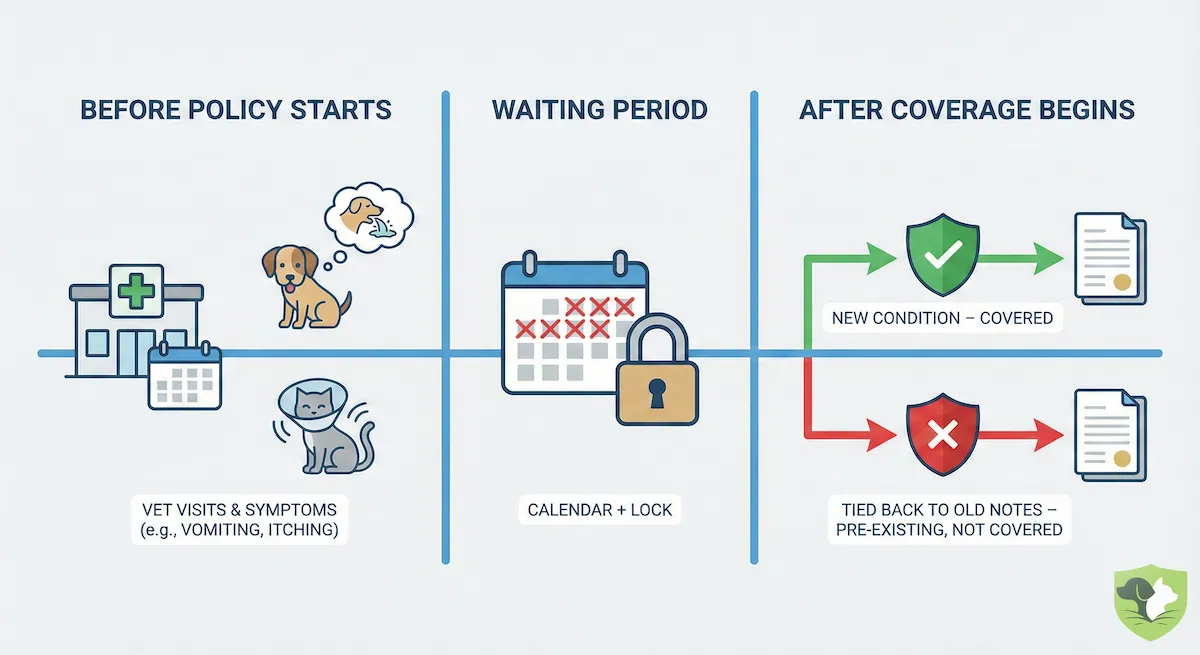
A pre-existing condition is any illness, injury, or symptom your pet had before your policy started or during the waiting period. The NAIC Pet Insurance Model Law frames it broadly: a condition can count if a vet gave medical advice, your pet received treatment, or verifiable signs or symptoms existed before the effective date or during a waiting period.
It doesn't have to be fully diagnosed. If your vet mentioned "possible allergies" or your dog had repeated vomiting noted in the record, insurers can treat that as pre-existing later. I think the key question is: "Could an adjuster reasonably tie this new claim back to something that showed up before coverage started?" If yes, they'll usually call it pre-existing.
Curable vs Incurable Pre-Existing Conditions
Not all pre-existing issues are treated the same.
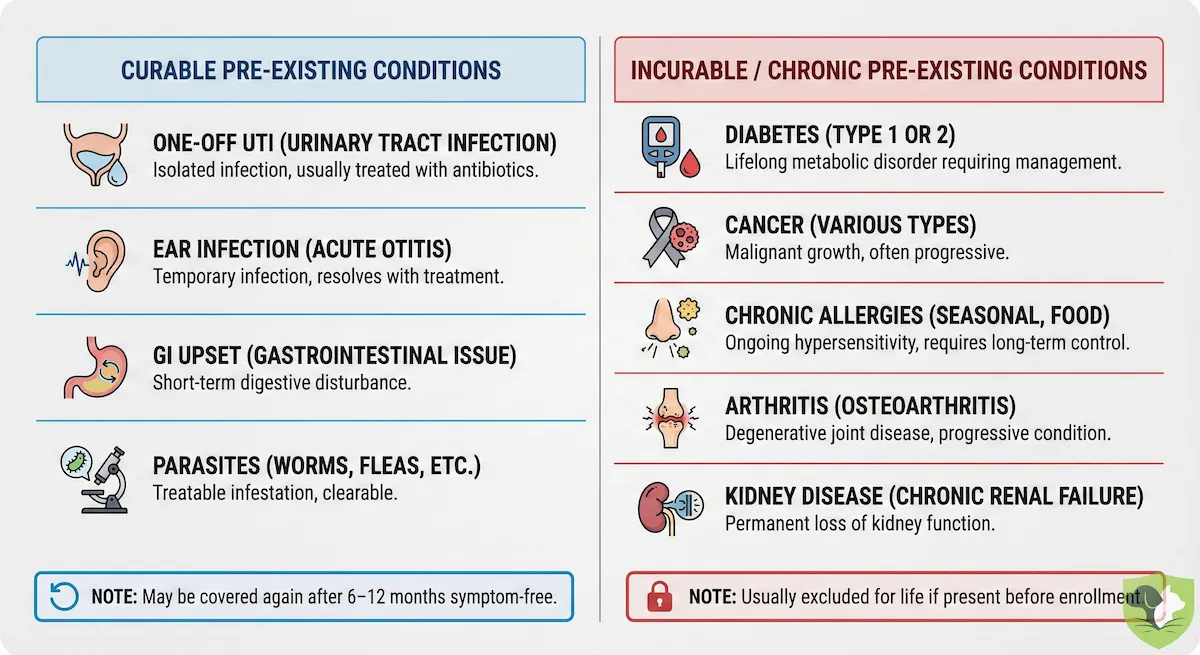
- Curable pre-existing conditions: short-term problems like respiratory infections, UTIs or bladder infections, vomiting/diarrhea episodes, minor injuries, broken bones, or kennel cough. If your pet is symptom-free and treatment-free for a set period, some companies may cover a recurrence later. The timing varies: Spot, ASPCA Pet Health Insurance, and Pumpkin use 180 days for eligible cured conditions, while Embrace uses 12 months.
- Incurable or chronic conditions: diabetes, cancer, chronic allergies, arthritis, kidney disease, and other long-term illnesses. Once these exist before enrollment, they're usually permanent exclusions, with AKC’s 365-day pre-existing-condition provision as the main exception to investigate.
In my opinion, understanding this curable vs incurable split is more important than memorizing any brand's marketing pitch.
Hidden Traps: Waiting Periods, Bilateral Issues, and Breed Risks
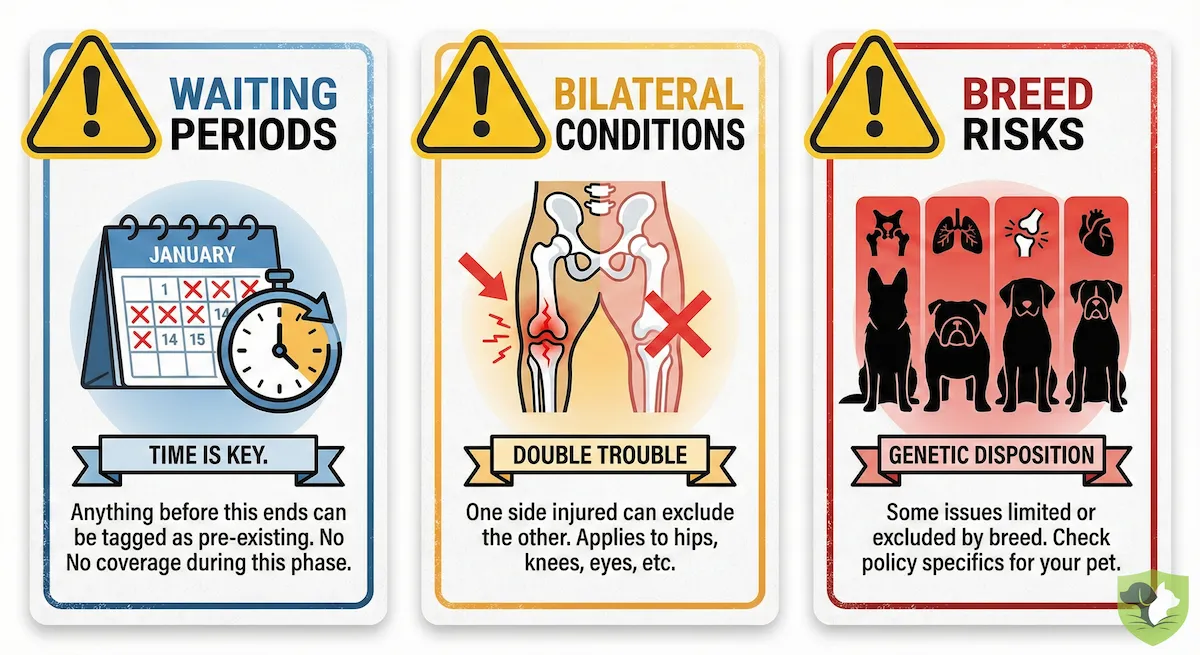
This is where pet insurance exclusions quietly multiply:
- Waiting periods: Anything that pops up before they end can be tagged as pre-existing.
- Bilateral conditions: A knee, ligament, hip, or eye issue on one side can affect coverage for the other side under some policies.
- Breed-related issues: Hereditary or congenital conditions may be covered if they are not pre-existing and the plan includes that coverage, but some policies limit them through exclusions, add-ons, age rules, or waiting periods.
I think of this section as the fine print that decides whether your future claim gets paid—or denied.
Is Pet Insurance Worth It If Your Pet Already Has a Condition?
This is the big question no one really answers. If your pet already has a diagnosis on their record, is pet insurance for pre-existing conditions even worth the money anymore? In my opinion, the answer is: sometimes yes, sometimes absolutely not. The trick is knowing which camp you’re in.
When It Still Makes Sense (Even With Exclusions)
Insurance can still be smart if:
- Your pet has one main issue, but is otherwise young or middle-aged.
- The condition is curable (such as a past UTI, ear infection, respiratory infection, minor injury, or GI bug).
- You can find a policy with a cured-condition rule that fits your timeline—commonly 180 days or 12 months among current options, or AKC’s separate 365-day continuous-coverage rule for eligible pre-existing conditions.
I think of it this way: you’re not buying coverage for the old problem. You’re buying protection for the next crisis you can’t see yet—car accidents, new cancers, surprise surgeries.
When It Probably Doesn’t Pencil Out
It may not be worth it if:
- Your pet is a senior with multiple chronic issues already.
- The main problem is clearly incurable (diabetes, CKD, chronic allergies, long-term arthritis).
- Most quotes feel like high premiums for very low annual limits.
In that scenario, in my opinion, you’re often better off putting that money into a dedicated vet savings fund instead of chasing the best pet insurance for pre-existing conditions that doesn’t really exist for your case.
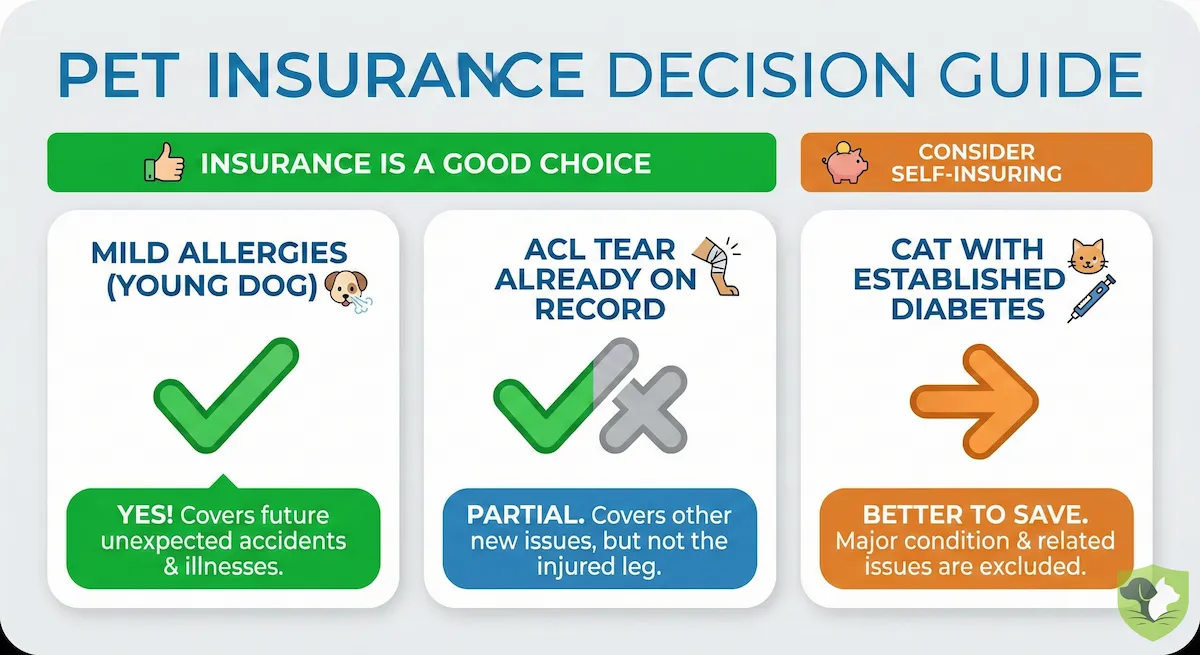
Quick Decision Matrix: Allergies vs ACL Tear vs Diabetes
| Scenario | Verdict |
|---|---|
| Young dog with mild allergies | Maybe. Future unrelated issues can still be worth insuring, but allergy care itself is likely excluded if symptoms appeared before coverage. |
| Dog with an ACL/CCL tear on record | Maybe. Knee and ligament claims, including the other knee, may be excluded under many policies, but unrelated accidents and illnesses may still be worth insuring. |
| Cat with established diabetes | Usually no for diabetes care. Focus on savings, discount plans, and honest talks with your vet; a policy may still help with unrelated new conditions. |
I think the goal is to buy insurance where it can still actually do something for you.
Types of Pre-Existing Conditions & How Insurers Treat Them
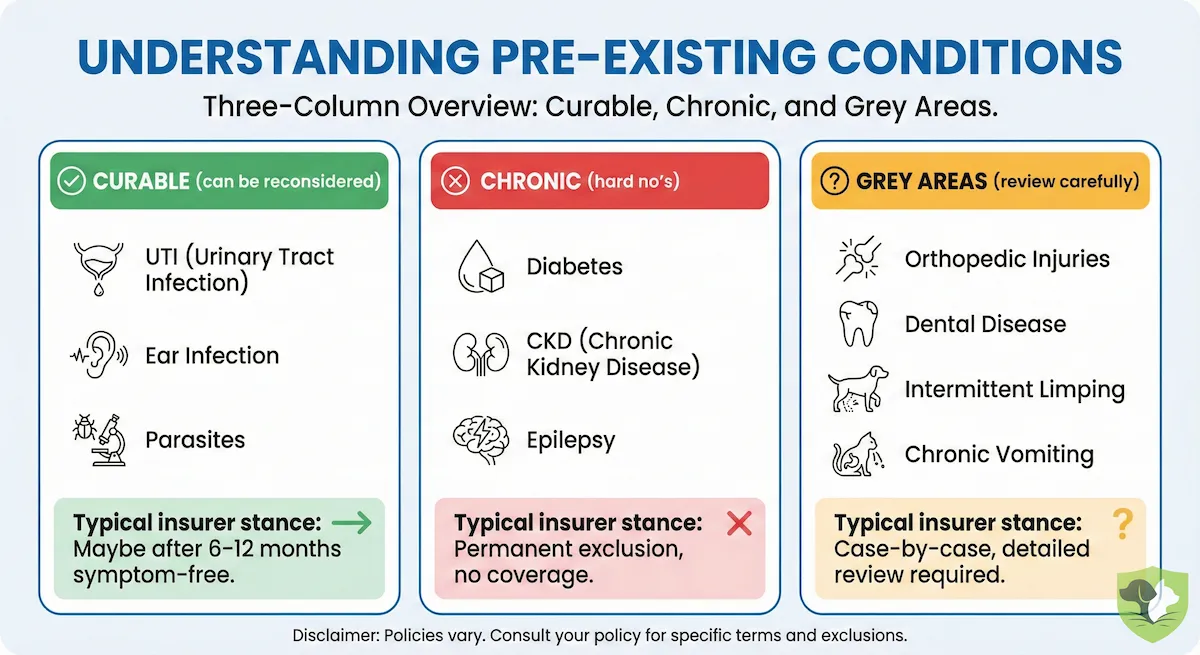
Not all pre-existing issues are treated equally. In my opinion, this is where most confusion (and disappointment) comes from.
Curable Pre-Existing Conditions (And Typical Waiting Rules)
These are short-term problems your pet can fully recover from: respiratory infections, UTIs or bladder infections, one-time vomiting or diarrhea episodes, minor injuries, broken bones, kennel cough, and similar resolved issues. Some current plans reconsider eligible conditions after a “clean” period with no symptoms, no treatment, and no related vet notes. Published windows commonly include 180 days or 12 months, while other carriers use individualized review with no universal contractual period.
Incurable or Chronic Conditions (The Hard No’s)
These include diabetes, cancer, chronic allergies, arthritis, kidney disease, and other long-term illnesses. Once these exist before enrollment, they’re generally permanent exclusions. AKC is unusual because its policy language says eligible pre-existing conditions can be covered after 365 days of continuous coverage, subject to state availability and policy terms.
Grey Areas: Orthopedic, Dental, and “Maybe” Conditions
Orthopedic issues, cruciate tears, hip dysplasia, dental disease, and vague symptoms (“intermittent limping,” “chronic vomiting”) live in the grey zone. I think of these as “review carefully” flags—they’re where insurers often argue something was pre-existing all along.
Best Pet Insurance for Pre-Existing Conditions in 2026 (Shortlist)
Let’s talk names. When people search for pet insurance with pre-existing conditions, they’re usually not asking for theory. They want, “OK, which companies should I actually look at now?” In my opinion, this is where most comparison sites get vague or overly polite. Here’s the blunt version.
At-a-Glance Comparison Table
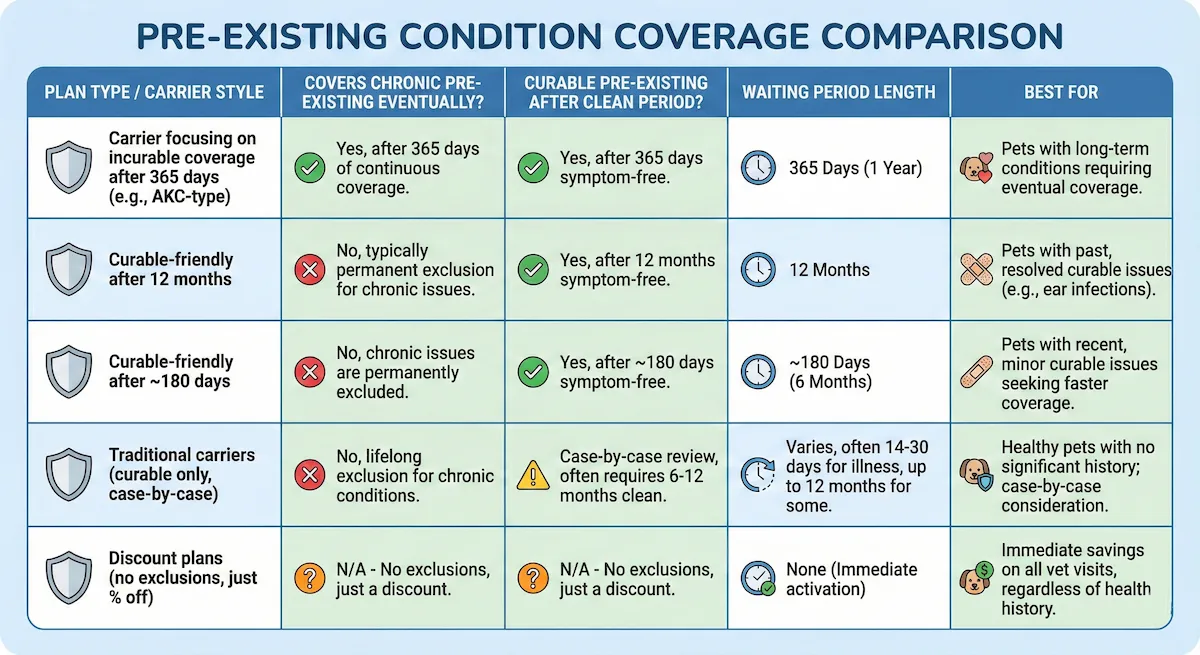
| Company | Policy on Pre-Existing Conditions | Best For |
|---|---|---|
| AKC Pet Insurance | Eligible curable and incurable pre-existing conditions may be covered after 365 days of continuous coverage, but availability varies by state/form and treatment must occur after the waiting period. Hereditary or congenital diagnoses may separately require HereditaryPlus; that endorsement is not the 365-day pathway itself. | Pets with serious history when you’re willing to play the long game and verify state/add-on rules. |
| Embrace | Clearly distinguishes curable vs incurable; some curable pre-existing conditions may be covered again after 12 months symptom- and treatment-free. | Owners willing to wait for a "clean slate" on minor issues. |
| Spot & ASPCA | May cover curable, cured pre-existing conditions again after 180 symptom- and treatment-free days; knee/ligament conditions are excluded on every state form, chronic conditions on most (see the Spot and ASPCA countrywide forms), and congenital, hereditary and orthopedic conditions on some. | Rescue pets with minor, resolved medical histories. |
| Pumpkin | Similar 180-day cured-condition rule for eligible curable issues, excluding ligament and knee conditions on every state form, chronic conditions on most (including the countrywide form), and congenital, hereditary and orthopedic conditions on some (such as the Florida form). | Cats and younger pets with minor resolved issues, especially if the quote is competitive. |
| Pets Best | Marketing says some fully healed conditions may stop being considered pre-existing, but audited sample contracts set no universal cure period. Eligibility is individualized; obtain a written determination and read the issued form. | Shoppers who like Pets Best otherwise, but want written confirmation for any past issue. |
| Pet Assure | Not insurance. Accepts pets with diagnosed/pre-existing conditions and provides a discount at participating vets, but it does not reimburse claims. | Pets that have been denied by everyone else, especially if your vet participates. |
I think of this list as your “shortlist to investigate,” not a final answer. The fine print still matters a lot, and state availability can change.
Best for Dogs With Pre-Existing Conditions
For dogs, AKC is the standout if you’re specifically hunting for pet insurance that may cover eligible pre-existing conditions, including some chronic ones, after a long wait. It’s not magic, but it’s unusual. For mostly healthy dogs with one or two past resolved issues, I’d start quotes with Embrace, Spot, ASPCA, Pumpkin, and Pets Best, then compare prices and written cured-condition rules side by side.
Best for Cats With Pre-Existing Conditions
Cats often have UTIs, GI flare-ups, or early kidney flags on their record. In my opinion, Pumpkin, Embrace, ASPCA, Spot, and Pets Best are worth checking first for curable pre-existing conditions, then comparing how they treat kidney, urinary, and dental illness risk.
Best “Non-Insurance” Option for Pets Nobody Will Cover
If every quote is “no, no, no,” I think it’s time to reframe. A discount plan like Pet Assure, plus a dedicated savings account, can be more honest and less stressful than paying for a policy that will never touch your pet’s real issues.
Deep Dives: How Each Top Insurer Handles Pre-Existing Conditions
Here’s where we get specific. In my opinion, this is the part most “best of” lists rush through, even though it’s what actually decides if your claim gets paid.
AKC Pet Insurance – The Rare Option for Some Incurable Pre-Existing Conditions
AKC is the unusual current option to investigate for a pet with a serious history. After 365 days of continuous coverage, eligible pre-existing conditions may be covered for treatment that occurs after that period. State availability, enrollment age, exclusions, limits, and the issued form still matter. Hereditary or congenital diagnoses may separately require the HereditaryPlus endorsement; that endorsement is not synonymous with the 365-day pre-existing-condition pathway. Verify both questions in writing.
Pumpkin – Strong for Curable Pre-Existing Issues (Especially Cats)
Pumpkin treats pre-existing conditions like most mainstream insurers: chronic issues stay excluded, but curable pre-existing conditions (like a UTI or paw fracture) may stop being treated as pre-existing after 180 days symptom- and treatment-free, subject to the issued state form and other coverage terms. Ligament and knee conditions are excluded from that path on every state form; most forms, including the countrywide one, also exclude chronic conditions, and some, such as Florida’s, exclude congenital, hereditary and orthopedic conditions too. I think Pumpkin is especially worth quoting for cats and younger pets with minor, fully resolved histories.
Embrace – Curable Pre-Existing Coverage After 12 Months
Embrace is one of the few carriers that clearly spells out a 12-month clean period: if a curable condition hasn’t shown symptoms or needed treatment for a full year from the last episode, it may be eligible for coverage again. Chronic stuff still stays excluded, but in my opinion, Embrace is strong for owners willing to think long-term about minor past issues.
Spot and ASPCA – The 180-Day Symptom-and-Treatment-Free Path
Spot’s sample policy and ASPCA’s pre-existing-condition page say most pre-existing conditions are excluded, but if an issue was curable, cured, and your pet stays symptom- and treatment-free for 180 days, the condition may stop being treated as pre-existing; the recurrence still must satisfy the issued policy's other coverage terms. Knees/ligaments are excluded from that path on every state form—once a knee or ligament condition occurs before coverage or during a waiting period, future knee/ligament claims may also be excluded. Most forms, including both brands’ countrywide forms (Spot, ASPCA), also exclude chronic conditions, and some state forms exclude congenital, hereditary and orthopedic conditions too.
Pets Best – Curable Only, But Confirm the Timing
Pets Best marketing says some fully healed conditions, such as broken legs or kennel cough, may cease to be considered pre-existing. The audited sample contract does not promise a universal symptom-free period or automatic recurrence coverage. Ask for a written determination for the exact condition and let the issued policy control.
ManyPets – Legacy U.S. Policies Only
ManyPets is not a current U.S. new-policy choice. It stopped new U.S. sales, and Odie became program administrator for renewal offers beginning January 1, 2025. An 18-month cured-condition rule may still matter to a legacy ManyPets policyholder, but only the old issued form and the continuity terms of an Odie renewal control. Do not use that legacy rule to compare new 2026 quotes.
Nationwide – Not a Pre-Existing-Condition Shortlist Pick
Nationwide currently says a condition documented by veterinary records as cured for at least six months may be eligible for coverage. That is a review pathway, not automatic reinstatement; chronic conditions, product, state, and policy form still control. Request the determination in writing before treating a prior condition as covered.
Pet Assure – Discount Plan That Accepts Pets With Pre-Existing Conditions
Pet Assure isn’t insurance; it’s a veterinary discount plan. It accepts pets of any age and with diagnosed conditions that insurance companies call pre-existing. Its terms say participating practices discount in-house medical services by 25%, but practices are not required to discount outsourced services, medications, take-home products, grooming, boarding, or certain other fees. I think of Pet Assure as the honest option when every insurer has said “no”: it won’t pay your bills, but it also doesn’t punish your pet for having a medical history.
How to Read Pre-Existing-Condition Fine Print (Without a Law Degree)
This is where, in my opinion, people either protect themselves… or get burned. The wording around pet insurance pre-existing conditions and pet insurance exclusions is where everything actually happens.
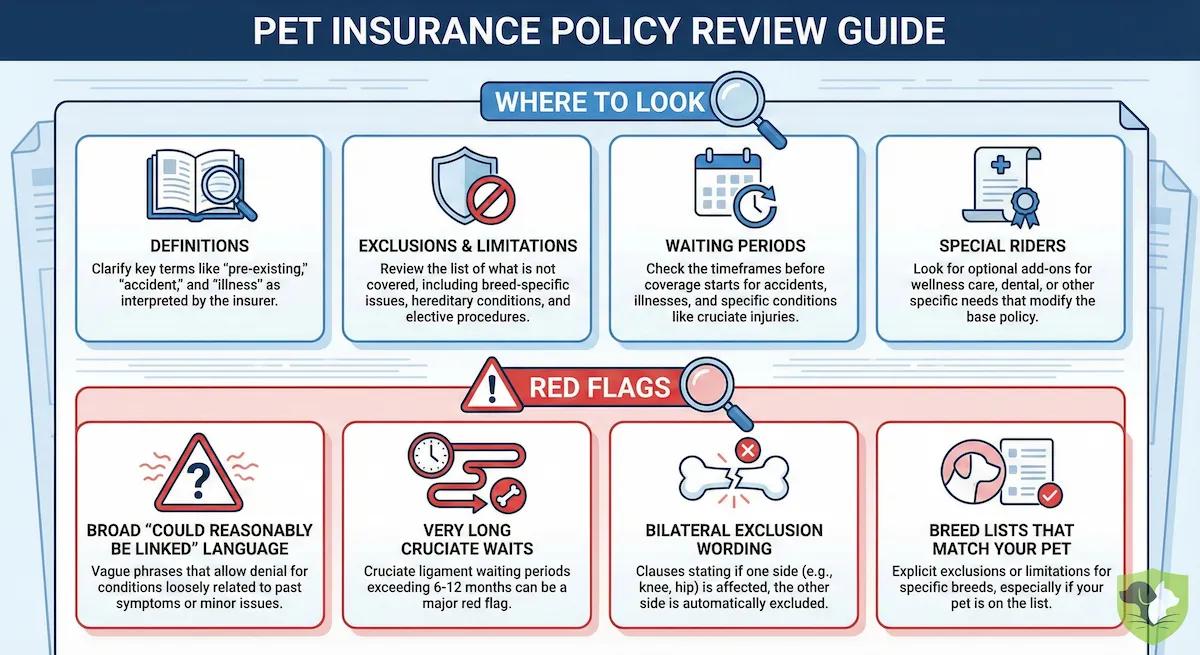
Where to Look in a Sample Policy
When you download a sample policy (you always should), I think you start with four sections:
- Definitions – how they define “pre-existing condition,” “symptoms,” “occurrence,” and “onset.”
- Exclusions & Limitations – the master list of “we will not cover…”
- Waiting Periods – different waits for accidents, illnesses, and orthopedic or ligament issues.
- Special Riders/Endorsements – hereditary coverage, orthopedic riders, hip dysplasia clauses, breed-specific notes, and state-specific notices.
If a company makes these sections hard to find, that’s already a red flag in my book. The NAIC model also expects insurers to disclose pre-existing-condition exclusions, waiting periods, deductibles, coinsurance, and annual or lifetime limits.
Red Flags That Should Make You Pause
In my opinion, you should slow down or walk away if you see:
- Super broad language like "any condition that could reasonably be linked…"
- Long or separate orthopedic, cruciate, or ligament waiting periods.
- Bilateral language that lets them exclude the "other side" later.
- Hereditary, congenital, or breed-risk language that points directly at your pet’s likely future claims.
These are the little sentences that later become big denials.
Questions to Ask Before You Click “Buy”
I think you should email or chat with support and ask, in writing:
- How do you treat curable pre-existing conditions after X months symptom-free?
- Do you ever re-evaluate exclusions? Under what rules and timeline?
- How do you handle vague notes like “intermittent limping” in records?
- Can I request a medical history review after enrollment, and can I cancel if the exclusions are worse than expected?
If they can’t answer clearly, that tells you a lot.
Real-World Scenarios: What Actually Gets Paid (and What Doesn't)
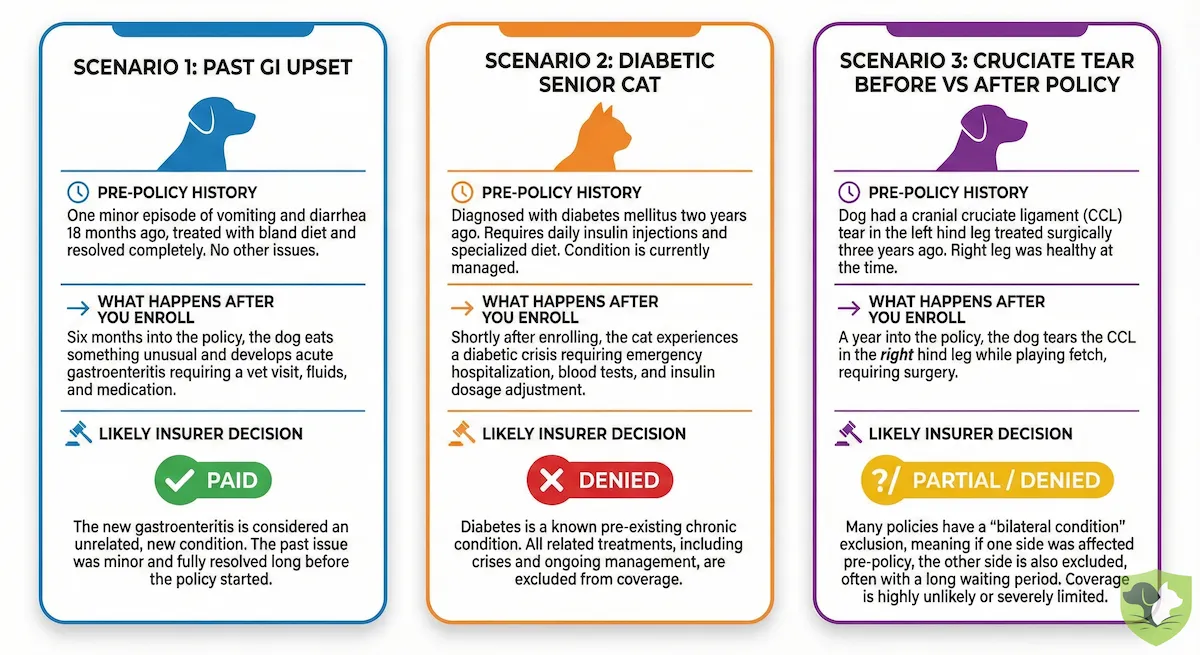
This is the part I wish every pet insurance pre-existing conditions page started with: real timelines, real outcomes. In my opinion, this is how you actually understand "Does pet insurance cover pre-existing conditions or not?"
Scenario 1 – Dog With a Past GI Upset and a New Claim
Your dog had one bad vomiting episode 10 months before you bought insurance. Vet note: “suspected dietary indiscretion, resolved.” You enroll, pass the illness waiting period, and a year later, there’s a new, unrelated GI crisis. If the first episode is treated as a curable pre-existing condition, your dog has been symptom- and treatment-free ever since, and your insurer’s clean period is already satisfied, a curable-friendly insurer may pay the new claim. If the plan uses a 12- or 18-month window, the answer could be different.
Scenario 2 – Senior Cat With Diabetes and a New Infection
Your older cat is diagnosed with diabetes before enrollment. That diabetes care is excluded. Six months into the policy, the cat gets a urinary infection. A new UTI may be covered if the insurer does not tie it to diabetes or another pre-existing condition, but insulin, glucose monitoring, and diabetic complications remain excluded. In my opinion, this is a “partial win” scenario—insurance helps at the edges, not with the main battle.
Scenario 3 – Cruciate Tear Before vs After Policy
If your dog had a cruciate/ACL/CCL problem before coverage or during a waiting period, knee and ligament claims may be excluded in the future, including the other knee under many policies. Tear it after the waiting period with no prior limping, vet advice, or related symptoms? That surgery is more likely to be covered, subject to the policy’s orthopedic and ligament rules. I think knee cases are where the fine print bites the hardest.
Expert Insights: What the Data (and Real Pet Parents) Say
When you zoom out from individual stories, pet insurance pre-existing conditions look very different from the marketing.
How Common Pet Insurance Really Is (And Why That Matters)
Pet insurance is still a small slice of the U.S. dog-and-cat market, but it keeps growing. NAPHIA’s 2026 State of the Industry data says 7.03 million pets were insured in North America at the end of 2024, up 12.2% from 6.25 million in 2023. In my opinion, that matters because the earlier you enroll, the fewer old chart notes there are for an adjuster to review.
Vet Bills vs What People Think Pet Care Costs
Pet owners often underestimate the cost side. Synchrony’s 2025 Pet Lifetime of Care Study found nearly 8 in 10 pet owners underestimate lifetime care costs, and 74% had faced unexpected pet care costs over $250. Average premiums are also real money: NAPHIA-based figures reported by Progressive put 2024 accident-and-illness premiums at about $69.67/month for dogs and $36.25/month for cats. I think that gap is why many people wait until after a diagnosis—when pre-existing-condition rules are already working against them.
A Common Regret Theme From Forums
Reading owner stories, one anecdotal pattern comes up again and again: “I wish I’d bought before this happened.” Not “I wish I’d found a cheaper plan,” but “I waited until it was already pre-existing.” I would treat forum posts as lived experience, not statistical proof, but the pattern matches the policy mechanics.
What Consumer Guides Recommend for Pre-Existing Conditions
Regulators and consumer guides are fairly aligned: read the definitions, exclusions, waiting periods, and limits before buying. The Maine Bureau of Insurance consumer guide also recommends comparing likely health care costs, emergency affordability, monthly premiums, cost-sharing, benefit limits, and exclusions. In my opinion, that mindset shift changes everything: use insurance to protect against the next big thing, not the one already on the chart.
Step-by-Step: How to Choose the Best Pet Insurance for Your Pet's Pre-Existing Condition
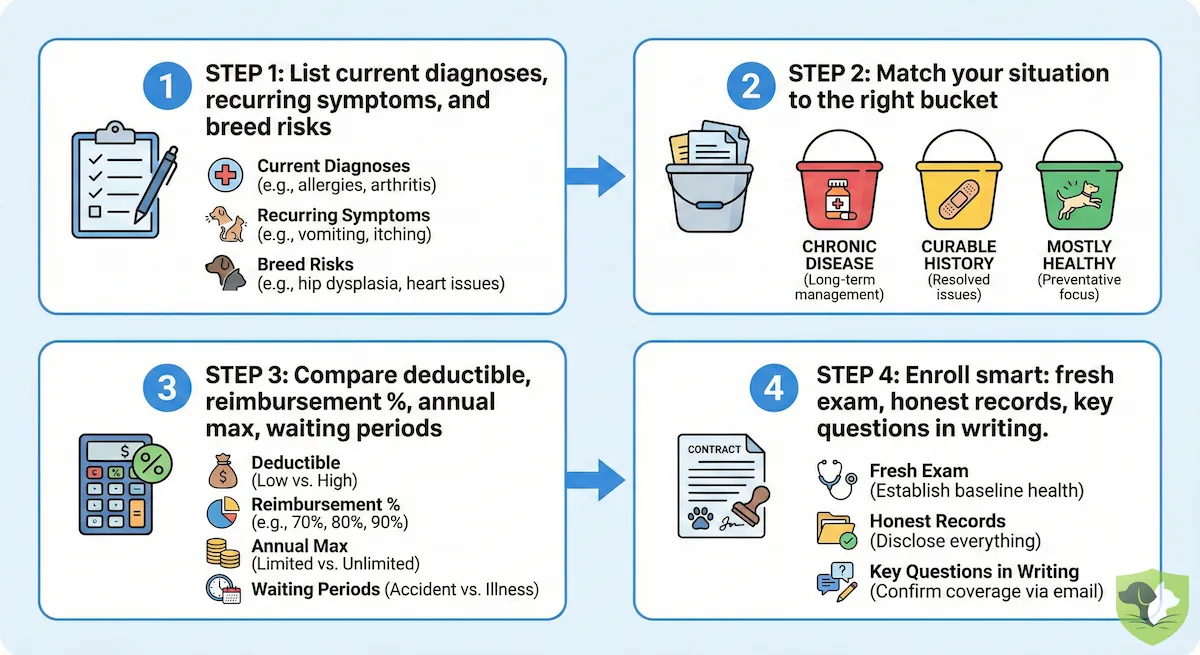
If you feel overwhelmed comparing plans, you're not alone. In my opinion, choosing the best pet insurance for pre-existing issues gets way easier if you follow a simple framework.
Step 1 – List Your Pet’s Current and Likely Future Issues
Grab a notepad. Write down:
- Existing diagnoses
- Recurring symptoms (“ear infections 2–3 times a year”)
- Breed risks (hips, heart, breathing, cancers)
I think this is your reality-check list. Insurers will see all of this anyway.
Step 2 – Match Your Situation to the Right “Bucket”
Roughly:
- Chronic pre-existing disease already on record → AKC if available in your state / discount plan / savings.
- One or two curable pre-existing conditions in the past → compare Embrace, Pumpkin, Spot, ASPCA, and Pets Best using each issued form and written determination.
- Young and mostly healthy → broader choice; focus on price, exclusions, reimbursement, limits, and long-term renewal risk.
Step 3 – Compare Real Numbers, Not Logos
For each quote, compare:
- Deductible
- Reimbursement %
- Annual max
- Waiting periods and pet insurance exclusions
- Medical-history review process
In my opinion, this “mini spreadsheet” tells you more than any award badge.
Step 4 – Enroll the Smart Way
Get a fresh exam if the policy requires or rewards one, keep records, and be fully honest on applications. Expect medical records to be requested at enrollment, during a medical history review, or when you submit a claim; timing varies by insurer. If something matters a lot, I think you should email the insurer and ask for the answer in writing before you buy.
When Insurance Isn’t an Option: Alternatives for Pets With Serious Pre-Existing Conditions
Sometimes, after you’ve checked every quote, the answer to pet insurance pre-existing conditions is still basically “no.” In my opinion, that doesn’t mean you’re out of options—it just means the strategy has to change.
Veterinary Discount Plans and Employer Benefits
If traditional insurance won’t touch your pet’s history, I think discount plans are the next thing to look at. Pet Assure says pets of any age and with diagnosed conditions can enroll, and its terms describe a 25% discount on in-house medical services at participating practices. That is not the same as insurance: it does not reimburse claims, your vet must participate, and practices are not required to discount outsourced services, medications, take-home products, grooming, boarding, and some other fees. Also check your HR portal. SHRM’s 2025 Employee Benefits Survey says 22% of employers offered pet insurance, unchanged from 2024.
Building a DIY “Pet Health Fund”
If you were ready to spend $60–$100/month on premiums that don’t really help, consider redirecting that into a separate savings account. In my opinion, an automatic transfer into a “pet fund” is the most honest way to self-insure a pet with serious pre-existing issues. No exclusions, no denials—just money you control.
Talking With Your Vet About Realistic, Compassionate Plans
I think one of the most underrated tools is an honest money talk with your vet. Tell them your pet’s conditions and your budget. Ask about:
- Generic vs brand-name drugs
- Staging tests over time instead of all at once
- Payment plans or lower-cost clinics for specific procedures
In my opinion, a good vet would rather help you build a realistic, compassionate plan than watch you avoid care out of fear.
Frequently Asked Questions (FAQs)
Does pet insurance ever cover pre-existing conditions?
Sometimes. In my opinion, you should assume active chronic conditions are excluded by most insurers. Some companies may cover curable pre-existing conditions after a clean period, and AKC may cover eligible pre-existing conditions after 365 days of continuous coverage where available.
What counts as curable vs incurable in practice?
Curable: one-off issues that fully resolve (UTI, respiratory infection, minor injury, GI bug).
Incurable: long-term diseases like diabetes, CKD, cancer, arthritis, and chronic allergies.
I think the key test is: can it truly go away without ongoing symptoms or treatment?
Do I have to send my pet’s full medical history?
Not always at purchase, but expect records to be requested eventually. Some insurers review records after enrollment; others ask when you submit your first claim. In my opinion, it’s better to assume they’ll see everything and be honest from day one.
Can switching companies wipe my pet’s record clean?
No. Your pet’s body doesn’t reset when you change logos. New insurers can still treat anything in the old records as pre-existing, unless their policy has a cured-condition rule that your pet clearly satisfies. For what does and doesn’t carry over, see our guide to switching pet insurance with pre-existing conditions.
How long does my pet need to be symptom-free before a condition is covered again?
The amount of time depends on the insurer, condition, state, and form. Spot, ASPCA, and Pumpkin publish 180-day rules for eligible cured conditions; Embrace publishes 12 months. Pets Best uses individualized review without a universal contractual period in the audited sample, Nationwide says a documented cure of at least six months may be reviewed, and AKC has a separate 365-day continuous-coverage pathway for eligible pre-existing conditions. Ask for the result in writing.
Is accident-only insurance worth it if my pet has a chronic illness?
Sometimes, yes. It won’t touch the chronic disease, but it can still save you from broken legs, car accidents, or swallowed toys if those events are unrelated and covered.
Can I insure multiple pets when one has a pre-existing condition?
Absolutely. One pet’s pre-existing condition doesn’t “infect” the others. I think multi-pet discounts can still make sense in that case.
WhiskerCover is a licensed insurance agency and is free to use. If you buy a policy through us, or click a link to one of our pet insurance partners and purchase, the insurer may pay us a commission at no extra cost to you. Learn more about how we make money.
Sources
- NAIC Pet Insurance Overview
- NAIC Pet Insurance Model Act
- AKC Pet Insurance Pre-Existing Conditions
- AKC Sample Policy
- Embrace Pre-Existing Conditions
- Spot Pre-Existing Conditions
- Spot Sample Policy
- ASPCA Pet Health Insurance Pre-Existing Conditions
- ASPCA Pet Health Insurance Sample Policy PET-P-20000-1024 (Texas, countrywide form)
- Pumpkin Pet Insurance FAQs
- Pumpkin Sample Policy PET-P-20000-1024 (Texas, countrywide form)
- Pumpkin Sample Policy PET-P-20000-FL-0525 (Florida)
- Pets Best Pre-Existing Coverage
- Nationwide Pre-Existing Conditions
- ManyPets U.S. Transition Announcement
- Information for Legacy ManyPets U.S. Customers — Odie
- Pets Best Accident & Illness Sample Policy
- Pet Assure
- Pet Assure Terms
- NAPHIA Industry Data
- NAPHIA Average Premiums
- Synchrony 2025 Pet Lifetime of Care Study
- Progressive Pet Insurance Cost Guide
- Maine Bureau of Insurance Pet Insurance Consumer Guide
- SHRM 2025 Employee Benefits Survey
- State of the Industry Report 2026 Highlights (2025 data) — NAPHIA