

Let’s be honest: the days of the $50 vet visit are gone.
If you're looking for breed-specific advice, check out our guides to the best dog insurance and Cat Insurance.
Shopping on a tight monthly budget? Start with our guide to the best affordable pet insurance, which ranks these same carriers on price-per-protection rather than raw coverage depth.
Veterinary care has continued getting more expensive. Recent BLS CPI data shows veterinarian services up 4.9% year over year in May 2026, while pet services rose 7.0%. A standard dog knee surgery can reach $10,000, making emergency care a serious financial burden.
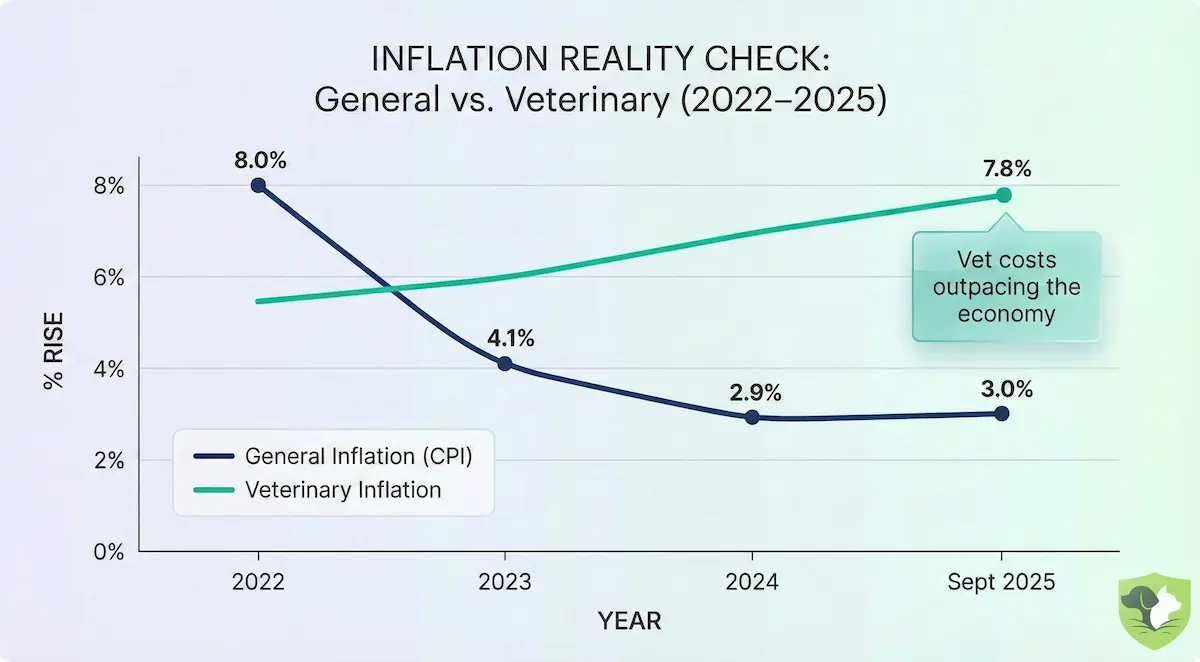
In 2026, pet insurance isn't just a "nice-to-have" for anxious pet parents; it is a critical financial safety net. But finding the right plan is harder than ever.
Table of Contents
- The Market's "Illusion of Choice"
- Quick Look: The Top Providers by Category (2026)
- Deep Dive: The Top 5 Companies Reviewed
- Expert Insights: The "Hidden Mechanics" of 2026 Policies
- The Economics of Pet Ownership in 2026
- How to Choose Based on Your Pet’s Life Stage
- Final Verdict: Is Pet Insurance Worth It in 2026?
- Frequently Asked Questions (FAQs)
The Market's "Illusion of Choice"
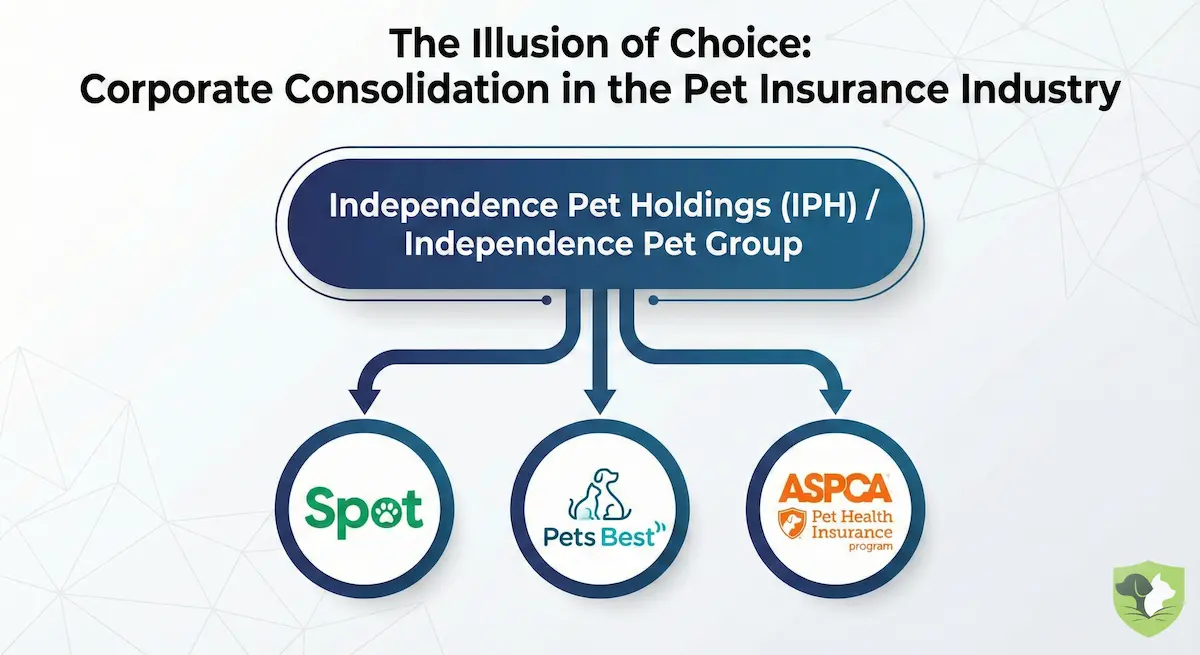
The market is filled with the 'illusion of choice.' Pets Best and Spot are part of Independence Pet Holdings’ pet-insurance portfolio, and ASPCA Pet Health Insurance is also associated with IPH’s pet-insurance brand portfolio through a licensed program structure. While their websites look different, their corporate or administrative ties can overlap.
IPH says its carrier-solutions business features the AM Best A- (Excellent) rated Independence American Insurance Company, which provides risk management, actuarial, and underwriting services to the pet insurance industry.
Corporate overlap does not mean the policies are identical. Shared ownership or administration can create overlap in claim operations, underwriting relationships, or back-end administration, but each brand’s policy terms, underwriter, exclusions, reimbursement rules, and state filings can still differ.
To see which plans truly deliver (beyond just marketing), we analyzed 2026 regulatory filings, actuarial data, and new transparency rules from California’s Senate Bill 1217.
Quick Look: The Top Providers by Category (2026)
If you're doom-scrolling and just need the highlights, here is the cheat sheet. We categorized these based on your pet's specific risk profile, focusing on medical history and breed-associated issues.
| Category | Top Pick | Why We Chose It |
|---|---|---|
| Total Peace of Mind | Trupanion | Trupanion is the standout for real-time vet-direct payment at checkout, where available through participating veterinary hospitals. Ideal for Frenchies, Goldens, and breeds with "genetic nightmares" because they have no payout limits. |
| Puppies & Tech Lovers | Lemonade | Fast digital claims; Lemonade says some simple, eligible claims can be handled instantly, but complex claims or missing records may take longer. Perfect for young, healthy pets if you hate paperwork. |
| Rescue & Senior Dogs | Spot | Some insurers have upper enrollment ages that can affect senior pets, while Spot has no upper age limit for new enrollments, making it useful for senior adoptions. |
| Mobility & Rehab | Pets Best | If your dog needs an eligible wheelchair or prosthetic device later in life, Pets Best can be worth comparing. Great for big dogs prone to hip issues. |
| Resolved Curable Histories | ASPCA | For a rescue with a minor, fully resolved history, ASPCA may stop treating an eligible curable condition as pre-existing after 180 symptom- and treatment-free days. Knee and ligament conditions are excluded from that rule on every state form, chronic conditions on most, including the countrywide form, and congenital, hereditary and orthopedic conditions on some, such as the Ohio form; the issued policy controls. |
Deep Dive: The Top 5 Companies Reviewed
We analyzed policy documents and 2026 market data to break down the leading providers. Instead of a generic ranking, we evaluated each carrier based on its specific underwriting strengths and potential drawbacks for different types of pet owners.
1. Trupanion: Chronic-condition and direct-pay design
Why it’s here: Trupanion uses a lifetime per-condition deductible and integrates with participating veterinary-practice software. That integration enables "Vet Direct Pay," allowing participating veterinary hospitals to be paid directly at checkout for eligible claims. This can reduce or eliminate the need to float thousands of dollars on a credit card while waiting for reimbursement.
- The "Lifetime Per-Condition" Deductible: Unlike annual deductibles that reset every year, Trupanion charges a deductible once per specific condition for the life of the pet. If your dog develops chronic allergies at age two, you pay the deductible once, and eligible future treatment for that condition can continue under the policy at the reimbursement percentage shown in the issued form, up to 90%, while coverage remains continuous.
- Unlimited Payouts: There are no annual, per-incident, or lifetime caps on coverage, which is mathematically critical for breeds prone to costly surgeries, such as French Bulldogs and Great Danes.
- Considerations: No public matched dataset establishes Trupanion's national price rank; run a same-day quote with the same profile and benefits used for every alternative. The direct product materials reviewed exclude sick-visit exam fees, while partner/channel products can differ. Confirm the issued reimbursement percentage, deductible, exclusions, and clinic participation before assigning value to the payment structure.
Best For: Owners of purebreds with known genetic risks and those who prioritize financial peace of mind over monthly cash flow.
2. Lemonade: Modular, app-first design
Why it’s here: Lemonade uses an app-first sales and claims workflow. Its "AI Jim" system can handle some simple, eligible, well-documented claims almost instantly. That does not mean every pet claim is paid in seconds; medical-record review, pre-existing-condition checks, invoices, and claim complexity can slow the process.
- The "A La Carte" Model: The base policy leaves some benefits to separately priced add-ons. Lemonade advertises pet insurance starting at $10/month, but real quotes can exceed $20/month, especially for dogs, older pets, higher annual limits, and higher-cost ZIP codes. Essential coverages like vet exam fees, physical therapy, and dental illness must be added as separate "riders" or add-ons.
- Considerations: The automated claims process still depends on documentation. Fast digital claims do not mean medical-history review disappears; insurers can still request records, review prior symptoms, and delay or deny claims if records are missing or suggest a pre-existing condition. Before recommending Lemonade for a senior pet, check eligibility directly because upper enrollment rules may vary by pet, breed, and location.
Best For: Owners of puppies and kittens with no prior medical history who want a fast, mobile-first experience.
3. Spot Pet Insurance: No-upper-age enrollment and flexible limits
Why it’s here: Spot addresses two major pain points in the 2026 market: age limits and orthopedic waiting periods. Unlike many competitors, Spot has no upper age limit for new enrollments, making it one of the few viable options for adopting senior pets.
- The Orthopedic Edge: Cruciate ligament waiting periods vary widely by insurer and state; some are extended, while others are much shorter. Spot’s sample policy lists a 14-day waiting period for ligament and knee conditions, which can be useful for active breeds prone to CCL injuries. Labradors are a higher-risk breed for cranial cruciate ligament rupture; one University of Wisconsin School of Veterinary Medicine source estimates that about 5%–10% of Labradors may experience a cruciate ligament rupture during their lifetime.
- Customizable Limits: You can choose an "Unlimited" annual limit plan, though premiums for these comprehensive policies can be high.
- Considerations: While flexible, the "Unlimited" selection can cost differently from a capped selection; compare matched quotes rather than assigning a market-wide price tier.
Best For: Senior dog adoptions and active breeds (such as Labradors and Rottweilers) at high risk of knee injuries.
4. ASPCA Pet Health Insurance: A 180-day curable-condition path
Why it’s here: ASPCA publishes a state- and form-dependent path under which some eligible curable conditions may stop being considered pre-existing.
- Curable Conditions Clause: While "incurable" pre-existing conditions like diabetes are typically excluded, eligible curable conditions such as ear infections, UTIs, or kennel cough may stop being considered pre-existing after the pet remains symptom-free and treatment-free for 180 days. Knee and ligament conditions are excluded from this rule on every state form; most forms, including the countrywide form, also exclude chronic conditions, and some, such as the Ohio form, exclude congenital, hereditary and orthopedic conditions too. The issued policy controls.
- Horse Coverage: ASPCA Pet Health Insurance also offers horse insurance, which can matter for households with horses as well as cats or dogs.
- The Downside: ASPCA Pet Health Insurance does not offer the same real-time checkout payment structure that Trupanion markets through participating veterinary hospitals.
Best For: Rescue pets with minor, fully resolved non-knee conditions whose issued policy includes the 180-day curable-condition rule.
5. Pets Best: Mobility-device coverage and post-approval vet payment
Why it’s here: Following its acquisition by Independence Pet Holdings, Pets Best still highlights mobility support in its coverage materials.
- Mobility Coverage: Their policies specifically cover prosthetic devices and wheelchairs. Coverage details for mobility devices vary by insurer, so this is worth checking for aging large breeds.
- Direct Pay Option: Pets Best offers a different "Vet Direct Pay" process: after claim approval and a signed release, payment can be routed to a participating veterinarian. It bridges checkout only if the clinic agrees to defer collection, so it should not be equated with Trupanion's real-time adjudication.
- The Downside: Recent customer reviews and complaints include reports of claim delays, phone wait times, and service frustration, although experiences are mixed. Premium changes can also vary by state, pet age, breed, local veterinary costs, and policy design.
Best For: Breeds prone to hip dysplasia, spinal issues, or those likely to need mobility assistance in their senior years.
Expert Insights: The "Hidden Mechanics" of 2026 Policies
The fine print in pet insurance contracts determines if your claims get paid—but most reviews stop at premiums. We analyzed the exact exclusionary clauses in contracts, uncovering the hidden mechanics that frequently catch owners off guard. Our pet insurance reviews apply the same fine-print test to every major U.S. carrier, with dated scores.
The "Bilateral Exclusion" Trap
Missing or incomplete medical records are a major source of claim delays and can contribute to pre-existing-condition disputes, especially for expensive orthopedic claims.
How it works: A "bilateral" condition affects paired body parts, such as the knees (cruciate ligaments) or the hips. If your dog shows signs of a limp on their left leg before getting insurance, some policies may treat a later right-leg claim as related or pre-existing, depending on the policy’s bilateral-condition language and medical records.
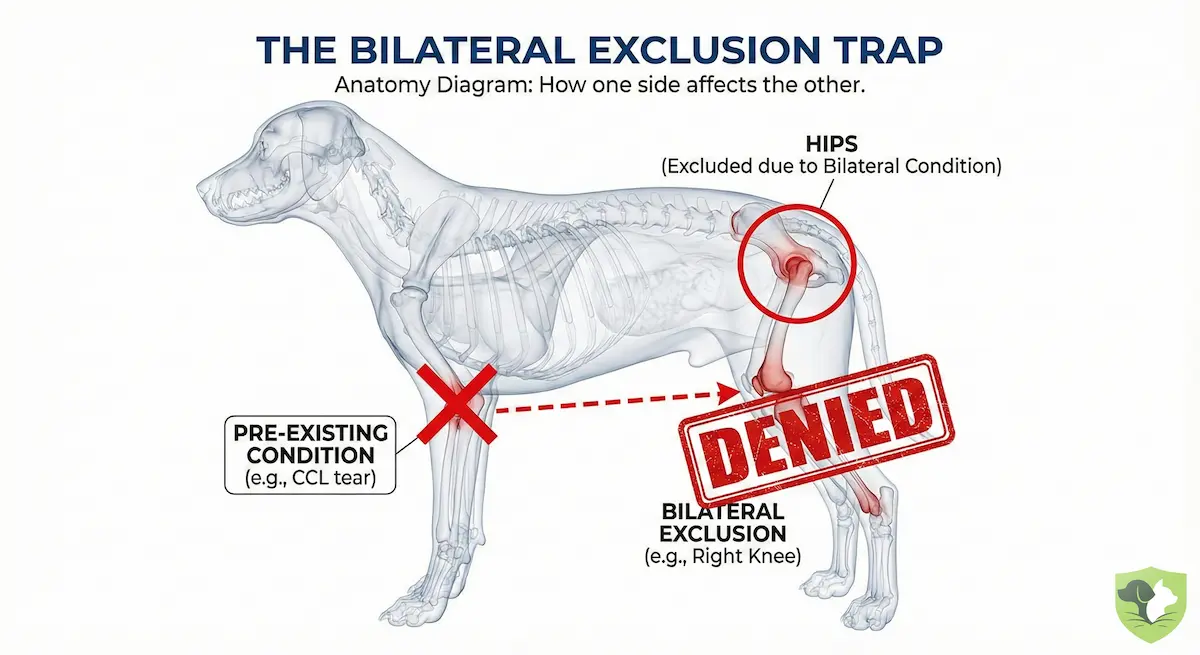
The Risk: For breeds like Labradors or Rottweilers, a torn ACL in one knee significantly increases the statistical probability of tearing the other. A bilateral exclusion means you could be on the hook for a $6,000–$8,000 surgery down the road.
The Solution: AKC Pet Insurance may offer limited coverage for some pre-existing conditions after 365 days of continuous coverage, where available and subject to policy terms. MetLife may cover a condition on the opposite side of the body only if that condition was not pre-existing under the policy terms. Check the bilateral-condition and pre-existing-condition language in the sample policy.
Curable vs. Incurable: The "Clean Slate" Clause
Historically, a "pre-existing condition" could follow your pet for the life of the policy. In 2026, some policies distinguish between incurable and curable histories.
- Incurable: Conditions like diabetes, hip dysplasia, and cancer are typically excluded if symptoms appear before enrollment.
- Curable: Episodic issues like kennel cough, ear infections, or urinary tract infections (UTIs) can often be covered again.
How to Leverage It: Providers like ASPCA, Spot, and Hartville may stop treating an eligible curable condition as pre-existing after 180 symptom- and treatment-free days. Knee or ligament conditions are excluded on every state form, chronic conditions on most, and congenital, hereditary and orthopedic conditions on some (compare ASPCA’s countrywide and Ohio forms); state and policy language control.
Pro Tip: Documentation still matters. Ask your vet to record when a temporary condition resolved so the claim file shows when the symptom- and treatment-free period began. In states that enacted the NAIC Pet Insurance Model Act, the insurer bears the burden of proving that a pre-existing-condition exclusion applies; elsewhere, applicable state law and the issued policy control.
The "Transparency" Shift: What SB 1217 Signals Nationally
Even if you don't live in California, the state's implementation of Senate Bill 1217 is worth watching because national carriers may adapt disclosures across multiple states. This law adds disclosure rules around the math behind your bill.
Rate Hike Realities: In California, pet insurers must provide clearer disclosures about whether premium may change because of the pet's age or a change in geographic location. The statute does not turn every possible rating input into a named disclosure item or cap an approved renewal increase. For a state-specific shortlist and the full SB 1217 rules, see our guide to the best pet insurance in California.
The Wellness Split: Under California’s new rules, "Wellness Plans" (for vaccines/checkups) are treated distinctly from "Insurance" (for accidents/illness). Why does this matter? It makes bundled pricing easier to evaluate. You can more clearly compare the annual wellness premium with the capped benefits you realistically expect to use, such as vaccines, annual exams, fecal tests, heartworm tests, dental cleaning, or preventive medication.
The Economics of Pet Ownership in 2026
Let’s face it—veterinary care now means costs rivaling a second mortgage, not just pricier kibble. It’s not just that prices are up (though they are); it’s that the standard of care has changed. In 2026, specialty practices may use MRIs, CT scans, and complex oncology protocols that were once far less common in pet care. That better care saves lives, but it wreaks havoc on your bank account.
Case Study: The $20,000 Knee (Yes, Really)
To understand why "Unlimited" payouts matter, let’s look at a costly orthopedic scenario for large dogs: the Cranial Cruciate Ligament (CCL) rupture. Think of it as an ACL tear for dogs. Here is an example for a 3-year-old Rottweiler with eligible TPLO-related bills:
Example only: if eligible TPLO-related bills total $20,000, a plan with a $5,000 annual limit could still leave roughly $15,000 before deductible, coinsurance, exclusions, and non-covered fees. With unlimited annual coverage, 90% reimbursement, and the full $250 deductible remaining, a deductible-first form could leave about $2,225, while a percentage-first form could leave about $2,250, assuming all $20,000 is eligible.
This is a simplified illustration, not a quote or guarantee. Actual reimbursement depends on the policy’s annual limit, deductible, reimbursement rate, exam-fee coverage, rehab coverage, waiting periods, bilateral-condition rules, pre-existing-condition review, and state-specific policy terms.
The Insurance Reality Check:
The point is not that every TPLO claim will look like this. The point is that annual limits, deductibles, reimbursement percentages, and exclusions can change the owner’s share by thousands of dollars. Owners of the breeds most exposed to these bills should start with our picks for the best pet insurance for large dogs.
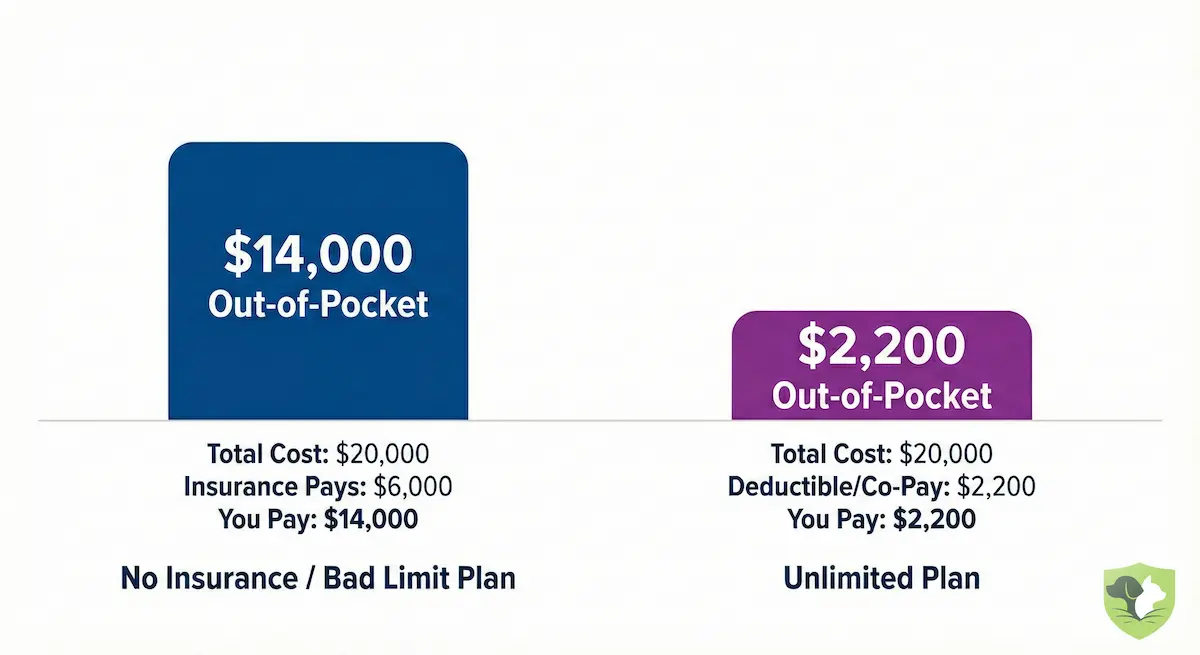
The Takeaway: For big dogs, an "Unlimited" plan can be worth pricing against cheaper plans with lower annual limits, especially if orthopedic or specialty-care risk is high.
Case Study: The Cat Bills Owners Forget to Budget For
Orthopedic emergencies grab the headlines, but cats run up their own five-figure risks. Feline lower urinary tract disease (FLUTD) is a common example: a urinary blockage is a true emergency, and PetPlace estimates a three-day blockage case at about $1,425 to $4,000. Layer in chronic conditions like kidney disease, hyperthyroidism, or diabetes that need years of monitoring, and a high-limit or unlimited plan can matter just as much for a cat as for a big dog.
Attained-age pricing and renewal risk
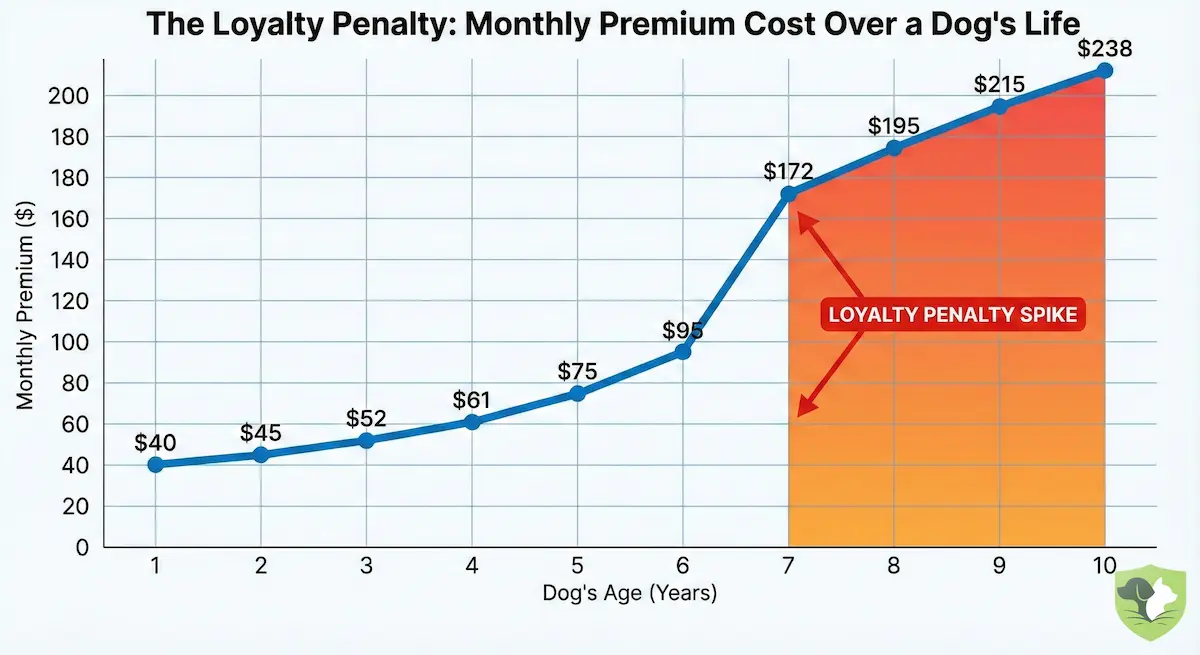
Most carriers may use attained age and other filed factors at renewal; that is not evidence of a tenure-based or individualized “loyalty penalty.” One Forbes Advisor age-rating dataset shows that the age factor for a 7-year-old dog was 71% above the base rate used for ages 1 and 2.
The "Lock-In" Effect: As your pet ages, they may develop minor health issues. If you try to switch insurance companies to find a cheaper rate, those issues are flagged as "pre-existing conditions" and excluded by the new carrier. That can make switching difficult.
Renewal repricing: Premiums can rise at renewal as pets age under attained-age methods and as other filed factors change. The exact change depends on the insurer, state, pet age, breed, local veterinary inflation, and policy design.
An enrollment-age exception: Trupanion says it does not raise rates based on your pet's birthday and instead prices around broader veterinary-cost factors. That method does not freeze the premium or prove a higher Day 1 price; compare matched quotes and the issued renewal-pricing disclosure.
How to Choose Based on Your Pet’s Life Stage
One-size-fits-all advice is the enemy of good insurance. A bubbly 10-week-old Golden Retriever needs a completely different strategy than a 12-year-old rescue mix with "mystery" stiff hips. Here is how to play your hand based on where your pet is in life.
The "Puppy Strategy" (Ages 0–1)
The Goal: Beat the medical record. The Strategy: You want to enroll your puppy as early as practical, ideally before symptoms or diagnoses appear in the medical record. Why? Because a vet note such as "noted slight limp" or "scratching ears" can become a pre-existing-condition issue later, depending on the policy and whether the condition is curable.
The Play:
- Lemonade can be competitively priced for some young, healthy pets, especially if you choose lower limits or fewer add-ons.
- MetLife can be worth comparing if you adopt littermates and want a policy structure built for multiple pets.
The "Genetic Time Bomb" (Purebreds)
The Goal: Maximum liability protection. The Strategy: If you own a French Bulldog, Bernese Mountain Dog, or Doberman, breed-associated health risks should shape your coverage choice. Frenchies, for example, are known for spinal and allergy risks that can become expensive over a lifetime.
The Play:
- Trupanion is one design to compare here. Their "Lifetime Per-Condition Deductible" means that once you pay the deductible for an eligible chronic breed issue (like allergies), you do not pay that condition deductible again.
- Plus, their direct pay feature can reduce the amount you need to put on a credit card when a participating hospital and eligible claim are involved.
The "Senior Rescue" (Ages 6+)
The Goal: Just getting approved. The Strategy: This is the hardest category. Some insurers have upper enrollment ages that can affect senior pets, while others advertise no upper age limit. You need a provider with senior-pet eligibility that fits your dog’s age, medical history, and budget.
The Play:
- Spot and Pets Best are strong options to compare here. Neither carrier imposes an upper age limit for new enrollments.
- Pro Tip: If your senior rescue has a history of minor issues (like ear infections), look at ASPCA or Spot. Their "curable" condition clauses may stop treating an eligible, fully resolved issue as pre-existing after 180 symptom- and treatment-free days; knee and ligament conditions are excluded from that path on every state form; both brands’ countrywide forms (ASPCA, Spot) also exclude chronic conditions, and some state forms add congenital, hereditary and orthopedic conditions, so the issued form controls.
Final Verdict: Is Pet Insurance Worth It in 2026?
Real talk: If you have $20,000 sitting in a savings account specifically labeled "Major Orthopedic Surgery," you may not need pet insurance. For many other pet owners, it is worth serious consideration.
The math has changed. With May 2026 BLS data showing veterinarian services up 4.9% year over year and pet services up 7.0%, and standard emergency surgeries costing as much as a used sedan, the financial risk is hard to ignore. For many owners, pet insurance is less about "saving money" on an annual vet visit and more about reducing the risk that a large emergency bill drives a painful care decision.
The "One Thing" You Must Do: Before you buy any policy, audit your pet's medical records. Read every note your vet has ever written. If there is a mention of "itching" from three years ago, that could become part of a pre-existing-condition review for a future allergy claim. Know what you are buying so you aren't blindsided by a denial later.
Our Final Advice:
- Scrutinize the "Wellness" Plans: Wellness plans are usually budgeting tools, not true insurance. Compare the annual wellness premium with the exact capped benefits you realistically expect to use, such as vaccines, annual exams, fecal tests, heartworm tests, dental cleaning, or preventive medication.
- Don't Wait: Insurance works best when you don't need it. The longer you wait, the more "pre-existing conditions" your pet may accumulate, which can create exclusions under a new policy.
Frequently Asked Questions (FAQs)
Does pet insurance cover pre-existing conditions?
Generally, no. If your pet showed symptoms before the policy started, it is typically excluded. However, some policies distinguish between incurable and curable histories. Incurable: Conditions such as diabetes or arthritis are usually incurable. One notable exception is AKC Pet Insurance, which may cover some pre-existing conditions after 365 days of continuous coverage, where available and subject to policy terms. Curable: Companies like ASPCA and Spot have a "curable" clause. If your pet is symptom-free and treatment-free for 180 days, they may reinstate coverage for episodic issues such as ear infections or kennel cough.
How do I decide between two similar plans if my pet fits multiple risk categories?
If you are stuck between two quotes that look identical, look at the deductible structure and the underwriter. If you have a breed prone to chronic issues, compare an annual deductible with a lifetime per-condition deductible such as Trupanion's model. Under that per-condition design, you pay the deductible once for eligible treatment of that condition and do not pay that same condition deductible again. For pets prone to unrelated accidents, an annual deductible can be easier to compare because it caps your deductible exposure for the year. The "Hidden" Parent: Be aware of the "illusion of choice." Pets Best, Spot, and ASPCA Pet Health Insurance have overlapping corporate or administrative ties through Independence Pet Holdings, but they are not identical products. If you are splitting hairs between them, compare each brand’s sample policy, underwriter, exclusions, waiting periods, and reimbursement rules.
What is the waiting period for knee injuries (ACL/CCL)?
This is the "gotcha" clause. Cruciate ligament waiting periods vary widely by insurer and state; some are extended, while others are much shorter. Spot lists a 14-day waiting period for ligament and knee conditions in its sample policy, while other insurers may use longer orthopedic or cruciate waiting periods. Always check the sample policy for cruciate, knee, hip, and orthopedic language.
Why did my premium go up?
Premiums can change with inflation, location, breed, policy design, approved rates, and — at most attained-age carriers — the pet's age. May 2026 BLS data show veterinarian services up 4.9% year over year and pet services up 7.0%. Those figures are market context, not a carrier-specific renewal formula; one Forbes Advisor age-rating dataset shows a 7-year-old dog age factor 71% above the base rate used for ages 1 and 2, but that is not a universal carrier method. Trupanion says a pet's birthday is not a direct renewal factor; its cohort and location rates can still change. Read the issued renewal-pricing disclosure.
Are there ways to lower premiums without sacrificing essential coverage?
Yes, but be careful not to strip away the catastrophic protection you actually need. Tweak the Deductible: Raising your deductible from $250 to $500 or $750 is often a straightforward way to lower your monthly premium. Check the "Wellness" Rider: Wellness add-ons are capped-benefit budgeting tools. Compare the annual premium with the exact benefits you expect to use before adding one. The "Nuclear" Option: If a full policy is out of budget, consider an Accident-Only plan. It won't cover cancer or illness, but it can help with eligible accident claims.
What documentation do I need to ensure my claims are approved?
Missing paperwork is one of the most avoidable claim problems. Fast digital claims do not mean medical-history review disappears; insurers can still request records, review prior symptoms, and delay or deny claims if records are missing or suggest a pre-existing condition. The "Golden Record": Many insurers may request roughly 12–24 months of medical history, but exact record requirements vary by insurer, pet age, claim type, and state. Some claims may require more complete records. The Pro Move: Do not wait for an emergency. Ask whether the insurer offers a "Medical History Review" or similar underwriting review after purchase. This can help surface potential pre-existing-condition exclusions earlier, before a major claim is pending.
Is a wellness plan worth it?
Wellness plans are usually budgeting tools, not true insurance. To test whether one makes sense, compare the annual wellness premium with the exact capped benefits you realistically expect to use, such as vaccines, annual exams, fecal tests, heartworm tests, dental cleaning, or preventive medication. Example only: if a wellness add-on costs $300 per year but you only use $220 of eligible benefits, you lose money. If you use $380 of eligible benefits and the plan reimburses those categories, you may come out ahead.
WhiskerCover is a licensed insurance agency and is free to use. If you buy a policy through us, or click a link to one of our pet insurance partners and purchase, the insurer may pay us a commission at no extra cost to you. Learn more about how we make money.
Sources
- Bureau of Labor Statistics CPI — May 2026
- NAPHIA Industry Data
- NAPHIA 2025 State of the Industry Report
- California SB 1217
- Independence Pet Holdings
- Pets Best Joins Independence Pet Holdings
- Independence Pet Holdings Acquires Spot Pet Insurance
- ASPCA Pet Health Insurance Partnership
- Trupanion VetDirect Pay
- Trupanion Claims
- Trupanion Payouts
- Trupanion Deductibles
- Trupanion Pricing Promise
- Lemonade Pet Insurance
- Lemonade Pet Insurance Cost
- Lemonade Form 10-K
- Lemonade Pet Medical Records
- Lemonade Pet-Insurance Optimized Medical Records
- Lemonade Pet Add-Ons
- Lemonade Preventative Care Options
- Lemonade TPLO Surgery Cost
- Spot Pet Insurance Enrollment Age
- Spot Sample Policy
- Spot Pre-Existing Conditions
- Spot Underwriting
- ASPCA Pet Health Insurance Pre-Existing Conditions
- ASPCA Pet Health Insurance Sample Policy PET-P-20000-1024 (Texas, countrywide form)
- ASPCA Pet Health Insurance Sample Policy PET-P-20000-OH-1024 (Ohio)
- ASPCA Pet Health Insurance Coverage
- ASPCA Pet Health Insurance Preventive Care
- ASPCA Pet Health Insurance Horse Insurance
- Pets Best Coverage
- Pets Best Vet Direct Pay
- Pets Best FAQ
- Pets Best Routine Care
- Pets Best Sample Policy
- Embrace Orthopedic Waiting Period
- Pumpkin Pet Insurance FAQs
- AKC Pet Insurance Pre-Existing Conditions
- MetLife Pre-Existing Conditions
- MetLife Bilateral Conditions
- American College of Veterinary Surgeons CCL Disease
- Forbes Advisor Pet Insurance Age Rating Factors
- Trustpilot Pets Best Reviews
- BBB Pets Best Complaints
You may be interested...
More published guides that build on this topic.
 Best
Best
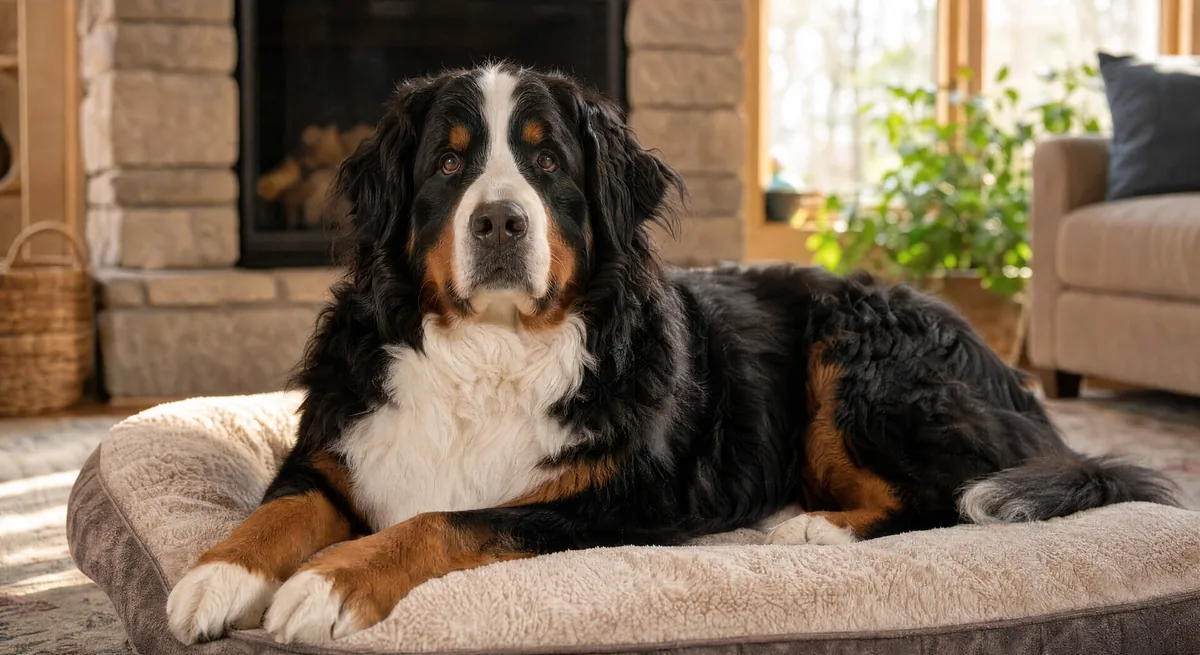
Best Pet Insurance for Large Dogs (2026): Picks by Breed and Risk
Large dogs face $5,000–$15,000 orthopedic and bloat bills. We rank insurers on what matters for big breeds — orthopedic waits, annual limits, and direct pay.
 Best
Best
Best Cheap Pet Insurance Plans in 2026: Real Protection on a Budget
Compare affordable pet insurance with matched quote settings in 2026. Learn how to tune deductibles, limits, and reimbursement without stripping out the protection you need.