

Your vet just said the words "torn cruciate" — maybe "TPLO" — and handed you a quote with a number that made your stomach drop. If you're reading this from the clinic parking lot, you're in the right place. Here's the deal, plainly: this page gives you the real 2026 cost of dog ACL surgery, what recovery actually demands of your household, and the honest truth about whether pet insurance will help.
That last part matters most, so we'll say it early: if your dog's knee is already diagnosed, a policy you buy today won't pay for this surgery. But there's still a lot you can do — for your budget, for the surgery decision, and for the other knee.
Here's what you'll learn:
- What ACL/TPLO surgery really costs — the full bill, not a single "average"
- When pet insurance does and doesn't cover cruciate surgery, carrier by carrier
- How to choose the right procedure and get your home ready for recovery
Table of Contents
- Dog "ACL" is really the CCL: a quick terminology reset
- How much does dog ACL/TPLO surgery cost?
- Is it too late to buy insurance? (Read this first)
- Does pet insurance cover ACL/CCL/TPLO surgery?
- The second knee: bilateral exclusions explained
- Which surgery does my dog need?
- Recovery timeline and household readiness
- If you can't pay upfront: direct pay and financing
- Complication and success reality
- Frequently Asked Questions
- Sources
Dog "ACL" is really the CCL: a quick terminology reset
Quick translation, because it trips everyone up. "ACL" — anterior cruciate ligament — is the human term. In dogs, the same knee stabilizer is the cranial cruciate ligament (CCL): same job, same injury, different letters, and your vet may use them interchangeably. You'll also hear "TPLO," "TTA," and "lateral suture" — those are the surgeries that fix it, which we'll sort out below.
Here's the part that actually matters for your wallet and your worry: in dogs, a cruciate tear usually isn't a one-off sports accident. It's most often a slow, degenerative breakdown of the ligament that finally gives way — which is why the limp can come and go for weeks before the knee fully ruptures. That degenerative nature explains two things we'll keep coming back to: why the other knee is also at risk, and why an insurer can treat an early limp as a "pre-existing" sign — even one nobody named as a torn cruciate at the time.
How much does dog ACL/TPLO surgery cost?
There's no single price — and anyone who quotes you one number is skipping the parts that add up. What you pay turns on the procedure, your dog's size, your region, and whether complications follow. Plan for the whole stack, not just the surgery line.
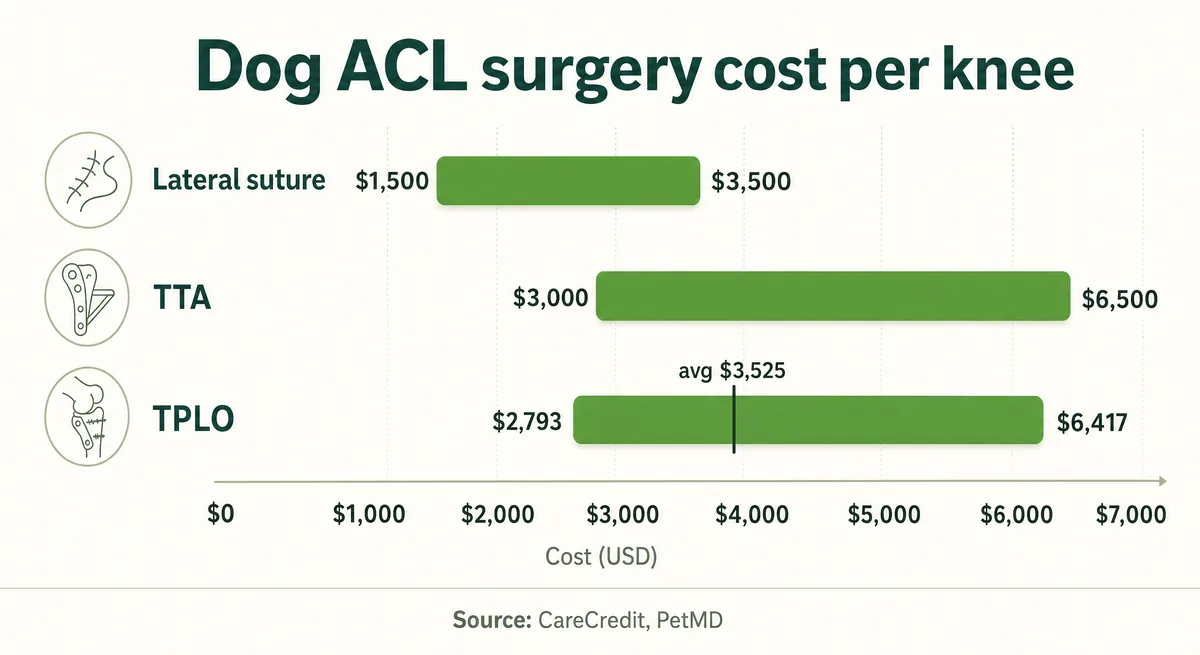
A realistic bill includes the consult and X-rays, pre-op bloodwork, the surgery itself plus implants, anesthesia and hospitalization, pain meds, recheck visits, and often a course of rehab. Diagnostics alone can run several hundred dollars before surgery even begins, with complications or the second knee as real possibilities on top. CareCredit puts the U.S. average for TPLO surgery at $3,525, commonly $2,793 to $6,417 by location — and that's typically before aftercare.
The procedure you choose moves the number most:
| Procedure | Best fit | Typical cost per knee |
|---|---|---|
| Lateral suture (extracapsular) | Small or sedentary dogs | ~$1,500–$3,500 |
| TTA (osteotomy) | Mid-size, active dogs | ~$3,000–$6,500 |
| TPLO (osteotomy, gold standard) | Large or athletic dogs | ~$3,525 avg; $2,793–$6,417 |
Across techniques, PetMD pegs the range at roughly $1,500 to $7,000 per knee — the top end reflecting a TPLO at a specialty hospital in a high-cost city.
What drives the price
Four levers: the procedure (osteotomies like TPLO and TTA cost more than a lateral suture), your dog's size (bigger dogs need bigger implants and drug doses), your region (the CareCredit spread is mostly geography), and complications (an infection or a meniscal tear adds to the total). Because location drives so much of the spread, the same surgery can cost noticeably more across town — call two or three clinics and ask each to itemize the consult, surgery, implants, and rehab separately, so you're comparing like for like. And get a second opinion before you commit.
Is it too late to buy insurance? (Read this first)
Here's the hard rule for an immediate bill: if your dog's knee is already diagnosed — or even just limping on the vet's chart — a mainstream policy bought today will not pay for this surgery. The condition predates the new coverage. AKC advertises a narrow, state- and form-dependent pathway for some eligible pre-existing conditions after 365 days of continuous coverage, but that does not pay a surgery needed now and should not be assumed without written confirmation.
The reason is the pre-existing condition rule: anything your dog showed signs of before your coverage started — or during the waiting period — is excluded. A limp noted at last week's appointment counts, even if nobody named it a torn cruciate yet. Buying a policy now simply can't reach back in time.
So what's the point? A new policy still protects you against new problems that haven't happened yet — a swallowed sock, an ear infection, cancer years from now — once you're past its waiting periods; our guide to what pet insurance covers for surgery walks through those general rules. What it usually can't protect is the other knee, because cruciate disease is degenerative and insurers often treat a problem on one side as a sign the other is coming. We'll unpack that next.
Does pet insurance cover ACL/CCL/TPLO surgery?
Under a mainstream accident-and-illness plan, yes — when the dog was insured before any sign of a knee problem and cleared the applicable cruciate waiting period. A knee already torn or limping on the chart is normally pre-existing. AKC is the unusual exception to investigate: in eligible states and forms, some pre-existing conditions may become covered after 365 days of continuous coverage, subject to exclusions and endorsements. For a new, symptom-free enrollee, future cruciate treatment is typically handled under the issued policy's orthopedic terms.
The catch most owners miss: cruciate injuries can carry a special, longer waiting period than the rest of the policy; some audited forms use roughly six months, while other state forms use different clocks. Some carriers or forms allow it to be waived or shortened if a vet examines your dog soon after enrollment and finds the knees healthy. Here's how a few common carriers handle it (verify the current terms for your state before you buy):
| Carrier | Cruciate waiting period | Can it be waived or shortened? |
|---|---|---|
| AKC | 180 days (about 6 months) | No |
| Embrace | Common dog forms use 6 months; state timing varies | Some applicable state forms permit reduction to as little as 14 days after a qualifying orthopedic exam; other states differ |
| Pets Best | 6 months for cruciate events in the audited sample forms | Only where the state, form, or enrollment channel permits it — for example, qualifying pre-purchase certification or uninterrupted prior coverage; confirm the issued policy |
Two more things to check on any policy. Bilateral handling: if one knee showed signs before coverage or during the waiting period, some forms may treat the other knee as pre-existing too — so a left-leg history can quietly exclude the right.
Reimbursement model: nearly all insurers pay you back after the fact — you pay the surgeon, file a claim, and get your covered share after the form identifies eligible charges and applies the remaining deductible and reimbursement percentage in its stated order, subject to your annual limit.
Two nuances worth a direct question before you enroll: a partial tear noted before coverage usually taints the full rupture that follows (same pre-existing condition), and a low annual cap can be drained by a single $5,000–$7,000 surgery — before the second knee even comes up. Cruciate terms change often and vary by state, so confirm the waiting period, bilateral rule, and annual limit against the carrier's current policy documents.
The second knee: bilateral exclusions explained
Here's the worry that outlasts the surgery itself: the other knee. Because canine cruciate disease is degenerative, a dog that blows one ligament is at real risk of blowing the other. Studies don't fully agree on the rate or the timing, but the picture is sobering. The American College of Veterinary Surgeons says 40–60% of dogs with cruciate disease in one knee later develop it in the other. And the risk doesn't end after the first year: in a study of 380 dogs treated surgically for a tear in one knee, 54% tore the other cruciate during the study period, and the median time to that second tear was 947 days — about 2.6 years.
Two forces drive it. First, the underlying weakness is usually bilateral from the start: the same genetic and degenerative process that frayed one ligament is quietly at work in the other knee. Second, while your dog favors the injured leg, it overloads the healthy one — speeding up the very breakdown you're trying to avoid.
Now the insurance sting. A bilateral exclusion means carriers treat paired structures — like the two cruciate ligaments — as a single condition. So if your dog's first knee was diagnosed or showed signs before coverage began, most insurers (AKC spells this out) will treat the second knee as pre-existing too — and decline it, even if it tears a full year into the policy. That's the trap: the dog most likely to need a second surgery is often the one an insurer won't cover for it.
The practical takeaway: if one knee is already on the record, budget for the second surgery as a genuine possibility. And if you have a young, healthy dog with no knee history, insuring now is the single best way to keep that second knee covered.
Which surgery does my dog need?
Three surgical fixes dominate, and the right one turns mostly on your dog's size and activity — not on price. Here's the plain-English version.
- TPLO (tibial plateau leveling osteotomy): the surgeon cuts and rotates the top of the shin bone to cancel the knee's instability. It's the gold standard for large, athletic dogs and gives the most reliable long-term function.
- TTA (tibial tuberosity advancement): a different bone-reshaping operation that changes the joint's mechanics — an osteotomy alternative often used for medium-size dogs.
- Lateral suture (extracapsular repair): a strong suture placed outside the joint stands in for the torn ligament. Simpler and cheaper, it suits smaller or less active dogs.
- Conservative management: rest, weight control, physical rehab, and anti-inflammatories — reasonable for small, sedentary dogs or some partial tears, but usually not enough on its own for a big, active dog.
| Your dog | Usual best fit |
|---|---|
| Small / sedentary | Lateral suture (or conservative for partial tears) |
| Medium / active | TTA or TPLO |
| Large / athletic | TPLO |
Two cautions. First, "stopped limping" doesn't mean "healed." Partial cruciate tears flare and settle in cycles, so a dog that seems fine one week can be worse the next — don't cancel a recommended surgery on a good day. Second, this is major orthopedic surgery: get a second opinion, and for an osteotomy look for an ACVS board-certified surgeon rather than choosing on price alone.
Recovery timeline and household readiness
The surgery is one day; the recovery is the hard part — and it's mostly on you. A typical cruciate recovery runs in phases:
- Weeks 1–2: strict rest and confinement, incision care, pain medication, and very short leash walks only for bathroom breaks.
- Weeks 2–8: continued strict rest, with slowly lengthening controlled leash walks as your surgeon directs — no running, jumping, or stairs.
- Weeks 8–12: a gradual return to normal activity, often with formal physical rehab, guided by recheck X-rays.
- Months 4–6: most dogs reach full, unrestricted function.
That's roughly two to three months of strict restriction. Before you schedule, honestly run this readiness check — can your household actually deliver it?
- A crate or small, confined, non-slip room to limit movement
- Leash-only potty trips, even in your own yard
- Rugs or runners over slippery floors, and a plan to avoid stairs
- A sling or support harness to help a big dog up and down
- Separation from other pets and excited greetings
- A talk with your vet about safe calming or sedation for a restless dog
- Someone home enough to enforce rest and manage medications
- Budget and time for recheck visits and any prescribed rehab
None of this is optional. The single most common way a good surgery goes wrong is too much activity too soon — a re-injury or a failed implant can mean a second operation. If your schedule can't cover the first two weeks especially, line up help before surgery day. Recovery is a marathon of patience, but dogs who get the restriction they need usually do beautifully.
If you can't pay upfront: direct pay and financing
Even with insurance, there's a cash-flow trap: most pet policies reimburse you after the fact, so you hand the surgeon the full $3,000–$6,000 at checkout and wait weeks to get your covered share back. Plan for that gap.
A few insurers soften it with direct pay — paying the hospital their portion at checkout, so you only owe your deductible and co-pay. Trupanion's VetDirect Pay is the best-known version, but it only works at participating hospitals — so call your surgeon's clinic and confirm it before surgery day, not after.
If you're paying out of pocket, medical-financing options like CareCredit and Scratchpay can bridge the bill — but treat them with care. They're loans with interest, and approval limits often land well below a $5,000-plus quote. Ask the clinic what it accepts, get the financing approved in advance, and read the terms before you sign.
Complication and success reality
Here's the reassuring headline: most dogs do very well. The American College of Veterinary Surgeons reports significant improvement in 85–90% of dogs after cruciate surgery — a return to comfortable, active life that conservative management rarely matches for a big, active dog.
No operation is risk-free, though, and it's fair to know what surgeons watch for. The recognized complications are surgical-site infection, a problem with the implant (loosening or breakage), a later meniscal tear, and lingering lameness or arthritis. Most are uncommon and treatable, and only a small share of dogs need a second — or "revision" — surgery to fix one.
Be skeptical of any single complication percentage you read. Reported rates swing widely between studies, mostly because researchers count "complication" differently — from a minor incision irritation to a failed implant — so there's no one true number. One thing to plan for: because torn menisci are commonly found during the operation, your surgeon will inspect and treat the meniscus while they're already in the joint. The honest bottom line is that complications are the exception, not the rule, and shouldn't scare a good candidate away from a surgery their vet recommends.
Frequently Asked Questions
How much does dog ACL surgery cost without insurance?
Without insurance, most owners pay roughly $1,500 to $7,000 per knee, depending on the procedure and where you live. CareCredit puts the TPLO national average at $3,525 (range $2,793–$6,417); a lateral suture runs less, TPLO and TTA more. Budget extra for the consult, X-rays, bloodwork, medications, rechecks, and rehab on top of the surgery itself — and remember that a torn cruciate often means the other knee follows.
Is dog ACL surgery worth it?
For most dogs — especially big, active ones — yes. Surgery is the most reliable way back to a comfortable, active life, with the American College of Veterinary Surgeons reporting significant improvement in 85–90% of cases. It isn't the only path: small or sedentary dogs and some partial tears can do well with conservative management. But a large dog left untreated usually faces ongoing pain and faster-progressing arthritis, so for them surgery is generally the better investment. Ask your vet what fits your dog.
Can a dog walk after ACL surgery?
Yes — gentle, controlled leash walking is actually part of recovery, but only short bathroom trips at first, and never free running or jumping. Expect about 8–12 weeks of strict rest with slowly lengthening leash walks, then a gradual return to full, off-leash activity around four to six months. Too much activity too soon is the single most common way a good surgery fails, so follow your surgeon's timeline closely rather than your dog's apparent comfort.
Can a dog's ACL heal without surgery?
A torn cruciate ligament doesn't truly heal or reattach on its own, but some dogs can still be managed without surgery. Conservative management — strict rest, weight control, physical rehab, joint support, and anti-inflammatories — can give small or sedentary dogs, or some partial tears, a reasonable quality of life. For large, active dogs it usually isn't enough on its own, and the unstable knee tends to keep degenerating. Whether it's a fair option for your dog is an honest conversation to have with your vet.
What pet insurance covers ACL surgery for dogs?
Most accident-and-illness plans cover cruciate (ACL/CCL) surgery when you enrolled before any sign of a knee problem and cleared the applicable cruciate waiting period. A knee already torn, limping, or noted on the chart is normally pre-existing, and many policies can also affect the other knee. AKC advertises a narrow 365-day pathway for eligible pre-existing conditions in qualifying states/forms, but no newly purchased policy pays an already-diagnosed surgery needed now.
What if I can't afford my dog's ACL surgery?
If you can't pay upfront, you have real options short of giving up on surgery. Ask the clinic about payment plans and medical financing like CareCredit or Scratchpay (apply early — approval limits can fall below a $5,000-plus quote); get a second opinion, since prices vary widely and a lateral suture may suit a smaller dog; and look into veterinary teaching hospitals and charitable-aid funds. And while most insurance reimburses you after the fact, an existing policy may offer direct pay at participating hospitals — though a policy bought now won't cover this already-diagnosed knee.
Does AKC pet insurance cover ACL surgery?
AKC applies a 180-day cruciate waiting period to newly arising cruciate conditions, and its FAQ says that clock cannot be waived. Separately, AKC advertises coverage for eligible pre-existing conditions after 365 days of continuous coverage where the state and issued form allow it. Hereditary or congenital diagnoses can have separate endorsement requirements. Confirm the knee, other-side, age, state, and endorsement terms in writing before relying on either path.
Sources
- Dog ACL (CCL) Surgery: Cost and Recovery Timeline — PetMD
- How Much Does CCL (ACL) Surgery for Dogs Cost? — CareCredit
- How Does Pet Insurance Work? FAQ — Coverage (cruciate waiting period) — AKC Pet Insurance
- Coverage for Eligible Pre-Existing Conditions — AKC Pet Insurance
- What Is the Waiting Period for Orthopedic Conditions? — Embrace Pet Insurance
- Pets Best Accident & Illness Policy Booklet (sample) — Pets Best
- Find a Board-Certified Veterinary Surgeon — American College of Veterinary Surgeons (ACVS)
- VetDirect Pay vs. Reimbursement in Pet Insurance — Trupanion
- Cranial Cruciate Ligament Disease — American College of Veterinary Surgeons (ACVS)
- Contralateral Cruciate Survival in Dogs with Unilateral Non-Contact Cranial Cruciate Ligament Rupture (Muir et al., 2011) — PLoS ONE