

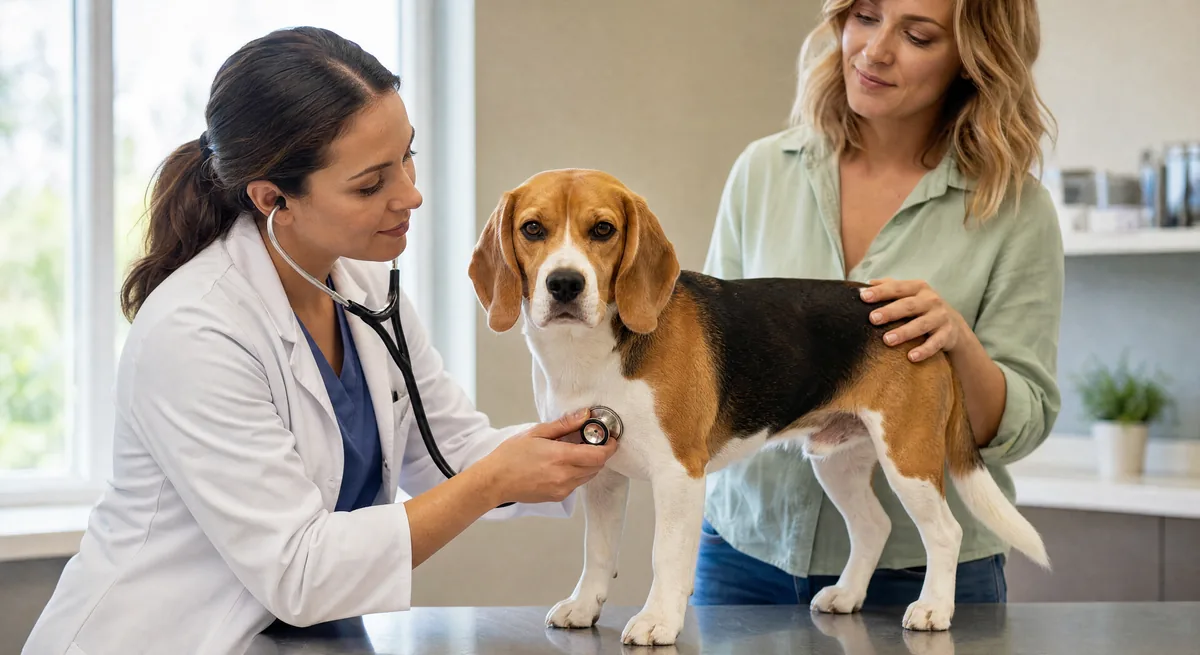
Here’s the honest starting point: most insurers will gladly sell you a policy for a Beagle, and at young-dog prices the math is often workable. Whether it’s still worth buying depends far less on the company than on timing — your dog’s age, what’s already in the vet chart, and how the premium will look five years from now.
That’s the real decision this guide walks through. Beagles are a generally healthy breed with a short list of expensive exceptions — back problems, knee injuries, chronic ears and allergies, and the cancers of old age — and insurance treats each of those very differently depending on when you enroll.
If a back flare, a limp, or an ear infection is already documented, some doors have closed; we’ll be clear about which ones. If you’re new to how dog insurance works in general, start with the basics; here we’ll stay focused on the Beagle-specific call: buy now, buy with limited expectations, or self-insure.
Table of Contents
- Should You Insure a Beagle Early or Wait?
- How Much Does Beagle Pet Insurance Cost?
- Which Beagle Health Risks Make Insurance Most Valuable?
- What Insurance Can Still Cover If Your Beagle Already Has a Medical History
- Best Pet Insurance for Beagles: What to Compare
- Is Pet Insurance Worth It for an Older Beagle?
- Frequently Asked Questions
- Sources
Should You Insure a Beagle Early or Wait?
Earlier is better — not because insurers say so, but because of how the product works. Most plans will exclude a condition or related signs already present in your dog’s medical record, so every month you wait is a month for something to land in the chart that narrows what a future policy will pay for.

With a Beagle, the things that narrow coverage tend to arrive quietly: a skipped step or brief limp, a first ear infection, an itchy season noted as “possible allergies.” None of those feel like emergencies. All of them can resurface later as pre-existing condition flags when an insurer reviews the record — formal diagnosis or not.
“I just adopted a Beagle from a shelter — should I get pet insurance?” is word for word how owners ask the timing question, and the adoption-day logic holds: a rescue’s coverage clock starts when you enroll, not at the age the dog joins you.
An adult rescue with a thin paper trail usually still enrolls with a mostly clean record. Just remember that illness coverage begins only after a waiting period, so the policy you buy today doesn’t protect against this week’s diagnosis.
The wait-and-see version of this story shows up on Reddit constantly. In one r/beagle thread, the owner of a six-year-old whose back had already “slipped” twice asked which insurer was still worth buying — while assuming any future spine surgery would be excluded. That’s the trap: by the time insurance feels urgent, part of its value is already gone.
Waiting isn’t worthless, though. Enrolling an older or already-charted Beagle can still protect against future, unrelated problems — we’ll get specific about what that means later in this guide.
And one thing should never wait: the vet visit itself. If your Beagle is limping or scratching today, get the care first. Medical records exist to keep your dog healthy, not to optimize a future insurance application.
How Much Does Beagle Pet Insurance Cost?
For a young Beagle on a standard accident-and-illness plan, two carrier-published benchmarks suggest roughly $40–$75 a month as planning context, not a matched market range. That span comes from Lemonade's own Beagle-policy data, and Fetch reports an average around $45 a month for the breed.
For context, the average U.S. accident-and-illness dog policy cost $836 a year — about $69.67 a month — in 2025, per NAPHIA. A “from $16/month” teaser is technically real but tells you almost nothing: that’s a stripped-down configuration, not a typical quote.
Price by life stage
Attained-age quotes generally rise as a pet gets older, but owner anecdotes do not isolate age from ZIP code, benefit settings, or carrier. In one r/beagle thread, a Pets Best policy ran $761 a year for a 2-year-old Beagle and $1,814 a year for an 11-year-old.
And premium drift starts early: another owner watched a healthy 3-year-old’s premium climb from $125 to $165 a month with no major claims.
For a senior with medical history, the math can genuinely invert. One Quora owner audited their Beagle’s final two years: about $6,600 in premiums, about $5,100 in submitted bills, about $2,700 reimbursed.
That’s one household’s outcome, not a universal rule — but it shows why a rising premium should be judged against the catastrophic risks still on the table, not against last year’s small claims.
| Life stage | Real-world anchors | What to watch |
|---|---|---|
| Puppy to age 3 | $40–$75/mo carrier benchmarks; $761/yr owner report at age 2 | Cleanest enrollment window; actual price remains profile- and benefit-specific |
| Adult (4–7) | Renewals can rise at attained-age carriers, claims or not | Renewal increases; deductible structure starts to matter |
| Senior (8+) | $1,814/yr owner report at age 11 | Premium vs. remaining catastrophic risk |
| Senior with history | One audit: $6,600 premiums, $2,700 back over two years | Exclusions can narrow what’s claimable |
What changes the price
Five levers shape a Beagle quote:
- Age — a major lever at most carriers. Most use attained-age pricing, so rates can rise as your dog ages. Trupanion instead says birthdays and the individual pet's claims are not direct factors, although cohort, location, and veterinary-cost changes can still raise its rates.
- Location — Pawlicy’s sample Beagle quotes run $27–$61 in Alabama versus $50–$114 in New York for comparable coverage.
- Plan design — deductible amount (and whether it’s annual or per-condition, which changes the value for chronic ear and allergy care), reimbursement rate (70–90%), and annual limit (what caps a cancer or surgery bill).
- Veterinary inflation — vet services prices were up 4.9% year over year in the May 2026 CPI release, so renewal pressure can affect healthy, claim-free dogs too; the exact rating method varies.
- Breed impact requires matched quotes — a carrier-published Beagle average cannot be ranked against an all-dog benchmark when the profiles and benefits differ. Age, ZIP code, and plan design also affect the quote; Trupanion uses enrollment age rather than birthdays as a direct factor.
When you compare quotes, hold the design constant — same deductible, reimbursement, and limit — or the cheaper number is usually just thinner coverage. Which risks that money actually protects against is the next question.
Which Beagle Health Risks Make Insurance Most Valuable?
Two kinds of risk matter here, and they argue for different things. A short list of catastrophic events — back surgery, cancer, a swallowed object — is where insurance earns its keep in a single bill. A longer list of chronic problems — ears, skin, teeth, weight — mostly tests your deductible, not your annual limit.
The catastrophic tail starts with the spine. Beagles are a long-and-low, disc-prone (chondrodystrophic) build, which predisposes them to intervertebral disc disease (IVDD) — a herniated disc can escalate from a wobbly walk to emergency neurosurgery in days, and the diagnosis-to-rehab path can reach five figures. In one IVDD support thread, an owner reported insurance covering roughly 70% of a 5-year-old Beagle’s surgery.
Cancer is the other tail risk — the $25,000 Pets Best cancer claim from an 11-year-old Beagle is the kind of bill no deductible debate survives. In between sit knee injuries (CCL tears), luxating patellas, and hip dysplasia — $1,500–$6,000 to treat, per Lemonade’s Beagle claims table.
Epilepsy runs chronic rather than catastrophic ($500–$2,500 typical, same table); Fetch’s own claims data flags epilepsy, swallowed objects, and eye disorders as categories where roughly 1 in 10 of its insured Beagles run up costs above its thresholds. And Beagles eat first, reconsider never: one owner keeps coverage “basically for obstruction”.
Beagle vet bills that make insurance or savings relevant
Real Beagle bills sort into three buckets — accident-and-illness claims, add-on territory, or self-pay. Costs are Lemonade’s published Beagle treatment averages:
| Bill | Typical cost | Where it usually lands |
|---|---|---|
| Ear infections | $300–$800 | Covered if new; chronic recurrence risks a pre-existing tag |
| Skin allergies | $400–$1,500 | Covered when new; lifelong management re-tests the deductible yearly |
| Dental disease | $400–$1,500 | Dental illness sometimes covered; routine cleanings are wellness/self-pay |
| Obesity-related care | $250–$800 | Weight itself usually isn’t claimable; what it aggravates is assessed separately |
| Rescue/heartworm care | Varies | Conditions present at adoption are typically pre-existing; prevention is self-pay or wellness |
| Accidents and ingestion | Varies to ER-level | Core accident coverage — the clearest-cut claims |
Dental deserves special respect: the AVMA notes most dogs show periodontal disease by age 3, and for Beagles it becomes a repeat cost category, not a one-off.
Diagnostic uncertainty: IVDD vs SRMA/Beagle Pain Syndrome vs hip/knee problems
The hardest Beagle scenario isn’t a named disease — it’s a young dog who starts limping, skipping, or going weak in the back legs with no answer yet. In one r/beagle thread, a two-year-old’s owners cycled through suspected CCL tear, hip dysplasia, IVDD, luxating patella, Lyme, iliopsoas strain, and SRMA.
The workup runs exam, X-rays, an orthopedic or neurology referral, possibly an MRI or CT — alone a few thousand dollars — plus bloodwork, pain management, ER monitoring if it escalates, then rehab.
SRMA (steroid-responsive meningitis-arteritis, sometimes called Beagle pain syndrome) is an immune-mediated inflammation seen disproportionately in young Beagles and usually treated with steroids — one more reason the bill arrives before the diagnosis does.
The insurance point: an accident-and-illness policy can carry much of this diagnostic phase — but only if the symptoms weren’t already charted when you enrolled, and exam-fee and rehab coverage vary by policy. Don’t diagnose your own dog; let the vet work the problem while your paperwork is already in order.
What Insurance Can Still Cover If Your Beagle Already Has a Medical History
Buy a policy today and it covers what happens next — new, unrelated problems. It will not pay for the condition already in your dog’s chart: mainstream U.S. accident-and-illness policies generally exclude pre-existing conditions, although cure-out rules and AKC's limited 365-day continuous-coverage pathway can create state/form-specific exceptions. So the honest question isn’t “can I still get a policy?” (almost always yes) but “what’s left that’s actually claimable?”
The definition is broader than most owners expect. Under the NAIC’s pet insurance model law, adopted by many states, a pre-existing condition includes anything a vet observed signs or symptoms of before coverage began or during the waiting period, formal diagnosis or not.
A “sore after the dog park” note in the chart can anchor an exclusion years later. And for paired body parts — ears, eyes, knees — some policies extend a problem on one side into an exclusion on the other.
There is one genuine carve-out: “curable” conditions. At some carriers, a one-off problem that fully resolved — a stomach bug, a UTI — can re-qualify for coverage after a symptom-free window, commonly 180 days to a year. The eligible list and the window are strictly carrier-specific, and chronic patterns like allergies rarely qualify.
Back, lameness, and orthopedic waiting periods
For Beagles, this is the flashpoint. The model law’s definition of “orthopedic” sweeps in bones, joints, ligaments, and cartilage — explicitly including hip dysplasia and intervertebral disc degeneration. Two consequences follow.
First, even a clean-charted Beagle usually faces a waiting period before illness and orthopedic coverage starts (lengths vary by carrier and state, and some insurers shorten the orthopedic wait with an enrollment exam), so day-one back coverage is uncommon; state law, policy form, channel, and an eligible exam or waiver can change the timing.
Second, a Beagle with a prior back flare or an unexplained limp — like the six-year-old from earlier in this guide — should expect future IVDD claims to be contested or excluded outright. If your dog’s history is orthopedic, that is the single biggest value limiter on a new policy, and mainstream new policies usually will not undo it, although limited cure-out or AKC pathways can vary by state and form.
What late enrollment still buys is everything genuinely new. An eight-year-old with charted allergies gets no allergy coverage, but a future obstruction surgery or a cancer diagnosis is unrelated and claimable under a standard policy. Whether that remaining slice justifies a senior premium is a question we take up below; our pre-existing conditions guide covers the definitions in depth.
Best Pet Insurance for Beagles: What to Compare
There is no universal best plan for Beagles — there’s a best plan for your dog’s age, chart, and the risks you decided matter most in the previous section. Six criteria do almost all the separating:
| Compare on | Why it matters for a Beagle |
|---|---|
| Deductible type | Chronic ears and allergies re-test an annual deductible every single year; per-condition designs behave differently (below) |
| Annual limit | IVDD surgery and cancer can pass $10,000 — the limit is what caps you |
| Reimbursement rate | 70–90% — the difference compounds on every claim |
| Vet-payment workflow | Trupanion can adjudicate eligible charges in real time at participating clinics; other direct-to-vet routes may pay only after claim approval |
| Diagnostics, second opinions, rehab | The lameness workup — exam fees, MRI/CT, specialist consults, physio — is covered very differently across plans |
| Dental and wellness handling | Cleanings usually need a wellness add-on; dental illness coverage varies widely |
The deductible question deserves plain English. Most policies use an annual deductible: you meet it once per policy year, then everything covered reimburses. A few — Trupanion’s design is the best known — use a per-condition, lifetime deductible: each condition has its own deductible, met once, forever.
For a chronic-condition breed that’s a real fork: per-condition favors a Beagle with one lifelong illness (epilepsy, say), while several small unrelated problems each re-trigger it — a mechanic Beagle owners report discovering only at claim time.
What owners actually report is usefully mixed. The $25,000 Pets Best cancer payout earns the brand catastrophic-tail credibility, while newer-buyer threads pair that praise with complaints about claim speed and renewals — and value Trupanion’s direct pay while resenting its premium climbs.
On Quora, a 22-year, three-Beagle owner credits a MetLife (formerly PetFirst) policy with making cancer treatment possible at 9.5 years old, and dental threads note MetLife’s preventive add-on reimburses up to $150 toward cleanings. One caution owners trip over: a Banfield-style wellness plan is routine-care membership, not accident-and-illness insurance — it won’t carry an IVDD surgery.
How to use this: pick the two or three risks that genuinely worry you, get quotes with the same deductible, reimbursement, and limit at each insurer, and compare only on those criteria. Our review methodology explains how we weigh these same factors.
Is Pet Insurance Worth It for an Older Beagle?
Sometimes — and less often than the quote pages imply. For a senior Beagle with a mostly clean chart, catastrophic-tail coverage can still be a rational buy: cancer risk is real at this age and it’s the one bill that justifies the product.
For a senior with documented conditions and a steep premium, a dedicated savings account is often the more honest answer, and saying so out loud is the point of this section.

The math gets tight fast. Two unmatched owner reports for 11-year-old Beagles cited $860 a year with a $1,000 deductible and $1,814 a year; these are anecdotes, not a market range. The share of likely problems that’s still claimable shrinks with every chart entry. The two-year audit from the cost section ($6,600 in premiums, $2,700 back) shows how a late-life policy can quietly invert.
The alternatives deserve equal billing. One recurring approach in senior-dog threads: keep coverage lean and only for new problems, and put at least $100 a month into savings alongside it.
Others skip insurance entirely and build the fund, with CareCredit-style financing as the bridge for a sudden bill. Neither is a failure of love; both are budgeting.
Before you cancel a rising Beagle policy
One cautionary tale first: in a Trupanion cancellation thread, a Beagle owner dropped a policy after years of increases and a deductible that small claims never cleared — and got a cancer diagnosis the following month. One story proves nothing about your odds. It does define the audit to run before deciding:
- What would this year’s premium actually buy? List the catastrophic risks still covered for your dog — cancer, surgery, ER — not last year’s small claims.
- How does your deductible work? Annual or per-condition, and is any of it already met for an ongoing problem?
- What’s excluded now — and what would a new policy exclude? You can’t shop your way back to a clean chart; canceling usually closes doors permanently.
- Could you fund a five-figure emergency from savings tomorrow? If not, the policy you resent may still be the only thing standing between you and that bill.
If the audit says the policy no longer earns its premium, canceling is a legitimate, adult decision — just make it on remaining risk, not on resentment.
Frequently Asked Questions
Does pet insurance cover thyroid?
Yes — if the thyroid condition develops after enrollment and after your policy’s illness waiting period. A thyroid problem diagnosed or showing related signs before coverage began will usually be excluded as pre-existing under mainstream plans; limited policy- and state-specific exceptions exist. Because thyroid disease is typically lifelong and managed with daily medication, enrollment timing decides nearly all of its insurance value.
What breed of dog is uninsurable?
There is no single breed-level answer. The major pet-health carriers reviewed generally do not blacklist a dog solely because of breed, so Beagles are commonly eligible. Product and state availability, enrollment age, and carrier rules can still limit eligibility, and breed can affect rating; confirm the quote and issued form.
Does pet insurance cover UTI?
Yes — a first-time urinary tract infection may be eligible as an illness claim on an accident-and-illness plan, subject to your deductible and waiting period. The catch is recurrence: repeat UTIs first covered under a continuously renewed policy are generally handled as an ongoing covered condition, subject to policy limits; a new carrier may treat the history as pre-existing, though some carriers restore coverage for fully resolved one-off conditions after a symptom- and treatment-free window under the issued form.
Does pet insurance cover pancreatitis?
A new episode may be eligible after the illness waiting period, subject to the issued policy. Bills can be substantial: roughly $1,000–$1,500 for outpatient treatment and $2,000–$5,000 for hospitalization. If the first episode was eligible under continuous coverage, a later recurrence is not retroactively made pre-existing; it is adjudicated under that same policy and its limits. But an episode or related signs before a replacement policy becomes eligible can cause later related claims to be excluded under the new form.
Are dental cleanings covered for Beagles?
Routine cleanings are not covered by standard accident-and-illness policies — they’re preventive care, which lives in wellness add-ons or your own budget. Dental illness (extractions, periodontal treatment, a fractured tooth) is covered by some policies and excluded or sub-limited by others, so read that line of the policy specifically. For a breed where dental work tends to repeat, this distinction is worth real money.
Dental illness (extractions, periodontal treatment, a fractured tooth) is covered by some policies and excluded or sub-limited by others, so read that line of the policy specifically. For a breed where dental work tends to repeat, this distinction is worth real money.
Does pet insurance cover Beagle ear infections and allergies?
When they’re new, yes — both are standard illness claims. The Beagle-specific catch is chronicity: recurring ear infections and lifelong allergies re-test an annual deductible every year, and a documented history before enrollment can be excluded as pre-existing — sometimes extending to the paired ear. If your Beagle already has an itchy-season pattern in the chart, expect that pattern to be carved out of a new policy.
The Beagle-specific catch is chronicity: recurring ear infections and lifelong allergies re-test an annual deductible every year, and a documented history before enrollment can be excluded as pre-existing — sometimes extending to the paired ear. If your Beagle already has an itchy-season pattern in the chart, expect that pattern to be carved out of a new policy.
Does pet insurance cover MRI, CT, or specialist visits for a Beagle?
Generally yes under accident-and-illness coverage when the underlying problem is new and covered — advanced imaging, neurology and orthopedic consults, and hospitalization are exactly what annual limits exist for. The variation is in the edges: exam fees, second opinions, and rehab or physical therapy are covered by some policies, optional add-ons at others, and excluded at a few. Check those three lines before you buy, not at claim time.
The variation is in the edges: exam fees, second opinions, and rehab or physical therapy are covered by some policies, optional add-ons at others, and excluded at a few. Check those three lines before you buy, not at claim time.
What if my Beagle is limping but the diagnosis is unclear?
Get the vet visit first — never delay care to protect a future application. If your policy was already in force before the limp appeared, the diagnostic workup for a new problem is typically claimable even before anyone names the condition. If you’re not yet insured, know that the limp itself will likely anchor a pre-existing exclusion on any policy you buy afterward — one of the clearest reasons Beagle owners enroll before symptoms, not after.
If you’re not yet insured, know that the limp itself will likely anchor a pre-existing exclusion on any policy you buy afterward — one of the clearest reasons Beagle owners enroll before symptoms, not after.
Should I cancel my Beagle's insurance if claims never meet the deductible?
Not on that basis alone. Small claims missing the deductible is how the product is designed to behave — the policy’s job is the cancer, IVDD surgery, or ER bill you couldn’t cash-flow. Before canceling, run the audit from this guide: what catastrophic risks are still covered, how your deductible works, what a replacement policy would now exclude, and whether your savings could absorb a five-figure emergency tomorrow.
Before canceling, run the audit from this guide: what catastrophic risks are still covered, how your deductible works, what a replacement policy would now exclude, and whether your savings could absorb a five-figure emergency tomorrow.
What if my Beagle already had back problems?
Most mainstream plans will exclude future back and IVDD claims related to the prior history as pre-existing — related prior signs such as soreness or a limp can matter even without a formal diagnosis. Cure-out rules and limited exceptions remain policy- and state-specific. A new policy can still cover genuinely unrelated risks like cancer, obstruction, or ear disease, so coverage isn’t pointless — but its value is narrower, and orthopedic timing varies by carrier, state, form, and any available exam waiver; some states prohibit accident waits or cap illness/orthopedic waits. Price the policy against what’s actually left covered.
A new policy can still cover genuinely unrelated risks like cancer, obstruction, or ear disease, so coverage isn’t pointless — but its value is narrower, and orthopedic timing varies by carrier, state, form, and any available exam waiver; some states prohibit accident waits or cap illness/orthopedic waits. Price the policy against what’s actually left covered.
Sources
- I just adopted a beagle from a shelter. Should I get pet insurance? — Quora
- Pet Insurance for Beagle! — Reddit r/beagle
- Beagle Pet Insurance — Lemonade
- Best Pet Insurance for Beagles — Fetch Pet Insurance
- NAPHIA 2025 State of the Industry Report — North American Pet Health Insurance Association
- Beagle Insurance — MetLife Pet Insurance
- Trupanion for Beagles? — Reddit r/beagles
- How does pet insurance work, and is it really worth getting for unexpected vet bills? — Quora
- Top Beagle Pet Insurance Plans — Pawlicy Advisor
- Bureau of Labor Statistics CPI News Release, May 2026 — U.S. Bureau of Labor Statistics
- Intervertebral Disc Disease — American College of Veterinary Surgeons
- recently diagnosed 5 year old beagle — Reddit r/IVDD_SupportGroup
- Beagle keeps eating things he shouldn't — Reddit r/beagles
- Pet Dental Care — American Veterinary Medical Association
- I don't believe the vet — Reddit r/beagle
- MRIs for Dogs — PetMD
- Meningitis and Encephalitis in Dogs — Merck Veterinary Manual
- NAIC Pet Insurance Model Act — National Association of Insurance Commissioners
- NAIC Regulator's Guide to Pet Insurance — National Association of Insurance Commissioners
- Overwhelmed with picking the BEST pet insurance — Reddit r/petinsurancereviews
- What is the best and easiest to understand Pet insurance? — Quora (Dog Lovers space)
- Best pet insurance options? Especially with good coverage for dental cleanings. — Reddit r/beagle
- Pets Best — Reddit r/petinsurancereviews
- What is the best pet insurance for older dogs with pre-existing illnesses? — Quora
- I've had it with Trupanion. Cancelling my subscription. — Reddit r/petinsurancereviews
- Pancreatitis in dogs: Does pet insurance cover it? — Yahoo Finance
- State of the Industry Report 2026 Highlights (2025 data) — NAPHIA