

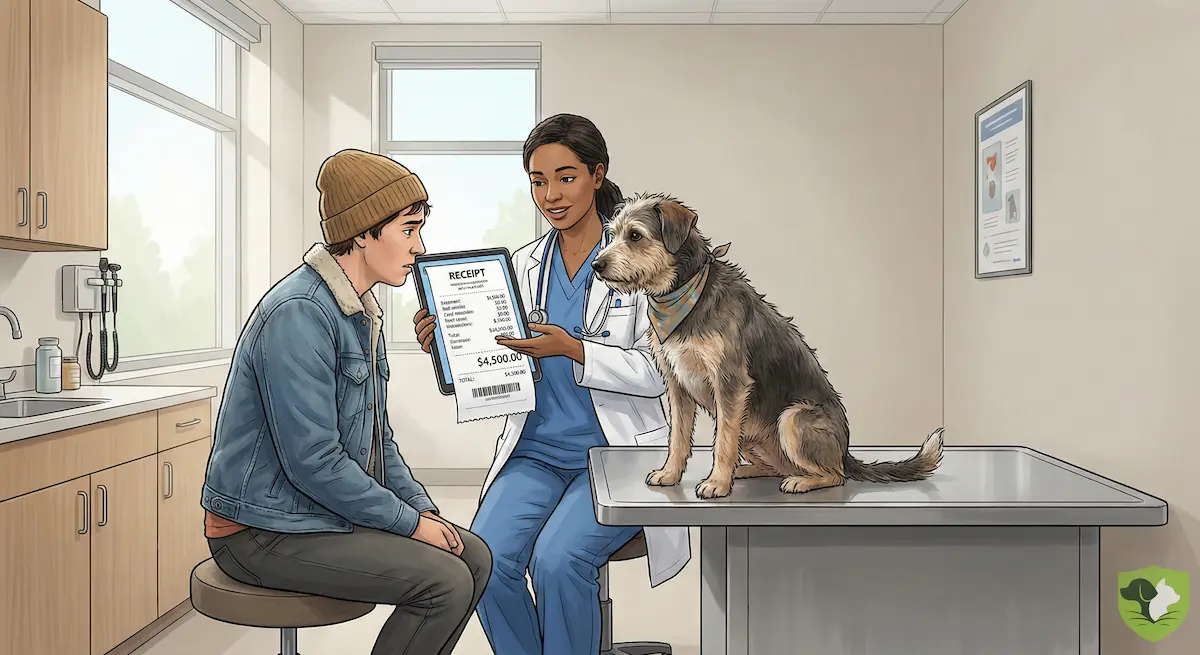
A massive veterinary bill doesn’t feel like a “pet expense.” It feels like an emergency you didn’t agree to. One minute, your dog is zooming around the living room. Next, you’re in a clinic being quoted a number that looks more like a used car than a medical treatment.
In that moment, you’re not just scared for your dog. You’re scared of your bank balance, too. That’s the brutal truth most dog parents discover the hard way: love doesn’t protect you from invoices.
Modern vet care can do incredible things, but it’s built on scans, specialists, and surgeries that add up fast. Veterinary prices have also kept rising: BLS CPI data for May 2026 show veterinarian services rose 4.9% year over year, compared with 4.2% for all items. If you don’t have a plan, you can be forced into ugly choices—delay treatment, cut corners, or take on debt and hope nothing else goes wrong this year.
Pet health insurance for dogs is simply a way to stop money from having the loudest voice in that room. You pay a predictable monthly amount so that when something big happens, you’re not starting from zero.
This guide will walk you through how coverage works, what it really costs, and how to choose a plan that lets you say “yes” to care when your dog needs you most.
Table of Contents
- Dog Insurance Basics: What Is It, Really?
- How Dog Insurance Works From Sign-Up to Payout
- Coverage in Real Life, Not Legalese
- Dog Insurance Cost – From Ballpark Numbers to Exact Quotes
- Is Dog Insurance Worth It? A Simple Decision Framework
- How to Choose the Best Dog Insurance (Including for Puppies)
- Side-by-Side Example: Same Dog, Three Policies
- Dog Insurance by Life Stage
- Why Breed Matters So Much in Dog Health Insurance
- Expert Insights: What the Data Says in 2026
- Wrapping It All Up: Peace of Mind for You and Your Dog
- Frequently Asked Questions (FAQs)
Dog Insurance Basics: What Is It, Really?
Pet insurance for dogs is a simple idea: you pay a monthly fee so part of your vet bills is paid back when your dog gets sick or hurt. It’s not a savings account, and it’s not a discount card. The NAIC describes pet insurance as coverage with exclusions, deductibles, payment limits, and reimbursement methods, so the policy language matters.
Here’s how it usually works. Many pet insurance plans let you use any licensed vet, emergency clinic, or specialist, but always check the policy. The NAIC’s Regulator’s Guide says most pet insurance plans use a reimbursement model: you pay the invoice, submit a claim through an app or website, and the insurer sends money back after reviewing the visit against the policy rules.
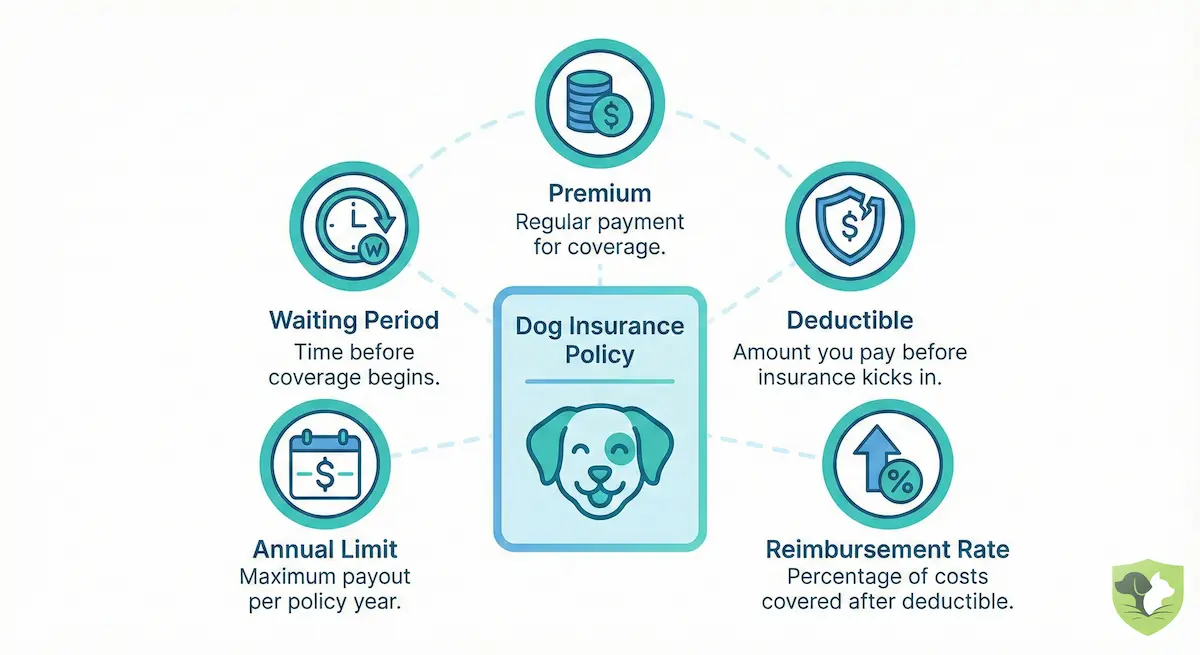
A few key terms you’ll see everywhere:
- Premium: What you pay each month to keep coverage active.
- Deductible: The amount assigned to you under the policy; the form controls whether it is applied before or after the reimbursement percentage.
- Reimbursement rate: The percentage of the covered bill the insurer pays back.
- Annual limit: The maximum the policy will pay in a year.
- Waiting period: Time after you buy before new problems are covered.
- Pre-existing condition: Under the NAIC Pet Insurance Model Act, this can include a condition where a veterinarian gave advice, the pet received treatment, or verifiable signs or symptoms existed before the policy effective date or during a waiting period.
Understand these ideas, and most policy fine print already starts to make sense.
How Dog Insurance Works From Sign-Up to Payout
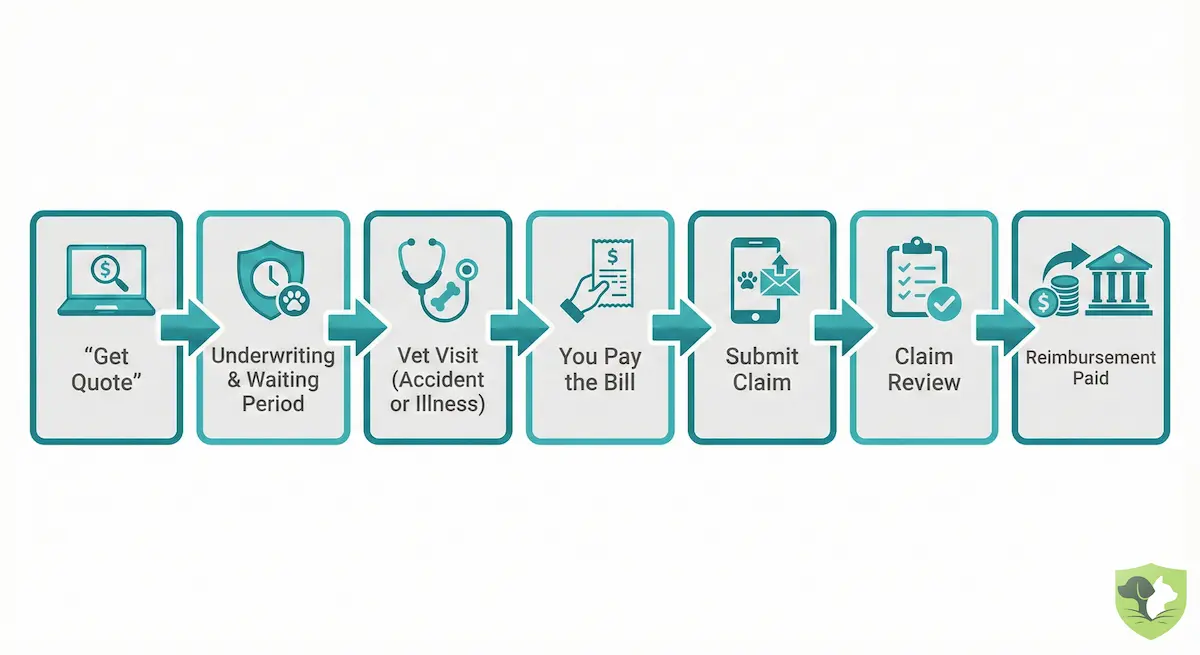
If you wanted to sketch the process, it's really just: Enroll → Vet visit → Pay bill → Submit claim → Insurer reviews → Reimbursement hits your account.
1. Before Your Dog Ever Gets Sick or Hurt
The journey starts before anything is wrong. You go online, plug in your dog’s age, breed, weight, and your ZIP code, and answer a few health questions. In my opinion, this is the most important moment, because what you say here shapes everything that happens later.
The insurer uses that info to “underwrite” your policy. In plain language, they look at your dog’s risk profile and decide what they’ll cover, how much it will cost, and what counts as a pre-existing condition.
Anything your dog has already shown signs of – even if it’s not fully diagnosed – can be listed as pre-existing and excluded going forward. That’s why I think insuring dogs earlier, before problems pile up in the medical record, usually works out better. The NAIC Model Act ties pre-existing conditions to prior advice, treatment, or verifiable signs and symptoms, which is why clean medical records matter.
Once you buy the policy, a waiting period kicks in. During this time, new issues generally aren’t covered yet. It can feel annoying, but it’s there to stop people from buying insurance on the way to the ER.
2. When Something Happens (Accident or Illness)
Fast-forward. Your dog eats a sock, tears a ligament, or wakes up with scary symptoms. You choose a licensed vet, emergency clinic, or specialist allowed by your policy, go in, and approve the tests and treatment your dog needs. At checkout, you usually pay the full bill yourself. That “pay first, claim later” setup is how most pet insurance for dogs works, though some insurers offer pre-approval or direct-pay options for eligible claims in participating clinics.
3. Filing a Claim
After the visit, you submit a claim through an app or website. You upload the itemized invoice, any medical notes the clinic provides, and answer a few basic questions. The insurer may request medical records, especially for a first claim or a claim that could involve a pre-existing condition.
4. Getting Reimbursed
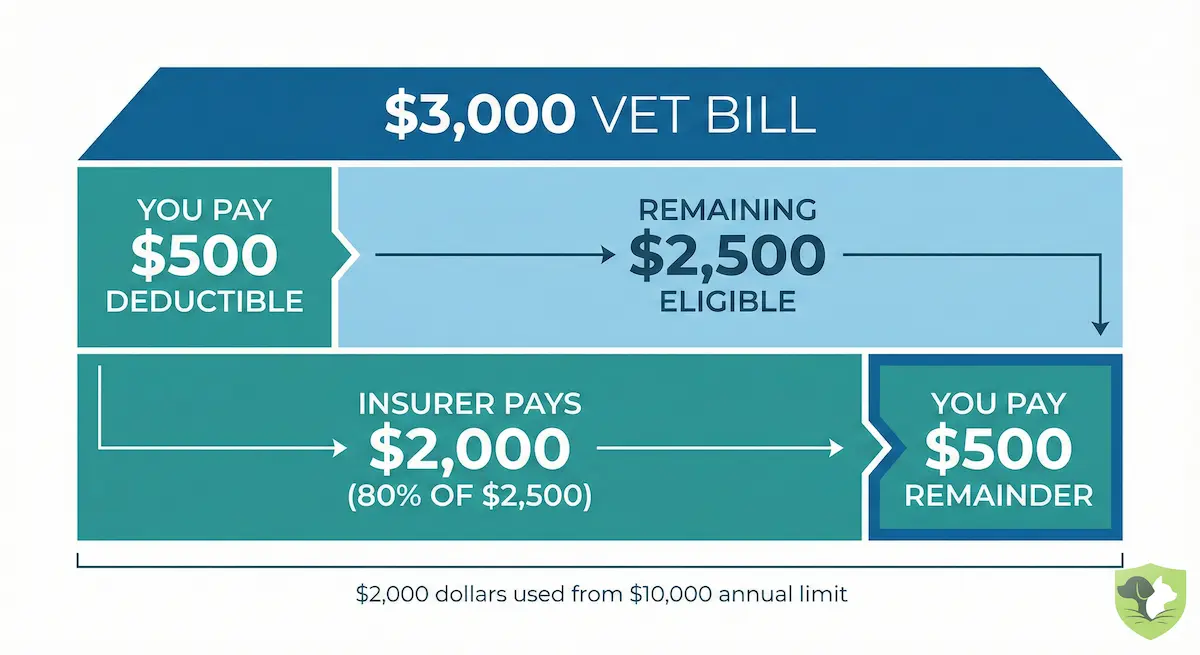
Once the insurer reviews your claim, they do the math based on your policy. Let’s say you had a $3,000 surgery, a $500 annual deductible, 80% reimbursement, and a $10,000 annual limit.
- First, you cover your $500 deductible.
- That leaves $2,500 of eligible costs.
- At 80% reimbursement, the insurer pays $2,000.
You've paid $1,000 total ($500 deductible + $500 remaining bill), and your policy has used up $2,000 of its yearly limit. This example assumes the whole bill is eligible, the deductible is applied before reimbursement, and the policy does not apply a benefit schedule or usual-and-customary fee cap.
Coverage in Real Life, Not Legalese
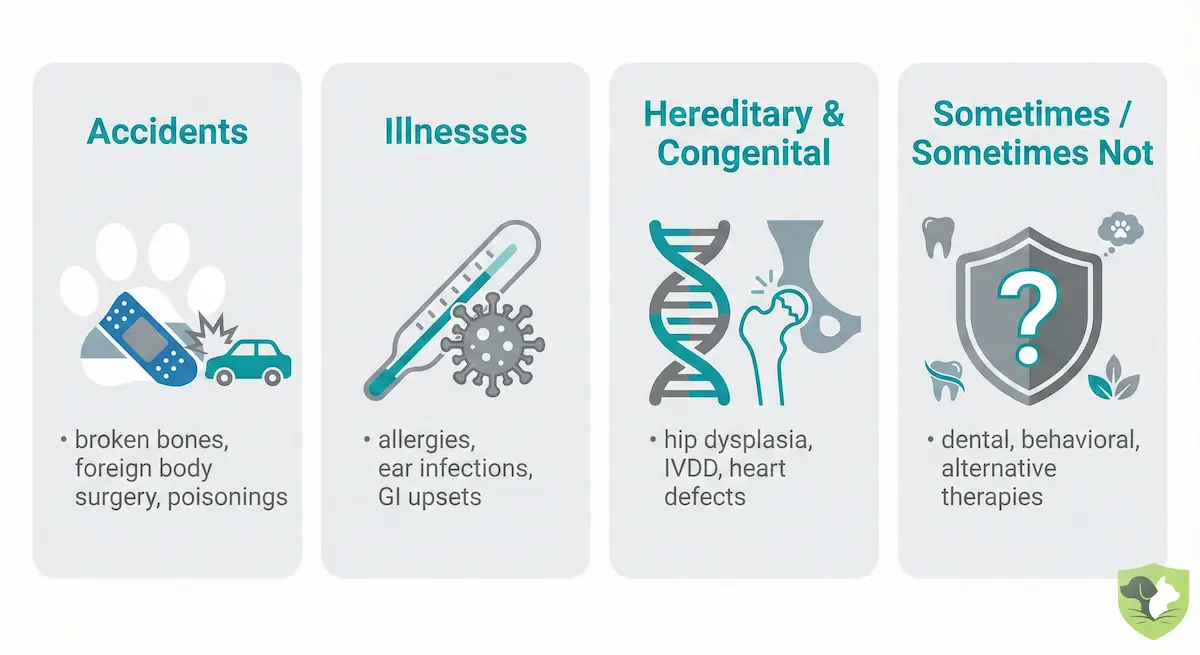
When you strip away the policy-speak, most coverage is built around a few big buckets: accidents, illnesses, inherited problems, and then a grey zone of “it depends.” The NAIC groups pet insurance products into accident-only, accident-and-illness, and wellness coverage; what each plan actually pays depends on its exclusions, deductible, reimbursement method, and limits.
Accidents
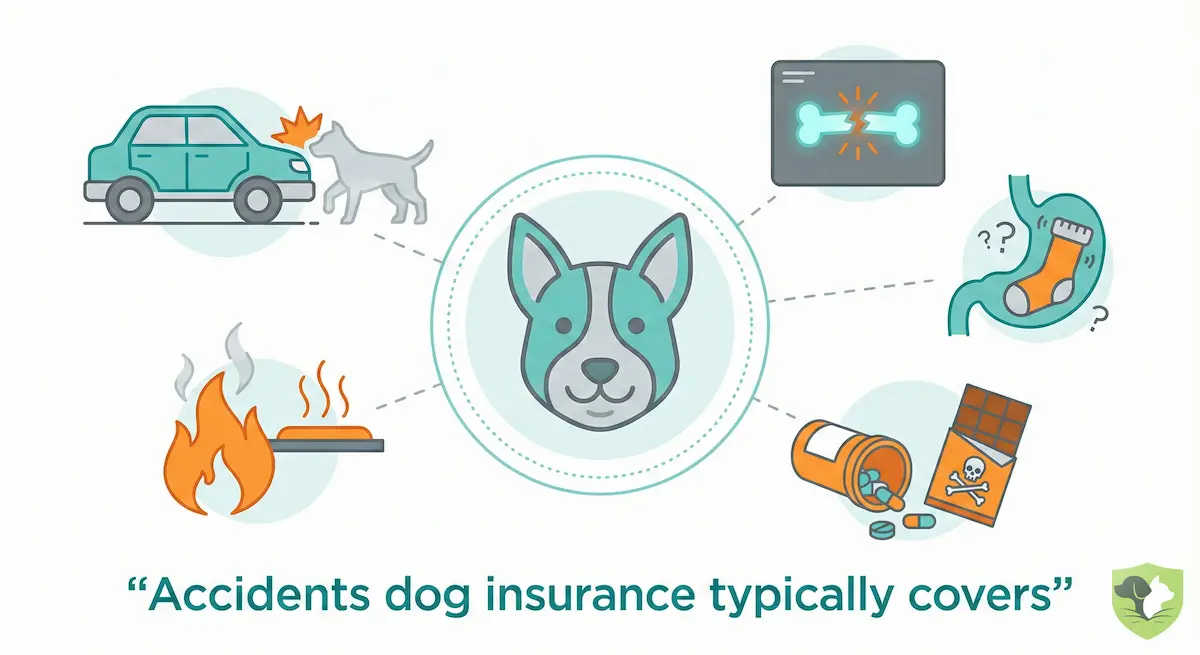
If your dog is hit by a car, breaks a leg on the stairs, swallows a toy, or licks up something toxic, accident coverage is usually the bucket that matters. Eligible care may include imaging, surgery, medications, hospitalization, and follow-up care, but exam fees can be covered, excluded, or sold as an add-on depending on the insurer. For the surgery side specifically (coverage, what a real claim pays, and the bilateral-exclusion catch), see does pet insurance cover surgery.
Illnesses
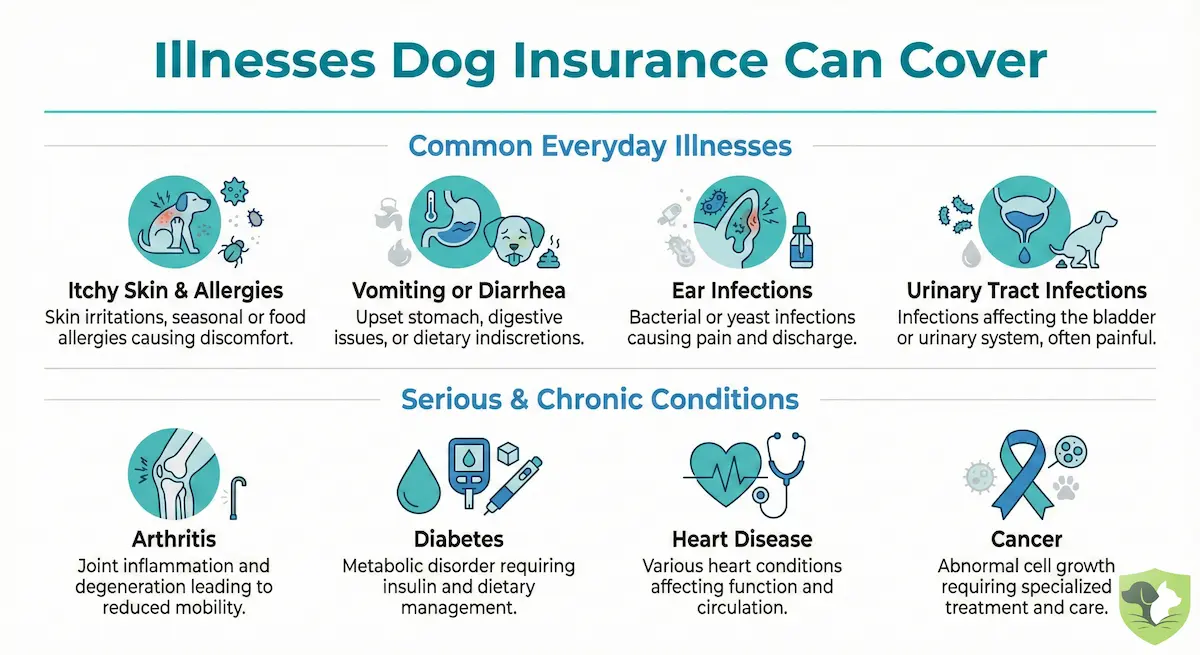
Most real-world dog bills are not dramatic movie-scene emergencies. Nationwide’s 2024 claims analysis found allergic skin disease, gastroenteritis, ear infections, arthritis, and trauma among the most common health problems prompting dog vet visits. Bigger diagnoses like diabetes, heart disease, and cancer can also be covered when they are new, eligible conditions under the policy.
In my opinion, this is where a good plan quietly earns its keep, because these conditions can come back year after year.
Hereditary and Congenital Issues
Things like hip dysplasia, IVDD (spine problems), certain heart defects, or breed-linked cancers are often treatable but expensive. Many modern plans will cover hereditary or congenital conditions if your dog had no signs or diagnosis before the policy started, and any waiting period has passed. Others limit or exclude them, especially for high-risk breeds, so the fine print here really matters.
Sometimes Covered, Sometimes Not
Dental is a perfect example. Dental accidents are commonly covered, dental illness varies widely by policy, and routine cleanings are usually handled through a separate wellness option rather than core accident-and-illness insurance.
Behavioral issues and alternative therapies, such as acupuncture, hydrotherapy, or laser therapy, may be fully covered, partly covered, require an add-on, or be excluded depending on the insurer.
Common Exclusions
The NAIC Regulator’s Guide lists common exclusions such as preventive care, wellness care, vaccinations, flea prevention, spaying or castration, and dental care. In practice, most policies will not pay for:
- Pre-existing conditions
- Elective or cosmetic procedures
- Breeding, pregnancy, or whelping
- Boarding, grooming, routine food, vitamins, and many supplements unless specifically prescribed and allowed
| Usually Covered | Sometimes Covered | Usually Not Covered |
|---|---|---|
| New accidents, such as broken bones or swallowed objects | Dental illness, exam fees, rehab, and behavioral care | Pre-existing conditions and elective procedures |
| New illnesses, such as allergies, ear infections, or cancer | Hereditary conditions, if no signs existed before enrollment | Routine care unless a wellness add-on applies |
Dog Insurance Cost – From Ballpark Numbers to Exact Quotes
Let’s talk money. When people ask, “How much does dog insurance cost?” the honest answer is: it depends, but there are solid ballparks rooted in the average cost of pet insurance.
The best current public benchmark is NAPHIA’s 2026 State of the Industry data: the average U.S. accident-and-illness premium for dogs was $836 per year, or about $69.67 per month, in 2025. NAPHIA’s report highlights put the average accident-only dog premium at $190 per year, or about $15.83 per month. Richer “everything covered” policies for certain breeds, older dogs, or high-cost ZIP codes can easily push past $100 a month.
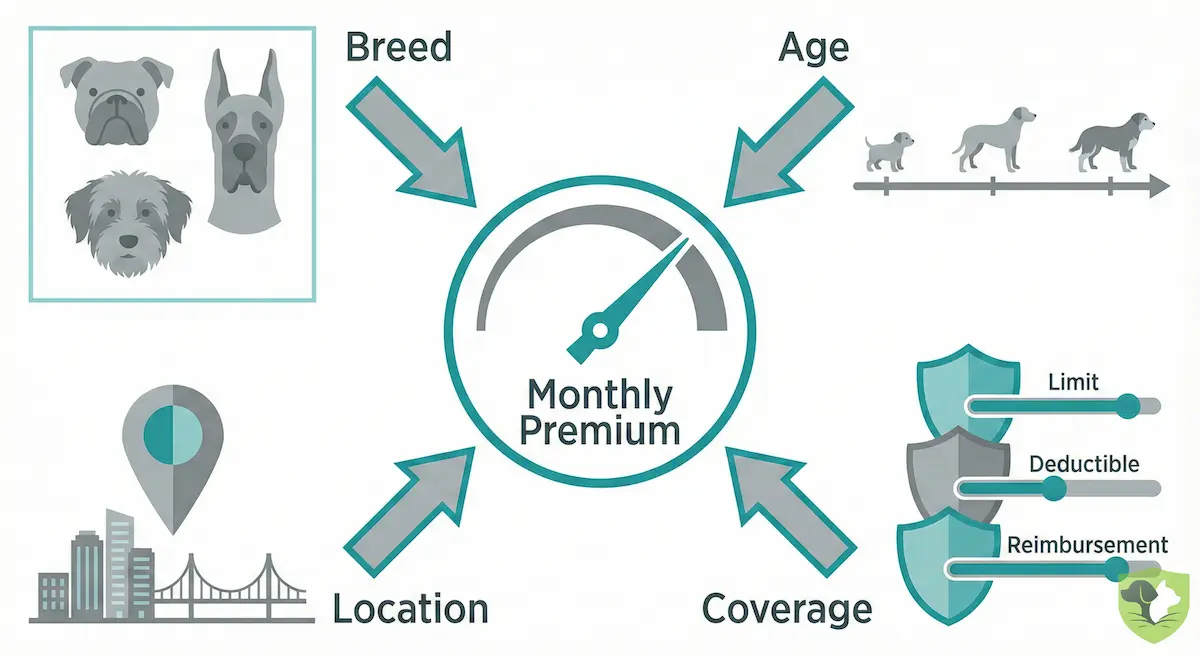
Why the spread? Insurers price pet insurance for dogs based on risk:
- Breed: High-risk breeds, including some large, very active, or flat-faced dogs, can cost more than lower-risk mixed breeds.
- Age: Puppies are usually cheaper; premiums often rise as your dog gets older.
- Location: Big-city vet clinics with higher fees can push premiums up.
- Coverage: Higher annual limits, lower deductibles, and higher reimbursement rates all raise the price.
There’s also the inflation problem. In May 2026, BLS CPI data showed veterinarian services up 4.9% year over year, compared with the 4.2% all-items rate. Over a longer period, AAHA reported that the average U.S. vet bill had risen more than 60% over the prior decade. In the UK, the Competition and Markets Authority’s 2025 provisional findings said average vet prices had risen more than 60% since 2016.
Surgeries that used to be a few thousand dollars can now run much higher, especially for orthopedic repairs. Lemonade’s TPLO surgery cost guide says dog knee surgery can reach $10,000. Premiums have followed that curve because those are the kinds of claims insurers are paying.
To make this more concrete, here are three rough scenarios for a mid-cost U.S. city:
- 2-year-old mixed-breed, $5,000 annual limit, 80% reimbursement, $250 deductible: roughly $35–$45 per month.
- 4-year-old Golden Retriever on the same plan: often $60–$80 per month.
- 9-year-old newly insured senior dog: $90+ per month, with more exclusions or fewer plan options depending on the insurer.
Those examples are illustrative, not quotes. Your real premium commonly depends on age, breed, ZIP code, and the policy settings you choose. Medical records more often determine exclusions and claim eligibility than the standard premium, although rating rules can vary by insurer and state. The goal isn’t to find the absolute cheapest number, but to choose a cost that fits your budget and still meaningfully protects you from a big vet bill.
Is Dog Insurance Worth It? A Simple Decision Framework
“Is pet insurance really worth it?” is the question everyone asks, and annoyingly, the answer is “it depends.” But it doesn’t have to be a guess. You can walk through a few simple checks and get to a clear yes/no for your own dog.
First, look at your dog’s risk. Some dogs are walking claim machines: big breeds with joint issues, flat-faced dogs with breathing problems, or super-active “I ate another sock” types. Nationwide’s claims data shows common dog claims are often recurring, ordinary-sounding problems like allergic skin disease, stomach trouble, ear infections, arthritis, and trauma, while serious conditions like orthopedic surgery or cancer can jump into the thousands.
Second, look at your financial buffer. Could you comfortably handle a $1,000–$5,000 veterinary bill tomorrow without taking on debt or delaying care? Federal Reserve data shows 63% of U.S. adults could cover a $400 emergency expense using cash or its equivalent in 2025, which means a meaningful minority could not.
Third, be honest about your tolerance for worst-case scenarios. Could you live with saying no to a recommended surgery or advanced treatment because the cash just isn’t there? Gallup and PetSmart Charities found that 52% of U.S. pet owners skipped or declined veterinary care in the past year, and cost was the leading barrier among those who skipped or declined care. That is the pressure a good policy is meant to reduce.
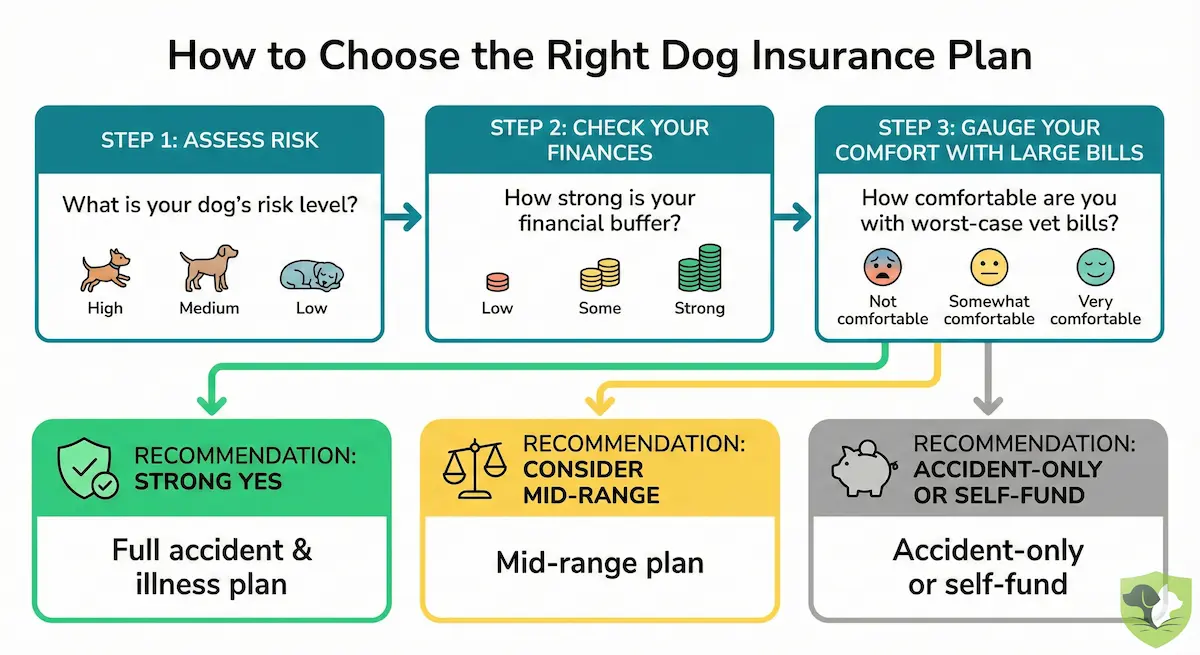
As a quick gut check:
- High-risk dog + low savings → coverage is usually a strong yes.
- Medium-risk dog + some savings → consider a higher deductible, mid-range plan.
- Low-risk dog + solid emergency fund → maybe a slim accident-only plan or self-funding is enough.
How to Choose the Best Dog Insurance (Including for Puppies)
Choosing the right policy isn’t about finding a magic brand. It’s about matching coverage to your dog and your bank account. Here’s a simple way to do it.
Step 1: Set your non-negotiables
Look for a dog health insurance plan that:
- Covers accidents and illnesses, not accidents only.
- Includes hereditary and chronic conditions, not just one year of treatment.
- Lets you use a licensed vet, emergency clinic, or specialist without a narrow network, if that matters to you.
- Has clear waiting periods, exclusions, and medical-record requirements you can actually understand.
Step 2: Adjust the dials
You control three levers that drive the monthly cost:
- Deductible: higher deductible, lower monthly premium (and vice versa).
- Reimbursement %: often 70%, 80%, or 90%; higher means you get more back but pay more each month.
- Annual limit: the most the policy will pay in a year; $5k is bare-bones, $10k+ is safer for big emergencies.
The NAIC Model Act requires disclosure if a pet insurer reduces coverage or increases premiums based on claim history, pet age, or geographic location, where the model has been adopted into state law. That makes renewal-pricing language worth reading before you buy, not after the first big rate increase.
Step 3: Ask these questions before you buy
- Are exam fees covered?
- How are bilateral issues (both knees, both eyes) handled?
- What exactly is covered for dental illness?
- How long do claims usually take to be paid?
- How much can premiums rise as my dog ages?
Use those answers to compare 3–4 pet insurance for dogs quotes side by side and circle the one that feels both affordable and genuinely protective. For a side-by-side look across insurers, see our roundup of the best pet insurance companies.
Side-by-Side Example: Same Dog, Three Policies
Let’s make this real. This is an illustrative example for the same dog: 3-year-old, 40 lb mixed-breed, spayed female, mid-cost city. Real premiums vary by insurer, ZIP code, breed, age, and plan design. Medical history more often affects exclusions and claim eligibility than the standard quoted rate, although insurer and state rules vary.
| Plan Type | Monthly Cost | Deductible | Reimbursement | Annual Limit |
|---|---|---|---|---|
| Budget | $35 | $750 | 70% | $5,000 |
| Balanced | $50 | $500 | 80% | $10,000 |
| Premium | $75 | $250 | 90% | $20,000 / Unlimited |
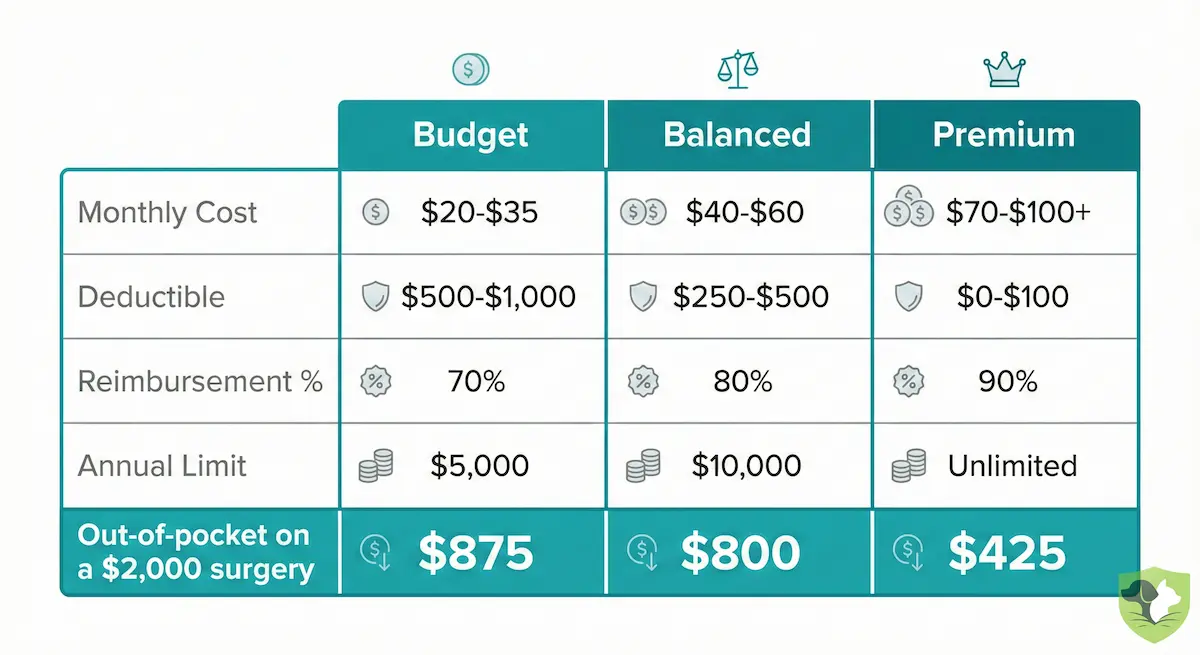
Now picture a $2,000 emergency surgery. Out-of-pocket on a $2,000 eligible bill:
| Plan Type | Bill | Deductible | Remaining | You Pay % | Insurer Pays | Your Cost |
|---|---|---|---|---|---|---|
| Budget | $2,000 | $750 | $1,250 | 30% ($375) | $875 | $1,125 |
| Balanced | $2,000 | $500 | $1,500 | 20% ($300) | $1,200 | $800 |
| Premium | $2,000 | $250 | $1,750 | 10% ($175) | $1,575 | $425 |
Same dog, same surgery, three very different totals. This is the number that really matters. The goal is to find the balance between the monthly premium and that final “Your Cost” number.
Dog Insurance by Life Stage
A good plan should age with your dog. What makes sense for a wild puppy isn’t always right for a grey-muzzled senior.
Best Dog Insurance for Puppies
With puppies, I think the big focus is accidents and early illnesses. They chew, swallow, fall, and bounce off everything. Starting coverage early means fewer “pre-existing condition” exclusions later, because most issues haven’t shown up yet. It also helps if something serious is picked up in that first year, like congenital heart problems or joint issues. The best dog insurance for a puppy is simply the plan you enroll in before any symptoms appear: illness waiting periods (often around 14 days) pass while your puppy is healthy, and starting young usually means a lower starting premium and fewer pre-existing-condition exclusions; it does not lock the renewal price.
Adult Dogs
For healthy adult dogs, the goal is balance. You’re protecting against surprise injuries and the first wave of chronic issues (allergies, joint pain, tummy troubles) without overpaying. This is often the sweet spot to establish a solid accident-and-illness plan, then fine-tune the deductible and annual limit so the premium fits your budget.
Senior Dogs
With seniors, the challenge is choice. Some insurers charge much higher premiums, add more exclusions, or stop accepting new enrollments above a certain age, while others advertise no upper age limit. Existing policies can be lifesavers here because ongoing eligible conditions are usually still covered as long as you keep the plan active. Dropping or switching late in life can mean losing protection right when your dog is most likely to need expensive care.
Why Breed Matters So Much in Dog Health Insurance
Whether we like it or not, insurers judge your dog by their risk profile. Some breeds are simply more expensive to treat, and that shows up directly in the premium.
Flat-faced breeds like French Bulldogs, Pugs, and Bulldogs often cost more to insure because they have known health risks. The AVMA notes that short-nosed dogs can be more prone to breathing difficulty and may also be more vulnerable to heat and stress. Many flat-faced breeds also have recurring skin, eye, and airway issues that can turn into repeat vet bills.
Big, deep-chested breeds – think Great Danes, German Shepherds, Rottweilers, and similar – have their own set of red flags. Merck Veterinary Manual notes that hip dysplasia mainly affects medium and large dog breeds. The American College of Veterinary Surgeons says cranial cruciate ligament disease is common in dogs and can affect one or both knees. And Cornell describes GDV/bloat as a life-threatening emergency seen especially in large, deep-chested breeds.
Mixed-breed dogs are often cheaper to insure because insurers may price them as having less breed-specific risk than some purebreds. They still get plenty of common claims, though: Nationwide’s claims analysis shows skin allergies, stomach trouble, and ear infections are common reasons dogs visit the vet, regardless of whether the dog has a pedigree.
| Breed Risk Pattern | Examples | Policy Detail to Check |
|---|---|---|
| Flat-faced / brachycephalic | French Bulldog, Pug, Bulldog | Airway, skin, eye, hereditary, and congenital-condition coverage |
| Large or deep-chested | Great Dane, German Shepherd, Rottweiler | Hip, elbow, cruciate, orthopedic waiting periods, and emergency surgery limits |
| High-energy / injury-prone | Sporting and working breeds | Accident coverage, rehab, exam fees, and annual limits |
Expert Insights: What the Data Says in 2026
When you zoom out from individual stories and look at the numbers, a few things jump out.
- Dogs are insured more often than cats, but most are still uninsured: NAPHIA reported U.S. pet insurance penetration of 5.46% for dogs at year-end 2024. That means coverage is growing, but it is still far from universal.
- Skin and allergy issues quietly dominate the charts: Nationwide’s 2024 analysis of more than 3.5 million pet health claims found allergic skin disease was the top condition prompting dog vet visits. It’s not glamorous, but it can be expensive because it often recurs.
- Common claims are not always rare disasters: The same Nationwide dataset put gastroenteritis, ear infections, arthritis, and trauma among the leading dog conditions. That matters because insurance is not only about one catastrophic surgery; it can also soften the steady drip of eligible repeat bills.
- Emergencies are where people panic: MetLife’s emergency vet cost guide lists common emergency services, including hospitalization, wound treatment, emergency surgery, and oxygen therapy, in ranges that can reach thousands of dollars. A simple exam fee is rarely the whole bill once diagnostics and treatment are added.
- The market is growing because costs are: Mordor Intelligence estimates the global pet insurance market at $17.59 billion in 2026 and projects it could reach $29.94 billion by 2031, driven in part by rising veterinary costs and more owners planning for large bills.
Put bluntly: the data shows that vet bills are rising and concentrated in a few repeat problem areas — exactly where a solid policy can earn its keep.
Wrapping It All Up: Peace of Mind for You and Your Dog
When you strip everything back, the policy is really about buying choices, not paperwork. It’s the choice to say “yes” to treatment without doing mental gymnastics in the waiting room.
It’s knowing that if your dog has a bad day, it doesn’t have to become the day your savings disappear. You don’t need a perfect policy. You just need one that fits your dog, your risk tolerance, and your budget.
Take ten minutes, compare a few plans, and pick a starting point. Future you — and the dog snoring on your couch — will be seriously grateful.
Frequently Asked Questions (FAQs)
What’s the best age to get dog insurance?
As early as practical. Insuring a puppy or young dog usually means fewer pre-existing-condition exclusions, broader coverage options, and lower starting premiums than waiting until health problems appear.
Can I get pet insurance for dogs after my dog is already sick?
You can buy a policy, but that specific illness and related issues will usually be excluded as pre-existing conditions. Under the NAIC Model Act, prior advice, treatment, or verifiable signs and symptoms can matter even before a formal diagnosis.
Does dog insurance cover dental work?
Dental accidents are commonly covered, but dental illness varies widely, and routine cleanings usually require a wellness option. Always check the dental section of the policy.
Can I use any vet?
Many dog health insurance plans let you use any licensed vet, emergency clinic, or specialist, but always check the policy. Most plans reimburse you after you pay the bill, though direct-pay options exist at some insurers and participating clinics.
What’s the difference between dog insurance and a wellness plan?
Accident-and-illness coverage handles big, unexpected costs such as accidents and illnesses. Wellness plans help with predictable routine care like vaccines and checkups; they are usually budgeting add-ons, not a replacement for medical coverage.
Can I change my deductible later?
Many insurers let you change your deductible or annual limit at renewal, but not mid-policy year. Changes can affect both coverage and price, and raising coverage later may trigger underwriting or new exclusions depending on the policy.
What is the best dog insurance for a puppy?
The best puppy policy is a comprehensive accident-and-illness plan you start before any health issues appear. Enrolling early keeps more conditions out of the pre-existing exclusion, clears the waiting periods while your puppy is still healthy, and locks in a lower starting premium. Compare accident-and-illness plans on coverage breadth and renewal pricing rather than the first premium alone.
WhiskerCover is a licensed insurance agency and is free to use. If you buy a policy through us, or click a link to one of our pet insurance partners and purchase, the insurer may pay us a commission at no extra cost to you. Learn more about how we make money.
Sources
- NAIC Pet Insurance Overview
- NAIC Pet Insurance Model Act
- NAIC Regulator’s Guide to Pet Insurance
- NAPHIA 2025 State of the Industry Report
- NAPHIA 2025 Report Highlights PDF
- Bureau of Labor Statistics CPI News Release, May 2026
- AAHA Insights on Pet Insurance in 2025
- UK Competition and Markets Authority Veterinary Services Market Investigation Provisional Findings
- Gallup / PetSmart Charities State of Pet Care Study
- Federal Reserve $400 Emergency Expense Data
- Nationwide Most Common Pet Health Problems Claims Analysis
- MetLife Emergency Vet Cost Guide
- Lemonade TPLO Surgery Cost Guide
- Merck Veterinary Manual: Hip Dysplasia in Dogs
- American College of Veterinary Surgeons: Cranial Cruciate Ligament Disease
- Cornell Richard P. Riney Canine Health Center: GDV / Bloat
- Mordor Intelligence Pet Insurance Market Forecast
- State of the Industry Report 2026 Highlights (2025 data) — NAPHIA
You may be interested...
More published guides that build on this topic.
 Dogs
Dogs
Best Pet Insurance for Golden Retrievers (2026): Costs, Cancer & Orthopedic Coverage
How much does pet insurance for a Golden Retriever cost? See how plans cover the breed's big risks — cancer, hip, ACL, and heart — plus a carrier shortlist.
 Dogs
Dogs
Beagle Pet Insurance: Costs, Coverage, and When It’s Worth It
Beagle insurance can look cheap early and expensive later. Real costs by life stage, the breed risks that matter, pre-existing traps, and when to self-insure.