

Yes — pet insurance covers surgery, including emergency operations, cancer surgery, and the big orthopedic repairs like a torn cruciate ligament. But "covered" comes with four conditions, and one of them decides most cases: a policy won't pay for the surgery your pet already needs if a symptom is already in the medical record.
That gap — between "can I buy a policy?" (almost always yes) and "will this policy cover this surgery?" (often no) — is where most pet owners get caught, and where most articles on this topic stay vague. We're going to be specific instead.
If you're reading this with an estimate in your hand, start with the timing question just below — the honest answer is in the first sentence. If your pet was just diagnosed, the pre-existing and appeal sections are written for you. And if you have a healthy dog or cat and you're planning ahead, you're in the best spot there is: this is the moment coverage actually works the way it's sold.
Either way, here's what this guide does that the carrier pages won't. We'll show you what "covered" really means, walk a real surgery bill through an actual reimbursement calculation, and decode the fine print that quietly kills surgical claims — pre-existing "signs," the second-knee trap, waiting periods, and benefit caps. Then we'll cover the part almost nobody explains: how you pay the vet before the reimbursement ever arrives.
This guide stays on surgery and the big medical bills. For the wider picture — what a policy covers day to day, which exclusions are standard, and where wellness add-ons fit — see our full guide to what pet insurance covers.
Table of Contents
- Yes, But "Covered" Has Four Conditions
- Is It Too Late to Insure a Surgery My Pet Already Needs?
- What a Real Surgery Claim Actually Pays: The Math
- Which Surgeries Are (and Aren't) Covered
- Pre-Existing Conditions and the "Signs Of" Trap
- The Second Knee: Bilateral Exclusions Explained
- Waiting Periods and the Timing Decision
- Cancer and Major Bills Across Renewals
- Does It Cover Emergency Surgery and Hospitalization?
- How You Actually Pay: Reimbursement Lag, Direct Pay & Financing
- When a Claim Is Denied: The Appeal Playbook
- Is Pet Insurance Worth It for Surgery?
- Check Your State: The Regulatory Floor
- Frequently Asked Questions
- Sources
Yes, But "Covered" Has Four Conditions
A surgical claim gets paid only when four things are true at once. Miss any one and the "yes" turns into a denial — or a much smaller check than you expected.
- The underlying problem is a covered accident or illness. A broken leg, a swallowed sock, a torn cruciate ligament, a tumor that grew after your policy started — all normally covered. Cosmetic and elective procedures, like a routine spay or an ear crop, are not.
- The first signs appeared after your coverage — and its waiting period — began. This is the condition that catches people. If the problem was already showing up in your pet's records, it's treated as pre-existing, no matter how clearly "medical" the surgery is.
- The specific line items are covered under your plan. The surgery, anesthesia, hospitalization, and follow-up care are standard; the exam fee that triggered the visit often isn't, depending on the carrier.
- You haven't used up your benefit. Most plans cap what they'll pay per policy year. A single big surgery — or a months-long cancer course — can reach that ceiling, and everything past it is on you until the year resets.
The plan type matters here, too. An accident-only policy covers surgery for injuries — the car, the fall, the swallowed object — but not for illness, which is where a lot of the priciest surgeries actually come from: cancer, chronic joint disease, organ problems. For surgical coverage that holds up across your pet's life, you almost always want an accident and illness plan.
Two things "covered" does not mean — and we'll come back to both. It does not mean the insurer pays your vet at checkout; with nearly every carrier you pay first and get reimbursed later. And it does not mean 100% of the bill; your reimbursement uses a selected percentage and deductible against eligible charges, with the issued form controlling which is applied first. Those facts are where the real number lives.
Is It Too Late to Insure a Surgery My Pet Already Needs?
For the surgery your pet needs right now, the honest answer is almost always no — a new policy won't cover it. You can still buy a policy today (that part is nearly always yes), but it won't pay for a condition your pet already has.
Here's why, and it's the single most important thing to understand about this whole topic. Insurers don't decide "pre-existing" by whether you already have a diagnosis. They decide it by whether a sign or symptom was already in your pet's record before the policy — and its waiting period — began. A limp your vet noted three months ago. A lump they told you to "keep an eye on." A single line that says "recheck." Any of those can make the related surgery pre-existing, even though no one has said the word "surgery" yet.
This is exactly where owners get caught. In pet-insurance forums the same scenario plays out constantly: the vet quotes a surgery for next week, a friend says "sign up for coverage now," the policy gets bought — and the claim comes back denied as pre-existing. Buying in a hurry doesn't beat the record. The record is what the insurer reads.
So if you're holding an estimate today, be clear-eyed: coverage almost certainly won't rescue this bill. For that, skip ahead to how you actually pay — direct-pay options and financing are the realistic levers now. But this is not a dead end. Insurance still protects the unrelated risks that haven't happened yet — a new illness next year, a future accident, and the healthy dog or cat at home who's still fully insurable. (The one thing it usually won't rescue is the matching side of the same problem: if one knee, hip, or eye already has a history, the other is often excluded too — more on that below.) The move is to cover the next risk, not to chase the one already in the chart. And whatever you decide, get the care your pet needs now and keep every record — waiting to see the vet never protects your coverage, it only delays treatment.
What a Real Surgery Claim Actually Pays: The Math
Here's the number nobody shows you. An "80% plan" does not necessarily pay 80% of your surgery estimate. It applies the selected percentage and deductible to eligible charges — in the order stated by the form — and "eligible" can drop a line item or two along the way. On a real bill, the gap between what you expect back and what actually lands in your account is often four figures.
Policy forms commonly use one of two calculation orders. This first formula is a deductible-first illustration:
(your bill − excluded line items − your remaining deductible) × your reimbursement percentage = your check — up to whatever is left of your annual limit.
Let's run a torn cruciate ligament, the most common major knee surgery in dogs and one of the priciest; for the knee-specific waiting periods and bilateral rules, see our full guide to whether pet insurance covers TPLO surgery. A TPLO repair runs roughly $2,800 to $6,400, averaging about $3,525, according to CareCredit. Say your estimate lands at $5,000, on a common plan: 80% reimbursement, a $500 annual deductible you haven't touched yet, and a $5,000 annual limit.
- $5,000 — the estimate.
- − $65 exam fee. Some carriers don't cover the exam fee that triggered the visit. Eligible charges: $4,935.
- − $500 deductible, subtracted before anything is reimbursed. Now: $4,435.
- × 80% reimbursement — the insurer's share of what's left: $3,548.
Under this deductible-first illustration, you pay $1,452 of a $5,000 surgery and the insurer sends $3,548 — comfortably under the $5,000 annual cap. It is not 80% of the full invoice because the exam fee is ineligible and the remaining deductible is applied before reimbursement.
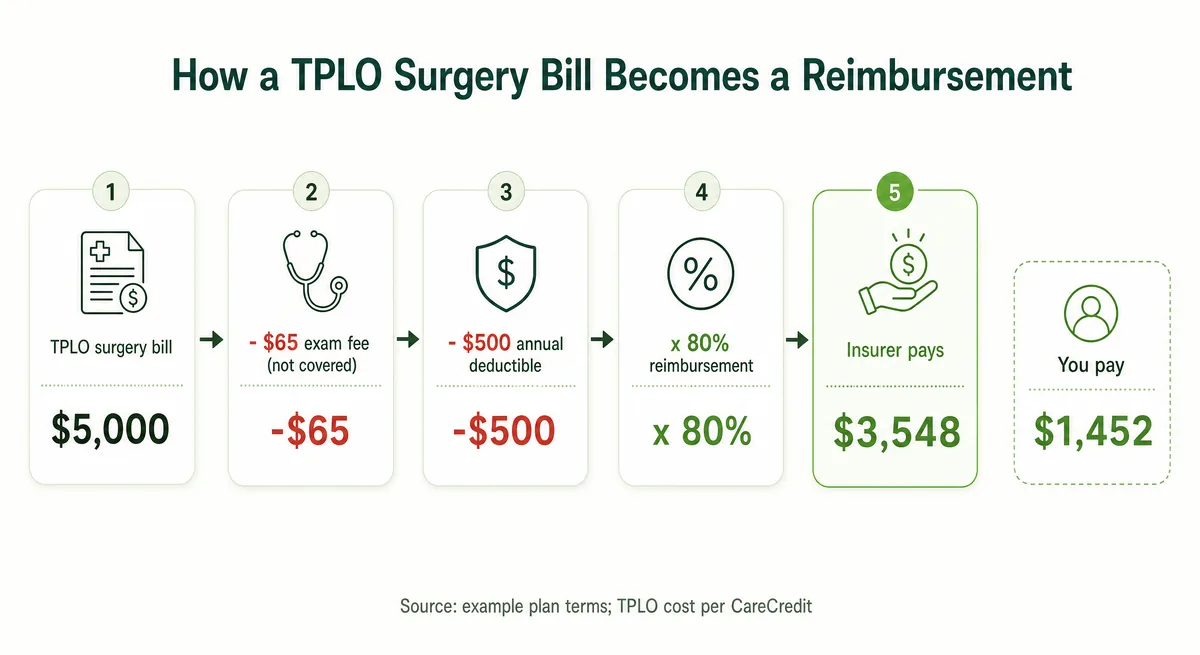
One detail worth confirming with your carrier: the order of that math. Some forms subtract the deductible first and then apply the percentage — the calculation above. Others apply the percentage to eligible charges and then subtract the full deductible. In this example, that percentage-first order would pay ($4,935 × 80%) − $500 = $3,448, or $100 less. Same headline settings, different form calculation.
And that annual limit matters more than it looks here. A single $5,000 surgery fits under a $5,000 cap — but a cruciate repair followed by a complication, or a cancer course that runs for months, can blow through it, and everything past the cap is yours until the policy year resets.
Which Surgeries Are (and Aren't) Covered
On a comprehensive accident and illness plan, most medically necessary surgery is covered — and, importantly, so is everything around it. When a surgical claim pays, it typically includes the operation plus the supporting line items:
- Emergency and trauma surgery — a hit-by-car repair, a swallowed-object removal
- Mass and tumor removal
- Dental surgery tied to a covered accident or illness — though dental coverage varies sharply by plan
- Orthopedic repairs — fractures, and many cruciate and hip procedures (see the catch below)
- Anesthesia, imaging, hospitalization, and follow-up care
What's reliably not covered is narrower but predictable: elective and cosmetic procedures — a routine spay or neuter, an ear crop, a dewclaw removal that isn't medically necessary — and anything tied to a pre-existing condition. Spaying and neutering can sometimes be reimbursed, but only through a separate wellness or routine-care add-on, never the core surgical coverage that pays for the emergencies.
Here's the trap, and it comes straight from a carrier's own page. Nationwide's pet surgery page — from one of the largest and oldest U.S. pet insurers — lists its exclusions plainly: pre-existing conditions, elective procedures, cosmetic procedures, C-sections, and "cruciate repair." Read that last one twice. A cruciate (CCL) repair is the single most common major orthopedic surgery in dogs, and on this particular product it's excluded outright — optional cruciate coverage can be added on some Nationwide plans.
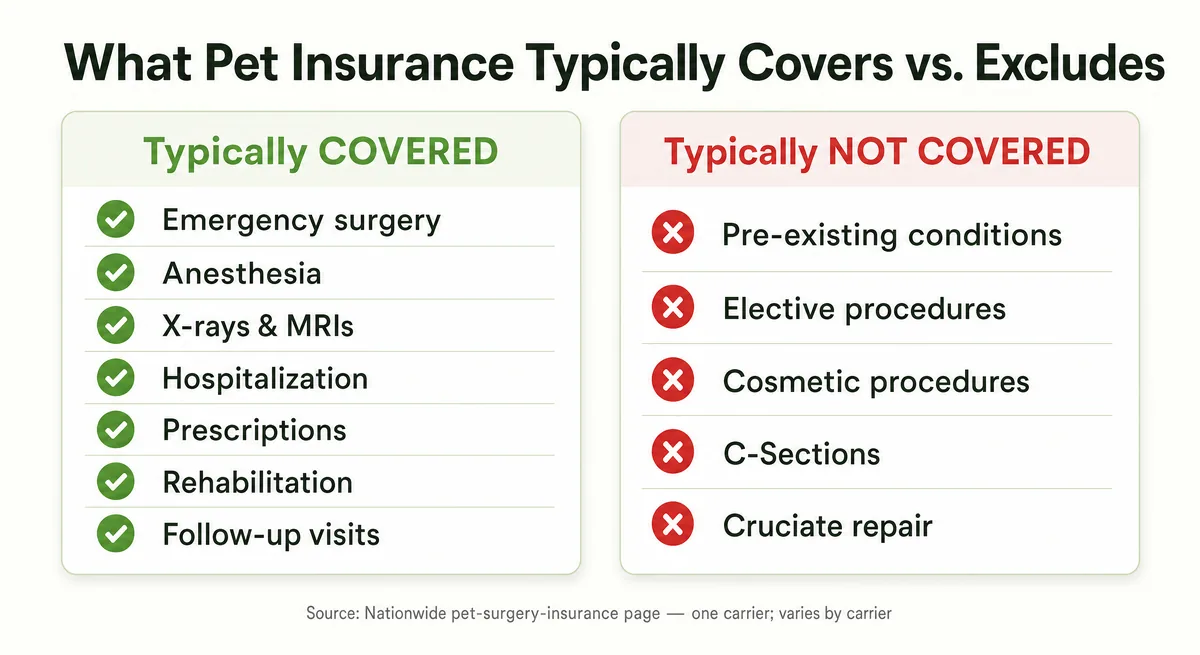
The lesson isn't "avoid Nationwide" — every carrier's exclusion list is different, and other insurers cover cruciate repair as standard. The lesson is that "covers surgery" and "covers your surgery" are two different promises. Before you buy — and especially if your breed is prone to a particular procedure — read the actual exclusions list for the specific plan, not the marketing headline. The surgery your dog or cat is most likely to need someday is exactly the one worth checking for by name in the policy document.
Pre-Existing Conditions and the "Signs Of" Trap
The word that decides more surgical claims than any other is "pre-existing" — and most owners misread it. A pre-existing condition is not "something your vet diagnosed before you bought the policy." It's something that showed signs before your coverage began, diagnosis or not.
Read one carrier's own definition: a pre-existing condition is one that "first occurred or showed clinical signs or symptoms (there doesn't need to be a diagnosis)" before coverage started. That parenthetical is the whole trap. A limp, a lump your vet told you to keep an eye on, a "recheck in two weeks" note — each is a sign, and each can make the surgery that follows pre-existing, even though no one has named a condition yet.
When you file your first claim, the insurer pulls your pet's records — often going back a year or more — and reads them for exactly these signals. That's why the record, not your intent or your memory, is what decides the claim.
There is a narrow exit for some problems. Many carriers treat a curable condition as no longer pre-existing once it stays symptom- and treatment-free for a set stretch — but the stretch varies: about 180 days at some carriers, a full 12 months at others. Chronic and orthopedic conditions — cruciate injuries included — usually don't qualify for that reset at all.
One myth worth correcting: you've probably read that you have to prove a condition wasn't pre-existing. In a growing number of states, that's backwards. Under the NAIC Pet Insurance Model Act, the insurer carries the burden of proving the exclusion applies. The NAIC's Summer 2026 state-action chart counts 17 model-adoption jurisdictions, but the applicable statute and effective date still control where you live — more on that below.
The Second Knee: Bilateral Exclusions Explained
This is the exclusion that hands owners their biggest surprise bill, and it has a name: bilateral. For conditions that can strike both sides of the body — cruciate ligaments, hips, cataracts, luxating patellas — if one side showed signs before your coverage began, the other side is usually excluded too, even though it hasn't happened yet.
Cruciate tears are the textbook case. The following wording comes from one Healthy Paws form generation; current waiting periods vary by state, so its 15-day clock is not a national rule. Read the clause in context: "If the cruciate ligament on one leg is injured prior to enrollment or during the 15-day waiting period, then the cruciate ligament on the other leg is excluded from coverage." One torn knee on the pre-eligibility record can put the second one — the leg most likely to go next — off the table under that clause; the issued form controls.
Here's why that stings. A dog that tears one cruciate is, in many vets' experience, likely to tear the other, and a single TPLO repair runs into the thousands. Owners in dog forums describe exactly this trap: a first surgery paid out of pocket, then a denial on the second knee, then an impossible choice between another few thousand dollars and their dog's mobility. It sits behind some of the hardest financial decisions owners ever face.
The wording varies by carrier, which is exactly why it pays to read it before you buy. Some, like MetLife, publish the full list of conditions they treat as bilateral — hip and elbow dysplasia, cruciate injuries, cataracts, luxating patella, glaucoma. Others exclude the second side "regardless of cause," meaning it doesn't matter how the second injury actually happened. And a few fold bilateral logic into their general pre-existing definition instead of spelling it out. The practical takeaway is the same across all of them: if your dog already has any history with one knee, hip, or eye, assume the matching side may not be covered — and confirm it in the policy document, not the brochure.
Waiting Periods and the Timing Decision
A waiting period is a period after a policy becomes effective during which a particular type of claim is not yet eligible. Do not confuse it with a delayed policy effective date. For surgery, the orthopedic clock matters most — and there is no single national number. Depending on the carrier, issuing insurer, state, and form edition, orthopedic conditions may ride the ordinary accident/illness clock or have a separate wait of 30 days, six months, or as long as a year for a named condition.
The brand name alone does not settle the answer. MetLife's current Metropolitan General materials say there is no separate orthopedic wait, while an archived IAIC form imposed a six-month dogs-only orthopedic wait. If the declarations name IAIC, obtain the current state form rather than assuming the Metropolitan General marketing applies. The audited 2023 Figo IAIC sample uses a six-month dogs-only orthopedic wait that can be waived with a form submitted within 30 days; newer state editions can use a 30-day clock. Pets Best sample forms use six months for cruciate events, but any waiver depends on the state, policy form, uninterrupted prior coverage, or an eligible enrollment channel — it is not a universal post-purchase exam waiver. Embrace commonly uses a six-month dogs-only orthopedic wait that can be reduced through its exam process, subject to state terms. Read the declarations and issued form, not a national comparison cell.
An exam-based waiver also has a trade. Anything the veterinarian documents can affect the pre-existing-condition review. If your pet's joints are sound, meeting the exact waiver deadline may be valuable; if there is a history, the exam can document the problem you hoped to insure. Obtain the carrier's form and written approval rather than assuming an ordinary wellness exam is enough.
Cancer and Major Bills Across Renewals
Yes — chemotherapy, radiation, and oncology medications are covered under a standard accident-and-illness policy at most carriers, as long as the cancer isn't pre-existing and the waiting period has passed. The hard part isn't whether cancer is covered; it's that treatment runs for months and collides with your policy's annual boundaries. A course of radiation runs roughly $2,500 to $7,000 at Cornell's teaching hospital, and chemotherapy protocols commonly span three to six months — long enough to straddle a renewal.
Two things reset when your policy year does. First, the payout cap: most plans limit what they pay per year, and unused room doesn't roll over. Hit a $5,000 annual limit mid-treatment and, as MetLife spells out, new expenses are excluded until the policy renews. Second, the deductible: Figo requires a fresh annual deductible for each policy period a treatment spans. The exception on both counts is Trupanion, whose filed policy sets no payout cap and charges its deductible once per condition for the life of your pet rather than every year.
The reassuring part: a cancer diagnosed while your pet is insured stays covered when you renew — Embrace, for one, continues coverage at renewal and won't reclassify an ongoing condition as newly pre-existing. In the states that have adopted the NAIC model act, that renewal protection is written into law (more on that below).
But there's a trap worth knowing before you touch your policy mid-treatment. If you discover your annual cap is too small, raising it is not a simple upgrade. Under Pets Best's policy, increasing your annual limit requires canceling your current policy and issuing a new one with new waiting periods — so a condition already showing signs, like a cancer under treatment, would be treated as pre-existing on the new policy. You cannot simply buy more headroom in the middle of chemo.
None of this is a reason to hesitate on care. What decides coverage is what's already in your pet's records, not the calendar — so never delay the workup to protect a policy. Get the diagnosis and the treatment your vet recommends, then work the coverage around it.
Does It Cover Emergency Surgery and Hospitalization?
Yes. An accident-and-illness policy covers emergency surgery and the hospital stay around it — diagnostics, anesthesia, the procedure itself, and overnight care — as long as the underlying problem isn't pre-existing and your waiting period has already passed. (The ER exam or consultation fee is the common exception — many base plans don't cover it without an add-on.) A dog that swallows a sock on a Tuesday is exactly what this coverage is for.
The catch is that "emergency" doesn't suspend the usual rules. The same pre-existing and waiting-period tests apply to a 2 a.m. crisis as to a scheduled procedure, so a condition your pet was already showing signs of before enrollment can still be denied — even in the ER.
When it is covered, the bills are real. Removing a swallowed foreign object runs anywhere from $1,600 to over $12,000 in Embrace's own claims data, and emergency bloat (GDV) surgery typically runs $3,000 to $6,000 (our large-dog guide covers whether pet insurance covers bloat and gastropexy).
Here's the part that catches owners off guard: most ER hospitals demand a large deposit at admission — before your insurer pays a cent. With a reimbursement policy, you front that money and wait. That cash-flow gap bites hardest in an emergency, which is why it's worth understanding how you'll actually pay the bill before you're standing at the counter.
How You Actually Pay: Reimbursement Lag, Direct Pay & Financing
Here's the reality no quote page mentions: with almost every carrier, you pay the vet in full first and get reimbursed days to weeks later. On a $5,000 surgery, that means finding $5,000 today and waiting for the check — a wait owners routinely describe as the most stressful part of a claim. Only a handful of carriers change that, and "direct pay" means very different things depending on who's offering it.
| How it works | Carrier | What it means at checkout |
|---|---|---|
| True point-of-sale direct pay | Trupanion (VetDirect Pay) | Pays the hospital in real time at checkout — but only at clinics running its software ; participation is clinic-specific and changes over time). You pay the deductible, coinsurance, and excluded charges shown by the issued policy. |
| Fast pay-to-owner | Pumpkin (PumpkinNow) | Pays you in as little as 15 minutes for eligible care over $500, if your bank supports instant payments. |
| Case-by-case pay-to-vet | Healthy Paws | Its Direct Pay team obtains the estimate and documentation; after services, it can send the reimbursable amount to the vet. The clinic must cooperate and defer collection if this is to bridge checkout. |
| Post-adjudication routing | Pets Best (Vet Direct Pay) | Sends money to the vet only after the claim is processed — so it won't bridge checkout unless the vet defers billing. |
| Reimbursement (the default) | Most carriers | You pay in full, file a claim, and wait days to weeks for the money. |
Point-of-sale adjudication can remove the covered share of the checkout gap at a participating clinic. It does not remove your deductible, coinsurance, excluded charges, or the need to confirm clinic participation before treatment.
When you do need to bridge the gap, two financing rails dominate vet counters. CareCredit offers promotional periods with no interest if you clear the full balance in time — but miss the deadline and interest (around 33% APR) is charged retroactively to the original purchase date, which is how a manageable plan quietly becomes an expensive one. Scratchpay works differently: checking your rate is only a soft credit pull, terms run from 0% to 36% APR, and it pays the clinic directly.
The practical takeaway: before you ever need it, find out which system your carrier uses and whether your regular clinic accepts it. In a real emergency, "covered" and "paid at the counter" are two very different promises — and the gap between them is measured in the thousands of dollars you may have to front yourself.
When a Claim Is Denied: The Appeal Playbook
A denial isn't always the end of the road. Many surgical claims are refused for reasons you can challenge — and your insurer is obligated to tell you exactly which policy provision it relied on, in writing. That written reason is the starting point for every appeal.
Most surgery denials trace to one of five causes: the claim was classified as an illness when the owner believes it was an accident (or the reverse); the underlying condition was ruled pre-existing under "signs of" language; a bilateral exclusion applied to a second knee, hip, or eye; the waiting period hadn't fully passed; or the annual benefit cap was already exhausted. The through-line: it's the medical record, not your intent, that decides the claim.
That's exactly what makes the appeal winnable. The playbook that works runs in three steps:
- Get a letter from your vet. A dated note documenting the onset — or, for an accident reclassification, a witnessed trauma event — is the single strongest piece of evidence, because it speaks to the record the adjuster is reading.
- File a formal written appeal before the deadline. Carriers set a window; Pets Best's policy, for instance, lays out a three-level path — an internal appeal within 60 days, then external review by an independent veterinarian, then arbitration.
- Escalate to your state Department of Insurance. If the carrier won't budge, every state's insurance regulator accepts pet-insurance complaints and will ask the insurer to justify its decision.
One reason to read renewal terms before you commit: the coverage you hold today isn't guaranteed forever. In June 2024, Nationwide non-renewed roughly 100,000 pet policies, citing veterinary-cost inflation, and a 2025 federal class action alleges it sold "lifetime" coverage it then dropped. The takeaway isn't to avoid a single carrier — it's to read the renewal and cancellation terms as closely as the coverage ones.
Is Pet Insurance Worth It for Surgery?
Here's the straight answer: for the average pet in the average year, you'll likely pay more in premiums than you get back. That isn't a scam — it's how catastrophe insurance works. You're not buying a rebate; you're buying protection against the surgery you can't predict and can't easily absorb.
Run the math both ways. An accident-and-illness policy for a dog averages about $62 a month — roughly $745 a year. Pay that for three years and a single $4,500 knee repair, with 80–90% selected reimbursement after the policy applies its deductible and other terms, can exceed every premium you've paid. Go those same three years with only routine care, and you're out of pocket ahead. In a Consumer Reports member survey, only about a third said they'd come out ahead — the honest base rate for a product you hope never to use.
And the premium isn't fixed. Most carriers use attained-age pricing, so age contributes to renewal increases. Trupanion instead uses age at enrollment plus cohort, territory, and veterinary-cost factors; a birthday is not the direct trigger, but cohort rates can still rise sharply. California regulators approved an average 33% Trupanion increase in 2025, and thousands of Florida owners saw double-digit hikes. Budget for a cost that grows.
So it comes down to your situation. Insuring a young, healthy pet before any signs appear is where coverage works best — premiums are lowest and nothing's excluded yet. If you're disciplined enough to bank $60–$100 a month untouched and could write a five-figure check tomorrow, self-insuring can win. But for most owners who couldn't absorb a $6,000 bill on short notice, coverage — or at least a financing backstop — is the safer bet. The worst place to be is both uninsured and unfunded.
Check Your State: The Regulatory Floor
Where you live can decide whether a surgical claim is handled fairly, because the protections vary widely by state. The NAIC Pet Insurance Model Act sets a floor that a growing number of states have written into law — and its provisions land squarely on surgery.
In a state that has adopted it, the model act caps illness and orthopedic waiting periods at 30 days — and "orthopedic" is defined to include cruciate ligament rupture, IVDD, and hip, elbow, and patellar conditions, the exact surgeries covered above. It bans waiting periods for accidents, requires that any waiting period be waivable by a vet exam, and — most importantly — puts the burden on the insurer to prove a condition was pre-existing, reversing the usual default. It also locks in renewals: a condition covered one year can't be reclassified as pre-existing the next.
One caveat: this is a procedural floor, not a coverage mandate. Insurers can still exclude hereditary or congenital conditions if the issued policy permits it. Adoption is also uneven. The NAIC's Summer 2026 chart counts 17 model-adoption jurisdictions, using the NAIC Legal Division's own classification. California is one of them: SB 1217 added the current waiting-period and pre-existing-condition protections effective January 1, 2025. Other large states still have no model adoption, and enactment and effective dates can differ. Confirm the current statute with your state insurance department before relying on any protection.
Frequently Asked Questions
What happens if your pet needs surgery and you can't afford it?
You have more options than a lump sum out of pocket. Ask the clinic about payment plans or in-house financing first; then look at medical-credit lines like CareCredit or Scratchpay that many vets accept, nonprofit treatment grants, and university veterinary teaching hospitals, which often price major surgery below private specialty clinics. If the condition is already in your pet's records, insurance won't rescue this particular bill — but these bridges can keep care within reach.
What does pet insurance not pay for?
Common exclusions include pre-existing conditions, elective or cosmetic procedures, and — under some forms — the matching side of a bilateral condition. Exam fees may be included, sold as an add-on, or excluded; costs above the selected annual or incident limit remain yours. Surgery rules can also differ by product: Nationwide's scheduled-benefit and current modular forms should not be blended into one exclusion list. Read the issued form and benefit schedule rather than treating a brand-level page as universal.
Does pet insurance cover pancreatitis?
Pancreatitis may be eligible under an accident-and-illness plan when the first related signs occur after coverage and the applicable waiting period. A first eligible episode under continuous coverage does not become pre-existing merely because it recurs. But an episode or related signs such as vomiting documented before a new policy becomes eligible can cause later flare-ups to be excluded under that policy. The issued definition and medical record control.
Which pet insurance covers hip dysplasia?
Most accident-and-illness plans can cover hip dysplasia, but age, hereditary coverage, and orthopedic timing vary sharply. Healthy Paws uses state-specific hip-dysplasia timing: its current FAQ lists 12 months in most states and 30 days in 16 named jurisdictions, with exam-waiver rules there; the cited FAQ limits hip-dysplasia coverage to pets enrolled before age six. Mainstream new policies treat prior signs as pre-existing; AKC separately advertises a state- and form-dependent 365-day pathway for some eligible pre-existing conditions. Read the issued form.
If I buy a policy today, will this week's surgery be covered?
Almost certainly not. Most policies apply one or more waiting periods, while some use a zero-day accident clock or delay the policy's effective date instead. Either way, a surgery already diagnosed, symptomatic, or scheduled before the applicable coverage begins is pre-existing and will not be covered by a newly purchased mainstream policy. Buying now protects against future, unrelated problems — not the one already in the record.
Do I have to pay the vet upfront?
Usually. Trupanion can adjudicate at checkout at participating clinics. Healthy Paws can arrange documentation- and approval-dependent payment to a cooperating vet after services; Pets Best can route a processed claim payment to a vet that signs its release; PumpkinNow is fast payment to the owner, not direct-to-vet payment. Confirm the exact mechanism with both carrier and clinic before treatment.
Is a pre-approved estimate a guarantee the claim will be paid?
No. A pre-authorization or pre-approved estimate is an indication, not a binding coverage decision — carriers make the final call when you file the claim and see the full records. Healthy Paws, for instance, notes that prior approval "is not a coverage determination." Get any pre-approval in writing, but treat it as a strong signal rather than a promise, and keep your documentation in case you need to appeal.
Does pet insurance cover cancer treatment like chemo and radiation?
Yes. Chemotherapy, radiation, and oncology medications are covered under standard accident-and-illness plans at most carriers, provided the cancer wasn't pre-existing and the waiting period has passed. The harder problem is money over time: because treatment often runs three to six months, it can straddle a policy renewal, resetting your deductible and testing your annual cap. Some carriers confirm coverage continues at renewal, so a cancer diagnosed while insured stays covered.
Sources
- How Much Does Dog ACL/Cruciate (TPLO) Surgery Cost? — CareCredit
- Pet Insurance Coverage and Exclusions — Healthy Paws
- Does Pet Insurance Cover Surgery? — NerdWallet
- Pet Surgery Insurance — Nationwide
- Pet Insurance and Pre-Existing Conditions — ASPCA Pet Health Insurance
- Pre-Existing Conditions — Embrace
- Pet Insurance Model Act (MDL-633) — NAIC
- Bilateral Conditions and Pet Insurance — MetLife Pet Insurance
- Does Pet Insurance Have a Waiting Period? — MetLife Pet Insurance
- Metropolitan General Pet Policy Sample (PET21-01-V) — MetLife Pet Insurance
- IAIC Pet Policy Sample (archived form IAIC PFI POL 1217) — MetLife Pet Insurance
- Figo Dog Policy Sample (IAIC FPI POL 0320) — Figo Pet Insurance
- Surgery Coverage — Pets Best
- What Is the Waiting Period for Orthopedic Conditions? — Embrace Pet Insurance
- Cancer Management: Frequently Asked Questions — Cornell University College of Veterinary Medicine
- Does Pet Insurance Cover Cancer Treatment? — MetLife Pet Insurance
- Cancer Coverage for Pets — Embrace Pet Insurance
- Trupanion Policy (Maine filed form, Exhibit A-1) — Maine Bureau of Insurance
- Pets Best Policy Booklet (Annual Illness, sample) — Pets Best
- Cost of Surgery to Remove a Swallowed Foreign Object — Embrace Pet Insurance
- Dog Bloat Surgery: Cost and What to Expect — Great Pet Care
- Trupanion Form 10-K (FY2025) — VetDirect Pay — U.S. Securities and Exchange Commission
- PumpkinNow Urgent Pay — Pumpkin Pet Insurance
- Pet Insurance Claims — Healthy Paws Pet Insurance
- Vet Direct Pay — Pets Best
- Deferred Interest vs. APR — CareCredit
- How It Works — Scratchpay
- Nationwide to Drop About 100,000 Pet Insurance Policies — CBS News
- Silberman et al. v. Nationwide Mutual Insurance Company — Class Action Complaint — U.S. District Court (D. Mass.), via ClassAction.org
- State of the Industry 2025 Report Highlights — NAPHIA
- Is Pet Insurance Worth It? — Consumer Reports
- Trupanion California Rate Hike Approved — Insurify
- Nearly 50K Florida Pet Parents Face Double-Digit Premium Hikes — InsuranceNewsNet
- SB 1217 — Pet Insurance — California Legislature
- Pet Insurance Model Act (#633) — State Adoption Page — National Association of Insurance Commissioners (NAIC)
- Pricing Promise — Trupanion
- State of the Industry Report 2026 Highlights (2025 data) — NAPHIA
You may be interested...
More published guides that build on this topic.
 Conditions
Why Is My Dog Lethargic? Causes, Red Flags & When to See a Vet (2026)
Worried your dog is lethargic? The red flags that mean ER now, what's normal after vaccines or boarding, what the vet will do, and what it may cost.
 Conditions
Dog ACL Surgery: Costs, Recovery & Whether Insurance Will Pay
What dog ACL/TPLO surgery really costs in 2026, how recovery works, and when pet insurance does (and doesn't) pay — including the second-knee trap.
 Conditions
My Dog Ate Chocolate: Symptoms, Vet Costs, and What to Do Next (2026)
Plain-English triage if your dog ate chocolate: symptoms by hour, dose by weight and product, real 2026 ER costs, and what pet insurance covers (and doesn't).
 Conditions
Cat Kidney Failure: Symptoms, Stages, and Real Vet Costs (2026 Guide)
Plain-English guide to cat kidney failure: IRIS stages, real US vet costs, what treatment looks like at home, and what insurance does (and doesn't) cover.