

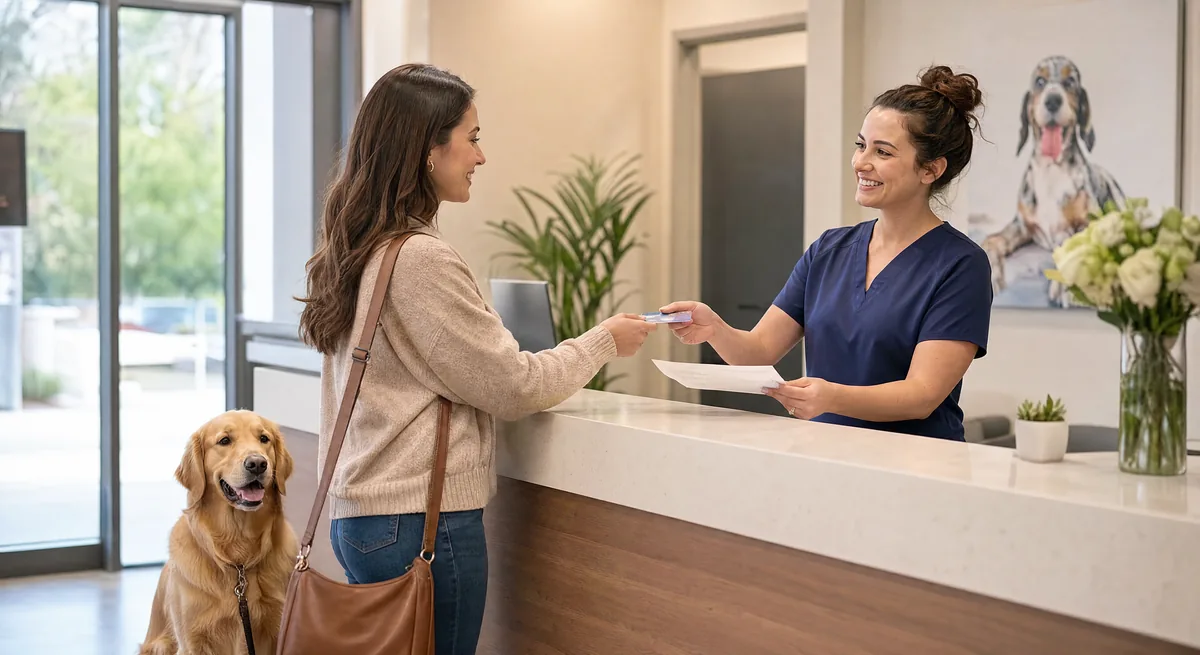
Here's how pet insurance usually works: you pay the vet, file a claim, and the insurer identifies eligible charges, applies the reimbursement percentage and remaining deductible in the order stated by the form, and checks the annual limit. Direct-payment arrangements are exceptions, and they do not all work the same way.
The part that trips up almost every first-timer is this: it's reimbursement, not a copay at the register. Unlike the human health insurance you're probably picturing, you front the whole bill yourself and get money back afterward — most U.S. policies pay on a reimbursement basis rather than paying the clinic directly.
If you've never bought a policy, that's actually the reassuring part: once you see how the handful of pieces fit together, the rest is mostly arithmetic. We'll define every term the first time it appears, so no insurance jargon is left sitting there cold.
This guide walks the whole machine in plain English: what you pay each month, how the effective date and any waiting periods determine when each benefit starts, what happens at the vet counter, and how your deductible, percentage, and limit shape the reimbursement.
Table of Contents
- How pet insurance works, start to finish
- You pay the vet first - the part that surprises everyone
- The three numbers that decide your payout
- A real claim, worked out
- How it works at the vet + the claim timeline
- When coverage starts: waiting periods & pre-existing
- What's covered vs not: accident-only, accident-and-illness, wellness
- What it costs - and does it work differently for dogs vs cats?
- So, is it worth it?
- Frequently Asked Questions
- Sources
How pet insurance works, start to finish
Most reimbursement-based pet policies follow the same basic sequence. Direct-pay programs alter the checkout step, but not the coverage, deductible, coinsurance, or limit analysis:
- You enroll and pick your terms. You choose a plan and set three dials — your deductible, your reimbursement percentage, and your annual limit — and together they decide both your monthly premium and, later, how much you get back.
- You pay a monthly premium. This keeps the policy active whether or not you ever file a claim, the same way your car or home insurance does.
- You reach the applicable coverage start. A policy may use formal waiting periods, a zero-day accident clock after effectiveness, or a delayed effective date. Illness and orthopedic timing often differs.
- Your pet gets sick or hurt. Something happens that isn't a pre-existing condition and isn't excluded by your plan.
- You usually pay the vet at the counter. Under the normal reimbursement model, you settle the bill first. A real-time direct-pay program at a participating clinic or a pre-approved payment arrangement can change the cash flow.
- You file a claim. You send your insurer the itemized invoice and, usually, your pet's recent medical records — with most carriers you can do it from a phone app.
- The insurer does the math. It determines eligible charges, applies the selected reimbursement percentage and any remaining deductible in the order stated by the form, then checks the result against your remaining annual limit.
- You get reimbursed. The money comes back to you by direct deposit or check, usually within a few days to a few weeks.
The thing to hold onto is that this is reimbursement insurance, not the network model you know from human health plans. There's no card to swipe at the front desk and no small copay at check-in — most U.S. policies pay you back after the fact. Each section below zooms in on one link in this chain: why you pay first, what those three dials actually do, how the math lands on a real bill, and what the whole thing looks like at the vet.
You pay the vet first — the part that surprises everyone
Here's the reality almost no first-timer expects: with nearly every U.S. policy, you pay the vet the full bill yourself, then get reimbursed afterward. It works nothing like the human health insurance you're picturing — there's no card to hand the front desk and no small copay at check-in. The money leaves your account first and comes back to you days to weeks later.
That timing gap is the real thing to plan for. If your dog needs $4,000 of emergency surgery on a Tuesday, you owe the clinic $4,000 that Tuesday, even on an 80% plan — your roughly $3,000 reimbursement only arrives after you file the claim and the insurer processes it. The confusion owners describe is fair: as one put it, "if I had the money to pay for it upfront, I wouldn't need insurance in the first place."
The common workaround is a bridge, not a financing plan: many owners put the bill on a credit card — or a veterinary card like CareCredit with an interest-free promotional window — and pay it off the moment the reimbursement lands. That works, but only if you clear the balance before any deferred interest kicks in. Leaning on it as long-term debt is how a manageable bill turns expensive.
“Direct pay” covers several different systems. Trupanion VetDirect Pay can adjudicate and pay participating clinics at checkout. Pets Best Vet Direct Pay routes an approved claim payment to a veterinarian after processing and requires the veterinarian's signed release, so the clinic must agree to defer collection. Healthy Paws can arrange case-by-case payment to a veterinarian when prior approval, records, and clinic cooperation are in place. Those are not interchangeable with fast reimbursement paid to you. Unless both carrier and clinic confirm the exact arrangement before treatment, plan to front the bill.
The three numbers that decide your payout
When you buy a policy you set three numbers, and together they decide every reimbursement you'll ever get. They're the part beginners most often blur into one vague "how much do they cover" — so here's what each one actually does, and which way it pushes your premium.
1. Your deductible — the amount you must satisfy
The deductible is the amount assigned to you under the policy. It may be annual or per condition, and the issued form controls whether it is subtracted before or after the reimbursement percentage. Most U.S. carriers use an annual deductible: you meet it once per policy year, then it's done no matter how many claims you file. Some use a per-condition deductible instead, which you re-meet for each new problem — Progressive lays out the difference, and Trupanion is the notable outlier, charging its deductible once per condition for the life of the pet. A higher deductible lowers your monthly premium, because you're absorbing more before coverage kicks in.
2. Your reimbursement percentage — the eligible-cost percentage
The reimbursement percentage is the insurer’s stated share of eligible costs — commonly 70%, 80%, or 90% — subject to the issued form’s deductible and calculation order. The rest is your coinsurance, the slice you keep paying. As ASPCA puts it, "if you select 90%, you'll be responsible for paying 10% of covered expenses." For example, on $1,000 of covered costs once the deductible has already been fully satisfied, a 90% plan returns $900 while an 80% plan returns $800 — the same bill, a $100 difference from the tier alone. A higher percentage means a bigger check but a higher premium.
3. Your annual limit — the ceiling
The annual limit is the most the insurer will reimburse in a single policy year. Only the dollars they actually pay you count against it — not the full bill — and once you hit it, you pay 100% of everything else until the policy renews, when the limit resets. Limits range from a few thousand dollars up to unlimited; a lower cap trims your premium but leaves less protection in a truly catastrophic year.
Here's the point that trips people up: a "90% plan" does not guarantee reimbursement equal to 90% of the total invoice. Ineligible line items, the remaining deductible, the form’s calculation order, and the annual limit can all reduce the payment. The next section runs both common deductible orders so you can see where the money goes.
A real claim, worked out
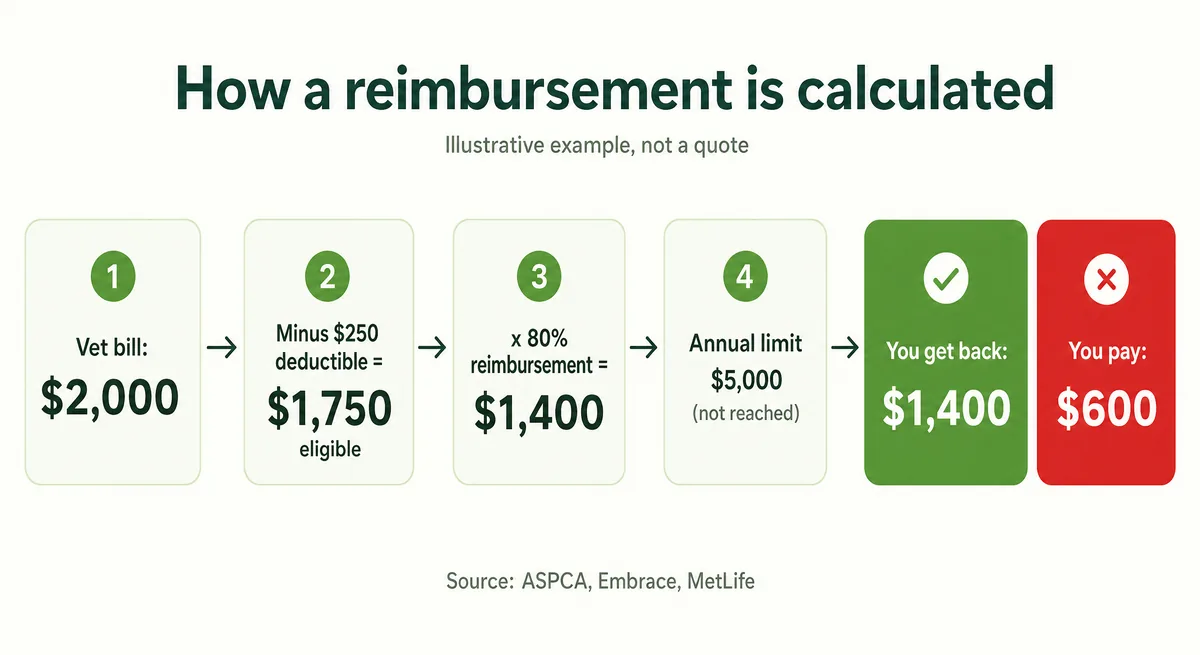
Definitions only get you so far — the real "aha" comes from running an actual bill through all three numbers. Say your dog needs treatment that totals a $2,000 vet bill, and your plan has a $250 annual deductible, 80% reimbursement, and a $5,000 annual limit. (Illustrative figures, not a quote.) Here is one common deductible-first calculation, step by step:
- Start with the covered bill: $2,000.
- Subtract your remaining deductible: $2,000 − $250 = $1,750 in eligible costs.
- Apply your reimbursement percentage: $1,750 × 80% = $1,400.
- Check it against your annual limit: $1,400 is well under $5,000, so it's paid in full — and your remaining limit drops to $3,600 for the rest of the policy year.
Under this deductible-first illustration, you get $1,400 back and pay $600 out of pocket — not the $400 (20% of $2,000) a first-timer might expect. The effective reimbursement is 70% of the total because the deductible and coinsurance both apply. A percentage-first form produces a different result, below.
One wrinkle changes the answer: carriers don't all run the steps in the same order. The method above is deductible-first — MetLife, for example, "subtracts your deductible first, and then applies your reimbursement rate," as do ASPCA and Embrace. Others use percentage-first: they multiply by your percentage, then subtract the full deductible — $2,000 × 80% = $1,600, − $250 = $1,350. Same headline settings, $50 less, because you absorb the whole deductible yourself. Embrace shows the same split on a $1,200 bill: $800 the deductible-first way versus $760 the percentage-first way. Some forms used by carriers such as Healthy Paws, Lemonade, and Pets Best have used percentage-first calculations, but the exact order can vary by policy form and state.
Two smaller things also trim the check: your covered bill may leave out line items like the exam fee or sales tax, so the number your percentage applies to can be lower than the total you actually paid. None of this is meant to discourage you — it's just the arithmetic, and once you've seen it run once it's easy to do on any quote. Before you enroll, read the actual policy documents — the sample policy, benefit schedule, and exclusions, not just the quote — for two things that shape your payout: which order the carrier uses, and whether exam fees count as covered. Carriers spell out how they calculate reimbursement, so confirm yours before you need it.
How it works at the vet + the claim timeline
At most visits, you are a regular paying customer and the insurance work happens after treatment. Ask for an itemized invoice. If you have confirmed real-time direct pay or a pre-approved pay-to-vet arrangement, follow that program's process instead; clinic participation and carrier approval are not automatic.
Filing is usually quick. With most carriers you snap a photo of that itemized invoice in the app and submit it, often along with your pet's recent medical records — MetLife, for one, asks for the last 12 months of records on a first claim. The insurer checks the visit against your policy, applies your deductible, percentage, and limit, and pays you back by direct deposit or check. You also usually have months to file, not days: Healthy Paws gives you 90 days and ASPCA up to 270, so there's no need to panic if you file a few days late.
How long until the money comes back? It depends on the carrier and the claim, so treat any single promise with a little skepticism. Healthy Paws says most claims are processed in about two business days, while Lemonade says some simple eligible claims can be handled quickly through its app. Those are carrier statements, not a cross-carrier average or guarantee. Actual timing depends on the claim, complete records, pre-existing-condition review, payment method, and current process; no matched public dataset supports a generic two-to-three-week rule. A standard claim still comes down to the same three beats: pay the vet, file, get reimbursed.
Send a complete itemized invoice and requested records the first time to avoid a preventable documentation round trip. A first claim may require a broader medical-history review, but neither that fact nor a later claim guarantees a particular turnaround. Track the carrier's stated deadline and follow up on any records request.
When coverage starts: waiting periods & pre-existing
Two separate rules decide what a new policy will pay. First, each benefit starts according to the policy effective date and any applicable wait; accident coverage can begin on the effective date in some forms. Second, mainstream plans generally exclude conditions that predate the applicable coverage, with narrow cured-condition and AKC state/form exceptions.
Waiting periods: the gap before coverage kicks in
A waiting period is a period after policy effectiveness during which a claim type is not eligible. Current structures include zero-day accident clocks, accident waits up to roughly 14–15 days, illness waits commonly around two weeks, and longer named orthopedic clocks. Some products delay the effective date instead of using a formal wait. Healthy Paws, for example, currently lists a 12-month hip-dysplasia wait in most states and a 30-day wait in 16 named jurisdictions, with exam-waiver rules there; the cited FAQ limits hip-dysplasia coverage to pets enrolled before age six. Read the state-specific issued form and keep effective date separate from waiting period.
Pre-existing conditions: what "already has" really means
A pre-existing condition is anything your pet showed signs of before coverage started (or during a waiting period) — and here's the part beginners miss: under the NAIC's model definition, a formal diagnosis isn't required. Signs or symptoms your vet noted — a limp, an itch, a stomach upset — can be enough, and the insurer decides at claim time by reviewing your pet's records. A few carriers are more forgiving: some will cover a curable pre-existing condition again after a symptom-free stretch (ASPCA, for example, uses 180 days), though mainstream plans usually continue to exclude chronic pre-existing conditions. AKC advertises a state- and form-dependent 365-day pathway for some eligible pre-existing conditions, so “never” is not universal. And in states that have adopted the NAIC model, the insurer — not you — carries the burden of proving a condition was pre-existing; not every state has, so check your own state's rules.
This is exactly why some owners on Reddit swear you should "never tell the vet anything." Please don't. Skipping or hiding care to protect a future claim can hurt your pet and can void a claim outright. The honest approach — and the one that actually holds up — is to get your pet the care it needs, keep good records, and enroll while your pet is young and healthy, before there's anything to exclude. The finer print on exclusions is a bigger subject than this overview; here, the mechanic is the point.
What's covered vs not: accident-only, accident-and-illness, wellness
Before you pick a plan, you pick a tier — and the tier decides what's covered. The industry sorts policies into three, which NAPHIA tracks as accident-only, accident-and-illness, and accident-and-illness with a wellness add-on.
| Tier | What it covers | What it doesn't |
|---|---|---|
| Accident-only | Injuries: swallowed objects, broken bones, bite wounds, cuts | Any illness — infections, cancer, chronic disease |
| Accident & illness (most common) | Everything above plus illnesses: infections, cancer, allergies, diabetes, and other chronic conditions | Routine/preventive care; pre-existing conditions under the issued policy's rules |
| + Wellness add-on | Adds routine care: exams, vaccines, flea/tick, dental cleanings | Does not change the underlying policy's pre-existing-condition rules |
Most people who say "pet insurance" mean the middle tier, accident and illness — it's the one that catches the big, unpredictable bills. That matters because the conditions pets actually rack up — skin allergies, ear infections, upset stomachs, cancer — are illnesses, not accidents. Accident-only costs less, but it won't touch any of them.
The surprise that trips up nearly every first-timer: routine care isn't included by default. Checkups, vaccines, and dental cleanings generally require a wellness benefit. Adding wellness does not override the insurance policy's pre-existing-condition rules. Some carriers reconsider eligible cured conditions, and AKC advertises a separate state- and form-dependent 365-day pathway for certain eligible pre-existing conditions, but neither is automatic. Every plan carries its own exclusions and issued terms.
What it costs — and does it work differently for dogs vs cats?
What you'll pay comes down to a handful of factors, and the biggest is the species. On the most common accident-and-illness plans, NAPHIA's 2025 industry data puts the U.S. average at about $836 a year (~$69.67/month) for dogs and $435 a year (~$36.25/month) for cats. Treat those as averages, not your quote: real premiums swing widely with your pet's breed and age, your ZIP code, and your plan choices, so your own number can land well below or above them.
So yes, it works a little differently by species: dogs cost roughly twice as much to insure as cats, because they tend to claim more often and their treatments run higher. The mechanics — reimbursement, deductibles, waiting periods — are identical; only the price and the most common conditions differ.
Beyond species, four things move your number:
- Breed. Bigger and higher-risk breeds cost more. On identical terms (Embrace's example prices a young dog in Texas), Embrace quotes a French Bulldog around $36/month versus a Chihuahua around $11 — a 3× spread from breed alone.
- Age at enrollment and renewal method. Most carriers use attained-age pricing, so quotes and renewals generally rise as the pet ages. Trupanion instead uses age at enrollment plus cohort, location, and veterinary-cost factors; a birthday is not itself the direct renewal trigger.
- Where you live. Local vet costs feed straight into your premium, so the same pet costs more in a high-cost metro than in a rural ZIP.
- Your three dials. A higher deductible or a lower annual limit trims the premium; a higher reimbursement percentage raises it.
That's the shape of the cost; working out the exact number for your pet — and whether it pencils out — is a bigger exercise than this overview. Here, the takeaway is simple: dogs cost about double cats, you'll pay less the younger you start, and those three dials are yours to tune.
So, is it worth it?
Honest answer: for some pets it clearly is, for others it isn't — and "how does it work" and "is it worth it" are really the same question, so here's the short version before you dig deeper.
The case for it is simple: insurance protects you against the rare, huge bill you can't easily save your way to. Setting aside $100 a month is smart, but it won't cover a single $6,500 surgery in year two or a $10,000 emergency — the kind of bills owners describe over and over. And the money does flow the other way, too: U.S. insurers paid out about $3.07 billion in claims in 2024. Think of it less as a bet you hope to win and more as a budgeting tool that limits your exposure to a big covered bill — though your deductible, reimbursement percentage, annual limit, and any exclusions still shape what you actually pay.
The honest counterweight: premiums can rise substantially at renewal. Most carriers use attained-age pricing, so age contributes to increases. Trupanion instead uses age at enrollment plus cohort, territory, and veterinary-cost factors; birthdays are not the direct trigger, but cohort rates can still rise. That is why the “worth it” verdict depends on pricing method, breed, location, plan design, and your ability to absorb a surprise bill.
Working that math all the way out — premiums paid versus likely payouts over a lifetime — is its own exercise. Now that you understand how the machine works, the honest next step is the full break-even analysis.
Frequently Asked Questions
How does pet insurance work when I go to the vet?
Usually you pay the vet and then file the itemized invoice and records for reimbursement. A few programs change the cash flow: Trupanion can adjudicate at checkout at participating clinics, while Pets Best and Healthy Paws use approval- and clinic-dependent pay-to-vet arrangements. Confirm the exact process before treatment.
Do I pay the vet, or does the insurance company pay directly?
Most U.S. policies reimburse you after payment. Trupanion's participating-clinic system can adjudicate at checkout; Pets Best can route a processed payment to a vet that signs its release; Healthy Paws can arrange case-by-case direct payment after approval. Because those mechanisms differ, ask both insurer and clinic what you must pay at checkout.
Why didn't I get my full reimbursement percentage back?
The headline percentage applies only to eligible charges, and the issued calculation order controls. On a deductible-first form, an eligible $2,000 bill with a $250 deductible and 80% reimbursement pays $1,400. A percentage-first form pays $1,350 on the same inputs. Excluded exam fees, taxes, limits, or other ineligible items can reduce either result. Compare the explanation of benefits with your policy rather than assuming every shortfall is correct.
What counts as a pre-existing condition?
Any condition your pet showed signs or symptoms of before your coverage started (or during a waiting period) — and a formal diagnosis isn't required. Under the model definition U.S. regulators use, a noted limp, itch, or stomach upset can be enough, and the insurer decides at claim time by reviewing your pet's records. This is why enrolling while your pet is young and healthy matters. Never skip or hide vet care to protect a future claim — get your pet the care it needs.
How soon does coverage start?
It depends on the effective date, state, form, and claim type. Some policies have a zero-day accident clock after effectiveness; others impose an accident wait or delay the policy's effective date. Illness is commonly around two weeks, and some orthopedic conditions have longer clocks. A problem that predates the applicable coverage will not be rescued by buying after it starts.
What are the downsides of pet insurance?
The main ones: most plans make you front the bill, coverage timing and exclusions are strict, and premiums can rise materially. Most carriers use attained-age pricing; Trupanion uses enrollment-age cohorts and other filed factors instead of birthdays as a direct trigger. Routine care generally requires a separate wellness benefit. Insurance protects against eligible large bills; it is not guaranteed savings.
Does pet insurance cover a UTI?
Usually yes, on an accident-and-illness plan — a urinary tract infection is treated as an illness, so it's covered as long as it isn't pre-existing and your illness waiting period has already passed. If your pet had urinary symptoms before coverage began, that specific problem may be excluded as pre-existing. Coverage specifics vary by carrier, so confirm against your own policy.
Does pet insurance cover IVDD surgery?
Often yes, if you have accident-and-illness coverage, the condition isn't pre-existing, and any orthopedic or illness waiting period has passed. Intervertebral disc disease (IVDD) surgery can run into the thousands, which is exactly the kind of bill insurance is designed for — but breeds prone to it, like Dachshunds, make the pre-existing and waiting-period rules especially important to check before you actually need the coverage.
Sources
- Pet Insurance — NAIC — Center for Insurance Policy and Research
- Vet Direct Pay vs. Reimbursement — Trupanion
- Pet Insurance That Pays the Vet Directly — U.S. News & World Report
- Pet Insurance Deductibles — Progressive
- Deductibles — Trupanion
- How Does Pet Insurance Work? — ASPCA Pet Health Insurance
- Annual Reimbursement Limit — MetLife Pet Insurance
- How Pet Insurance Companies Calculate Your Refund — Embrace Pet Insurance
- What Is Reimbursement? — MetLife Pet Insurance
- Filing a Pet Insurance Claim — MetLife Pet Insurance
- Pet Insurance Claims — Healthy Paws Pet Insurance
- How to File a Claim — ASPCA Pet Health Insurance
- Pet Insurance Claims Process — MoneyGeek
- How Do Pet Insurance Waiting Periods Work? — U.S. News & World Report
- Frequently Asked Questions — Healthy Paws Pet Insurance
- Pet Insurance Model Act (MO-633) — National Association of Insurance Commissioners
- Pet Insurance and Pre-Existing Conditions — ASPCA Pet Health Insurance
- State of the Industry Report 2025 (Highlights) — NAPHIA
- Pet Insurance 101 — Progressive
- How Much Does Pet Insurance Cost? — Embrace Pet Insurance
- How Much Does Pet Insurance Cost? — MetLife Pet Insurance
- State of the Industry Report 2025 — NAPHIA
- VetDirect Pay — Trupanion
- Vet Direct Pay — Pets Best
- Claims and Direct Pay — Healthy Paws
- Pricing Promise — Trupanion
- State of the Industry Report 2026 Highlights (2025 data) — NAPHIA
You may be interested...
More published guides that build on this topic.
 Pet Insurance Basics
How Does Pet Insurance Work If You Switch Providers?
Switching pet insurance starts a new policy, not a transfer. How it works, what resets, how insurers decide what's pre-existing, and when not to switch.
 Pet Insurance Basics
Is Pet Insurance Worth It in 2026? The Honest Math
We break down the financial reality of pet insurance in 2026 using current BLS, NAPHIA, NAIC, and veterinary sources.