

If you're here because a vet just said the words "kidney failure" — or because a routine senior panel came back with numbers you didn't expect — you're probably worried about one specific cat right now. Take a breath. This is one of the most common diagnoses in older cats, and "kidney failure" covers a far wider range of situations than that scary phrase suggests.
This is a plain-English guide for U.S. cat owners. We can't diagnose your cat or replace the vet who knows her — but we can help you think clearly about what the label actually means, what the IRIS stages say about the road ahead, and what the months of care realistically cost.
We'll walk through the symptoms worth watching, how the disease is diagnosed and staged, and what treatment looks like at home. We'll also cover the honest part almost no one prints: real vet-cost ranges by phase, and what pet insurance does and doesn't cover once kidney disease is already in the picture.
Table of Contents
- What "kidney failure" actually means in cats
- Symptoms and what to watch for
- Stages of kidney failure (IRIS Stages 1–4)
- How long do cats live with kidney failure?
- How kidney failure is diagnosed
- Treatment options (and what they actually do)
- What if my cat refuses the renal diet?
- What sub-Q fluids look like at home
- End-stage kidney disease and quality of life
- Real vet costs for kidney failure
- Renal transplant: is it ever an option?
- Does pet insurance cover kidney failure?
- When you can't afford the ideal care
- Frequently Asked Questions
- The bottom line
- Sources
What "kidney failure" actually means in cats
"Kidney failure" is a catch-all — owners use it loosely, and so do plenty of vets. If you've heard the phrase, the useful first step is figuring out which situation you're dealing with, because the outlook and the costs differ a lot.
Chronic kidney disease (CKD) is the common one: a slow, progressive, ultimately irreversible loss of kidney function over months or years. It can't be cured, but it can often be managed for a long time.
Acute kidney injury (AKI) is a sudden drop in function — from a toxin (lilies, antifreeze), an infection, a blockage, or dehydration. Caught early, it's sometimes reversible. But it's serious: in severe cases that need hospital treatment, roughly half of cats don't survive.
Acute-on-chronic is the one that confuses owners most. It's a cat who already has CKD and suddenly "crashes" — often from an infection or dehydration. The crash can stabilize with treatment, but bouncing back doesn't reverse the underlying disease.
End-stage is the final phase of CKD (IRIS Stage 4), where care shifts from slowing the disease to keeping your cat comfortable (more below).
| Type | Onset | Reversible? | Typical cost shape |
|---|---|---|---|
| CKD (chronic) | Slow — months to years | No, but manageable | Steady monthly care + lab checks |
| AKI (acute) | Sudden — hours to days | Sometimes, if caught early | One large hospital bill up front |
| Acute-on-chronic | Sudden crash on a CKD baseline | Crash may stabilize; disease doesn't | Crash bill plus ongoing chronic costs |
| End-stage (Stage 4) | The final phase of CKD | No — comfort-focused | Palliative / end-of-life care |
Symptoms and what to watch for
The hard part about early kidney disease is that the first signs are quiet — owners almost always say they only spotted them in hindsight. Two patterns are worth knowing: the slow early signs, and the red flags that mean call today.
Early signs tend to build gradually:
- Drinking and peeing more than usual — vets call this PU/PD, and it often shows up before any weight loss
- Slow, steady weight loss
- Sniffing food and walking away (owners describe this far more than plain "picky eating")
- Lower energy, occasional vomiting, a dull coat, or bad, ammonia-like breath
One or two of these in an older cat don't prove anything — but a cluster, or a clear change from your cat's normal, earns a vet visit. None of this is a diagnosis; only an exam and lab work can confirm what's going on.
Some signs can't wait. Get to an emergency vet right away for any of these red flags:
- Collapse or sudden severe weakness
- Producing little or no urine, or straining to pee
- Seizures, disorientation, or pale gums (a sign of anemia)
- Repeated vomiting, or refusing all food for 24 hours or more
Stages of kidney failure (IRIS Stages 1–4)
The International Renal Interest Society (IRIS) stages feline CKD from 1 (earliest) to 4 (most advanced) using two blood markers — creatinine and SDMA. Knowing the stage is what turns a scary lab result into a plan.
| IRIS stage | Creatinine (mg/dL) | SDMA (µg/dL) | What this means for your cat |
|---|---|---|---|
| Stage 1 | < 1.6 | < 18 | Earliest — usually no outward signs; found on labs |
| Stage 2 | 1.6–2.8 | 18–25 | Mild; subtle signs may begin (drinking and peeing more) |
| Stage 3 | 2.9–5.0 | 26–38 | Moderate; signs are usually clear and need active management |
| Stage 4 | > 5.0 | > 38 | Severe; comfort and symptom control become the focus |
Two more measurements substage the disease and matter a lot for the outlook. UPC (the urine protein-to-creatinine ratio) flags protein leaking into the urine, which tends to speed progression. Blood pressure catches hypertension, common in CKD cats — IRIS aims to keep systolic pressure under 160 mmHg. Both are often skipped in routine visits, so they're worth asking your vet about.
One caveat: SDMA reference ranges vary by lab, and a single high creatinine isn't a diagnosis on its own — dehydration alone can push it up. Staging is done once the diagnosis is confirmed and the numbers are stable.
How long do cats live with kidney failure?
There's no honest single number — survival depends heavily on the stage at diagnosis and how the disease is managed. As a broad anchor, a large UK VetCompass study found a median survival of about 388 days after diagnosis, across all stages combined.
Stage sharpens that picture. In a 211-cat survival study, median survival ran roughly:
- Late Stage 2: about 1,151 days — over three years
- Stage 3: about 679 days — close to two years
- Stage 4: about 35 days
Two things to hold onto. These are medians — half of cats lived longer, and individual cats vary enormously. And day-to-day management makes a real difference — the renal diet and controlling complications carry the strongest survival evidence, while sub-Q fluids and a good appetite mainly keep a cat comfortable. A short Stage 4 median is a reason to plan, not to panic; some cats stabilize and outlast the averages.
How kidney failure is diagnosed
Diagnosis comes from a small panel of blood and urine tests, and it helps to know what each one tells your vet. Here's the plain-English version of what shows up on the report:
- Creatinine — a waste product the kidneys clear; higher means less filtering. It's the classic marker, but only rises after roughly 75% of kidney function is gone.
- SDMA — a newer marker that starts rising earlier, at about 40% loss, so it can flag trouble sooner.
- BUN (blood urea nitrogen) — another waste product; it fills in the picture but is easily swayed by diet and dehydration.
- Phosphorus — tends to climb as the disease advances and is a key treatment target.
- USG (urine specific gravity) — how concentrated the urine is; dilute urine is an early clue the kidneys aren't conserving water.
- UPC (urine protein-to-creatinine ratio) — measures protein leaking into the urine, which affects the outlook.
- Blood pressure — screens for hypertension, which often rides along with CKD.
A kidney ultrasound can show size, stones, or structural problems; a biopsy is rare and reserved for unusual cases. One caution: a single high creatinine isn't a diagnosis on its own — dehydration alone can push it up, and a thin, muscle-wasted cat can read deceptively normal. That's why vets repeat tests and watch the trend. Two useful questions to ask: "Can we add SDMA?" and "Should we check urine protein and blood pressure too?"
Treatment options (and what they actually do)
Nothing here cures CKD — the goal is to slow it and keep your cat feeling well. Here's what each common treatment actually does:
- Renal diet — lower in phosphorus with controlled, high-quality protein; it's the most evidence-backed step for slowing progression.
- Phosphorus binders — a phosphorus binder is a medication mixed into food that traps phosphorus in the gut so less gets absorbed (aluminum-, lanthanum-, or calcium-based); used when diet alone isn't enough.
- Telmisartan and amlodipine — telmisartan reduces protein loss in the urine; amlodipine lowers high blood pressure, where vets aim for a systolic reading under 160 mmHg.
- Sub-Q fluids — fluids given under the skin to fight the dehydration that drives so many symptoms (more on this just below).
- Anti-nausea meds — maropitant (Cerenia) or ondansetron, to settle the nausea that quietly kills appetite.
- Appetite stimulants — capromorelin (Elura) or mirtazapine (Mirataz) to coax a reluctant cat back to the bowl.
- Anemia management — for advanced cases, Varenzin-CA1 (molidustat), which holds only conditional FDA approval for CKD-related anemia in cats.
Diet, fluids, and blood-pressure and phosphorus control are the long-established backbone. Newer options come with more caveats: Varenzin-CA1's approval is conditional, and the toxin-binder Renaltec (Porus One) is still experimental, backed only by small early trials. One genuine shift worth raising with your vet: there's growing support for starting the renal diet earlier — at Stage 1 or 2, rather than waiting for Stage 3. Ask whether an early diet change makes sense for your cat.
What if my cat refuses the renal diet?
First, breathe — this is one of the most common frustrations in renal care, and a refused bowl is not a failure on your part or your cat's. The principle vets and experienced owners come back to is simple: fed is best. A cat eating regular wet food is in far better shape than one holding out against renal food and eating nothing.
Here's a calm way to read where you are:
- Eating the renal diet? Great — keep going, and don't fix what's working.
- Eating some of it? Partial is still a win. Continue, and let weight and lab trends tell you whether it's enough.
- Refusing it outright? Switch to calorie-first thinking — feed something your cat will actually eat, and ask your vet about a phosphorus binder or a lower-phosphorus food.
- Not eating at all? This is the urgent one. A CKD cat that won't eat needs nausea control and an appetite stimulant — call your vet within 24 hours.
What not to do: don't panic-swap brands, and don't try a homemade renal recipe without a veterinary nutritionist — getting the phosphorus and protein balance wrong does real harm. A binder plus a food your cat genuinely enjoys is a perfectly respectable middle path.
What sub-Q fluids look like at home
Sub-Q (subcutaneous) fluids are sterile fluids given under the skin — usually lactated Ringer's from an IV bag through a small butterfly needle — to fight the dehydration that drives so many CKD symptoms. Of everything in the toolkit, this is the one many owners credit most: the cat that perks up, grooms again, and eats better once fluids start. It supports hydration and quality of life — not a cure, and not a guarantee of more time, but often a genuine comfort boost.
Sessions commonly run around 100–150 mL, given daily or every few days as the disease advances, but your vet sets the amount and rhythm and will show you the technique hands-on. We won't walk through the how here — it's worth learning in person. Two cautions: not every cat is a candidate (heart disease changes the math), and too much fluid too fast can overload the system.
End-stage kidney disease and quality of life
What end-stage kidney disease looks like
"End-stage" usually means IRIS Stage 4 — severe kidney disease — at the point where a cat is no longer responding well to treatment and quality of life is slipping. Not every Stage 4 cat is there yet; some are still actively managed for months. But by this point a cat is often dealing with acute-on-chronic crashes, a fading response to fluids, steady weight loss, and an appetite that keeps collapsing despite medication. Some cats still have good days mixed in, which makes the picture genuinely confusing — that's normal, and it doesn't mean the diagnosis is wrong.
When is it time to consider euthanasia?
Two tools help you decide with your head as well as your heart. The first is the HHHHHMM quality-of-life scale, developed by veterinarian Dr. Alice Villalobos, which scores seven everyday measures: Hurt, Hunger, Hydration, Hygiene, Happiness, Mobility, and More good days than bad. The second is watching for three plain signals:
- Appetite collapse that holds even with anti-nausea medication and an appetite stimulant on board.
- Repeated crashes that keep returning despite fluids.
- Your cat no longer doing cat things — grooming, jumping up, seeking out a warm spot or your lap.
When that's where you are, choosing comfort is not giving up — it's one of the kindest decisions an owner makes. Many families choose in-home euthanasia so the last moments are calm and familiar. Your vet will help you with the timing, and there's no wrong amount of love in wanting a little more time, or in deciding it's enough.
Real vet costs for kidney failure
The most useful way to think about CKD costs isn't one big number — it's two very different kinds of month. A stable month at home is modest and predictable; a crash month, when your cat lands in the ER, is where the real money is. Owners are blunt that single-number estimates feel dishonest, so here are approximate US ranges by phase instead — they swing with your region, your clinic, and how your cat responds:
| Phase | Typical US range |
|---|---|
| Diagnosis (exam, bloodwork, urinalysis, blood pressure) | $300–$800 |
| Stable month at home (diet, binders, meds, sub-Q supplies) | $80–$200 / month |
| Monitoring labs (every 3–4 months) | $300–$600 |
| Crash: ER visit or hospitalization | $1,500–$5,000+ |
| End-of-life / in-home euthanasia | $200–$500 |
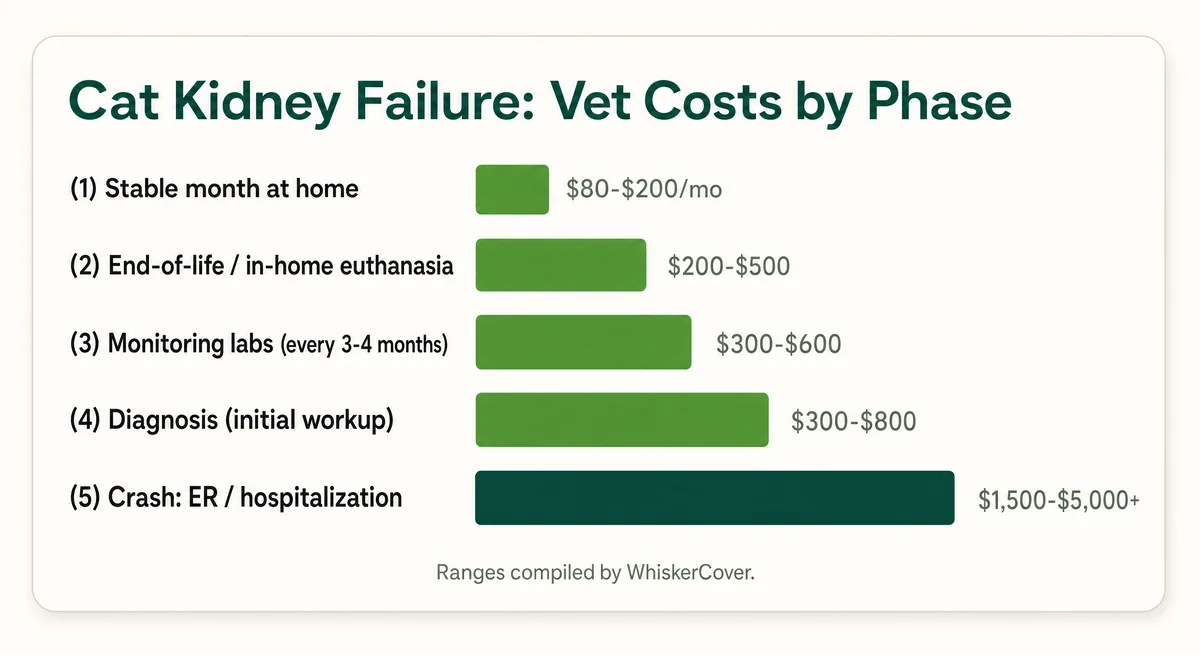
Two things make those numbers land. First, owners routinely underestimate the total: Synchrony's 2025 study found nearly 8 in 10 pet owners underestimate lifetime care costs, and 74% had faced an unexpected bill over $250. Second, the crash line is the budget-breaker — emergency and hospital care is exactly where an acute-on-chronic episode can run into the thousands.
Renal transplant sits in a different league entirely, which we cover just below. One note on the recurring side: pet-insurance premiums for cats average about $36.25 a month — an all-cat 2025 figure, with older cats and richer plans costing more — though whether a policy actually helps with kidney disease comes down entirely to timing, which is the next big thing to understand.
Renal transplant: is it ever an option?
Yes — but only for a small minority of cats, and it's a major undertaking. Estimates generally run from about $12,000–$15,000 up to $20,000–$30,000 depending on the center, so ask the program directly rather than trusting a single number. Reported one-year survival is often around 50–70%, the cat needs lifelong anti-rejection medication, and there's an ethical condition that surprises people: the donor cat must be adopted into your family. The surgery is offered at only a handful of US referral centers, such as UC Davis and Penn Vet, and isn't available in the UK at all. For most owners this stays a "not for us, but good to know it exists" option — worth understanding, rarely the road taken.
Does pet insurance cover kidney failure?
It depends almost entirely on timing. Under the mainstream pre-existing-condition rule, kidney disease diagnosed or showing verifiable signs before coverage began — including during an applicable waiting period — is excluded. A policy bought today will not pay today's already-known renal bills. One narrow exception is worth knowing: AKC says eligible pre-existing conditions may become covered after 365 days of continuous coverage in qualifying states and forms. That is not immediate coverage, and exclusions, endorsements, and the issued policy still control.
If a policy was already active before the diagnosis, though, the picture is much brighter. An accident-and-illness plan may reimburse eligible costs — subject to your deductible, reimbursement rate, and annual limit — across things like:
- Sub-Q fluid bags, lines, and needles
- Prescription medications — telmisartan, amlodipine, anti-nausea drugs, often appetite stimulants
- Repeat bloodwork and urinalysis for monitoring
- Hospitalization for a crash
Prescription renal food is commonly excluded as ordinary food, but not universally. Pumpkin says its plans cover food prescribed to treat an eligible condition, with no separate time limit for that benefit; MetLife says prescribed, medically necessary specialty food is typically covered; and Trupanion describes a limited-duration prescription-food benefit. The condition must itself be covered, and duration, retailer, caps, and other conditions vary by plan, so the issued policy controls. For the full mechanics, see our coverage guide and cat insurance guide.
When you can't afford the ideal care
"What if I can't afford the vet?" is one of the most common — and most quietly painful — questions owners ask. It deserves a straight answer, not judgment, and you usually have more options than the worst-case picture in your head.
Start with a single, focused vet visit. The goal isn't to commit to everything at once; it's to rule out a reversible cause, pin down the stage, and agree on a realistic 30-day plan you can actually afford. From there:
- Payment plans: CareCredit and similar financing can spread a big bill over months.
- Low-cost and charitable help: ASPCA and Humane Society partner clinics, plus funds like Frankie's Friends, exist for exactly this — the Humane Society keeps a directory of where to turn.
And if aggressive treatment simply isn't on the table, comfort-focused (palliative) care — keeping your cat eating, hydrated, and pain-free for as long as that's working — is a legitimate, loving choice. It is not giving up.
Frequently Asked Questions
Can cats bounce back from kidney failure?
It depends on which kind they have. Acute kidney injury (AKI) can sometimes be reversed if it's caught and treated early, but chronic kidney disease (CKD) can't be cured — only managed. An acute-on-chronic crash can stabilize with treatment, yet bouncing back from the crisis doesn't undo the underlying chronic damage.
Why does my Stage 4 cat seem fine?
Cats are experts at masking illness, so a lab report can look severe while your cat still eats, grooms, and seems content — especially while fluids, medication, and diet are holding symptoms at bay. It doesn't mean the diagnosis is wrong; it usually means management is working. Keep watching appetite, energy, and the small daily "cat things."
Is regular wet food okay if my cat refuses the renal diet?
Yes. A cat eating regular wet food is far better off than one refusing renal food and eating nothing at all — vets call this "fed is best." The renal diet is ideal because it's lower in phosphorus, but calories come first. Ask your vet about mixing a phosphorus binder into a food your cat will actually eat.
How often should sub-Q fluids be given?
It varies — anywhere from a few times a week to daily as the disease advances — and your vet sets both the amount and the schedule. Subcutaneous (sub-Q) fluids support hydration and comfort, but they aren't right for every cat, so the rhythm should always come from your vet rather than a fixed online rule.
What's the difference between SDMA and creatinine?
Both are blood markers of kidney function, but SDMA tends to rise earlier — at around 40% loss of function — while creatinine often doesn't climb until roughly 75% is gone. Creatinine is also more easily skewed by dehydration and muscle loss, which is why vets increasingly look at both together.
Does pet insurance cover kidney failure?
Usually only when coverage began before the disease appeared. A newly purchased mainstream policy will exclude already-diagnosed or symptomatic kidney disease; AKC has a state- and form-dependent pathway for some eligible pre-existing conditions after 365 days, not for immediate bills. On an existing policy, eligible fluids, medications, labs, and hospitalization may be covered. Prescription renal food is commonly excluded, but Pumpkin, MetLife, and limited Trupanion benefits are counterexamples, so check the issued form.
The bottom line
Lean on the vet who knows your cat, and if you already have a policy, file claims even for the routine supplies — fluids, needles, and repeat labs add up fast. If you don't have coverage and your cat has no kidney flags yet, read our cat insurance guide before the next senior wellness visit, while timing is still on your side.
Sources
- Chronic Kidney Disease — Cornell Feline Health Center
- Kidney Failure in Cats: Symptoms, Stages, and Causes — PetMD
- IRIS Staging of CKD (2023 Guidelines) — International Renal Interest Society (IRIS)
- Chronic kidney disease in cats attending primary care practice in the UK: a VetCompass study — Veterinary Record
- Survival in Cats with Naturally Occurring Chronic Kidney Disease (2000–2002), Boyd et al. — Journal of Veterinary Internal Medicine
- Feline CKD: Diagnosis, staging and screening — what is recommended? — Journal of Feline Medicine and Surgery (PMC)
- New Synchrony Study Finds Nearly 8 Out of 10 Pet Owners Underestimate Lifetime Care Costs (2025) — Synchrony
- Emergency Vet Visit Cost and Veterinary Financing — CareCredit
- How Much Does Pet Insurance Cost? (NAPHIA-based average premiums) — Progressive
- Are You Having Trouble Affording Your Pet? — The Humane Society of the United States
- Coverage for Eligible Pre-Existing Conditions — AKC Pet Insurance
- Prescription Food for Covered Conditions — Pumpkin
- Prescription Food and Supplements — MetLife Pet Insurance
- Prescription Pet Food Coverage — Trupanion
- State of the Industry Report 2026 Highlights (2025 data) — NAPHIA