


If you've read three "best pet insurance" lists and walked away with three different winners, you're not imagining it. Somewhere around the fourth undated star rating, most shoppers do the same thing: they stop trusting review sites and add "reddit" to the search. That instinct is healthy. Most pet insurance reviews are built to sell you a policy, not to show you evidence.
This page works differently. Our scores come from the binding policy documents each carrier actually issues — not its marketing pages — read alongside regulator data: complaint records, state rate filings, and the new market-conduct data as it becomes public. And every volatile number on this page, from a score to a complaint index to a platform rating, carries the date we last verified it, because a rating without a date is a rating you can't trust.
One more thing before the verdicts. WhiskerCover is a licensed insurance agency — we can help you get your dog or cat covered, which is exactly why you deserve to know how we're paid. We explain that in plain English a short scroll below, before any recommendation, not buried in a footer.
The master ratings table comes first, so if you just need a shortlist, it's one scroll away. If you've been burned before, stay for the parts no review site shows: who really owns which brands, what regulators know that star ratings hide, and why every "best of" list names a different winner.
Table of Contents
- Our ratings at a glance
- What is the most trusted pet insurance?
- How we rate (and how we're paid)
- The reviews behind the reviews: who owns whom
- What regulators know that review sites don't show
- Why every “best pet insurance” list names a different winner
- Carrier-by-carrier verdicts
- Is any pet insurance actually worth it?
- The fine print that decides your claims
- What Reddit actually says (dated and screened for astroturf)
- Frequently Asked Questions
- Sources
Our ratings at a glance
As of July 2026, no major U.S. pet insurer earns better than 3.9 out of 5 on our board — which tells you something about the 4.8s and 4.9s you've seen elsewhere. Every score below comes from our own weighted rubric, built on each carrier's binding policy forms and the regulator record, and every score carries the date we assigned it. The full weights are published in How we rate (and how we're paid), and the clause-level evidence lives in our fine-print index.
One honest note on what's not in this table: we don't print NAIC complaint-index numbers as brand scores. Complaint results depend on the legal entity, jurisdiction, year, and selected line or coverage type; one insurer can support multiple brands and programs. The regulator section explains the scope needed before a result can be interpreted.
| Carrier | Our score (as of Jul 2026) | Underwritten by (financial strength) | Regulator & renewal record | What owners report (dated) |
|---|---|---|---|---|
| Embrace | 3.9 / 5 | American Modern Home; American Southern Home in FL — American Modern group AM Best A+, affirmed Jul 17, 2025; declarations control | — | Platform sentiment is split; renewal repricing is a recurring grievance in the cited owner reports |
| Spot | 3.7 / 5 | United States Fire — AM Best A+ (Aug 28, 2025) or Independence American — A− (Dec 17, 2025); declarations control | — | Quiet positive claims stories; low annual caps criticized (Jan 2026) |
| AKC (PetPartners) | 3.7 / 5 | Independence American or Independence Pet Insurance Co.; IAIC is AM Best A−, affirmed Dec 17, 2025; do not transfer that rating to the other entity | — | Cited as the community's pre-existing escape — the 365-day exception (Jul 2025) |
| Prudent Pet | 3.6 / 5 | Markel Insurance Co. or Markel American Insurance Co. — Markel NA group AM Best A, affirmed Nov 21, 2025 | — | Trustpilot 4.8 (category capture Jan 29, 2026) |
| Trupanion | 3.5 / 5 | American Pet Insurance Co. or ZPIC Insurance Co.; APIC alone has Demotech A′ (A Prime, "Unsurpassed"), affirmed Jun 19, 2026; no AM Best rating exists | CA renewals: +12% (2023), +29% (2024), +33% avg (2025), each CDI-approved | Split verdict: "$54,400 paid across 3 dogs" vs. per-condition-deductible regret (May 2026) |
| Pumpkin | 3.5 / 5 | United States Fire — AM Best A+ (Aug 28, 2025) or Independence American — A− (Dec 17, 2025); declarations control | — | $150/mo at age 10+, $250 projected next renewal — but $24k paid in final-year claims (May 2026) |
| ASPCA Pet Health Insurance | 3.5 / 5 | United States Fire — AM Best A+ (Aug 28, 2025) or Independence American — A− (Dec 17, 2025); declarations control | — | Few fresh reports in our July 2026 capture |
| Pets Best | 3.4 / 5 | American Pet, Independence American, Independence Pet, or MS Transverse; APIC is Demotech A′ and IAIC is AM Best A−; each insurer has its own responsibility and declarations control | CA: +45% effective Apr 2, 2025 on APIC-written policies; insurer projected 12,700+ cancellations | Value praised; slow claim processing noted (Jul 2025) |
| Figo | 3.4 / 5 | Independence American (IAIC) — AM Best A−, affirmed Dec 17, 2025 | — | Mixed-to-negative via the Costco channel (Jul 2025) |
| Lemonade | 3.4 / 5 | Lemonade Insurance Co. or Metromile Insurance Co.; LIC has Demotech A (Exceptional) (current listing) | — | App-first positioning; simple-claim speed is reported, while complex-claim denial disputes are also reported (Jan 2026) |
| MetLife Pet | 3.3 / 5 | Metropolitan General Ins. Co. or IAIC by state — no separate AM Best FSR published for Metropolitan General (checked May 2026); IAIC — A−, affirmed Dec 17, 2025 | — | Coverage praised — "grandfathered everything in"; service complaints (Apr 2026) |
| Fetch | 3.1 / 5 | AXIS Insurance Co. on current U.S. business — AM Best A (Excellent), affirmed Aug 28, 2025 | — | On the community avoid-list: rate increases tied to claim history reported (Feb 2026) |
| Healthy Paws | 2.9 / 5 | ACE American, Westchester Fire, Indemnity Insurance Company of North America, ACE Property and Casualty, Atlantic Employers, or another disclosed U.S. Chubb affiliate; declarations control. The cited AM Best release assigns A++ to listed Chubb operating subsidiaries, affirmed Jan 16, 2026 | 2020 WA order: underwriters repaid $4.7M to ~18,000 policyholders over rating practices on policies sold through Healthy Paws (WA OIC) | Senior renewal exit stories — $240/mo at age 12 on a healthy lab (Mar 2026) |
| Nationwide | 2.6 / 5 | Veterinary Pet Insurance Co. / National Casualty — Nationwide group AM Best A, affirmed Nov 7, 2025 (downgraded from A+ in Dec 2023) | ~100,000 pet policies non-renewed from mid-2024 (CBS News); the Silberman class action was dismissed Nov. 20, 2025 — allegations were not findings | Denial-scope confusion and exit anger (Jun 2026) |
| Physicians Mutual | Not yet scored — policy-form audit pending | Underwriter not yet verified by us | — | The community's anti-private-equity pick (Apr 2026) |
| Odie | Not yet scored — policy-form audit pending | Current panel: Trisura Insurance, Trisura Specialty, or Accredited Surety & Casualty; state availability varies and declarations control | — | "Stay away" warnings (Jan 2026); 155 BBB complaints in 3 years, as of Jul 4, 2026 |
How to read this: a dash means our July 2026 research pass found no state-regulator action or documented mass renewal event for that carrier — it is not a clean bill of health, just an absence of documented record. Scores are ours alone; they deliberately do not echo any other site's ratings. The owner-report column summarizes dated, screened community threads — sentiment evidence, not statistics. And two carriers stay unscored on purpose: we don't rate what we haven't audited.
If you just need a shortlist
- A pet likely to develop a chronic, expensive condition: Trupanion — no-payout-limit options and real-time direct pay at participating clinics, if you go in accepting the documented renewal record above.
- A balanced first policy for a young, healthy pet: Embrace — accident coverage from the effective date and a 14-day illness wait in current materials, with dog orthopedic timing and exam-reduction availability varying by state; the issued form controls.
- A senior pet other carriers won't enroll: Spot — no upper age limit at enrollment.
- Switching with a medical history: AKC — the only major carrier with a 365-day path to covering pre-existing conditions (not offered in Florida or Washington). Read the switching-trap answer in the FAQ before you move.
- Budget shortlist: Lemonade or Pets Best — quote both on identical coverage; no national cheapest carrier can be established without matched pet, ZIP, date, and plan inputs.
Those are conditional calls, not crowns. The rest of this page shows the evidence behind every cell — starting with exactly how we score, and who pays us.
What is the most trusted pet insurance?
The most trusted pet insurance is the one whose underwriter holds a current financial-strength rating, whose complaint record with state regulators runs below average for its size, and whose renewal price increases are documented and moderate. No star average measures any of those three things, so "most trusted" has no single-name answer.
That definition isn't ours by accident — each test rests on evidence regulators actually collect. The table above carries the first and third tests in its columns; the second, the complaint record, gets its own section below.
A rated underwriter. The brand on the ad is not necessarily the company that pays your claim. The NAIC Pet Insurance Model Act requires insurers to disclose when the underwriting company differs from the marketing brand — regulators treat that gap as a consumer-protection issue. So trust starts with knowing who actually stands behind the policy, and whether AM Best or Demotech currently rates them.
A properly scoped complaint record. The NAIC's Consumer Insurance Search can show complaint information for a legal insurer, with 1.0 representing its expected share where an index is available. Entity, jurisdiction, year, and selected line or coverage type control the result. Because an insurer may support multiple brands or programs, the number is not automatically a brand-specific trust score.
A documented renewal record. Trust isn't tested at signup — it's tested at renewal, when the premium moves. State rate filings are the receipts: California's insurance department tells shoppers outright to ask whether premiums rise with age and claims. A carrier whose increases are on file and moderate has earned something no testimonial can.
Notice what's missing from that test: star ratings. When owners ask "most trusted," what they mean — in their own words — is "did claims actually get paid", and stars don't answer that either. We won't crown one winner, because the trustworthy choice depends on your pet: the carrier you trust with a chronic illness is not the one you trust to stay affordable for a healthy cat. The table above applies all three tests to sixteen carriers, dated.
How we rate (and how we're paid)
Here is the whole machine: the weights we score with, the documents we score from, and the money behind the page. If a review site won't show you all three, you're reading its incentives, not its research.
The scoring weights, in full
| What we score | Weight | What feeds it |
|---|---|---|
| Policy fine print | 30% | The binding policy form: how "pre-existing" is defined and how far back it looks, waiting periods (including orthopedic), deductible structure (annual vs. per-condition), exam-fee treatment, direct vet pay, enrollment age caps |
| Renewal behavior | 25% | Documented premium trajectory: state rate filings, regulator-approved increases, mass non-renewals — plus dated owner-reported renewal quotes as corroboration |
| Claims & service experience | 20% | Dated, astroturf-screened community reports of claims actually paid or fought, processing speed, and support quality |
| Regulator record | 15% | Enforcement actions and restitution orders, complaint data where it's meaningful for the underwriter, and market-conduct filings as they become public |
| Financial strength | 10% | The underwriter's current AM Best or Demotech rating, with its affirmation date |
Two of those weights deserve a word of defense. Renewal behavior gets a quarter of the score because it is the single most documented consumer harm in this market: California's regulator approved single-year increases of 25–45% on some carriers' renewal books in 2025 alone, while veterinary-services inflation ran about 6.5% in 2025 — a gap a shopper only discovers at renewal, unless a review told them first. And fine print gets the largest weight because it decides claims: two policies with identical premiums can treat the same limping dog completely differently, depending on a lookback clause.
What we read (and what we don't)
Every score starts with the carrier's policy form — the contract you'd actually sign — pulled state by state where terms differ. That's where the real answers live: the definitions section, the exclusions list, the deductible mechanics. Marketing pages, press releases, and other review sites' scores are not inputs; when we quote a platform rating or a community thread, it appears as context, dated, never as the basis of a score. The full process, including how often each input is re-verified, is on our methodology page.
What we can't read, we say so: insurers' claim-denial rates are filed confidentially with regulators, so no site — including this one — knows them. Where a cell in our table rests on thinner evidence, the capsule for that carrier says so plainly.
And because carriers change underwriters, ratings get affirmed or pulled, and renewal books get re-filed, every volatile figure here is re-verified on a rolling basis — the page's last-verified date moves only after the whole board has been rechecked. A rating that was true in January and quoted in July isn't a small error in this market; it's how shoppers end up trusting a carrier that no longer exists in the form they read about.
How we're paid, in plain English
WhiskerCover is a licensed insurance agency. If you buy a policy through us, the insurer typically pays us a commission. That is the business model — not banner ads, not selling your data, not charging you.
Three commitments keep that money away from the scores. First, scores come out of the rubric above before any commercial consideration enters the room; nobody re-scores a carrier because of a payout rate. Second, no carrier can pay for placement — the table sorts by score, and several carriers on it pay us nothing at all. Third, when a carrier we can earn commission from scores badly, the score stands; you can check that claim against the table above, where partner and non-partner carriers sit in the same columns with the same dates.
You also won't find the word "independent" anywhere on this page — on purpose. The FTC's Consumer Review Rule, in force since October 21, 2024, treats a company-controlled review site that misrepresents its independence as a violation, and the FTC's own guidance says a disclosure can't cure an express independence claim. We sell insurance and we rate insurers; the honest posture is to show you the rubric and the receipts, and let you judge whether the evidence holds up.
The reviews behind the reviews: who owns whom
The U.S. pet insurance shelf looks like dozens of competing companies. Underneath, it's a handful of underwriters — and, increasingly, one owner. That matters for a simple structural reason: reviews attach to brands, but complaints, rate filings, and solvency attach to underwriters. The NAIC's Pet Insurance Model Act requires insurers to disclose when the underwriting company differs from the marketing brand, because regulators already treat that gap as a consumer-protection issue. A reviews page that doesn't map it can't actually explain what it's rating.
The map: brands, underwriters, owners
| Possible legal insurer | Brands that may appear on its paper | Worth knowing |
|---|---|---|
| United States Fire (Crum & Forster) | Some Spot, Pumpkin, ASPCA Pet Health Insurance / Hartville policies | The ASPCA doesn't run its brand — it licenses the name for royalties |
| Independence American (IAIC) | Figo and some AKC, Pets Best, Spot, Pumpkin, ASPCA-brand, and MetLife Pet policies | IAIC is the Doubtless group's own carrier |
| American Pet Insurance Co. (APIC) | Some Trupanion, Pets Best, and Chewy CarePlus policies | Pet-only insurer; entity-level data can still span multiple pet brands and programs |
| American Modern Home / American Southern Home (FL) | Embrace, including the USAA program | American Modern is the group/brand; the declarations name the legal insurer |
| ACE American / Westchester Fire / Indemnity Insurance Co. of North America / ACE Property and Casualty / Atlantic Employers / other disclosed U.S. Chubb affiliate; declarations control | Healthy Paws | Chubb bought the Healthy Paws program in 2024 |
| AXIS Insurance Company | Current new Fetch U.S. business | XL Specialty can remain relevant to legacy Fetch policies; declarations control |
| Lemonade Insurance Co. / Metromile Insurance Co. | Lemonade; CarePlus availability varies | Both are Lemonade group legal entities; declarations control |
| Metropolitan General / IAIC by state | MetLife Pet | |
| Veterinary Pet Ins. Co. / National Casualty | Nationwide pet | The book shrank by ~100,000 policies from mid-2024 |
| Markel Insurance Co. / Markel American Insurance Co. | Prudent Pet | Do not collapse the two legal entities |
| Trisura Insurance / Trisura Specialty / Accredited Surety & Casualty | Odie | Current disclosed panel; availability varies by state. Clear Blue is legacy, not in the current panel reviewed |
A shared owner behind a large brand portfolio
On June 29, 2026, JAB's pet insurance platform relaunched globally as Doubtless — six million insured pets across ten markets, and one owner standing behind ASPCA Pet Health Insurance, Hartville, Figo, AKC, Pets Best, Pumpkin, Embrace, and Spot, plus the underwriter IAIC. The pieces were bought one by one: Pumpkin in May 2023, Pets Best in early 2024, Spot in June 2024.
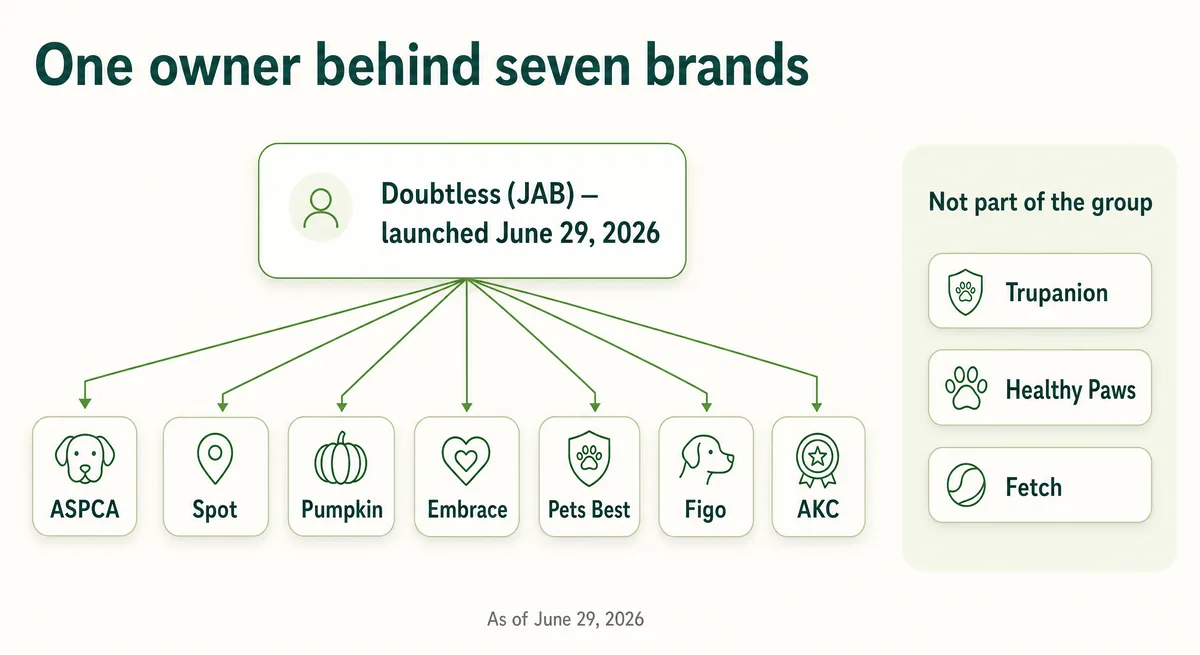
So when a best-of list presents ASPCA and Spot as entirely independent rivals, it misses that both sit in the same corporate portfolio and disclose overlapping possible insurer panels; their issued declarations can still name different legal insurers and their terms can differ. Pet owners have started to notice the ownership concentration — a widely upvoted Reddit comment calls it a "pet insurance monopoly" — though community lists often include Fetch incorrectly. Fetch's current new U.S. business discloses AXIS paper and is not part of that portfolio.
To be equally clear about what consolidation does not mean: shared ownership doesn't make the products identical. Spot and Pumpkin share an owner and disclose overlapping possible insurer panels, but the declarations can name different legal insurers and the products differ on caps, cure provisions, and price. That is why we show owner, brand, and possible legal insurer separately.
Financial strength, with dates
Three rating events from the past year show why an undated financial-strength letter is nearly useless.
- Crum & Forster was upgraded to AM Best A+ (Superior) on August 28, 2025 — yet most review pages still print the stale "A" for Spot, Pumpkin, and ASPCA policies. In this case, undated means undersold.
- IAIC spent four months under review. AM Best placed it under review on August 6, 2025 after re-filed 2024 statements showed its pet reinsurance failed risk transfer, and removed the status — affirming A− — on December 17, 2025, after renegotiated reinsurance and a $125 million capital contribution from its parent. A shopper reading an undated "A−" that fall had no idea any of it was happening.
- Trupanion's underwriter has no AM Best rating at all. The "AM Best downgraded APIC to B++" claim that circulates on review sites traces to no AM Best release we could find; APIC's actual rating is Demotech A′ (A Prime, "Unsurpassed"), affirmed June 19, 2026. Repeating the myth makes Trupanion look downgraded; omitting the Demotech rating makes it look unrated. Both errors are live on this SERP right now.
The roster itself also moves: Odie says it became program administrator for former ManyPets U.S. policies beginning January 1, 2025, and ManyPets is not a current new-policy choice in this review. Companion Protect no longer sold directly to consumers when we checked on July 4, 2026. Dating the roster isn't pedantry — it is the difference between current availability and a historical brand list.
What regulators know that review sites don't show
Three layers of regulator data exist for pet insurers — a complaint index, a brand-new market-conduct dataset, and an enforcement paper trail — and as of July 2026, no page ranking for "pet insurance reviews" uses more than a sliver of any of them. Here's what each one can tell you, what it can't, and how to pull it yourself.
The NAIC complaint index — powerful, and easy to misread
Every state files consumer complaints into a national database, and the NAIC turns them into a complaint index: 1.0 means a company drew exactly its expected share of complaints for its premium volume; 2.0 means twice its share. It's the closest thing to an objective, cross-company trust score in insurance.
Two things make an index misleading if it is quoted carelessly. First, the lookup scope matters: legal entity, jurisdiction, year, and selected line or coverage type. Selecting a pet-relevant line does not mean the result belongs to one marketing brand; the same insurer and line can support multiple programs, and brand-to-insurer mappings can change. Even a pet-focused entity such as APIC must be matched to the declarations and product being discussed. Second, values move by reporting period, so record the retrieval date and exact filters.
To check a carrier yourself, open the NAIC's Consumer Insurance Search, enter the underwriter's NAIC code from our ownership map (Trupanion's APIC is 12190), click the company result, and choose "Go To Complaint Trend Report." Sixty seconds, primary source, current year — better than anything a star rating can tell you.
The new pet MCAS — denial reasons, finally counted
Since the 2024 data year, every insurer writing any U.S. pet premium must file a pet-specific Market Conduct Annual Statement — there's no minimum-premium exemption. The filing instructions show what regulators now count that reviewers never could: claims closed without payment broken out by reason — pre-existing condition exclusion, waiting period, hereditary exclusion, benefit limit, below-deductible — plus company-initiated non-renewals, applications declined for health status, and lawsuits closed with consideration for the consumer.
Here's the honest catch: company-level filings are confidential. What's public is the state-level scorecard dashboard, with 2024 and 2025 data already posted. That means a hard rule you can use against any review site: no public per-carrier claim-denial rate exists for U.S. pet insurance. Any page quoting one — "Carrier X denies 14% of claims" — is quoting something that cannot be sourced. We'd love to print those numbers too. Nobody can.
The enforcement record — history with dates on it
The paper trail is thinner than you'd expect, which is itself information — but what exists is specific, and it clusters exactly where owner complaints cluster: pricing practices.
- 2020, Washington: the state fined two Chubb underwriters $950,000 (with $200,000 suspended) and ordered $4.7 million repaid to roughly 18,000 policyholders over policies sold through Healthy Paws — including raising rates based on pet age when filings said age wouldn't be a factor. Six years old now; we date it and weigh it as history, not headline.
- 2016–2019, Washington: the Trupanion group drew fines totaling $500,000 across three orders — incorrect rates and complaint handling, sales through unlicensed sellers, and gifts to vet clinics. Same caveat: dated history.
- 2023–2025, California: the current record is rate filings, not fines — the CDI approved the stacked Trupanion increases and the 45% Pets Best increase detailed in the renewal section below, and now maintains a public roster of pet insurers doing business in the state.
- March 2025, Washington: a $30,000 fine and cease-and-desist against a company marketing an unlicensed pet "insurance" club — proof the category is being watched.
Read the pattern: regulators have acted on how pet insurance is priced and sold, almost never on whether individual claims were wrongly denied — that's what MCAS was built to surface next. So when a review page shows you five stars and no filing history, it isn't summarizing this record. It just never looked.
Why every “best pet insurance” list names a different winner
Because "best" is a formula, and every site runs a different one. In our early-July 2026 audit of the pages ranking for pet insurance reviews, the major lists crowned different winners in the same season — not because the carriers changed, but because the scoring recipes did. Once you see the four mechanisms, the disagreement stops being confusing and starts being useful.
1. Weight artifacts. Forbes Advisor's methodology, as captured July 1, 2026, put half its score on cost — plan pricing counted for 50%, more than coverage, satisfaction, and company integrity combined. MoneyGeek ran affordability at 50% too (June 2026 capture). A formula that's half price will reliably crown the cheapest credible carrier — which tells you what's cheap, not what pays claims well at renewal time.
2. Micro-samples presented as findings. U.S. News (May 14, 2026 capture) built 60% of its score on a satisfaction survey of 844 respondents spread across 11 brands — roughly 77 owners per carrier, with per-brand counts undisclosed. Per-brand slices that thin swing on a handful of experiences, yet they're rendered as decimal-point ratings.
3. "Competitors" that share an owner. NerdWallet's list (May 1, 2026 capture) ended in a five-way 5.0 tie: ASPCA, Spot, MetLife, Hartville, and Pumpkin. Four of those five ride the same underwriting family we mapped in the ownership section. A tie between four storefronts of one group isn't a competition — it's a catalog.
4. Monetization sitting next to the ratings. Pet Insurance Review — the aggregator that ranks for this keyword — displayed a "100% Independent" badge in July 2026 with no methodology page anywhere, scores clustering at 4.9 for Embrace, Healthy Paws, Fetch, Trupanion, and Pets Best alike, and disclosed paid-click monetization. Pet Insurance Gurus lists "AM Best rating of the underwriter" among its criteria — and prints no actual rating on the page.
We state these as observations from the pages themselves, dated; draw your own conclusion about what a uniform wall of 4.9s can discriminate. Credit where due: Pawlicy Advisor — a licensed agency like us — refuses to print numerical scores at all and names underwriters; but its page hadn't been refreshed since February when we checked in July 2026, and stale honesty still misleads.
Now set all of that against the one rater with no affiliate stake. Consumer Reports, surveying 3,583 members between December 2024 and January 2025, concluded that none of the 14 providers it rated rose above a middling grade — while 53% of insured owners were very or completely satisfied and only 34% said they saved more than they paid in premiums and deductibles.
And the review platforms can't even agree with each other: Trustpilot's category page (captured January 29, 2026) had Trupanion and Nationwide at 4.4 while Pet Insurance Review scored the same carriers 4.9. Somebody's instrument is broken, and it isn't the pet owners'.
None of this means the incumbent lists are corrupt — cost-heavy weighting is a defensible choice if you know it's there. It means a "best" verdict is meaningless without its formula. So use any best-of list, including ours, the same way:
- Find the weights first. If you can't find them, you've learned the most important thing already.
- Check the sample. A satisfaction score without an n and a date is decoration.
- Map the winner to its underwriter and owner. Two "rival" winners from one family means the list compared brands, not insurers.
Our formula is published above, weights and all, precisely so you can run this test on us.
Carrier-by-carrier verdicts
Sixteen capsules, ordered by our score, each built the same way: the score with its date, who underwrites the policy, the fine-print clause that most defines it, the dated reputation record, what owners consistently report, and who it actually fits. These are deliberately short — each carrier gets a dedicated full review that goes clause-by-clause; until a carrier's review publishes, its capsule here is our complete verdict.
Embrace — 3.9/5
Score as of July 2026. Underwritten by American Modern Home Insurance Company, except American Southern Home Insurance Company in Florida; the American Modern group is AM Best A+, affirmed July 17, 2025. The current consumer disclosure says accident coverage begins on the policy effective date and illness has a 14-day wait; dog orthopedic timing and waiver availability vary by state, so the issued form controls.
No regulator-documented mass-renewal event surfaced in our July 2026 pass, but owner-platform sentiment is not quiet: renewal repricing is the loudest recurring grievance in the cited reports. Best for: a young, healthy pet whose owner wants the strongest all-around terms on our board. Full review: the dedicated Embrace review is scheduled for July 13, 2026.
Spot — 3.7/5
Score as of July 2026. Underwritten by United States Fire or Independence American depending on the issued policy; United States Fire's group was upgraded to AM Best A+ August 28, 2025. Two clauses define it: no upper age limit at enrollment, and a 180-day path under which an eligible cured condition may be reconsidered, subject to the issued form; knee and ligament events are carved out on every state form, chronic conditions on most (including the countrywide form) and congenital, hereditary and orthopedic conditions on some (such as the California form).
Owners report smooth claim experiences, with the recurring caution that a selected $5,000 annual cap can be thin for emergencies — higher options are available. Part of the Doubtless family. Best for: senior pets and owners who want a potential cure-back path. Full review → our dedicated Spot review is in production; until then, this is our complete verdict.
AKC (PetPartners) — 3.7/5
Score as of July 2026. Underwritten by Independence American or Independence Pet Insurance Company; IAIC alone is AM Best A−, affirmed December 17, 2025. One clause earns this ranking: after 365 days of continuous coverage, AKC's plans can cover even incurable pre-existing conditions — the only escape hatch of its kind among major carriers (not offered in Florida or Washington), and the reason the community treats it as the pre-existing workaround.
The trade-offs: longer standard waiting periods and a Doubtless-family underwriter that spent late 2025 under ratings review before its affirmation. Best for: switchers and owners of pets with a medical history who can commit to a full year. Full review → our dedicated AKC review is in production; until then, this is our complete verdict.
Prudent Pet — 3.6/5
Score as of July 2026. Underwritten by Markel Insurance Company or Markel American Insurance Company; Markel NA group AM Best A affirmed November 21, 2025. Our policy-form audit found no standout trap, and its platform reputation runs unusually high — Trustpilot 4.8 at the January 29, 2026 category capture.
The honest caveat: the record is thin because the book is smaller and younger than the giants', so there are simply fewer renewals and claims to judge. Independent of the Doubtless group. Best for: owners who want a well-rated independent and accept a shorter track record. Full review → our dedicated Prudent Pet review is in production; until then, this is our complete verdict.
Trupanion — 3.5/5
Score as of July 2026 — and the sharpest split verdict on this page. Issued by American Pet Insurance Company or ZPIC Insurance Company depending on jurisdiction. APIC has no AM Best rating (despite what some review sites claim), but Demotech rates it A′, affirmed June 19, 2026.
Trupanion’s direct product markets no payout caps and offers real-time VetDirect Pay at participating clinics. Its direct product commonly uses a lifetime per-condition deductible and excludes exam or office-visit fees, but lookback definitions, reimbursement, deductible type, and fee treatment vary by jurisdiction, form, and direct-versus-partner channel. Read the issued form rather than applying one direct-product design to every Trupanion-branded policy; owners of repeat-symptom pets can still experience disputed condition classification as a deductible treadmill.
The renewal record is regulator-documented: CDI-approved increases of +12%, +29%, and +33% average stacked across 2023–2025 in California — the middle step confirmed in Trupanion's own release on the approval. Owners with chronically ill pets report five-figure payouts and stay; owners of healthy pets watch premiums climb and leave. Both are right. Best for: a pet likely to develop an expensive chronic condition, insured young and held. Full review →
Pumpkin — 3.5/5
Score as of July 2026. Underwritten by United States Fire or Independence American depending on the issued policy; their ratings differ. Fine print includes a 180-day path under which an eligible cured condition may be reconsidered, with a knee/ligament carve-out on every state form, a chronic-condition carve-out on most (including the countrywide form) and congenital, hereditary and orthopedic carve-outs on some (such as the Florida form); reimbursement options include 80% and 90%.
The reputation signal to know: owners of older pets report steep late-life pricing — one dated account put a 10-year-old dog at $150/month with $250 projected — while the same policy paid roughly $24,000 in final-year claims. That's the senior-pet bargain in one anecdote: expensive, and it paid. Doubtless family. Best for: owners who want high reimbursement percentages and accept senior-age pricing. Full review → our dedicated Pumpkin review is in production; until then, this is our complete verdict.
ASPCA Pet Health Insurance — 3.5/5
Score as of July 2026. Underwritten by United States Fire or Independence American; declarations control and the two entities have different ratings. Know what the name is: the ASPCA licenses its brand for royalties — the charity doesn't run the insurer. The product publishes a 180-day path under which an eligible cured condition may be reconsidered, subject to the issued form, with a knee/ligament carve-out on every state form (chronic conditions are also carved out on most, including the countrywide form, and congenital, hereditary and orthopedic conditions on some, such as the Ohio form) and customizable plan options.
Few fresh owner reports surfaced in our July 2026 capture; we do not infer a brand-specific complaint record from shared ownership or administration. Best for: owners who want the Spot/Pumpkin-style terms from the family's longest-standing storefront — just don't pick it because of the name on the door. Full review → our dedicated ASPCA review is in production; until then, this is our complete verdict.
Pets Best — 3.4/5
Score as of July 2026. Current disclosures list American Pet, Independence American, Independence Pet, or MS Transverse as possible insurers — check your declarations page and attach a rating only to the named entity. The plan publishes a broad configuration range, and its Vet Direct Pay process can pay a clinic after claim approval and a signed release; pricing must be compared with matched quotes.
The record cuts both ways: California approved a 45% renewal increase effective April 2, 2025 on APIC-written policies — with the insurer itself projecting 12,700+ cancellations — and owners report slow claim processing alongside paid large claims; those anecdotes are not a measured carrier average. Best for: budget-first buyers who understand the renewal risk they're pricing in. Full review → our dedicated Pets Best review is in production; until then, this is our complete verdict.
Figo — 3.4/5
Score as of July 2026. Underwritten by Independence American (A−, December 17, 2025). Its fine-print distinction is the reimbursement ceiling — plans run up to 100%, which almost nobody else offers (note the pairing rules: the 100% option isn't available with every deductible and annual-limit combination).
Reputation is mixed and channel-dependent: the sharpest complaints in our capture came through the Costco-sold version — coverage denials and cancellation friction — and its underwriter spent August–December 2025 under ratings review before affirmation. Doubtless family. Best for: owners chasing a 100% reimbursement structure who buy direct and read the exclusions first. Full review → our dedicated Figo review is in production; until then, this is our complete verdict.
Lemonade — 3.4/5
Score as of July 2026. Issued by Lemonade Insurance Company or Metromile Insurance Company; LIC has Demotech A (affirmed June 19, 2026), while Metromile has no current Demotech FSR listed. Lemonade markets a low entry price, but only matched quotes establish relative cost; exam-fee coverage is sold as an add-on on the reviewed product. Its app can automate some claim handling, but no matched public dataset supports a universal speed ranking.
A January 2026 dispute over a five-figure chronic-kidney claim, denied with reference to a predictive tool, is one owner's account, but it matches the pattern owners describe: great until it's complicated. Best for: a young, healthy pet when the matched all-in quote, selected cap, and optional benefits fit. Full review: the dedicated Lemonade review is scheduled for July 19, 2026.
MetLife Pet — 3.3/5
Score as of July 2026. Underwritten by Metropolitan General or Independence American depending on state — and note that Metropolitan General had no separately published AM Best financial-strength rating when we checked in May 2026 (the "A+" quoted on review sites belongs to MetLife's life-insurance companies). Coverage earns real praise: multi-pet handling, and a documented case of a switcher whose conditions were grandfathered in rather than re-excluded.
Operations are the complaint: unreachable support and enrollment errors recur in owner reports, and one documented first-year renewal in our capture ran roughly +40%. Best for: multi-pet households that value coverage breadth over service polish. Full review → our dedicated MetLife review is in production; until then, this is our complete verdict.
Fetch — 3.1/5
Score as of July 2026. Current U.S. business is underwritten by AXIS Insurance Company, AM Best A (Excellent), affirmed August 28, 2025 — and Fetch is not part of the Doubtless group, despite what community lists claim. The terms look generous on paper — sick-visit exam fees are covered as a standard policy item, which most carriers don't do.
Owner threads allege claim-history-related increases and slow reimbursement, including one uncorroborated account that a coverage inquiry was recorded as a claim. These are dated anecdotes, not proof of Fetch's filed rating method or a measured average. Best for: buyers who value included sick-visit exam fees and obtain a satisfactory quote after reviewing the renewal-pricing disclosure. Full review → our dedicated Fetch review is in production; until then, this is our complete verdict.
Healthy Paws — 2.9/5
Score as of July 2026. Possible legal insurers include ACE American, Westchester Fire, Indemnity Insurance Company of North America, ACE Property and Casualty, Atlantic Employers, and other disclosed U.S. Chubb affiliates; declarations control. The cited AM Best release assigns A++ to listed Chubb operating subsidiaries, affirmed January 16, 2026 — the highest financial-strength grade among the listed current insurer ratings, paired with material renewal and coverage concerns.
The current consumer FAQ says exam fees are excluded and uses state-specific hip-dysplasia timing: 12 months in most states, but 30 days in 16 named jurisdictions; audited forms may also provide examination-based waiver mechanics; the cited eligibility rule requires enrollment before age six.
The record: the 2020 Washington order over age-based rating ($4.7M repaid), a 2020 age-escalation lawsuit terminated in December 2024 (allegations, not findings), owner-reported senior premiums like $240/month at age 12, and policyholder-reported notices — unconfirmed by the company — of benefits moving to 70%/$500 in December 2025.
Best for: a young, healthy pet whose owner values a simple accident-and-illness plan with a selectable no-annual-or-lifetime-cap option, can front bills or arrange case-specific payment, and can absorb renewal changes; existing policyholders should read our switching-trap answer before leaving. Full review: the dedicated Healthy Paws review is scheduled for July 16, 2026.
Nationwide — 2.6/5
Score as of July 2026. Underwritten by Veterinary Pet Insurance Co. / National Casualty; Nationwide group AM Best A affirmed November 7, 2025, a notch below its pre-2023 A+. The score is about commitment: Nationwide non-renewed roughly 100,000 pet policies from mid-2024, and a pending class action — allegations, not findings — quotes its own marketing promise never to drop pets for age.
Owner threads add denial letters whose scope owners can't parse. A carrier can pay claims well and still strand you at renewal; that's the specific risk here. Best for: eligible exotic-pet owners and buyers who value available routine-care options and can verify the exact product, channel, limits, and renewal risk; some legacy policyholders may also have plans worth keeping. Full review →
Physicians Mutual — not yet scored
We don't rate what we haven't audited, and as of July 2026 our policy-form audit of Physicians Mutual's pet product is pending — so no number. What we can report, dated: it's a newer entrant to pet insurance, and community sentiment is notably warm for a reason that says everything about this market — owners recommend it as the carrier least likely to be acquired by private equity.
That's a trust thesis, not a coverage verdict. Best for: watch this space; we'll score it when the audit completes. Full review → our dedicated Physicians Mutual review is planned; this capsule will carry the score first.
Odie — not yet scored
Unscored because our policy-form audit is incomplete. Odie's current disclosure lists Trisura Insurance Company, Trisura Specialty Insurance Company, and Accredited Surety & Casualty, with state availability varying; Clear Blue is legacy. Odie also absorbed ManyPets' exiting U.S. book from January 1, 2025 — a migration that produced a measurable complaint wave: 155 BBB complaints in three years, 143 of them in the last twelve months, as of July 4, 2026.
Community shorthand is blunt avoidance. We'll rate it only after the current form set and each insurer's terms have been audited. Best for: ManyPets refugees who should compare their migrated terms against the market before renewing. Full review → our dedicated Odie review is planned; this capsule will carry the score first.
Is any pet insurance actually worth it?
Usually yes — but not as a way to save money, and the industry's own numbers say so. In Consumer Reports' member survey (3,583 respondents, December 2024–January 2025), only 34% of insured owners saved more than they paid in premiums and deductibles — yet about two-thirds still called pet insurance worth it. Both numbers are true, and the gap between them is the honest answer.
The gap closes when you understand what you're buying. Most owners lose a little money on pet insurance most years — that's how insurance works. What they're paying for is the year they don't lose: the emergency where treatment is possible but expensive, and the decision would otherwise be made by their bank balance. Veterinary professionals put this more bluntly than any brochure; the most-upvoted vet answer in our community research says the point isn't saving on vet bills — it's never having to put a pet down for financial reasons.
The math makes the same case. Consumer Reports' surveyed owners paid median premiums of $654 a year for dogs. Set that against a single common orthopedic emergency: TPLO surgery for a torn ACL averages about $3,525, and ranges to $6,417 — one incident that can swallow five-plus years of premiums, and cruciate tears are famously bilateral. Owners who carry coverage know this trade: in a January 2026 U.S. News survey of 1,500 pet owners, 86% of insured owners said they get their money's worth — while 65% of the uninsured said cost is what keeps them out.
And yet the self-insurance argument deserves a straight telling, because it now wins top-comment slots even in threads where a pet died: put the premium into a dedicated savings account and cover emergencies yourself. That's rational — under conditions. So here's the conditional answer, not a crown:
- Young, healthy pet and thin savings: insurance is worth it — you're buying the best odds that a covered $5,000 night at the ER stays a bill, not a goodbye, within your policy's limits and exclusions.
- Substantial liquid savings and a tolerance for tail risk: self-insuring can be defensible — if the account really exists, really grows, and you'd really spend it at 2 a.m.
- Older pet or one with a medical history: run the numbers before assuming either way — enrollment caps and pre-existing exclusions change the math, and the fine print below decides more than the premium does.
We keep a full worked analysis — break-even math by pet age and scenario — in our guide to whether pet insurance is worth it. For this page, the verdict-relevant point is simpler: "worth it" depends far more on which policy and which clauses than on the category — which is why the capsules above rate carriers, not the concept.
The fine print that decides your claims
Star ratings measure how people feel; clauses decide what gets paid. These are the three clause families that generate the most denied claims, the most renewal shock, and the most regret in every thread we screened — with the actual carrier-by-carrier spread, dated.
Does any pet insurance cover hip dysplasia?
Yes — most accident-and-illness policies cover hip dysplasia, but three clauses decide whether yours will: the orthopedic waiting period, the enrollment-age cutoff, and the bilateral exclusion. Miss any one of them and a covered condition becomes a denied claim.
The spread is wide. Embrace says orthopedic timing varies by state; common dog forms use six months, and some state forms allow it to be reduced to as few as 14 days through an orthopedic exam process. Healthy Paws uses a state split: its current FAQ lists a 12-month hip-dysplasia wait in most states and a 30-day wait in 16 named jurisdictions, with exam-waiver rules there; the cited FAQ still limits hip-dysplasia coverage to pets enrolled before age six.
And the bilateral exclusion is the quiet one: if one hip (or knee) shows trouble before coverage, many policies exclude the other side too, on the logic that bilateral conditions are one condition. Regulators are tightening this space — the NAIC model act caps waiting periods at 30 days and mandates exam-based waivers in the states that have adopted it, and California went further by statute. But adoption is state-by-state, so read your state's rules, not a national average.
Does pet insurance cover diabetes and other chronic conditions?
Yes — if the policy was in force before the first symptom hit the chart. Enrolled after? Then it depends entirely on how your carrier defines "pre-existing," and that definition varies more than any other clause in pet insurance.
The documented spread is form-specific. ASPCA, Spot, Pumpkin, and Hartville publish a 180-day path under which an eligible curable condition may be reconsidered after the required symptom- and treatment-free period; it is not automatic, and the carve-outs vary by state form: knee/ligament events on every form, chronic conditions on most, and congenital, hereditary and orthopedic conditions on some (compare ASPCA's countrywide and Ohio forms). Healthy Paws' consumer FAQ describes a 365-day cure path for certain conditions, but the audited binding form does not promise that cure-back, so treat the 365-day statement as marketing guidance and obtain a written determination under the issued form.
Eligible AKC forms provide a separate 365-day pathway that can extend to some incurable pre-existing conditions, except in Florida and Washington and subject to endorsements and exclusions. In states that have enacted corresponding provisions from the NAIC model act, state law and the issued policy control the available protections.
The fights owners actually have are rarely about a diagnosis — they're about classification. A stray "signs of" entry in an old chart becomes the anchor for a pre-existing denial years later; the same mechanics let repeated symptoms be split into separate conditions, each restarting its own per-condition deductible. Two practical defenses from the veterans' playbook: if a denial letter is ambiguous about scope — one condition or the whole pet — make the carrier state it in writing; and appeal with a vet-written relatedness letter, which veterinary staff report succeeding routinely when diagnoses are coded consistently.
One thing we will not tell you: to delay a vet visit so nothing lands in the record. Records affect coverage — that's real — but a chart note costs you a clause fight; a missed diagnosis can cost your pet. Get the care, keep copies of everything, and pick the carrier whose lookback you can live with.
Renewal hikes: what the regulator record shows
Plan for pet-insurance premiums to change at renewal. Most carriers may use attained age alongside location, veterinary costs, experience, and approved rate changes. Trupanion is the important exception: it says birthdays and the individual pet's claims are not direct renewal factors, although its age-at-enrollment cohort rates can still rise materially.
California's Department of Insurance approved Trupanion increases of +12% (2023), +29% (2024), and a +33% average for 2025 across 97,153 policies — roughly +92% of stacked base-rate growth in about 25 months, every step approved. It approved a 45% Pets Best increase effective April 2, 2025, on about 64,770 policies — with the insurer itself projecting 12,700+ cancellations. For scale: veterinary-services inflation ran about 6.5% in 2025.
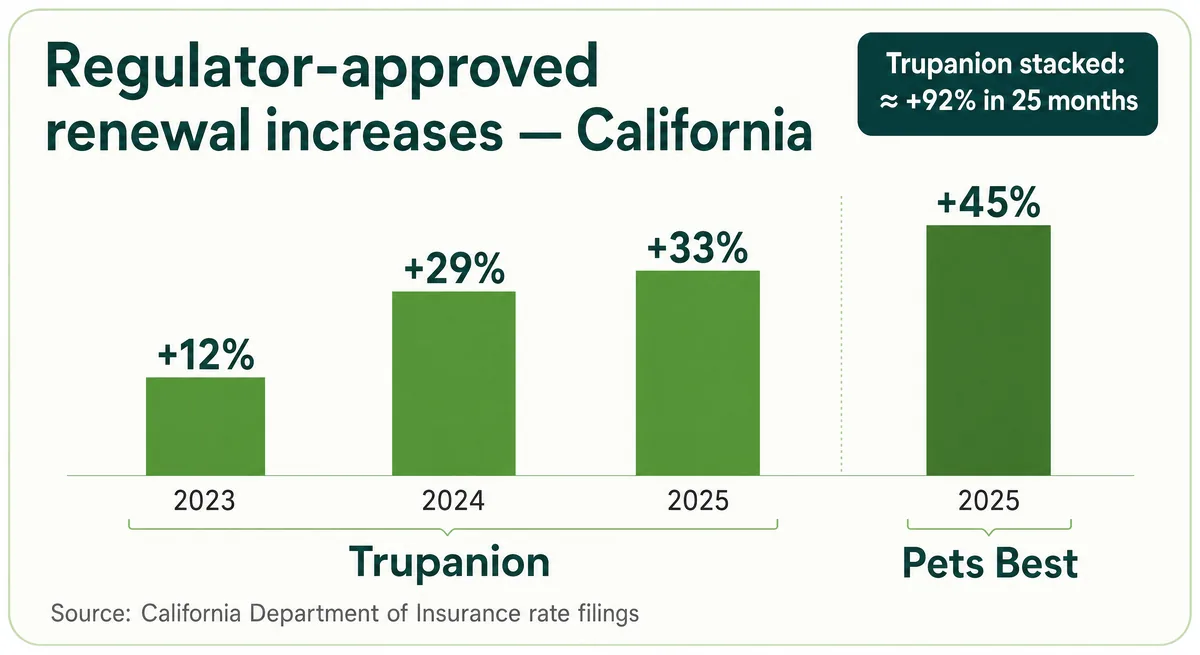
A carrier can also withdraw a product: Nationwide non-renewed roughly 100,000 pet policies from mid-2024, and the resulting class action is pending; its allegations are not findings. Owner posts describing a 40% renewal are separate anecdotes: without the same legal insurer, state, form, coverage, and rating profile, they cannot be matched to a California base-rate filing or used to rank carriers. California's SB 1217 now requires insurers to disclose whether premiums rise with age — ask that question in any state before buying.
Every clause in this section comes from the policy forms we track in our fine-print index, carrier by carrier — when a capsule above says "read the policy language," that's where it lives.
What Reddit actually says (dated and screened for astroturf)
Shoppers append "reddit" to pet insurance searches for one reason: editorial review pages read like ads, and owners want to know what people who actually filed claims experienced. The instinct is right. The execution needs care — because the community's own space has been partially captured by the same affiliate economics it exists to escape.
Here's the finding no ranking page prints. The original hub, r/petinsurance, is gone. Its successor — the roughly 29,000-member subreddit that Google ranks on page one for this exact keyword — was the subject of an August 2025 community investigation alleging it is partially operated as an affiliate funnel by its own moderators: seeded "what's the best insurance?" posts answered with links to commercial sites, and manufactured "best according to Reddit" threads built to intercept exactly the search you may have just made.
We saw the residue in our own July 2026 capture — a product plug here, a bare carrier-URL "recommendation" there, both reading as seeded. Quora's pet insurance feed showed the same monetization pattern when we reviewed it the same week.
So we screen before we cite. Every community claim on this page comes from a thread we read in full, carries its date, drops anything that pattern-matches to seeding, and is treated as sentiment — never as statistics. Unhappy owners write more than happy ones; that's the medium. What survives the screen is genuinely valuable, and it clusters into three durable themes:
- Verdicts split by pet, not by carrier quality. The community's Trupanion argument — five-figure payouts praised in one thread, deductible mechanics resented in the next — isn't noise; it's the accurate shape of the product. Our capsules keep those splits intact instead of averaging them away.
- Renewal stories are observations, not a rate study. A post can show what one owner experienced, but it cannot be matched to a filing or generalized without the legal insurer, state, form, pet profile, coverage, and rating factors. We label anecdotes separately from the regulator record.
- A method, not a carrier. The veterans' checklist repeats across threads: read the policy before the reviews, get a baseline exam at enrollment, don't buy limits under $10k, and understand your deductible structure before the first claim, not after.
The purest artifact of that third theme is a March 2025 post that became community canon: an owner who read the fine print of 16 companies and published the spreadsheet, with the takeaway that you should always read the policy documents yourself. That is the community's answer to review-site distrust — do the primary reading. It's also, not coincidentally, this page's entire method: the same reading, done as a full-time job, with the receipts and the dates shown.
One standing request: if a thread you trust contradicts a capsule above, check the dates first — carrier terms and scores drift, and a 2024 thread can be honestly wrong about a 2026 policy. If the dates hold, we want to know about it.
Frequently Asked Questions
If I switch pet insurers, does everything become pre-existing?
Not automatically, but switching creates a real pre-existing-condition risk. A diagnosis, symptom, or treatment in the record may meet the new policy's definition and be excluded; new effective dates and applicable waiting periods also apply. Eligible AKC forms provide a limited 365-day pathway, and some carriers may reconsider certain fully cured conditions after a stated period, subject to the issued form and written review. Get the new carrier's determination before leaving and do not cancel existing coverage until the new policy is effective.
Can I still get pet insurance for a senior dog or cat?
Usually you can buy a policy, but eligibility and value depend on the product, age, and exclusions. Spot publishes no upper age limit, while other carriers use product-specific caps. A diagnosis, symptom, or treatment already in the record may be excluded under the new form, but valid cure-back provisions and eligible AKC forms create limited pathways. Compare the exact enrollment rules, written exclusions, and quote rather than assuming the entire chart transfers or is excluded.
Does any pet insurance pay the vet directly?
There are several different models. Trupanion can adjudicate and pay participating clinics at checkout. Pets Best can pay a clinic after claim approval with a signed release. Healthy Paws may approve a pre-arranged clinic payment before treatment if the clinic agrees. Other products normally reimburse the policyholder. Confirm carrier approval, clinic participation, timing, and your remaining balance before relying on any option.
Do I have to use a specific vet with pet insurance?
Most U.S. pet policies let you seek eligible treatment from a licensed veterinarian without a human-health-style provider network, subject to the policy's definition of veterinarian, territory, and jurisdiction. That freedom does not guarantee reimbursement: the expense must still satisfy the issued policy. It is also separate from direct pay, which requires carrier approval and clinic participation where offered.
Do pet insurance companies profit by denying claims?
Not the way the fear suggests. Insurers price premiums above expected claims — that's the business — and denials cluster in defined clauses: pre-existing exclusions, waiting periods, and benefit limits, which is why reading the policy protects you better than reading star ratings. Worth knowing: no public per-carrier denial rate exists — insurers' market-conduct filings collect denials by reason, but company-level data is confidential. Any site quoting a specific denial percentage is quoting something that cannot be sourced.
What happened to ManyPets, Nationwide, and other brands I've seen reviewed?
The roster moved. Odie says it became program administrator for former ManyPets U.S. policies beginning January 1, 2025; ManyPets is not a current new-policy choice in this review. Nationwide non-renewed roughly 100,000 policies beginning in 2024 but still sells other pet products. Companion Protect did not sell directly to consumers when checked. Always distinguish a brand exit, a program-administrator change, a product withdrawal, and a carrier leaving the category.
Is Chewy CarePlus the same as Trupanion or Lemonade?
Related, not identical. CarePlus is Chewy's marketplace brand, underwritten by Trupanion's insurer or Lemonade depending on your location — but the plan terms are not carbon copies of those carriers' direct products, and owners report differences in deductible structure and exam-fee handling. Treat it as its own policy: read the CarePlus documents, not the underwriter's reviews, before buying.
What's a good NAIC complaint index score for a pet insurer?
Where an NAIC complaint index is available, below 1.0 means the legal entity drew fewer complaints than expected for the selected scope and premium volume; above 1.0 means more. Record the legal entity, jurisdiction, year, and selected line or coverage type. Even a properly filtered entity result is not automatically a marketing-brand score because one insurer can support multiple programs.
Why is my new-policy quote so much cheaper than the renewal stories on this page?
A new-policy quote and a renewal story may use different pets, locations, coverage, legal insurers, and policy editions. Most carriers may also use attained age and other filed factors at renewal. Trupanion says birthdays and the individual pet's claims are not direct renewal factors, but its age-at-enrollment cohort rate can still change. Compare matched quotes and filed methodology rather than projecting one owner's story onto your policy.
Sources
- American Pet Insurance Company — FSR A′ (A Prime) — Demotech
- Lemonade Insurance Company — FSR A (Exceptional) — Demotech
- AM Best Affirms Credit Ratings of Munich Re and Its Subsidiaries (American Modern) — Business Wire
- Crum & Forster Upgraded to A+ (Superior) Financial Strength Rating by AM Best — PR Newswire
- AM Best Removes From Under Review, Affirms Independence American Insurance Co. — Insurance Journal
- AXIS Insurance Company — AM Best rating disclosure — AM Best
- AM Best Affirms Credit Ratings of Chubb Limited and Its Subsidiaries — AM Best
- AM Best Affirms Credit Ratings of Nationwide Mutual Insurance Company — AM Best (press release PDF)
- AM Best Affirms Credit Ratings of Markel Group Inc. and Its Subsidiaries — Business Wire
- Prudent Pet — Underwriting Disclosure — Prudent Pet
- Pets Best — Underwriters & Licensing — Pets Best
- AKC Pet Insurance — Underwriters — AKC Pet Insurance
- ASPCA Pet Health Insurance — Underwriting — ASPCA Pet Health Insurance
- ASPCA Pet Health Insurance — Sample policy PET-P-20000-1024 (Texas, countrywide form) — ASPCA Pet Health Insurance / Independence American Insurance Company
- ASPCA Pet Health Insurance — Sample policy PET-P-20000-OH-1024 (Ohio) — ASPCA Pet Health Insurance / Independence American Insurance Company
- Spot — Underwriting — Spot Pet Insurance
- Spot — Sample policy PET-P-20000-1024 (countrywide form) — Spot Pet Insurance / Independence American Insurance Company
- Spot — Sample policy PET-P-20000-CA-IAIC-1024 (California) — Spot Pet Insurance / Independence American Insurance Company
- Pumpkin — Underwriting — Pumpkin
- Pumpkin — Sample policy PET-P-20000-1024 (Texas, countrywide form) — Pumpkin / Independence American Insurance Company
- Pumpkin — Sample policy PET-P-20000-FL-0525 (Florida) — Pumpkin / Independence American Insurance Company
- Fetch — current AXIS underwriting disclosure — Fetch
- Trupanion policyholders face 33% rate hike for pet insurance in California — Insurify (WFMZ syndication)
- 45% rate hike on the way for Pets Best policyholders in California — Insurify (WFMZ syndication)
- Nationwide to drop about 100,000 pet insurance policies — CBS News
- Kreidler orders two pet insurers to repay $4.7 million to consumers — Washington State OIC (Wayback capture)
- Pet Insurance Company category ratings — Trustpilot
- Odie Pet Insurance Marketing, Inc. — Complaints — Better Business Bureau
- Odie — Licensing Disclosures — Odie Pet Insurance
- I've had it with Trupanion — cancelling (r/petinsurancereviews) — Reddit
- My experience with Spot so far (r/petinsurancereviews) — Reddit
- Are there any good pet insurance companies left? (r/petinsurancereviews) — Reddit
- Pet insurance increased by 40% (r/Pets) — Reddit
- Lemonade pet claim denial dispute (r/Insurance) — Reddit
- MetLife price increase & switching carriers? (r/petinsurancereviews) — Reddit
- Why I chose Fetch — top comment warnings (r/petinsurancereviews) — Reddit
- Best pet insurance, for dogs specifically? (r/petinsurancereviews) — Reddit
- Insurance denying claims — how do I appeal? (r/Frenchbulldogs) — Reddit
- Vet bill scared me into getting pet insurance (r/petinsurancereviews) — Reddit
- Overwhelmed with picking the BEST (r/petinsurancereviews) — Reddit
- NAIC Pet Insurance Model Act (Model #633) — NAIC
- How to file a complaint and research complaints against insurance carriers — NAIC
- Pet Insurance Questions and Answers — California Department of Insurance
- 16 CFR Part 465 — Rule on the Use of Consumer Reviews and Testimonials — eCFR / Federal Trade Commission
- Consumer Reviews and Testimonials Rule: Questions and Answers — Federal Trade Commission
- Veterinarian services price inflation (BLS CPI series) — BLS CPI aggregation (in2013dollars)
- Doubtless Pet Care Launches to Provide Peace of Mind to Pet Parents — Business Wire
- JAB acquires majority stake in Pumpkin Insurance Services — Business Wire
- IPH Enters Strategic Partnership with Synchrony and Completes Acquisition of Pets Best — PR Newswire
- Independence Pet Holdings Acquires Spot Pet Insurance — Business Wire
- AM Best Places Credit Ratings of Independence American Insurance Company Under Review — Business Wire
- Important information for former ManyPets policyholders — Odie
- Embrace Pet Insurance — Underwriting — Embrace Pet Insurance
- Healthy Paws — Legal / Underwriting — Healthy Paws
- Westchester sample policy — binding-form comparison for Healthy Paws cure guidance — Healthy Paws
- Chewy CarePlus Pet Insurance Review — NerdWallet
- Consumer Insurance Search — NAIC
- Market Conduct Annual Statement — 2024 (pet insurance line) — NAIC
- MCAS Instructions — Pet insurance, 2024 data year — NAIC
- MCAS Data Dashboard — NAIC
- Pet Insurers Doing Business in California — California Department of Insurance
- Washington Fines Petcube, Orders It to Stop Marketing Unauthorized Pet Insurance — Insurance Journal
- Best Pet Insurance Companies Of 2026 — Forbes Advisor
- Best Pet Insurance Companies — MoneyGeek
- Best Pet Insurance Companies of 2026 — U.S. News & World Report
- Best Pet Insurance Companies for 2026 — NerdWallet
- Pet Insurance Review — ratings hub — PetInsuranceReview.com
- Pet Insurance Gurus — best pet insurance rankings — PetInsuranceGurus.com
- Best Pet Insurance Companies (member survey, Dec 2024–Jan 2025) — Consumer Reports
- Best Pet Insurance — comparison guide — Pawlicy Advisor
- Trupanion Pet Insurance Review — U.S. News & World Report
- Pet Insurance for Pre-Existing Conditions — NerdWallet
- Embrace Pet Insurance — Waiting Periods — Embrace Pet Insurance
- Benanav v. Healthy Paws Pet Insurance LLC — docket — CourtListener
- Healthy Paws Pet Insurance — consumer reviews — ConsumerAffairs
- Wanting a vet's honest opinion about pet insurance (r/AskVet) — Reddit
- Pet Owner Cost Survey (January 2026, n=1,500) — U.S. News & World Report
- California Insurance Code §12880.7 (SB 1217 disclosures and waiting-period limits) — Justia
- Silberman et al. v. Nationwide Mutual Insurance Company — complaint — ClassAction.org
- r/petinsurancereviews run as affiliate spam ring by its own mods — investigation (r/TheseFuckingAccounts) — Reddit
- I read the fine print of 16 companies and made a spreadsheet (r/petinsurancereviews) — Reddit
- Best Age to Get Pet Insurance: When to Enroll Your Dog or Cat — Spot Pet Insurance
- Pet Insurance Plans and FAQs — Figo Pet Insurance
- Does Fetch Pet Insurance cover exam fees? — Fetch Pet Insurance
- Pre-Existing Conditions Coverage for Pets — AKC Pet Insurance
- Trupanion Comments on Rate Filing Approval in California — GlobeNewswire (Trupanion release)
- Silberman v. Nationwide docket and November 20, 2025 dismissal — U.S. District Court docket via Justia
- State of the Industry Report 2026 Highlights (2025 data) — NAPHIA
You may be interested...
More published guides that build on this topic.
 Reviews
PetPartners Pet Insurance Review (2026): What the Fine Print Actually Says
PetPartners administers policies it doesn't underwrite. We read the forms: who really pays your claims, what a per-incident cap costs you, and the renewal trap.
 Reviews
Chewy CarePlus Pet Insurance Review (2026): Who Insures You, and Which Plan You're Really Buying
Chewy CarePlus is one brand over two insurers, Trupanion and Lemonade. A licensed agent's 2026 review: which you get, the deductible catch, and the risk.
 Reviews
Companion Protect Pet Insurance Review (2026): Who Underwrites It, and Which Version You Have
A licensed agent's 2026 Companion Protect review: who actually underwrites it, why many reviews describe a retired product, and how to tell which one you have.
 Reviews
Kanguro Pet Insurance Review (2026): Is It Worth It — and Who Actually Backs It?
A licensed agent's 2026 Kanguro review: who really underwrites it, how its two policy forms disagree on waiting periods, what it costs, and what to check.
 Reviews
Odie Pet Insurance Review (2026): Cheap Premiums, Real Claims Friction
Odie is cheap but claims-sensitive. See who underwrites it (Trisura/Accredited), how claims pay out, the ManyPets & BBB record, and whether it is worth it.
 Reviews
USAA Pet Insurance Review (2026): Is It Worth It — and Who Actually Backs It?
USAA doesn't underwrite its pet insurance — American Modern (A+) does, via Embrace. What the member discount really buys, its real cost, and the renewal catch.
 Reviews
Wagmo Pet Insurance Review (2026): Is It Insurance, a Wellness Plan — or Both?
A licensed agent's honest 2026 Wagmo review: it's two products — a wellness membership and a separately underwritten insurance policy. Costs, coverage, fit.
 Reviews
Fetch Pet Insurance Review (2026): Is It Worth It — and Who Actually Backs It?
Who underwrites Fetch, what its policy really covers and costs as your pet ages, and what its 4.6-star-vs-1.13-BBB ratings mean — an honest 2026 verdict.
 Reviews
MetLife Pet Insurance Review (2026): Is It Worth It — and Who Actually Backs It?
Who really underwrites MetLife, what its policy covers and excludes, what it costs as your pet ages, and the employer-benefit catch — the honest 2026 review.
 Reviews
Prudent Pet Insurance Review (2026): Is It Worth It — and Who Actually Backs It?
Who underwrites Prudent (Markel), how its claims really pay out, and what the fine print says — where its own pages disagree — plus an honest 2026 verdict.
 Reviews
Hartville Pet Insurance Review (2026): Is It Worth It — and Who Actually Backs It?
We read Hartville's policy and its underwriters' ratings: who really pays your claim, what's covered, what it costs, and what the 24PetWatch switch means.
 Reviews
Pumpkin Pet Insurance Review (2026): Is Its Broad Coverage Worth the Rising Price?
An honest 2026 Pumpkin Pet Insurance review: who underwrites it, the knee-clause fine print, true cost as your pet ages, PumpkinNow, and who to skip.
 Reviews
Spot Pet Insurance Review (2026): Is It Worth It — and Who Actually Backs It?
An honest 2026 Spot Pet Insurance review: who really underwrites it, the waiting-period and knee-clause traps, true cost vs. average, and Spot vs. Pumpkin.
 Reviews
AKC Pet Insurance Review (2026): Does the Kennel Club's Plan Actually Pay?
AKC Pet Insurance is a licensed brand underwritten by Independence American. Here's what it really covers, what it costs, and whether it fits purebred owners.
 Reviews
ASPCA Pet Insurance Review (2026): Is It Worth It — and Does the ASPCA Actually Run It?
An honest 2026 review of ASPCA pet insurance — who really underwrites it, what it costs, the fine-print traps, and whether buying supports the ASPCA charity.
 Reviews
Embrace Pet Insurance Review (2026): Is It Worth It?
A licensed agent's honest 2026 Embrace review: real costs, the fine print, how claims work, and how it compares to Lemonade, so you can decide if it fits.
 Reviews
Figo Pet Insurance Review (2026): Is It Worth It?
An honest, broker's-eye Figo review: the limits on its 100% option, why claims get denied, how the fine print changes with your state, and who should skip it.
 Reviews
Healthy Paws Pet Insurance Review (2026): Is It Worth It?
A licensed agent's honest 2026 Healthy Paws review: real costs, the rate-hike reality, what's not covered, and how claims work, so you can decide if it fits.
 Reviews
Lemonade Pet Insurance Review (2026): Is It Worth It?
Evidence-based 2026 Lemonade review covering matched-price methodology, add-ons, waits, underwriters, ratings, renewals, and claims.
 Reviews
Pets Best Pet Insurance Review (2026): Is It Worth It?
Evidence-based 2026 Pets Best review covering source-specific prices, plan and form options, waits, exact underwriters, claims, direct pay, and renewal factors.
 Reviews
Nationwide Pet Insurance Review (2026): Is It Worth It After the Cancellations?
An honest 2026 Nationwide pet insurance review: how each plan really pays (benefit schedule vs. % of bill), the non-renewals, real costs, and who it's for.
 Reviews
Trupanion Pet Insurance Review (2026): Cost, Terms & Direct Pay
Review Trupanion's direct-product cost, lifetime per-condition deductible, exclusions, VetDirect Pay, and state/form/channel caveats.