


Trupanion is a U.S. pet-insurance brand built around one unusual idea: a per-condition, lifetime deductible you pay once per illness or injury — not every year — paired with up to 90% reimbursement and no payout caps, plus the option to pay your vet directly at checkout. Our short verdict: the structure fits some pets and budgets much better than others, and only a matched quote can establish its price for you.
That "once per condition" deductible is the whole ballgame, and it's the part most reviews gloss over. For a pet that develops a chronic, lifelong condition, meeting the deductible a single time can save you thousands. For a healthy pet with a string of unrelated one-off problems, an ordinary annual deductible can work out cheaper.
So it tends to fit owners of chronic-illness-prone or large, predisposed breeds, anyone who wants uncapped coverage without fronting a five-figure bill, and people enrolling a young, healthy pet before problems become "pre-existing." It's a weaker fit for budget shoppers, low-risk pets, and anyone who wants routine-care coverage or needs exam-fee coverage under the product offered to them. This review focuses on Trupanion's direct product; a Trupanion-branded partner product, such as the plan sold through Chewy, can use a different deductible and exam-fee design.
We're a licensed agency, not a review farm, and we've read Trupanion's policy so you don't have to. Below: what it really costs, what the fine print excludes, and whether it's right for your pet. Here's how we review.
Table of Contents
- Our Verdict at a Glance
- How the Per-Condition Deductible Works
- What Trupanion Really Costs (and Why Premiums Rise)
- Coverage, Reimbursement & VetDirect Pay
- What Trupanion Doesn't Cover
- Is Trupanion Legit? Financial Strength & Complaints
- Trupanion vs. Lemonade
- What Real Owners Say
- Who Should (and Shouldn't) Choose Trupanion
- Frequently Asked Questions
- Sources
Our Verdict at a Glance
We rate Trupanion 3.5 out of 5. It combines uncapped benefits, a lifetime per-condition deductible, and clinic-level direct pay, but no public matched dataset establishes a national price rank. Whether that trade is worth it comes down to your pet's health risk and your budget, not a one-size verdict. Our rating rewards the uncapped coverage and direct-to-vet payment, and marks it down for the price and the fine print (see how we review).
Pros
- No annual, per-incident, or lifetime payout caps, with reimbursement up to 90%; the issued form and jurisdiction control.
- A per-condition deductible that can save thousands on a chronic, lifelong illness — you pay it once, not every year.
- At participating clinics, VetDirect Pay can settle approved charges with your vet at checkout, so you don't front a five-figure bill and wait for a refund.
- Covers hereditary and congenital conditions and reimburses your actual vet bill, not a capped fee schedule.
Cons
- Published third-party sample premiums can be high, but they do not establish a national carrier ranking without matched profiles.
- Cohort-based renewal increases can be steep — double-digit, and sometimes far more.
- The direct product has no wellness plan and its current materials describe no coverage for exam fees or routine care; partner/channel products can differ.
- That per-condition deductible works against you if your pet has many small, unrelated problems.
Best for: owners of chronic-illness-prone or large, predisposed breeds who enroll before any symptoms appear; anyone who wants uncapped catastrophic protection; and owners who couldn't easily float a five-figure emergency bill out of pocket.
Not ideal for: budget shoppers comfortable with a payout cap, pets that mostly generate small one-off issues, owners who want routine or exam-fee coverage, and anyone likely to cancel after a few price hikes — you have to keep the policy to bank the deductible advantage.
How the Per-Condition Deductible Works
The direct Trupanion product reviewed charges its deductible per condition, not per year: you meet it once for each new illness or injury, and it never resets as long as your coverage stays continuously active. That single design choice is the biggest reason Trupanion can be a bargain for one pet and a poor deal for another, and it's the part most reviews skate past.
You choose a deductible from $0 to $1,000. With an ordinary annual deductible, the meter resets every policy year. On that direct-product design, once you have paid the deductible for, say, allergies, you do not pay that condition deductible again while coverage remains continuously active.
Where it saves you money
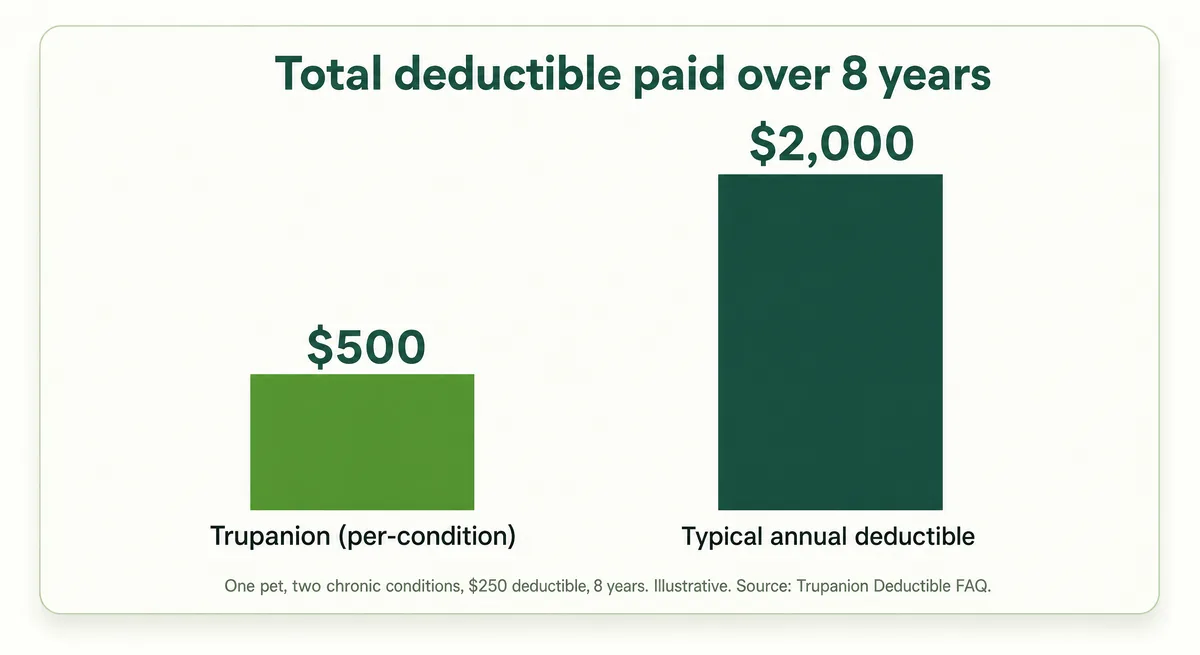
Say your dog develops two chronic conditions — allergies and diabetes — on a $250 deductible, over eight years of treatment. Under the illustrated direct-product design, you pay $250 once for each: $500 total. A carrier with a $250 annual deductible would charge it every year: $250 × 8 = $2,000. That's roughly $1,500 less over your pet's life, and the gap only widens the longer a lifelong condition is treated (Trupanion's own worked example).
Where it costs you more
Now flip it. A healthy pet with a run of unrelated one-off problems — a swallowed sock one month, an ear infection the next, a torn nail after that — can trigger a fresh deductible each time. Four separate conditions in a year could mean four $250 deductibles ($1,000) with Trupanion versus a single $250 with an annual-deductible carrier (NerdWallet). And whether recurring symptoms count as one condition or several is Trupanion's call, which owners sometimes dispute.
One more wrinkle: on a form with 90% reimbursement, Trupanion applies that percentage before subtracting the remaining deductible, which nets slightly less than carriers that subtract the deductible first. The gap is 10% of your remaining deductible — about $20 on a $200 deductible (NerdWallet).
The catch most reviews skip
That "never resets" promise only holds while the policy stays continuously active — let it lapse and re-enroll, and conditions you'd built up coverage for can be treated as pre-existing. You can also only lower your deductible within the first 30 days; after that you can raise it but not reduce it. If any of this is load-bearing for your budget, confirm the current terms in your state's sample policy before you buy.
What Trupanion Really Costs (and Why Premiums Rise)
No public matched dataset establishes Trupanion's national price rank. Its quote varies with the pet's breed, age at enrollment, location, deductible, jurisdiction, and product. In one mid-2026 third-party estimate, U.S. News put Trupanion at about $165 a month for a dog and $83 for a cat, but that source-specific estimate is not comparable with NAPHIA's market average or a different carrier profile. It is one observation, not a national rank.
Because location and breed drive so much, real quotes range widely. NerdWallet's 2026 sample quotes for pets in Katy, Texas ran from about $168 a month for a medium mixed-breed dog to $371 for a French bulldog at age 2, and climb further in high-cost metros. Those source-specific profiles show possible range, not a like-for-like comparison with other carriers. Trupanion prices on age at enrollment, breed, location, and the chosen deductible, so run same-day matched quotes — a "starts at" figure won't reflect your pet.
"No birthday pricing" vs. real increases (can you negotiate?)
Trupanion's "Pricing Promise" is true as far as it goes: your premium won't rise just because your pet had a birthday (Trupanion, How We Price). But that's not a frozen price. Trupanion raises rates by cohort — groups of similar pets by breed, enrollment age, and location — as regional vet costs climb. So your bill can still jump sharply, just not because of your pet's age.
How sharply? California regulators approved Trupanion increases of roughly 12%, then 29%, then 33% in about two years, with the largest effective for mid-2025 renewals. One California owner reported their monthly premium climbing from $128 to $251 over three years (an owner account, not a typical figure). Cohort increases have hit owners in other states too.
Can you push back? Not really — pet insurance rates are filed with and overseen by state insurance regulators (the exact rules vary by state), so there's no haggling a renewal down. What you can do is change your coverage: raising your deductible (or lowering your reimbursement percentage where your state allows it) trims the premium. Just weigh that against the long-term deductible math above.
Coverage, Reimbursement & VetDirect Pay
Trupanion's direct accident-and-illness product reimburses up to 90% of eligible actual veterinary costs with no payout caps, and it can pay your vet directly at checkout. The direct product has no accident-only tier or wellness plan; partner/channel products can differ.
The plan covers hospitalization and surgery, diagnostics, hereditary and congenital conditions, cancer, prescription medications, and some prescription food and supplements. Two features set it apart:
- No payout limits. No per-incident, annual, or lifetime cap — which matters when a cancer or complex-surgery case runs into five figures.
- Actual-cost reimbursement. Trupanion pays a percentage of your real invoice, not a "reasonable and customary" fee schedule that can leave you owing the difference at a pricey specialty or emergency hospital.
Current direct-product materials commonly show 90% reimbursement, while lower reimbursement or different coinsurance options exist in some jurisdictions and forms. After a condition's deductible, you pay the selected coinsurance plus excluded charges. The direct product materials reviewed exclude exam fees and taxes; partner/channel products can differ.
VetDirect Pay: the standout feature (and its limit)
VetDirect Pay is Trupanion's signature perk. At a participating clinic, the hospital submits your invoice and Trupanion sends its share straight to the vet, so you cover the deductible, the selected coinsurance (10% on a 90% form), and excluded items — no fronting a big bill and waiting weeks for a refund. One owner described a roughly $988 bill where Trupanion paid about $719 within about four minutes at checkout (an owner account).
The catch: it only works at clinics running Trupanion's software. Many primary vets and some ER and specialty hospitals participate, but plenty don't — call ahead to confirm, especially for your nearest emergency hospital. Where direct pay is unavailable, you pay up front and file for reimbursement. One third-party review reports most claims within 24 hours, but actual timing depends on the claim, records, payment method, and current carrier process.
What Trupanion Doesn't Cover
The direct Trupanion product reviewed excludes exam fees, sales tax, routine care, wellness care, and pre-existing conditions — and one clause, the bilateral exclusion, catches owners off guard.
Exam fees and taxes. Nearly every sick visit carries an exam or office-visit fee, and the direct product Trupanion describes excludes it — you pay it out of pocket even on an otherwise-covered claim. A Trupanion-branded partner product can differ, so identify the product and issued form. It also excludes sales tax and all routine and preventive care: vaccines, spay/neuter, flea and tick control, and dental cleanings.
Pre-existing conditions. Anything your pet showed signs or evidence of in the 18 months before your policy's effective date — or during the waiting period — is excluded, even if it was never formally diagnosed. (The policy form can reach back further than 18 months, so check your state's sample policy.) This is why enrolling a young, healthy pet matters: buying a policy is easy, but getting a specific condition covered is a separate question.
The bilateral exclusion (the knee trap)
This is the fine print that surprises people most. For a set of conditions that tend to strike both sides of the body, if your pet showed signs on one side before coverage began (or during the waiting period), the other side is excluded too — even years later. So if your dog had a minor luxating patella in the left knee before enrolling, a later luxating patella needing surgery on the right knee can be denied under the bilateral clause, even though the right side was healthy at signup. State policy forms vary, so confirm the exact list.
The listed bilateral conditions include cruciate ligament injuries, luxating patella, hip and elbow dysplasia, cataracts, cherry eye, glaucoma, and entropion/ectropion. If your pet has any history on one side, ask Trupanion in writing how it will treat the other side before you count on that coverage.
Coverage timing varies by location, form, and enrollment channel. Trupanion's current national timing FAQ describes 5 days for injury coverage and 30 days for illness coverage, while explicitly telling shoppers that timing varies by location. A current state disclosure example instead says the policy has no formal waiting periods but uses a delay between enrollment and the effective date; an eligible Exam Day Offer can make it effective immediately. Those structures are not interchangeable. Use the effective date, coverage-start language, and any condition-specific timing in your issued state form and declarations.
Is Trupanion Legit? Financial Strength & Complaints
Yes — Trupanion is a legitimate, state-regulated insurance program, not a scam. Depending on jurisdiction and the issued form, U.S. policies can name American Pet Insurance Company (APIC) or ZPIC Insurance Company (ZPIC) as the legal insurer. But Trupanion's Q2 2026 Form 10-Q, filed August 5, 2026, says APIC "underwrites all of our policies in the U.S." and ZPIC "has not yet begun underwriting activity." The declarations page controls. The honest nuance is that ratings attach to the named insurer, not automatically to the Trupanion brand.
Financial strength. APIC carries a Demotech Financial Stability Rating of A′ (A Prime, "Unsurpassed"), affirmed June 19, 2026. APIC does not have an AM Best rating, so an older "B++" claim should not be repeated without a current AM Best record. This Demotech rating applies to APIC only; it must not be transferred to ZPIC or to every policy sold under the Trupanion brand. On capital, Trupanion's insurance arm reported a cushion above its regulatory minimum at the end of 2024, but the current insurer named on your declarations and the policy terms remain the relevant claim protections.
What the complaint record actually shows
Here's where reviews split. On the Better Business Bureau, the Trupanion brand is BBB-accredited with an A+ rating, yet its customer-review average sits near 1 out of 5 across a couple hundred reviews. On Trustpilot it scores about 4.4 stars — but that's a paid, company-managed profile that actively invites customers to review, so it skews positive. Neither number alone tells the story.
Customer-review platforms are self-selected and cannot establish a claim-payment rate or carrier ranking. Raw complaint counts also lack a valid denominator. For regulator data, identify the declaration-page insurer, jurisdiction, year, and selected line or coverage type; a multi-line legal-entity complaint index is not a Trupanion-pet denial rate, and public pet MCAS company-level filings are confidential. See the scope rules in our reviews methodology.
A 2016 Washington action addressed specified rate, advertising, and licensing violations. That historical order should be described on its own terms; it is neither a current pet-complaint index nor proof of a present claim-denial rate.
Trupanion vs. Lemonade
Trupanion and Lemonade use materially different designs: Trupanion's direct product emphasizes uncapped benefits, a lifetime per-condition deductible, and participating-clinic direct pay; Lemonade uses an annual deductible, an annual limit, and an app-first reimbursement model. Price still requires matched quotes.
| Feature | Trupanion | Lemonade |
|---|---|---|
| Deductible | Per-condition, lifetime ($0–$1,000) | Annual, resets yearly ($100–$750) |
| Reimbursement | Up to 90%; form/jurisdiction-specific | 70%, 80%, or 90% |
| Payout limit | Unlimited | Annual cap ($5,000–$100,000) |
| Pay the vet directly? | Yes (VetDirect Pay) | No — reimburses you via app |
| Price comparison | Matched quote required | Matched quote required; eligible bundle discounts vary |
| Wellness/routine care | Not offered | Optional add-on |
| Availability | Manager licensed in all 50 states + DC; product/form availability varies | 41 states + DC in Lemonade's July 9, 2026 consumer FAQ |
The deepest difference is the deductible: Lemonade's resets every year, while Trupanion's is paid once per condition and then never again for that condition — so the two designs quietly reward very different pets and spending patterns.
Which should you pick? If you have a young, low-risk pet and a tight budget — and you're comfortable with a payout cap and paying up front — the current quote and optional wellness coverage of this app-based plan may fit better. If your pet is a chronic-illness-prone or large breed, or you value uncapped coverage and participating-clinic direct pay, compare whether Trupanion's per-condition deductible and matched quote fit your budget.
One catch cuts both ways: Lemonade uses attained-age pricing, so its premiums climb as your pet gets older, while Trupanion's rise by cohort instead — either can reprice at renewal. For the full breakdown, including how each handles pre-existing conditions and claims, see our side-by-side comparisons.
What Real Owners Say
Across Reddit and Quora, the crowd consensus is consistent: Trupanion pays claims reliably and the direct pay is a genuine lifesaver — but the rising price is the near-universal gripe. (These are owner opinions, not verified facts, and forums skew toward people with something to vent about.)
The loudest complaint is renewal increases. On r/petinsurancereviews, rate-hike threads outnumber everything else. Owners describe premiums climbing steeply over a few years, especially in California and other high-cost areas, and several feel "trapped" — unable to afford the new price yet unable to switch without their pet's conditions becoming pre-existing somewhere else.
The biggest surprise is the per-condition deductible. Newcomers repeatedly realize it applies per condition, not per year — and that a pet with recurring, separate issues can trigger a fresh deductible each time.
What owners praise. Two themes hold up even among critics. First, Trupanion actually pays: some owners report five-figure and even ~$80,000 lifetime payouts on chronically ill pets. Second, VetDirect Pay is the number-one reason people stay, because they never have to front a huge bill. On Quora, a licensed insurance agent framed it simply: pet insurance is peace of mind you're glad to have when the emergency arrives.
The net verdict from the crowd: if you understand the deductible and can stomach the price curve, Trupanion is a trusted, generous insurer — just go in with eyes open about where the cost is headed.
Who Should (and Shouldn't) Choose Trupanion
Trupanion earns its premium for pets with real catastrophic or chronic risk, and it's a poor deal for low-risk pets whose owners shop on price first. Here's how that breaks down by situation.
Choose Trupanion if…
- You're insuring a young, healthy puppy or kitten — enroll early, before anything can be called pre-existing, and you get the most from the lifetime deductible.
- Your pet is a breed prone to chronic or hereditary conditions (allergies, diabetes, hip or elbow problems, cancer), where the per-condition deductible and uncapped payouts earn their keep.
- You'd struggle to front a $5,000–$10,000 emergency bill and want VetDirect Pay to settle it at the counter.
Look elsewhere if…
- You have a low-risk pet and a tight budget, and a cheaper annual-deductible plan — with a payout cap you can live with — makes more sense.
- You want wellness or exam-fee coverage: the direct product reviewed offers neither and has no multi-pet discount; partner/channel products can differ.
- You're on a fixed income and worried a cohort rate hike could price you out in a few years — a real risk for pets enrolled later in life.
Whichever way you lean, if you go with Trupanion, enroll before symptoms appear — and know that switching away later can be hard, because ongoing or chronic conditions are likely to count as pre-existing at a new carrier (rules for long-cured conditions vary). To pressure-test the price against alternatives, weigh it in our side-by-side comparisons and run your own numbers with our cost guide.
Frequently Asked Questions
Is Trupanion pet insurance worth it?
It depends on your pet and your budget. Trupanion’s direct product can fit pets with chronic or catastrophic risk — its lifetime per-condition deductible and no-payout-limit structure can suit lifelong conditions, and VetDirect Pay can reduce what you front at participating clinics. Partner/channel forms can differ. It's a weaker value for young, low-risk pets on a tight budget, who should compare a capped annual-deductible plan on identical quote inputs.
Does Trupanion raise your rates when you file a claim?
No. Trupanion doesn't raise your premium because of the claims you file, or because your pet had a birthday. Instead it adjusts rates by cohort — groups of similar pets by breed, age at enrollment, and location — as veterinary costs climb in your area (Trupanion). So your bill can still rise sharply over time, just not as a penalty for using your coverage.
What isn't covered by Trupanion?
The direct Trupanion product reviewed excludes exam or office-visit fees, sales tax, and routine or wellness care (vaccines, spay/neuter, dental cleanings, flea and tick control). It also excludes pre-existing conditions and applies a bilateral clause — a prior issue on one knee, hip, or eye can permanently exclude the other side (Trupanion). Always read your state's sample policy for the full list.
Does Trupanion pay the vet directly?
Yes — at participating clinics. Trupanion's VetDirect Pay lets the hospital bill Trupanion at checkout, so you pay the deductible, the selected coinsurance (10% on a 90% form), and excluded items instead of fronting the whole invoice. It only works where the clinic runs Trupanion's software, so confirm with your regular vet and your nearest emergency hospital before you count on it.
How much does Trupanion cost per month?
There's no single price — it depends on your pet's breed, age at enrollment, ZIP code, and deductible. As a rough gauge, one 2026 national sample put Trupanion near $165 a month for a dog and $83 for a cat, under that source's assumptions; it is not a national price rank (U.S. News). Large or high-risk breeds in expensive metros can run well over $200. Always pull a real quote.
Which pet insurer has the fewest complaints?
There is no clean “fewest complaints” winner. Raw counts need a denominator, while an NAIC complaint index must be read for the exact legal insurer, jurisdiction, year, and selected line or coverage type; a multi-line entity index is not a pet-brand denial rate. Public pet MCAS company-level filings are confidential, so do not infer a Trupanion-pet ranking from brand reviews or raw totals.
Trupanion or Lemonade — which is better?
Neither is universally better; they suit different pets. Trupanion fits chronic-illness-prone or large breeds and owners who want uncapped coverage and direct-to-vet payment. Lemonade fits budget-minded owners of young, low-risk pets who are fine with an annual deductible, a payout cap, and paying up front. See our side-by-side comparisons to weigh them for your own pet.
Sources
- Deductibles — how Trupanion's per-condition deductible works — Trupanion
- No payout limits — Trupanion
- Trupanion Pet Insurance Review 2026 — U.S. News & World Report
- What isn't covered by a Trupanion policy — Trupanion
- Trupanion Pet Insurance Review 2026: Pros and Cons — NerdWallet
- How We Price (Policy Basics flyer) — Trupanion
- Trupanion hits California pet owners with another rate hike — Insurify
- Trupanion 33.69% price increase in 2026 (owner report) — Reddit — r/petinsurancereviews
- Pet insurance coverage — Trupanion
- Vet direct pay vs. reimbursement — Trupanion
- Data point for Trupanion direct pay to vet (owner report) — Reddit — r/petinsurancereviews
- Pre-existing conditions, and how they're determined — Trupanion
- American Pet Insurance Company sample policy form (Maine filing) — Maine Bureau of Insurance
- When does my coverage begin (waiting periods) — Trupanion
- Report on Examination of American Pet Insurance Company — New York Department of Financial Services
- American Pet Insurance Company — Financial Stability Rating — Demotech, Inc.
- Trupanion, Inc. FY2024 Form 10-K — U.S. Securities and Exchange Commission
- Trupanion, Inc. Q2 2026 Form 10-Q — U.S. Securities and Exchange Commission
- Trupanion — BBB profile & customer reviews — Better Business Bureau
- Trupanion reviews — Trustpilot
- Seattle pet insurer fined $150,000 for many violations — The Seattle Times
- Lemonade pet insurance FAQ (deductible, reimbursement, limits, add-ons) — Lemonade
- Just want to share my experiences with Trupanion (owner reports incl. ~$80k payout) — Reddit — r/petinsurancereviews
- Is Trupanion pet insurance a scam? (owner and agent answers) — Quora
- Insurer Disclosure of Important Policy Provisions — Rhode Island timing example — Trupanion
- What is an Exam Day Offer? — Trupanion
- State notices and disclosures naming APIC or ZPIC — Trupanion