
The best pet insurance for a large dog isn't a single company — it's the one whose policy fits your breed's risks. Big and giant breeds carry heavy odds of hip, cruciate, and bloat emergencies, and a single surgery can run into the thousands, so the right pick turns on the coverage terms, not the headline brand.
We sort the picks by scenario, not one blended score, and show you exactly which policy clauses decide whether a five-figure claim pays.
Here's what you'll learn:
- Which insurer fits your situation — orthopedic-risk breed, bloat-prone giant, direct-pay-at-the-ER, or budget-first
- The large-dog policy clauses that make or break a claim: orthopedic waiting periods, bilateral exclusions, annual limits, and direct pay
- What coverage realistically costs for a big breed — and why enrolling before the first limp matters
Table of Contents
Why large dogs need different coverage
Large dogs cost more to insure for one blunt reason: severity. The same diagnosis simply costs more on a big body, and big breeds are genetically loaded for the most expensive problems. A "best for large dogs" pick is really a bet on how a policy handles a handful of predictable, often five-figure risks that hit big breeds harder than small ones.
Start with the size tax. Medications and anesthesia are dosed by body weight, surgeries take longer and use bigger implants, and a 110-pound dog needs more hospital days than a terrier — so the identical procedure runs materially higher on a giant breed. Then add the genetics: big and giant breeds carry elevated odds of orthopedic disease (hip and elbow dysplasia, cruciate-ligament tears), bloat (GDV) in deep-chested breeds like Great Danes and Standard Poodles, bone cancer (osteosarcoma), and — in Dobermans — heart disease (DCM).
The bills are real. A cruciate (CCL) repair — one of the most common large-dog claims — runs roughly $1,500 to $7,000 per knee, with active big dogs usually needing the pricier TPLO; and because the second knee often goes later, that bill can land twice. Emergency bloat (GDV) surgery starts around $1,500 and commonly climbs to several thousand dollars once hospitalization is added. Hip and elbow dysplasia drive similar surgical bills. (For how a surgery claim actually pays out, see does pet insurance cover surgery.)
Which reframes the whole decision. At 2 a.m. in the ER, the number that matters isn't your monthly premium — it's whether you can say yes to a $6,000 surgery without hesitating. That's the job you're hiring an insurer to do, and it's why the policy terms below matter more than the brand on the card.
Our top picks for large dogs
There's no single best insurer for a big dog — the right one depends on which risk you're most exposed to. We've matched each pick to a scenario and the one policy term that earns it the slot. Verify the exact terms for your state and plan before you buy; carriers change them.
Best overall: Pets Best
A plan worth comparing for large dogs: Pets Best offers an unlimited annual-benefit option (no payout ceiling for a giant-breed catastrophe), Vet Direct Pay at participating clinics, and a multi-pet discount. Its price cannot be ranked without a matched quote. Caveat: an orthopedic waiting period applies — confirm it for your state.
Best for orthopedic and cruciate risk: Embrace
The clause most likely to sink a year-one hip or CCL claim is the orthopedic waiting period. Where the applicable state form permits it, Embrace lets you reduce its orthopedic waiting period to as little as 14 days by completing an orthopedic exam and waiver soon after enrolling. Caveat: orthopedic timing and reduction eligibility vary by state, the process is dogs-only where offered, and you must file the report card promptly.
Best for bloat-prone giant breeds: an unlimited annual limit
For a Great Dane or Mastiff, the priority is a limit a single five-figure GDV night can't max out. Pets Best's unlimited tier (above) and Trupanion both remove the annual cap; whichever you choose, confirm the policy doesn't exclude bloat or GDV. Caveat: prophylactic gastropexy is usually treated as elective — see the bloat section below.
Best for direct pay at the ER: Trupanion
Trupanion's VetDirect Pay can adjudicate eligible charges in real time at a participating clinic, so you may not have to front the covered share of a $7,000 bill. Pets Best uses a different process: it can route an approved claim payment to a participating clinic after claim processing and a signed release, which does not by itself bridge checkout. Caveat: confirm the exact process with both the carrier and hospital before an emergency; Trupanion's premiums can also rise as cohort and veterinary-cost factors change.
Budget-first quote candidate: Lemonade
Lemonade advertises an entry price and adds up to a 10% multi-pet discount. That marketing does not establish a market-wide price rank; compare a matched quote with identical benefits. Coverage caveat: service is app-first and add-ons are thinner — check that the annual limit and orthopedic waiting period are adequate for a big breed.
Worth knowing: the experts don't agree. Editorial picks lean toward Pumpkin, ASPCA, Lemonade, Pets Best, and Spot; one names Embrace for bloat; large-dog owners on Reddit most often praise Trupanion, Lemonade, and Pets Best. We map those to scenarios rather than averaging them into one score — see our full rankings for the broader picture.
| Scenario | Pick | Standout term |
|---|---|---|
| Overall | Pets Best | Unlimited option + Vet Direct Pay |
| Orthopedic / CCL risk | Embrace | State/form-specific; some dog forms reducible to ~14 days |
| Bloat-prone giants | Unlimited-limit plan | No annual cap on a $7k+ GDV night |
| Direct pay at the ER | Trupanion | Eligible charges can be adjudicated in real time at a participating clinic |
| Budget-first quote | Lemonade | Advertised entry price + up to 10% multi-pet; no market-wide rank without a matched quote |
The large-dog policy checklist
These five clauses — not the brand on the card — decide whether a five-figure big-dog claim actually pays. Read them on any quote before you buy.
1. Orthopedic waiting periods
A waiting period is the gap after you enroll before claims are covered. For orthopedic conditions — exactly what big dogs are built for — that wait is often separate from, and much longer than, the standard illness waiting period, and it varies widely by carrier and state:
| Carrier | Orthopedic waiting period |
|---|---|
| Shortest case | No separate orthopedic wait — the standard illness waiting period applies (around 14 days) |
| Embrace | Common dog forms use 6 months; some applicable state forms permit reduction to as little as 14 days after a qualifying orthopedic exam, while timing and reduction eligibility differ elsewhere |
| Healthy Paws | 12 months for hip dysplasia in most states; 30 days in 16 named jurisdictions; the cited eligibility rule requires enrollment before age 6 and state exam-waiver terms vary |
Because big-breed orthopedic disease often surfaces in the first year or two, enroll before any limp — and if the carrier has a long orthopedic wait, check whether an exam can waive it.
2. Bilateral-condition exclusions
Some policy forms treat a bilateral condition — one that can strike both sides, like cruciate ligaments, hips, or elbows — as a single condition across both sides. So if your dog tore one knee, or showed hip dysplasia on one side, before coverage or during the waiting period, the matching problem on the other side may be treated as pre-existing and excluded — even if it blows a year later (MetLife spells this out). It hits big dogs hard: a dog that ruptures one cruciate frequently ruptures the second. Confirm how your carrier handles bilateral conditions.
3. Hereditary and congenital coverage
Three terms to separate: hereditary means inherited (hip and elbow dysplasia), congenital means present from birth, and pre-existing means any sign appeared before coverage began. The trap is that big-breed orthopedic disease is largely hereditary, so a plan that excludes hereditary or congenital conditions is nearly useless for a large dog. Most leading carriers do cover them when they aren't pre-existing — confirm it in writing.
4. Annual limits vs. real claim costs
Will the annual payout cap survive a giant-breed year? Do the math: a cruciate repair runs roughly $1,500–$7,000 per knee, and because the second knee often follows, a bilateral year — or a bloat surgery that runs several thousand dollars with complications — can clear a $5,000 cap fast. For a big dog, lean toward a $10,000-plus or unlimited annual limit.
5. Direct pay at the ER
Most insurers reimburse you after you've paid the bill; a few pay the vet directly. Trupanion's VetDirect Pay can adjudicate eligible charges in real time at a participating clinic; Pets Best's Vet Direct Pay can route approved payment to a participating vet after claim processing and a signed release. These are different workflows, and the Pets Best option does not by itself bridge checkout — so verify with your actual ER or specialty hospital, and be ready to put down a deposit.
Bloat, GDV, and gastropexy: what's actually covered
First, the terms. Bloat — gastric dilatation-volvulus, or GDV — is when a dog's stomach fills with gas and twists on itself: a sudden, life-threatening emergency that needs surgery within hours. A gastropexy is the operation that tacks the stomach to the body wall so it can't twist, done either as an emergency (during GDV surgery) or preventively, often at spay or neuter.
Here's the split most "best for large dogs" lists skip:
| Procedure | Typically covered? |
|---|---|
| Emergency GDV surgery | Yes — under a standard accident-and-illness policy, if it isn't pre-existing or specifically excluded |
| Preventive (prophylactic) gastropexy | Usually no — treated as elective, like a neuter; only via a specific wellness rider or provision, if at all |
PetMD describes the preventive version as elective, performed alongside a spay or neuter — which is exactly why insurers exclude it. So don't assume a plan covers it: confirm it in writing, and read the exclusions list. Coverage isn't universal — owners have reported policies that exclude bloat or gastropexy outright. For a deep-chested breed, that single clause is the difference between a covered emergency and a five-figure bill you eat alone.
The dollars explain the anxiety. A planned gastropexy is owner-reported around $1,100–$2,000 (the pexy itself is often only a few hundred dollars when bundled with a spay or neuter). An emergency GDV is a different universe: PetMD puts it at $1,500 and up, climbing to several thousand once hospitalization is added — and large- and giant-breed owners report real bills from roughly $5,000 to $14,500 depending on complications and days in intensive care.
How much does insurance for a large dog cost?
Budget for more than the average. Across all dogs, an accident-and-illness policy runs about $836 a year — about $69.67 a month (NAPHIA, 2025) — but big and giant breeds sit above that line, because their claims are bigger. For a large-breed puppy such as a Bernese Mountain Dog, owners report quotes around $60 to $98 a month, depending on carrier, deductible, and ZIP code.
And the premium usually won't stay there. Most carriers use attained-age pricing, so renewals can rise as your dog ages and as veterinary costs inflate — one long-term owner described premiums nearly doubling over five years. Trupanion is a notable exception: it says birthdays and the individual pet's claims are not direct pricing factors, although cohort, location, and veterinary-cost changes can still produce large increases. Rating methods vary by insurer and state, so owner reports are possible outcomes, not forecasts for your dog.
Which is why when you enroll matters as much as how much you pay. Big-breed orthopedic problems often surface between 12 and 24 months of age, and signs, veterinary advice, treatment, or a diagnosis related to a condition before coverage starts — or during an applicable waiting period — can make that condition a pre-existing condition that most plans exclude, although cure-out rules and limited state/form-specific exceptions exist. Enroll before the first limp, not after.
Don't count on switching carriers later to dodge a rising premium, either: a new insurer will usually evaluate your dog's existing conditions as pre-existing, so a TPLO or hip-dysplasia history can make related coverage difficult to replace; cure-out rules and limited state/form-specific exceptions may apply. The owners who regret pet insurance most aren't usually the ones who paid premiums for years — they're the ones who waited until the first diagnosis, when it was already too late to cover the thing that mattered.
Best by breed
Every large breed shares the big-dog risks — orthopedic disease, bloat, cancer — but each one skews toward a particular problem, and that tells you which policy term to weigh most heavily. Use this map to decide what your breed's coverage actually has to do, then match it to the scenario picks above.
| Breed | Top breed risks | Policy terms to prioritize |
|---|---|---|
| Great Dane | Bloat/GDV, dilated cardiomyopathy, bone cancer | Unlimited or high annual limit; no bloat exclusion; direct pay |
| German Shepherd | Hip & elbow dysplasia, degenerative myelopathy, cruciate tears | Waivable orthopedic waiting period; hereditary coverage; bilateral clause |
| Labrador & Golden Retriever | Cruciate tears, hip/elbow dysplasia, cancer (especially Goldens) | Bilateral-condition clause; cancer-ready annual limit; hereditary coverage |
| Rottweiler | Bone cancer (osteosarcoma), hip/elbow dysplasia, cruciate tears | High annual limit; hereditary coverage; enroll early |
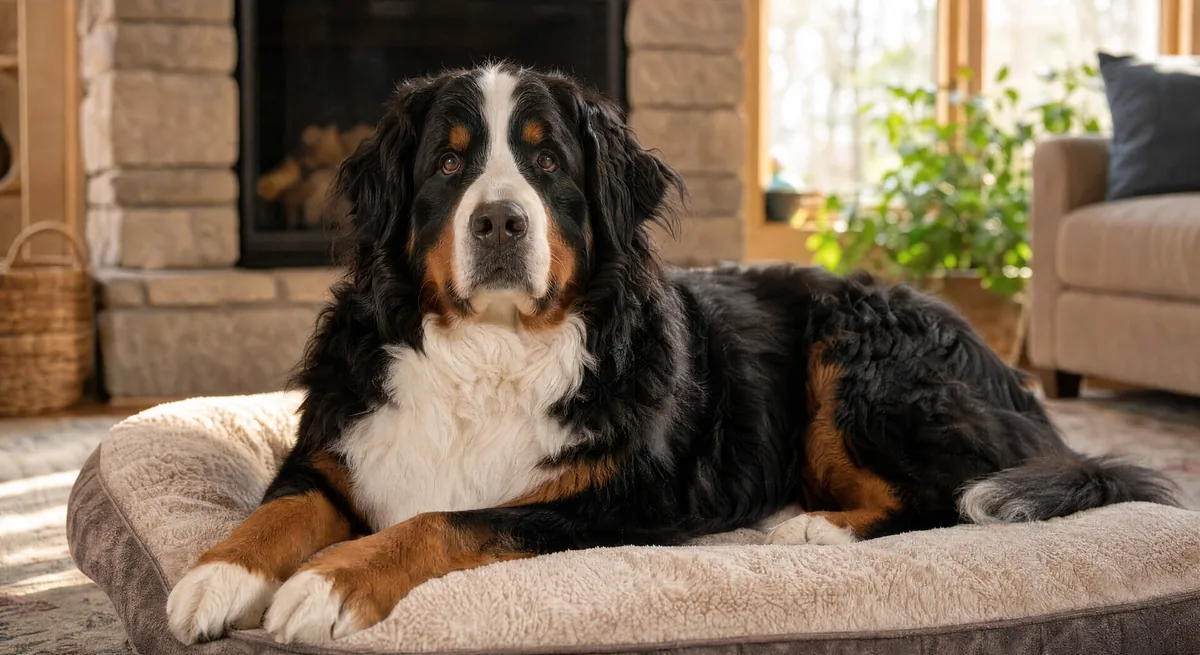
| Bernese Mountain Dog | Cancer (histiocytic sarcoma), hip/elbow dysplasia, cruciate tears | Unlimited limit; enroll early; hereditary coverage |
| Mastiff | Hip/elbow dysplasia, bloat/GDV, cardiac disease | Unlimited limit; bloat covered; orthopedic waiting period |
| Doberman | Dilated cardiomyopathy, von Willebrand disease, hip dysplasia | Hereditary & congenital coverage; high annual limit; enroll early |
The pattern points you straight at a scenario pick. Bloat-prone giants like the Great Dane and Mastiff need the unlimited-limit and direct-pay logic; cancer-heavy breeds — the Bernese Mountain Dog, Golden Retriever, and Rottweiler — live or die by a high or unlimited annual cap, since cancer treatment can outrun a $10,000 limit. Orthopedically loaded breeds like the German Shepherd and Labrador get the most from a waivable orthopedic waiting period.
One rule cuts across all of them: the Doberman's cardiomyopathy and the Berner's cancer tend to surface in middle age, so the breeds with the scariest genetics are exactly the ones where enrolling early — before a single chart note — does the most work. A diagnosis that lands before coverage starts is usually excluded. Chronic conditions such as dysplasia, DCM, and cancer generally remain excluded under mainstream plans, although AKC advertises a limited 365-day continuous-coverage pathway for eligible pre-existing conditions in participating states and forms.
How we chose (methodology)
We don't publish a single blended score, because no one number survives a real large-dog emergency. Instead we judged carriers on the four things that actually decide a big-breed claim: orthopedic coverage (waiting periods, bilateral and hereditary clauses), annual-limit adequacy against five-figure bills, direct pay at the ER, and how each handles bloat and GDV — then matched those strengths to scenarios rather than crowning one universal winner.
The evidence came from four places: current carrier policy and help documents (the source for every waiting-period, direct-pay, and exclusion detail above), industry premium data from NAPHIA, veterinary clinical references such as PetMD for procedure costs, and real owner reports from large- and giant-breed communities for lived cost and claim experience.
Where expert "best of" lists and owner consensus disagreed — and they often did — we didn't average them into a number. We named the divergence and let the policy terms, not the popularity, decide which carrier fits which dog. Every carrier fact here was checked against a current source, and where a figure was owner-reported, we labeled it as such.
Frequently Asked Questions
What pet insurance do most vets recommend?
There's no official veterinary endorsement of any one company. Trupanion may come up in emergency-clinic discussions because participating clinics can adjudicate eligible charges in real time. Pets Best uses a different post-approval, signed-release payment route rather than the same checkout workflow, while most plans reimburse the owner. Ask your own vet and nearest ER which exact workflow they support before relying on it.
Does any pet insurance cover hip dysplasia?
Yes. Most accident-and-illness policies cover eligible hip dysplasia diagnostics and surgery — as long as it isn't a pre-existing condition and you've cleared the waiting period (rehab or physical therapy may need a higher tier or add-on). Watch that period: it can be around 14 days under some forms; Embrace commonly uses six months for listed dog orthopedic conditions but state timing and exam-reduction eligibility vary; Healthy Paws currently lists a 12-month hip-dysplasia wait in most states and a 30-day wait in 16 named jurisdictions. Because dysplasia often shows up young, enroll before the first limp.
Will pet insurance cover a heart murmur?
It depends on timing. A heart murmur is a sign rather than a diagnosis, so what matters is when it's first noted. If a vet records it before your coverage starts or during the waiting period, the murmur and any underlying condition — such as a Doberman's dilated cardiomyopathy — are usually evaluated as pre-existing and may be excluded under the applicable policy. If it's first detected after coverage is active, the diagnostics and treatment are generally covered.
Does pet insurance cover hyperthyroidism?
Generally yes, as an illness — provided it isn't pre-existing and the waiting period has passed. Hyperthyroidism is uncommon in dogs (it's far more typical in cats), but the rule is the same across conditions: if related symptoms or a diagnosis are documented before your policy begins, the condition is usually excluded as pre-existing; if it develops afterward, the workup and treatment may be eligible under the issued policy.
Is a torn cruciate (CCL) an accident or an illness?
Often an illness, which surprises owners. Many carriers classify cruciate-ligament tears as an orthopedic condition rather than a sudden accident — so they fall under the orthopedic waiting period and the bilateral-condition clause (if one knee was affected before coverage, the other may be excluded). The classification affects when you're covered, so read the policy wording before assuming a torn CCL counts as an accident.
Is a $5,000 annual limit enough for a large dog?
Often not. One cruciate repair runs about $1,500 to $7,000 per knee, and an emergency bloat surgery is owner-reported between roughly $5,000 and $14,500 — so a single rough year can meet or blow past a $5,000 cap, especially since the second knee frequently goes too. For a big or giant breed, a $10,000-plus or unlimited annual limit is the safer choice.
When should I insure a large-breed puppy?
As early as you can — ideally in puppyhood, before the first vet visit flags anything. Big-breed orthopedic problems often surface in the first one to two years, while cancer and heart disease tend to come later — but related signs, veterinary advice, treatment, or a diagnosis before coverage begins, or during an applicable waiting period, can make that condition a pre-existing condition that most plans exclude, although cure-out rules and limited state/form-specific exceptions exist. Enrolling early is the single highest-leverage move for a large dog.
Sources
- Dog ACL (CCL) Surgery: Cost and Recovery Timeline — PetMD
- Gastropexy in Dogs: Benefits, Risks, and Cost — PetMD
- Pets Best Unveils New Unlimited Pet Insurance Plan — Pets Best
- Vet Direct Pay — Pets Best
- What Is the Waiting Period for Orthopedic Conditions? — Embrace Pet Insurance
- VetDirect Pay vs. Reimbursement in Pet Insurance — Trupanion
- Pet Insurance for Multiple Pets — Lemonade
- Pet Insurance for Hip Dysplasia — Healthy Paws
- Bilateral Conditions: Are They Covered? — MetLife Pet Insurance
- Pet insurance that covers GDV/bloat? (r/greatdanes) — Reddit
- Gastropexy for Dane (r/greatdanes) — Reddit
- Pet insurance (r/germanshepherds) — Reddit
- Average Pet Insurance Premiums (2024 State of the Industry) — NAPHIA
- Pet Insurance (PetsBest or Trupanion?) (r/bernesemountaindogs) — Reddit
- Pet Insurance Feels Like a Trap — My Experience with Trupanion (r/petinsurancereviews) — Reddit
- Pet Insurance With No Payout Limits — Trupanion
- State of the Industry Report 2026 Highlights (2025 data) — NAPHIA