


If you're pricing pet insurance in Illinois, here's the short version: expect to pay roughly $30–$60 a month for a dog and $15–$40 for a cat, depending on your city, your pet's age and breed, and how much coverage you choose. Quotes vary a lot between carriers, so it pays to compare a few. And there's no Illinois-only pet insurer — you buy a nationwide carrier that's available to Illinois residents and file claims from wherever you live, Chicago to Carbondale.
No carrier can be ranked as Illinois's cheapest or best without same-day matched quotes and a declared editorial rubric. This guide therefore compares use cases and policy mechanics; the legal insurer, issued form, and quote for your pet control.
Important correction: Illinois did not enact the proposed Pet Insurance Article in HB 3595. The final enrolled measure, Public Act 104-0480, took effect July 1, 2026 but contains no pet-insurance provisions. It therefore did not create the proposed accident-wait ban, 30-day illness/orthopedic cap, or 30-day free-look right.
Below, we get specific: what coverage actually costs across Illinois, why a single Chicago vet bill can dwarf a year of premiums (and how to find an affordable, non-corporate clinic), why a clinic "wellness membership" isn't insurance, what Illinois law currently does and does not guarantee, and which carrier fits your situation.
Table of Contents
- How much does pet insurance cost in Illinois?
- Why Chicago vet care costs so much — and how to manage it
- Wellness membership vs pet insurance — don't confuse them
- How paying the vet works in Illinois — don't get surprised at the counter
- Illinois pet-insurance law: what is actually in force
- Pet insurance in Illinois: a use-case shortlist
- Illinois-specific risks worth insuring against
- Already have a diagnosis? Read this before buying
- Frequently Asked Questions
- Sources
How much does pet insurance cost in Illinois?
Secondary sources reviewed in July 2026 place Illinois accident-and-illness premiums roughly around $30–$60 a month for a dog and $15–$40 for a cat. Those are planning ranges, not quotes. The latest defensible national benchmark is NAPHIA's 2025 U.S. average: $69.67/month for dogs and $36.25/month for cats. Neither figure predicts a carrier's price for your pet.
A valid carrier comparison must hold constant the quote date, ZIP code, species, breed, sex, date of birth, annual limit, reimbursement percentage, deductible amount and type, add-ons, and enrollment channel. Record the legal insurer and policy edition too. If a source does not disclose those inputs, its carrier price should be treated as an observation rather than a ranking.
What changes an Illinois quote
- Location: filed territorial factors and local veterinary costs can make a Chicago-area quote differ from a downstate quote.
- Age method: most carriers may use attained age; Trupanion says age at enrollment helps place the pet in a cohort and birthdays are not a direct renewal factor.
- Breed and species: expected claim frequency and severity differ.
- Benefit design: limit, reimbursement, deductible, exam-fee coverage, wellness benefits, and direct-payment mechanics all affect what is being priced.
For that reason, this edition does not reproduce unmatched carrier or owner-price tables. Pull at least three same-day quotes with identical settings and compare the issued benefits before deciding which Illinois option costs less.
Why Chicago vet care costs so much — and how to manage it
This is the real reason to insure a pet in Illinois: Chicago vet bills are steep, and one bad day can dwarf a whole year of premiums. Here's what Chicago owners actually report paying — real bills, not statewide averages:
- A routine senior-dog checkup — exam, vaccines, a urine test — ran about $750.
- ER hospitalization quoted at roughly $2,000 a night.
- A neuter quoted near $1,000 at a corporate clinic.
- Dental at a VCA hospital quoted $2,000–$3,000 — a comparable cleaning ran under $1,100 at UIC's Medical District Veterinary Clinic.
A lot of the local anger points at one thing: private-equity and corporate consolidation. Chicago owners say chains like VCA and Banfield (both Mars-owned) and Thrive have been buying up neighborhood hospitals and pushing prices up — one owner reported costs running "400% higher" after a buyout. To be fair, vets are genuinely underpaid and short-staffed, so not every increase is greed — but the jumps are real, and you can route around them.
How to find an affordable, non-corporate vet
Chicago owners trade names of independent clinics they trust — among those they point to are Ravenswood Animal Hospital, the Medical District Veterinary Clinic at UIC, Burnham Park, Forest Glen, and Oz. A smart local tactic: look up a clinic's business license to see who actually owns it before assuming it's independent. For low-cost spay/neuter, Spay Illinois serves the suburbs, and Dutch, an online vet service, may help with some minor, non-emergency issues where it's available. Prices also vary widely across the state, so suburban and downstate clinics often beat Chicago rates for the same procedure.
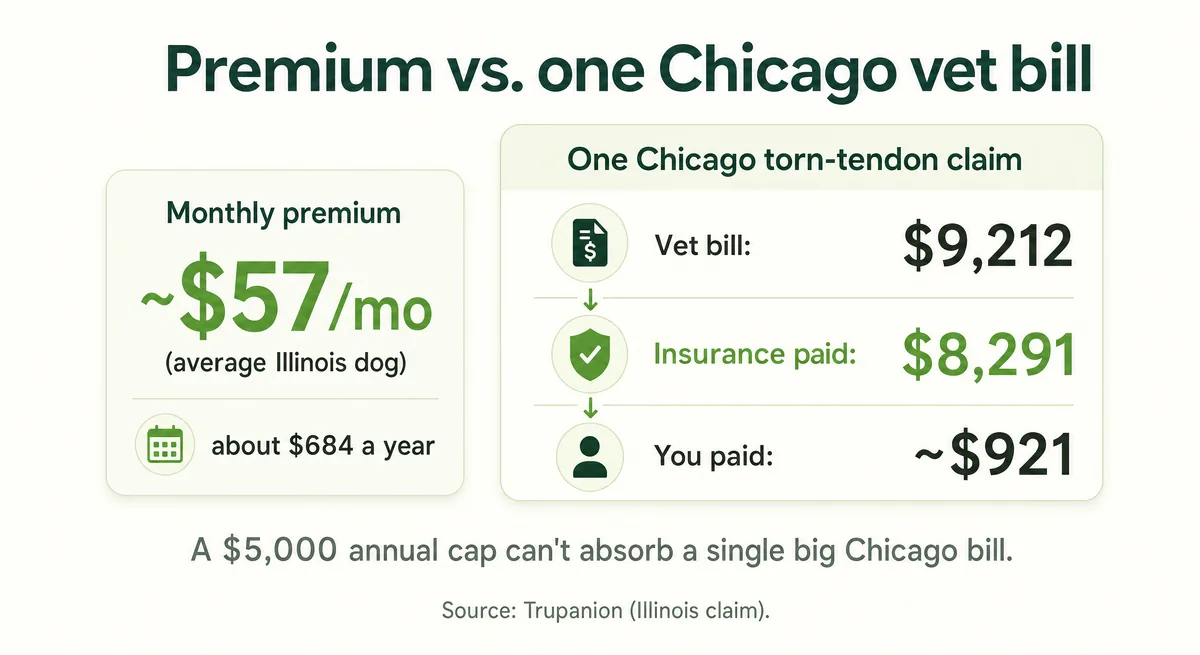
All of this feeds one insurance decision: your annual limit. A $5,000 cap looks fine until a single specialty surgery — a TPLO knee repair or a swallowed-object removal — blows right through it. In a city where one claim can run into five figures, an unlimited or high annual limit is usually worth the few extra dollars a month — it's the difference between a five-figure specialty bill wrecking your month and paying just your deductible and coinsurance.
Wellness membership vs pet insurance — don't confuse them
Plenty of Illinois owners think they have pet insurance when they actually have a wellness membership. Some literally call their Banfield plan "my pet insurance" — understandable, since Banfield's clinics sit inside PetSmart stores all over the state. But the two products do completely different jobs.
A wellness membership is prepaid preventive care — exams, vaccines, a dental cleaning, parasite prevention. It has no accident, illness, or catastrophic coverage: if your dog swallows a sock or tears a knee, a wellness plan pays nothing toward it. Accident-and-illness insurance is the reverse — it covers the big, unexpected bills, not routine checkups (unless you bolt on a wellness rider). Here's the split:
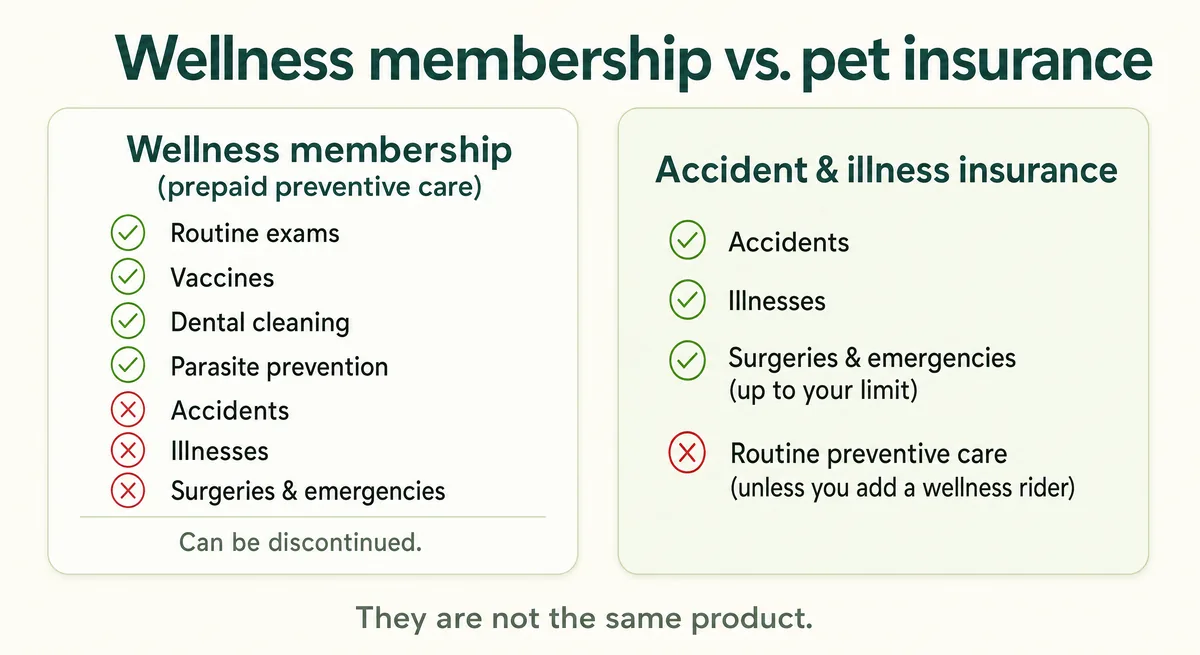
Chicago clinics offer plenty of these memberships — GoodVets' "GoodPet+" ran about $120/mo (recently discontinued), Banfield's Active Care Plus around $63/mo, and Forest Glen's "Happy Healthy Pets" about $50/mo. They're fine for predictable care — but a plan only pays off if you'd actually use every service it includes, and there are two catches: a clinic can discontinue its plan (as GoodVets did, leaving members scrambling), and a membership ties you to one provider.
For most Illinois owners the smartest combination is simple: self-fund the routine stuff (or use a cheap wellness plan if the math truly works for you), and buy accident-and-illness insurance for the catastrophic bills a Chicago ER can hand you. The membership smooths small, expected costs; insurance is the backstop for the ones that could otherwise force a heartbreaking choice.
How paying the vet works in Illinois — don't get surprised at the counter
Before you pick a carrier, understand how you'll actually pay — in a city where one visit can run into the thousands, the mechanics matter. With almost every pet insurer, coverage is reimbursement-first: you pay the vet in full, file a claim, and get reimbursed often within days, though it can take a couple of weeks depending on the insurer and the claim. You front the money first.
That's the rub for big Chicago bills. Owners say fronting a $2,000 ER night or a five-figure surgery and waiting on reimbursement is a real hardship — which is why some choose a carrier that pays the clinic directly.
The main option is Trupanion's VetDirect Pay, which can settle with the hospital at checkout instead of reimbursing you later — but only if your clinic is enrolled, so ask your Chicago-area vet whether they participate before you count on it. (More on Trupanion's trade-offs in the picks below.)
Without direct pay, a financing bridge can cover the gap: a veterinary credit line like CareCredit, or an online vet such as Dutch for minor issues. Just watch the deferred-interest fine print on those cards, and treat financing as a stopgap, not coverage. For a planned procedure, ask whether your insurer offers pre-authorization or a coverage review, and get any answer in writing — final payment still depends on your pet's records and the policy's terms.
One reality even insured owners hit: you still owe your deductible, your share of the coinsurance, and anything the policy doesn't cover — and you owe the entire bill if a claim is denied. So keep a small cushion or a financing option ready even after you're covered.
Illinois pet-insurance law: what is actually in force
As of July 10, 2026, Illinois has not enacted a dedicated Pet Insurance Article. HB 3595 was introduced with pet-insurance provisions, but the Senate replaced that text before passage. The final 1,148-page Public Act 104-0480 concerns early-care-and-education terminology and contains no Pet Insurance Article, accident-wait ban, 30-day illness or orthopedic cap, or pet-policy free-look rule. The ILGA index still displays the introduced bill title, so the enrolled act—not that title—controls.
| What applies in Illinois | What PA 104-0480 did not create |
|---|---|
| Your issued policy and existing Illinois insurance law govern waiting periods, exclusions, limits, renewals, and claims. | No Illinois-wide ban on accident waiting periods through HB 3595. |
| The Illinois Department of Insurance provides pet-insurance consumer guidance and accepts complaints. | No 30-day statutory cap on illness or orthopedic waiting periods through HB 3595. |
| Carriers must honor the policy form and applicable general insurance requirements. | No new 30-day pet-policy free-look right through HB 3595. |
Before buying, read the declarations and policy for the actual accident, illness, and orthopedic timing; any examination waiver; the definition of pre-existing condition; and the cancellation or free-look terms. Do not rely on the introduced version of HB 3595 as a statement of current Illinois law.
How to file a complaint with the Illinois Department of Insurance
If a carrier mishandles a claim, the Illinois Department of Insurance (IDOI) accepts consumer complaints and can ask the insurer to respond. Keep your declarations, full policy, claim submission, medical records, explanation of benefits, and denial or appeal letters. IDOI review does not guarantee payment, but it is the appropriate state channel for a coverage or claims-handling dispute.
Pet insurance in Illinois: a use-case shortlist
There is no universal best or cheapest Illinois carrier. Start with the policy feature that matters, then compare same-day matched quotes and the issued form:
- Flexible annual-limit and reimbursement choices: Embrace publishes $2,000-to-unlimited annual limits and 70%–90% reimbursement; state and issued-policy terms control.
- Real-time checkout adjudication: Trupanion's VetDirect Pay can pay eligible charges at a participating clinic. Confirm the clinic, issued reimbursement percentage, deductible, exclusions, and current quote.
- A potential cured-condition pathway: ASPCA Pet Health Insurance, Spot, and Pumpkin publish 180-day symptom- and treatment-free rules for certain eligible cured conditions, with chronic-condition and knee/ligament exceptions on each brand's Illinois sample policy (ASPCA, Spot, Pumpkin) and issued-form control.
- App-first claim management: Lemonade offers app-based submission and tracking, but the interface does not guarantee a particular turnaround or price.
- Up to 100% reimbursement: Figo publishes a 100% option in eligible quote configurations; deductible, limit, pet, state, and option pairing still matter.
- Sick-visit exam-fee coverage: Fetch includes eligible sick-visit exam fees in current materials; verify the annual limit, reimbursement, deductible, and issued exclusions.
Two insurer-published Illinois claim examples illustrate possible covered bills, not expected returns or carrier rankings: ASPCA reports paying $5,625 of a $6,794 torn-ACL bill, and Trupanion reports paying $8,291 of a $9,212 Chicago torn-tendon claim. Actual payment depends on eligibility, deductible, coinsurance, exclusions, limits, and the issued policy.
If cash flow matters, confirm the payment model precisely: Trupanion can adjudicate at participating clinics; Pets Best routes payment only after claim approval and a signed release; ordinary reimbursement requires you to pay first. Whichever shortlist you use, verify your own Illinois clinic and compare identical quote settings before choosing.
Illinois-specific risks worth insuring against
Illinois's climate and geography create a handful of region-specific health threats — and they're exactly the kind of accident-and-illness events insurance exists for (a wellness plan won't touch them). A few worth knowing:
- Leptospirosis — a bacterial infection spread through Illinois soil and standing water, and transmissible to humans; serious cases mean days of hospitalization.
- Lyme and other tick-borne disease — notable across Illinois; ask your vet about tick prevention and the Lyme vaccine.
- Blue-green algae poisoning — thrives in Illinois fresh water in warm weather and can be rapidly fatal; never let a pet drink or swim where there's bluish-green surface scum.
- Heatstroke and toxic plants such as hydrangeas, among the common warm-weather hazards for Illinois pets.
- Venomous snakes — downstate Illinois is home to the cottonmouth, copperhead, and timber rattlesnake; a serious bite can mean a four-figure emergency.
- Winter hazards — road salt on paws, plus cold-weather slips and injuries.
None of this should scare you off a hike or a swim — it's simply why a solid accident-and-illness policy (not a routine-care membership) is the right backstop for an Illinois pet.
Already have a diagnosis? Read this before buying
Here's the catch that surprises Illinois owners most: the very vet visit that scared you into buying insurance can itself become a pre-existing exclusion. If your dog just had foreign-body surgery or your cat was diagnosed with a chronic condition, a policy you buy today will almost certainly exclude that condition — and sometimes the matching body part too (a left-knee cruciate tear can get the right knee excluded as well). The single best move is to enroll before symptoms start, while your pet's record is clean.
Two red flags to watch when you read the fine print:
- Renewal terms. Read how a policy treats an ongoing condition at renewal, along with any per-condition or annual limits — the fine print is where coverage can quietly narrow over time.
- Upper age limits. A few policies only enroll new pets up to about age 8 — a problem if you wait too long with a senior pet.
It isn't always hopeless: some carriers reinstate a curable condition after a symptom-free window, and changing carriers has its own rules. For the full mechanics, see our guides to pre-existing conditions and switching pet insurance. But the Illinois takeaway is simple: the cheapest coverage to get is the policy you buy before your pet needs it.
Frequently Asked Questions
How much does pet insurance cost in Illinois?
Secondary sources reviewed in July 2026 give planning ranges of roughly $30–$60 a month for a dog and $15–$40 for a cat. The latest NAPHIA national benchmark is $69.67 for dogs and $36.25 for cats using 2025 U.S. accident-and-illness data. Neither figure is a quote or a carrier ranking; compare same-day matched settings for your pet and ZIP.
Which company has the cheapest pet insurance in Illinois?
No company is universally cheapest. Compare same-day quotes for the same pet, ZIP code, annual limit, reimbursement, deductible amount and type, add-ons, and enrollment channel. If those inputs are not disclosed, a carrier price is an observation rather than a ranking.
Is it really worth it to get pet insurance?
It can be worthwhile for an Illinois owner who could not comfortably absorb a large covered bill, but it is risk transfer rather than a promise to earn back premiums. A Chicago ER night can run about $2,000 and a specialty surgery into five figures. The following insurer-published claim examples illustrate possible covered bills, not an expected return: ASPCA paid $5,625 of a $6,794 torn-ACL bill and Trupanion paid $8,291 of a $9,212 claim. It's least useful for routine care and most useful as a catastrophic backstop.
Does pet insurance cover diabetes?
Only if it isn't pre-existing. If your pet is diagnosed with diabetes before your coverage starts (or during the waiting period), mainstream plans will generally exclude it. AKC advertises a limited pathway for eligible pre-existing conditions after 365 days of continuous coverage in participating states and forms, so check the issued policy rather than assuming an exception applies. Enroll before any symptoms appear and the condition can be covered if it develops later.
Will pet insurance cover heart murmurs?
It depends on timing. A murmur — or related symptoms — noted in your pet's records before coverage begins (or during the waiting period) will usually be treated as pre-existing and excluded. A murmur first detected after your waiting periods are over is generally covered, though coverage for congenital and hereditary conditions varies by carrier, so check that exclusion before buying.
Is pet insurance cheaper downstate than in Chicago?
There is no universal direction without matched quotes. Territorial factors and local veterinary costs can make a Chicago-area quote differ from a downstate quote, but carrier, pet, and benefit settings also matter. Run the same profile and coverage in the actual ZIP codes rather than treating carrier-published city figures as a market rule.
Is Banfield's Optimum Wellness Plan the same as pet insurance?
No. Banfield's Optimum Wellness Plan is a prepaid preventive-care membership — exams, vaccines, dental cleaning — with no accident or illness coverage. It won't pay for an emergency surgery or a new diagnosis. It's fine for routine care, but it is not a substitute for accident-and-illness insurance.
Should I add a wellness plan?
Compare the add-on's annual price with the exact capped preventive benefits you realistically expect to use. A clinic membership and an insurance wellness rider use different mechanics, and neither replaces accident-and-illness coverage. There is no universal cheaper choice; use the benefit schedule and your expected routine care.
Sources
- Best Pet Insurance in Illinois — U.S. News & World Report
- Best Pet Insurance in Illinois — WSJ Buy Side
- Insuring Your Pet in Illinois — Embrace Pet Insurance
- Illinois Pet Insurance Guide — Lemonade
- What Is the Average Cost of Pet Insurance? — Quora
- Vet bill scared me into getting pet insurance — what do people actually use? — Reddit (r/petinsurancereviews)
- What Is Your Vet Bill Like? (r/chicago) — Reddit (r/chicago)
- Are there any non-private-equity-owned vets/clinics in Chicago? — Reddit (r/AskChicago)
- Optimum Wellness Plans — Banfield Pet Hospital
- What Chicago vet clinics offer monthly wellness plans (not insurance)? — Reddit (r/AskChicago)
- If you have a dog or cat, do you have pet insurance? Why or why not? — Quora
- Who are the leading companies in the pet insurance space? — Quora
- Is there a real pet insurance (USA) that's not a scam? — Quora
- HB3595 bill history — proposed pet-insurance article removed before enactment — Illinois General Assembly
- Public Act 104-0480 — final enrolled text — Illinois General Assembly
- Pet Insurance — Consumer Information — Illinois Department of Insurance
- ASPCA Pet Health Insurance — ASPCA Pet Health Insurance
- Complete Coverage sample policy PET-P-20000-IL-1024 (Illinois) — ASPCA Pet Health Insurance / Independence American Insurance Company
- Accident & Illness sample policy PET-P-20000-IL-1024 (Illinois) — Spot Pet Insurance / Independence American Insurance Company
- Sample policy PET-P-20000-IL-1024 (Illinois, March 2026) — Pumpkin / Independence American Insurance Company
- Pet Insurance in Illinois — Trupanion
- What's Covered: Illinois Pet Insurance — Nationwide Pet Insurance
- What is a good pet insurance company that serves [my state]? — Quora
- State of the Industry Report 2026 Highlights (2025 data) — NAPHIA