


New York is one of the largest pet insurance markets in the United States — New Yorkers hold roughly 7.4% of every insured pet in the country — and, unlike a growing list of other states, it has no pet-insurance law of its own. Your policy is regulated here as generic “animal insurance”, a category in which the word “pet” never appears.
That is not a technicality. It is why some New York policies carry six-month orthopedic waiting periods, and why six carriers delete the free-look or money-back rights from their New York contracts specifically.
Below: what coverage actually costs across New York, with the configuration and the date attached to every number; how you will really pay an emergency bill here; what state law does and does not require of your insurer; and what you cannot buy in this state.
Table of Contents
- How much does pet insurance cost in New York?
- Why the price changes across New York — and what changes when you move
- You pay the vet first — there is no network
- What happens when the bill lands tonight
- What New York law actually protects — and what it doesn't
- The waiting periods New Yorkers actually get
- What you can't buy in New York
- Already diagnosed, or adopted with no records?
- Which New York buyer should choose what
- Upstate New York: the problem is usually access, not price
- Frequently Asked Questions
- How we sourced this
- Sources
How much does pet insurance cost in New York?
There is no single New York price. Nationally, accident-and-illness coverage averaged $836 a year for dogs and $435 for cats in 2025. Two separate readings each put New York above that line — by roughly 10–13%, depending on which you use — though they measure different things and do not reconcile. What you actually pay turns on your ZIP code, your pet’s age and breed, and the deductible, reimbursement rate and annual limit you choose.
The national line is climbing steadily. NAPHIA’s five-year series for dogs runs $625, $640, $675, $749 and then $836 — an 11.5% jump in 2025 alone.
The first is NAPHIA’s own state shares: New York holds 7.4% of the country’s insured pets but 8.1% of national premium dollars, which works out to about 9.5% more per insured pet. That last figure is our arithmetic on two published shares, not a number NAPHIA states, and some of the gap may simply be New Yorkers buying richer plans.
The second is MoneyGeek, which quoted one fixed pet and policy across 18 insurers and puts New York 12% above national for dogs and 13% for cats, ranking the state 43rd of 51 for affordability.
| Figure | Dogs | Cats | Stated configuration | Source (as of) |
|---|---|---|---|---|
| U.S. average premium | $836/yr | $435/yr | Accident-and-illness policies; 2025 data year | NAPHIA, published 21 Jun 2026 |
| New York vs. national | +12% | +13% | 6-year Labrador and 7-year Ragdoll; $5,000 annual limit, $500 deductible, 80% reimbursement; 18 insurers | MoneyGeek, updated 2 Jun 2026 |
| U.S. range by product tier (dogs) | $190–$1,414/yr | — | Accident-only at the low end; accident-and-illness with embedded wellness at the high end; 2025 data year | NAPHIA, published 21 Jun 2026 |
Now the awkward part, which we would rather show you than smooth over: MoneyGeek’s New York dog average of $823 a year is lower than NAPHIA’s national dog average of $836 — even though the same page says New York runs 12% above national. Both were current when we checked on 25 July 2026. We could not reconcile them, so treat either as a rough anchor, not a quote.
One more reason to distrust a bare average: NAPHIA’s tiers for dogs run from $190 a year for accident-only cover to $1,414 with embedded wellness. That is a 7.4× spread within one species. Fix the tier before you compare anything.
Why the price changes across New York — and what changes when you move
Where you live inside New York moves your premium more than most buyers expect. Carriers price by ZIP code, so the same policy on the same pet can cost meaningfully more a few miles away — and the spread inside this state is wider than the gap between New York and the national average.
One carrier publishes enough to measure it. Embrace’s New York page prices a 1-year-old Havanese by city at 70% reimbursement, a $1,000 deductible and a $5,000 annual limit. Against Buffalo as the baseline, Manhattan lands at 1.89×, Long Island at 1.39× and Albany at 1.20×. Manhattan and Brooklyn are priced identically, to the cent.
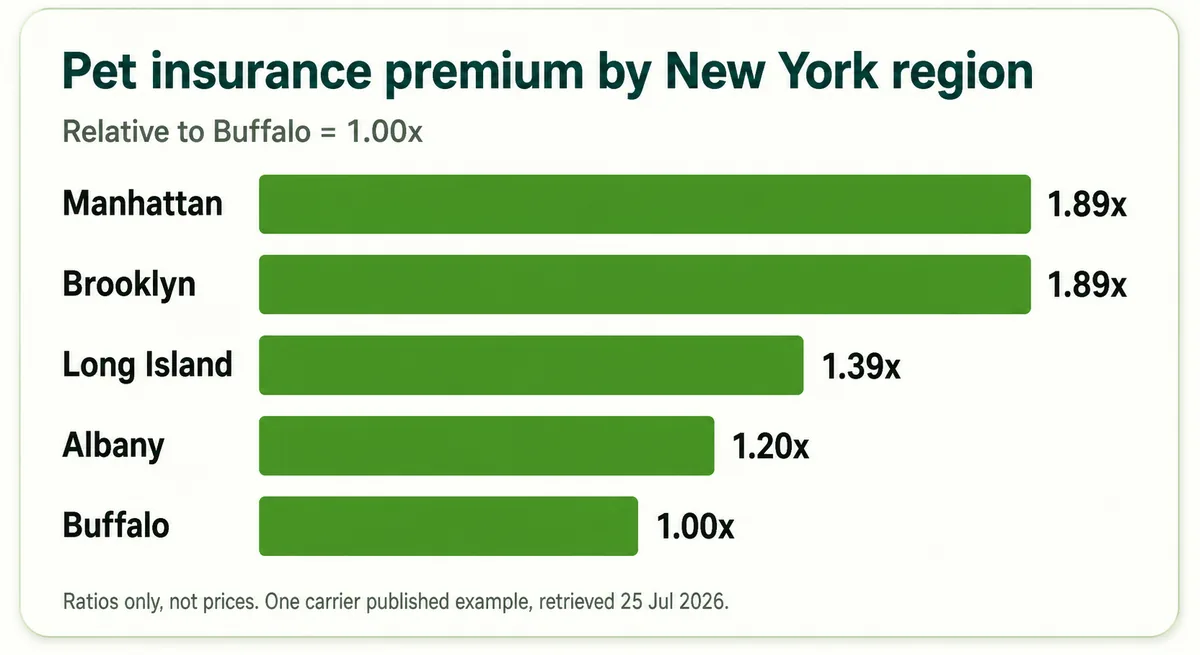
Read those as ratios, not as prices. The page carries no date at all — we retrieved it on 25 July 2026 — every dog in the table is a toy or small breed, and only the Long Island multiplier holds across all five of the carrier’s dog examples. One row even puts Albany cheaper than Buffalo. This is one insurer’s rate structure, not a New York index.
An owner priced the same effect by accident. After moving from Queens to Brooklyn on a Pets Best policy — $1,000 deductible, 90% reimbursement, healthy seven-year-old dog — their premium went from $27 to $40 a month. “I realized I never updated my address after moving,” they wrote. Same pet, same plan, roughly 48% more.
That also shows carriers draw the lines differently. Embrace treats Manhattan and Brooklyn as one territory; Pets Best evidently does not treat Queens and Brooklyn as one. “New York City is a single rating area” is a claim about a particular insurer, never a general rule.
Past those two data points, the public record thins out fast. We found no configuration-labelled premium data at all for Queens, the Bronx, Staten Island, Rochester, Syracuse, Poughkeepsie or Ithaca. If you live in one of those, the only trustworthy number is a quote for your own pet.
You pay the vet first — there is no network
Pet insurance does not work like your health plan. There are no in-network vets, no participating providers, and nothing to check before you book. You take your pet to any licensed veterinarian, pay the bill yourself, and then file a claim and wait for reimbursement. Embrace’s New York page says it flatly — “No network restrictions. Visit any licensed vet in New York” — and Pumpkin states the same.
This trips up a lot of New Yorkers, and not because they are careless. The New York State Bar Association’s consumer FAQ on pet insurance still tells readers to research participating veterinarians on the insurer’s website, and suggests your vet may hold a contract with your insurance company. Neither matches what the carriers themselves document.
An owner in an AskNYC thread put the correction better than most explainers: pet insurance “does not work like health insurance where there is a network of providers” — it is closer to property coverage. So choose the best vet for your pet, not the one you assume is covered.
What happens when the bill lands tonight
At a New York emergency or specialty hospital, you will usually be asked for money before treatment starts — not after your insurer decides anything. That is the gap insurance does not close, and it is worth planning for separately from the premium.
Cornell’s teaching hospital in Ithaca requires full payment for outpatient visits at the time of service, and states plainly that it does not participate directly with any insurance companies. For admissions, a deposit of 50% of the highest estimate is expected — that applies to the Companion Animal Hospital, and the hospital asks you to confirm the policy separately with its Small Animal Community Practice.
Manhattan’s Schwarzman Animal Medical Center is blunter: for care requiring hospitalization for the day or overnight, a 50% deposit of the estimate is required at admission, with a $5 monthly fee on unpaid balances. AMC also staffs a pet insurance coordinator who will submit your claim, obtain pre-approvals for direct-pay plans and help appeal a denial — genuinely useful, and the best accommodation we found in the state. Nothing on those pages says it waives the deposit.
Elsewhere the shape is the same. BluePearl says that with Trupanion it works directly with the insurer for payment, and that with any other pet insurance “you’ll pay up front”. Veterinary Emergency Group does not take pet insurance at the time of the visit at all, pointing owners to CareCredit and Scratch Pay instead.
Trupanion is the clearest documented exception: its software can pay the hospital directly at checkout, leaving you only the deductible and co-pay. Other carriers advertise their own direct-pay arrangements, so ask about yours. Either way it works only if your hospital runs it, and there is no public list of participating New York hospitals to check against. If direct pay matters to you, ask your regular vet and your nearest emergency hospital now — not at 2 a.m.
What New York law actually protects — and what it doesn’t
New York has no pet-insurance statute, but this is not a free-for-all — and the protection you do have is one almost nobody mentions. Because non-commercial pet policies are treated as personal lines, Insurance Law § 3425 applies: a required three-year policy period, tight limits on mid-term cancellation, and 45 to 60 days’ notice before non-renewal. That is stronger than what pet owners get in many states.
There is more. A 2002 opinion from the Department of Financial Services holds that an insurer may not cancel a policy because the pet became seriously ill from a covered condition — “the very risk that the insurer is insuring against.” Two caveats: it is a General Counsel opinion, not a statute or regulation, and it is now more than twenty years old.
Now the gaps. New York regulates your policy as generic “animal insurance”, a category written for livestock as much as for pets. New York has not adopted the NAIC’s Pet Insurance Model Act — the association’s Summer 2025 chart lists New York under “no current activity,” while California and Florida are among the sixteen jurisdictions that did adopt it. So there is no statutory cap on waiting periods, no ban on accident waiting periods, no pet-specific definition of “pre-existing condition,” and no pet-specific rule putting the burden of proving an exclusion on the insurer.
DFS publishes nothing for pet insurance buyers either: no consumer guide, no circular letter, and no pet-insurer complaint ranking — though it ranks auto and health insurers. You cannot look up your pet insurer’s complaint record with the state.
That may change. A bill carrying the model act’s core terms — a 30-day cap on illness and orthopedic waiting periods, a ban on accident waits, a 30-day free look — passed both houses in 2026. Its last recorded action was “returned to Assembly” on 2 June 2026; it has not been transmitted to the Governor, and it is not law. Two earlier versions passed near-unanimously and were vetoed, in November 2024 and October 2025.
Can my insurer raise my premium like that?
Neither of the protections above answers that. § 3425 governs whether your policy can be cancelled or non-renewed and how much notice you get — it does not cap the size of a renewal increase, and neither does the 2002 opinion. We did not find a New York authority that caps one. One New Yorker asked whether a 169% increase was even allowed and never got an answer. We cannot verify it, but the pattern is real: owners here report premiums climbing with age with no claims, one Rochester owner going from under $50 a month to $86 over nine years.
The waiting periods New Yorkers actually get
Because no New York law caps them, your waiting periods are whatever your carrier’s New York form says — and they differ enormously. Two days versus fourteen for an accident; fourteen days versus six months for a knee.
| Carrier | Accident | Illness | Long orthopedic clock | NY underwriter |
|---|---|---|---|---|
| Embrace | 2 days | 14 days | 6 months, dogs only (reducible) | American Modern Home |
| Figo † | 1 day | 14 days | 6 months, all orthopedic | Independence American |
| Pets Best | 3 days | 14 days | 6 months, cruciate only | American Pet Insurance Co. |
| AKC / PetPartners | 2 days | 14 days | 180 days, cruciate and IVDD | Independence American |
| Trupanion † | 5 days | 30 days | None | American Pet Insurance Co. |
| MetLife Pet | None | 14 days | None on the current form ‡ | Metropolitan General |
| Spot | 14 days | 14 days | None | United States Fire |
| ASPCA Pet Health | 14 days | 14 days | None | United States Fire |
| Pumpkin | 14 days | 14 days | None | United States Fire |
Three things that table hides. First, Embrace’s six-month clock applies to dogs only — cats get fourteen days — and it can be shortened by an orthopedic exam, so a flat “New York means six months” overstates it. Yet Embrace’s own marketing says “all” its policies start accident coverage on the effective date. Not true here: its New York form imposes a two-day accident wait.
Second, Pets Best’s New York policy never uses the word “orthopedic.” Only cruciate injuries carry the six-month clock, so IVDD, hip dysplasia and luxating patella fall under the ordinary fourteen-day illness wait — genuinely better than Figo’s all-orthopedic definition.
Third, two widely repeated figures are wrong. Spot, ASPCA and Pumpkin do not impose six-month cruciate waits — all three are fourteen days, on the same New York contract. And MetLife’s current form carries no orthopedic wait at all; the six-month number traces to a superseded legacy form.
One distinction runs backwards from intuition. In several other states, Embrace handles those same orthopedic conditions with an exclusion rather than a waiting period — and an exclusion never expires. The condition stays pre-existing for the life of the policy. New York’s six-month clock at least runs out. Shorter is not always better.
Each linked carrier above is sourced to its own New York policy form or state-terms page, retrieved 25 July 2026. † Figo and Trupanion publish no New York document we could reach on that date, so confirm those two figures directly with the carrier. ‡ MetLife’s published sample is a general MetGen policy rather than a New York-specific form. Either way, check your own declarations page.
What you can’t buy in New York
Several things carriers advertise nationally are quietly removed from their New York contracts. Most often it is the free-look period — the window in which you can cancel a brand-new policy and get your money back.
| Carrier | Removed in New York | Document (date) |
|---|---|---|
| Healthy Paws | Free Look period, “deleted in its entirety” | NY amendatory LD-51188 (Jan 2019) |
| Spot, ASPCA, Pumpkin | Money Back Guarantee, Promotional Items, Non-Insurance Services | NY endorsement PET-AE-20001-NY-0918 (Sep 2018) |
| Figo | 30-day free look — “Not available in FL or NY” | State documents page |
| Trupanion | Exam Day Offer — “Not valid in the state of New York” | Automated offer terms |
| AKC / PetPartners | 30-day introductory offer — excluded in CA, NY and WA | Underwriting page |
| Odie | 30-day free look — NY Trisura policies excluded | Help centre |
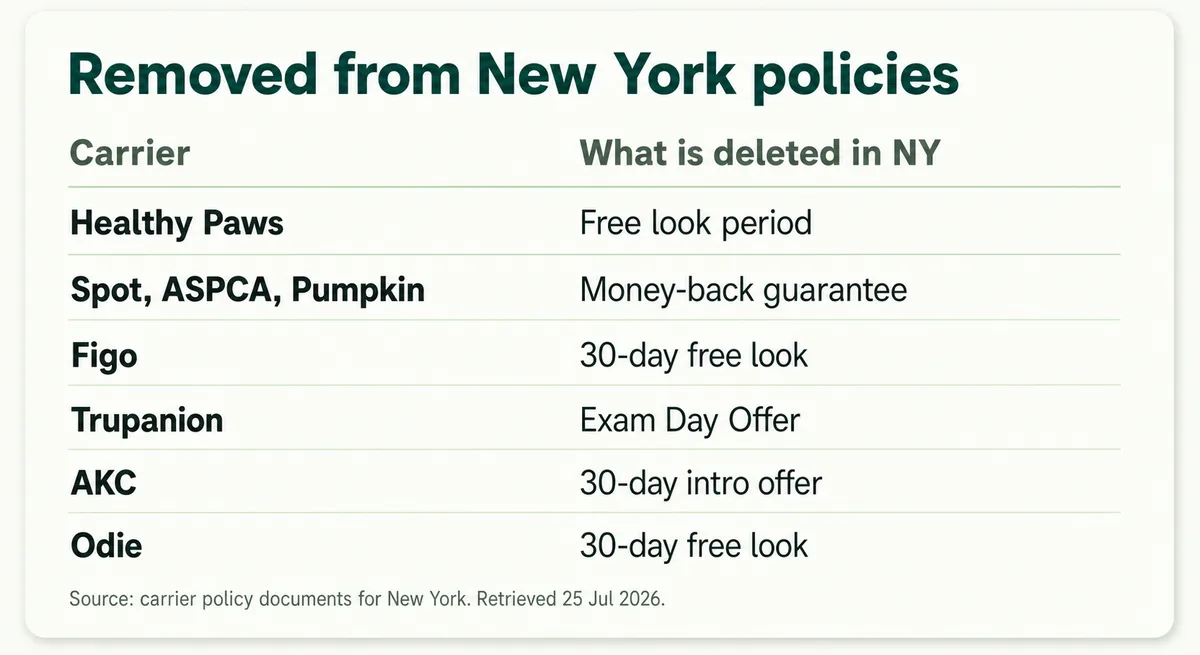
Part of this has a plain explanation. Insurance Law § 2324 bars offering any valuable consideration or inducement not written into the policy, allowing only merchandise worth up to twenty-five dollars. (A 2004 Department opinion cites a fifteen-dollar figure under the law as it stood then.) That rule covers the sign-up gift cards, free first months and trial certificates. It does not obviously explain the deleted free-look periods, which are rights written into the policy — and no carrier we read gives a reason for those.
The documents themselves are old. The Healthy Paws amendatory dates to January 2019 and the Spot/ASPCA/Pumpkin endorsement to September 2018 — which is its own small finding. Nothing has forced a refiling.
One thing the table understates: Spot, ASPCA and Pumpkin issue New York on the identical United States Fire form. Comparing those three brands here means comparing one contract.
And here is the part worth sitting with. The bill that passed both houses in 2026 would require a 30-day free look in New York — the exact right several of these policies delete today.
Already diagnosed, or adopted with no records?
First, a correction. It is not illegal for pet insurance to cover a pre-existing condition — a claim that circulates in New York owner threads and stops people from looking for the routes that do exist. Those routes are narrow, but real.
The AKC/PetPartners New York form lists pre-existing conditions as a covered item after 365 days of continuous coverage. That is not a New York concession — the same clause appears verbatim in the company’s countrywide form — and AKC is not alone: Embrace restores coverage for curable conditions after twelve symptom-free months, and Pumpkin after 180 days. One catch for New Yorkers: AKC’s 30-day introductory offer is not available here.
Whose word counts as “pre-existing”
If your pet arrived without a file, what decides your claims is not what the records say — it is what the policy accepts as evidence. The standards differ sharply.
| Carrier | How it treats an undocumented history |
|---|---|
| Pets Best (NY form) | Reaches conditions in remission or controlled by medication, whether or not noted in the records |
| ASPCA (NY form) | Counts symptoms observed by “any individual,” or detectable by a routine exam |
| Pumpkin (NY form) | Curable conditions clear after 180 symptom-free days — knee and ligament conditions excluded |
| Embrace | Requires information from “verifiable sources,” and caps its lookback at the date you acquired the pet |
“Any individual” is wide enough to include a shelter worker. Embrace’s verifiable-sources standard is a materially higher bar, and its acquisition-date cap is the most adopter-friendly language we found.
The trap sits in every waiver form: the enrolment exam is both the substitute for your missing file and the instrument that creates the exclusions. What it finds can become the evidence a carrier later uses to call something pre-existing, under that policy’s own definition. New York does not help here — nothing in the state’s pet-dealer law requires a shelter to give you veterinary records.
An owner in a New York thread put the related warning plainly: if your dog has had prior issues and you swap insurers, those count as pre-existing on the new policy. Compare before you switch, not after. And get your pet the care they need, whenever they need it — the lesson here is to enrol early, never to wait.
Which New York buyer should choose what
There is no single best pet insurance in New York, and anyone who names one has not read the forms. What there is: a handful of situations where one carrier’s New York terms are clearly better suited than another’s.
| If your situation is… | Look at | The New York reason |
|---|---|---|
| You could face a five-figure emergency bill | Trupanion | No per-year payout cap, and a single NYC specialty admission can exhaust a $5,000 annual limit |
| You want the hospital paid at checkout | Trupanion | Its software pays participating hospitals directly at checkout — confirm your hospital runs it first |
| You want the shortest waiting periods | MetLife Pet | No accident wait and no orthopedic clock on its current form, against six-month clocks elsewhere in New York |
| Your dog is an orthopedic-risk breed | Pets Best | Its New York policy applies the six-month clock to cruciate only, so IVDD, hip dysplasia and luxating patella sit under the 14-day illness wait |
| You adopted a pet with no records | Embrace or AKC | Embrace needs “verifiable sources” and caps its lookback at the acquisition date; AKC’s New York form covers pre-existing conditions after 365 days of continuous coverage |
If you take one thing from this section, make it the annual limit. Owners who have actually claimed say it louder than anything else — an emergency can burn through a $5,000 cap in a single visit, and a policy that stops paying mid-treatment is the worst outcome you can buy.
We have deliberately not named a cheapest option. No public source prices New York carriers against each other on matched configurations, and as the regional numbers showed, location alone can move the premium substantially. Get two or three quotes at the same deductible, reimbursement rate and annual limit, then compare.
For the fuller picture, see our carrier reviews and the side-by-side comparison.
Upstate New York: the problem is usually access, not price
We should be straight about the evidence here: it is heavily downstate. In our own sweep of twelve New York subreddits, New York City produced eight insurance-shopping threads and roughly 256 comments; Buffalo, Rochester and the upstate subreddit produced three threads and about 47 comments between them, with the upstate sub returning none at all.
That is not because upstate owners have fewer problems. Their threads are about getting seen at all — an emergency clinic routinely at capacity and redirecting people to Buffalo, or the nearest 24-hour care for a rabbit being Cornell, roughly three hours away. Insurance does not solve a drive.
And the price gradient does not run the way you might guess. One Rochester owner whose dog broke both front legs was quoted $30,000 for the surgery in Buffalo — their own emergency vet said Buffalo would run close to three times other options — and ended up paying $12,000 in Yonkers, downstate. That is one owner’s account, not a price survey.
No primary source compares New York City and upstate veterinary prices. The comparisons that exist online are low-authority aggregators, several of them apparently machine-generated, and we are not citing any of them.
Frequently Asked Questions
What is the best pet insurance in NY?
There isn’t one. New York carriers differ enough in their state-specific forms that the right choice depends on your situation: Trupanion if you want no annual payout cap or direct payment at checkout, MetLife for the shortest waiting periods, Pets Best if your dog is an orthopedic-risk breed, and Embrace or AKC if you adopted a pet without records. Get two or three quotes at the same deductible, reimbursement rate and annual limit before deciding — configuration and location both move the price materially, so a brand comparison on mismatched settings tells you very little.
Is it actually worth it to get pet insurance?
It depends on whether you could absorb a five-figure vet bill out of savings. Insurance is not a discount on routine care; it trades a monthly premium for help with eligible emergency costs — though your deductible, co-insurance, annual limit and renewal increases all stay with you. In New York it also does nothing for the bill you face tonight, because you pay the practice first and claim afterwards, and a specialty hospital here may want half the estimate at admission. If you have the reserves and the discipline to self-fund, skipping it is a defensible choice.
Is $50 a month a lot for pet insurance?
For a dog in New York, $50 a month is on the low side. The US accident-and-illness average was $836 a year for dogs in 2025 — about $70 a month — and the New York readings below run above that. What matters more is what the $50 buys: a $50 premium with a $1,000 deductible and a $5,000 annual cap is a very different product from $50 with a $250 deductible and no cap at all. Compare the configuration, not the headline price.
Does my vet have to accept my pet insurance?
No — there is nothing to accept. Pet insurance has no provider networks, so you can use any licensed veterinarian in the United States. You pay the practice directly and file a claim for reimbursement afterwards. Direct pay is the partial exception: Trupanion’s software can pay a participating hospital at checkout, and some other carriers advertise their own arrangements — but that depends on the hospital, not on your policy. Choose the best vet for your pet, not the one you assume is covered.
Is there free pet insurance in New York?
No. There is no free pet insurance in New York or anywhere else in the US, despite how often the phrase is searched. If premiums are out of reach right now, the honest alternatives are an accident-only policy — which averaged $190 a year for dogs in 2025 — a dedicated savings account you actually leave alone, or the city’s low-cost clinic list for routine care.
Do I get a free-look period on a New York pet insurance policy?
Not always — several carriers delete it specifically in New York. Healthy Paws removes the free-look provision in its entirety from its New York policy, Figo’s 30-day free look is not available here, and Spot, ASPCA and Pumpkin drop the money-back guarantee from the shared New York endorsement. The carriers do not publish a reason, so read your own policy documents rather than assuming you have a cancellation window.
Does New York have a pet insurance law?
Not a pet-specific one. Your policy is regulated as generic “animal insurance”, and New York has not adopted the NAIC Pet Insurance Model Act — it was listed under “no current activity” on the association’s Summer 2025 chart. You do get personal-lines protections under § 3425, which restrict when an insurer may cancel mid-term and require 45 to 60 days’ notice before non-renewal. That is not a three-year price guarantee, and it does not make any condition covered.
Can I get pet insurance if my pet already has a condition?
You can almost always buy a policy. The real question is whether that condition will be covered, and at first it usually will not be. A few carriers offer a narrow route back: AKC/PetPartners’ New York form covers pre-existing conditions after 365 days of continuous coverage, while Embrace and Pumpkin restore only curable conditions — Embrace after twelve symptom-free months, Pumpkin after 180 days and not for knee or ligament conditions. It is not illegal to cover a pre-existing condition, despite a claim that circulates locally.
How we sourced this
Everything above was retrieved on 25 July 2026. Statutes, regulator opinions, NAIC charts, carrier policy forms and hospital payment pages are primary sources and are linked directly. MoneyGeek is secondary and labelled as such. Owner-reported figures from Reddit are attributed anecdotes, never New York prices.
What we could not find matters too. No public source prices New York carriers by ZIP code, and none of the nine New York emergency and specialty hospitals we checked publishes a fee schedule. Several of the New York policy forms carriers publish are dated 2015 to 2020, and we could not confirm which are still issued to new buyers.
WhiskerCover is a licensed insurance agency — not your lawyer, and not your veterinarian. This is general information; your own declarations page governs. More on how we work in our methodology.
Sources
- NAPHIA 2026 State of the Industry Report — Highlights — North American Pet Health Insurance Association (NAPHIA)
- N.Y. Insurance Law § 1113 — Kinds of insurance authorized — New York State Senate
- How Much Does Pet Insurance Cost in New York? — MoneyGeek
- Pet Insurance in New York (state page, incl. by-city premium examples) — Embrace Pet Insurance
- Pet Insurance for Spoiled NYC Pups? (owner-reported premiums) — Reddit — r/NYCbitcheswithtaste
- Pet Insurance FAQs (no provider networks) — Pumpkin Pet Insurance
- LegalEase: Pet Insurance — Frequently Asked Questions — New York State Bar Association
- Best pet insurance in NYC? (owner correction on provider networks) — Reddit — r/AskNYC
- Hospital Clients — payment policy — Cornell University Hospital for Animals
- Payment Policy — Schwarzman Animal Medical Center
- Pet Insurance Coordinator — Schwarzman Animal Medical Center
- Pet Owner FAQs — payment and pet insurance — BluePearl Pet Hospital
- Services — payment and financing options — Veterinary Emergency Group (VEG)
- Veterinarian FAQ — direct payment at checkout — Trupanion
- N.Y. Insurance Law § 3425 — Personal lines policies: cancellation and renewal — New York State Senate
- OGC Opinion 02-05-12 — Pet insurance as personal lines — New York State Department of Financial Services
- Pet Insurance Model Act (#633) — state adoption chart, Summer 2025 — National Association of Insurance Commissioners (NAIC)
- Consumers — insurance topics index — New York State Department of Financial Services
- Assembly Bill A11164 (2025–2026) — actions and text — New York State Assembly
- Senate Bill S5324A (2025) — veto record — New York State Senate
- Is pet insurance allowed to increase your premium 169%? I am in New York. — Quora (unanswered question)
- Question about pet insurance (owner-reported renewal increases) — Reddit — r/Rochester
- State Terms V5 — New York waiting periods — Embrace Pet Insurance
- Pet insurance waiting periods (marketing page) — Embrace Pet Insurance
- New York Policy Booklet — Pets Best Pet Health Insurance
- New York Sample Policy (May 2024) — Pumpkin Pet Insurance
- MetGen Pet Insurance Policy Sample (form PET21-01-V) — MetLife Pet Insurance
- N.Y. Insurance Law § 2324 — Discrimination, rebating, inducements — New York State Senate
- OGC Opinion 04-08-03 — Permissible promotional merchandise — New York State Department of Financial Services
- New York state amendatory statement (LD-51188, 01/19) — Healthy Paws Pet Insurance
- New York sample policy pages and endorsement PET-AE-20001-NY-0918 — Spot Pet Insurance (United States Fire Insurance Company)
- New York accident & illness policy form IAIC PPI AI POL NY 007 0415 (sample) — AKC Pet Insurance / PetPartners (Independence American)
- Pre-existing conditions coverage — Embrace Pet Insurance
- Underwriting and state availability — AKC Pet Insurance
- New York sample policy pages (ASPCA Pet Health / Hartville, United States Fire) — ASPCA Pet Health Insurance
- Exotic emergency vet access in western New York (owner thread) — Reddit — r/Buffalo
- Emergency vet refusal and specialty surgery quotes (owner thread) — Reddit — r/Rochester
- Low-Cost Veterinary Resources (updated January 2025) — NYC Animal Care Centers
- Senate Bill S7845 (2023–2024) — veto record — New York State Senate