


New Jersey signed a pet insurance law on January 12, 2026. You don't get it yet.
The Pet Insurance Act — P.L.2025, c.224 — passed both chambers without a single vote against it, then set its own start date twelve months out. It takes effect January 1, 2027. Until then the pet-specific rulebook is the state's 1987 statute, N.J.S.A. 17:46D-1, which permits the product, allows exclusions and deductibles, and requires little else — so what you get is set by the contract your carrier wrote. New Jersey's general insurance laws still apply, and the Act says so expressly: all other applicable provisions "shall continue to apply to pet insurance." What's missing until 2027 is the pet-specific protections below.
That gap is the most useful thing to understand before you buy here. Four questions decide whether a New Jersey policy is worth your money:
- What it costs — with the deductible, reimbursement rate and annual limit spelled out, because a monthly figure without them tells you nothing.
- Who is actually on your policy — the brand on the website is often not the company carrying the risk, and New Jersey is one of the few states where you can simply look it up.
- What you lose by living here — several carriers give New Jersey buyers measurably worse terms today than they give buyers in other states.
- What happens at the counter — you pay the hospital first, and New Jersey's emergency hospitals say so in writing.
Every figure below is in US dollars and current as of July 2026, with its assumptions stated. Where the honest answer is "no one has published that," we say so instead of guessing.
Table of Contents
- What New Jersey pet insurance costs right now
- New Jersey's new pet insurance law, and why it doesn't help you yet
- Can your insurer raise your premium — and will you be warned?
- Who actually insures you in New Jersey
- What you lose by buying in New Jersey
- What vet care actually costs in New Jersey
- How you'll actually pay
- Pre-existing conditions in New Jersey
- Comparing providers for New Jersey
- Frequently Asked Questions
- Sources
What New Jersey pet insurance costs right now
Expect roughly $40 to $50 a month for a healthy two-year-old mixed-breed dog and $23 to $27 for a two-year-old cat in New Jersey — at a $250 deductible, 80% reimbursement and a $5,000 annual limit, from sample quotes collected in Jersey City and published in May 2026. Change any one of those three settings and the number moves.
Those three settings are why most published New Jersey prices are useless. Here are three carriers quoted at the same configuration, which is what makes them comparable at all (NerdWallet, May 2026):
| Carrier | Dog, age 2 | Dog, age 8 | Cat, age 2 |
|---|---|---|---|
| Pumpkin | $40/mo | $96/mo | $23/mo |
| ASPCA | $46/mo | $110/mo | $27/mo |
| Lemonade | $49/mo | $95/mo | $23/mo |
Now look at the middle column. Quotes for an eight-year-old dog run roughly double the quotes for a two-year-old at every one of those three carriers. Read that as what it is — two sample pets priced on the same day, not one policy's renewal history — but the direction is the thing to plan around.
For the age question specifically there is better evidence, because one publisher models the same coverage across a pet's whole life. MoneyGeek puts a New Jersey pet at $33 a month at age one, $43 at five, $79 at ten and $148 at fifteen — a 348% climb "across identical policy terms." Its state benchmark, built on a six-year-old Labrador and a seven-year-old Ragdoll at a $500 deductible, 80% reimbursement and a $5,000 annual limit, puts New Jersey dogs at $63 a month ($761 a year) and cats at $38.
That curve, not the opening premium, is the number to budget against.
So what is "the" New Jersey average? There isn't one you should trust. Four publishers put the average New Jersey dog premium at $46, $58, $63 and $75 a month — and all four figures were published inside the same ten-week window in 2026. The spread is 63%, and it is almost entirely a story about unstated assumptions: different breeds, different ages, different deductibles, different limits, all averaged and presented as one number.
Read those numbers as a starting point, not a quote. They are third-party modelled and collected figures, not prices we pulled ourselves, so treat them as a range and then quote your own pet. A New Jersey premium is also set partly by your ZIP code, so a Bergen County quote and a Cumberland County quote for the same dog will not match. For how the underlying maths works — deductible against reimbursement rate against annual limit — see our guide to what pet insurance costs.
New Jersey's new pet insurance law, and why it doesn't help you yet
New Jersey now has a real pet insurance consumer-protection statute. It just isn't switched on. The Pet Insurance Act, P.L.2025 c.224, was signed on January 12, 2026 and is codified at N.J.S.A. 17:46D-3 through 17:46D-11 — but its own final section delays it by a year.
It was not a close call. The bill cleared the Assembly 72–0 and the Senate 37–0, with no recorded vote against it at any committee or floor stage across a three-session effort.
Section 11 reads: "This act shall take effect on the first day of the 12th month next following the date of enactment." The statute does not print a calendar date — counting twelve months from a January 12, 2026 enactment puts it at January 1, 2027. Until that morning, the protections below are law on paper and unenforceable in practice.
One source you may run into says otherwise. The NAIC's most recent state-adoption chart for its Pet Insurance Model Act — the Summer 2025 edition — still lists New Jersey as "NO CURRENT ACTIVITY." That entry isn't wrong so much as stale: it was published before the Act passed, and no newer edition has been issued. If you see New Jersey described as a no-protection state, check the edition date.
What changes on January 1, 2027
- Accident waiting periods become illegal. The Act says plainly: "Waiting periods for accidents are prohibited."
- Illness and orthopedic waits are capped at 30 calendar days. Several carriers currently make New Jersey buyers wait six or twelve months for orthopedic conditions.
- The Act puts the burden of proving a pre-existing exclusion on the insurer — "the pet insurer has the burden of proving that the preexisting condition exclusion applies to the condition for which a claim is being made." Today no pet-specific statute says who carries that argument, which in practice leaves it to the policy wording.
- A 30-business-day free look — the most generous in the country. Note the unit: business days, not calendar days, and it's forfeited the moment you file a claim.
- Carriers must tell you if the underwriting company differs from the brand name on the website. More on why that matters below.
One thing the Act does not do: require carriers to let you waive a waiting period with a vet exam. The NAIC model contains that requirement; New Jersey's bill never included it, in any version. Waiver stays entirely at the carrier's discretion, before and after 2027.
Can your insurer raise your premium — and will you be warned?
Yes to both, and the warning is the part worth knowing about. An insurer filing a rate increase that needs the state's prior approval has to write to its own policyholders and say so — before the department rules on it. The Department of Banking and Insurance's rule covers "certain rate increases requiring prior approval for personal lines property/casualty coverages" — the category New Jersey puts pet insurance in — and sends notice "by regular or electronic mail to the named policyholders." It isn't universal: the rule carves out limited prior-approval filings, rating-system changes and some auto filings, so not every price move triggers a letter.
Here is what one actually looks like. A Spot policyholder posted the notice they received in April 2026:
"This is to provide notice as required pursuant to N.J.S.A. 52:27EE-51 that Independence American Insurance Company filed on April 13, 2026, with the New Jersey Department of Banking and Insurance a request for a rate increase of 18.595% on Pet Health Insurance plans… The request for a rate increase is subject to review and approval by the Department of Banking and Insurance pursuant to law, and the request ultimately may not be approved or may not be approved for the full amount requested. If approved in whole or in part, the rate change will not affect existing policies until they come up for renewal."
Read the last two sentences again, because they do a lot of work:
- A filing is a request, not a decision. The department can approve it, reduce it, or refuse it.
- Nothing changes mid-term. An approved increase reaches you at renewal, which is your window to shop.
Two honest limits. We could not find these pet filings published on any public state page — the notice goes carrier-to-you by email, so it's hard to verify one online. The wording is the state's own, though: its rule requires the notice to say a request "ultimately may not be approved or may not be approved for the full amount requested." The 18.595% figure comes from policyholders posting what they received. And you'll see a claim circulating that New Jersey caps annual increases at 25% — the owner who raised it said plainly they were reading a rate filing, not a statute, and others in the same thread reported far larger jumps. We can't source it, so we won't repeat it as law.
If a notice lands in your inbox, treat it as a calendar reminder rather than a bill: check your renewal date and re-quote your pet before it arrives.
Who actually insures you in New Jersey
The brand on the website is usually not the company that pays your claim. New Jersey is one of the few states where you can simply look up which one is — the Department of Banking and Insurance publishes a Pet Health Insurers directory mapping each licensed insurer to the brands it underwrites here.
That page is the top Google result for "pet insurance new jersey" — a bare table with no explanation attached. Here is what it tells you (as observed July 2026):
| Brand you buy from | Insurer DOBI lists for New Jersey |
|---|---|
| Trupanion, Pets Best, Chewy | American Pet Insurance Company |
| Spot, Figo, PetPartners | Independence American Insurance Company |
| ASPCA | United States Fire Insurance Company (disputed — see below) |
| Healthy Paws | Westchester Fire Insurance Company |
| Nationwide | National Casualty Company |
| MetLife | Metropolitan General Insurance Company |
| Embrace | American Modern Home Insurance Company |
| Fetch | AXIS Insurance Company (and XL Specialty) |
This isn't cosmetic, and it genuinely changes at the state line. Spot's New Jersey sample policy is issued by Independence American on form PET-P-20000-1024; the same product in New York is issued by United States Fire on form PET-P-20000-NY-0920. Same brand, same website, different insurer.
The directory also flags three entries as "not accepting any new business" in New Jersey: 24PetWatch, Bivvy, and Lemonade Insurance Company.
Two entries don't reconcile, and we'd rather show you than smooth over them. DOBI lists ASPCA under United States Fire — but the New Jersey sample policy ASPCA itself serves, form PET-P-20000-0723, is headed Independence American Insurance Company. Both documents were current in July 2026, which is why the table reports DOBI's listing rather than treating it as settled.
The Lemonade entry needs the same care. What DOBI flags as closed to new business is the insurer, Lemonade Insurance Company — while Metromile Insurance Company sits unflagged in the same group row, whose consumer link points at Lemonade's pet page. So the flag doesn't tell you whether the Lemonade-branded product is closed here, and Lemonade still lists New Jersey among the states it serves. Read a directory flag as being about a legal entity, not a brand, and check your own declarations page.
Why New Jersey has no guaranty-fund backstop
In most insurance lines, if your carrier goes insolvent a state guaranty fund steps in. New Jersey's Property-Liability Insurance Guaranty Association Act names "pet health insurance" among the lines its scope excludes — language DOBI restates verbatim in Order No. A24-05 (June 2024). Because the Act excludes pet insurance from its scope, that backstop does not reach a New Jersey pet policy — regardless of whether the insurer is admitted.
Worth being precise: no state document says "pet insurance claims are not covered" in those words — this follows from the scope provision. Every pet insurer on DOBI's list is admitted here, which buys form and rate review and a complaint channel. It just doesn't buy an insolvency safety net.
What you lose by buying in New Jersey
Several carriers write New Jersey policies on worse terms than they write elsewhere. This isn't a pricing difference — it's in the filed policy wording, and you can read it before you buy. Here is what we found on the forms served to New Jersey (as observed July 2026):
| Carrier | What New Jersey gets | What other states get |
|---|---|---|
| Healthy Paws | 12-month wait on hip dysplasia, no waiver available | 30 days, waivable by vet exam — in 16 states, not New Jersey |
| Embrace | 180-day exclusion on cruciate disease, IVDD, patellar luxation and hip dysplasia — treated as pre-existing for the life of the policy | Same wording across 42 states |
| Fetch | No waiting-period waiver in the New Jersey form | Countrywide form allows a waiver after a vet exam in the first 15 days |
| Figo | Six-month orthopedic wait for dogs, on a 2020 form | Ohio's 2024 form: 30 days, no injury wait |
| ASPCA | "Promotional Items" struck out by a New Jersey endorsement | Discounts, gift cards and merchandise remain in the policy |
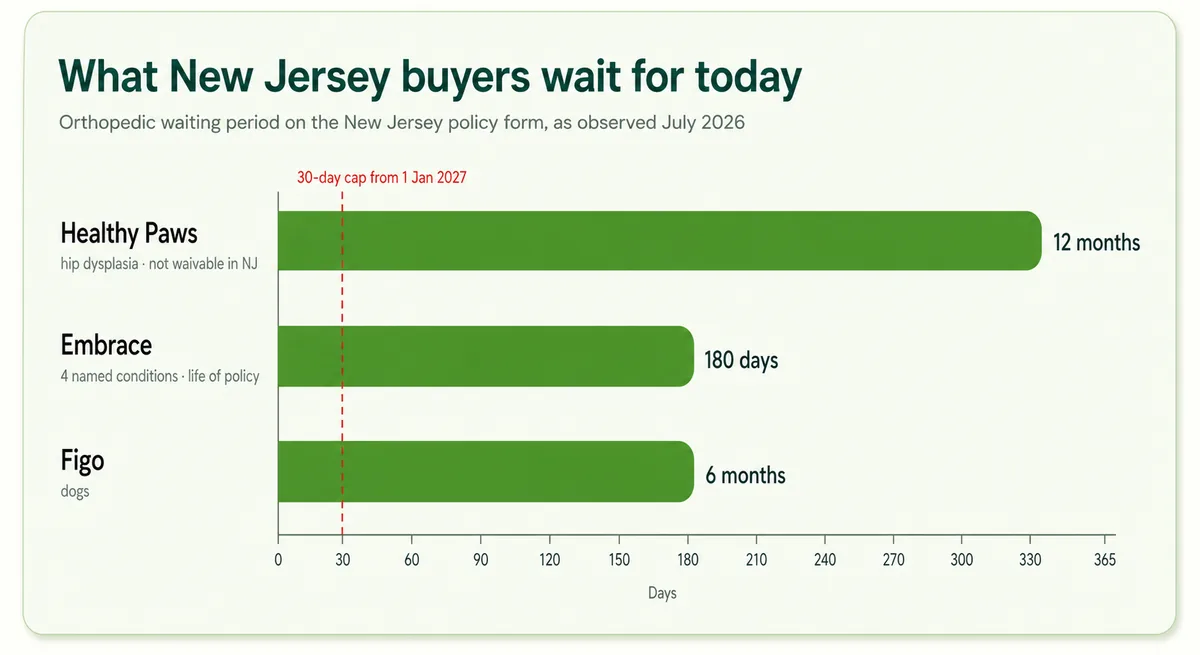
The Figo case is the plainest. New Jersey is assigned the company's default multistate policy — a 2020 form — while nine other states have their own newer versions. Ohio's 2024 rewrite cuts the orthopedic wait to 30 days and opens with a full "right to examine and return" page that New Jersey policyholders never receive.
It isn't uniformly worse. Fetch's New Jersey free look is actually better than its countrywide one: the national form refunds your premium only if you haven't filed a claim, and the New Jersey version drops that condition. We also can't tell you why ASPCA removes promotional items here — the endorsement states the change without giving a reason, so we won't invent one.
Now put this section next to the last one. Reading the Act's 30-day cap and accident-wait ban against these forms, most of the terms in that table cannot lawfully be written into New Jersey policies once the Act takes effect — the twelve-month and six-month orthopedic waits especially. Two caveats. That is our reading of the statute against the wording, not a statement any carrier has made. And the Act says only that its requirements apply to policies "issued to any resident of this State" and "delivered or issued for delivery" here — it never says what happens to a policy already in force, so whether your terms change at renewal or sooner is a question the statute leaves open. If you're buying now, you are buying the version in the middle column.
What vet care actually costs in New Jersey
More than you'd guess, and the spread inside the state is wider than the spread between states. That matters here because your deductible, reimbursement rate and annual limit all apply to this number — not to a national average.
Take a routine dental under anaesthesia. In one New Jersey discussion, one owner reported paying about $1,800 at Red Bank Veterinary Hospital. Another said they paid $300 at a rural New Jersey practice — and when challenged, confirmed that included X-rays, an IV catheter and fluids, pre-anaesthetic bloodwork, and scaling and polishing. A veterinary technician in the same thread put it plainly: prices in Warren County and prices in Bergen County are not the same conversation.
Those are individual owners' bills, not a survey. For a published figure you can check, Preventive Paws in Mt Arlington lists dental under anaesthesia — inclusive of anaesthesia, X-rays, cleaning, extractions and medications — at $550 for cats and $650 to $750 for dogs by weight. Treat that as one clinic publishing its prices, not a statewide benchmark: it's a high-volume practice, and the owner-reported figures above sit on both sides of it.
The direction of travel is not in doubt. The BLS series for veterinarian services rose 5.14% in the twelve months to June 2026 — roughly four times the rate for pet food and supplies.
One thing we can't give you: a north-versus-south premium map. Carriers do rate by ZIP code, but no public source quantifies New Jersey's internal spread, and we won't invent one. The vet-price gradient above is real and documented; the premium gradient isn't.
Where you go when it's serious
New Jersey has substantial private emergency and specialty capacity — Red Bank, Oradell, NorthStar VETS, BluePearl, Garden State, AnimERge and VEG among others, per the state veterinary association's list.
What it doesn't have is an academic tertiary hospital. Rowan University's veterinary school opened in 2025 and holds provisional AVMA accreditation, but its teaching hospital states directly that it is "unable to hospitalize pets" — it's daytime urgent care. University-level referral still means Penn, Cornell or Tufts.
Crossing a state line here is usually about money rather than referral. One North Jersey owner reported a New York hospital came in "thousands cheaper" than Oradell; a South Jersey thread about specialist eye surgery stayed in-state at Red Bank rather than crossing to Philadelphia. If you're regularly using New York hospitals, our New York guide covers that market — but your policy is still governed by the state you live in.
How you'll actually pay
You pay the hospital. All of it. Then you claim back the part your policy covers — eligible costs only, after your deductible and at your reimbursement percentage, up to your annual limit. That order catches a lot of people out, and it's an entirely reasonable thing to get wrong: human health insurance trained all of us to expect the opposite.
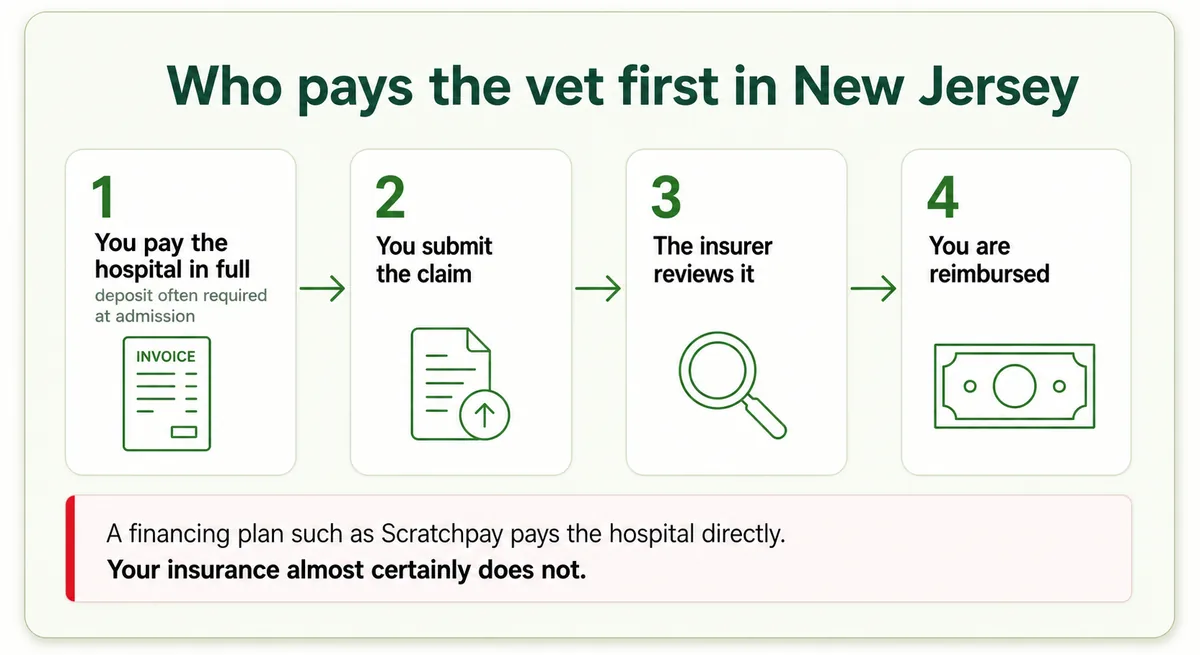
New Jersey's emergency hospitals are unusually direct about this in their own published policies:
- Red Bank Veterinary Hospital (Mount Laurel) — "we still require you to pay your medical bill directly", and will help with the reimbursement paperwork afterwards.
- Oradell Animal Hospital (Paramus) — a deposit of the low end of the treatment plan is required before or at admission, balance due at discharge.
- NorthStar VETS — "Full payment is due when service is rendered."
- AnimERge (Raritan) — a deposit upfront for any hospitalization.
Referral centres are stricter still. Cornell asks for at least 50% of the highest estimate at admission; Tufts collects 75%.
Here's the part worth sitting with. The financing plans these same hospitals point you toward — Scratchpay among them — pay the veterinarian directly. Your insurance, at almost every New Jersey emergency hospital, does not. Some carriers advertise direct-to-vet payment, but those claims rest on the carrier's own unaudited figures, and we could not find a single New Jersey hospital that confirms it participates. Plan on paying first.
Two things that are not true, and cost people money:
- There is no network. Pet insurance doesn't have in-network and out-of-network vets — you can typically use any licensed veterinarian, though it's worth checking your own policy for geographic limits. Don't drive past the closer hospital.
- DOBI's "Direct Writer" column doesn't mean direct payment. On the state's insurer directory that phrase describes how the policy is sold — direct or through an agent — not whether anyone pays your vet.
Don't let the order of payments delay treatment. Get the care, keep the itemised invoice and the records, and claim afterwards. If the mechanics are new to you, our beginner's guide to how pet insurance works walks through deductibles and reimbursement in more depth.
Pre-existing conditions in New Jersey
If a condition — or a sign or symptom of one — is already in your pet's records when coverage starts, expect it to be excluded, and expect the argument to be yours to make. Two things soften that: the exclusion has to fit the policy's own definition, and several carriers cover a condition again once it has been resolved for long enough. From January 1, 2027 the Act shifts that burden of proof onto the insurer. Today no pet-specific statute says who carries it.
Here is the moment it usually catches people, from a New Jersey thread: an owner with a seven-year-old cat — some asthma, a small heart murmur, bloodwork just came back with elevated levels, ultrasound already booked — asking whether to buy a policy before anything is formally diagnosed. Two veterinary technicians answered within the hour, and the answer was no. The carrier reads the records, not the diagnosis date.
This is the distinction that costs New Jersey owners the most money: you can almost always buy a policy. That is not the same as the condition being covered. Insurers will happily sell to a pet with a charted murmur; they simply won't pay for the murmur.
What the Act changes in 2027 is who carries the argument. Under C.17:46D-8(a), the insurer will bear the burden of proving a pre-existing exclusion applies to the condition you're claiming for. The statutory definition also reaches signs or symptoms that appear during a waiting period — so a clean record at purchase is not automatically a clean slate at day 31.
Two practical notes for now. If you adopted with incomplete records, the first claim is when those gaps get examined — gather whatever the shelter or previous vet has before you need it. And "curable" rules vary sharply by carrier — a 180-day symptom-free window at some, twelve months at others, no such provision at all at several — with knee and ligament conditions carved out almost everywhere.
None of this is a reason to postpone a vet visit. Get your pet seen; then read our guide to pet insurance and pre-existing conditions for how the definitions differ between carriers.
Comparing providers for New Jersey
We're not going to name one best insurer for New Jersey, because the evidence doesn't support one. What we can do is narrow the field honestly.
Start by checking what you can actually buy. As observed in July 2026, the state's insurer directory flags three entries as not accepting new New Jersey business: 24PetWatch, Bivvy and Lemonade Insurance Company. Note that those flags sit on insurers, not brands — as the underwriter section explains, Lemonade's group has a second, unflagged company listed alongside it, so the Lemonade-branded product's status here isn't settled by that flag alone. Availability shifts either way, so get a live quote before you count anything in or out.
Then weigh what actually differs here:
- If your pet is young and the records are clean — the orthopedic waiting periods in the carve-out table above are the thing to compare, not the monthly price. A twelve-month hip dysplasia wait costs nothing today and everything in month eleven.
- If your pet is middle-aged — look at how the carrier prices age. One reader in a New Jersey rate discussion argued for Trupanion on exactly that basis, because how a carrier prices age compounds over ten years in a way the opening premium doesn't. Other New Jersey owners in the same threads report claim denials and steep increases with the same carrier. Both experiences are real, and neither tells you how the carrier actually rates — ask for the rating factors in writing before you buy.
- If you're price-sensitive — Figo offers a discount tied to Costco membership, which came up twice in New Jersey discussions and surprised a Costco member who hadn't heard of it. No ranking page mentions it.
- If you want the smoothest claims experience — Lemonade drew the most consistent praise from New Jersey owners, including one who reported a $5,000 emergency bill reimbursed in about a week and a half. Note the availability flag above before you rely on it.
On Nationwide, New Jersey opinion genuinely splits: two veterinary technicians in one thread advised against it on documentation burden, while several owners in the same thread reported good claims experiences including prescription food and medication. That's a real disagreement, not a consensus we're hiding.
Whichever way you lean, get quotes at the same deductible, reimbursement rate and annual limit — otherwise you're comparing three different products. Our best pet insurance guide covers the national picture, and how we evaluate carriers explains what we weight.
Frequently Asked Questions
How much does pet insurance cost in New Jersey?
Budget roughly $40 to $50 a month for a healthy two-year-old mixed-breed dog and $23 to $27 for a two-year-old cat — at a $250 deductible, 80% reimbursement and a $5,000 annual limit, from Jersey City quotes published in May 2026. Age moves it hard: quotes for an eight-year-old dog ran $95 to $110. Modelled across identical policy terms, a New Jersey pet goes from $33 a month at age one to $148 at fifteen. Any monthly figure you see without those three settings attached is unusable — which is why four publishers put the average New Jersey dog premium at $46, $58, $63 and $75 within the same ten-week window.
What is the best pet insurance in New Jersey?
There isn't one, and the New Jersey evidence doesn't support naming one. What genuinely differs here is availability and policy wording rather than headline price. As of July 2026 the state's insurer directory flags 24PetWatch, Bivvy and Lemonade Insurance Company as not accepting new New Jersey business, and several carriers impose longer orthopedic waiting periods on their New Jersey forms than on forms filed in other states. Compare those two things first, then quote your shortlist at an identical deductible, reimbursement rate and annual limit.
Is it actually worth it to get pet insurance?
It's worth it if an unexpected four-figure bill would mean borrowing, and much less so if you could absorb one comfortably. Insurance isn't a savings plan — you're buying protection against the bill you can't plan for. Two things tilt the answer in New Jersey. Prices inside the state vary enormously: owners in one New Jersey discussion reported paying about $300 and about $1,800 for the same routine dental. And nationally, veterinarian services rose 5.14% in the twelve months to June 2026. Our honest maths on whether pet insurance is worth it works through the trade-off.
Is $50 a month a lot for pet insurance?
For a young dog in New Jersey, $50 a month is roughly market rate rather than a lot. Three carriers quoted $40, $46 and $49 a month for a healthy two-year-old dog at a $250 deductible, 80% reimbursement and a $5,000 annual limit in May 2026 — so $50 sits right at the top of that spread. For a two-year-old cat it's high — the same configuration came in at $23 to $27. What matters more is what your $50 buys: a $1,000 deductible at 70% is a very different product from $250 at 80%. And budget for the age curve: modelled on identical terms, a New Jersey pet reaches $148 a month by fifteen.
Does New Jersey's new pet insurance law protect me if I buy a policy today?
Not yet. The Pet Insurance Act was signed on January 12, 2026, but its final section delays it to "the first day of the 12th month next following the date of enactment" — January 1, 2027 by arithmetic, since the statute prints no calendar date. A policy you buy before then is governed by your contract's own terms and by New Jersey's permissive 1987 pet insurance statute. The 30-day waiting-period cap, the ban on accident waiting periods, the 30-business-day free look and the shift of the pre-existing burden onto the insurer are all still ahead of you.
Can I buy pet insurance if my pet already has a health problem?
Almost always yes — but the existing condition itself won't be covered, and that gap costs New Jersey owners the most money. A carrier will write the policy; the murmur already sitting in your pet's file stays excluded. What decides it is the records, not the date of a formal diagnosis — and the exclusion has to fit the policy's own definition. Many carriers do cover a condition again once it has been cured and symptom-free for a set window: 180 days at some, twelve months at others, and several have no such provision at all. From January 1, 2027 the Act puts the burden of proving an exclusion on the insurer. Our guide to pre-existing conditions compares them.
Will my New Jersey vet bill my insurance company directly?
Almost certainly not — you pay the hospital and claim the money back afterwards. New Jersey's emergency hospitals publish this plainly: Red Bank Veterinary Hospital in Mount Laurel says it still requires payment directly, and NorthStar VETS that full payment is due when service is rendered. Referral centres go further and collect deposits at admission. A few carriers advertise direct-to-vet payment, but we could not find a New Jersey hospital that confirms it participates. One related relief: pet insurance has no provider network, so go to whichever licensed vet is closest.
How do I find out which company actually underwrites my New Jersey policy?
Look it up on the New Jersey Department of Banking and Insurance's Pet Health Insurers directory, which maps each licensed insurer to the brands it underwrites in the state — very few states publish anything like it. It's useful because some brands won't tell you before you buy: Spot and Pumpkin each name two possible underwriters and ask you to "refer to your policy forms." The insurer, not the brand, is who appears in a rate filing or a complaint record. From January 1, 2027, carriers selling here will have to disclose when the underwriting company differs from the brand name.
Can my insurer raise my premium in New Jersey, and will I get any warning?
Yes to both, and the warning is unusual. New Jersey requires an insurer filing a rate increase that needs the state's prior approval to notify its policyholders directly, before the department rules on it — though the rule carves out some filing types, so not every price move triggers a letter. New Jersey owners reported receiving exactly that notice in April 2026, for an 18.595% request filed by Independence American Insurance Company on pet health plans. Two things to hold onto: a filing is a request, and the department can approve it, reduce it or refuse it; and an approved increase reaches you at renewal, never mid-term. Treat the email as a prompt to re-quote before that date.
If my pet insurer goes out of business, is my New Jersey policy protected?
Probably not, and New Jersey is unusually explicit about why. The state's Property-Liability Insurance Guaranty Association Act names "pet health insurance" among the lines its scope excludes — language DOBI restates verbatim in Order No. A24-05. Sitting outside that scope, a New Jersey pet policy has no insolvency backstop, whether or not the insurer is admitted here. To be precise, that's an inference from the scope provision rather than a sentence any state document prints. Admitted status still buys you form and rate review and a complaint channel — it just doesn't buy a safety net.
Sources
- P.L.2025, c.224 — Pet Insurance Act — New Jersey Legislature
- N.J.S.A. 17:46D-1 — Hospital, medical benefits for pets — New Jersey Statutes
- The Best Pet Insurance in New Jersey for 2026 — NerdWallet
- How Much Is Pet Insurance in New Jersey? — MoneyGeek
- Pet Insurance in New Jersey — Compare.com
- Best Pet Insurance in New Jersey — Insurify
- Pet Insurance Model Act #633 — state adoption chart, Summer 2025 — NAIC
- SPOT — Looking to substantially raise their rates in NJ (N.J.S.A. 52:27EE-51 notice quoted verbatim by recipient) — r/petinsurancereviews
- Pet Health Insurers — consumer directory — NJ Department of Banking and Insurance
- Spot Pet Insurance — state sample policies — Spot Pet Insurance
- Order No. A24-05 (June 28, 2024) — NJ Department of Banking and Insurance
- New Jersey policy documents and state amendatory endorsement — Healthy Paws
- Frequently asked questions — hip dysplasia waiting period by state — Healthy Paws
- State terms — wording version 6 — Embrace Pet Insurance
- New Jersey pet insurance coverage — Fetch Pet Insurance
- Sample policy (default multistate form, 08/2023) — Figo Pet Insurance
- State documents and sample policies — ASPCA Pet Health Insurance
- How much is too much for a dog's dental cleaning (r/newjersey) — Reddit
- Patient center — pricing — Preventive Paws Spay Center, Mt Arlington NJ
- CPI series CUUR0000SS62054 — Veterinarian services, U.S. city average — U.S. Bureau of Labor Statistics
- Emergency veterinary facilities in New Jersey — New Jersey Veterinary Medical Association
- Accredited veterinary colleges — American Veterinary Medical Association
- Small Animal Teaching Hospital — urgent care — Rowan University Shreiber School of Veterinary Medicine
- Payment options and resources — Red Bank Veterinary Hospital Mount Laurel
- Payment options — Oradell Animal Hospital
- Pet parents — frequently asked questions and payment policy — NorthStar VETS
- Patients — payment policy — AnimERge
- Client information — deposits and payment — Cornell University Hospital for Animals
- Payment information — Tufts Foster Hospital for Small Animals
- How it works — Scratchpay
- Do all vets accept pet insurance? — Progressive
- Recommendations for Pet Insurance in NJ? (r/newjersey) — Reddit
- Pet insurance in NJ (r/newjersey) — Reddit
- Anybody in NJ seeing premiums double, or is the ins dept holding them down? — r/petinsurancereviews
- Underwriting & Administration Information — Spot Pet Insurance
- Underwriting Information — Pumpkin
- Notice to Policyholders of Consumer Insurance Rate Increases (PRN 2003-309, N.J.A.C. 11:1-45) — NJ Department of Banking and Insurance
- ASPCA Pet Health Insurance — New Jersey sample policy, form PET-P-20000-0723 — Independence American Insurance Company