


Companion Protect is not an insurance company. It is a licensed insurance agency and program administrator: the business that sells the policy, services it, and processes claims. A separate insurer holds the money that pays them. The disclosure for the Progressive program it administers states the split in one line: "Progressive Casualty Insurance Company, or one of its corporate affiliates, is the underwriter (insurance company) for this Policy. This Policy is administered by Companion Protect Agency, LLC." Which insurer that is changes by program and by state, so the name on your own paperwork is the one that counts.
That distinction matters more here than for most brands, because much of the review writing you can find describes a product that is no longer sold — the coverage details those pages quote belong to an earlier version of the business.
So start where you stand. If you already hold a policy, work out which version you have before judging anything you read about it. If you have just been quoted one, start with which company would owe you the money.
If this has been hard to untangle, that is the product's doing, not yours. Everything below reflects the public disclosures as of July 2026.
Table of Contents
- Which Companion Protect Are You Looking At?
- Who Actually Insures You
- How Claims and Money Actually Work
- What You Actually Get Today
- If You're Already a Policyholder
- What the Star Ratings Are Actually Measuring
- Where to Complain, and About Whom
- What We Could Not Verify
- What To Do Next, Depending on Your Situation
- Frequently Asked Questions
- Sources
Which Companion Protect Are You Looking At?
There is no single Companion Protect policy. At least five materially different products have carried the name since 2018, with different waiting periods and different limit structures — and, where the insurer is published at all, a different insurance company behind each. Before any review is useful to you — including this one — you need to know which one you hold or are being offered.
| Era | Dated evidence | Who carried the risk |
|---|---|---|
| Network plan | Policy form ASPPHI002KS 1018, October 2018 (archived sample policy) | Aspen American Insurance Company |
| Direct-to-consumer, shelter-adoption pitch | Policy form LIUIPHI001KS 0420, April 2020 (archived sample policy) | Liberty Insurance Underwriters, Inc. |
| AAA / CSAA program | Forms CSAAPHI001DDE 1023 and CSAAPHI001DCA 1224 (state disclosure) | CSAA General Insurance Company |
| Ringo | "RINGO" trademark, first use in commerce March 31, 2024, registered July 2, 2024 to Companion Protect, LLC (USPTO Reg. 7434311) | Not published anywhere we could find |
| Progressive program | Launched January 20, 2026, live in 43 states and D.C. (Progressive newsroom) | Progressive and its affiliated underwriting companies |
The five-second test: find your form number
Policy and disclosure documents print a form number in the footer of every page. Match yours against the middle column and you have identified your era. Treat those strings as exact lookup keys — the numbering does not follow a reliable pattern, so don't try to decode an unlisted one. The newest programs are identified by their named insurer rather than a form number, and the insurer in your own policy documents is the final word.
Two backup checks if you can't find a form number:
- The address on your paperwork. 10950 El Monte, Overland Park, KS is the legacy address. 11460 Tomahawk Creek Parkway, Suite 300, Leawood, KS is the current one.
- Where your login lands. The brand's own site now routes existing customers to two portals, and one of them redirects to my.ringopet.com — a different brand name, with no explanation on either page (Companion Protect).
One thing that is not a test: the phone number. (800) 304-9930 appears on legacy pages and the 2024-dated CSAA disclosure alike, so it tells you nothing.
Finally, a distinction worth keeping straight. The consumer website stopped serving a live page between late May and mid-July 2024 — the last archived working page is from 28 May 2024 — and now redirects to a business-to-business page. That dates the website, not the product: a separate notice from early 2022 said only that new enrollments had stopped "in your area", and no company announcement explains when, or whether, any particular program closed to new business.
Who Actually Insures You
Companion Protect is a licensed insurance agency and program administrator, not an insurance company. It sells and services pet policies and handles claims, while a separate insurer — Progressive Casualty, Old Republic, Liberty Mutual Fire or CSAA, depending on the program — carries the risk and owes the claim payment.
It helps to think in jobs rather than names. One company sells you the policy. A second holds the money that pays your claim. A third reviews the claim and decides what comes back to you. In this brand's programs those jobs do not all sit with the same business — and the disclosures differ on how the last two are split. Which insurer holds your money depends on the program you bought through.
| Channel | Insurer carrying the risk | Companion Protect's role |
|---|---|---|
| Progressive Pet Insurance (program 1) | Progressive Casualty Insurance Company and its affiliates | "administered by Companion Protect Agency, LLC" |
| Progressive Pet Insurance (program 2) | Old Republic Insurance Company | Placed the policy and administers it; paid a commission |
| Progressive Pet Insurance (program 3) | American Pet Insurance Co., Independence American, or MS Transverse | None — this one is administered by Pets Best |
| Liberty Mutual Pet Insurance [source] | Liberty Mutual Fire Insurance Company | Administrator, named as Companion Protect Insurance Agency, LLC |
| AAA / CSAA Pet Insurance [source] | CSAA General Insurance Company | Administrator, named as Companion Protect Agency, LLC |
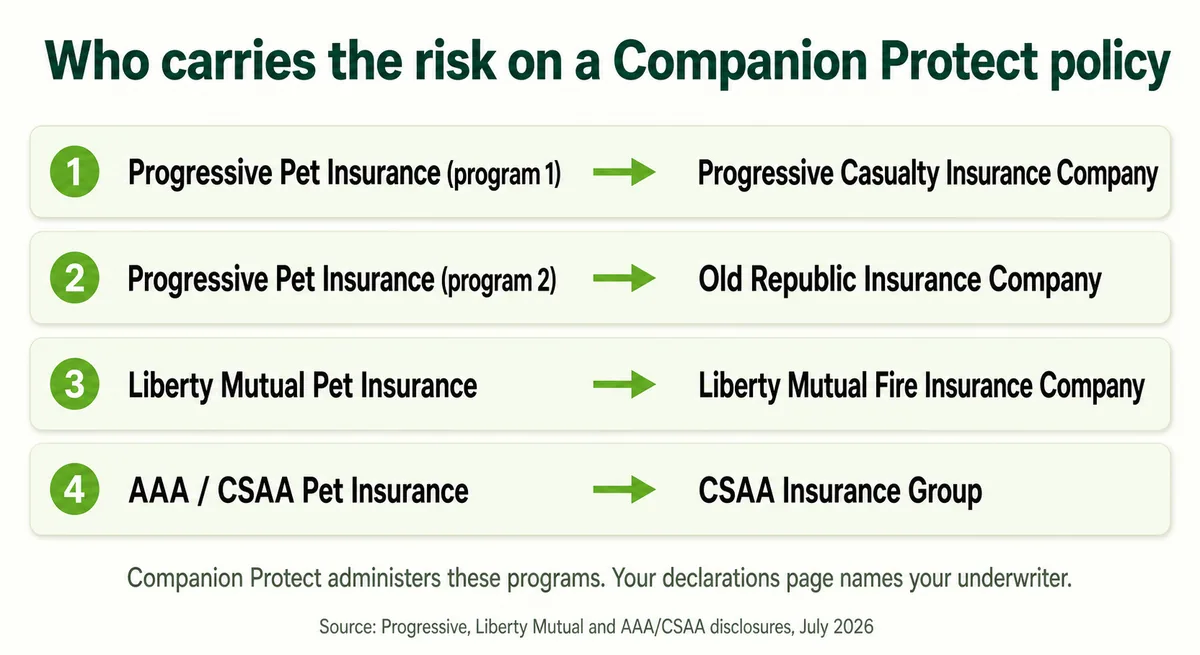
Note the third row: Progressive sells through three programs, and one has no Companion Protect involvement at all — so a Progressive quote does not by itself tell you whose product you are looking at.
Layered arrangements like these are ordinary and lawful across US insurance; a brand, an agency, an administrator and a risk-bearing insurer are routinely four different companies. The disclosures carry their own separation statements: Progressive records that it "is not affiliated with Companion Protect," and that the program "is not offered by or sponsored by Companion Life Insurance Company" — a different company with a similar name (Progressive enrollment site). In California the agency is licensed under a different name again, CP Pet Insurance Services, LLC.
One question the disclosures answer two ways
On what Companion Protect does for the Progressive-underwritten program, two current official sources disagree. The insurer disclosure form PUP300 (03/25) says the policy is "administered by Companion Protect Agency, LLC" (Progressive, March 2025). Progressive's own enrollment site says Companion Protect "underwrites and adjusts claims on behalf of Progressive under this program." The two are reconcilable — an administrator can hold delegated authority to underwrite and adjust for the insurer — but they imply different levels of control over your claim, and neither page says which applies. It is a fair question to put to whoever quotes you.
How Claims and Money Actually Work
You pay your veterinarian in full at the counter, then file a claim and wait for the money to come back. That reimbursement model is the norm across most of the US market, but it is worth understanding before a large bill, not during one.
Direct payment did exist here once, and its withdrawal is dated. A notice on Companion Protect's veterinary portal, dated 9/8/22, tells practices that "Direct Pay/EasyPay claims for clients enrolled in Companion Protect programs are no longer supported," and instructs them to "Collect payment in full at the time of service" (Companion Protect veterinary portal). The current Progressive and AAA/CSAA disclosures both say claims are paid to the insured, so assume reimbursement and confirm your own policy’s process in writing.
On speed, it is worth separating the company's expectation from the contract. The same portal — the page carrying that 2022 notice — says most claims are "completed within 3-5 days of submission", a company statement about processing time, not an audited measure of when money reaches your account. The contractual language is narrower than it first looks: claims "are paid directly to the insured within 30 days after the disposition of the claim" — a clock that starts at the decision, not at submission, so no total submission-to-payment deadline is stated anywhere (form PUP300 (03/25)).
That gap matters, because reimbursement does not reduce what you owe on the day — it repays you afterward. Gallup found that 66% of US pet owners could pay $1,000 or less for lifesaving treatment, and the Federal Reserve reports that 63% of US adults would cover a $400 emergency using cash or its equivalent — leaving more than a third who would not. For those households a four-figure invoice is not a waiting period; it is a threshold. If fronting the bill would be hard for you, settle that before you buy: ask the agent, in writing, who pays the clinic and when.
What You Actually Get Today
What you get depends on which program you are buying, and the live menus do not match. Treat them as three separate products sharing an administrator.
| Program | Limit structure | Reimbursement | Deductible |
|---|---|---|---|
| Progressive referral program — Old Republic Insurance Company (Companion Protect-administered) [source] | Annual: $5,000 / $10,000 / $20,000 | 70% / 80% / 90% — but 90% is available only with the $5,000 limit | $250 / $500 / $1,000 |
| Liberty Mutual [source] | Annual: $5,000 / $10,000 / $15,000 | 70% / 80% / 90% | $250 / $500 / $1,000 |
| AAA / CSAA [source] | No annual cap; $100,000 lifetime | 70% / 80% / 90% by tier | $300 / $200 / $100 by tier |
Three caveats the grid cannot show. Row one's deductible and reimbursement menus are published for the Old Republic referral program; for the program Progressive underwrites itself, the disclosure gives only the annual benefit and the fact that "a deductible and copay are applied to claims" — so get your own figures in writing. The AAA/CSAA tier is calculated differently: copay comes off the full approved bill before the deductible, paying slightly less than the deductible-first order used below — though its deductible applies once per condition, not annually. And that document carries a 2022 form footer, so confirm those tiers still stand.
Waiting periods differ too. The Progressive-underwritten program applies none for accidents, 15 days for illness and 30 days for orthopedic conditions not caused by an accident (form PUP300 (03/25)); Liberty Mutual applies a flat 14 days to everything. A waiting period is the gap between buying and that coverage becoming usable. Progressive's can be waived, but only by a veterinary exam after purchase — which the policy states you pay for yourself.
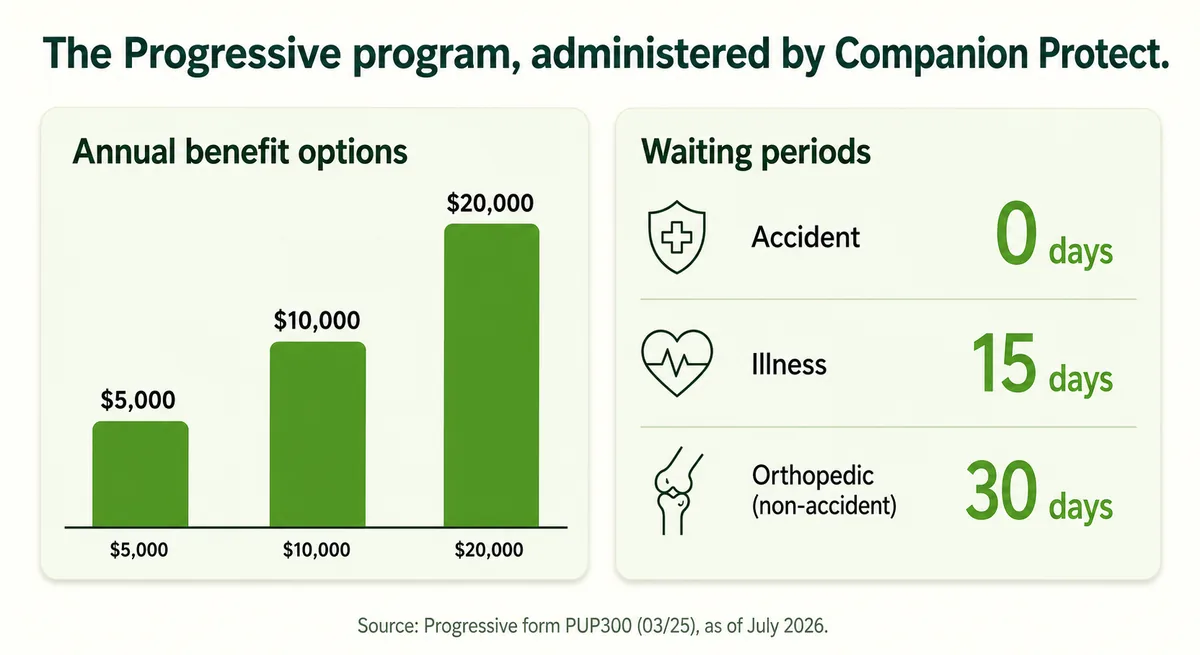
Is the annual cap enough?
A limit only means something against a bill you can picture. Embrace's largest 2025 claim was $40,392 for a 12-year-old Maine coon with a gastrointestinal obstruction. Run it against the richest documented pairing at the top Progressive cap — $20,000 limit, 80% reimbursement, $250 deductible, deductible first:
- $40,392 − $250 deductible = $40,142
- $40,142 × 80% = $32,113.60 — what the formula alone would pay
- The annual limit caps it at $20,000, leaving $20,392 with you
The cap decides that outcome, not the deductible: $12,113.60 of payable benefit is lost to it. Switching to a $1,000 deductible would cut the uncapped figure by $600 and change what you receive by nothing, because the cap binds either way. That is arithmetic on one published claim, not a forecast for your pet — but it is how to test a limit before picking one.
If You're Already a Policyholder
If a renewal notice has changed your terms, read it for the trade-off rather than the headline price. The pattern one owner documented in December 2025 was not a straight increase: on the menu they were offered, keeping 90% reimbursement meant accepting the lowest annual limit available to them, $10,000, while moving up to a $20,000 limit meant dropping to 80% reimbursement and paying more (r/petinsurancereviews, 2025-12-20). Each term could be kept only by surrendering another.
A second owner in the same thread, posting in May 2026, described a before-and-after: an earlier emergency of more than $10,000 in bills reimbursed at 90%, against a later one under an 80% policy with a $10,000 annual cap — and reimbursements that had once arrived in days taking noticeably longer.
Two cautions. This rests on roughly five identifiable owners across a handful of dated posts — enough to show a mechanism, nowhere near enough to say how often it happens — and it describes the migrated legacy book, not the Progressive, Liberty Mutual or AAA programs sold today.
The harder problem is leaving. Any condition your pet has developed since you first enrolled will likely count as pre-existing at a new carrier — one owner's cat had developed a heart murmur (r/petinsurancereviews, November 2024). How broadly that bites — whether related conditions go too, and whether you are offered a policy at all — varies by carrier, state, your pet's age and the policy's own definitions. So get the replacement policy issued, with its exclusions in writing, before you cancel anything. That is the ratchet: weaker terms on one side, an uncovered condition on the other.
So work through it in this order. Get the care your pet needs now. Postponing a diagnosis to protect insurability costs more than it saves; the record catches up regardless. Then compare your renewal against a fresh quote elsewhere with your pet's records in hand, and read our guide to switching pet insurance first — cancelling early is how people end up uninsured mid-treatment. If the exit really is closed, a weaker policy may still beat no policy; just make that a decision you took rather than one that happened to you.
What the Star Ratings Are Actually Measuring
Search this brand and some of the most prominent numbers you will meet are not about the insurance at all. Staff review sites rank strongly for the company name — Glassdoor and Indeed both carry Companion Protect employer pages, and the score they report is the share of employees who would recommend working there. That is a staffing measure, not a claims measure, and it tells you nothing about whether a policy pays.
The consumer records split by entity as well. The Better Business Bureau file belongs to Companion Protect Agency, LLC — the licensed agency — so it reflects agency conduct rather than any insurer's claims handling. As of July 2026 it showed a C+ grade and one unanswered complaint.
Financial-strength ratings work the same way: they attach to a licensed insurance company, never to a brand. There is no Companion Protect financial-strength rating, and there cannot be one, because the brand carries no risk. The rating that matters is the one held by whichever insurer appears on your declarations page — Old Republic Insurance Company, for instance, holds an AM Best A+ (Superior) rating, most recently affirmed on April 29, 2026.
None of this makes any particular score wrong. It just means a score is only useful once you know what was rated: the employer, the agency, or the company that would pay your claim.
Where to Complain, and About Whom
Route the complaint by what went wrong, starting with the appeal procedure your denial letter sets out. Beyond that, a coverage or claim dispute belongs to the insurer on your declarations page — Progressive Casualty, Old Republic, Liberty Mutual Fire or CSAA — while complaints about how the policy was sold go to the agency. Companion Protect holds no complaint index of its own, so name both it and the insurer when you write to a regulator.
Several states have decided these are exactly what a buyer should be able to answer:
- Washington and Ohio require a pet insurer to disclose whether the underwriting company differs from the brand name used to market the product.
- California requires the department's mailing address, toll-free number and website at issuance, directing consumers there only after raising the matter with the insurer.
- Florida goes furthest, requiring a link and toll-free number for its Division of Consumer Services specifically for pet-insurance complaints.
Those are the four we confirmed; rules elsewhere vary, so check your own state's department before assuming a protection applies. Washington's takes consumer complaints on 800-562-6900.
One practical note: Companion Protect's own dispute form routes a denied claim to its legal department in Leawood, Kansas by certified mail. It asks for your policy and claim numbers but never names the insurer — work that out from your declarations page first.
What We Could Not Verify
Several things we went looking for are simply not in the public record. Where that is the case we say so, and turn it into something you can ask.
- No specimen declarations page is published for any current program — even though that is the document Progressive says determines who your underwriter is. Ask to see one before you buy.
- No state insurance-department filing could be retrieved for the current forms. PUP300 and PUP100 are program disclosures published by Progressive: primary sources, but not the same thing as a filed document.
- Whether Companion Protect administers your policy or also decides your claims is stated both ways, by Progressive itself. Ask which applies to yours, in writing.
- The "Prior Coverage Endorsement" — referenced in the disclosures as replacing the pre-existing-condition definition for people switching from another carrier — is not published anywhere we could find. Ask for a copy if that is you.
- No state-by-state availability list is published for any program.
So ask. On this brand, the answers come from whoever is selling you the policy — not from a search result, and not from us.
What To Do Next, Depending on Your Situation
There is no single verdict here, because there is no single product. What makes sense depends on which of these describes you.
- Quoted through Progressive, Liberty Mutual, AAA or an employer benefits menu. Get the insurer's name and the annual limit in writing before you compare anything on price. If your Progressive quote turns out to be the Pets Best program, you are looking at a different product entirely, with different waiting periods.
- Still holding a legacy Companion Protect policy. Find your form number and establish what you actually have. If it is still paying claims on the terms you originally bought, there is rarely a reason to move for its own sake.
- Recently moved onto a new brand at renewal. Read the new terms against the old ones side by side — reimbursement percentage, annual limit, deductible — rather than comparing the premium alone. The change may be structural rather than just a price rise.
- An older pet, or one with a diagnosis already on record. Price a replacement policy before you cancel anything, and expect existing conditions to be excluded by any new carrier. Staying put on weaker terms can still be the better arithmetic.
If you would rather compare providers on the same basis, our carrier reviews apply one rubric across every company we cover.
Frequently Asked Questions
Is Companion Protect an insurance company?
No. It holds an insurance agency licence and acts as a program administrator, which means it can sell you a policy and process your claim — but it is not the company whose balance sheet the money comes from. The practical consequence is that the financial-strength rating, the complaint record and the legal obligation to pay all belong to a different company, the one named on your declarations page.
Who underwrites Companion Protect pet insurance?
It depends on the program. Progressive-branded policies administered by Companion Protect are underwritten either by Progressive Casualty Insurance Company or one of its corporate affiliates, or, through a separate referral program, by Old Republic Insurance Company. The Liberty Mutual program is underwritten by Liberty Mutual Fire Insurance Company, and the AAA program by CSAA General Insurance Company. Progressive tells buyers to check the declarations page to identify their own underwriter, because the answer varies by channel and by state.
Can I still buy Companion Protect pet insurance?
Not directly. There is no consumer quote path under the Companion Protect name — the brand's own site now sends existing customers to claim portals and offers no way to buy. What is still sold is partner-branded: Progressive, Liberty Mutual and AAA policies that Companion Protect administers behind the scenes, plus some employer benefit menus. So if you are being offered cover today, you are buying a partner's policy rather than a Companion Protect one.
Does my vet get paid directly, or do I pay first?
You pay first. Every current Companion Protect-administered program reimburses you after the fact rather than settling with the clinic at the counter, so you need to be able to front the entire bill on the day of treatment. Practically, that means checking your own liquidity before you buy — and, if a large bill is plausible for your pet, asking whether your clinic offers a payment plan, because the policy will not bridge that gap for you.
What happened to my original Companion Protect policy?
Policies sold under the original brand appear to have moved. One documented owner account describes a renewal letter placing them on a differently branded product, and the company's own customer portal now redirects to a site called Ringo. Companion Protect has published no announcement explaining the change, so the reliable way to establish what you actually hold is the policy form number printed in your documents and the insurer named on your declarations page.
How much does Companion Protect pet insurance cost?
There is no published rate card. The only official figure attached to any Companion Protect-administered program is Progressive's statement that its pet policies average $47 per month — a blended figure with no deductible, reimbursement percentage, annual limit, species or state attached to it. Species, age, breed and where you live all move an individual quote materially, so a blended book average says little about yours. Get one with the configuration written down beside it.
What are the employee reviews like at Companion Protect?
Those rate the employer, not the insurance. They come from staff review sites and describe what it is like to work at the company — pay, management, culture — which tells you nothing about whether a claim gets paid. It is an easy confusion to fall into here, because those pages rank prominently for the brand name. For the policy itself, the signals that matter are the insurer on your declarations page and the terms in your policy form.
Is Companion Life Insurance Company the same as Companion Protect?
No — they are unrelated companies with similar names. Progressive's disclosures state that its Companion Protect-administered program is not offered by or sponsored by Companion Life Insurance Company or its affiliated companies. The overlap is evidently common enough that the distributing carrier addresses it directly. Similar confusion exists with other "Protect"-named pet brands, so confirm the exact legal entity before drawing conclusions from any review or rating.
Sources
- Companion Protect sample policy, form ASPPHI002KS 1018 (archived) — Companion Protect / Internet Archive
- Companion Protect sample policy 2021, form LIUIPHI001KS 0420 (archived) — Companion Protect / Internet Archive
- Disclosure of Important Policy Provisions, forms CSAAPHI001DCA 1224 / DDE 1023 (combined) — CSAA Insurance Group / Companion Protect
- RINGO trademark record, Reg. No. 7434311 (Serial 90312015) — United States Patent and Trademark Office
- Progressive Insurance introduces pet insurance for cats and dogs — Progressive
- Companion Protect programs — current customer portals — Companion Protect
- Companion Protect homepage, last archived live capture (28 May 2024) — Companion Protect / Internet Archive
- Policy updates — notice that new enrollments stopped “in your area” (archived) — Companion Protect / Internet Archive
- Progressive Pet Insurance enrollment site (administered by Companion Protect) — Companion Protect / Progressive
- Insurer Disclosure of Important Policy Provisions, form PUP300 (03/25) — Progressive Casualty Insurance Company
- Liberty Mutual Pet Insurance — program disclosure and underwriter — Liberty Mutual Insurance
- Companion Protect veterinary portal — Vetwork updates and claims process (notice dated 9/8/22) — Companion Protect
- 52% of U.S. Pet Owners Skipped or Declined Veterinary Care — Gallup
- Federal Reserve Board issues Report on the Economic Well-Being of U.S. Households — Board of Governors of the Federal Reserve System
- Pet Insurance | Progressive — program disclosures — Progressive Casualty Insurance Company
- Progressive (ORIC) Q&E FAQ — annual limits, reimbursement and deductible options — Companion Protect / Progressive
- Liberty Mutual Pet Insurance — plan options — Liberty Mutual Insurance
- CSAA Q&E FAQ — pet insurance tiers and lifetime benefit — CSAA Insurance Group / Companion Protect
- Embrace Pet Insurance's 2025 Recap — most expensive claims of 2025 — Embrace Pet Insurance via PR Newswire
- Ringo (formerly Companion Protect): constant changes — owner account of renewal terms — r/petinsurancereviews (Reddit)
- Companion Protect — owner accounts of the Ringo migration — r/petinsurancereviews (Reddit)
- Companion Protect Reviews (employee reviews) — source of the Google featured snippet — Glassdoor
- Companion Protect Agency, LLC — BBB business profile — Better Business Bureau
- Old Republic Insurance Company — AM Best company profile (rating affirmed 2026-04-29) — AM Best
- RCW 48.205.040 — Pet insurance disclosures — Washington State Legislature
- Ohio Revised Code 3970.04 — Pet insurance disclosures — Ohio Laws and Administrative Rules
- California Insurance Code § 12880.6 — required consumer disclosures — California Legislative Information
- Florida Statutes § 627.71545 — Pet insurance — The Florida Senate
- Pet insurance — consumer guidance and complaint line — Washington State Office of the Insurance Commissioner
- Notice of Dispute / Arbitration Request Form — Insurance Coverage Denial — Companion Protect
- Accident and Illness sample policy, form PUP100 (03/25) — Progressive Casualty Insurance Company