


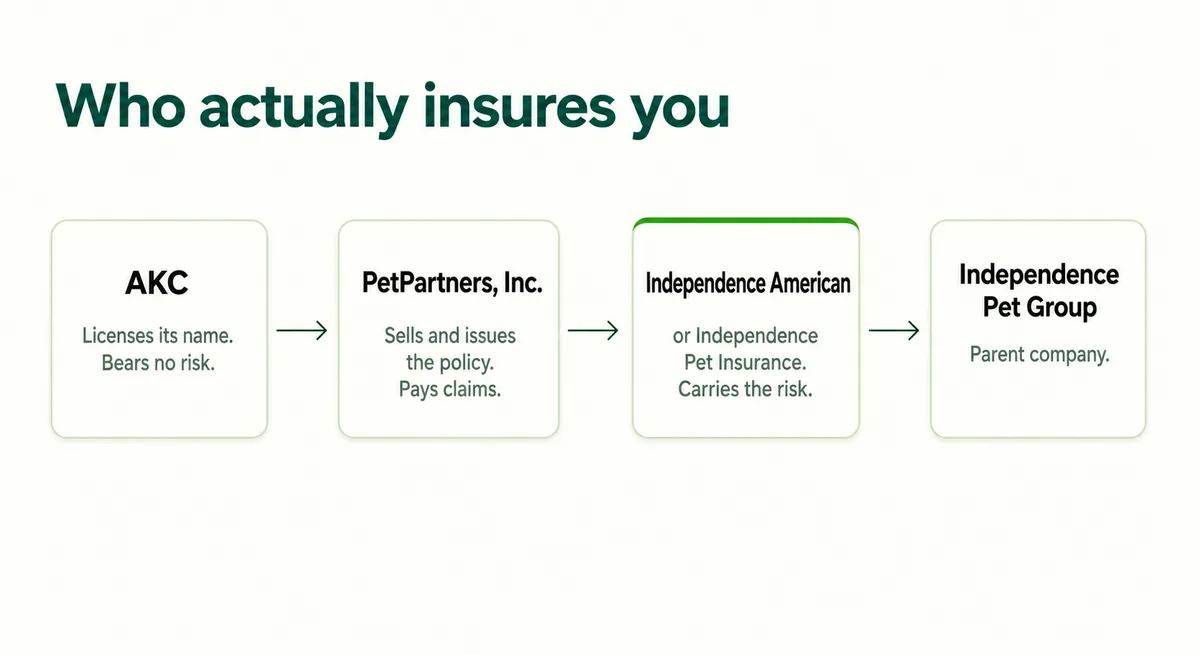
Someone has probably already put this policy in front of you — a comparison site, an HR benefits menu, or the paperwork that arrived with an AKC-registered puppy. So start here: PetPartners, Inc. is not an insurance company. It is a licensed agency that sells and administers the policy — including your claims — while a separate carrier underwrites it and owes the benefits. The same company sits behind the AKC-branded storefront and the pet plan on some employer benefits menus.
That matters more than it sounds. What costs you money here is not the brand — it is the plan tier you choose, and one clause about changing it. We read the filed policy forms for this review, across several states, rather than averaging star ratings.
The verdict, in short
- Worth considering if you are insuring a young, healthy pet on a tier with no per-incident cap — or if your pet already has a diagnosis and you can pay premiums for a full year before you need a payout — an unusual route, with conditions we set out below.
- Think hard if you are offered a low-premium tier carrying a per-incident limit. On those tiers, that limit decides your claim — not the bigger annual limit on the brochure.
- The clause that decides it: changing your plan at renewal can be treated as a new enrollment, restarting your waiting periods and re-opening the pre-existing question.
Table of Contents
- PetPartners, AKC Pet Insurance, and Your Employer's Plan Are the Same Company
- The Plans, and What Each One Actually Caps
- The Per-Incident Limit Is the Most Important Number on Your Policy
- Pre-Existing Conditions After 365 Days: What It Really Requires
- The Renewal Trap: Changing Your Plan Can Restart Your Clock
- Waiting Periods — and Why Yours Depend on Your State
- Riders: What the Base Plan Leaves Out
- What It Costs — and What Happens at Renewal
- If You're Being Offered This at Work
- Claims, Complaints, and What the Ratings Actually Measure
- Who Should Buy It — and Who Shouldn't
- Frequently Asked Questions
- Sources
PetPartners, AKC Pet Insurance, and Your Employer's Plan Are the Same Company
Four entities sit between you and your claim. PetPartners, Inc. (national producer number 7612549) is the licensed agency that sells the policy, issues it and adjudicates your claims. The risk sits with a different company: the disclosure names Independence American Insurance Company (NAIC #26581) or Independence Pet Insurance Company (NAIC #17543), without saying which one writes in which state. Both sit under the parent group, Independence Pet Group.
The American Kennel Club is not in that chain at all. It licenses its name, and the storefront says so in its own footer: “‘AKC Pet Insurance’ program is a marketing name used by PPI and is not an AKC business nor an insurer.” The Better Business Bureau reaches the same conclusion from the other direction, listing “AKC Pet Insurance” as an alternate name for PetPartners, Inc.
One figure explains the shape of the product. As of Delaware's 2022 examination of the carrier, PetPartners earned a 32.5% to 38.5% commission on new business it produced. That is context for how this policy is sold and priced — not a verdict on whether it pays.
If you arrived through the kennel-club storefront, our AKC Pet Insurance review covers that side. From here on, this review is about PetPartners.
The Plans, and What Each One Actually Caps
One distinction matters more than any other here: whether a plan caps what it pays per incident or only per year. Two of the five advertised tiers come with a per-incident limit built in and a third lets you set one, and wherever that number applies it — not the annual limit — decides most large claims.
| Plan | Deductible & coinsurance | Annual limit | Per-incident limit | Who it fits |
|---|---|---|---|---|
| CompanionCare (accident & illness) | You choose | You choose, including an unlimited option | None advertised | Most buyers who want the cap risk off the table |
| CompanionCare Lite (accident & illness) | $100 / 20% | Not published | $500, unlimited incidents | Buyers who only want help with small, one-off bills |
| CompanionPlus (accident & illness) | You choose | You choose | You choose | Workable — but only if you set the incident limit high |
| AccidentCare (accident only) | $100 / 10% | Unlimited | None published | Accidents only, on a budget |
| CompanionSelect (accident only) | $100 / 20% | $11,000 | $3,000 | Rarely — the incident cap binds long before the annual limit does |
Terms above come from PetPartners' own accident-and-illness and accident-only plan pages. CompanionSelect is not sold in New York.
One caveat worth knowing before you compare tiers: PetPartners publishes state-by-state sample policies for only three products — CompanionCare, AccidentCare and the 30-day starter certificate. CompanionCare Lite, CompanionPlus and CompanionSelect have no published sample form in any state, so the marketing page is the only place their terms appear. Plan availability and wording also vary by state form, so ask for your state's sample policy before you enroll.
The Per-Incident Limit Is the Most Important Number on Your Policy
A per-incident limit is the most your policy will reimburse for one condition — not one year of it, but the condition itself. Under the sample policy we read, it does not reset when you renew: a $500 per-incident limit means $500 toward that condition, for as long as your pet has it.
An annual limit behaves the way most buyers expect: it refills every policy year. A per-incident limit does not. The Nebraska sample policy defines it at Section 2(y) as “the maximum We will reimburse You for a Covered Expense for each Incident,” and states that per-incident limits “do not reset at Renewal or with changes to coverage.”
Section 9(j) adds a ratchet: move to a lower per-incident limit and the lower one governs the earlier condition too. That definition is generic — any applicable limit “is shown on the Declarations Page” — so it binds whatever number your own policy carries. No sample form is published for the capped tiers themselves, so check the one you are actually issued.
Note what the cap constrains — the payout, not the bill. Coinsurance comes off first, then the cap applies to what is left.
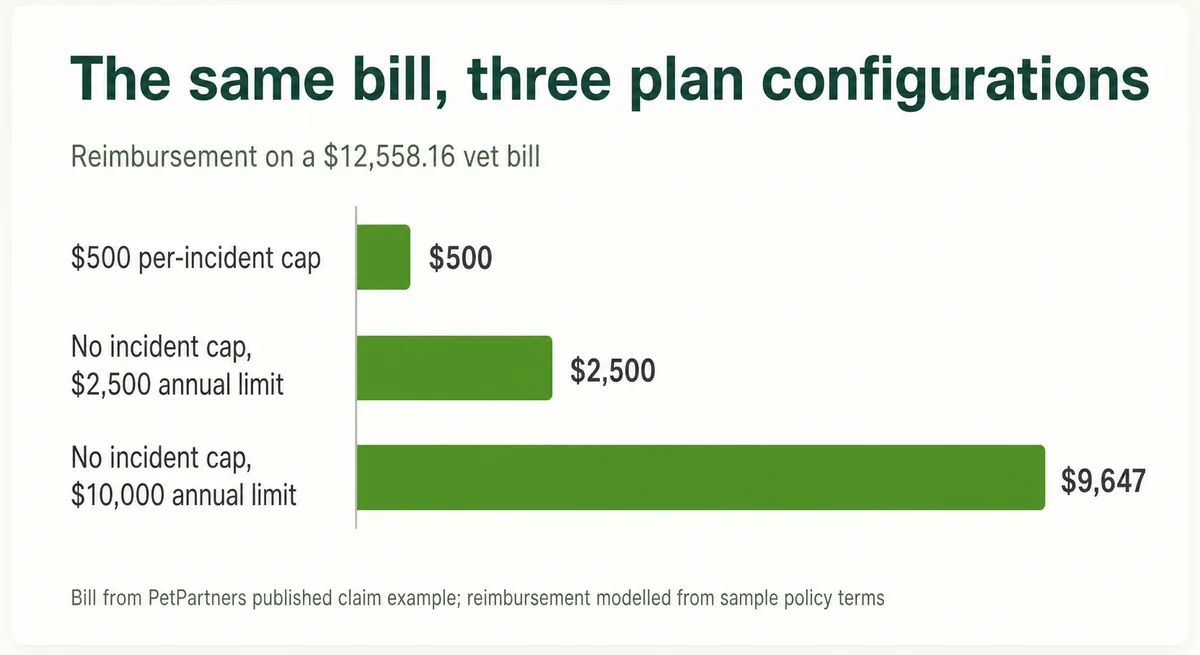
Here is what that looks like on a real bill. PetPartners publishes a claim of $12,558.16 for a dog treated for cancer. On a $500-per-incident tier, that claim reimburses $500. Remove the cap and the annual limit binds instead: running the policy's own formula — the bill, less a $500 deductible, times 80% reimbursement, then capped — it pays $2,500 against a $2,500 annual limit, or about $9,650 against a $10,000 one. (PetPartners says it paid $9,146; the configuration behind that figure isn't published, so we modelled from the sample policy instead.)
The cap bites on ordinary claims too. Nationwide's 2025 claims data puts an 80th-percentile dental-disease episode at $1,420 for dogs and $1,671 for cats — both already past what a $500 cap will pay. A single TPLO knee repair was listed at $4,500 at Colorado State's teaching hospital, in a fee schedule since taken down.
Owners tend to discover this at the worst moment. One owner on r/EpilepsyDogs found their cheaper tier would pay “up to $500 for epilepsy related expenses for his entire life” — less than a year of premiums.
Pre-Existing Conditions After 365 Days: What It Really Requires
This is the feature that brings most people to PetPartners. It is real — but it works as an expiring exclusion, not a promise. In the current Nebraska form, three exclusions — pre-existing conditions, treatment connected to them, and bilateral versions of them — each end “on the date after coverage has been continuously in effect for three hundred and sixty-five (365) days from the Pet Original Start Date.”
Read that as a set of conditions, because that is how it gets applied:
- The clock starts at your Pet Original Start Date — the day your pet was first covered — not the day the problem appeared.
- Coverage has to stay continuous. A lapse restarts it — and so, in some cases, does changing your plan (see the next section).
- Only those three exclusions expire. If a condition is excluded on other grounds too — a hereditary one without the HereditaryPlus rider, say — day 366 changes nothing.
One note on the marketing. PetPartners advertises coverage for “curable and incurable” pre-existing conditions. Those words appear in none of the four accident-and-illness forms we read. The forms never ask whether a condition is curable; they let the exclusion run out on time — better than the marketing implies, but not language you can hold anyone to. Two definitions of “pre-existing” are live across form generations, so which test governs depends on your state and purchase date.
Does it actually pay? The contract creates the route; the public evidence that claims follow it is thin. Owners report reimbursement for epilepsy medication and bloodwork once the year was served, and for allergies previously denied — unverified accounts, not carrier data. Buying a policy and getting a condition covered remain two different questions.
The Renewal Trap: Changing Your Plan Can Restart Your Clock
Picture an ordinary decision. Your premium jumps at renewal, so you trim the policy to keep it affordable — raise the deductible, lower the reimbursement rate. That is the standard advice for a renewal increase, and owners describe doing exactly that. Under this contract, it can also be the moment your waiting periods start over.
Section 11 of the Nebraska form — Section 10 on the accident-only version — says certain changes at renewal “will result in a new enrollment and the issuance of a separate and distinct subsequent Policy rather than a Renewal of this Policy.” What follows is the consequential part: “coverage will not be considered continuous,” a “new Pet Original Start Date” is set, “Applicable Waiting Periods will be reset,” and “Pre-existing Conditions will be determined based upon the new Policy's effective date.” The same wording appears in the Maine and Mississippi forms.
One owner on r/EpilepsyDogs hit this trying to escape a $500 per-incident cap: the better plan existed, but moving to it would have restarted the 365-day clock they had already served.
Here is the part worth pausing on. No document we found defines which changes count. The forms say “certain changes” and “no substantial change in coverage” without setting a threshold, giving examples, or defining the term anywhere. Deductible and reimbursement adjustments — the two most common — are not addressed at all. And if a reset does happen, credit for your prior coverage is discretionary: the insurer “may” provide it, subject to its own approval and underwriting guidelines.
So the protective habit is simple. Before you accept any change at renewal, ask in writing whether it re-issues the policy — and get the answer before you agree to it, not after.
Waiting Periods — and Why Yours Depend on Your State
There is no single national answer here, because PetPartners has two generations of policy form in circulation and your state determines which one you get.
On the older forms — still the version posted for most states — the Illinois sample policy sets 14 days for illness and 2 days for injury, then carves out two conditions with a 180-day wait: IVDD and cruciate ligament problems. Those matter most to large-breed and dachshund owners — 90 times the ordinary accident wait.
The newer forms, written for states that adopted the NAIC's pet insurance model act, drop the waiting period for accidents and for “Orthopedic Injuries.” Read that term carefully: the form defines Orthopedic Injuries as broken bones only. Cruciate tears, hip and elbow dysplasia, IVDD and luxating patellas are classed as orthopedic illnesses — and they still wait.
Worse for comparison shopping, those newer forms do not print the illness or orthopedic waiting periods at all. They defer to your Declarations Page, which you receive after buying. On the NAIC's Summer 2025 chart, only 16 jurisdictions had adopted the model act, and most of the largest states by population are not among them.
The newer forms do add a waiver: a vet exam within seven days of your start date can waive the waits. It is granted at the insurer's discretion, and anything the exam turns up becomes a pre-existing condition. As ever — ask for your state's sample policy before you enroll.
Riders: What the Base Plan Leaves Out
PetPartners sells a short list of add-ons — ExamPlus for exam fees, HereditaryPlus for hereditary and congenital conditions, Defender and DefenderPlus for routine care, SupportPlus for end-of-life costs, plus BreedingCoverage and AlternativePlus. One of them does far more work than the rest.
HereditaryPlus is the one to get right. The Nebraska form excludes hereditary disorders and congenital anomalies unless you buy it — and adds that where such a condition is also an orthopedic illness, that too needs the rider. Hip and elbow dysplasia, patellar luxation and disc disease all turn on it. Cancer, heart disease and diabetes do not: the same form states an orthopedic condition “does not include cancer or metabolic, hemopoietic, or autoimmune disease.”
The catch is timing. Eligibility for the rider is age-limited, and owners report a cut-off as low as two years in California — meaning that for many buyers it is realistically available only at the very start.
The consequence is concrete. One French bulldog owner was denied a $540 claim after a vet merely raised the possibility of a luxating patella — a problem that turned out to be a sprain and cleared up in 24 hours. A suspicion in the notes was enough.
What It Costs — and What Happens at Renewal
PetPartners publishes no rate card, so every figure below carries the configuration it was quoted at.
NerdWallet's May 2026 sample quotes for Katy, Texas — accident and illness, $250 deductible, $5,000 annual limit, 80% reimbursement — came out at $69 a month for a 2-year-old French bulldog and $190 at age 8; $51 and $142 for a Labrador; $23 and $51 for a domestic shorthair cat. MoneyGeek's July 2026 standardized profiles put the averages at $67 a month for dogs (6-year-old Labrador) and $39 for cats (7-year-old Ragdoll), each at a $5,000 limit, $500 deductible and 80% reimbursement.
For context, NAPHIA puts the 2025 US average accident-and-illness premium at $836 a year for dogs and $435 for cats.
Renewals are harder to pin down, because the company does not publish them. One owner asked a representative for a ballpark on annual increases and was told they could not give one. What exists instead is what owners report: a Labrador approaching six in West Los Angeles going from under $90 to $166 a month; a Southern California policy rising about 50% in a year; a cat premium up 44% in the same thread, and that was after the owner cut reimbursement from 90% to 80%.
Treat those as individual experiences rather than a rate table. But note the pattern, and that the reasons the company gave were the pet's age and the owner's ZIP code.
If You're Being Offered This at Work
PetPartners' own website is now largely a business-to-business one. It sells OnePack, a group product where the employer is the policyholder and staff enroll at open enrollment through payroll deduction. Pet benefits are increasingly common: 22% of employers offered pet health insurance in SHRM's 2024 survey.
Group pricing is not published anywhere, and we found exactly one enrollee who posted theirs: an $8,000 annual maximum and a $500 deductible for about $200 a month. They ran the numbers and declined. One quote is not a pattern — but it is a good reason to price the group offer against a retail quote rather than assume the workplace version is the better deal.
One real advantage does exist. Some state forms grant credit toward your waiting periods for time already served under a prior Independence American group policy — but only where that policy ran immediately before this one with no gap, proof of it may be required, and the clause is not in every state's form.
Before your enrollment deadline, check three things: the annual limit and whether a per-incident cap applies; whether your state's form carries the group-credit clause; and what happens to the policy if you leave the job.
Claims, Complaints, and What the Ratings Actually Measure
The scores do not agree, and averaging them would be a mistake. As observed on 24 July 2026, Trustpilot showed 1.9 out of 5 for the PetPartners storefront across 18 reviews, and 2.3 for the AKC-branded one across roughly a thousand. The BBB gives PetPartners, Inc. an A+ — a grade for complaint handling and responsiveness, not for customer satisfaction.
The pools differ in quality, too. That 18-review page carries complaints about grooming, a self-service dog wash and microchip registration; PetPartners' own reply to one of them points out it is a different business entirely. Any star score here measures a mixed bag, so it is worth knowing which pool a number came from.
Claims themselves look ordinary. Owners describe a workable online portal, an explanation of benefits within a few business days and reimbursement soon after — alongside denials that stuck. One denial for prescription allergy medication was overturned on appeal with a short signed letter from the vet, which is the most useful thing to know about the process.
Two regulatory actions exist, and they are not equivalent. Vermont assessed a $163,050 penalty in 2022 over claims adjusted by unlicensed staff, and the underwriter acknowledged the violations. California's 2025 consent order over how plans were offered across distribution channels was settled with an explicit denial of liability, and its $500,000 penalty applies only if the regulator finds non-compliance later.
Who Should Buy It — and Who Shouldn't
It makes sense for a young, healthy pet on an uncapped tier — and for the case this product is built for: a pet with an existing diagnosis, where you can hold continuous coverage for a full year before you need a payout. That route is unusual.
Skip the capped tiers if your pet has a chronic condition, or is a large breed carrying orthopedic risk. A $500 ceiling that never resets is not real protection against epilepsy, diabetes or a cruciate repair — and the premium is cheap because of it.
Compare the doors before you buy. Retail, the AKC storefront and an employer plan are the same company — not necessarily the same configuration or price.
Then do one thing before you enroll: request your state's sample policy and check the Declarations Page for your annual and per-incident limits. If your question is whether to insure at all, start with what pet insurance costs or our pre-existing conditions guide.
Frequently Asked Questions
How does PetPartners insurance work?
PetPartners is a licensed agency, not an insurance company. It sells and administers the policy and handles your claims, while Independence American Insurance Company or Independence Pet Insurance Company underwrites it and owes the benefits. You pay the vet, submit the bill, and PetPartners reimburses you at your plan’s rate after your deductible — subject to your annual limit and, on some tiers, a per-incident limit. The same company also runs the AKC-branded storefront and the pet plan on some employer benefit menus.
Is PetPartners the same as AKC Pet Insurance?
Yes — the same company administers both. The AKC licenses its name to PetPartners, Inc., and the storefront states plainly that “AKC Pet Insurance” is a marketing name used by PPI and is not an AKC business nor an insurer. The Better Business Bureau lists AKC Pet Insurance as an alternate name for PetPartners, Inc. The buying experience and some plan configurations still differ between the two doors, so it is worth comparing them rather than assuming they are identical.
Does PetPartners cover pre-existing conditions?
Eventually, and only on conditions. In the current sample policy, the pre-existing exclusion — along with related treatment and bilateral versions of it — expires once coverage has been continuously in effect for 365 days from your Pet Original Start Date. It is an expiring exclusion rather than a waiting period, it is not retroactive, and wording varies by state form, so confirm yours. A lapse restarts the clock, and a condition excluded on other grounds — a hereditary one without the HereditaryPlus rider, say — stays excluded regardless.
Why was my claim only reimbursed $500?
Most likely because your plan carries a $500 per-incident limit — the maximum the policy will reimburse for that one condition. In the sample policy that limit does not reset at renewal, so where those terms apply it works as a lifetime ceiling for that condition rather than an annual one. Check your Declarations Page: if a per-incident limit is listed, it will decide a large claim long before your annual limit comes into play.
How do I cancel, and is there a free-look period?
A free look is advertised where your state allows it, not everywhere. PetPartners says it will refund 100% of your premium within the first 30 days as long as no claims have been filed, and notes the period varies by state and is not available in all of them; the Nebraska form grants 30 days outright. Beyond that window, cancellation terms sit in your policy’s cancellation section rather than on the marketing pages, so ask for them in writing along with your state’s sample policy before you enroll.
What is the free 30-day AKC certificate, and what happens after it?
It is a real short-term policy that comes with AKC registration, not a discount. The published terms are a $100 deductible, a $500 incident limit, a $1,500 coverage limit and 20% coinsurance, with a one-day accident wait and a five-day illness wait. It expires 30 days after activation and must be activated within 28 days of registration — owners have reported claims denied for missing that step. It is not offered in California, New York or Washington. What you pay once it expires is not published.
How do I file a claim with PetPartners?
Through the online portal, or by email with a claim form. Owners describe submitting through the member portal and receiving an explanation of benefits within a few business days, with reimbursement soon after; others still email a printed claim form with the invoice. If a claim is denied and you disagree, appealing is worth the effort — one owner had a denial for prescription allergy medication overturned after supplying a short signed letter from their vet.
Can I insure a senior pet with PetPartners?
Accident-only coverage, generally yes; accident-and-illness only if you enroll before the cut-off. PetPartners’ own FAQ says a pet must be enrolled before its ninth birthday for illness coverage — so the last year you can start one is the year your pet is eight — and that dogs and cats aged nine and over are offered an accident-only plan. Coverage you already hold is not withdrawn as your pet ages; the limit applies to new enrollments. Confirm eligibility before you count on it.
Does PetPartners cover hip dysplasia and other hereditary conditions?
Only if you add the HereditaryPlus rider. The Nebraska sample policy excludes hereditary disorders and congenital anomalies without it, and adds that where such a condition is also an orthopedic illness, that too needs the rider — which is what puts hip dysplasia behind it. The rider is age-limited, with owners reporting a cut-off as low as two years in California, so it is realistically a decision you make at the start. One owner was denied a $540 claim after a vet merely raised the possibility of a luxating patella.
Sources
- Underwriting and Licensing Disclosure — AKC Pet Insurance (PetPartners, Inc.)
- AKC Pet Insurance — site footer brand disclosure — AKC Pet Insurance (PetPartners, Inc.)
- PetPartners, Inc. — BBB Business Profile — Better Business Bureau
- Examination Report of Independence American Insurance Company as of December 31, 2022 — Delaware Department of Insurance
- Accident & Illness Pet Insurance Plans — PetPartners
- Accident-Only Pet Insurance Plans — PetPartners
- State Documents and Sample Policies — PetPartners
- Sample Policy — CompanionCare Accident & Illness, form IAIC PPI AI POL 007 0124 NE (ed. 01/2024) — Independence American Insurance Company / PetPartners
- Dog Insurance — published claim example — AKC Pet Insurance (PetPartners, Inc.)
- Chronic Conditions Dominate This Year's List of Most Common and Expensive Pet Health Problems (2025 claims data) — Nationwide, via PR Newswire
- Orthopedic Surgery Pricing (archived 2025-10-11) — Colorado State University Veterinary Teaching Hospital, via the Internet Archive
- Is AKC Pet Insurance Worth It? — r/EpilepsyDogs discussion — Reddit
- Pre-Existing Conditions coverage page — AKC Pet Insurance (PetPartners, Inc.)
- AKC pet insurance coverage — r/EpilepsyDogs discussion — Reddit
- AKC Pet Insurance any good? — r/petinsurancereviews discussion — Reddit
- Sample Policy — Accident & Illness, form IAIC PPI AI POL 007 0123 ME (ed. 01/2023) — Independence American Insurance Company / PetPartners
- Sample Policy — Accident Only, form IAIC PPI A POL 007 0124 MS (ed. 01/2024) — Independence American Insurance Company / PetPartners
- AKC Pet Insurance has skyrocket — r/petinsurancereviews discussion — Reddit
- Sample Policy — Accident & Illness, form IAIC PPI AI POL 007 IL 1120 (ed. 11/2020) — Independence American Insurance Company / PetPartners
- Pet Insurance Model Act (Model #633) — National Association of Insurance Commissioners
- Pet Insurance Model Act — state adoption chart (Summer 2025) — National Association of Insurance Commissioners
- AKC Pet Insurance? — r/petinsurancereviews discussion — Reddit
- A warning about AKC Insurance — r/Frenchbulldogs discussion — Reddit
- AKC Pet Insurance Review — sample monthly quotes (Katy, TX) — NerdWallet
- AKC Pet Insurance Review — standardized cost profiles — MoneyGeek
- State of the Industry Report 2026 (Highlights) — average annual premiums, US, 2025 — North American Pet Health Insurance Association (NAPHIA)
- Who here has used akc pet insurance, specifically for cats? — r/Pets discussion — Reddit
- AKC Pet Insurance cost increased 50% after first year — r/petinsurancereviews discussion — Reddit
- PetPartners — employer pet insurance (OnePack Plan) — PetPartners
- 2024 Employee Benefits Survey — Executive Summary — SHRM
- Pet insurance and annual maximum payouts low? — r/bernesemountaindogs discussion — Reddit
- Sample Policy — Accident & Illness with group credit, form IAIC PPI AI POL 007 ID 1120 — Independence American Insurance Company / PetPartners
- PetPartners reviews (Trustpilot profile, observed 2026-07-24) — Trustpilot
- AKC Pet Insurance reviews (Trustpilot profile, observed 2026-07-24) — Trustpilot
- AKC denied my dog's prescription allergy meds — r/petinsurancereviews discussion — Reddit
- Stipulation and Consent Order, Docket 22-018-I (Independence American Insurance Company) — Vermont Department of Financial Regulation
- Stipulation and Consent Order, File NC-2024-00009 (Independence American Insurance Company) — California Department of Insurance
- Get a quote — policy terms and free-look disclosure — AKC Pet Insurance (PetPartners, Inc.)
- AKC Pet Insurance 30-Day Certificate Information Sheet — AKC Pet Insurance (PetPartners, Inc.)
- 30 days of pet insurance for AKC-registered pets — offer terms — AKC Pet Insurance (PetPartners, Inc.)
- Frequently Asked Questions — PetPartners