


Neither carrier wins outright. Pets Best is generally the easier policy to get into; Healthy Paws is the simpler one to hold once you're in. Which is right for you comes down to two questions: how old your pet is, and whether you already have a policy somewhere.
We read both carriers' filed policy documents rather than their marketing pages, and we compare quotes only at a matched deductible, reimbursement rate and annual limit. That matters more than it sounds — published comparisons of these two disagree wildly on price, on enrollment age limits, even on how fast each pays a claim, because most are paraphrasing brochures. You can see how we evaluate carriers if you want the full method.
The honest answer also changes depending on who is asking. A first-year quote is one layer of value; the layer that decides this matchup is years three through ten — when premiums re-rate, a pet's chart fills up, and switching quietly stops being an option. So this comparison ends in four verdicts, not one.
Table of Contents
- The short answer, by situation
- Who actually insures you
- Price, compared properly
- Plan shape: one plan vs a configurable stack
- Waiting periods depend on your state
- Getting in the door: exams, records and age
- Already insured? Read this before you switch
- Dental and exam fees
- When the vet actually gets paid
- What happens at renewal
- Frequently Asked Questions
- Sources
The short answer, by situation
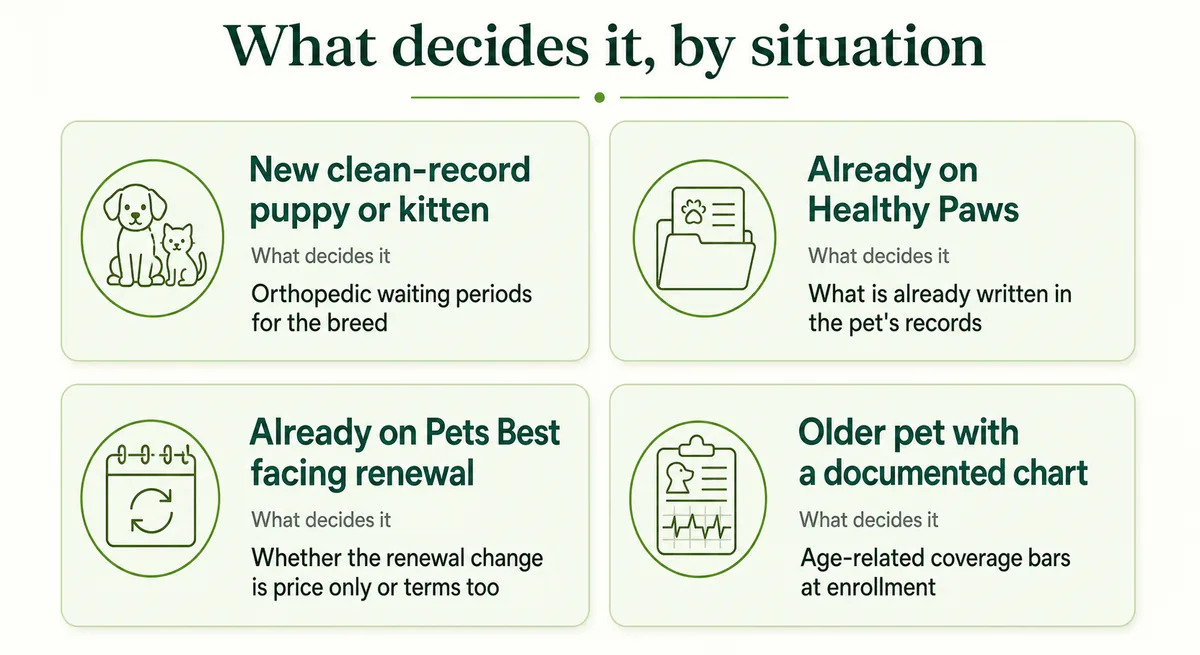
Four honest answers, and which is yours depends on your pet's history — not on a star rating.
Insuring a new, clean-record puppy or kitten? Start with Pets Best. No vet exam is required to enroll, and its filed waits are shorter: 3 days for injuries, 14 for illnesses, against 15 days for both at Healthy Paws. What flips it: your breed's orthopedic risk — these two contracts fail in opposite directions on knees and hips.
Already with Healthy Paws and eyeing the door? Decided by what's already in your pet's records, not by the quote. Request them before you shop. What flips it: a genuinely clean chart makes leaving realistic; one noted symptom usually doesn't.
Already with Pets Best and facing a renewal? Read the notice for what it actually changes — price only, or your reimbursement rate and deductible too. What flips it: if your pet has developed anything since you enrolled, re-buying waiting periods elsewhere rarely pays.
Older pet, or one with a chart? Lean Pets Best. It publishes no upper enrollment age; Healthy Paws publishes no number either way, and its policy states that for pets six or older at enrollment, "no coverage shall apply for illness related to hip dysplasia" — permanently, not as a waiting period. It may still sell you the policy; that clause decides what the policy then does. What flips it: nothing about price.
| At a glance | Pets Best | Healthy Paws |
|---|---|---|
| Plan structure | Tiers + add-ons | One plan |
| Accident wait | 3 days | 15 days |
| Illness wait | 14 days | 15 days |
| Knee (cruciate) wait | 6 months | Illness wait only |
| Hip dysplasia | Illness wait only | 12 months; never if enrolled at 6+ |
| Vet exam | Not required | Required, up to 15 days after coverage starts |
| Exam fees on a claim | Paid add-on | Excluded |
| Upper enrollment age | None published | Not published ("varies by state") |
Those are base-policy terms. Several states change the waiting periods on both sides, and soften the Healthy Paws exam requirement. Every row is decoded below.
Who actually insures you
Neither name on the marketing is the company carrying the risk — and on one side, which company that is depends on your state.
Healthy Paws is a Chubb brand. Its policies are underwritten by Chubb group companies, and the sample policy it publishes for most states is issued by Westchester Fire Insurance Company. AM Best affirmed those Chubb subsidiaries at A++ (Superior) on 16 January 2026.
Pets Best is a licensed insurance agency, not an insurer. Your policy is written by one of three companies — American Pet Insurance Company, Independence American, or MS Transverse — and the carrier tells you to "refer to your declarations page to determine the underwriter for your policy". Their grades differ: Independence American holds AM Best A- (Excellent), affirmed December 2025; MS Transverse was upgraded to A+ (Superior) in June 2025; and American Pet Insurance Company is rated by Demotech rather than AM Best, at A′ (A Prime, "Unsurpassed"), affirmed 19 June 2026.
Worth keeping in proportion: these grades measure each insurer's whole balance sheet, not how it handles pet claims. Check your own declarations page to see which one you actually bought.
Price, compared properly
In the one matched-configuration sample we could find, Pets Best quoted lower on every pet — but the gap is smaller than most comparison pages imply, and it holds only for the setup it was measured at.
At the same deductible, reimbursement and limit
The most recent quotes we found at one identical configuration for both carriers: 4-year-old pets in Raleigh, North Carolina, unlimited annual coverage, a $500 deductible and an 80% reimbursement rate, collected by MarketWatch and dated July 2026.
| Pet | Pets Best (monthly) | Healthy Paws (monthly) |
|---|---|---|
| Labrador retriever | $34.08 | $61.11 |
| Golden retriever | $34.69 | $61.11 |
| Miniature poodle | $18.67 | $41.35 |
| Ragdoll cat | $14.53 | $24.17 |
One configuration, one state, one date. Your own quote will differ.
Why published comparisons disagree
Because most of them don't match the configurations before comparing. Across the pages ranking for this matchup, the same carrier's sample dog premium appears at $45.88 on one page and $136 on another. U.S. News puts Pets Best at "about $17 cheaper" for dogs, while its own footnotes show the Healthy Paws figure was priced at 70–80% reimbursement instead of 90%, and at a $500 deductible instead of $250 for the older dog. A true match is also structurally awkward: Healthy Paws sells unlimited annual coverage, so a like-for-like table has to push Pets Best up to its unlimited option too.
Exam fees: does the cheaper premium survive a real year?
Healthy Paws excludes the exam fee — the charge just for being seen. Its own cost guide puts emergency exam fees at $100 to $300, "often higher after hours or on weekends". Pets Best sells exam-fee coverage as an add-on you have to elect when you enroll.
Both carriers apply your reimbursement percentage first, then subtract the deductible. Healthy Paws' own worked example takes a $1,200 bill at 80%, giving $960, then subtracts a $250 deductible: $710 back. The Pets Best form works the same way. Three such visits in a year at the low end of that range is $300 that never enters the calculation at all. Whether the Pets Best add-on wins that back depends on what it costs, which the carrier doesn't publish; you will only see it on your own quote.
Plan shape: one plan vs a configurable stack
Pets Best sells a stack you configure; Healthy Paws sells one plan. That shape — not the opening quote — is what you live with for the next decade.
| What you can choose | Pets Best | Healthy Paws |
|---|---|---|
| Accident-and-illness tiers | Three (Essential, Plus, Elite) | One plan |
| Accident-only plan | Yes | No |
| Wellness / routine add-on | Yes, two tiers | No |
| Annual limits | $2,500, $5,000, $10,000 or unlimited | See the note below |
| Deductible | $50–$2,000 | Not consistently published |
| Reimbursement | 50%–90% | Not consistently published |
The Pets Best menus come from its filed policy form, which is wider than most summaries report. Its tiers differ by which extras are bundled (exam fees, take-home prescriptions, rehabilitation), not by how much the policy pays out.
The catch is what happens when you want more coverage later. At Healthy Paws, the annual limit you pick at enrollment "can never be increased across the life of your pet's policy". At Pets Best you can raise it — but the form says that requires "the cancellation of your current policy and the issuance of a new policy", with fresh waiting periods and the pre-existing exclusion re-applied from the new effective date. Neither is a free upgrade.
One inconsistency worth knowing: the sample policy Healthy Paws still publishes describes a lifetime limit and never mentions an annual one, while its current FAQ offers annual limit choices. That posted contract is dated 2018, so read your quote and declarations page, not the sample.
Waiting periods depend on your state
Neither carrier simply has "shorter waits" — your state decides it. Both run a reduced schedule in about a dozen states, following the NAIC Pet Insurance Model Act that states began adopting in 2022.
Knees vs hips: they fail in opposite directions
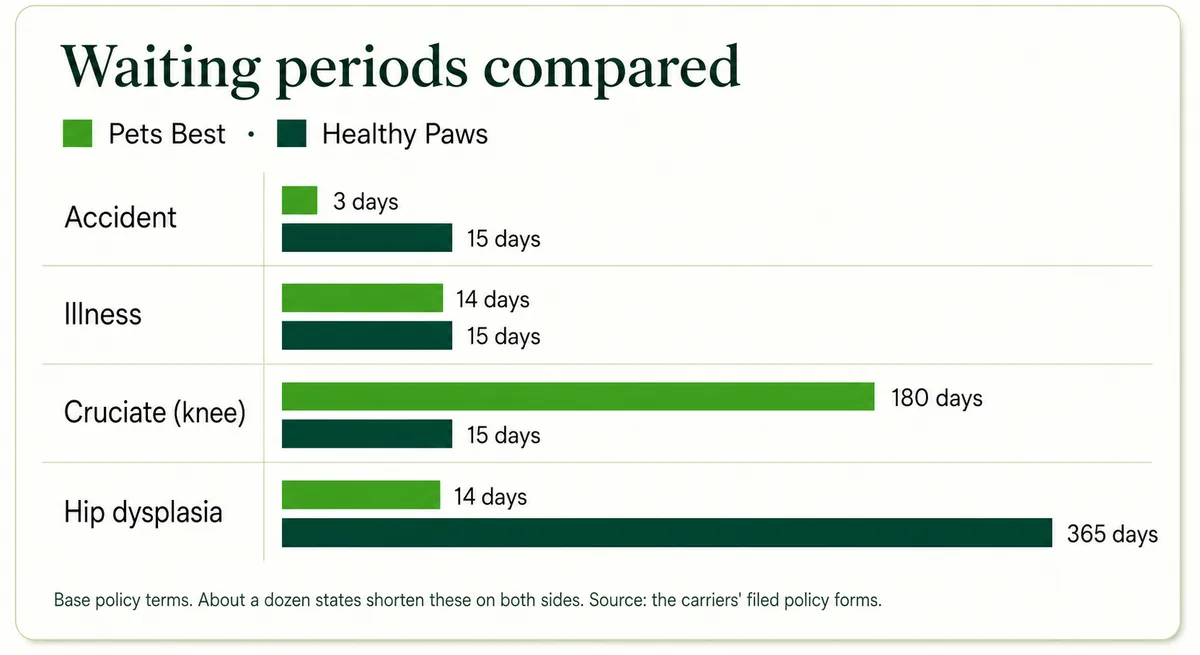
On base terms, Pets Best makes you wait six months for cruciate ligament claims but applies no hip-specific wait. Healthy Paws is the mirror image: no cruciate carve-out, but twelve months on hip dysplasia. For a Labrador or a Golden that single difference can decide the whole thing — and it points opposite ways depending on which joint you're worried about.
Where the reduced schedules apply:
- Pets Best — twelve states drop to a 0-day accident wait, 14 days for illness and 30 days for cruciate, each tied to a policy-purchase date running from Maine in late 2022 to Vermont in mid-2025; North Dakota sits at 3 / 14 / 30. See the carrier's state table.
- Healthy Paws — in the states it names, the schedule moves to 15 days for illness, injury and orthopedic conditions other than hip dysplasia, 30 days for hip dysplasia, and no wait at all for anything resulting from an accident — with both waits waived once your pet completes a clinical exam. Its California endorsement is one example of the form that does it.
One caution: Healthy Paws' FAQ lists sixteen states for that reduced schedule, but the endorsements it actually posts support only about a dozen. Check the document for your own state before you count on it.
Getting in the door: exams, records and age
This is the sharpest difference between the two, and it's invisible in a quote.
Healthy Paws requires a vet exam. Its policy says a pet under six "must have undergone a complete clinical examination" in the twelve months before coverage starts or within fifteen days after — thirty days before, for a pet six or older — and that failing to supply it "may void the policy." In the dozen-odd endorsement states, that "must" softens to "should" and the voiding language drops out.
Pets Best requires none of that. It doesn't ask for an exam to enroll, takes pets from seven weeks with no upper age limit, and if you can't produce records its form says it "may deny your claim(s)". That clause reaches the claim, not the policy — though, like most contracts, both forms separately allow voiding for false or misleading information.
Two age rules get muddled constantly, so keep them apart:
- Whether they'll sell you a policy. Pets Best publishes no ceiling. Healthy Paws says only that maximum enrollment age "varies by state": no number, so check yours.
- What they'll cover once they do. Enroll a pet at six or older with Healthy Paws and hip dysplasia is excluded permanently, not delayed; that clause survives even in the endorsement states.
Being sold a policy and having a condition covered are not the same promise. For an older pet, ask about the second.
Already insured? Read this before you switch
Switching resets your pet's slate in the wrong direction. Any condition already showing signs or symptoms in your pet's record can be treated as pre-existing at the new carrier, and every waiting period starts over. That is true of both of these companies.
Do this first: ask your vet for your pet's complete records, and read them. Owners get caught by a line they never thought about — a note about occasional itching, one limp, a single mention of vomiting. The quote won't show you that. The records will.
None of this is a reason to put off a vet visit. Getting your pet seen is always the right call; the point is to know what's written down before you shop.
"Curable" conditions: read that promise carefully
Healthy Paws' FAQ says a condition "may no longer be considered pre-existing" after 365 days free of signs and treatment. That language appears nowhere in its filed policy — and the same FAQ carves out the conditions that actually cost money: cruciate tears, orthopedic problems like patellar luxation and hip dysplasia, and anything needing ongoing medication, such as heart disease or seizures.
Pets Best is often credited with a 180-day version of the same thing. We could not find it in either filed form we read; it appears only in a blog post, hedged. Treat both windows as company practice, not contract terms.
The second-knee rule works differently on each side
Healthy Paws applies its bilateral exclusion only to cruciate ligaments, and the trigger is a problem that predates your policy: where cruciate problems in another leg existed before the effective date and "have been identified," future treatment of a leg is excluded, related or not. A tear that happens while you're covered doesn't trigger it. Pets Best has no all-leg sweep, but its bilateral clause names ten conditions — luxating patellas, hip dysplasia, elbow dysplasia, cataracts, cherry eye and others.
One owner reported moving a 9-year-old dog with no claims in eight and a half years from Healthy Paws at $230 a month (90% reimbursement, $100 deductible) to Pets Best at $123 with a $200 deductible. That is one unverified premium report, not evidence of how later claims were handled — a reason to read your own chart, not to assume switching goes that way.
Dental and exam fees
Pets Best covers some dental illness; Healthy Paws covers dental only after an accident.
Healthy Paws files dental care under its preventive-care exclusions, and defines that term to include extractions and reconstructions — so a tooth pulled because of disease sits inside the exclusion. Only accident-damaged teeth are carved back in. It also excludes periodontal disease it attributes to insufficient brushing — a condition on your habits Pets Best doesn't impose.
Pets Best does cover periodontal disease if your pet showed no signs of it before coverage started, but narrowly: endodontic work on canine and carnassial teeth, plus extractions. Routine cleanings are excluded on both sides.
The California catch. The Pets Best booklet for California adds something the Texas one doesn't: from age three, your pet's teeth must have been cleaned under general anesthesia within the previous thirteen months for a periodontal claim to qualify — a cleaning the policy itself won't pay for. Check which booklet your state uses.
One gap worth knowing: Pets Best's coverage page says most plans include exam fees, while the filed form makes it a paid add-on you elect at enrollment.
When the vet actually gets paid
Both carriers can pay your vet directly, but the mechanisms are mirror images — and the difference shows up at 2 a.m.
Healthy Paws requires you to arrange it "in advance of the treatment," and only "during business hours". Pets Best works the other way round: a release form your vet signs for a bill you haven't paid — which only helps if the clinic agrees to wait for its money.
A weekend emergency falls outside the Healthy Paws window; the Pets Best route depends on your clinic. Neither is a contractual right — no direct-pay provision appears in either filed policy.
On speed, read the published figures carefully — both measure payment after a decision, not the decision itself. Healthy Paws says that once a claim is approved, reimbursement is issued "on average within 2 business days", with no data period or sample size attached. Pets Best publishes 5–7 days to a bank account, footnoted to its own 2024 claims data. Neither figure covers how long the decision takes, neither is independently audited, and the Healthy Paws policy itself allows up to sixty days to pay a completed claim.
What happens at renewal
Both carriers re-rate over time. California is the one state where you can watch the size of those moves in public filings rather than in anecdote — bearing in mind these are program-wide rate changes, not the increase any one renewing customer sees.
| Filing (underwriter) | Requested | Approved | Closed |
|---|---|---|---|
| Westchester Fire — Healthy Paws | 44.8% | 44.8% | Mar 2025 |
| American Pet Insurance — Pets Best | 45% | 24.3% | May 2025 |
| American Pet Insurance — Pets Best | 53.4% | 53.4% | May 2026 |
| Independence American — Pets Best | 17.1% | 7.9% | Jul 2025 |
Those two columns are not the same thing, and the difference gets lost constantly. One widely-shared article reported that California "approved a 45% rate increase" for Pets Best; the regulator's own record shows 45% requested and 24.3% approved.
For scale: veterinary services rose 5.14% in the year to June 2026. These increases are multiples of that. Outside California there is no comparable public pet-line record — worth remembering whenever a site tells you one carrier raises rates more than the other.
Price isn't the only thing that can change. Through mid-2026 several Healthy Paws customers reported being moved at renewal from 90% reimbursement and a $250 deductible to 70% and $500 — a change to the terms, not just the premium. That is owner-reported, not a measured rate, and we found no equivalent reports on the Pets Best side. A posting pattern isn't proof of a difference, but it is worth reading your renewal notice for what it changes, not just what it costs.
Frequently Asked Questions
Which is better, Pets Best or Healthy Paws?
Neither, in general — it depends on your pet's age and whether you already hold a policy. For a new, clean-record puppy or kitten, Pets Best is usually the easier entry: no vet exam to enroll, and shorter accident and illness waits. For an older pet, Pets Best tends to be the safer bet: Healthy Paws may still issue the policy, but its filed form permanently excludes illness related to hip dysplasia for pets enrolled at six or older. If you are already insured, what decides it is not the quote — it is what is already written in your pet's records.
Which one is cheaper?
At a matched configuration Pets Best usually quotes lower — but only compare figures taken at the same deductible, reimbursement rate and annual limit. Quotes collected for 4-year-old pets in Raleigh, North Carolina at unlimited coverage, a $500 deductible and 80% reimbursement put a Labrador at $34.08 with Pets Best against $61.11 with Healthy Paws. Published comparisons of these two disagree wildly, mostly because they don't match the settings before comparing.
Is there an age limit to enroll with Healthy Paws?
Healthy Paws doesn't publish a single number — its plan pages say maximum enrollment age "varies by state". Third-party reviews quote figures that don't agree with one another, so check the terms for your own state rather than relying on them. The age rule that is in the policy is easy to miss and more consequential: enroll a pet at six or older and hip dysplasia is excluded permanently, not merely delayed. Pets Best publishes no upper enrollment age.
Does Healthy Paws raise premiums as a pet gets older?
Both carriers re-rate over time, and California's regulator publishes the filings. Healthy Paws' underwriter was granted 44.8% in full in March 2025. Pets Best's programs show 45% requested and 24.3% approved in May 2025, then 53.4% granted in full in May 2026 — so neither brand is the consistently gentler one. These are program-wide changes, not one customer's renewal, and for scale veterinary services rose 5.14% in the year to June 2026. Outside California no comparable public record exists.
Can an insurer change my reimbursement rate at renewal?
Check your own policy, because the filed wording is narrower than people assume. The Healthy Paws form says only that your coverage, coinsurance and deductible "will not change due to your pet's claims experience" — it does not promise they cannot change on other grounds. Separately, some Healthy Paws customers reported being moved to 70% and a $500 deductible at renewal in 2026; those are unverified owner accounts. Read your renewal notice for what it changes, not only for what it costs.
Does Pets Best require a yearly dental cleaning?
In California, effectively yes. The Pets Best booklet for California says that from age three, your pet's teeth must have been cleaned and examined under general anesthesia within the previous thirteen months for a periodontal claim to qualify. The Texas booklet carries no such requirement. Routine cleanings aren't covered by the policy itself, so in California that is a recurring out-of-pocket cost attached to keeping dental illness coverage alive.
Should I switch from one to the other?
Only if your pet's records are genuinely clean. Anything already noted — a limp, recurring itching, one episode of vomiting — becomes a pre-existing condition at the new carrier, and every waiting period starts again. Ask your vet for the complete records and read them before you request quotes. None of this is a reason to put off care your pet needs; it is a reason to know what is documented before you shop.
What do owners say about these two on Reddit?
Discussion skews heavily toward renewal costs rather than claim handling, and toward Healthy Paws — but that is a posting pattern in a complaint-seeking venue, not a measured difference between the carriers. The most useful recurring advice from owners is practical rather than comparative: check what is in your pet's medical records before switching, because a single note can make a condition pre-existing at the next insurer. Treat forum threads as vocabulary and warning signs, not as coverage rules.
Sources
- Pet Health Insurance Policy, form LD-50812 (07/18) — Westchester Fire Insurance Company (Healthy Paws)
- Accident and Illness Policy, form IAIC-PB10001-ILL (Texas sample) — Independence American Insurance Company (Pets Best) — via Internet Archive
- Pets Best FAQ — enrollment age — Pets Best — via Internet Archive
- AM Best Affirms Credit Ratings of Chubb Limited and Its Subsidiaries — AM Best
- Underwriters & Licensing — Pets Best — via Internet Archive
- AM Best Affirms Credit Ratings of Independence American Insurance Company — AM Best
- AM Best Upgrades Credit Ratings of MS Transverse Specialty Insurance Company, MS Transverse Insurance Company and TRM Specialty Insurance Company — AM Best
- American Pet Insurance Company — Financial Stability Rating — Demotech, Inc.
- Pets Best vs Healthy Paws: 2026 Comparison (matched-configuration quotes, Raleigh NC) — MarketWatch Guides
- Pets Best vs Healthy Paws Pet Insurance Comparison 2026 — Hepper
- Pets Best vs. Healthy Paws Pet Insurance — MoneyGeek
- Healthy Paws vs. Pets Best Pet Insurance — U.S. News & World Report
- The Most Common Pet Emergencies and Their Real Costs — Healthy Paws
- Frequently Asked Questions (reimbursement worked example) — Healthy Paws
- Pet Insurance Model Act (#633) — National Association of Insurance Commissioners
- What are waiting periods? (state-by-state table) — Pets Best — via Internet Archive
- Amendatory Endorsement — California, form LD-54156 (10/24) — Healthy Paws / Westchester Fire Insurance Company
- Dog & Puppy Insurance — enrollment eligibility — Healthy Paws
- Owner discussion: rate increases and switching between Healthy Paws, Pets Best and Embrace — Reddit — r/petinsurancereviews (owner-reported, not incidence data)
- Dental Health — coverage and exclusions — Healthy Paws
- Accident and Illness Policy, California sample (form IAIC-PBI0001-ILL, 02/2023) — Independence American Insurance Company (Pets Best) — via Internet Archive
- Coverage — what Pets Best plans include — Pets Best — via Internet Archive
- Can Healthy Paws pay my veterinarian directly? — Healthy Paws
- Vet Direct Pay — Pets Best — via Internet Archive
- Rate Filing Closed and Approved Filings (requested vs approved columns) — California Department of Insurance
- Pets Best 45% rate hike in California (figure corrected against the CDI record) — Insurify
- CPI — Veterinarian services, U.S. city average (series CUUR0000SS62054) — U.S. Bureau of Labor Statistics
- Healthy Paws — coverage cut as pet ages (owner reports) — Reddit — r/petinsurancereviews (owner-reported, not incidence data)