


Neither wins outright. Trupanion's deductible attaches to each condition and is paid once; Pets Best's attaches to the year and resets every renewal. So the answer turns on one question about your pet: are you likely to face one long-running illness, or several unrelated problems?
We built this comparison from the two carriers' filed policy forms and the public rate-filing record — not from their own comparison pages, both of which rank for this search and both of which are selling you something. You can see how we evaluate carriers if you want the full method.
That one mechanical difference matters more than the opening quote, because it compounds over a pet's lifetime while a first-year premium doesn't. So this comparison ends in four verdicts rather than one. And if you already hold one of these policies, your answer is different again — that is the part almost nobody writes about.
Table of Contents
- The short answer, by situation
- The deductible is the whole comparison
- Who actually insures you
- Price, compared properly
- Waiting periods depend on your state
- Cash flow at the vet counter
- Already insured? Read this before you switch
- What happens at renewal
- Exam fees and what else isn't covered
- Frequently Asked Questions
- Sources
The short answer, by situation
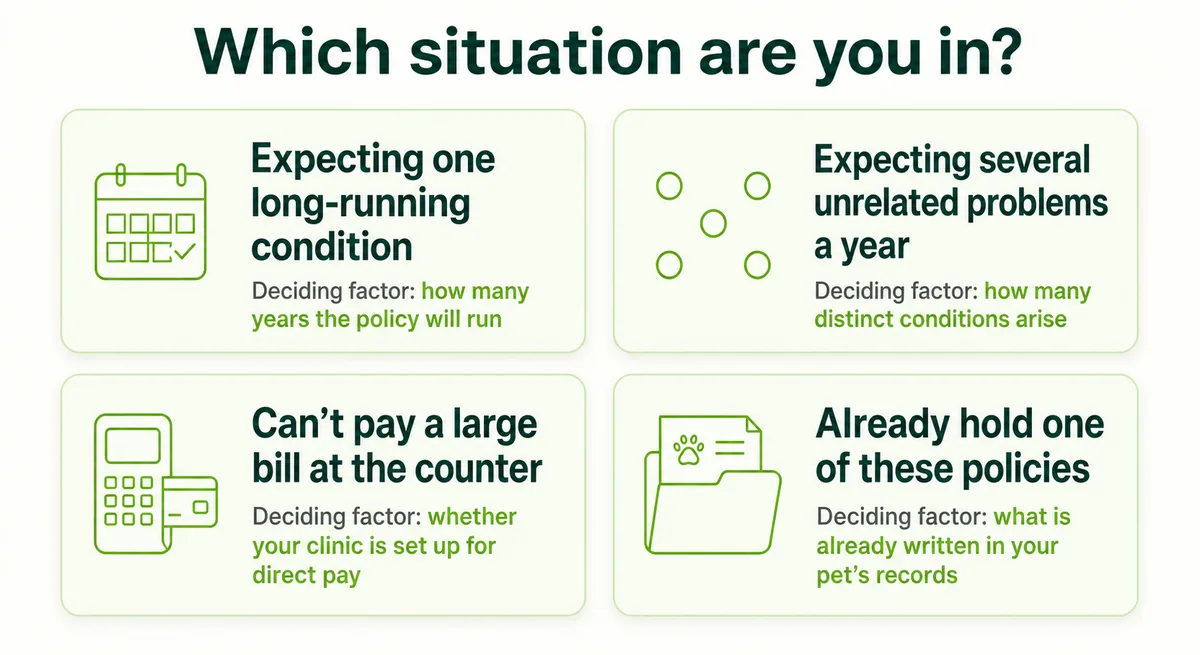
Neither policy is better in general. What decides it is the shape of the claims you expect, and whether you can pay at the counter. Find yourself here.
- You expect one long-running condition — diabetes, allergies, a chronic gut problem. Trupanion. Its deductible is paid once for that condition and never comes back. Flips if: you don't keep the policy long, because the saving compounds over years.
- You expect several unrelated problems in a year — a young dog, or a cat that swallows things. Pets Best. One deductible covers the whole year, however many things go wrong. Flips if: those problems turn out to be one recurring condition.
- You can't put a four-figure bill on a card tonight. Trupanion, but only if your clinic is set up for it. Flips if: your vet doesn't run its software, which nothing obliges them to. Ask the clinic, not the carrier.
- You already hold one of them. Probably stay. Moving restarts every waiting period and re-tests your pet's history for pre-existing conditions. Flips if: the record is clean.
The base-policy terms behind those verdicts, read from the carriers' own filed documents — Trupanion's sample policy and state disclosures, and Pets Best's filed booklet.
| Base policy | Trupanion | Pets Best |
|---|---|---|
| Deductible | Per condition, paid once | Annual, resets every renewal |
| Annual limit | No limit provision in the form | Tiered, $2,500 up to no annual limit |
| Waiting periods | Varies by state: 30 days illness, 5 days injury in the 2019 sample policy; 30 days illness in California, which a qualifying exam can waive; no waiting periods in Washington or Louisiana, but a 12-day delay before the policy takes effect unless you enroll on an Exam Day Offer (see below) | 14 days illness, 3 days injury, 6 months cruciate |
| Exam fees | Never covered | Add-on, chosen at enrollment |
| Paying the vet directly | At checkout, if the clinic runs the software | After the claim is decided, if the vet signs a release |
Your state can rewrite these. Trupanion's 30 and 5 days come from its 2019 sample policy and its own FAQ, and in some states its filed disclosure replaces them with something else entirely. We come back to that below.
The deductible is the whole comparison
The difference shows up on the second claim. Your dog's allergies flare again a year later: under Trupanion you already paid that deductible and never pay it for allergies again. Under Pets Best the policy year has turned, so you pay it again.
Set both policies to a $250 deductible and 90% reimbursement, with each flare costing $1,000 in eligible treatment. Both carriers take the coinsurance first and subtract the deductible after, so 90% of $1,000 is $900, less $250, and the first claim reimburses $650 either way (Trupanion's own worked example; Pets Best's insuring agreement sets the same order). What separates them is everything after that.
| Deductibles paid over eight years | Trupanion | Pets Best |
|---|---|---|
| One chronic condition | $250 | $2,000 |
| Four unrelated problems in one year | $1,000 | $250 |
| One new condition every year | $2,000 | $2,000 |
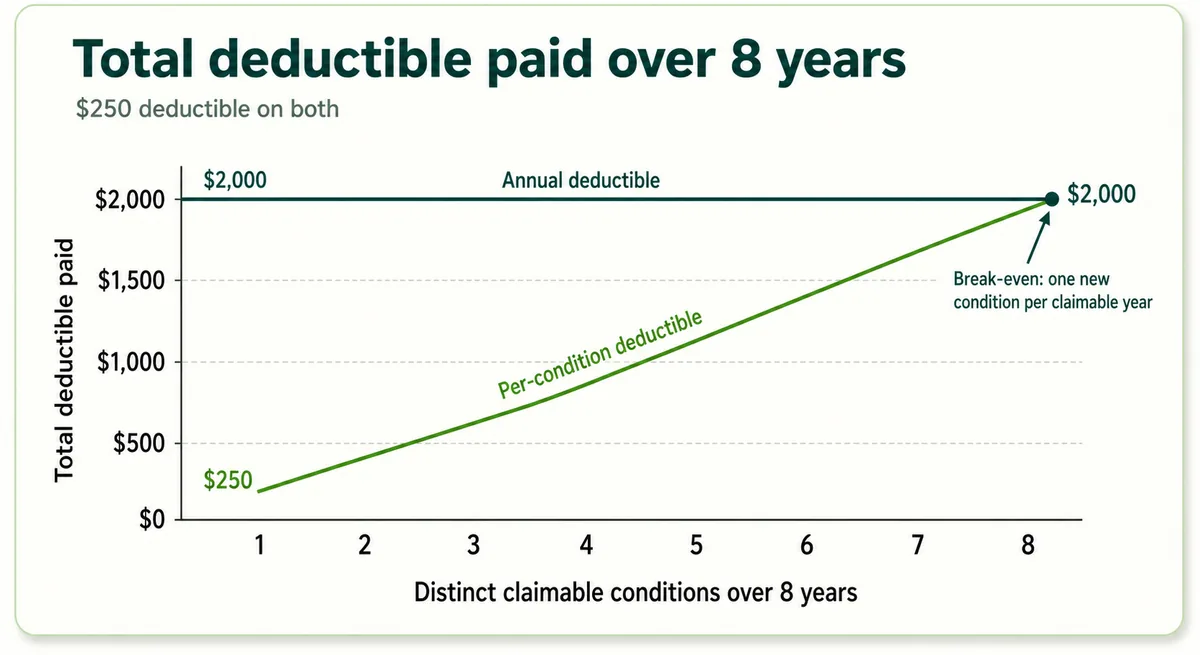
The rule to apply to your own pet: you pay less in deductibles under Trupanion only if your pet develops fewer distinct conditions than the number of years you claim. One new condition a year is the break-even, and past that Pets Best is the cheaper side of this one line item.
This compares deductibles and nothing else. It assumes the same deductible and reimbursement rate on both, enough eligible cost each time to use the deductible up, annual limits that never bind, and waiting periods already served. It leaves premiums out entirely, and premiums are the larger number — we come to those below.
Two things the brochures don't say
Trupanion sells this as a "lifetime per-condition deductible", but the word lifetime appears nowhere in the deductible definition in its filed sample policy, form TRU (D) 00001, still the February 2019 edition. Pets Best's annual reset is equally plain in its own filed booklet, form APIC-PBI0001-ILL, dated 12/2015. Both are old documents and both are still what the carriers publish.
More importantly, neither form publishes the rule for what counts as one condition, and that count drives the whole calculation. One owner picked a $0 deductible for exactly that reason: "I could see there being disagreement about whether an illness was recurring or new". And if you bought through Chewy CarePlus, administered by Trupanion but a separate product, your deductible is annual and none of this applies.
Who actually insures you
Neither brand is an insurance company. Trupanion's US policies are all underwritten by American Pet Insurance Company, its own wholly-owned subsidiary. Pets Best uses that same company in New York and Washington, and Independence American Insurance Company in the other 49 jurisdictions, California included. A third insurer, MS Transverse, is named as a possible underwriter but isn't attached to any state in the published library. "Pets Best's policy" is therefore not one contract, and which one you get depends on where you live.
The two brands are financially tangled as well. American Pet has underwritten Pets Best since 2015, and Trupanion's FY2025 annual report puts Pets Best premiums at 30% of its total revenue while stating the relationship "will terminate over future periods". That is worth knowing and easy to over-read. A shared underwriter does not make the products equivalent, does not carry a rating or a complaint record from one brand to the other, and does not mean your claim is handled the same way. What it tells you is which legal entity owes you the money, and that entity is named on your declarations page.
Ratings attach to those entities, never to a brand. American Pet carries a Demotech Financial Stability Rating of A′ (A Prime), affirmed June 2026, and AM Best lists it as a non-rated entity. Independence American holds an AM Best A− (Excellent). None of those grades measures how a company handles a claim.
Price, compared properly
We aren't publishing a price table, and you should be wary of the ones you find. A premium moves with your pet's species, breed and age, with your ZIP code, and then again with the deductible, reimbursement rate and annual limit you choose. Two quotes are comparable only when all of those match.
Almost nothing ranking for this comparison clears that bar. Not one of the eight pages we could read published the date its quotes were pulled, so no figure on any of them can be checked against a carrier today. Two unrelated sites publish identical Trupanion averages to the cent, with no configuration attached at all — one and the other. Numbers that agree that precisely were copied, not quoted.
Do this instead. Run both quotes yourself on the same day, for your actual pet and ZIP, with the deductible, reimbursement percentage and annual limit set identically on each. That is the only comparison worth anything, and a first-year premium still isn't what this costs you. What happens at renewal is below.
Waiting periods depend on your state
The schedules in the table above are the base forms, and for a lot of readers they are simply wrong, because the variable here is your state rather than which company underwrites you.
The NAIC pet insurance model act caps illness and orthopedic waits at 30 days and prohibits waiting periods for accidents outright. States that adopted it — California, Washington and Maine among them — override both carriers' schedules. Maine is the clean proof: Pets Best publishes separate state notices there, and the one on American Pet paper and the one on Independence American paper both cut the cruciate wait to 30 days. Same rule, different underwriters.
Trupanion responds to those laws differently. Its Washington disclosure says flatly that new policyholders get no waiting periods at all, then adds a 12-day delay between enrolling and the policy taking effect unless you go through its exam program. Louisiana's notice reads the same way. That sounds like the same trade and isn't. During a waiting period you are a policyholder with one condition not yet covered; during a pre-effective delay you have no policy at all.
So the document you actually live under may not be the one the carrier advertises. Trupanion's national FAQ publishes 30 days and five days; its Washington paperwork replaces that schedule entirely. Pets Best's Washington booklet still prints six months for cruciate ligaments, while Washington's own pet insurance statute caps orthopedic waits at 30 days. Read your state's notice, not the sample policy.
Cash flow at the vet counter
It's 2 a.m., the emergency vet needs $3,000 before they admit your dog, and the only question that matters is who pays it tonight.
Under Trupanion, if that hospital runs its veterinary portal software, the carrier settles with the hospital at checkout and you pay only your share. Under Pets Best, no. Its direct-pay route is a separate form signed by you and by the vet, and the money moves only once the claim has been adjudicated. Tonight, someone still has to carry the bill.
Neither mechanism is a right you can hold a carrier to. Trupanion's filed form makes it conditional on an arrangement between the carrier and your hospital. The Pets Best booklet used in most states, form IAIC-PB10001-ILL, contains no direct-pay provision at all. California is the exception.
Both carriers publish speed figures, and they measure different things. Trupanion says 85% of direct payments are issued in five minutes or less — money reaching a hospital that runs its software. Pets Best counts from the other end: direct deposit in as little as two days, or 5–7 days by check, all measured after your claim has been processed. It publishes no figure for how long the decision itself takes. Both sets are self-reported and unaudited, so don't stack them against each other.
Plan to pay and be reimbursed, and ask your clinic directly whether it runs the software. Owners consistently report that the carrier's own list of participating hospitals is out of date.
Already insured? Read this before you switch
You can move between these two carriers at almost any point — buying a new policy is rarely the problem. What changes once your pet has a medical history is what the new policy will actually pay for, and the moment you find that out is usually the moment you most want to leave.
Two owners in the same thread describe it. One watched a Pets Best premium go from about $95 a month to over $400 when their dog turned ten, and found it "too late to get other insurance with all his elderly pre existing conditions". Another, whose dog developed epilepsy after enrolling, put it plainly: "we basically have to stay". Owner reports — but the mechanic behind them is in the contracts.
Nothing carries across. None of the six filed forms we read contains a portability or prior-carrier provision, so every waiting period restarts. A condition your pet showed signs of, or was treated for, before the new policy began is pre-existing under it, and the claim you filed at the old carrier is the evidence. Routine wellness care isn't a condition; a diagnosis, or a note about a symptom, is.
Some conditions are hardest to leave behind, because the forms name them and apply them to either side of the body. Trupanion's form lists luxating patella, glaucoma, entropion, ectropion, elbow dysplasia, cataracts, cherry eye and cranial cruciate ligament, so one repaired knee can exclude the other. Chronic conditions never stop being present.
So before you request a single quote, ask your vet for your pet's complete records and read them. A one-line note from a wellness visit years ago can be enough. Owners report that Trupanion sends a list of excluded conditions early on and that Pets Best does not, but neither is a documented commitment. Build that picture yourself.
None of this is a reason to put off an appointment. A pet that needs seeing gets seen. The point is to know what is already in the file before you shop, not to keep the file empty.
What happens at renewal
Your premium will rise. What almost nobody explains is by how much, and who decides.
California is the only state publishing a usable record, and its rate-filing workbooks carry two different numbers for every filing: what the carrier asked for, and what the regulator allowed.
| California filing | Requested | Approved |
|---|---|---|
| Trupanion (CDI 24-32) | 51.5% | 28.9% |
| Pets Best (CDI 24-2140) | 45.0% | 24.3% |
Anyone quoting a single number is quoting the wrong one half the time. Trupanion's own investor release announced the approved 29% and never mentioned it had asked for 51.5%.
For scale, veterinary services in the consumer price index rose 5.14% in the year to June 2026. Approved increases on both sides are multiples of that. Outside California there is essentially no public pet-line rate record, so what you read about your own state is inference.
One precision point, because it is the most repeated claim about Trupanion and the easiest to state wrongly: its premiums do rise, but your pet's age is not re-rated after enrollment. Several Pets Best owners describe steep jumps as their pet aged. Those are owner reports, not a rate table.
Exam fees and what else isn't covered
Trupanion never covers the exam fee itself, and sells no rider that changes it. Pets Best does cover exam fees, but only as a supplemental benefit you elect when you enroll. Add it later and you are rebuilding the policy from scratch.
On one visit this barely registers. It bites on repeat visits, and owners describe exactly where: weekly recheck charges through a course of chemotherapy, and separate inpatient exam fees inside a single hospital stay.
The other thing worth reading is what sits underneath Trupanion's "no limits" line. Its filed form covers prescription food at 50% of cost, for up to two months of normal feeding from the onset of the condition, and caps treatment on teeth other than the canines and carnassials at the estimated cost of extraction. Both are ordinary policy terms and most insurers have something similar. They are also limits, sitting beneath a claim of none.
Frequently Asked Questions
Is Trupanion actually worth it?
It is worth it in one specific situation: your pet develops a long-running condition, you keep the policy for years, and your clinic runs Trupanion's payment software. Under those conditions you pay one deductible for that condition, ever, and the hospital can be paid at checkout instead of you fronting the bill. It is a poor fit if your pet has several unrelated problems, because each one carries its own deductible. Premiums can also rise at renewal, and an approved statewide rate change is an average across a book of policies rather than a prediction of your own.
What's better than Trupanion?
That depends entirely on what you are trying to solve. If you expect several unrelated conditions rather than one chronic one, an annual-deductible plan such as Pets Best will usually cost you less, because a single deductible covers the whole policy year no matter how many things go wrong. If you need the vet paid at checkout rather than being reimbursed afterwards, there are few real alternatives, and even Trupanion's version only works at clinics running its software. And if your pet already has a diagnosis, nothing is better, because any new policy re-tests the entire medical history.
Is Pets Best insurance reputable?
Pets Best is a brand rather than an insurer, so the honest answer is about the companies behind it. Independence American Insurance Company underwrites it in 49 jurisdictions and holds an AM Best rating of A− (Excellent), affirmed in December 2025; American Pet Insurance Company writes New York and Washington. On the regulatory record, California's insurance department brought a matter against Independence American that settled in March 2025 — the company denied the allegations, made no admission of liability, and the $500,000 penalty is contingent on future non-compliance and has not been paid.
What is the most highly rated pet insurance?
No single authority answers this, and the ratings people cite measure different things. Agencies such as AM Best and Demotech grade an insurer's financial strength, meaning its capacity to pay claims at all, not how it handles yours. Review-site rankings are editorial opinion, and most publish no date for the pricing behind them. The more useful question is which structure fits how your pet is likely to get sick, which is what the arithmetic above settles. Our carrier reviews cover each company's terms individually.
Is Trupanion through Chewy the same as Trupanion?
No, and confusing the two is the most common mistake in owner discussions. Chewy CarePlus is administered by Trupanion but is a separate product with an annual deductible rather than a per-condition one, and its Complete tier includes exam-fee coverage that Trupanion's own policy never provides. It is not sold in California. If you bought through Chewy, nothing in this comparison about Trupanion's deductible structure describes your policy, so check your declarations page before assuming it does.
Does either one cover pre-existing conditions?
Neither does. Pets Best's marketing suggests conditions that heal or are cured stop counting as pre-existing, but no such window exists in either of its published booklets — the American Pet form or the Independence American one — the word "curable" does not appear in them, and every reference to 180 days is a claim-filing deadline rather than a cure period. Trupanion states its position plainly: a condition diagnosed before the policy started is not eligible, even after years with no symptoms. Both also treat conditions in remission or controlled by medication as present. What counts as pre-existing is worth reading before you buy.
What counts as one condition under Trupanion's deductible?
Nothing published says. The filed policy refers only to "a specific Illness or Injury" and sets out no grouping rule, which matters because that count is exactly what decides whether the per-condition structure saves you money. Owners report it applied inconsistently, including an eye problem coded as something new on a later visit and charged a second deductible. Some owners choose a $0 deductible specifically to remove the question. It costs more each month and takes the classification argument off the table entirely.
Can I lower my deductible later?
Mostly not, and this catches people out. Trupanion's filed policy lets you raise your deductible at any time but lower it only within the first 30 days after enrollment. Pets Best lets you raise it whenever you like and lower it at renewal, though on Independence American paper that is subject to underwriting at the time you ask. Buying more coverage is harder still: adding a supplemental benefit or a higher annual limit with Pets Best means cancelling and reissuing the policy, which restarts every waiting period and re-applies the pre-existing exclusion.
How long is the waiting period for cruciate ligament injuries?
Six months under both Pets Best form families as written, which is the longest single wait in either contract. In states that adopted the NAIC pet insurance model act it drops to 30 days, and that change applies on both underwriters' paper — Maine's notices show it on each. Trupanion's current policy carries no cruciate-specific waiting period at all. If your dog is a breed prone to knee injuries, check your own state's notice rather than the sample booklet, because the sample is frequently out of date.
Sources
- Trupanion Sample Policy, TRU (D) 00001 (V10.201902) — Trupanion
- Pets Best Accident & Illness Policy Booklet, Washington (APIC-PBI0001-ILL 12/2015) — Pets Best (via Internet Archive)
- Pets Best Vet Direct Pay Release Form — Pets Best (via Internet Archive)
- When does my coverage begin? (published waiting periods) — Trupanion
- Insurer Disclosure of Important Policy Provisions, California, TRU (D) 00012 CA (v01.202001) — Trupanion
- Trupanion through Chewy vs. Pets Best — owner discussion — r/petinsurancereviews
- Trupanion, Inc. FY2025 Form 10-K — U.S. Securities and Exchange Commission
- Pets Best sample policy library (underwriter by jurisdiction) — Pets Best
- Pets Best underwriters and licensing disclosure — Pets Best
- Rating Information Disclosure Form, American Pet Insurance Company (NAIC 12190) — Demotech
- AM Best Affirms Credit Ratings of Independence American Insurance Company (2025-12-17) — AM Best
- Pets Best vs Trupanion Pet Insurance — Hepper
- Pets Best vs Trupanion Pet Insurance — The Vet Desk
- Pet Insurance Model Act #633 — National Association of Insurance Commissioners
- California Insurance Code §12880.7 (SB 1217) — California Legislative Information
- RCW 48.205 — Pet Insurance — Washington State Legislature
- 24-A M.R.S. §3156 — Pet insurance waiting periods — Maine State Legislature
- Notice to Maine Residents — policies underwritten by American Pet Insurance Company — Pets Best (via Internet Archive)
- Notice to Maine Residents — policies underwritten by Independence American Insurance Company — Pets Best (via Internet Archive)
- Insurer Disclosure of Important Policy Provisions, Washington, TRU (D) 00012 WA (V01.202309) — Trupanion
- Insurer Disclosure of Important Policy Provisions, Louisiana, TRU (D) 00012 LA (V01.202309) — Trupanion
- Pets Best Accident & Illness Policy Booklet, Texas (IAIC-PB10001-ILL) — Pets Best (via Internet Archive)
- Trupanion direct-payment speed figures — Trupanion
- How fast will I receive my reimbursement? — Pets Best (via Internet Archive)
- Pets Best has the cheapest premium by far. What am I missing? — owner discussion — r/petinsurancereviews
- Trupanion Sample Policy, TRU (D) 00001 (V10.201902) — Trupanion (via Internet Archive)
- PSA: Trupanion will give you a list of pre-existing condition exclusions in the first 30 days — r/petinsurancereviews
- Prior Rate Filing Approvals (rate-filing workbooks) — California Department of Insurance
- Trupanion Comments on Rate Filing Approval in California (2024-05-17) — Trupanion Investor Relations
- CPI, Veterinarian services, U.S. city average (series CUUR0000SS62054) — U.S. Bureau of Labor Statistics
- Stipulation and Consent Order, Independence American Insurance Company, NC-2024-00009 — California Department of Insurance