


Before you decide whether Chewy CarePlus is right for your pet, settle one thing: "CarePlus" isn't a single insurance plan, and Chewy isn't the insurer. It's a Chewy-branded storefront sitting on top of two completely separate insurance companies — Trupanion and Lemonade — and which one you get is decided by your state, your pet's age, and its breed, not by you.
That distinction matters because the two versions differ on the things that cost you money: the deductible, the annual payout cap, the waiting periods, and whether your vet can be paid directly. A review that treats CarePlus as one product — as nearly every page ranking for it does — is simply wrong for about half its readers. Buying coverage from inside your Chewy cart is a reasonable thing to do; you just want to know what you're buying first.
So we did the unglamorous part: we read the CarePlus sample policy forms and Chewy's own insurance disclosure line by line. This review walks you through which of the two insurers you're being sold — and how to tell from documents you already have — what your deductible really does over the years, whether CarePlus can pay your vet at the counter, and the risk no other review names: what happens if Chewy and your insurer part ways.
Table of Contents
- CarePlus Is One Brand, Two Insurers: Which Are You Getting?
- The Deductible Catch: Annual Here, Per-Condition If You Buy Trupanion Direct
- What Each Plan Actually Covers
- Waiting Periods and Pre-Existing Conditions
- Can CarePlus Pay Your Vet Directly?
- What It Costs, and Why It's Often Cheaper Than Buying Direct
- The Risk Nobody Mentions: What If Chewy's Partnership Ends?
- So Is Chewy CarePlus Worth It?
- Frequently Asked Questions
- Sources
CarePlus Is One Brand, Two Insurers: Which Are You Getting?
CarePlus is a Chewy retail brand, not an insurance company — and the most useful thing to know before you buy is that Chewy carries none of the risk. Every CarePlus policy is sold by one producer (the licensed agency that sells and services the policy), Chewy Insurance Services, LLC (national producer number 19685062), and then underwritten — actually insured, and paid out — by one of four companies arranged in two completely independent "stacks."
One stack runs on Trupanion; the other on Lemonade. Each has its own administrator (the company that handles your claims day to day), its own underwriter, and — the part that changes your decision — its own rules and payout limit.
| Role | Trupanion stack | Lemonade stack |
|---|---|---|
| Producer (sells the policy) | Chewy Insurance Services, LLC — NPN 19685062 | |
| Administrator (handles claims) | Trupanion Managers USA, Inc. | Lemonade Insurance Agency, LLC |
| Underwriter (carries the risk) | American Pet Insurance Co. (NAIC 12190) or ZPIC Insurance Co. (NAIC 17044) | Lemonade Insurance Co. (NAIC 16023) or Metromile Insurance Co. (NAIC 16187) |
| Annual payout cap | Unlimited | $20,000/year |
Those NAIC numbers are each insurer's ID with state regulators, so you can look any of them up yourself — American Pet Insurance Company, for instance, files public examination reports. Every one is a licensed, state-regulated U.S. insurer, so this isn't a fly-by-night arrangement. The point is narrower: "CarePlus" is really two different products wearing one label.
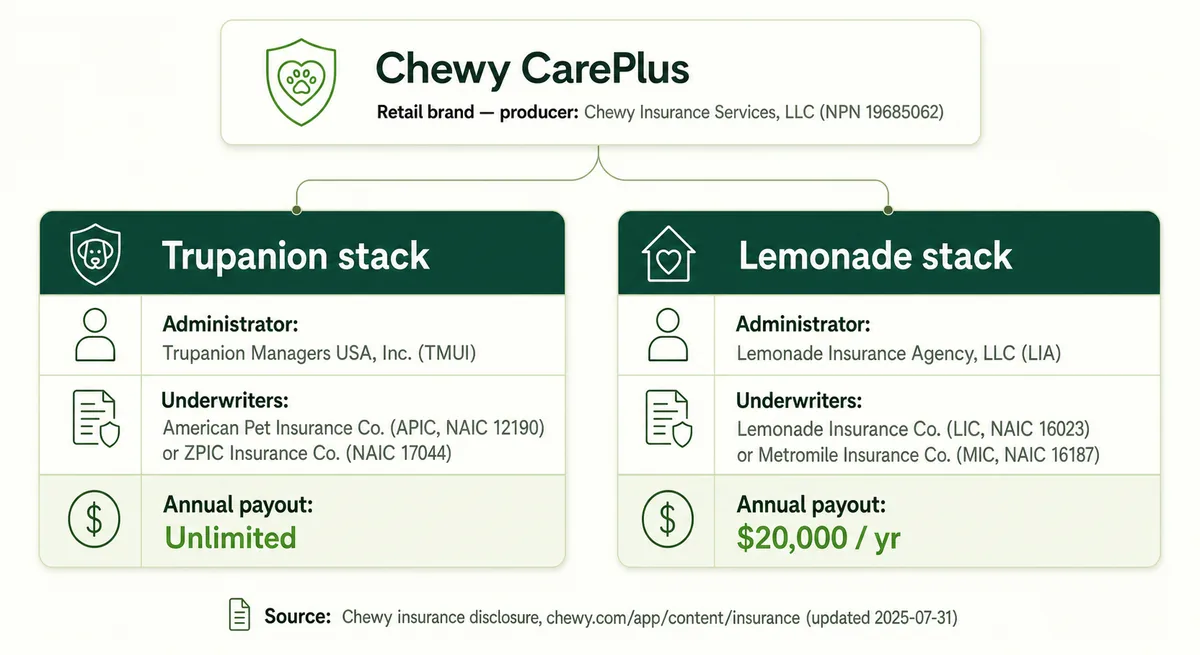
So how do you tell which one you're being offered? You don't choose it — Chewy routes you to one stack, apparently by your state, your pet's age, and its breed, though it doesn't publish the exact rules. But three tells give it away:
- The payout cap. An unlimited annual limit means you're on Trupanion; a $20,000 cap means Lemonade (NerdWallet).
- The underwriter named at quote. The insurer's name is on your quote and your policy documents — read it before you enroll.
- Accident-only is always Trupanion. If you're pricing an accident-only plan, it's the Trupanion stack every time.
One honest caveat: the exact state-by-state routing is largely owner-reported, not published by Chewy. California shoppers, for example, have repeatedly said they could only get the Lemonade stack — but that pattern comes from other buyers and secondary reviews, not a Chewy rate map, so treat it as a strong hint rather than a rule. When in doubt, your own quote is the source of truth.
The Deductible Catch: Annual Here, Per-Condition If You Buy Trupanion Direct
Whichever CarePlus stack you land on, your deductible — the amount you pay out of pocket before the insurer starts covering a claim — is annual: it resets every 12 months. The Trupanion-backed form states it plainly — "Your deductible will reset every 12 months" — and the Lemonade-backed form applies an annual deductible "once per policy period". Several review sites call the CarePlus/Trupanion deductible "per-condition." That's wrong — and it's an expensive thing to get wrong.
Here's why it matters. Buy Trupanion directly and its signature feature is a per-condition lifetime deductible: you pay it once for each condition, ever, and it never resets. Buy the same underwriter as CarePlus and that feature is gone — you meet the deductible again every year the condition needs treatment.
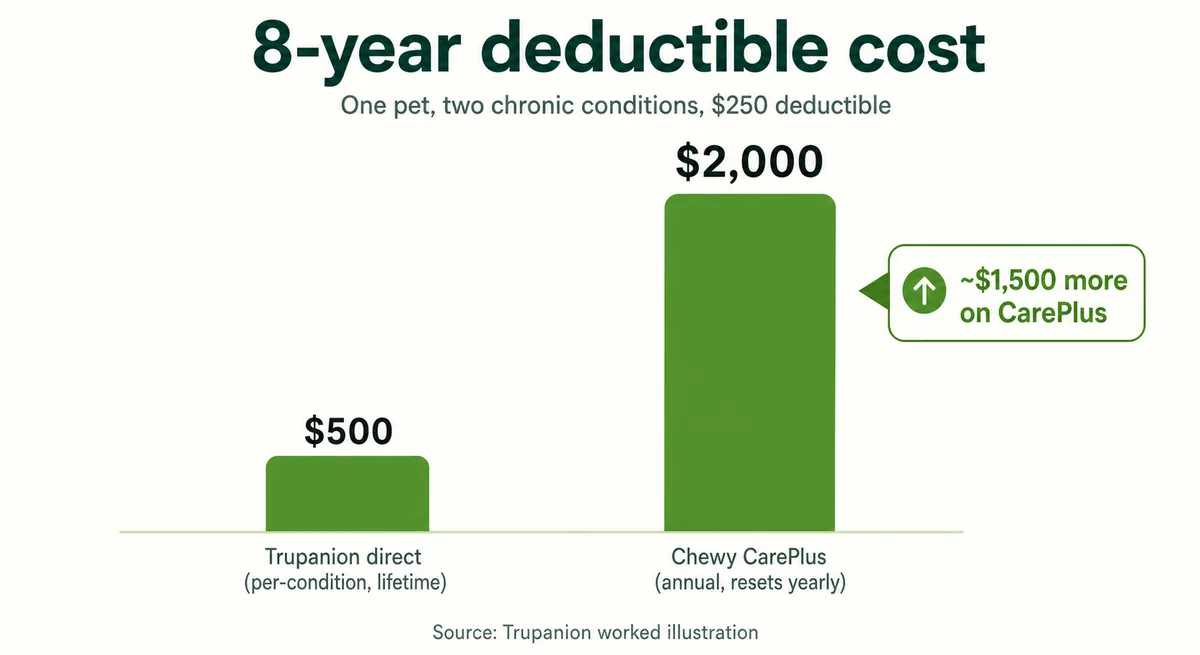
Trupanion's own illustration makes the gap concrete. Take a pet that develops two chronic conditions — say allergies and diabetes — on a $250 deductible, over 8 years (Trupanion):
- Direct Trupanion (per-condition, lifetime): $250 for allergies + $250 for diabetes = $500 total, for all 8 years.
- CarePlus (annual, resets): $250 every year × 8 years = $2,000.
That's roughly $1,500 more in deductibles over the pet's chronic years — and the gap widens every year the condition persists.
The annual structure isn't always the loser, though. Because you meet an annual deductible only once a year no matter how many conditions appear, a single bad year — three unrelated problems in twelve months — costs you one deductible under CarePlus versus three under a per-condition plan. Annual wins the crowded year; per-condition wins the long chronic haul.
One caveat on the numbers you'll see quoted: the familiar $250 / $500 / $1,000 deductible menu comes from review sites, not the sample policy forms, which confirm only that the amount is selectable — the Trupanion form lets you raise it anytime and lower it at renewal. Treat the exact tiers as a guide and confirm your real options in the quote. For how other carriers handle this, see our pet insurance fine-print index.
What Each Plan Actually Covers
Because the two stacks are different insurers, they cover different things — and within each stack, the tier you pick decides what's included. Here's what the CarePlus sample policy forms actually say. In the tables, "✓" means covered on that tier (still subject to your deductible and your reimbursement — the share of the bill the plan pays back); "✗" means not covered. These are the published sample-form terms; the tier and state version you're actually quoted, and the policy you're ultimately issued, are what govern.
On the Trupanion stack
Three tiers — Accident-Only (form 00001.1), Essential (00001.2), and Complete (00001.3):
| Covered? | Accident-Only | Essential | Complete |
|---|---|---|---|
| Exam / visit fees | ✗ | ✗ | ✓ |
| Dental disease (illness) | ✗ | ✓* | ✓* |
| Behavioral therapy | ✗ | ✗ | ✓ |
| Rehab / physical therapy | ✗ | ✗ | ✓ |
| Prescription / vet-diet food | ✗ | ✓ (100% on Chewy.com) | ✓ (100% on Chewy.com) |
| Annual payout limit | Unlimited | Unlimited | Unlimited |
Complete is the only Trupanion tier that adds exam fees, behavioral therapy, rehab, and alternative care; Essential already covers dental disease and prescription food. All three carry an unlimited annual payout — no yearly cap on what the plan pays. *Dental disease is covered only if your pet's teeth are cleaned within 90 days of a vet's recommendation.
On the Lemonade stack
Three tiers — Base (form LPC-PET 05-24), Value, and Value Plus (form LEM-PET 04-21):
| Covered? | Base | Value | Value Plus |
|---|---|---|---|
| Exam / visit fees | ✗ | ✓ | ✓ |
| Dental disease (illness) | ✗ | ✗ | ✗ |
| Behavioral therapy | ✗ | ✗ | ✓ ($1,000/yr cap) |
| Rehab / physical therapy | ✗ | ✗ | ✓ |
| Prescription / vet-diet food | ✗ | ✗ | ✗ |
| Annual payout limit | $20,000 | $20,000 | $20,000 |
The Lemonade tiers all cap at a $20,000 annual limit, cover no dental disease on any tier, and reimburse no prescription food. Behavioral therapy shows up only on Value Plus, and there it's held to a $1,000/year sub-cap on diagnosis and therapy sessions.
Two things trip owners up across both stacks. First, routine dental cleaning is covered in exactly one place in all of CarePlus — the Lemonade "Value + Preventative Care Plus" package, capped at $150/year. Second, dental disease and dental cleaning are different things: Trupanion Essential and Complete cover the disease (as an illness), while a routine cleaning is a wellness expense your insurance tier won't touch.
Waiting Periods and Pre-Existing Conditions
A waiting period is the gap between enrolling and when coverage actually starts; a pre-existing condition is anything your pet already showed signs of before that coverage began. Neither stack covers pre-existing conditions — and, importantly, CarePlus's waiting periods are not the same as standalone Trupanion's, so a review that copies those over is describing a different policy.
| Waiting period | CarePlus / Trupanion | CarePlus / Lemonade |
|---|---|---|
| Accidents | From your effective date | From your start date |
| Illnesses | 12 days | 14 days |
| Cruciate / orthopedic | Treated as an illness (12 days) | 30 days |
| Waive the wait with a vet exam? | No | Yes (exam + form within 2 days) |
| Vet exam required to enroll? | Yes, if your pet is over 1 | No |
Standalone Trupanion advertises a 5-day accident wait, a 30-day orthopedic wait you can waive with an exam, and an 18-month records lookback — none of which appear in the CarePlus/Trupanion form. Import those numbers and you'll set the wrong expectations.
On pre-existing conditions the two forms diverge sharply — and this is where "can I buy a policy?" and "will this be covered?" pull apart. Enrolling and getting a condition covered are separate questions: a pre-existing condition won't be covered, whether or not you're able to buy the policy (and eligibility to buy still turns on your quote, your pet's age, and state rules).
- Trupanion stack: no cure window. Anything with signs or symptoms before your waiting period ends is excluded — even if it was never written into your pet's records — with no path back to coverage for that condition.
- Lemonade stack: an explicit "cured" carve-out — a past condition that's genuinely resolved can regain eligibility. The often-quoted "12 months symptom-free" figure comes from Lemonade's marketing pages, not the CarePlus form — so don't count on it; the definition of "cured" in the policy you're actually issued is what controls.
Both stacks can request your pet's full medical history and can deny or cancel coverage if they can't get it — which is why the enrollment exam and clean records matter. If your pet needs care, get the care: the resulting records are the basis of any future claim, and delaying treatment to protect insurability is never worth it. For the full mechanics, see our guide to pet insurance and pre-existing conditions.
Can CarePlus Pay Your Vet Directly?
Only the Trupanion-backed CarePlus plans can pay your vet directly, and only if your clinic runs Trupanion's software; the Lemonade-backed plans reimburse you after you've paid the bill yourself, every time. It's not a flat CarePlus feature — it depends on both your stack and your clinic.
On the Trupanion stack, if your clinic uses Trupanion's vet-portal software, the insurer can pay its share straight to the clinic at checkout, so you front only your deductible, your co-insurance, and any charges the plan doesn't cover — an excluded exam fee on some tiers, say — rather than the whole bill (NerdWallet). If your clinic isn't set up for it, you pay the full bill and upload the invoice for reimbursement — Trupanion typically settles claims within one to three days.
The Lemonade stack is reimbursement-only: you pay the vet, file a claim in the app, and Lemonade pays your bank account. Some claims are approved almost instantly — but "instant" describes the decision, not the money, which still lands after you've fronted the whole bill.
Why this matters: roughly two-thirds (66%) of U.S. pet owners say the most they could put toward a lifesaving procedure is $1,000 or less (Gallup), and a single emergency visit often costs more. Paying at the counter, rather than waiting for a refund, is what makes coverage usable for a lot of households.
So before you enroll, ask two questions: does my clinic run Trupanion's software, and which stack am I actually on? If direct pay matters to you and your clinic supports it, the Trupanion stack is the only CarePlus path that delivers it.
What It Costs, and Why It's Often Cheaper Than Buying Direct
Chewy publishes no rate card — you only see a price after entering your pet and ZIP. The one public figure is a dated "starting at $20/month" from a 2023 announcement, which tells you little, because the premium depends on species, age, breed, state, deductible, limit, and reimbursement. Here's a configured sample to anchor expectations — accident & illness, $250 deductible, $20,000 limit, 80% reimbursement, Katy, TX (NerdWallet):
| Pet | Age 2 | Age 8 |
|---|---|---|
| Labrador Retriever | $54/mo | $100/mo |
| French Bulldog | $77/mo | $146/mo |
| Domestic Shorthair cat | $23/mo | $34/mo |
These are separate quotes for pets entered at ages 2 and 8, not one policy tracked over six years — and the $20,000 limit puts this particular sample on the Lemonade stack. Read that way, they still show the reality behind every pet policy: an older pet costs materially more to insure (the dog quotes here run close to double at age 8, the cat's rise more modest). Age, not the CarePlus label, drives most of the jump.
Why might it come out cheaper? CarePlus isn't a separate product — it's the same underwriters sold through Chewy's storefront, sweetened with Chewy-channel perks like 100% reimbursement on eligible medications and vet-diet food bought on Chewy.com. Owners sometimes see it priced a little under buying direct: one on Reddit priced a 1.5-year-old dog at $46.50/month through CarePlus versus $53 direct from Trupanion at the same $250 deductible, rehab included — though that's a single owner's anecdote, not a promise your own quote will land the same way.
Within CarePlus, the two stacks price very differently. For an 8-year-old on a $500 deductible, one owner saw Lemonade at about $75/month ($20,000 limit, 80%) against Trupanion at about $175 (unlimited, 90%, plus dental) — a $100 gap that buys a very different policy.
What happens at renewal
The two stacks raise prices on different logic — and it's the underwriter's logic, not Chewy's. Lemonade uses attained-age pricing, so premiums climb as your pet gets older (one owner tracked a Lemonade policy going $72 → $115 over about five years). Trupanion uses cohort, state-approved rating tied to local vet-cost trends (U.S. News), so its renewals can climb sharply even in a year your own pet stays healthy. Either way, the intro price is not the forever price.
The Risk Nobody Mentions: What If Chewy's Partnership Ends?
Here's the question no ranking page answers: what happens to your coverage if Chewy and your underwriter stop working together? The honest answer is that the policy forms don't say. No CarePlus form contains an assumption, portability, or partnership-termination clause, and because coverage is month-to-month auto-renewal, the policy itself makes no promise beyond the current month.
There's already a real-world hint of how this can go. Owners report that CarePlus stopped offering the Trupanion stack to new California shoppers — and, as one long-time commenter noted after digging, no one seems to know what happened to Californians who already held a CarePlus/Trupanion plan, or whether their terms changed at renewal. Chewy hasn't published an account either way, so treat it as an unresolved question rather than a settled fact — but a pointed one to raise before you enroll.
It gets thornier. Owners who called both companies to ask "if you split, will my conditions still be covered?" got directly contradictory answers. One was told by Trupanion it would not grandfather CarePlus customers — any condition that developed during the CarePlus policy would be treated as pre-existing on a new plan — while Chewy told that same owner coverage would simply "default to American Pet Insurance" (the Trupanion underwriter). A different owner was told by Chewy the opposite: that Trupanion would grandfather their plan, annual deductible and all. We can't resolve that for you, because the companies themselves haven't.
Meanwhile, one of the two partnerships has already loosened. In April 2025, Lemonade terminated its warrant and omnibus agreements with Chewy and cancelled roughly 3.17 million unvested warrant shares (Lemonade 8-K) — unwinding the equity tie between them, though the underlying agency agreement survives, so Chewy can still sell Lemonade policies today.
None of this makes CarePlus a bad policy. But it turns one thing into a question worth asking out loud before you enroll: if this partnership ends, will my pet's current conditions still be covered on whatever replaces it — and can you put that in writing? Get the answer before you're relying on it.
So Is Chewy CarePlus Worth It?
It depends on which stack your state routes you to, and how you weigh convenience against a couple of real trade-offs. There's no single answer — but the evidence points cleanly to who it fits and who should look elsewhere.
CarePlus makes sense if:
- your quote puts you on the Trupanion stack (the tell is an unlimited annual payout), and you value paying one annual deductible and getting direct-to-vet payment at a clinic that runs Trupanion's software;
- you already shop at Chewy and would use the 100% reimbursement on eligible medications and vet-diet food bought on Chewy.com;
- you've asked the partnership question and you're comfortable with the answer you got.
Buy direct or shop elsewhere if:
- you're insuring a pet before any chronic condition has appeared and want the cheapest long-run deductible math — if it later develops a lifelong condition, buying Trupanion directly (with its per-condition-for-life deductible) often beats CarePlus's annual reset over time. One caution: if your pet already has a diagnosed condition, don't drop coverage to chase this — that condition would be treated as pre-existing, and excluded, on any new plan;
- your state routes you to the Lemonade stack but you want a higher annual limit, dental-disease coverage, or direct vet pay — none of which the Lemonade tiers offer;
- portability certainty matters to you more than the convenience of buying at checkout.
The one move that serves every reader: pull your actual quote, read which insurer it names, and test that against the deductible math and the direct-pay question above before you enroll. CarePlus can be a genuinely good deal — but only once you know which CarePlus you're buying. If it isn't the fit, our pet insurance reviews rate every major U.S. carrier from its own policy documents.
Frequently Asked Questions
Who actually insures a Chewy CarePlus policy — do I get to choose?
No — you don't choose your insurer. Chewy Insurance Services, LLC sells and services every CarePlus policy as the licensed producer, but the actual coverage is underwritten by one of two independent stacks: Trupanion (American Pet Insurance Company or ZPIC) or Lemonade (Lemonade Insurance Company or Metromile). Which one you're offered is decided by your state, your pet's age, and its breed, not by you. Chewy itself carries none of the risk.
How do I tell whether I'm on the Trupanion or Lemonade stack?
Look at the annual payout limit: an unlimited limit means the Trupanion stack, and a $20,000 cap means Lemonade (NerdWallet). An accident-only plan is always Trupanion. The surest tell is the quote itself — the underwriter's name appears on your quote and your policy documents, so read it before you enroll.
Is the CarePlus deductible annual or per-condition?
It's annual on both CarePlus stacks — your deductible resets every 12 months, quoted directly from the policy forms. Only if you buy Trupanion directly (not through CarePlus) do you get Trupanion's signature per-condition-for-life deductible. Several review sites get this wrong; the CarePlus forms don't.
Does Chewy CarePlus pay my vet directly?
Only the Trupanion-backed CarePlus plans can, and only if your clinic runs Trupanion's software; the Lemonade-backed plans reimburse you after you've paid, every time (NerdWallet). Before you enroll, ask your clinic whether it's set up for Trupanion direct pay, and confirm which stack your quote puts you on.
Does CarePlus by Chewy cover vaccines and wellness visits?
Not on the insurance tiers — routine vaccines and wellness exams are only covered if you add a wellness or preventative package (Trupanion's Wellness plans or Lemonade's Preventative Care packages), each with its own per-item dollar caps (Chewy insurance disclosure). This is the difference between insurance (unexpected illness and injury) and wellness (predictable, routine care) — keep the two separate when you compare plans.
How much does Chewy CarePlus cost?
There's no public rate card — the premium depends on species, age, breed, state, deductible, limit, and reimbursement, so you only see a price after you quote. As one anchor, a NerdWallet sample (accident & illness, $250 deductible, $20,000 limit, 80% reimbursement, Katy, TX) put a Labrador at about $54/month at age 2 and $100/month at age 8. Expect the premium to roughly double as your pet ages.
Is CarePlus cheaper than buying the same carrier directly — what's the catch?
It's often a little cheaper — one owner priced a young dog at $46.50/month via CarePlus versus $53 direct from Trupanion. The "catch" isn't a hidden fee; it's that CarePlus/Trupanion uses an annual deductible instead of Trupanion's per-condition one (which can cost a chronically ill pet more over time), plus the partnership risk. It's the same underwriters in a Chewy wrapper, with Chewy-channel perks.
What happens if Chewy and Trupanion or Lemonade end their partnership?
The policy forms don't say — there's no assumption or portability clause, and coverage renews month to month. And it's not purely hypothetical: owners report Chewy stopped offering the Trupanion stack to new California shoppers, and in April 2025 Lemonade unwound its equity ties with Chewy (Lemonade 8-K), though it can still sell Lemonade policies. Owners who called to ask whether their conditions would be grandfathered got contradictory answers, so ask — in writing — before you enroll.
Is CarePlus by Chewy a good pet insurance?
It can be — but the honest answer is situational, because CarePlus is really two products. It's strongest for a Chewy shopper whose quote lands on the Trupanion stack, who values the annual deductible and direct-to-vet payment, and who's comfortable with the partnership risk. If you're insuring a pet before any chronic condition appears, buying Trupanion directly can be cheaper long-term (its per-condition deductible) — but a pet that already has a diagnosed condition can't fix that by switching, since it'd be pre-existing on any new plan. If you're routed to the Lemonade stack, weigh the $20,000 cap and the missing dental-disease coverage.
Sources
- Pet Insurance Terms & Disclosure — Chewy
- Chewy Pet Insurance (CarePlus) Review — NerdWallet
- American Pet Insurance Company — Examination Report — New York State Department of Financial Services
- CarePlus Essential Accident & Illness sample policy (form TRUCP (D) 00001.2) — Chewy / Trupanion
- CarePlus Lemonade Base sample policy (form LPC-PET 05-24) — Chewy / Lemonade
- Deductibles — Pet Insurance FAQ — Trupanion
- CarePlus Accident-Only sample policy (form TRUCP (D) 00001.1) — Chewy / Trupanion
- CarePlus Complete Accident & Illness sample policy (form TRUCP (D) 00001.3) — Chewy / Trupanion
- CarePlus Lemonade Value Plus sample policy (form LEM-PET 04-21) — Chewy / Lemonade
- CarePlus Lemonade Value + Preventative Care Plus package — Chewy / Lemonade
- Pet Insurance and Pre-Existing Conditions, Explained — Lemonade
- Pet Owners Have Skipped or Declined Veterinary Care — Gallup / PetSmart Charities
- Chewy Expands CarePlus Pet Insurance and Wellness Offerings Nationwide (2023) — Chewy Investor Relations
- Talk me out of Chewy CarePlus (owner pricing report) — Reddit — r/petinsurancereviews
- Cheaper Lemonade vs Trupanion (Chewy CarePlus) (owner pricing report) — Reddit — r/petinsurancereviews
- Lemonade vs. Trupanion Pet Insurance — U.S. News & World Report
- Experience with CarePlus by Chewy (grandfathering reports) — Reddit — r/petinsurancereviews
- Lemonade, Inc. Form 8-K (Item 1.02, Warrant & Omnibus Agreement termination, Apr 4 2025) — U.S. Securities and Exchange Commission