

Neither carrier wins outright, and any page that says otherwise skipped the step that matters. Whether Fetch or Pets Best is the better buy turns on facts about your pet: whether a diagnosis or symptom is already in the file, which state you live in, whether your breed puts knees and hips in play, whether you are buying a first policy or moving off one you hold, and whether you can front a five-figure vet bill and wait to be paid back.
Price will not settle it either. Two reviewers pricing these brands months apart reached opposite conclusions — NerdWallet's 2026 samples put Fetch below Pets Best for purebred dogs in Katy, Texas; MoneyGeek's August 2026 comparison put Pets Best at roughly half Fetch's price for a six-year Labrador averaged across fifty states. Both are real numbers, pulled at different ages, in different places, at different deductibles.
So we do something else. Below: what has to be equal before two quotes can be compared at all, what the two contracts actually do differently — that is where a claim is won or lost — and a recommendation split six ways by the situation you are in. Whether you searched fetch vs pets best or pets best vs fetch, the answer has the same shape.
Table of Contents
- The matched quote: same pet, same plan, both carriers
- How a claim is actually paid
- Waiting periods, exclusions and the orthopedic trap
- Pre-existing conditions, by contract generation
- Already insured? What switching between these two costs
- What happens at renewal
- Cash flow: who pays the vet first
- Who underwrites each brand
- Which one should you pick
- What we could not establish
- Frequently Asked Questions
- Sources
The matched quote: same pet, same plan, both carriers
Before any of that, here is what the two contracts actually say. Every row is read from the carrier's own filed form or published page, with its scope and source type attached.
| Term | Fetch (form GPTM 050 1125 A) | Pets Best (booklet IAIC-PB10001-ILL) | Source type |
|---|---|---|---|
| Exam required to start | Yes — first exam within 12 months before or 30 days after inception; findings excluded | None at enrollment | Filed form |
| Accident wait | None | 3 days (0 in twelve jurisdictions) | Filed form / carrier page |
| Illness wait | 15 days | 14 days | Filed form |
| Orthopedic gating | 180-day exclusion, knees-only exam carve-out; 30-day wait in FL, RI and PA | 6-month wait; cruciate events defined as illness, not accident | Filed form |
| Pre-existing look-back | Onset-based, no fixed window | None in 48 jurisdictions; 18 months in CA, NY and WA | Filed form |
| Exam fees, take-home Rx, rehab | Included as standard | Supplemental benefits — configurable at enrollment | Filed form / carrier page |
| Direct payment to the vet | No | Vet Direct Pay, after adjudication | Carrier page |
| Claim-filing deadline | 90 days; 180 in RI, one year in CA | 180 days | Filed form |
| Claims history affects renewal | Carrier says yes | Filed form says no | Filed form / carrier page |
| Underwriter | AXIS Insurance Company | One of four; check your declarations page | Carrier page |
Terms read 7–8 September 2026. Both brands run more than one edition, so the row that matters is the one on your declarations page.
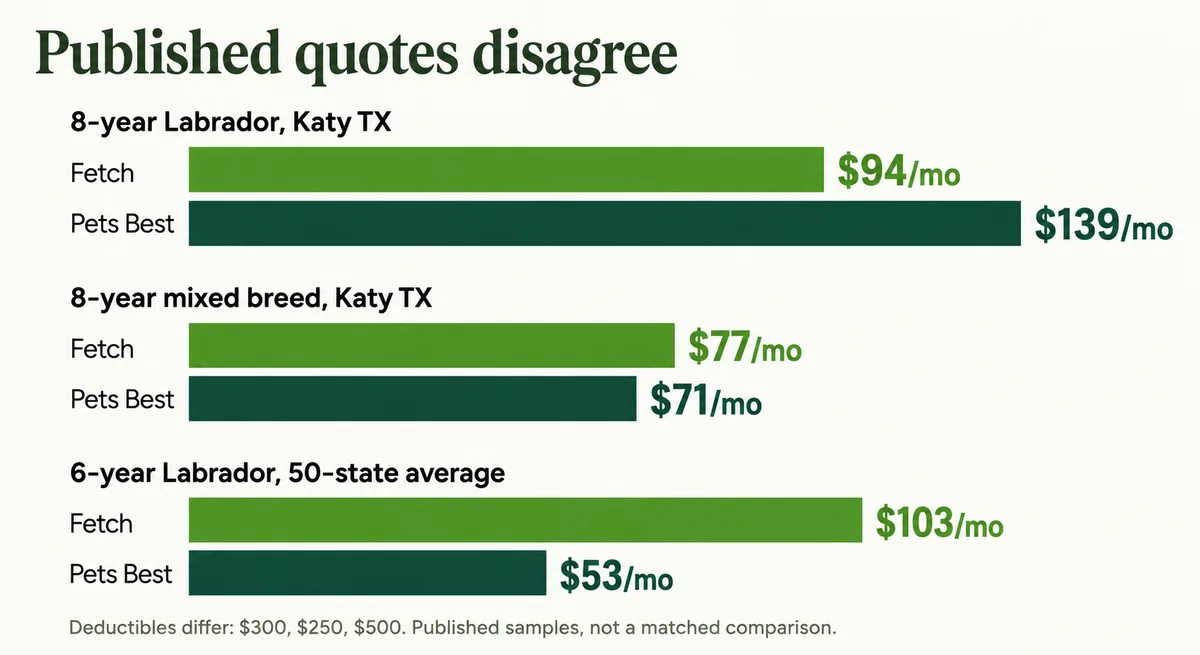
Before comparing two premiums, eight things must match: ZIP code, pet age, breed, annual limit, reimbursement percentage, deductible amount and type, add-on scope, payment frequency. Change one and the cheaper carrier can flip.
NerdWallet's 2026 samples for dogs in Katy, Texas put an eight-year Labrador at $94/month with Fetch and $139 with Pets Best — but an eight-year mixed breed at $77 with Fetch and $71 with Pets Best. MoneyGeek, in August 2026, put a six-year Labrador averaged across fifty states at $103 with Fetch and $53 with Pets Best. All real; none matched — the Fetch quotes carry a $300 deductible, the Pets Best quotes $250, MoneyGeek's pair $500.
Two charges outside the configuration still move the number:
- Payment fees. Pets Best adds a $2.00 processing fee on monthly, quarterly and semi-annual payments — not on annual, and not in Alaska, Maryland or New Hampshire. Fetch says its quote "includes all monthly taxes & fees", yet a May 2025 Fetch article discloses an installment fee. No published schedule for it exists — check your quote screen.
- Discounts. Pets Best gives 5% off for enrolling more than one pet, on accident-and-illness plans; Fetch gives 10% to veterans and active military. Fetch's multi-pet FAQ mentions no discount — not proof there isn't one. Ask.
Why the two quotes may not describe the same coverage
Pets Best's booklet treats three things as supplemental benefits — exam fees, take-home prescriptions, and rehabilitation, acupuncture and chiropractic care — excluded if not bought at enrollment. Fetch includes all three as standard.
That reads like a coverage gap; it is a configuration difference. Pets Best's own guidance describes exam fees as included in most plans but removable to cut the premium, and physical therapy as included while acupuncture and chiropractic are configurable. A quote that omits them is a fact about that quote, not the brand. Match the add-ons first, and read the declarations page, not a plan-tier name.
How a claim is actually paid
Both carriers apply the reimbursement percentage first, then subtract the deductible. Most comparison pages get this backwards, and the order is worth real money.
An illustration, not a quote: a $1,000 eligible bill, 80% reimbursement, a $500 annual deductible you have not met.
- The way both carriers do it: $1,000 × 80% = $800, minus $500 = $300 back.
- The way people assume it works: $1,000 − $500 = $500, × 80% = $400 back.
That is $100 on one ordinary bill — and you need about $625 of eligible expense before any payment starts.
Fetch states the rule in its policy form and prints its own worked example — a $3,601 bill at 90% with a $300 deductible pays $2,940. Pets Best publishes the same order, with a $1,000 bill at 90% and a $250 deductible paying $650. That page covers American Pet Insurance Company policies and Independence American policies effective after 31 May 2023; older ones are pointed to an unpublished guide.
This is not a reason to pick one carrier. It is a reason to read a quote correctly.
Waiting periods, exclusions and the orthopedic trap
The two contracts diverge here by mechanism, not number: each gates knees, hips and discs in a different part of the document.
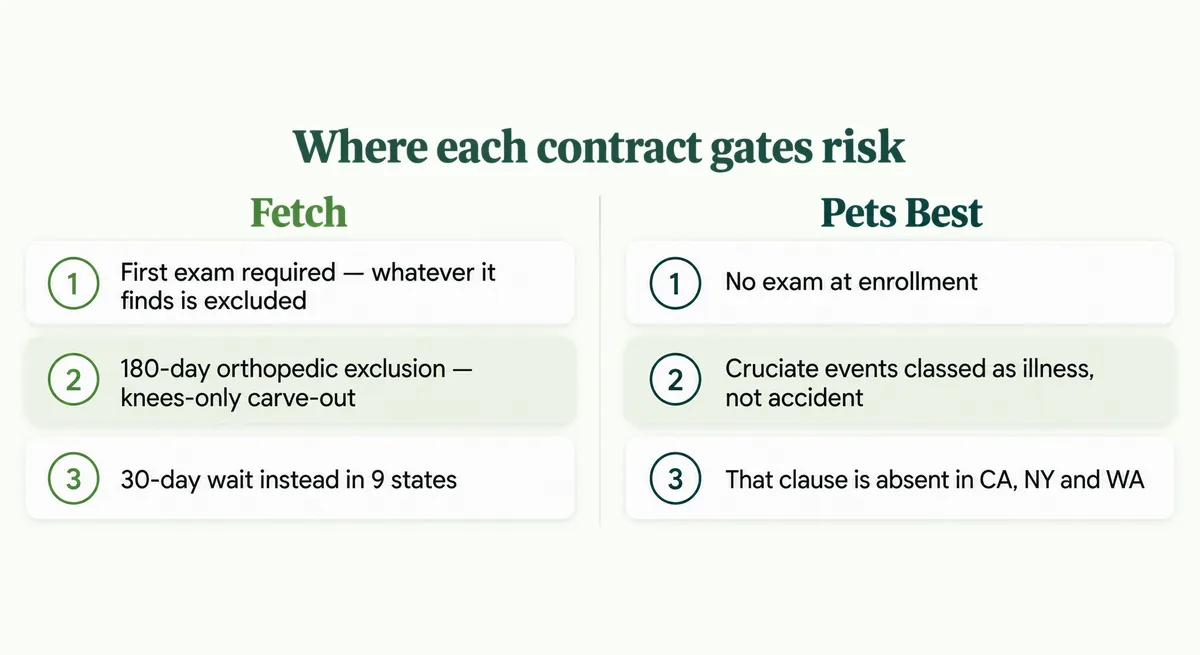
Fetch does not run an orthopedic waiting period. It runs an exclusion. Its base form (GPTM 050 1125 A) says orthopedic conditions occurring in the first 180 days "are excluded and are pre-existing conditions for the life of the policy" — with one carve-out: a vet exam inside those 180 days noting no pre-existing knee problems makes knees coverable. Hips, elbows and discs stay excluded. Fetch's FAQ calls this a "6-month waiting period", which undersells it — though not by as much as the wording suggests: Pets Best's booklet also defines anything advised, treated or showing signs "during any Waiting Period" as pre-existing, so a cruciate tear inside its six months is gone for good too. The real difference is scope. Fetch's clause reaches every orthopedic condition arising in the window, diagnosed or not; Pets Best's reaches what the record shows.
We read all 42 current Fetch editions on 8 September 2026: 39 carry that exclusion. Three — Florida, Rhode Island and Pennsylvania — substitute a 30-day orthopedic wait instead, and fifteen let a comprehensive exam in the first fifteen days waive the wait outright.
Pets Best writes its trap into a definition. Accidents wait three days, illnesses fourteen — but the booklet used in 48 jurisdictions (IAIC-PB10001-ILL) defines cruciate ligament events as "always considered medical Conditions, as opposed to a Condition caused by an Accident or injury." A dog tearing a ligament off the couch in week three is not a three-day injury; it is a six-month condition. That sentence is absent from the California and New York/Washington booklets, and twelve jurisdictions now run 0/14/30 days.
Two cautions. Florida and Rhode Island still show the older schedule there, although Florida's statute and Rhode Island's (effective 1 January 2026) both cap illness and orthopedic waits at 30 days and forbid an accident wait on new policies. Read your declarations page. And for a healthy puppy this is a window you wait out; for an adult dog with orthopedic history it is the most consequential term on either contract.
Fetch's first exam
Fetch's real gate is not a clock. Its policy requires a first exam within twelve months before or thirty days after your start date, and a separate exclusion automatically excludes anything "observed or recorded during the first exam" — and anything caused by it. Telehealth does not count. Pets Best requires no enrollment exam.
Get the exam anyway: skipping it protects nothing, and Fetch's form says failure "may reduce coverage." One open question — its Adoption Support benefit requires a named condition to be noted on that first exam, which the exclusion otherwise treats as a trigger. The form does not say which wins.
Pre-existing conditions, by contract generation
"Pets Best excludes pre-existing conditions" is true and nearly useless: Pets Best runs three contracts under one brand that treat your pet's history in opposite ways.
On the main form, used in 48 jurisdictions, pre-existing conditions carry no look-back at all, and "bilateral" appears once — in a definition, with no exclusion behind it.
In California, New York and Washington, the booklet looks back 18 months — and three categories never age out: chronic conditions, bilateral conditions, and intervertebral disc conditions. "Chronic" is defined to include cruciate events and hip dysplasia. The look-back is not the lenient half of that pair. A knee your dog hurt years ago can be pre-existing under either booklet — on the 48-jurisdiction form because nothing ages out, and in California, New York or Washington because cruciate events are named chronic and never age out. What the 18-month version adds is the express permanent carve-out; what the 48-jurisdiction version omits is any expiry at all. Both count conditions in remission or controlled by medication, recorded or not.
Pets Best's website says cured conditions stop being pre-existing and can be covered if they recur. No matching clause appears in the booklet. Treat it as a promise worth confirming in writing.
Fetch's curable pathway contradicts itself. Its definitions and its operative exclusion give different rules for when a recurrence becomes permanent, and no clause says which wins. Fetch's consumer page follows the exclusion — a year symptom-free, in the first or second year. That exclusion also requires an annual exam after the clear period and before any recurrence, which no comparison page mentions.
For both: get the records, and check the edition on your own declarations page before assuming any of this applies.
Already insured? What switching between these two costs
Moving is cheap when your pet's file is clean and expensive when it is not: the new insurer starts its own pre-existing clock, and your current policy is the only one still covering what is already in the record.
| Your situation | What moving actually costs |
|---|---|
| Clean record, no claims filed | Waiting periods restart; otherwise little. This is the moment to shop. |
| A diagnosis, symptom or claim already in the file | Expect it to be pre-existing at the new carrier, subject to that contract's own definitions and any curable-condition pathway. Price the move as cover for everything else. |
| On Fetch, want more coverage | After any claim, Fetch's current base editions (clause VII.10 of GPTM 050 1125 A) bar an increase outright: "if you have submitted a claim with us, your coverage is not eligible to be increased at any time." Thirteen state editions omit that sentence — California, Washington, Florida, Pennsylvania, Rhode Island, Mississippi, Maine, Maryland, Louisiana, Montana, Nebraska, Hawaii and New Hampshire — so check the edition on your own declarations page. Before a claim, an increase resets waiting periods and the pre-existing determination. |
| On Pets Best, want more coverage | Adding a benefit or raising the limit cancels and reissues the policy (48-jurisdiction booklet IAIC-PB10001-ILL) — new waiting periods, pre-existing reapplied. |
Before you cancel anything:
- Do not let coverage lapse. Bind the new policy first. Pets Best's booklet waives its waiting periods for policies "renewed without interruption, including at our discretion when coverage was provided by another pet insurance provider" — a discretionary waiver you forfeit with a gap, not a transfer of coverage for what is already in the file.
- Read your declarations page for the state and edition you hold — the same brand behaves differently by state.
- Ask in writing how your pet's history will be treated. "Can I buy a policy?" and "will this be covered?" are different questions.
If your pet's main risk is already excluded everywhere else, staying put is usually cheaper — even on a policy you have stopped liking. Our switching guide covers the general mechanics.
What happens at renewal
This is the part almost no comparison page covers, and it is the only part backed by regulators rather than marketing. State insurance departments publish what each insurer asked for and what it was granted — two different numbers.
From California's approved filings: AXIS Insurance Company, which underwrites Fetch, was approved for 18.0% in 2024 and 12.9% in 2026. American Pet Insurance Company, on the Pets Best program, was approved for 19.4% in 2024 (from 50.6% requested), 24.3% in 2025 (from 45% requested) and 53.4% in 2026, granted in full. In Georgia, the same insurer was approved for 36.9% on 11,769 Pets Best policies in a filing reported in March 2026.
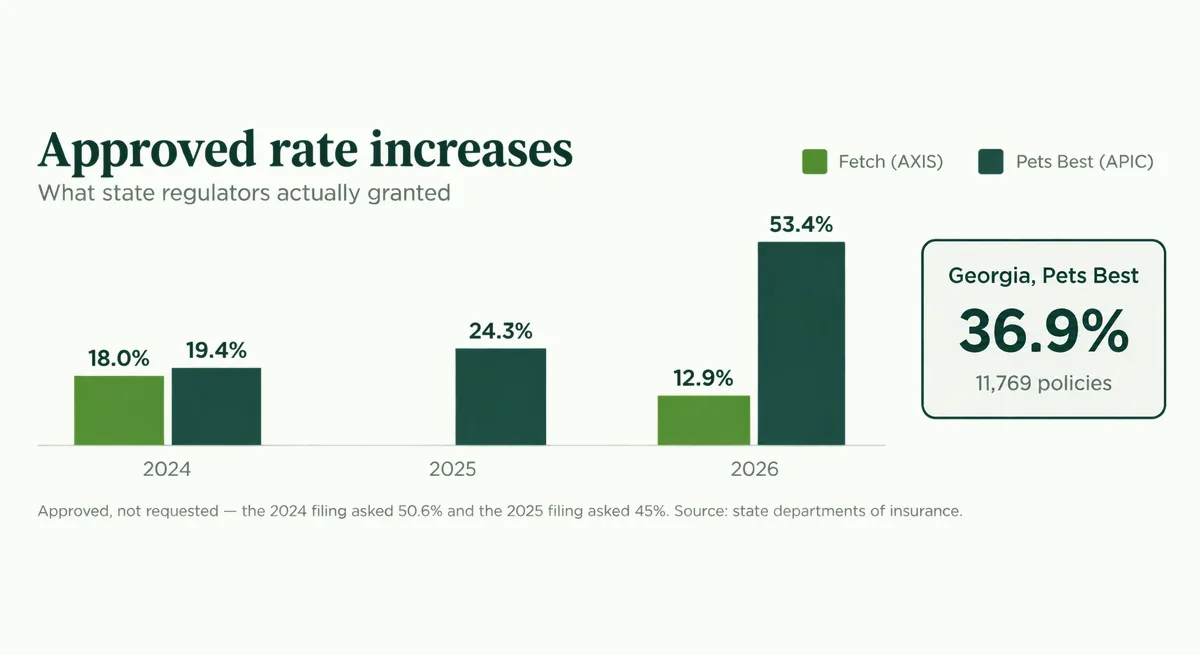
Read those carefully. The widely repeated line that regulators "approved 45%" for Pets Best is wrong — 45% was requested, 24.3% granted. And an insurer's name never identifies a brand: American Pet Insurance Company underwrites Pets Best and Trupanion, so a filing under that name may belong to either.
On whether your own claims move your price, the two carriers say opposite things. Pets Best's filed form states your premium will not change based on your pet's individual claim experience. Fetch's claims page says the opposite — "the short answer is yes," filing claims can raise your premium at renewal — reversing what its own FAQ said in 2024. Fetch's 2025 editions also add a clause no competitor mentions: after 50 paid claims it reserves the right to offer alternative, lower coverage.
For scale, not explanation: veterinary services prices rose 4.7% in the twelve months to July 2026. These approvals span 2024 to 2026 and run well ahead of that — on both sides, and across the wider California market, not just these two brands.
Cash flow: who pays the vet first
If you cannot comfortably put a five-figure bill on a card and wait, this section decides your answer. Fetch reimburses you; it does not pay veterinarians directly. Pets Best offers Vet Direct Pay — send a signed veterinarian release with the claim and any eligible reimbursement goes straight to the clinic.
Two caveats. It happens after adjudication, not at the counter — and the release itself says the request "does not guarantee claim payment", leaving you liable for the deductible, your co-insurance share and anything not covered. Your vet has to agree to it too.
The filing clocks differ. Pets Best gives you 180 days from treatment. Fetch's filed form gives 90 days in most states — 180 in Rhode Island, a year in California — and requested records must arrive within nine months or the claim is closed. Both normally want a paid, itemized invoice — Fetch's form asks for "proof of payment (i.e. receipt and/or invoice showing zero balance due)" — and Vet Direct Pay is the express exception: its release form is for use "only if you have not paid for your services."
One asymmetry if budget is the constraint: Pets Best sells a separate accident-only plan at a fixed $9/month for dogs and $6 for cats — $10 and $7 in Washington — on sales data the carrier dates to October 2022 through September 2023. We found no accident-only or reduced-scope Fetch product — not the same as none existing, so ask before assuming the cheaper tier is there.
Who underwrites each brand
Fetch and Pets Best are the brands you buy from. The company that owes you money is the insurer on your declarations page — one answer on one side, four on the other.
Fetch is underwritten in the US by AXIS Insurance Company, which AM Best affirmed at A (Excellent), stable outlook, on 28 August 2025.
Pets Best names four possible underwriters; only two appear on published booklets. Independence American Insurance Company was affirmed at A- (Excellent) by AM Best on 17 December 2025 — after five months under review, resolved by a $125 million capital contribution from its parent. American Pet Insurance Company carries no AM Best rating — and Trupanion's 2025 annual report calls it "our primary insurance subsidiary and underwriter" — so on some Pets Best paper the insurer behind your policy sits inside a competitor's group. The same filing says Trupanion expects "our business activity with them will terminate over future periods," without dating it.
Pets Best declines to say which insurer writes where: "please refer to your declarations page to determine the underwriter for your policy." Follow that. The answer depends on your state and when you bought.
Which one should you pick
Six situations, six different answers. Find yours.
Buying for a new puppy or kitten, clean record
Either works, and this is the only moment you choose freely. Decide on the orthopedic clause: Fetch's 180-day rule is an exclusion that rescues knees only, so book the qualifying exam inside that window and diary it. If you would rather not manage a deadline, Pets Best's schedule is simpler in most states.
An adult pet with a clean record
Same logic, less runway. Quote both at matched settings, then let the exam requirement decide: Fetch requires a first exam and excludes whatever it finds; Pets Best requires none at enrollment.
A senior pet, or any pet that already has a chart
Neither carrier has an upper enrollment age, so you can buy — just not cover for what is already documented. Fetch reads onset, with no fixed window. Pets Best reads its booklet: no window at all in 48 jurisdictions, and in California, New York and Washington an 18-month look-back with no expiry for chronic, bilateral and disc conditions. Fetch also ties renewal for dogs 8+ and cats 10+ to following veterinary advice on senior testing. No per-brand claims-service comparison exists, so we will not claim one handles older pets better.
A breed or history that puts knees, hips or discs in play
Re-read the orthopedic section before buying. This is where the contracts differ most, and where your state changes the answer.
Already insured elsewhere
Price the move as cover for everything except what is already in the file, and never let the old policy lapse.
You cannot front a five-figure bill
Pets Best, on Vet Direct Pay and its accident-only plan — with the caveat that direct pay is post-adjudication, and we found no equivalent budget tier on the Fetch side.
What we could not establish
There is no published comparison of denial rates, appeal outcomes or claim-payment timing between these two brands — and it cannot be built from public data. That is a structural limit, not a gap in our reading.
The NAIC’s market-conduct dashboard collects the right metric from pet insurers, but publishes it by state as counts of unnamed companies. No carrier is ever identified, by design.
What it does support is a benchmark, and only as a distribution. Its 2024 Pet scorecard reports, per state, how many insurers fell into each band of claims closed without payment as a share of claims closed — never which insurer. Across all 51 state filings the most common band is 20–30%, and roughly 45% of filings sit between 20% and 40%. California's most common band is 30–40%; Florida, Texas and Washington sit at 20–30%. That is not a denial rate. It bundles claims under the deductible and claims closed for missing paperwork together with genuine coverage refusals.
So if a page tells you one of these carriers denies more claims than the other, ask where the number came from. We could not find one worth printing.
Frequently Asked Questions
How much does Fetch pet insurance cost per month?
Fetch's own published average is $35 a month for dogs and $22 for cats — but read the basis before you use it. That figure is for one specific configuration ($10,000 annual limit, $300 deductible, 80% reimbursement) over the policy year ending June 2025. Third-party samples for real breeds and ages run much wider, from around $22 for a young cat to well over $100 for an older large-breed dog. Your number depends on species, breed, age, ZIP and the plan you configure.
Is Fetch considered a good pet insurance?
It depends on which part of the contract matters to your pet. Fetch's base form (GPTM 050 1125 A) covers sick-visit exam fees, take-home prescriptions and rehabilitation as standard — three things a Pets Best quote treats as optional supplemental benefits — and AXIS Insurance Company underwrites it at an AM Best A (Excellent), affirmed August 2025. The trade-offs are real too: a 180-day orthopedic exclusion that rescues knees only, a required first exam whose findings are automatically excluded, and a claims page saying claims can raise your renewal premium.
What is the cheapest but best pet insurance?
There is no single answer, and any page that gives you one has skipped the arithmetic. In NerdWallet's 2026 samples for a mixed-breed dog in the same city — Katy, Texas — Fetch quoted $30 a month at age two against Pets Best's $32 — then the order reversed at age eight, $77 against $71. Deductibles differed ($300 and $250), which is the point: price your own pet at identical settings on every carrier, add-ons and fees included.
What's better, Trupanion or Fetch?
They are built on different ideas, so the answer turns on how you want to pay. Trupanion's structure centers on a per-condition lifetime deductible and paying participating vets directly; Fetch runs an annual deductible and reimburses you after the fact. If fronting a large bill is your constraint, that difference matters more than any coverage checklist. Our Trupanion review covers its terms in detail.
Is the deductible taken out before or after the reimbursement percentage?
The percentage is applied first, then the deductible is subtracted — on Fetch, and on the Pets Best generations the carrier publishes: American Pet Insurance Company policies and Independence American policies effective after 31 May 2023. This is the most common misunderstanding in pet insurance, and it costs money: on a $1,000 eligible bill at 80% with an unmet $500 deductible, you receive $300, not the $400 most people expect. Older Independence American policies are pointed to a separate guide — check yours.
Does filing a claim raise my premium?
The two carriers answer this differently, in writing. Pets Best's filed policy states your premium will not change based on your pet's individual claim experience. Fetch's claims page says the opposite — "the short answer is yes" — reversing what its own FAQ said in 2024. Fetch's 2025 policy editions also allow it to offer alternative, lower coverage after 50 paid claims. If this matters to you, get the current answer in writing before you buy.
Can my pet insurer raise my premium by 40% or more at renewal?
Yes — California approved 53.4% for the Pets Best program in 2026, granted in full. That is one state, not a pattern: increases are filed with and approved by state regulators, and the approval is often well below the request — the same insurer asked for 50.6% in 2024 and got 19.4%. The AXIS program behind Fetch was approved for 12.9% in California in 2026. Your state's insurance department publishes these filings, so you can look up your own insurer's record.
If my vet finds something at a routine exam, is it then pre-existing?
Timing decides it. Anything documented before your policy starts — or, with Fetch, at the required first exam — is treated as pre-existing, and excluded unless the contract's own curable-condition terms bring it back. Once coverage is in force and any waiting period has passed, a new finding at a routine visit is generally a new condition. Never delay or skip veterinary care to manage this: an undiagnosed problem still gets worse, and the records question is far easier to resolve than the health one.
Does my vet have to accept Fetch or Pets Best?
No. Neither works like a human health network — you can use any licensed vet in the United States, and both carriers normally reimburse against a paid, itemized invoice. The one place your clinic's cooperation matters is Pets Best's optional Vet Direct Pay, where the practice signs a release so the reimbursement goes to them instead of you. Your vet can decline that; it does not affect whether the claim is covered.
Sources
- Fetch Pet Insurance Review — NerdWallet
- Fetch vs. Pets Best Pet Insurance: Which Is Better? (2026) — MoneyGeek
- Pets Best Pet Insurance Review — NerdWallet
- Pets Best FAQ — fees and discounts — Pets Best
- Pet Insurance Comparisons — Fetch Pet Insurance
- Pet Insurance Policy Price Comparison — Fetch Pet Insurance
- Military Pet Insurance Discount — Fetch Pet Insurance
- Multiple Pet Insurance Policies — Fetch Pet Insurance
- Is Fetch Pet Insurance Worth It? — Fetch Pet Insurance
- How Are Claim Payments Calculated? — Pets Best
- What Are Pet Insurance Waiting Periods? — Fetch Pet Insurance
- What Are Waiting Periods? (per-state schedule) — Pets Best
- Pre-Existing Condition Coverage — Pets Best
- Pre-Existing Conditions — Fetch Pet Insurance
- Terms & Conditions (policy form index) — Fetch Pet Insurance
- Download a Sample Policy — Pets Best
- Approved Rate Filings (prior approval lists) — California Department of Insurance
- Pet Insurance Claims — Fetch Pet Insurance
- CPI — Veterinary services, U.S. city average (series CUUR0000SS62054) — U.S. Bureau of Labor Statistics
- Vet Direct Pay — Pets Best
- Underwriters & Licensing — Pets Best
- Trupanion, Inc. Form 10-K for the fiscal year ended December 31, 2025 — U.S. Securities and Exchange Commission
- Market Conduct Annual Statement (MCAS) data dashboard — National Association of Insurance Commissioners
- How Much Does Pet Insurance Cost? — Fetch Pet Insurance
- Georgia OKs 36.9% pet insurance rate hike for Pets Best policyholders — Insurify
- AM Best affirms credit ratings of AXIS Capital Group members — AM Best (via Business Wire)
- AM Best removes from under review, affirms credit ratings of Independence American Insurance Company — AM Best
- How much does pet insurance cost? — Pets Best
- Florida Statutes §627.71545 — Pet insurance — The Florida Senate
- R.I. Gen. Laws §27-83-4 — Policy conditions — Rhode Island General Assembly