
What pet insurance in Michigan actually does for you comes down to two documents: your carrier's Michigan policy form, which decides what's covered and when, and your hospital's payment rules, which decide what you owe at the counter before any claim is paid.
What it costs. U.S. News's May 2026 quotes at one Ypsilanti ZIP code (48197) averaged $49.63 a month for a 1-year-old neutered medium mixed-breed dog and $27.43 for a 1-year-old neutered domestic shorthair cat, on an accident-and-illness plan with a $10,000 annual limit, a $500 deductible and 90% reimbursement. That's one ZIP code, not a state average.
What the law does. Michigan has no pet-insurance law. The National Association of Insurance Commissioners' Summer 2026 chart lists the state as "NO CURRENT ACTIVITY" on its pet-insurance model law, and a September 29, 2026 search of Michigan's compiled laws and 2025–2026 bills found no match for "pet insurance." That isn't the same as no rules: the general Insurance Code still reaches your policy by its own terms (your carrier's form, for one, had to be filed for state approval), and the state's insurance regulator, DIFS, takes complaints about policies issued in Michigan.
How coverage works in Michigan:
- There's no network. You pay the hospital, then claim. A hospital doesn't have to "take" your insurer; you just need its paperwork to file, which BluePearl, for one, says it provides.
- Payment at checkout is the exception. The insurer pays the hospital at checkout only where that hospital has agreed to it.
- The counter comes first. Michigan ERs that publish a payment rule expect payment at the time of service or before discharge. Two publish deposit formulas: Animal Emergency Center (Novi and Rochester Hills) requires a 50% deposit on estimates over $500, and MSU's Veterinary Medical Center asks for half the upper end of the estimate (pages read September 29, 2026).
- Your carrier's Michigan form sets the rules. No Michigan law caps waiting periods, so each carrier's form sets its own waits and exclusions, and the forms differ most on knees.
Which policy fits depends on your situation, not on a single winner. Here's what decides it in six common cases, each unpacked in best pet insurance in Michigan, by situation:
- Can't front an ER deposit: whether your hospital bills the insurer at checkout.
- Large or orthopedic-prone dog: the form's knee and hip rules, more than the price.
- Past problem that has cleared up: whether the form will ever cover it again, and after how long.
- Senior pet: enrollment age limits, and which conditions already in its records stay excluded.
- State of Michigan employee: the terms of your MetLife employee benefit.
- Upper Peninsula owner: access more than price. A Marquette practice names a hospital in Appleton, Wisconsin, as the closest 24-hour option, so check that your policy pays vets outside Michigan.
Table of Contents
- What pet insurance costs in Michigan
- Michigan pet insurance laws: what exists and what doesn't
- What Michigan policies actually say
- Paying the vet in Michigan: deposits, direct pay and who's open
- Buying through an employer, alumni group or club in Michigan
- Best pet insurance in Michigan, by situation
- Renewals, rate increases and moving out of Michigan
- Michigan risks worth checking your policy against
- Frequently Asked Questions
- Sources
What pet insurance costs in Michigan
In Ypsilanti, Michigan (ZIP 48197), accident-and-illness pet insurance averaged $49.63 a month for a 1-year-old neutered mixed-breed dog and $27.43 for a 1-year-old domestic shorthair cat across the insurers U.S. News quoted there in May 2026 at a $10,000 annual limit, a $500 deductible and 90% reimbursement. Because it's a single ZIP code, use it to benchmark your own quote rather than as a statewide average.
| Monthly premium, Ypsilanti 48197 ($500 deductible, 90%) | $10,000 limit | Unlimited* |
|---|---|---|
| Dog, 1 year old | $49.63 | $62.23 |
| Dog, 6 years old | $78.83 | $104.27 |
| Cat, 1 year old | $27.43 | $35.46 |
| Cat, 6 years old | $39.62 | $54.27 |
*In the unlimited column, U.S. News quoted Lemonade at a $100,000 limit and Fetch at $15,000, with a $400 deductible on Fetch's cat quotes. MetLife was quoted only at $10,000 and Healthy Paws only at unlimited, so the two columns don't average quite the same insurers. Dogs are neutered medium mixed breeds and cats neutered domestic shorthairs; prices come from each insurer's own online estimator (page updated August 28, 2026).
Other Michigan figures you'll find online seem to contradict this one, and each other. Mostly they measure different things: different pets, settings, methods and years. Read each on its own terms, and never average them together.
| Source and Michigan figure (per month) | What it measures |
|---|---|
| MoneyGeek: $45 overall; dogs $59, cats $30 | A 6-year-old Labrador and a 7-year-old Ragdoll at a $5,000 limit, $500 deductible and 80%, modeled from gathered quotes with AI-assisted extrapolation. Updated Sept. 17, 2026. |
| Pawlicy Advisor: $38.78 (middle half $26.80–$61.83) | The median of 2026 purchases through Pawlicy, though its columns say "Average" and "Range." Settings not stated. Updated Sept. 15, 2026. |
| NerdWallet: dogs $45, cats $31 | Wag! data at a $5,000 limit, $250–$500 deductible and 80%. Updated July 10, 2026; Wag!'s data date not given. |
| Fetch (own data): dogs $32, cats $22 | Its average premium at the setup it sells most in the U.S. ($10,000 limit, $300 deductible, 80%), July 2024–June 2025. |
| Lemonade (own data): "roughly $30 to $35" | Detroit, Grand Rapids and Sterling Heights $30–$35; Warren $35–$40. Settings not stated; rates as of October 2024. |
| Embrace (own data): "between $40 and $50" | Its 2025 Michigan average premium. Settings not stated. |
The last three rows are insurers describing their own customers and prices. Those are marketing figures: useful for scale, but not comparable with each other or with the rows above.
Within the U.S. News table, price moves in predictable ways. Aging the dog from 1 to 6 adds 58.8% at the $10,000 limit ($49.63 to $78.83), and the cat 44.4%. The unlimited column runs 25% to 37% above the $10,000 column across the four pets, and the young cat costs about 55% of what the young dog does.
Over a year at the $10,000 limit, that's about $596 for the 1-year-old dog and $329 for the cat. Breed, ZIP code and the deductible you choose move a quote too; our guide to what drives pet insurance prices walks through each one.
One more piece of fine print changes what you get back: the order of the math. Independence American Insurance Company's Michigan form, PET-P-20000-MI-1024, which Spot, ASPCA and Pumpkin all link for Michigan, says: "We subtract that deductible from covered expenses before applying the reimbursement percentage."
On a $3,000 eligible bill with a $500 deductible and 90% reimbursement, that pays $2,250: ($3,000 − $500) × 90%. A policy that applied the 90% first and subtracted the deductible afterward would pay $2,200 on the same bill. Two policies that both advertise "90% and a $500 deductible" can pay different amounts, so check the order in the policy form, not the sales page.
Neighboring states, same method and month: the 1-year-old dog and cat averaged $47.30 and $25.14 a month in Hamilton, Ohio (45011); $40.52 and $23.50 in West Lafayette, Indiana (47906); $66.96 and $37.08 at Illinois ZIP 60007, labeled "Chicago" by U.S. News but actually Elk Grove Village; and $51.51 and $29.04 in Milwaukee (53215). That puts Michigan's dog figure about 5% above Ohio's and 22% above Indiana's, and about 26% below Illinois's and 4% below Wisconsin's. Each figure is still one ZIP code, not a state average.
Just as useful is what nobody has published. We found no premium with its full setup stated for Kalamazoo, Flint, Traverse City or the Upper Peninsula, no Michigan table that varies the deductible or reimbursement rate, and no matched quotes comparing Michigan ZIP codes side by side. So there's no honest basis for saying rural Michigan is cheaper, or pricier, to insure than metro Detroit.
How we sourced these prices. Every price above comes from the publisher or insurer named beside it, with that source's own pet, settings and date; the percentages and yearly totals are our arithmetic on those figures. None is a WhiskerCover quote, and we never average one source's number with another's. We read each page on September 29, 2026; our methodology explains where our information comes from.
To compare quotes fairly, keep the pet, ZIP code, deductible, reimbursement rate and annual limit the same across insurers, and change one setting at a time. Even then, matching settings doesn't make two policies the same product, which is why the Michigan policy forms matter as much as the price.
Premiums vs. the bills Michigan owners report
A premium is easier to judge next to real bills. These are costs Michigan owners have posted on Reddit: single, unverified reports, labeled with the place and date given, and not prices you'll be quoted.
- Emergency visits: $150 "just to walk in the door" at Kalamazoo's local emergency vet (r/kzoo, September 2024); a little over $800 for a stomach emergency at an Ann Arbor ER (r/AnnArbor, May 2025); almost $600 for stitches at an ER, from a Lansing owner (r/lansing, January 2024); and a Kalamazoo commenter's rule of thumb to expect over $1,000 for an off-hours ER visit (r/kzoo, July 2026).
- Knee surgery (TPLO): $4,000–$4,500 quoted for a 55-pound dog in Grand Rapids (r/grandrapids, October 2024). In the same thread, one owner put a finished TPLO at about $4,400, with their policy covering 80%; others recalled about $5,500 at MSU and close to $5,500 per knee at BluePearl in 2021 and 2022. A Grand Rapids-area owner paid $4,300 for an 11-year-old dog (r/grandrapids, June 2025).
- Cat dental cleaning: $800–$1,100 quoted in Grand Rapids (r/grandrapids, June 2025). On the Independence American form that Spot, ASPCA and Pumpkin use, a dental cleaning like this isn't covered unless it treats a covered illness or an endorsement, such as a wellness add-on, covers it.
Insurers' own Michigan numbers put the average claim far lower. Spot says its average Michigan claim is $357 (administrative data, 2019–2024), and Embrace reports "over 6,000 claims in Michigan in 2024 at an average cost of $420 per claim." Both are marketing figures. Meanwhile the bills keep climbing: the Bureau of Labor Statistics' national veterinarian-services price index rose 5.7% from August 2025 to August 2026, and BLS publishes no Michigan or Detroit version.
Put the bills next to the premium and you have the honest answer to "isn't it just a savings account?" At the Ypsilanti rate, the young dog's premium is about $596 a year, so one $4,300–$5,500 knee surgery equals about seven to nine years of it.
The question isn't whether insurance pays off on average. It's whether you could cover one bill like these in your pet's first year, before savings have had time to build. Our honest math on whether pet insurance is worth it takes the numbers further.
Michigan pet insurance laws: what exists and what doesn't
Michigan has no law written for pet insurance, so your carrier's Michigan policy form is the rulebook: your waiting periods, exclusions and refund terms come from that contract, not from a pet-insurance statute. You're not left without rules, though. The state's general Insurance Code reaches a pet claim by its own terms, on late payment, claim handling and pricing among other things, and the Department of Insurance and Financial Services (DIFS) takes complaints about policies issued in Michigan.
So the rules for pet health insurance in Michigan come down to two questions: what does your policy form promise, and what does the state's general insurance law let you demand? Some states write minimum terms into a pet-insurance statute, which is why pet insurance rules differ by state.
The record: what we searched, and what came back
A "no law" finding is only as good as the search behind it, so here's ours, with dates. Bills can be introduced whenever the Legislature sits, and the search links below show the live count.
- Enacted pet-insurance law: none. The National Association of Insurance Commissioners (NAIC) chart for its pet-insurance model law (ST-633, Summer 2026 edition, re-checked September 29, 2026) lists Michigan as "NO CURRENT ACTIVITY," which NAIC defines as "No state activity on the topic as of the date of the most recent update." Of the neighboring states, only Ohio sits among the 17 jurisdictions in the chart's model-adoption column; Indiana, Illinois and Wisconsin show no activity either. NAIC notes that the chart "does not constitute a formal legal opinion."
- Pending pet-insurance bills: none. A full-text search of 2025–2026 Michigan bills for the exact phrase "pet insurance" returned 0 results on September 29, 2026. One pending bill does involve dogs and insurance, but not pet insurance: House Bill 5580 of 2026, referred to the House Committee on Insurance on February 24, 2026, would bar insurers from considering a dog's breed in homeowners and renters liability coverage, from January 1, 2027, if it's enacted.
- Past pet-insurance bills: one. Searched across every session the Legislature's website offers, the phrase turns up a single bill: Senate Bill 648 of 2017, which would only have required pet insurers to disclose limits on coverage (including for pre-existing and hereditary conditions), waiting periods and deductibles, with rules to follow from the state's insurance director. It was introduced and referred to the Senate Committee on Insurance on November 2, 2017, and its record shows no later action. It never became law.
- The Insurance Code: no mention of pets. A full-text search of the Insurance Code (chapter 500 of the Michigan Compiled Laws) on September 29, 2026 returned 0 results for "pet," "pets" and "veterinary." As a check that the search works, "livestock" returned 4.
- Regulator guidance: none found. None of the 38 DIFS bulletins linked from its 2025 and 2026 indexes mentions pets, animals or veterinary care, and none of its 47 sets of administrative rules deals with pets. DIFS publishes no consumer guide, publication or declaratory ruling on pet insurance, and we found no DIFS enforcement order against a pet insurer (DIFS records searched September 28, 2026).
- Classification: property or inland marine. NAIC's lines-of-business matrix maps Michigan's "Pet Insurance Plans" line to "Property (MCL 500.610) or Inland Marine (MCL 500.616)." That's NAIC's mapping; no Michigan statute names pet insurance. DIFS also has no pet-only limited license for agents: its limited property and casualty lines are aviation, legal expense, livestock mortality, malpractice and professional liability, and turkey. That's a fact about license categories, not permission to sell pet insurance without a license.
Put together: nothing enacted, nothing pending and no guidance on pet insurance. What still applies is Michigan's general Insurance Code, covered two headings down.
What a pet-insurance law would have given you
Ohio, next door, adopted NAIC's model. Its pet-insurance law, Ohio Revised Code chapter 3970, took effect January 22, 2025, and three of its rules show what Michigan buyers don't get by statute:
- A 30-day free look. You can cancel within 30 days of first receiving the policy and get a full refund, "so long as no claim has been made" (section 3970.04(B)(1)).
- Waits capped at 30 days. A waiting period "shall not exceed thirty days for illnesses or orthopedic conditions not resulting from an accident" (section 3970.05(C)(1)).
- No accident wait. A waiting period "shall not apply to an accident" (section 3970.05(C)(2)).
Everything else about Ohio's law is in our Ohio pet insurance guide. In Michigan, the nearest thing to a free look is contractual: most of the Michigan documents carriers link include a refund window, each with its own condition.
| Carrier (Michigan document) | Full refund if you cancel… |
|---|---|
| Spot, ASPCA, Pumpkin (Independence American PET-P-20000-MI-1024) | Within 30 days of your first effective date, if no covered expense has been applied to your deductible or reimbursed |
| Fetch (GPTM 050 MI 1125 A) | Within 30 days of the original inception date, if you haven't submitted a claim |
| Embrace (V6 terms) | Within 15 days of receiving the policy, or 30 days of the start date, with no claim filed; a claim in the first 30 days makes the first month's premium "fully earned" |
| AKC (IAIC PPI AI POL 007 MI 1120) | Within 30 days of the effective date on your first enrollment, if you haven't filed a claim |
| Pets Best (IAIC-PB10001-ILL) | Within 30 days of the policy effective date, "as long as no claims have been paid" |
| Figo (generic sample; no Michigan form) | By written notice within 30 days of the original start date, with no claim made; a claim in the first 30 days makes the first month's premium "fully earned" |
These are contract terms, not statutory rights, and most hinge on whether you've claimed. They come from the sample documents each carrier links for Michigan (read September 29, 2026), so your own policy and declarations page are the final word. Ohio's statute doesn't reach a Michigan policy; moving is covered in the renewals section below.
The Michigan rules that still reach a pet claim, by their terms
These rules are written for insurers in general, not for pet insurance, and none of them carves pet policies out. But no court or DIFS ruling has applied them to a pet policy, so applying them to your claim is our inference from their wording, not settled law.
Late payment earns interest (MCL 500.2006). Within 30 days of receiving a claim, the insurer must specify in writing what counts as "satisfactory proof of loss," unless it settles the claim within those 30 days. If you're the insured and you're paid more than 60 days after the insurer received satisfactory proof, the statute adds 12% simple interest a year from that 60-day mark, paid on top of the benefit. The clock runs from satisfactory proof, not from the vet visit or a first upload that was missing records.
Say a $4,000 reimbursement arrives 90 days after satisfactory proof: that's 30 days late, or about $39.45 in interest ($4,000 × 12% × 30/365). The Michigan Supreme Court held in Nickola v MIC General Insurance Co (2017) that an insured is owed this interest even when the claim was reasonably in dispute, but that was an underinsured-motorist auto case, not a pet claim.
Unfair claim handling (MCL 500.2026). The statute's list of unfair claim practices includes refusing to pay claims without a reasonable investigation, failing to affirm or deny coverage within a reasonable time after proof-of-loss statements are complete, and failing to promptly explain the policy basis for a denial. It targets practices that, "other than isolated incidents, are a course of conduct indicating a persistent tendency," so it's aimed at patterns rather than one mishandled claim.
No pricing on how likely you are to shop around (MCL 500.2027a). On March 6, 2024, DIFS told property and casualty insurers in Bulletin 2024-09-INS that "the use of price optimization in ratemaking is not permitted under Michigan law." A new section of the Insurance Code, added by 2026 Public Act 98 with immediate effect on September 21, 2026, now writes that ban into law.
Price optimization means charging based on your price tolerance (how likely you are to switch insurers or cancel, or how much more than other customers you'd be willing to pay) in ways that aren't actuarially justified or tied to risk and expense. Pet insurers here write property or inland marine coverage, so the ban reaches them (our inference). It's a prohibition, not a cap on renewal increases, and it isn't evidence that any pet insurer has priced this way.
A right to see what's behind your rate (MCL 500.2021). An insurer that makes its own rates must, within a reasonable time after your written request and on payment of a reasonable charge, give you "all pertinent information to the rate," trade secrets excepted. It's one way to ask why a renewal price moved; renewals have their own section below.
Policy forms need approval (MCL 500.2236). An insurer can't issue a policy form in Michigan unless it has been filed with DIFS and approved; a form counts as approved if DIFS doesn't act within 30 days of receiving it. Approval checks a form against Michigan law. It doesn't make carriers' terms alike, which is why the Michigan forms in the next section differ so much.
If your insurer fails (MCL chapter 79). The Michigan Property and Casualty Guaranty Association pays covered claims when an insurer authorized in Michigan becomes insolvent, on policies "issued for all kinds of insurance except life and disability insurance" (MCL 500.7925), which takes in pet insurance (our inference). The limits:
- Unearned premium is refunded only up to $2,063 per person, per failed insurer, for July 1, 2026 through June 30, 2027 (DIFS Bulletin 2026-13-INS), and refunds under $50 aren't made.
- A policy in force stays covered for no more than 30 days after a receiver is appointed (MCL 500.7931).
- The 12% late-payment interest can't be claimed from the association, which excludes obligations "arising out of sections 2001 to 2050," the part of the code that holds the interest rule (our inference from MCL 500.7925).
- Policies from surplus-lines insurers get no protection, because those insurers don't count as authorized (MCL 500.7911).
The association deals with insolvency only; it doesn't overturn an ordinary claim denial.
If a claim is denied or paid late
Who do you complain to? The insurer first, then DIFS, which encourages consumers to try resolving a dispute with the company before filing.
- Get the reason in writing. Ask the insurer for a written explanation listing, in the words of DIFS's complaint form, "the specific rules or language in the policy" that allow it to deny or exclude coverage. If your policy has an appeal process, use it: the Independence American form that Spot, ASPCA and Pumpkin use in Michigan, for example, says you'll get a written decision within 30 days of its receiving everything needed to review your appeal.
- Keep the paper trail. Save the date and time you submitted the claim, the itemized invoice, the complete medical records, and every request from the insurer with your reply. Together they show when "satisfactory proof of loss" existed, which is when the 60-day interest clock would start.
- Then go to DIFS. File online, send the paper form FIS 0030 by mail, email or fax, or call 877-999-6442 (Monday to Friday, 8 a.m. to 5 p.m.). Include the insurer's legal name from your declarations page (it may not be the brand you bought from), your policy and claim numbers, the declarations page itself, the denial, your vet records and your correspondence. Send copies, not originals.
- Know what to expect. DIFS gets a written response from the insurer, reviews it against your policy and the law, and sends you copies of the correspondence and a letter explaining its findings. It doesn't publish a timeline, and it cautions that it "may not be able to provide the exact results you desire." Its authority covers insurance contracts issued in Michigan; a complaint about a policy issued elsewhere should, "in most cases," go to that state's regulator.
Looking for Michigan's dog laws? Licensing, leash and dog-bite rules, and whether a dog's breed can affect homeowners or renters insurance (what HB 5580 would change), are a separate topic from pet health insurance. This section covers only insurance that pays vet bills.
What Michigan policies actually say
Michigan policies disagree most on the terms that decide a claim: how long you wait, what happens to a bad knee, whether a problem that clears up can ever be covered again, and how the money reaches you. The form Spot, ASPCA and Pumpkin use won't cover an accident in a policy's first 14 days, while several others have no accident wait at all, and Fetch and Embrace exclude early orthopedic problems for as long as the policy lasts. A 14-day accident wait is exactly what Ohio's pet-insurance law bans next door. With no such law in Michigan, terms like these are lawful contract features, not violations.
You don't have to enroll to see them. Most carriers post the sample policy they use for Michigan, and the table below sets out what each one says. For the same rules compared across 22 insurers nationally, see our pet insurance fine-print index.
| Carrier and Michigan document | Waits: accident / illness / orthopedic | Knee and orthopedic rules | Cure window | Exam fees | Claim window | Paying the vet |
|---|---|---|---|---|---|---|
| Spot, ASPCA, Pumpkin: Independence American form PET-P-20000-MI-1024 | 14 days for accidents, illnesses and knee or ligament conditions; no exam waiver | No knee or ligament cover at all if any such condition occurred before coverage or during the wait | 180 days free of treatment and symptoms; never for chronic, knee or ligament conditions | Covered | 270 days | To the vet if you ask on the claim form, once it's processed; you stay "financially responsible to your veterinarian" |
| Fetch: GPTM 050 MI 1125 A | Accidents: none. Illness and injuries "resulting from normal activity": 15 days | Orthopedic conditions in the first 180 days excluded for the life of the policy (except accident-caused ones, and knees cleared at a vet exam by day 180); cruciate disease and IVDD aren't accidents | Excluded for 365 days, then coverable after a vet's annual exam. On a recurrence, the exclusion adds a second 365 days and makes a further one permanent, but the form's definition says any recurrence, even later, excludes it for your pet's life | "Sick Visit Fee" covered | 90 days | Reimburses you; the claim needs proof you've paid |
| Embrace: V6 terms | Accidents: none. Illness: 14 days | Dogs' cruciate disease, IVDD, patellar luxation and hip dysplasia with signs in the first 180 days excluded for the life of the policy; no waiver | 12 consecutive months free of signs and treatment | Only if listed on your Schedule of Insurance | Notice within 60 days of the policy's end or renewal | Reimburses you |
| Healthy Paws: base form LD-50812 (07/18), Michigan endorsement LD-50782 (01/24), claims endorsement PIM-52552 (08/19) | Accidents and illness: 15 days. Hip dysplasia: 12 months | No hip-dysplasia cover if enrolled at 6 or older; if a cruciate problem in any leg predates the policy, the other legs aren't covered | None in the documents | Excluded | None in the documents | No clause in the documents; the website's Direct Pay must be requested before treatment |
| AKC: IAIC PPI AI POL 007 MI 1120 | Injury: 2 days (cruciate: 180). Illness: 14 days (IVDD: 180) | Hip and elbow dysplasia, luxating patella and other inherited conditions excluded unless you add HereditaryPlus, sold only before age 2 | Pre-existing conditions eligible after 365 days of continuous cover (inherited ones still need HereditaryPlus) | ExamPlus add-on only | 180 days | You may direct payment to the vet |
| Pets Best: IAIC-PB10001-ILL | Injury: 3 days. Illness: 14 days. Cruciate: 6 months. A participating vet's health certification may cut waits, at the insurer's discretion | Cruciate problems are never treated as accidents | None in the form | Add-on, chosen at enrollment | 180 days, with paid invoices | No clause in the form; the website's Vet Direct Pay pays the vet after processing |
| Figo: generic sample IAIC FPI POL 0320; no Michigan form | Injury: 1 day. Illness: 14 days. Dogs' orthopedic: 6 months, waivable with a vet's waiver form within 30 days | Orthopedic signs during the 6-month wait count as pre-existing | 12 months; never knee or ligament conditions | Add-on only | 180 days, or "as soon as reasonably practicable," with a paid invoice showing a zero balance | You may direct payment to the vet |
| Nationwide: VS-G-16-MI (6-24) (Choice), VS-G-13-MI and VS-G-14-MI (01-23), VS-G-15 (9-24) (Modular); its forms page doesn't say which is sold new | Modular: 14 days, written into the form | Choice: cruciate and meniscal problems never count as accidents; first-term signs excluded; cruciate cover only if added at a renewal 12 or more months in | VS-G-14-MI: excluded conditions listed on your declarations page reviewable once cured for 6 months; chronic ones never | Not stated | VS-G-14-MI: 90 days. Choice: 180 days | VS-G-14-MI: the policy can't be assigned |
| MetLife: only an Ohio-coded sample, PET21-01-V; its Michigan page says there's "no substantive difference" between its Michigan policy and those in other states | Accidents: 0 days, no initial exam (Michigan page). Illness: 14 days (MetLife's blog) | No separate orthopedic wait (blog) | None: pre-existing conditions excluded outright (Ohio sample) | Covered (Ohio sample) | 90 days | Paid "to You, not the Veterinarian" |
| Lemonade: website terms; no published Michigan form | Accidents: 0 days (coverage starts 12:01 a.m. the day after purchase). Illness: 14 days. Orthopedic, including cruciate: 30 days | Cruciate signs before or during the 30-day wait count as pre-existing | 12 months "in most states"; never knee, ligament or chronic conditions (FAQ) | Vet-visit-fee add-on | 180 days | Reimburses you |
| Trupanion: February 2019 form TRU (D) 00001 (V10.201902), the default its sample-policy page serves Michigan | Illnesses in the first 30 days and injuries in the first 5 days after enrollment count as pre-existing | Cranial cruciate disease is among eight conditions excluded if signs showed on either side from 18 months before enrollment to 30 days after; hip-dysplasia or IVDD signs count however long ago | None | Excluded | 90 days | Paid at checkout where the hospital runs Trupanion's software |
Terms are as printed in the documents each carrier's own website links for Michigan, read September 29, 2026 (ASPCA and Pumpkin link the same form as Spot). Where there's no Michigan form, the first column names what stands in. A sample shows the wording, not your contract: your issued policy and its declarations page are the final word.
The knee is the biggest difference
If your dog is large or active, read the knee column first. A torn cruciate ligament, the dog version of a torn ACL, is behind the knee-surgery bills Michigan owners report, and the other knee is part of the worry: "I'd also start saving for the opposite leg as well," one Grand Rapids commenter told an owner facing the surgery (r/grandrapids, October 2024; an owner's comment, not a statistic). Each Michigan document handles knees its own way:
- Spot, ASPCA and Pumpkin: a 14-day knee wait, then no knee cover at all if any knee or ligament condition occurred before coverage or during the wait. A knee never counts as "cured."
- Fetch: orthopedic conditions in the first 180 days are excluded for the life of the policy, unless an accident caused them (cruciate disease never counts as one) or, for knees, a vet exam in that window records no knee problems.
- Embrace: cruciate disease, IVDD, a slipping kneecap (patellar luxation) or hip dysplasia showing signs in the first 180 days is excluded for the life of the policy, with no waiver. It's an exclusion window, not a wait that ends.
- AKC: a 180-day cruciate wait. A tear before coverage or during a wait makes the other side pre-existing too, which on our reading can become eligible after 365 days of continuous cover; luxating patella needs HereditaryPlus.
- Pets Best: a six-month cruciate wait however the tear happened, since the form never treats a cruciate problem as an accident.
- Healthy Paws: a cruciate problem in any leg before the policy starts shuts out later treatment of the other legs, related or not. Hip dysplasia waits 12 months, with no cover for pets enrolled at 6 or older.
- Nationwide's Choice form: cruciate problems are never covered as accidents, first-term signs are excluded, and cruciate cover can only be added at a renewal 12 or more months in.
- Lemonade: a 30-day orthopedic wait under its website terms; cruciate signs before or during it count as pre-existing.
- Trupanion's 2019 form: cruciate disease is excluded if signs showed on either side from 18 months before enrollment to 30 days after, and earlier hip-dysplasia signs count however long ago.
"Bilateral" is the word behind the other-knee worry: a condition that can affect both sides of the body. The Independence American form that Spot, ASPCA and Pumpkin share defines knee and ligament conditions as "bilateral conditions and related, regardless of cause; meaning an occurrence on one side of the body affects both sides of the body." That definition excludes nothing on its own. Four exclusions do the work, and all four turn on timing: (c) bilateral conditions of pre-existing conditions, (f) conditions that occur during a waiting period, (o) knee and ligament conditions if any occurred before your first effective date or during a waiting period, and (s) pre-existing conditions.
So, on our reading of the sample, a first knee problem that starts after the 14-day wait isn't caught by these exclusions, and neither is a later problem in the other knee. A knee problem that occurred before you enrolled, or in those first 14 days, takes both knees out of coverage.
The practical rule holds across these forms: enroll while your dog's knees have no history, get the first vet exam done early (Fetch's knee exception depends on one within the first 180 days), and keep the records. Skipping the vet to keep the record clean doesn't work, and it's never worth the risk to your dog: the Independence American form counts a condition from when signs were first "observed by any individual, recorded in your pet's medical record, or would have been detectable by a routine physical veterinary exam." Our guide to dog ACL surgery goes deeper on the surgery, recovery and the second knee.
Three things owners often assume are covered
- Dental cleanings. The Independence American form excludes "Dental cleanings unless used to treat a covered illness or covered by an applicable endorsement."
- Spay/neuter and vaccines. These fall under wellness add-ons, sold separately; Spot's Platinum add-on pays up to $150 a year toward a cleaning or spay/neuter.
- Conditions noted before enrollment. You can still buy a policy; it won't cover them. Hence a Lansing owner's advice to get coverage "in force Day 1." Problems starting in the wait count too.
A clinic's wellness membership is something else again: a payment plan for routine care, not insurance.
Paying the vet in Michigan: deposits, direct pay and who's open
Plan to pay at the counter, before any insurance money arrives. Each Michigan emergency hospital below that publishes a payment rule wants payment when the care is given or before your pet goes home, and two set a deposit formula. A pet insurance claim normally repays you after it's processed. Money reaches the hospital at checkout only where the hospital has agreed to bill the insurer, and the one insurer these hospitals name for that is Trupanion.
| Hospital | Rule at the counter | Fees and financing it names |
|---|---|---|
| Animal Emergency Center (AEC), Novi and Rochester Hills | "requires a 50% deposit when service estimates exceed $500"; "Payment in full is required for all services before discharge" | Exam and consult $134; $142 from midnight to 6 a.m. and on weekends; $152 on seven named holidays. Cherry, Scratchpay, All Pet, CareCredit; no in-house payment plan |
| MSU Veterinary Medical Center, East Lansing | A deposit "equal to one half of the upper end of the estimated cost of services" | CareCredit, which its payment policy offers for "out-of-pocket expenses not covered by pet insurance" |
| BluePearl (Southfield, Auburn Hills, Grand Rapids, Ann Arbor), per its company-wide FAQ | "Payment is generally due at the time of services" | CareCredit |
| Animal Emergency & Specialty Hospital (AESH), Grand Rapids and Byron Center | "Payment is due at the time of service"; personal checks "($500 limit)". Waits: typically 2–4 hours, and at peak times "extended by 8 hours or more" | CareCredit, Scratchpay |
| Emergency Veterinary Care Centers (EVCC): Holland, Kalamazoo, Saginaw | "Typically, payment is required at the time of service" | CareCredit; VetBilling "with a 30% down payment", plus enrollment and monthly fees |
| Oakland Veterinary Referral Services (OVRS), Bloomfield Hills | "all payments are due at the time services are provided"; the same page says "Payment is expected at time of discharge" and requires a deposit if your pet is hospitalized (no amount given) | CareCredit, Scratchpay, Wells Fargo |
| Bay Area Pet Hospital, Traverse City | "Payment is due at the time of service" | CareCredit, Scratchpay; VetBilling with "A 50% down payment" |
These are each hospital's own published policies, read September 29, 2026, and each applies only to the hospital named. Policies change, so call ahead and ask how the hospital takes payment.
In cash terms (illustrations, not quotes): a $3,000 estimate at AEC means a $1,500 deposit up front and the balance before discharge. A $6,000–$8,000 referral estimate at MSU means a $4,000 deposit, because the deposit is half the top of the range, not half the middle.
The insurance money comes later. The Independence American form that Spot, ASPCA and Pumpkin use in Michigan gives you 270 days from the date of service to submit a claim, and if a complete claim sits unpaid more than 60 days after the insurer has satisfactory proof of loss, Michigan's 12% late-payment interest rule may apply (the law section explains how).
Now suppose the whole $3,000 AEC bill is covered by a policy that pays 90% after a $500 deductible. You'd get $2,250 back, so your final cost is $750, but only after paying all $3,000 yourself. The cash you need at the peak can equal the whole bill, even when your final cost is much smaller. Reimbursement doesn't pay the deposit.
"Direct pay" means three things
When owners ask whether a policy "pays the vet directly," they can mean three different arrangements, and only the first puts insurance money in the hospital's hands at checkout.
- The insurer pays at checkout. At the Michigan hospitals whose pages we read, only Trupanion is named for this. AESH: "We send Trupanion your bill, and they pay us directly at checkout." BluePearl's FAQ: "If you have Trupanion, we work directly with them for payment," while with another insurer "you'll pay up front." EVCC can submit Trupanion claims directly, but owners with any other insurer, such as Pets Best, Fetch or Nationwide, "must pay upfront." It works only where the hospital runs Trupanion's software, and you still pay your own share: the 2019 form Trupanion serves for Michigan lists it as exam fees, your deductible if you chose one (it applies once per condition), your coinsurance (10% if the policy pays 90%), taxes and anything the policy doesn't cover.
- The insurer pays the vet after the claim is processed. This is assignment, and it happens after checkout, not at it. The Independence American form used by Spot, ASPCA and Pumpkin says, "If you so indicate on your claim form, we can pay the veterinarian directly," and the same form leaves you financially responsible to your vet. AKC's Michigan form lets you "direct Us to pay benefits to the Veterinary provider," and Figo's generic sample (Figo posts no Michigan form) has the same wording. Pets Best's Vet Direct Pay sends your reimbursement to the vet once the claim is processed, with your deductible, coinsurance and anything not covered still owed to the vet; it's a website program, and the Michigan form has no such clause. Some forms expect the bill to be paid before they process a claim: Figo's sample asks for "A paid invoice showing a zero balance," Pets Best's Michigan form for paid invoices, and Fetch's Michigan form for "Proof of payment."
- Healthy Paws Direct Pay, arranged before treatment. This is a website program, not a clause in the Michigan documents Healthy Paws links. You must ask "in advance of the treatment," it works only "if your veterinary hospital is willing to accept direct payment," and it's available during business hours. "Approval for direct payment does not mean a claim will be covered, and you will remain responsible for all amounts due." Its pages disagree on timing: the claims page says the vet is paid "after services are performed," the FAQ "before services are performed," so ask which applies when you call.
Pre-approval is different again: the insurer reviews an estimate and tells you what it expects to cover. It moves no money and doesn't change a hospital's deposit rule. No payment route is guaranteed to remove a deposit unless the hospital agrees to be paid by the insurer. To see the difference on one emergency bill, read how Spot's pay-the-vet request compares with Trupanion's checkout payment.
If the deposit is due tonight
Get your pet the care it needs first; the claim can be filed afterward. If you can't cover the deposit, the hospitals in the table name six financing options between them: CareCredit, Scratchpay, Cherry, All Pet, VetBilling and Wells Fargo.
Approval isn't guaranteed. In single, unverified posts on Michigan subreddits, owners describe being denied for CareCredit (r/AnnArbor, January 2026), not having the income-to-debt ratio to qualify (a Lansing poster's sister; r/lansing, May 2025) and a first credit limit of about $1,500 (r/AnnArbor, February 2025), while another owner applied in the parking lot and was approved on the spot (r/AnnArbor, May 2025). Ask the front desk which options it takes, in case the first one says no.
Read the terms on the lender's own site before you sign. AEC's comparison of its payment-plan partners marks two of the four as "Deferred Plans" rather than true zero interest, and VetBilling needs money down: 30% at EVCC and 50% at Bay Area Pet Hospital.
With a reimbursement policy, the order looks like this:
- Pay or finance the deposit, then the balance at discharge.
- Before you leave, get the itemized invoice and your pet's records, and file the claim.
- Wait for the reimbursement.
- Put it straight toward the financed balance.
If the struggle is paying for routine care or a premium at all, rather than bridging one emergency, nonprofit clinics may help more than a policy; the situations table below lists some Michigan options, none of them emergency services.
Who is open 24/7, by region
Find your nearest overnight hospital now, and call before you drive. "Wherever you are going, make sure to call first, especially after hours," an Ann Arbor owner advised, adding that BluePearl's Ann Arbor ER "used to be a true 24/7 emergency room" (r/AnnArbor, May 2025). Its page now lists emergency hours of 11 a.m. to 10 p.m.
| Region | What the hospitals' own pages say (read Sept. 29, 2026) |
|---|---|
| Metro Detroit | Open 24/7: AEC Novi and Rochester Hills; BluePearl Southfield and Auburn Hills; MedVet Commerce; OVRS, Bloomfield Hills; Veterinary Emergency Group (VEG) Northville. BluePearl's Farmington site is a neurology practice seen by referral, not an ER. |
| Ann Arbor | BluePearl Ann Arbor: ER 11 a.m. to 10 p.m. daily, closed overnight. VEG Ann Arbor: "OPEN 24/7" on its location page, though VEG's Michigan page still says VEG "will be open soon in Michigan." |
| Grand Rapids and West Michigan | Open 24/7: AESH Grand Rapids and Byron Center, including holidays; BluePearl Grand Rapids, which asks you to "please call ahead so we can confirm availability"; VEG Kentwood; EVCC Holland. |
| Lansing | MSU Veterinary Medical Center, East Lansing: small-animal phone 517-353-5420 "(24 hours for emergencies)." Greater Lansing Veterinary Center, Williamston: "24 hours a day, 7 days a week, 365 days a year," on a homepage last updated in 2022. |
| Kalamazoo | VCA Kalamazoo, Portage: "Open 24 hours" every day. EVCC Kalamazoo: 24 hours only from Thursday 7 a.m. to Tuesday 7 p.m. |
| Saginaw and Flint | EVCC Saginaw, which lists Midland, Bay City and Flint among the areas it serves: 24 hours only from Friday 7 p.m. to Monday 8:30 a.m. (last patient 7 a.m. Monday). Animal Emergency Hospital, Burton: not open around the clock. We couldn't verify a 24-hour ER in Flint itself. |
| Traverse City and the north | Bay Area Pet Hospital, Traverse City: "24 hours a day, 7 days a week, 365 days a year." Thunder Bay Veterinary Urgent Care, Alpena: an urgent care open Friday through Sunday, until 8 p.m. Grayling Hospital For Animals: emergency care "During regular business hours," with after-hours cases referred elsewhere. |
| Upper Peninsula | The Animal Medical Center of Marquette says its "24/7 Emergency hours are no longer available due to staffing issues" and names BluePearl Fox Valley in Appleton, Wisconsin, as "The closest 24-hour pet hospital." Sault Animal Hospital, Sault Ste. Marie: after hours, points callers to Bay Area Pet Hospital in Traverse City. Northern Veterinary Associates, Ishpeming: after-hours cover shared with two other practices, for its own clients. We couldn't verify a 24-hour ER in Houghton or Escanaba. |
| Port Huron and the Blue Water area | We couldn't verify a 24-hour ER. |
Even a 24-hour hospital can close unexpectedly. MSU's hospital closed on Monday, September 21, 2026, after a campus-wide power failure, and reopened at 7 a.m. the next day. Keep a backup hospital's number in your phone too.
Buying through an employer, alumni group or club in Michigan
You may qualify for a published pet insurance discount if you work for the State of Michigan, belong to the University of Michigan's alumni association, or are a Costco or USAA member. A discount lowers the price, not the rules: in each case an insurer, not your employer or club, issues the policy and pays the claims, and its terms decide what's covered.
State of Michigan employees: a benefit, not a public plan
The pet insurance page on the State of Michigan's website describes a benefit for the State's own workers, not a state plan anyone can join. The Michigan Civil Service Commission lists it among the voluntary benefits for active employees, and that page is where State workers can check eligibility and find the enrollment link. MetLife Pet administers the plan; Metropolitan General Insurance Company issues the coverage.
The plan's options, as that undated page listed them on September 29, 2026:
- Reimbursement: 50%, 70%, 80%, 90% or 100%, though "100% reimbursement is limited to no Wellness and an annual maximum of no more than $5,000."
- Deductible: "$0 up to $2,500."
- Annual maximum: "$500 or $1,000 - $25,000," or unlimited, which you can elect only by phone and not for exotic pets.
- Discounts: a "10% group discount for State of Michigan employees," which can combine with others the page lists, such as its veterans and first responders discount, up to a 30% cap.
- Claims and enrollment: claims "Within 90 days" of the date of service; enrollment is open year-round.
- Family plans: up to three pets on one policy with the same coverage choices, for dogs under 13 and cats under 15; the multi-policy discount doesn't apply to them. Here's how a family plan compares with separate policies.
Those are the options of the State's employee plan, not a menu MetLife offers every Michigan buyer. The page shows no premiums and lists no waiting periods or exclusions; for those it says "See policy." The only sample policy MetLife posts is coded for Ohio, so ask MetLife Pet for the policy wording before you enroll. The page also doesn't say what happens to the discount if you leave State employment.
The plan works by reimbursement: you "pay at the time of service" and claim afterward, so you'll still need the cash or financing at the hospital counter.
Alumni, Costco and USAA members: check whose policy it is
| Group | Discount, as published | Who issues the policy, and whose terms apply |
|---|---|---|
| Alumni Association of the University of Michigan members (Nationwide) | "discounts from 5-15% on base medical or wellness plans, depending on how many pets are enrolled", on a membership-benefits page last updated in July 2024 | National Casualty Company, per Nationwide's page for association members; Nationwide's Michigan forms are listed in the forms table |
| Costco members (Figo) | An "exclusive 15%" off the base rates Figo charges non-members (not offered in Washington state); Executive members also get Lost Pet Recovery | Independence American Insurance Company. Costco and its insurance agency "do not underwrite insurance or pay claims." Figo posts no Michigan-specific policy, so ask for the Michigan terms |
| USAA members (Embrace) | Up to 15% off, plus an extra 10% for military members and members with service dogs or multiple pets, "for a maximum discount of 25%" | An American Modern Insurance Group insurer, not USAA, with Embrace Pet Insurance Agency administering. USAA's page points to Embrace's terms, which for Michigan are its V6 terms |
Discounts are as each page published them on September 29, 2026, and the pages note that discounts can vary or aren't offered everywhere, so confirm the discount on your quote. Our USAA pet insurance review works through how USAA's discounts add up.
The same check applies when you buy through a company you already use. Progressive's pet insurance page describes three routes: coverage underwritten by Progressive Casualty and administered by Companion Protect; Old Republic Insurance Company coverage placed through Companion Protect; and referrals to Pets Best, whose policies can be written by any of three insurers. It says availability varies by state without saying which route serves Michigan, so ask whose name will be on your declarations page, then read that insurer's Michigan form.
How to compare a discounted price
The same checks work for any group deal, including one from a private employer:
- Price identical coverage. Quote the same pet, ZIP code, annual limit, deductible, reimbursement and add-ons through the group and through at least one other insurer.
- Compare yearly totals after the discount. Payroll deduction doesn't change the total: the State's page spreads the monthly premium times 12 across the year's pay periods.
- Read the insurer's Michigan terms, not the discount page. A USAA discount leaves Embrace's 180-day orthopedic exclusion for dogs in place, and a Costco discount leaves the six-month orthopedic wait for dogs in the generic sample Figo serves Michigan.
- Ask how long the discount lasts, including at renewal and if you change jobs or let a membership lapse.
For example (an illustration, not a quote): 15% off a $600-a-year quote brings it to $510. If another insurer quotes the same coverage at $480 a year, that policy still costs less; at $540, the discounted one does.
Best pet insurance in Michigan, by situation
There's no single best pet insurance in Michigan. The right policy depends on your situation: whether you could pay an emergency deposit, your dog's breed and joints, your pet's history and age, whether a group discount applies, and where in the state you live. The best choice is the policy whose Michigan form fits that situation.
One rule holds in every row below: buying a policy and having a condition covered are separate questions. A policy can be for sale while something already in your pet's records stays excluded. Each row says what decides it, which Michigan documents fit and what would change the answer (the documents are the ones in the policies table above).
| Your situation | What decides it in Michigan |
|---|---|
| Can't front an ER deposit | Whether your hospital agrees to be paid by the insurer, since that's the only way a policy takes the place of a deposit. For payment at checkout, the Michigan hospitals we checked name only Trupanion (AESH, BluePearl, EVCC), and you still pay your share. Read its terms first: the February 2019 form it serves for Michigan treats illnesses in the first 30 days and injuries in the first 5 as pre-existing, counts earlier hip-dysplasia or spinal (IVDD) signs however long ago, excludes exam fees and needs claims within 90 days. Healthy Paws Direct Pay, arranged before treatment, and Pets Best's Vet Direct Pay, paid after the claim is processed, also send money to the vet, but only where the vet agrees. Whatever you buy, line up financing too. Changes if: your ER doesn't run Trupanion's software. Then you pay up front and claim afterward, as with any insurer. |
| Large or orthopedic-prone dog | For big breeds such as the Rottweiler and Cane Corso, both on AKC's 2025 list of Detroit's most popular breeds, the knee, hip and both-sides (bilateral) rules matter more than the price. Fetch and Embrace exclude early orthopedic conditions, those showing in the first 180 days, for the life of the policy. The Spot, ASPCA and Pumpkin form waits 14 days on knees and never treats one as cured. AKC excludes hip and elbow dysplasia and luxating patella unless you add HereditaryPlus, which it offers only while your pet is under 2. Healthy Paws gives no hip-dysplasia coverage to dogs enrolled at 6 or older. Pets Best waits six months on cruciate problems, Lemonade 30 days on orthopedic ones, and Nationwide's Choice form adds cruciate coverage only at a renewal 12 or more months in. Enroll young, get the first vet exam done and keep the records; our guide to insuring large dogs goes breed by breed. Changes if: a knee or hip problem is already in the records. That joint then counts as pre-existing with any insurer. |
| Past problem that has cleared up | Whether the form will ever cover it again, and after how long. You can usually still buy a policy; the cure window decides the rest. It's 180 days free of symptoms and treatment on the Spot, ASPCA and Pumpkin form; 12 months at Embrace, at Lemonade ("in most states") and in Figo's generic sample; a 365-day exclusion, then a vet's annual exam, at Fetch, though its form contradicts itself on what happens if the problem comes back; 365 days of continuous coverage at AKC, inherited conditions aside; and, on Nationwide's VB-II form, a review after 6 months cured for exclusions listed on your declarations page. The Healthy Paws, Pets Best and Trupanion forms and MetLife's Ohio sample have none. Changes if: the problem is chronic or involves a knee or ligament. Most of these windows never apply to those. |
| Senior pet | What's already in the records, more than the birthday. Spot, ASPCA and Pets Best say they have no upper enrollment age, so one Grand Rapids owner's conclusion that with a 12-year-old cat "pet insurance is off the table" (r/grandrapids, June 2025) doesn't hold for buying a policy. What age changes is the coverage and the price: existing conditions stay excluded, premiums start higher (see the cost table), Healthy Paws gives no hip-dysplasia coverage to pets enrolled at 6 or older, Fetch requires you to follow your vet's advice on senior wellness testing when you renew a dog 8 or older or a cat 10 or older, and the State employee plan's family plans take only dogs under 13 and cats under 15. Changes if: what you most want covered is already diagnosed. No age rule helps with that; see the cure windows above. |
| Price comes first | Price the same coverage, because "cheapest" depends on who measured it and on what setup; the two lists below measure different things. MoneyGeek's modeled Michigan averages for a 6-year-old Labrador and a 7-year-old Ragdoll ($5,000 limit, $500 deductible, 80%) put Pumpkin lowest at $27 a month, then Pets Best at $28 and Lemonade at $29. In U.S. News's Ypsilanti quotes ($10,000 limit, $500 deductible, 90%), Lemonade was lowest: $28.21 for the 1-year-old dog and $16.36 for the cat, against averages of $49.63 and $27.43. Lemonade's base policy, though, doesn't pay for the exam itself unless you add its vet-visit-fee add-on, while the Spot, ASPCA and Pumpkin form covers examinations, so price that add-on in before you compare. Our guide to cheap pet insurance shows what else a low premium can leave out. Changes if: a quote is lower only because its settings are thinner: a smaller limit, a higher deductible or a lower reimbursement rate. |
| Group or club member | The yearly cost of identical coverage after the discount. State of Michigan employees (MetLife), University of Michigan alumni association members (Nationwide), Costco members (Figo) and USAA members (Embrace) can get published discounts; the terms are in the section on buying through a group. A discount lowers the price, not the policy's exclusions. Changes if: another insurer prices the same coverage below your discounted quote. |
| Upper Peninsula owner | Access more than price. The Animal Medical Center of Marquette names a hospital in Appleton, Wisconsin, as the closest 24-hour option, so check that your policy pays vets outside Michigan. Several carriers say so plainly: the Spot, ASPCA and Pumpkin form covers expenses incurred anywhere in the U.S., Embrace's V6 terms set the policy territory as the United States, and Lemonade's FAQ says "any licensed vet in the United States." Choose an annual limit sized for a specialty-hospital bill, and budget separately for gas and a hotel, which, on our reading of these forms, aren't vet expenses. Changes if: you're in the eastern UP, where Sault Animal Hospital points after-hours callers to Traverse City, inside Michigan. |
| Chronic condition, thinking of switching | What keeping coverage for that condition is worth, not just next year's premium. A new insurer will treat it as pre-existing, and the cure windows above are built for problems that clear up. Pets Best's Michigan form shows both sides: a condition a policy has covered "cannot be considered a Pre-existing Condition on any renewal of the policy," but starting a new policy applies the pre-existing exclusion "at the Policy Effective Date of the new policy," even with the same insurer. Our guide to switching pet insurance walks through the trade-off. Changes if: your current policy already excludes the condition for good. Then switching costs you nothing on it, and price and terms decide. Check that the exclusion can't lift first: AKC's Michigan form, for one, makes pre-existing conditions (inherited ones aside) eligible after 365 days of continuous coverage, and switching would give that up. |
| Can't afford a premium or the first bill | Nonprofit clinics and assistance before insurance, since a policy can't undo an exclusion or pay a deposit you can't cover. Michigan Humane runs clinics in Detroit, Westland and Rochester Hills: Rochester Hills publishes yearly wellness packages at $101–$182 for an adult cat and $165–$260 for an adult dog, and the Detroit clinic lists spay or neuter surgery from $225 for dogs and $100 for cats, plus urgent (not emergency) appointments. The Humane Society of Huron Valley's clinic in Ann Arbor sees pets by appointment only, and MSU's veterinary college lists donor funds for clients with a demonstrated need, with no published way to apply, so ask the hospital. None of these is an emergency service. Changes if: a premium fits your budget but a surprise bill wouldn't. That gap is what insurance is for. |
| Might move to Ohio, Indiana or Wisconsin | How your policy's wording handles a new state. Depending on the insurer, a move can change the price, put the policy on that state's form or end it, and it doesn't make an existing condition covered. The renewals and moving section quotes what the insurers say and lists what to settle in writing. Changes if: the move is only a maybe. Then choose for where you live now, and ask each insurer on your shortlist how it handles a move. |
Whichever row is yours, the next step is the same. Shortlist the insurers whose Michigan documents pass your row, then quote them on identical settings: the same pet, ZIP code, deductible, reimbursement rate and annual limit. Read each one's Michigan sample form for the terms your row turns on, and call your nearest emergency hospital to ask how it takes payment, before you need it.
WhiskerCover is a licensed insurance agency in Michigan, and these checks work the same whether you buy through us or directly from an insurer.
Renewals, rate increases and moving out of Michigan
Expect your premium to change at renewal. None of the Michigan policy documents we read locks in your price, and no Michigan law caps how much a renewal can rise. What differs by insurer is why the price moves, whether your own claims count and how much warning you get. A move out of state is a separate trigger: depending on the insurer, it can reprice your policy, put it on your new state's form or end it.
No price lock: what the Michigan documents say
The reasons insurers give include the rising cost of vet care, your address and your pet's age: Spot's and Embrace's Michigan pages both print "Premium may increase due to the age of your pet at renewal." Four of the insurers below also say your own claims won't raise your premium. That isn't the same as claims not mattering: Healthy Paws' FAQ says its premiums still reflect "the overall claims experience for the program within the region where the pet resides." Your own claims don't set the price there, but everyone's claims in your region help move it.
| Insurer and Michigan document | What it says about your renewal price |
|---|---|
| Spot, ASPCA, Pumpkin: Independence American form PET-P-20000-MI-1024 | At each renewal the "existing policy expires and a new policy is issued. Coverage and rates are subject to change at reissuance." Spot's FAQ adds: "Your premium will not increase due to filing a claim." |
| AKC: IAIC PPI AI POL 007 MI 1120 | "Premiums may increase at renewal for: Pet age, veterinary cost inflation, actuarial changes, address changes, Annual Limit increase and other Policy parameters." Changes come in writing at least 30 days before the renewal date. |
| Fetch: GPTM 050 MI 1125 A | It may change "the premium, maximum annual policy coverage, co-pay amounts, deductible(s) and policy terms and conditions at renewal," with notice in writing. Once it has paid more than 50 claims for your pet, "you may lose your promotional discount or credit received," and it may offer you "alternative, lower coverage." |
| Healthy Paws: LD-50812 (07/18) | Premiums "may change for all policyholders to reflect changes in the costs of veterinary medicine," with at least 60 days' notice, while your coverage, coinsurance and deductible "will not change due to your pet's claims experience." Its FAQ adds: "Premium increases are not based on your individual claim submissions." |
| Pets Best: IAIC-PB10001-ILL | "Your premium will not change based on your Pet's individual claim experience." It "may change if your address changes." |
| Embrace: V6 terms | A pet added mid-term joins the policy's existing renewal date, and "The premium can change at Renewal regardless of how soon it occurs." |
| Trupanion: Michigan page | It "does not practice birthday pricing," but your cost "can still change over time due to things like inflation and advances in veterinary care." It says you'll "never pay more just for using your coverage." |
Policy wording comes from the sample documents each insurer links for Michigan; FAQ and page quotes come from its website. We read all of them on September 29, 2026, and your renewal declarations page is the final word.
An insurer can also decline to renew, with notice: at least 45 days on AKC's form, and at least 60 on Fetch's, which names "a material change in the condition, factor, or loss experience material to insurability" among its reasons. Spot's FAQ promises at least 60 days.
What Michigan owners report, and a stress test
Owners' renewal posts are single, unverified accounts, not rates you'll be quoted, but they show how wide the range runs:
- In a Trupanion thread: a Michigan owner of a mixed-breed dog wrote that the policy "started at $54," then rose $12 at one renewal and $9 at the next, to $75: about 39% over two renewals (r/petinsurancereviews, April 2026). The comment itself names no insurer and no billing period.
- Pets Best: about $20 a month more for a middle-aged Border Collie in Detroit, after about $15,000 of cancer treatment had been covered in the past year (r/petinsurancereviews, March 2026).
- Fetch, two different owners: a Goldendoodle's first-year $65 a month, which included a wellness add-on, renewed at $81, or $56 without the add-on, after about $3,700 of claims (r/petinsurancereviews, July 2026). Another Michigan owner reported a renewal more than 100% higher, which they put down to their dog turning 10 (r/petinsurancereviews, May 2025).
None of these posts can show why a price rose, and we didn't retrieve any Michigan pet-insurance rate filing to check them against.
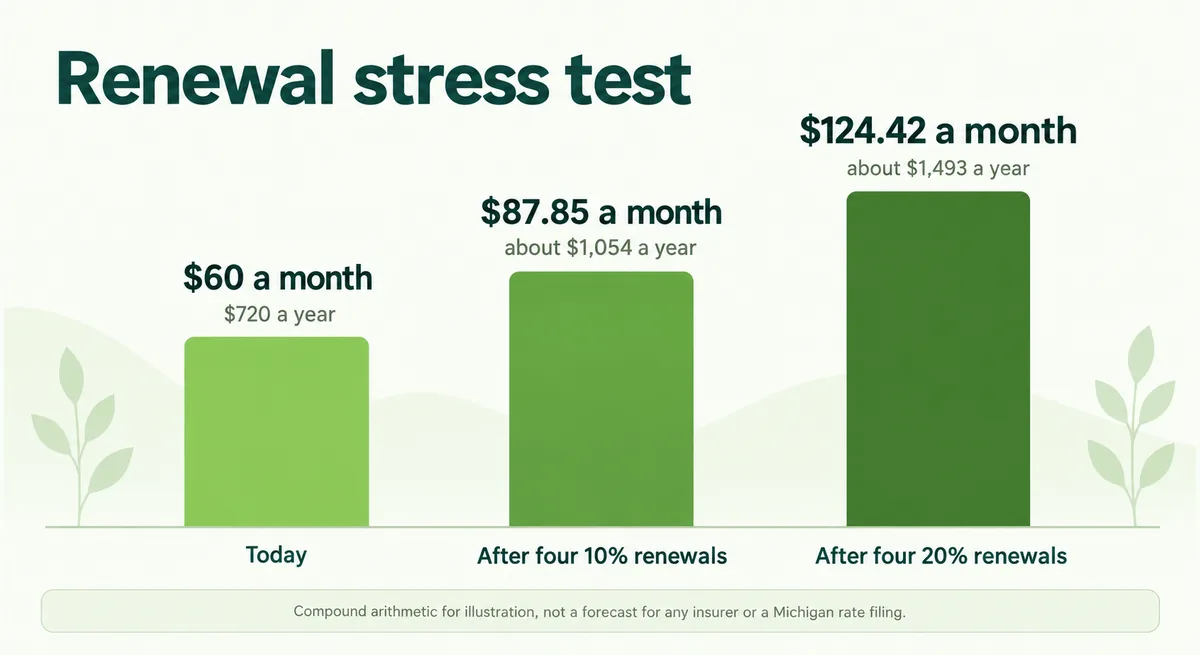
So stress-test the price before you buy. This is arithmetic, not a forecast: a $60 monthly premium that rises 10% at each of four renewals reaches $87.85 a month, about $1,054 a year. At 20% a renewal it reaches $124.42 a month, about $1,493 a year, more than double where it began. Check the higher figure against your budget now, not when the fourth notice arrives.
When the renewal notice arrives
Michigan law won't cap the increase, but the law section covers two general rules that, on our reading, reach pet policies: you can ask in writing for the information behind your rate (MCL 500.2021), and property and casualty insurers may not price on how likely you are to shop around (MCL 500.2027a). Then:
- Read the whole renewal declarations page, not just the price. On the Spot, ASPCA and Pumpkin form, that page "will specify the coverage and rates that apply," and "You accept these changes by renewing your policy." Fetch's and AKC's forms let the deductible, your share of each bill and other terms change at renewal too.
- Trim coverage with care. Cutting is easy; putting it back may not be. Pets Best's form lets you lower coverage at any time, but you can raise your reimbursement rate or lower your deductible only at renewal, subject to underwriting, and a higher annual limit takes a new policy, with new waiting periods. Under Embrace's V6 terms, raising it later restarts the illness waiting period and the pre-existing-condition review. And Healthy Paws' FAQ says that after a claim you can only lower your reimbursement or raise your deductible.
- Weigh a switch against your pet's records. A new policy, even from the same insurer, looks for pre-existing conditions from its own start date, as Pets Best's form spells out; the situation table's switching row covers the trade-off.
Moving out of Michigan: what your policy says happens
A trip isn't a move. Embrace's terms, for example, allow exceptions for "military deployments and vacations" as long as your primary residence stays in the policy territory. A new permanent address is what changes a policy:
- Spot, ASPCA, Pumpkin: their shared form says your pet "must reside with you at the primary address listed on the declarations page," a new address can change "coverage availability and rates," and the insurer may cancel, on at least 30 days' notice, if you move "into a state where the policy is not available." Spot's FAQ asks you to call first.
- Embrace: its terms require your pet to live at the address and ZIP code on your declarations page, and its Help Center says "Current coverage is not available if you have moved across state lines."
- Pets Best: its form asks for notice within 30 days of an address change and says the premium may change; for a new state, its FAQ says to contact Customer Care.
- Lemonade: "the premium and availability might change depending on where you're moving," and in a state it doesn't serve, "you will need to cancel your policy, and we'll issue you any applicable refund" (FAQ, updated September 1, 2026).
- Healthy Paws: its FAQ doesn't cover moving, so ask before you go.
Of the states bordering Michigan by land, only Ohio has a pet-insurance law, and it applies to policies issued to Ohio residents, sold in Ohio or delivered there (section 3970.02). A policy re-issued or renewed on Ohio paper after a move would therefore likely carry the terms in our Ohio pet insurance guide: a 30-day free look, illness and orthopedic waits of no more than 30 days, and no accident wait. That's our reading. Whether a mid-term move brings them in before renewal isn't established, and on the same reading, a policy re-issued in Michigan after a move from Ohio would leave them behind.
Indiana and Wisconsin have no pet-insurance law (NAIC's chart shows no activity for either), so a move there brings no pet-insurance statute. It can still change your ZIP-based price, possibly your policy form, and, once the policy is issued there, which state's general insurance rules and regulator apply: DIFS's authority covers contracts issued in Michigan. And no move, even to Ohio, makes an existing condition covered.
Before you move, get written answers to six questions:
- Will the same legal insurer, the one named on your declarations page, keep covering your pet?
- Will the policy be endorsed, renewed on your new state's form, or replaced?
- Do your original coverage date and the conditions already covered carry over?
- Will any new waiting periods or exclusions apply?
- Do the deductible you've met and the limit you've used carry over?
- What are the new premium, effective date and notice terms?
Michigan risks worth checking your policy against
Six exposures are worth checking against a Michigan policy: ticks, heartworm, blastomycosis, toxic algae, antifreeze and deicers, and, for hunting hounds, wolves. Each line below pairs a documented exposure with the policy term to find. The sources show exposure, not claims: none reports how often insured Michigan pets are treated for these hazards, or how often insurers pay.
- Ticks and Lyme disease. The Companion Animal Parasite Council's 2026 forecast describes "expanding risk across Indiana, Illinois, Michigan, and Ohio" for Lyme disease. Check how your form treats tick-borne illness, including its parasite exclusions and any conditions about vaccines or preventive medication. Tick medication and the Lyme vaccine are preventive care, which sits in wellness add-ons, not accident-and-illness cover: Pets Best's Michigan form, for example, covers them only under its optional Wellness endorsement.
- Heartworm. The same forecast says heartworm's northward expansion "has not yet substantially reached" the Upper Midwest, Michigan included, though transporting dogs from the South to cities there "poses a meaningful risk." Check whether heartworm disease itself is covered, and on what condition: Pets Best's form lists giving the preventive medication your vet recommends, against "fleas, ticks, and heartworm," among the steps whose neglect "could result in denied claims." Healthy Paws' Michigan-linked policy goes further, excluding "Diseases preventable by vaccines and prophylactic medications (such as heartworm, lice, internal parasites and fleas)," and AKC's Michigan form excludes treatment for parasites, heartworms included. Prevention is a wellness item here too.
- Blastomycosis. A 2019 Michigan State University study of Michigan dogs, drawn from clinic cases rather than ongoing surveillance, found that travel to or living in Northern Michigan, north of the 45th parallel, was "a strong risk factor" for this fungal infection. Check the illness waiting period and pre-existing terms, especially when insuring a dog that spends time up north; the forms table lists each insurer's waits.
- Toxic algae. Michigan's health department (MDHHS) confirmed harmful algal blooms in 92 Michigan waterbodies in 2024 and notes that blooms "can cause illness in people and animals." Check whether your form counts a toxin exposure as an accident or an illness, which can change the waiting period and, on an accident-only plan, what gets paid: Embrace's terms leave out later treatment, such as for "liver damage from an accidental poisoning incident," on policies without illness coverage.
- Antifreeze and deicers. The state's MI Ready site warns that "Ingesting anti-freeze can be fatal for a dog or cat," and the state agriculture department (MDARD) says deicers "can be toxic to pets." Check poisoning cover and any repeat-activity clause: the Spot, ASPCA and Pumpkin form lists "Poison control consultation fees" among accident expenses, while AKC's excludes more than one illness or injury in a pet's lifetime from a repeated activity, naming "toxin ingestion" among its examples.
- Wolves and hunting hounds. Michigan's Department of Natural Resources and USDA Wildlife Services verified 94 wolf attacks on domestic dogs in Michigan from 1996 to 2021, and 64% involved hunting hounds in the field (Michigan Wolf Management Plan, updated 2022). Check for a working-dog or business-use exclusion, and ask in writing whether hunting counts: AKC's form excludes conditions from activities related to "working," and Healthy Paws' Michigan-linked policy defines a pet as a cat or dog "owned for companionship or as a help dog."
The policy wording above comes from the documents each insurer links for Michigan, read on September 29, 2026; your own policy and declarations page govern.
Before you buy, and again at each renewal, read your Michigan form's exclusions for the risks that fit your pet's life, and get the insurer's answer in writing wherever the wording leaves you unsure.
Frequently Asked Questions
How much is pet insurance in Michigan?
At one Ypsilanti ZIP code (48197), U.S. News's May 2026 accident-and-illness quotes averaged $49.63 a month for a 1-year-old medium mixed-breed dog and $27.43 for a 1-year-old domestic shorthair cat, at a $10,000 annual limit, $500 deductible and 90% reimbursement. Other published Michigan figures disagree because each prices a different pet, setup, method or year. One ZIP code isn't a state average, so compare your own quotes on identical settings.
What is the best pet insurance in Michigan?
No single insurer is best for every Michigan pet, so match the policy to your situation:
- Deposit worries: whether the insurer pays your ER at checkout. Michigan ERs we checked, like AESH in Grand Rapids, name only Trupanion.
- Large dog: the knee and hip rules in each carrier's Michigan form.
- Past problem that cleared up: how long, if ever, until it's covered again.
Our situation table covers ten cases.
Do I need a Michigan vet that "takes" my pet insurance?
No. Most pet insurance reimburses you rather than working through a network: you pay the hospital, then claim, so a hospital doesn't have to accept your insurer unless it bills the insurer directly. At the Michigan ERs whose payment pages we read, Trupanion is the only insurer named for direct billing at checkout. With other insurers, BluePearl's FAQ says, you pay up front and get the paperwork to claim.
Can a Michigan emergency vet ask for a deposit up front?
Many Michigan ERs publish up-front payment rules as their own policy. Animal Emergency Center in Novi and Rochester Hills requires a 50% deposit on estimates over $500, and MSU's Veterinary Medical Center asks for half the upper end of the estimate (both read September 29, 2026). Insurance doesn't change that unless the hospital bills your insurer. Ask which financing the hospital accepts, and get your pet the care first.
Does Michigan have a pet insurance law? Is pet insurance required?
Michigan has no pet-insurance law, and no statute requires pet health insurance. The National Association of Insurance Commissioners' Summer 2026 chart lists Michigan as "NO CURRENT ACTIVITY," and on September 29, 2026, searches of the state's compiled laws and 2025–2026 bills found no match for "pet insurance." General rules, like 12% interest on late-paid claims, still reach pet policies by their wording (our reading), and the state regulator, DIFS, takes complaints.
How do I complain about a denied or late pet insurance claim in Michigan?
Start with the insurer: ask in writing which policy language it relied on, and use any appeal process. Keep dates, invoices, records and letters. Then file with DIFS online or on form FIS 0030; its call center, 877-999-6442, can help. If you're paid more than 60 days after the insurer had satisfactory proof of loss, Michigan's 12% annual interest rule may apply. DIFS publishes no timeline and may not get the result you want.
Can I insure an older pet or one that's already been diagnosed?
Usually you can buy a policy, but conditions already in your pet's records stay excluded as pre-existing. Spot, ASPCA and Pets Best say they have no upper enrollment age. Whether a cleared-up problem is covered again depends on the form: after 180 days free of symptoms and treatment on the Spot, ASPCA and Pumpkin form (never chronic, knee or ligament conditions), after 12 months at Embrace, and never on some others.
What happens to my pet insurance if I move out of Michigan?
It depends on your policy's wording: a move can reprice, re-issue or end it. Spot, ASPCA and Pumpkin's form lets the insurer cancel where the policy isn't offered; Embrace says current coverage doesn't cross state lines; Pets Best wants notice of a move within 30 days; and Lemonade has you cancel, with any refund due, where it doesn't sell. Re-issued or renewed in Ohio, a policy would likely gain Ohio's pet-insurance protections (our reading).
Is pet insurance worth it in Michigan?
It's worth it mainly if one large vet bill, early on, would be hard to pay. In one Grand Rapids Reddit thread (October 2024), owners reported $4,000 to $5,500 for a dog's knee surgery (unverified), against about $596 a year in premiums for a 1-year-old dog at the Ypsilanti average. Insurance isn't a savings account and may never "pay off" on average; it protects you from a bill you couldn't yet cover.
Is Costco pet insurance cheaper?
Cheaper than Figo's own non-member price, yes: Costco members get an exclusive 15% off the base rates Figo charges non-members (not offered in Washington state). Cheaper than every other insurer, not necessarily. The discount doesn't change the coverage, and Figo posts no Michigan-specific policy, so ask for the Michigan terms, then quote identical coverage elsewhere.
Do any pet insurance plans cover 100%?
Some plans offer 100% reimbursement, with conditions. The MetLife benefit for State of Michigan employees lists 100%, but only without wellness coverage and with an annual maximum of $5,000 or less. Figo advertises up to 100% reimbursement; we didn't verify it as a Michigan option. Even at 100%, your deductible, annual limit and exclusions still apply, so 100% doesn't mean every bill is paid in full.
Sources
- Best Pet Insurance in Michigan for 2026 (updated August 28, 2026) — U.S. News & World Report
- Pet Insurance Model Act (#633) state chart, ST-633 (Summer 2026 edition) — National Association of Insurance Commissioners (NAIC)
- Michigan Compiled Laws full-text search: “pet insurance” (searched September 29, 2026) — Michigan Legislature
- Bill search, 2025–2026 session: “pet insurance” (searched September 29, 2026) — Michigan Legislature
- MCL 500.2236 — Filing and approval of policy forms — Michigan Legislature (Insurance Code of 1956)
- Insurance Complaint Form and Guide to Resolving Insurance Problems, FIS 0030 (Rev. 01/2021) — Michigan Department of Insurance and Financial Services (DIFS)
- Pet Owner FAQs (read September 29, 2026) — BluePearl Pet Hospital
- Pet Insurance & Payment Options (read September 29, 2026) — Animal Emergency & Specialty Hospital (AESH)
- Payment Options, Traverse City (read September 29, 2026) — Bay Area Pet Hospital
- Payment Options (read September 29, 2026) — Animal Emergency Center (AEC)
- Client Information (read September 29, 2026) — Michigan State University Veterinary Medical Center
- Pet Insurance, State of Michigan employee voluntary benefits (undated; read September 29, 2026) — Michigan Civil Service Commission (MDCS)
- Emergency Care (page modified January 4, 2025; read September 29, 2026) — Animal Medical Center of Marquette
- Best Pet Insurance in Ohio for 2026 (updated August 28, 2026) — U.S. News & World Report
- Best Pet Insurance in Indiana for 2026 (updated September 11, 2026) — U.S. News & World Report
- Best Pet Insurance in Illinois for 2026 (updated September 1, 2026) — U.S. News & World Report
- Best Pet Insurance in Wisconsin for 2026 (updated September 4, 2026) — U.S. News & World Report
- Best Pet Insurance in Michigan (2026) (updated September 17, 2026) — MoneyGeek
- Pet Insurance Methodology (updated April 24, 2026) — MoneyGeek
- How Much Pet Insurance Costs in 2026: Average Prices by State and Breed (updated September 15, 2026) — Pawlicy Advisor
- How Much Is Pet Insurance? 2026 Guide (updated July 10, 2026) — NerdWallet
- Pet Insurance in Michigan (read September 29, 2026) — Fetch Pet Insurance
- Pet Insurance in Michigan guide (rates as of October 2024; read September 29, 2026) — Lemonade
- Pet Insurance in Michigan (read September 29, 2026) — Embrace Pet Insurance
- Michigan Accident & Illness sample policy, form PET-P-20000-MI-1024 (October 2024 edition), as linked by Spot — Independence American Insurance Company (via Spot Pet Insurance)
- Michigan Accident & Illness sample policy, form PET-P-20000-MI-1024 (October 2024 edition), as linked by ASPCA — Independence American Insurance Company (via ASPCA Pet Health Insurance)
- Michigan sample policy, form PET-P-20000-MI-1024 (March 2026 sample), as linked by Pumpkin — Independence American Insurance Company (via Pumpkin)
- Accident and Emergency Pet Insurance in Michigan (read September 29, 2026) — Spot Pet Insurance
- Consumer Price Index, Veterinarian services, U.S. city average, series CUUR0000SS62054 (August 2026 data) — U.S. Bureau of Labor Statistics
- Emergency vet care, comment (r/kzoo, September 18, 2024) — Reddit, r/kzoo
- Affordable Emergency Vet Hospital, comment (r/AnnArbor, May 16, 2025) — Reddit, r/AnnArbor
- Good affordable Vets (r/lansing, January 29, 2024) — Reddit, r/lansing
- Bad experiences at VCA emergency vet?, comment (r/kzoo, July 31, 2026) — Reddit, r/kzoo
- My Dog needs ACL surgery… Any recommendations? (r/grandrapids, October 30, 2024) — Reddit, r/grandrapids
- Dog #2 needs ACL surgery, comment (r/grandrapids, June 20, 2025) — Reddit, r/grandrapids
- Good/cheap vet clinics (r/grandrapids, June 10, 2025) — Reddit, r/grandrapids
- House Bill 5580 of 2026 (read September 29, 2026) — Michigan Legislature
- Bill search, all sessions: “pet insurance” (searched September 29, 2026) — Michigan Legislature
- Senate Bill 648 of 2017 (read September 29, 2026) — Michigan Legislature
- Michigan Compiled Laws search, chapter 500: “pet” (searched September 29, 2026) — Michigan Legislature
- 2025 Bulletins (index; searched September 28, 2026) — Michigan Department of Insurance and Financial Services (DIFS)
- 2026 Bulletins (index; re-checked September 29, 2026) — Michigan Department of Insurance and Financial Services (DIFS)
- Michigan Administrative Code: Department of Insurance and Financial Services rule sets (searched September 28, 2026) — Michigan Administrative Rules System (LARA)
- UCAA Lines of Business Matrix (undated; read September 29, 2026) — National Association of Insurance Commissioners (NAIC)
- Available Lines of Authority (read September 29, 2026) — Michigan Department of Insurance and Financial Services (DIFS)
- Ohio Revised Code Chapter 3970, Pet Insurance (effective January 22, 2025) — Ohio Laws and Administrative Rules (Ohio Legislative Service Commission)
- Ohio Revised Code Section 3970.04 (effective January 22, 2025) — Ohio Laws and Administrative Rules (Ohio Legislative Service Commission)
- Ohio Revised Code Section 3970.05 (effective January 22, 2025) — Ohio Laws and Administrative Rules (Ohio Legislative Service Commission)
- Michigan sample policy, form GPTM 050 MI 1125 A (November 2025 edition) — AXIS Insurance Company (via Fetch Pet Insurance)
- Embrace Pet Health Insurance policy terms, V6 (read September 29, 2026) — Embrace Pet Insurance
- Michigan accident and illness sample policy, form IAIC PPI AI POL 007 MI 1120 (November 2020 edition) — Independence American Insurance Company (via AKC Pet Insurance)
- Michigan accident and illness sample policy booklet, form IAIC-PB10001-ILL (no edition printed) — Independence American Insurance Company (via Pets Best)
- Sample dog policy, form IAIC FPI POL 0320 (sample dated August 1, 2023) — Independence American Insurance Company (via Figo Pet Insurance)
- MCL 500.2006 — Timely payment of claims; 12% interest — Michigan Legislature (Insurance Code of 1956)
- Nickola v MIC General Insurance Co, No. 152535 (Mich. May 12, 2017) — Michigan Supreme Court
- MCL 500.2026 — Unfair claim-settlement practices — Michigan Legislature (Insurance Code of 1956)
- Bulletin 2024-09-INS, Price Optimization (March 6, 2024) — Michigan Department of Insurance and Financial Services (DIFS)
- MCL 500.2027a — Price optimization in ratemaking (added by 2026 PA 98) — Michigan Legislature (Insurance Code of 1956)
- MCL 500.2021 — Rate information on written request — Michigan Legislature (Insurance Code of 1956)
- MCL 500.7925 — Covered claims, Property and Casualty Guaranty Association — Michigan Legislature (Insurance Code of 1956)
- Bulletin 2026-13-INS, guaranty association maximum unearned-premium refund (April 23, 2026) — Michigan Department of Insurance and Financial Services (DIFS)
- MCL 500.7931 — Coverage continued after an insurer's insolvency — Michigan Legislature (Insurance Code of 1956)
- MCL 500.7911 — Property and Casualty Guaranty Association membership — Michigan Legislature (Insurance Code of 1956)
- Filing a Complaint with DIFS (read September 29, 2026) — Michigan Department of Insurance and Financial Services (DIFS)
- Consumer online complaint forms (read September 29, 2026) — Michigan Department of Insurance and Financial Services (DIFS)
- Pet health insurance policy, form LD-50812 (07/18 edition), linked for Michigan — Westchester Fire Insurance Company (via Healthy Paws Pet Insurance)
- Amendatory Endorsement – Michigan, form LD-50782 (01/24 edition) — Westchester Fire Insurance Company (via Healthy Paws Pet Insurance)
- Claims Process Endorsement, form PIM-52552 (08/19 edition), linked for Michigan — Westchester Fire Insurance Company (via Healthy Paws Pet Insurance)
- Frequently Asked Questions (read September 29, 2026) — Healthy Paws Pet Insurance
- Coverage FAQ (read September 29, 2026) — AKC Pet Insurance
- Vet Direct Pay (read September 29, 2026) — Pets Best
- State Documents and Sample Policies (read September 29, 2026) — Figo Pet Insurance
- My Pet Protection Choice coverage form, VS-G-16-MI (6-24 edition) — National Casualty Company (via Nationwide Pet Insurance)
- My Pet Protection with Wellness coverage form, VS-G-13-MI (01-23 edition) — National Casualty Company (via Nationwide Pet Insurance)
- My Pet Protection coverage form, VS-G-14-MI (01-23 edition) — National Casualty Company (via Nationwide Pet Insurance)
- Modular pet insurance coverage form, VS-G-15 (9-24 edition) — National Casualty Company (via Nationwide Pet Insurance)
- Policy forms (read September 29, 2026) — Nationwide Pet Insurance
- Sample policy, form PET21-01-V (Ohio-coded; the only public MetLife Pet sample) — Metropolitan General Insurance Company (via MetLife Pet Insurance)
- Pet Insurance in Michigan (modified April 7, 2025; read September 29, 2026) — MetLife Pet Insurance
- Get Covered: Pet Insurance With No Waiting Period (blog, August 11, 2025) — MetLife Pet Insurance
- Pet Insurance Waiting Period Guide (updated June 3, 2026) — Lemonade
- The Ultimate Lemonade Pet FAQ (updated September 1, 2026) — Lemonade
- Medical Insurance for the Life of Your Pet, sample policy TRU (D) 00001 (V10.201902, February 2019) — American Pet Insurance Company (via Trupanion)
- Can I view a sample Trupanion policy? (read September 29, 2026) — Trupanion
- Pet Insurance in Michigan for Dogs & Cats (read September 29, 2026) — Trupanion
- Preventive Care Amendatory Endorsement, Platinum, PET-AE-20000-0723 (July 2023 edition) — Independence American Insurance Company (via Spot Pet Insurance)
- My Dog needs ACL surgery…, comment (r/grandrapids, October 30, 2024) — Reddit, r/grandrapids
- Getting a puppy in July and starting to look for a vet now, comment (r/lansing, March 8, 2026) — Reddit, r/lansing
- Frequently Asked Questions (read September 29, 2026) — Animal Emergency Center (AEC)
- Payment Policy (read September 29, 2026) — Michigan State University Veterinary Medical Center
- Contact (read September 29, 2026) — Michigan State University Veterinary Medical Center
- Veterinary Medical Center Temporary Closure (posted September 20, 2026; updated September 21, 2026) — Michigan State University College of Veterinary Medicine
- BluePearl Pet Hospital, Ann Arbor, MI (read September 29, 2026) — BluePearl Pet Hospital
- BluePearl Pet Hospital, Southfield, MI (read September 29, 2026) — BluePearl Pet Hospital
- BluePearl Pet Hospital, Auburn Hills, MI (read September 29, 2026) — BluePearl Pet Hospital
- BluePearl Pet Hospital, Grand Rapids, MI (read September 29, 2026) — BluePearl Pet Hospital
- BluePearl Pet Neurology, Farmington, MI (read September 29, 2026) — BluePearl Pet Hospital
- What To Expect (read September 29, 2026) — Animal Emergency & Specialty Hospital (AESH)
- Home page (read September 29, 2026) — Animal Emergency & Specialty Hospital (AESH)
- Emergency Vet Financing (read September 29, 2026) — Emergency Veterinary Care Centers (EVCC)
- Common Pet Emergency Questions (read September 29, 2026) — Emergency Veterinary Care Centers (EVCC)
- EVCC Holland (read September 29, 2026) — Emergency Veterinary Care Centers (EVCC)
- EVCC Kalamazoo (read September 29, 2026) — Emergency Veterinary Care Centers (EVCC)
- EVCC Saginaw (read September 29, 2026) — Emergency Veterinary Care Centers (EVCC)
- Payment Options (read September 29, 2026) — Oakland Veterinary Referral Services (OVRS)
- Home page (read September 29, 2026) — Oakland Veterinary Referral Services (OVRS)
- Contact Us, Traverse City (read September 29, 2026) — Bay Area Pet Hospital
- Michigan locations (read September 29, 2026) — Veterinary Emergency Group (VEG)
- VEG Ann Arbor (read September 29, 2026) — Veterinary Emergency Group (VEG)
- VEG Kentwood (East Grand Rapids) (read September 29, 2026) — Veterinary Emergency Group (VEG)
- VEG Northville (read September 29, 2026) — Veterinary Emergency Group (VEG)
- MedVet Commerce (read September 29, 2026) — MedVet
- Home page (last modified April 12, 2022; read September 29, 2026) — Greater Lansing Veterinary Center (GLVC)
- VCA Veterinary Specialty & Emergency Center of Kalamazoo (read September 29, 2026) — VCA Animal Hospitals
- 24-Hour Emergency Service (read September 29, 2026) — Northern Veterinary Associates
- Experiencing an Emergency? (read September 29, 2026) — Sault Animal Hospital
- Home page (read September 29, 2026) — Thunder Bay Veterinary Urgent Care
- Emergency Veterinary Care (read September 29, 2026) — Grayling Hospital For Animals
- Home page (read September 29, 2026) — Animal Emergency Hospital (Burton)
- File a Claim (read September 29, 2026) — Healthy Paws Pet Insurance
- Emergency vet, no money, comment (r/AnnArbor, January 3, 2026) — Reddit, r/AnnArbor
- What resources are available for emergency vet expenses in Lansing? (r/lansing, May 20, 2025) — Reddit, r/lansing
- Pet cat emergency, comment (r/AnnArbor, February 25, 2025) — Reddit, r/AnnArbor
- Affordable Emergency Vet Hospital, comment (r/AnnArbor, May 16, 2025) — Reddit, r/AnnArbor
- Affordable Emergency Vet Hospital, comment (r/AnnArbor, May 15, 2025) — Reddit, r/AnnArbor
- Go Blue Rewards: Nationwide Pet Insurance (page modified July 24, 2024; re-read September 29, 2026) — Alumni Association of the University of Michigan
- Nationwide pet insurance for Alumni Association of the University of Michigan members (read September 29, 2026) — Nationwide
- Pet Insurance (read September 29, 2026) — Costco Wholesale (Costco Insurance Agency)
- Pet Insurance (read September 29, 2026) — USAA
- Embrace Pet Insurance Policy Terms & Conditions (read September 29, 2026) — Embrace Pet Insurance
- Pet Insurance for Dogs & Cats (read September 29, 2026) — Progressive
- 2025's Most Popular Dog Breeds by City (March 18, 2026) — American Kennel Club (AKC)
- Pet Insurance Frequently Asked Questions (read September 29, 2026) — Spot Pet Insurance
- The Best Senior Dog Insurance (read September 29, 2026) — ASPCA Pet Health Insurance
- Frequently Asked Questions (read September 29, 2026) — Pets Best
- Good/cheap vet clinics, comment (r/grandrapids, June 10, 2025) — Reddit, r/grandrapids
- Vet Care (read September 29, 2026) — Michigan Humane
- Rochester Hills Veterinary Clinic (read September 29, 2026) — Michigan Humane
- Detroit Veterinary Clinic (read September 29, 2026) — Michigan Humane
- Veterinary Clinic, Ann Arbor (read September 29, 2026) — Humane Society of Huron Valley
- Funds to Support (read September 29, 2026) — Michigan State University College of Veterinary Medicine
- How to Update Your Address (read September 29, 2026) — Embrace Pet Insurance
- Ohio Revised Code Section 3970.02 (effective January 22, 2025) — Ohio Laws and Administrative Rules (Ohio Legislative Service Commission)
- Can those in a lower cost-of-living area speak to premium increases with Trupanion?, comment (r/petinsurancereviews, April 22, 2026) — Reddit, r/petinsurancereviews
- Pets Best CRAZY premium increase, comment (r/petinsurancereviews, March 30, 2026) — Reddit, r/petinsurancereviews
- Positive review/advice for Fetch (r/petinsurancereviews, July 23, 2026) — Reddit, r/petinsurancereviews
- Fetch Insurance | 50 Claims (r/petinsurancereviews, May 20, 2025) — Reddit, r/petinsurancereviews
- 2026 Annual Pet Parasite Forecasts (March 16, 2026; updated April 15, 2026) — Companion Animal Parasite Council (CAPC)
- Prevalence, distribution, and risk factors for canine blastomycosis in Michigan, USA (Medical Mycology, 2019) — Medical Mycology (via PubMed Central)
- Harmful Algal Bloom 2024 Data Summary, MDHHS-Pub-1827 (February 2026) — Michigan Department of Health and Human Services (MDHHS)
- Winter Weather and Pets (undated; read September 29, 2026) — State of Michigan, MI Ready
- MDARD Encourages Owners to Help Keep Their Animals Warm and Safe in Cold Temperatures (January 23, 2026) — Michigan Department of Agriculture and Rural Development (MDARD)
- Michigan Wolf Management Plan, Updated 2022 (Wildlife Division Report No. 3703, September 2022) — Michigan Department of Natural Resources (DNR)
- Dog Insurance (undated; read September 29, 2026) — Figo Pet Insurance