

Pet insurance for a one-year-old dog in Washington averages about $53 a month across twelve carriers at a $10,000 annual limit, a $500 deductible and 90% reimbursement — and roughly $31 for a cat. Moving to an unlimited limit takes those to about $63 and $38.
That is a sample, not a statewide average: those quotes are priced for Pasco, in the Tri-Cities. Your own number moves with your pet's age and those three settings far more than with your ZIP code.
Two things on this page are not on the pages ranking above it. Washington has had its own pet-insurance law since 1 January 2024: accident waiting periods are banned outright, and a condition your policy already covered cannot be treated as pre-existing at renewal. No competing page cites it — including the Washington Insurance Commissioner's own.
And before any of that matters, a Washington emergency room wants money first: in Spokane, a 75% deposit may be collected once you approve the estimate.
Table of Contents
- How much pet insurance costs in Washington
- Is Washington actually an expensive state for pet insurance?
- What Washington vet care and emergencies actually cost
- Paying before you're reimbursed
- What Washington law gives you
- Can an insurer drop you because your pet got old?
- Why premiums jump at renewal
- Best pet insurance in Washington by situation
- Provider comparison
- Pre-existing conditions and waiting periods here
- Free and low-cost help in Washington
- Frequently Asked Questions
- Sources
How much pet insurance costs in Washington
Age moves the price here more than anything else you can control. At identical settings, U.S. News puts a one-year-old dog at $53.24 a month and a six-year-old at $80.78 — a 52% jump for nothing but five birthdays. The full grid, averaged across twelve carriers at a $500 deductible and 90% reimbursement:
| Annual limit | Dog, age 1 | Dog, age 6 | Cat, age 1 | Cat, age 6 |
|---|---|---|---|---|
| $10,000 | $53.24 | $80.78 | $30.86 | $41.71 |
| Unlimited | $62.64 | $105.78 | $38.00 | $52.78 |
Those quotes were priced in Pasco, in the Tri-Cities — ZIP 99301, at the dry eastern end of the state. Not Seattle, and not a statewide average. U.S. News is straightforward about the method — "we took the averages across the 12 companies considered for our best pet insurance companies rating" — but no page ranking above this one tells you which Washington city its headline number came from.
Three settings drive every figure on this page. The annual limit is the most a policy will pay out in a year. The deductible is what you cover before it pays anything. The reimbursement percentage is the share of the rest you get back. Lifting the limit from $10,000 to unlimited costs about $9 a month more on that one-year-old dog and $25 on the six-year-old.
Other publishers quote Washington at other settings, and the settings explain most of the gap between them:
- $76 dog / $38 cat — two-year-old pets, 80% reimbursement, $500 deductible, $5,000 minimum limit (Insurify, data current 31 May 2026).
- $84 dog / $42 cat — a six-year-old Labrador and a seven-year-old Ragdoll at $5,000 / $500 / 80% (MoneyGeek, updated 3 August 2026).
- $46 dog / $23 cat — headline state averages, with no configuration stated anywhere on the page (WSJ Buy Side, updated 10 March 2026).
So write down all five — species, age, limit, deductible, reimbursement — before you set one quote beside another. Two "Washington averages" that differ by more than 80% are usually not disagreeing about Washington at all. For how each setting moves the number, see our guide to what pet insurance costs.
Is Washington actually an expensive state for pet insurance?
No — and the widely repeated "37% above average" figure is an artifact of the dog it was measured on, not a fact about Washington.
Two vendors publish a Washington-versus-national comparison and disagree wildly. Insurify puts Washington dogs 7% above its own national figure — $76 here against $71 nationally — and cats just 2.7% above. MoneyGeek puts dogs 37% above and cats 31%. Both hold the policy identical: a $5,000 limit, a $500 deductible, 80% reimbursement.
The difference is the pet, not the state. Insurify prices a two-year-old mixed breed; MoneyGeek prices a six-year-old Labrador, against a different dataset and a different national baseline. Two figures built that differently cannot be compared, let alone averaged — and neither one isolates what Washington itself adds.
The whole-book number settles it. NAPHIA's 2026 industry report puts Washington at 3.8% of all US insured pets and 3.8% of gross written premium — seventh by pets, eighth by premium. When those two shares match, the average premium per insured pet works out at roughly the national average rather than above it. Both figures are rounded, and this is aggregate parity across the pets Washington actually insures — not a like-for-like quote comparison. Massachusetts is the contrast: 4.0% of the premium on 3.4% of the pets. Nationally, accident-and-illness cover averaged $836 a year for a dog and $435 for a cat in 2025.
What genuinely moves your number is inside your own quote. Holding the settings fixed, MoneyGeek's Washington curve runs from $42 a month for a one-year-old dog to $105 at ten and $177 at sixteen, and from a $39 Chihuahua to a $194 Olde English Bulldogge. NAIC's regulator guide — dated 2019 and illustrative only — shows the same ordering: its geographic factor of 1.160 sits below both the pet-age factor of 1.240 and the per-incident-limit factor of 1.280.
So compare quotes on your pet's age and your chosen settings. The state line is close to the smallest thing on that list.
What Washington vet care and emergencies actually cost
Routine care costs more on the west side. The same dog office visit lists at $93.95 at Banfield in north Seattle and $74.95 in Spokane — 25% apart on an identical service, both last priced in May 2025. The gap narrows as bills grow: a matched dental cleaning is 18% apart. These are vet prices, not premiums, but they sit underneath both.
Past the exam room, Seattle's Urban Animal publishes $375 for a two- or three-view radiograph set and $895 to $3,000 for a dental procedure, on an undated price page.
Emergencies make geography a distance question, not a price one. The Puget Sound corridor has depth — BluePearl in Tukwila, Kirkland, Tacoma and Olympia, Veterinary Emergency Group in Lynnwood, Redmond and Seattle. East of the mountains, Pet Emergency Clinic in Spokane calls itself the largest emergency and referral hospital "on this side of the Cascades," and its on-site specialties run to internal medicine, oncology and a blood bank, by appointment on weekdays.
Behind it sits the state's only accredited veterinary college, WSU's Veterinary Teaching Hospital in Pullman, whose emergency service runs around the clock. Internal medicine, neurology and orthopedic surgery each carry a "veterinarian referral required" flag, so your own vet has to open the door.
What WSU does not publish is a price. No exam fee, no emergency fee, no figure appears on its billing page — so an eastern Washington owner learns the cost on arrival.
Paying before you're reimbursed
Almost every Washington hospital that publishes a payment rule wants your money before your insurer sends any. Pet insurance is a reimbursement product: you settle the bill, file a claim, and wait. The exception is direct pay, where the insurer pays the hospital at checkout — and here that is narrower than the marketing suggests.
What the hospitals publish: at Pet Emergency Clinic in Spokane, "after estimate approval, a 75% deposit may be collected prior to treatment" — discretionary, but that is the stated policy — and paying by card adds a 3.5% transaction fee, on debit as well as credit. At Pacific Northwest Pet ER in Vancouver, "you will be required to leave the high end of the estimate" before treatment begins. At WSU in Pullman the balance falls due at discharge, against an estimate given as a range. Even routine care has moved: Seattle Veterinary Associates takes a deposit equal to the exam fee when you book a first appointment, and $200 to schedule any non-emergency anesthetic procedure.
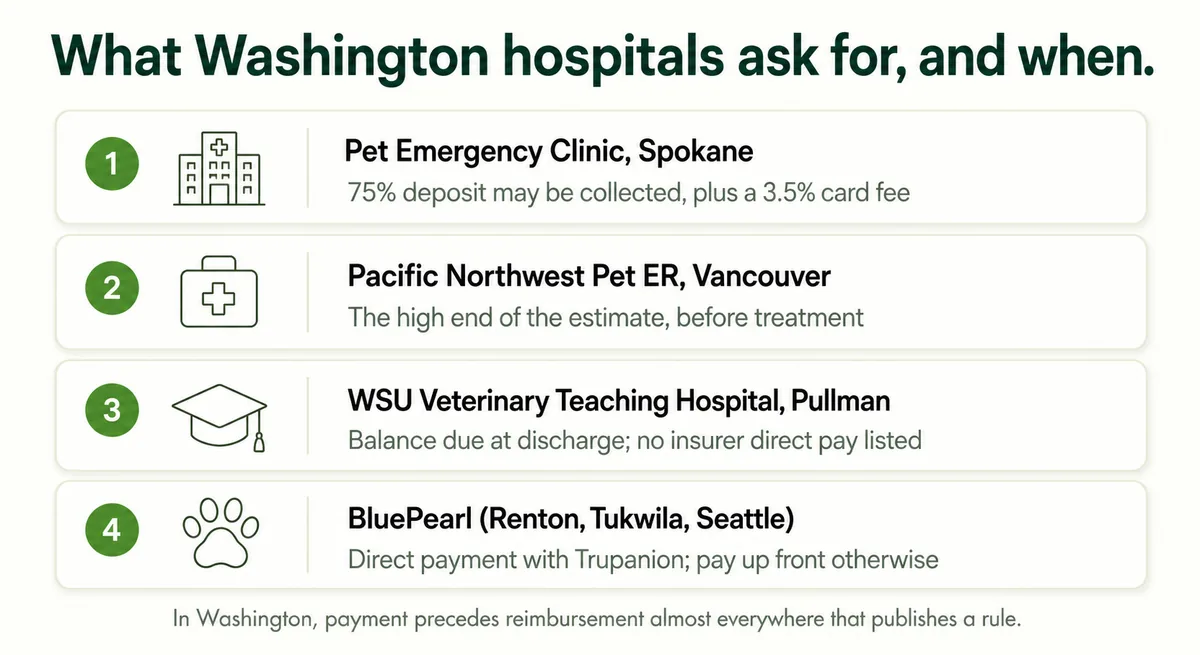
BluePearl states the two-tier reality more plainly than any insurer does: "If you have Trupanion, we work directly with them for payment when you visit one of our hospitals… If you have another type of pet insurance, you'll pay up front for your pet's care." Boundary Bay in Bellingham participates in that same Trupanion program, and the Vancouver hospital accepts it too. Emerald City in Seattle is the only Washington hospital we found describing a multi-carrier route — pre-approving the anticipated cost so you skip the up-front deposit — and it names no carrier, while still billing you the exam, your deductible, a percentage and sales tax.
So direct pay here behaves like a single-carrier feature, and nobody can tell you how far it reaches. Trupanion's annual report discloses no hospital count and no state breakdown, and its own hospital finder ignores the location you type into it. A Seattle owner put the trade-off exactly, in a thread on the subject: Trupanion is "the one vets always recommend… also by far the most expensive one I found." Owner-reported and unaudited — but an honest shape for the choice.
Before you pick a policy, ask your own hospital which insurers it settles with directly — and treat every other policy as one you will fund yourself first.
What Washington law gives you
Since 1 January 2024, a policy sold to you in Washington cannot make you wait for accident coverage at all — not three days, not fourteen. That is state law, not a carrier's goodwill, and none of the pages ranking above this one mentions it. The ban runs from the day your policy takes effect, so check that date too: some carriers put a gap between the day you enrol and the day cover starts.
Chapter 48.205 RCW sets these floors under every policy sold here:
- No waiting period for accidents. "Waiting periods for accidents are prohibited," and a wait for illness or a non-accident orthopedic condition may not exceed 30 days (RCW 48.205.050(2)(a)).
- No waiting period at renewal. The same subsection bars applying one "to renewals of existing coverage."
- The insurer has to prove a pre-existing exclusion — you don't have to disprove it. "The pet insurer has the burden of proving that the preexisting condition exclusion applies to the condition for which a claim is being made" (48.205.050(1)).
- A covered condition cannot become pre-existing when you renew. It "cannot be considered a preexisting condition on any renewal of the policy" (48.205.020(6)(b)).
- No exam to renew. An insurer may not require a veterinary examination as a condition of renewing (48.205.050(3)).
- At least 15 days to change your mind. The free look — return the policy, get the premium back — has a statutory floor of 15 days (48.205.040(2)). Trupanion and Pets Best give 30.
The definition doing the quiet work is "orthopedic," which the statute defines to include ruptured cranial cruciate ligaments (48.205.020(4)). Cruciate tears are where this industry's longest waiting periods traditionally sit. In Washington they cannot exceed 30 days.
Two disclosure duties are worth knowing as well. An insurer must name the underwriting company when it differs from the brand you bought, and must disclose whether it reduces coverage or raises premiums based on claim history, your pet's age, or a move (48.205.040(1)). Marketing a wellness plan as pet insurance is separately prohibited (48.205.060).
The provenance is clean, which matters when you are relying on it. The chapter came from Senate Bill 5319, Chapter 42 of the 2023 session laws — passed 48–0 in the Senate and 96–0 in the House, signed 6 April 2023, effective the following January. Its eight sections each still close with the same 2023 citation; nothing has amended them since.
Where the published advice and the statute disagree
Washington's own Office of the Insurance Commissioner publishes a pet-insurance page that ranks fourth for this search. Under "Renewable benefits" it says: "If your pet is treated for a covered condition during the policy term, some companies may consider it a pre-existing condition when the policy renews. As a result, the company may exclude coverage for that condition in the renewal policy."
For a condition the policy covered, RCW 48.205.020(6)(b) says the opposite. Reading that page on 31 August 2026, we found no mention of "48.205" anywhere on it, no "free look," no "waiting period," no "burden of proof," and no last-updated date. That is a discrepancy in what is published — not an accusation about anyone's conduct — but it is why this article cites the statute for the renewal rule and never the summary.
The practical upshot: if a renewal notice re-labels a condition your policy already covered, you have a section number to quote back.
Can an insurer drop you because your pet got old?
Yes. Washington's pet-insurance statute contains no ban on declining to renew because your pet has aged or developed a chronic condition — the protection owners assume they have is the one that is missing.
That surprises people, because a bill to ban exactly that nearly passed. Substitute House Bill 1078 would have prohibited age-based and condition-based nonrenewal, and it passed the House 95–0 on 10 February 2026. Headlines at the time implied it had become law. Passing one chamber is not enactment.
The Senate held a public hearing on 18 February and executive sessions on 25 February without acting. On 12 March 2026 the bill's last recorded action was "By resolution, returned to House Rules Committee for third reading," and its status still reads "HRules 3C."
You can confirm the outcome in one place: RCW 48.205.050 still ends at subsection (5), closing with its original 2023 citation. The subsections that bill would have added are simply not there.
What that means in practice is worth stating precisely. The protections in the previous section govern a policy while it is in force — an insurer cannot re-label a covered condition as pre-existing at renewal, or impose a fresh waiting period on coverage you already hold. None of them obliges an insurer to keep offering you the policy at all. Non-renewal and repricing are separate levers, and Washington regulates neither on price.
So if long-term coverage for an aging pet is why you are buying, ask the insurer in writing what its nonrenewal practice is — and get the answer while your free-look window is still open.
Why premiums jump at renewal
Because the statute does not touch price. Chapter 48.205 RCW governs disclosure, waiting periods and pre-existing conditions across its eight sections — none of them caps what an insurer may charge you at renewal.
Washington owners discuss this more than any other part of the product. The figures below are individual, owner-reported and unaudited — not averages, and not a forecast for your pet:
| Owner-reported change | Detail |
|---|---|
| $268 → $1,162 | Healthy Paws in Washington; the owner calls it a 432% increase — strictly, 4.3 times the old premium |
| $70/mo in 2017 → about $400/mo | 9-year-old dog; sat near $100 until October 2025 |
| $75 → $175/mo | 9-year-old dog, no pre-existing conditions |
| $98.86 → $138.36 | dog turning seven; $250 deductible and 90% reimbursement unchanged |
That last row matters as much as the first. Renewal risk here is two-dimensional: one owner reports "my rate doubled and they increased my deductible and lowered my reimbursement," while others in the same thread kept their terms intact. Read the renewal notice for structure, not just for the number.
The explanation is unglamorous, and it sits in the regulatory filings. A loss ratio is the share of premium an insurer pays back out as claims. In 2024, Washington's pet-insurance loss ratio was 75.00% against 71.94% countrywide, with Oregon at 68.93% and Idaho at 62.36%. Two groups writing here were underwater: Chubb, which owns Healthy Paws, at 114.07%, and Metropolitan at 102.87%. Paying out more than you take in is not sustainable, and repricing is the lever that follows.
Concentration compounds it. Two groups write half of Washington's pet-insurance premium — Trupanion's at 35.26% and Nationwide's at 14.66% — so when either reprices, a large share of Washington policyholders feels it in the same season.
The trend shows up in audited numbers too: Trupanion's monthly revenue per pet reached $80.79 across its subscription book in 2025. That is a trajectory, not a one-off.
None of this makes any particular increase fair or unfair. It makes it foreseeable — so price the policy on what it will cost when your dog is eight, not on what it costs today.
Best pet insurance in Washington by situation
There is no single best policy here, and any page naming one is guessing at your circumstances. What follows is which trade-off matters most, given where you are standing.
A new puppy or kitten
You are in the cheapest window you will see — a one-year-old cat averages about $31 a month at a $10,000 limit, against roughly $42 at six years old. Because state law bars accident waiting periods once cover is in force, waiting periods are not what to shop on. Compare illness and orthopedic waits inside the 30-day cap, then compare limit, deductible and reimbursement.
An older or recently adopted pet
Two constraints bind. Anything already in your pet's records is likely excluded, and an insurer here may still decline to renew as your pet ages. Ask both in writing — what is excluded, and what the nonrenewal practice is — while your free-look window is open. If the answers come back vague, that is itself an answer.
Budget-first
Be honest about the alternative, because for some readers a dedicated savings account genuinely does beat a policy. It works if you fund it every month and leave it alone, and if the bill you are bracing for is years away rather than months. Where it fails is scale: a policy caps what a bad year can cost you in a way a young savings account cannot. What insurance will not do is cover the deposit at the door — you fund that either way, then claim it back.
Buying against catastrophe
Take the highest annual limit you can afford before you optimize the deductible — the limit is the setting that fails you on a major surgery, and it is cheapest to fix early. And if the payment at the door is the part that frightens you, direct pay is the feature to weigh — Trupanion is the one every Washington hospital we checked names by name, and also the one an owner in those threads called the most expensive they found. Confirm it with your own hospital rather than assuming.
Provider comparison
Accident waiting periods are missing from this table on purpose: state law settles them for everyone, so they cannot separate one carrier from another here. What still varies is everything below — all of it taken from each company's own Washington document. Two carry a date worth knowing: the Embrace row is an archived May 2025 capture, its live page being unreachable, and Trupanion's disclosure is a September 2023 edition. Confirm both against the paper you are actually offered.
| Brand | Illness wait | Orthopedic / cruciate | Claim math | Free look | Washington underwriter |
|---|---|---|---|---|---|
| Pets Best | 14 days | 30 days | percentage, then deductible | 30 days | American Pet Insurance Company |
| Trupanion | none; a 12-day delay before the policy starts | none stated | percentage, then deductible | 30 days | American Pet Insurance Company |
| Spot / Pumpkin | 14 days | inside the same 14 days | deductible, then percentage | 15 days | United States Fire Insurance Company |
| MetLife | applies; length not stated | none stated | deductible, then percentage | 15 days, first policy only | Metropolitan General Insurance Company |
| Embrace | 14 days, waived at renewal | 30 days, by Washington endorsement | deductible, then percentage | 15 days | American Modern Home Insurance Company |
The claim-math column is worth real money. On a $1,000 bill with a $250 deductible at 90% reimbursement, deductible-first pays $675 and percentage-first pays $650. The gap is always the deductible multiplied by the share you don't get back, so it widens as your deductible rises or your reimbursement falls — at $1,000 and 70%, it is $300.
Free look is the genuinely local column. The statutory floor is 15 days; Trupanion and Pets Best give 30. Spot goes the other way — its footer states a 15-day money-back guarantee in ME, LA and WA, shortening to the Washington minimum what it offers for longer elsewhere. Its own FAQ, meanwhile, answers with a flat 30 days and never mentions the exception — so confirm the number in writing before you buy.
Who actually underwrites your policy
Trupanion is a Seattle company, headquartered at 6100 4th Avenue South. Its insurer is not. American Pet Insurance Company is domiciled in New York and regulated by the New York Department of Financial Services, and it underwrites all of Trupanion's US policies. That is not a criticism — APIC is admitted in Washington — but headquarters is not domicile, and the brand on the website is rarely the company on the risk. RCW 48.205.040(1)(e) exists for exactly this reason: it requires disclosure whenever the underwriting company differs from the brand you were sold.
Pre-existing conditions and waiting periods here
Washington law already handles the parts that go wrong most often — the insurer must prove an exclusion applies, no waiting period may be re-imposed at renewal, and a covered condition cannot be reclassified when you renew. The general mechanics are the same everywhere, and we cover them in our guide to pre-existing conditions.
What the statute does not standardize is how you switch a waiting period off, and the windows are unforgiving. Pets Best, Spot and Pumpkin all accept an exam from three days before to seven days after your start date, with the form returned inside 30 calendar days — and all three say plainly that the waiver "does not alter the pre-existing conditions exclusion." MetLife is stricter: a full waiver requires the exam within seven days before the effective date, and an exam up to five days after earns only a partial one.
One Washington rule deserves its own warning. Under Embrace's Washington terms, a pet with no vet exam in the prior 12 months or within 14 days after the start date has its policy default to accident-only.
And know the trade before you shop a renewal: everything already in your pet's records follows them to the next insurer. That is a reason to buy early, never a reason to postpone care your pet needs.
Free and low-cost help in Washington
Four routes are worth knowing before the bill arrives.
WSU's Good Samaritan Fund helps clients "who cannot fully pay for care due to circumstances beyond their control" — but read the timing. Applications "must be submitted before your animal has been discharged," and the hospital says plainly that funds "may not be available on an emergency basis."
Seattle Humane runs a low-cost spay and neuter clinic for income-qualified King County residents, by appointment, plus a Community Clinic offering reduced-cost wellness exams at its Bellevue campus and pop-up clinics around the county.
East of the Cascades, SpokAnimal runs its own clinic on North Crestline Street in Spokane, with spay/neuter and vaccination services. It publishes no prices, so call before you go.
And if a claim is mishandled, the state insurance commissioner takes consumer complaints at no charge.
Frequently Asked Questions
How much is pet insurance in Washington state?
About $53 a month for a one-year-old dog and $31 for a cat at a $10,000 annual limit, a $500 deductible and 90% reimbursement — rising to roughly $81 and $42 by age six. Those are U.S. News averages across twelve carriers, priced in Pasco rather than statewide. Other publishers quote more because they price older pets: MoneyGeek's $84 dog is a six-year-old Labrador.
What is the best pet insurance in Washington state?
There isn't one, and the useful question is which Washington mechanic matters most to you. If paying the hospital up front is the problem, direct pay decides it — and Trupanion is the only carrier with a confirmed Washington footprint. If you want time to reconsider, Trupanion and Pets Best give 30 days against the 15-day legal floor. Buy on the mechanic that fits your situation.
Is pet insurance actually worth it?
It depends whether you could absorb a five-figure bill without borrowing. If you can, and your pet is young and healthy, banking the premium in a dedicated savings account is a defensible choice — we would rather say so than sell you something. Insurance wins on timing rather than total cost: the emergency arrives before the balance does, and Washington hospitals ask for money at the door.
Is Costco offering free pet insurance?
No. Nobody gives away pet insurance. Membership programs sometimes negotiate a discount, but the policy is still written by a licensed insurer and still carries deductibles, waiting periods and exclusions — a discount is not free cover. Separately, on licensing: in March 2025 the Washington insurance commissioner fined Petcube and Vets Plus More $30,000 for selling pet coverage here without a licence.
What does Washington law guarantee me?
Four things, all in Chapter 48.205 RCW since 1 January 2024. Accident waiting periods are prohibited. Illness and orthopedic waits cannot exceed 30 days, and "orthopedic" is defined to include ruptured cranial cruciate ligaments. The insurer carries the burden of proving a pre-existing exclusion applies. And a condition your policy covered cannot be reclassified as pre-existing when you renew.
Can I buy pet insurance after my pet has been diagnosed with something?
Yes — you can almost always buy a policy, but expect that diagnosis, and signs related to it, to be excluded. Insurers separate two questions that sound like one: whether they will sell to you, and whether they will pay for this condition. Anything already in your pet's records follows them to any insurer you approach, and how far the exclusion reaches depends on that policy's own definition — get the determination in writing. That is a reason to buy early, never a reason to delay care.
Can an insurer refuse to renew my policy because my pet got old?
Yes — Washington's pet-insurance statute contains no ban on it. A bill to ban age-based nonrenewal — Substitute House Bill 1078 — passed the House 95–0 in February 2026 and then stalled in Rules. Check it yourself: RCW 48.205.050 still ends at subsection (5). The statute protects coverage while a policy is in force; it does not oblige anyone to keep offering it.
Will any insurer pay my Washington vet directly?
Sometimes — and Trupanion is the only carrier the Washington hospitals we checked name. BluePearl states the rule plainly: with Trupanion "we work directly with them for payment"; with any other insurer "you'll pay up front." Nobody can tell you how far it reaches — Trupanion publishes no hospital count and no state breakdown. Ask your own hospital which insurers it settles with.
Sources
- Best Pet Insurance in Washington for 2026 — U.S. News & World Report
- Chapter 48.205 RCW — Pet Insurance — Washington State Legislature
- Emergency Fees and Payment Policy — Pet Emergency Clinic, Spokane
- Best Pet Insurance in Washington — Insurify
- How Much Does Pet Insurance Cost in Washington? — MoneyGeek
- Best Pet Insurance in Washington — WSJ Buy Side
- State of the Industry Report 2026 (Highlights) — NAPHIA
- A Regulator's Guide to Pet Insurance — NAIC
- Banfield Pet Hospital — Seattle (Aurora) service pricing — Banfield Pet Hospital
- Banfield Pet Hospital — Spokane service pricing — Banfield Pet Hospital
- Pricing — Urban Animal (Seattle)
- Pet Emergency Clinic, Spokane — Pet Emergency Clinic
- Accredited Veterinary Colleges — American Veterinary Medical Association
- 24-Hour Emergency Service — WSU Veterinary Teaching Hospital
- Small Animal Services — Cats and Dogs (referral requirements) — WSU Veterinary Teaching Hospital
- Billing and Payment Options — WSU Veterinary Teaching Hospital
- Emergency Services (estimates and deposits) — Pacific Northwest Pet ER & Specialty Center, Vancouver
- Deposit Policy — Seattle Veterinary Associates
- Pet Owner FAQs — BluePearl Pet Hospital
- Payment Options — Boundary Bay Veterinary Specialty Hospital, Bellingham
- Payment Options — Emerald City Emergency Clinic, Seattle
- Trupanion, Inc. Form 10-K for fiscal year 2025 — U.S. Securities and Exchange Commission
- Best pet insurance for the area? — r/AskSeattle
- RCW 48.205.050 — Preexisting conditions, waiting periods — Washington State Legislature
- RCW 48.205.020 — Definitions — Washington State Legislature
- RCW 48.205.040 — Disclosures — Washington State Legislature
- RCW 48.205.060 — Wellness programs — Washington State Legislature
- Senate Bill 5319, Chapter 42, Laws of 2023 (session law) — Washington State Legislature
- Pet insurance — Washington State Office of the Insurance Commissioner
- SHB 1078 — Concerning pet insurance (bill summary and history) — Washington State Legislature
- HealthyPaws 432% Increase, From $268 to $1162 in WA State — r/petinsurancereviews
- Healthy Paws: changes deductible and reimbursement levels in Washington? — r/petinsurancereviews
- 2024 Market Share Report for Property/Casualty Groups and Companies (line 09.2 Pet Insurance) — NAIC
- Pet Insurance — Healthy Paws, a Chubb company — Chubb
- Notice to Washington Residents — Insurer Disclosure of Important Policy Provisions — Pets Best
- Insurer Disclosure of Important Policy Provisions — Washington (TRU (D) 00012 WA) — Trupanion
- Washington Policy Provisions — Spot Pet Insurance
- Notice to Washington Residents (PET-USFWA-Notice-0124-PUMPKIN) — Pumpkin
- Disclosure of Important Policy Provisions — Washington — MetLife Pet Insurance
- Washington state terms (archived 24 May 2025) — Embrace Pet Insurance
- Spot Pet Insurance (site footer — money-back guarantee terms) — Spot Pet Insurance
- Veterinary Care Center — Seattle Humane
- SpokAnimal — SpokAnimal C.A.R.E.
- File a complaint or check your complaint status — Washington State Office of the Insurance Commissioner
- Kuderer fines unlicensed pet insurance sellers — Washington State Office of the Insurance Commissioner