


If your pet is young with a clean record, choosing between Pets Best and Lemonade mostly comes down to price and claim speed. If your dog or cat already has a medical history — or is a large breed with knee risk — the waiting-period and pre-existing rules decide it, and those differ.
That is the honest short version. It is also why this page is built around your pet's situation instead of a single winner.
Both are legitimate products, and both have a catch worth knowing before you buy. So this comparison works from the contracts and each company's own filings rather than from their marketing pages: which insurance company is actually named on your policy; how each side's waiting periods actually run, clock by clock; how quickly each one decides a claim versus how quickly the money reaches your account; and what switching does to a pet that already has notes in its chart.
Where a figure could not be confirmed against a primary source, we say so rather than filling the gap.
Six buyer situations run through everything below, and the verdict at the end answers each one separately. The table that follows is the short version; the sections after it cover the handful of rows that actually change the answer.
Table of Contents
- Pets Best vs Lemonade at a glance
- Who actually insures you: the company on the policy vs the brand on the ad
- What a matched quote actually costs
- Waiting periods, and the orthopedic clock that decides it for large breeds
- Claims: decision speed vs payment speed
- Pre-existing conditions, and whether a resolved condition can ever come back
- Already have one of these policies? What switching does
- Changing your plan later: what's reversible and what isn't
- Will your premium jump at renewal?
- Where each brand is sold, and what happens if you move
- Who each one is actually for
- Frequently Asked Questions
- Sources
Pets Best vs Lemonade at a glance
Every figure comes from a filed form or the carrier's own page; the qualifier sits in the cell.
| Pets Best | Lemonade | |
|---|---|---|
| Annual deductible | $50–$2,000 in $50 steps (filed form) | $100 / $250 / $500 / $750 (carrier page; a second page omits $750) |
| Reimbursement | 50–90% (filed form) | 70 / 80 / 90% |
| Annual limit | $2,500, $5,000, $10,000 or unlimited | $5,000–$100,000; no unlimited tier |
| Accident wait | 3 days in its filed booklets; 0 days in 12 states on its own site | None in the filed form; 0 days on its comparison table |
| Illness wait | 14 days | 14 days |
| Cruciate / orthopedic | Cruciate 6 months; no orthopedic category, so hips and IVDD sit at 14 days | One 30-day orthopedic clock covering cruciate, hips, elbows, IVDD and patellas |
| Direct vet pay | Yes, but only after the claim is decided, with a signed clinic release | Not offered; you're reimbursed |
| Enrollment age | From 7 weeks, no published upper limit | No number published; the carrier says a limit exists |
Check availability first: Pets Best publishes booklets for all 50 states and DC, while Lemonade's own pages disagree — 41 states plus DC in its FAQ, 40 on its state index.
Who actually insures you: the company on the policy vs the brand on the ad
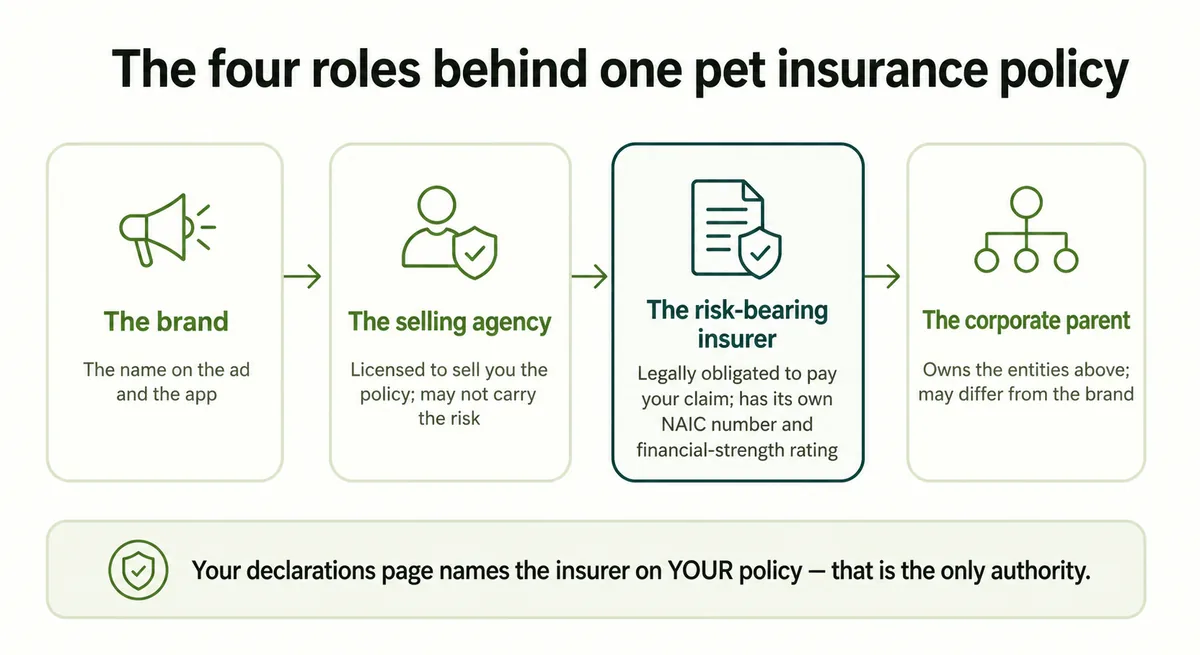
Neither "Pets Best" nor "Lemonade" is the company that pays your claim. Both are brands sitting on top of licensed insurers, and neither publishes a state-by-state map of which insurer you get. Both tell you the same thing: read your declarations page.
Four different roles hide behind one logo. There is the brand you saw advertised, the agency licensed to sell you the policy, the risk-bearing insurer legally obligated to pay — which carries its own NAIC number and its own financial-strength rating — and the corporate parent that owns them. They are frequently not the same company, and the rating you read about belongs to exactly one of them.
| Risk-bearing insurer | NAIC | Domicile | Corporate parent | Financial-strength rating |
|---|---|---|---|---|
| Behind Pets Best — four insurers named on its underwriters & licensing disclosure (stamped "Information Current as of 06/16/2025"); sold by Pets Best Insurance Services, LLC | ||||
| American Pet Insurance Company | 12190 | New York | Trupanion, Inc. (SEC subsidiary exhibit) | Demotech FSR A′ (Unsurpassed), affirmed 6/19/2026 |
| Independence American Insurance Company | 26581 | Delaware | Independence Pet Holdings / JAB | AM Best FSR A− (Excellent), ICR "a−", affirmed 17 December 2025 |
| Independence Pet Insurance Company | 17543 | Delaware | Independence Pet Holdings / JAB | No published rating record located |
| MS Transverse Insurance Company | 21075 | Texas | MS&AD Insurance Group (Mitsui Sumitomo) | AM Best FSR A+ (Superior), ICR "aa", upgraded 20 June 2025 |
| Behind Lemonade's pet policies — two insurers, both wholly owned by Lemonade, Inc. per its FY2025 10-K; sold by Lemonade Insurance Agency, LLC | ||||
| Lemonade Insurance Company | 16023 | New York | Lemonade, Inc. | Demotech FSR A (Exceptional), affirmed 3/23/2026 |
| Metromile Insurance Company | 16187 | Delaware (commercially domiciled in California) | Lemonade, Inc. | NR (Not Rated) by Demotech |
Three details are worth getting right, because they are commonly published wrong. Demotech and AM Best are different agencies on different scales — an AM Best "A−" and a Demotech "A" are not the same measurement, and neither converts into the other. Within Demotech's own scale, American Pet Insurance Company's A′ sits one category above Lemonade Insurance Company's A. And Lemonade holds no AM Best rating at all — its 10-K says so plainly, adding that not having one "may prevent us from expanding our business."
Two things that look like verdicts are not. A missing rating record, as with Independence Pet Insurance Company, is an absence of published information rather than evidence about claims-paying. And the fact that a Pets Best policy issued in New York or Washington may sit on paper from a company owned by Trupanion — a direct competitor — changes nothing about your policy terms; it is simply how the underwriting market is arranged.
How to find your underwriter on your own declarations page
Open the PDF your insurer emailed when the policy was issued — it is usually titled "Declarations" or "Policy Schedule," and it is also in your online account. Near the top you will find a company name that is not the brand name, usually with "Insurance Company" in it and often a NAIC number beside it. That company is the one obligated to pay your claim, and that is the name to check a rating against. If your policy renews and the name changes, your underwriter changed — worth a call to ask what else moved with it.
What a matched quote actually costs
We are not going to print a price comparison here, and the reason matters: both carriers gate their premium behind your personal details, so a genuinely matched quote — same pet, same ZIP, same day, same deductible, same reimbursement percentage, same annual limit, same add-ons — cannot be pulled without submitting a real enrolment. Every published "Pets Best vs Lemonade" price table we could read is either unmatched or undated. An unmatched price table is worse than no price table, because it looks like an answer.
There is a second, more structural reason. The two menus barely overlap. Pets Best's filed form sells annual limits of $2,500, $5,000, $10,000 or no annual limit at all, co-insurance from 50% to 90%, and deductibles from $50 to $2,000 in $50 steps. Lemonade publishes a range — "an annual limit between $5,000 and $100,000" — with deductibles of $100, $250, $500 or $750 and co-insurance of 70%, 80% or 90%. Lemonade does not publish discrete limit tiers, so the five-tier list you will see on review sites is not carrier-confirmed. Pets Best, for its part, advertises a narrower menu than it files, omitting the 50% and 60% co-insurance levels and the $2,500 limit from its shopper page.
So if you want a real comparison, quote both yourself on the same afternoon, and write down all five variables before you look at the monthly number. That is the only method that produces a like-for-like answer.
One instinct worth naming: a cheaper quote at the same reimbursement percentage is not evidence of a worse policy. In the one same-day pair we found an owner post publicly, the cheaper option was rejected specifically for being "suspiciously cheap" — and that pair was not matched anyway, because the deductible and the annual limit both differed. Price differences at identical settings mostly reflect different rating models, not different intentions.
Where the annual-limit menus diverge, and when that starts to matter
Here is the one difference that is genuinely structural: Pets Best sells an uncapped annual limit and Lemonade does not. Lemonade's published ceiling is $100,000.
The annual limit caps what the insurer pays, and both carriers apply the reimbursement percentage before the deductible. So the eligible vet cost at which a ceiling starts to bite is (annual limit + deductible) ÷ reimbursement percentage. Comparing each carrier's top tier, using only settings both actually sell:
| Reimbursement | Deductible | Lemonade's $100,000 ceiling binds at | Pets Best uncapped |
|---|---|---|---|
| 90% | $100 | $111,222 | Never binds |
| 80% | $250 | $125,313 | Never binds |
| 80% | $500 | $125,625 | Never binds |
| 70% | $750 | $143,929 | Never binds |
Read that honestly: the uncapped tier only pays you a dollar more once eligible costs pass roughly $111,000 to $144,000 in a single policy year. For most households the two ceilings are functionally identical, and "unlimited" is worth exactly what it costs — no more. If it is priced the same, take it; if it costs meaningfully more, you are buying protection against a scenario most pets never reach.
The bottom of the ladder is where the maths turns urgent. A $5,000 annual limit at 80% with a $250 deductible is exhausted at $6,563 of eligible cost — a single cruciate repair with complications can cross that inside one year. If you are choosing a limit, that is the number to worry about, not the ceiling.
Waiting periods, and the orthopedic clock that decides it for large breeds
If you have a large-breed dog, this is the section that decides the matchup. The two carriers handle knees in structurally opposite ways, and the gap is five months wide.
Here is what the filed policy forms say — Pets Best's accident-and-illness booklets (§5.A.4) and Lemonade's specimen policy, form LEM-PET (09-23):
| Clock | Pets Best (filed booklets) | Lemonade (specimen policy) |
|---|---|---|
| Accident / injury | 3 days | No accident line in the form at all |
| Illness | 14 days | 14 days |
| Orthopedic (blanket) | No such category exists | 30 days |
| Cruciate ligament | 6 months | Inside the 30-day orthopedic clock |
The mirror image is the interesting part. Pets Best has no orthopedic category — it has a cruciate-only carve-out built through a definition. The word "orthopedic" appears zero times across all 51 booklets. Its definitions section reclassifies cruciate events as medical rather than accidental, so the three-day injury wait can never apply to a torn CCL even when the tear is obviously traumatic; it does the same to intervertebral disc conditions. By elimination, hip and elbow dysplasia, IVDD and luxating patella sit under the ordinary 14-day illness wait — an inference from two provisions rather than a sentence you can point to.
Lemonade has no cruciate carve-out — it has one 30-day clock whose definition swallows everything: bones, muscle, cartilage, tendons, ligaments and joints, naming elbow and hip dysplasia, disc degeneration, patellar luxation and ruptured cranial cruciate ligaments outright. Its FAQ adds the trap worth knowing: signs that appear during those 30 days convert the condition into a pre-existing one.
One complication you should check yourself. Pets Best's own state pages now publish a shorter, model-act-style schedule — 0 days accident, 14 days illness, 30 days orthopedic — in twelve jurisdictions (CA, DE, LA, MD, ME, MS, NE, NH, OH, PA, VT, WA), each with its own dated cutover, plus a hybrid in North Dakota. The filed booklets for those same states still print 3 days and 6 months. We are reporting two of the carrier's own documents that disagree, not alleging anything about either. Every booklet defers to the same authority anyway: "Please refer to your declaration page for your Pet's specific Waiting Period." Read yours.
Can either waiting period be waived? Exam window, deadline, and what a waiver does not do
Both carriers offer a route out, and no competitor page we could read explains either one.
Pets Best publishes a downloadable Waiting Period Health Assessment Form (03/2025). A vet exam must fall between 3 days before and 7 days after your policy's effective date, and the form must be submitted within 30 calendar days of that exam. If granted, coverage starts the later of your effective date or the day after the exam. The form's grid asks the vet to mark twenty condition classes confirmed, possible, or no — with dedicated lines for knee and ligament conditions and for IVDD, and "possible" defined as signs without a diagnosis.
Lemonade's waiver lives in the contract rather than a form: waiting periods "may be waived upon the completion of a comprehensive medical examination by a vet," submitted within 2 days of the exam. The exam itself is not covered by the policy.
Now the part that matters most, and which both carriers state plainly in their own words. A waiver shortens the clock; it does not give you a clean slate. The Pets Best form says outright that it "does not alter the pre-existing conditions exclusion," and Lemonade warns that "any conditions found during this exam may be considered a pre-existing condition." So a thorough exam can simultaneously start your coverage sooner and document the exact problem that will later be excluded. That is not a reason to skip the exam — your pet should get the care either way — but it is a reason to understand what you are trading.
Claims: decision speed vs payment speed
A claim has two clocks: how long until someone decides whether you are covered, and how long until money reaches your account. These two brands publish opposite halves.
Lemonade advertises decision and handling speed but publishes no guaranteed funds-arrival deadline — its figures describe how often claims are handled fast, not when money is committed to land. Pets Best publishes payment windows and no decision timeframe, saying only that it "strives to process claims as quickly as possible." Pets Best's clock starts roughly where Lemonade's ends, so the two numbers cannot be raced against each other.
| Published figure | What it measures | Scope / denominator | Data window |
|---|---|---|---|
| Lemonade — 96% automated | First notice of loss intake only, not coverage decisions | Company-wide: renters, home, pet, car, life | None disclosed |
| Lemonade — ~55% automated | Claims "automated… instant or near-instant" | Company-wide, not pet | As of 31 Dec 2025 |
| Lemonade — 50% paid instantly | Instant payment | Pet, but "eligible claims" is undefined | None disclosed |
| Lemonade — 50% / 80% in 5 days | Handling | Pet claims | None disclosed |
| Pets Best — 5–7 days to bank, 3–5 to CareCredit | Payment only, after a decision | Reimbursement method | Jan–Dec 2024 |
Two things follow. "Lemonade automates 55% of pet claims" is not a supported statement — that figure is company-wide across every line it writes. And Lemonade's own SEC filing is softer than its marketing: where the consumer page says 50% of eligible claims are paid instantly, the 10-K says a "meaningful portion" of standard pet claims are paid almost instantly and that "in many cases the incident is also reviewed by a human." Pets Best publishes no claims-automation percentage anywhere — a documented absence, not something we failed to find.
One note on the fastest Pets Best route: 3–5 days lands on a CareCredit card versus 5–7 to a bank account. CareCredit is a Synchrony credit product, so the quickest cash path runs through a credit card you would have to open.
What happens when the insurer asks for medical records
Both filed forms make complete records a precondition of processing a claim, so framing this as a Lemonade-only burden gets it wrong. Lemonade's form requires "all available medical records" and your cooperation in obtaining them; Pets Best's §7.D claims materially the same authority. The one real difference is the remedy: Pets Best says it "may deny your claim(s)" if you cannot or will not produce a complete history, while Lemonade says it "may not be able to process claims."
Lemonade's FAQ adds a bound — records covering roughly the last 12½ months — and is explicit that this gate sits ahead of payment, not enrolment: records "aren't required to sign-up for a policy… but we need to have records on file in order to repay claims." Pets Best names one claim type that routes to a records check by rule: periodontal claims need proof of a cleaning under general anaesthesia within the last 13 months.
Approved but not paid — the third outcome
Most comparisons treat a claim as approved or denied. There is a third state worth planning for: approved, and the money has not arrived. A published decision-speed figure describes adjudication, not a payment deadline. Treat any "instant" or "5–7 days" number as one stage under normal conditions — and if a decision has landed but the funds have not, chase that as a payments problem, separately from the coverage question.
What you still front at the vet counter
Here is the part readers most often get wrong, because they import the human-health model: there is no network, no copay at the desk, and no card to hand over. Neither product pays at the point of sale.
Lemonade: no. It says so itself — "very few insurers pay vets directly, and Lemonade is no exception" — and its vet-facing page presents that as a feature: the client pays the clinic, exactly as they always have. Its filed form permits assignment, but only with the insurer's agreement — a contractual possibility rather than an offered service.
Pets Best: only partly, and not at checkout. Its Vet Direct Pay sends the eligible reimbursement to your clinic after the claim is processed, so the clinic is agreeing to wait, and a signed release from both you and the vet is required. You still owe the deductible, the coinsurance and anything uncovered. It is also an operational programme rather than a term of the base filed policy: §8.A says plainly that "you are financially responsible to your Veterinarian for the payment of all fees and costs." In California it is a contract right on request: the California booklet says payments go to you "unless we receive a written notice from you requesting that such payment be made directly to the veterinary provider listed on the Claim."
Either way: budget to front the entire bill, and treat a faster arrangement as a bonus your clinic has to agree to.
Pre-existing conditions, and whether a resolved condition can ever come back
You already know the hard part: it is signs and symptoms that bind you, not a diagnosis. Both carriers write it that way. What surprises most readers is that the definitions are nearly identical — the definition is not the differentiator; the machinery around it is.
Both forms track NAIC Model Act #633 closely, down to the same policyholder-favourable closing line: a condition covered on a policy cannot be treated as pre-existing on any renewal. Both also run the test through the waiting period, not merely up to your start date. That second point has teeth: a knee problem that surfaces during Pets Best's six-month cruciate clock is excluded permanently.
The real differences sit in two places — how far back the insurer may look, and whether a resolved condition can ever come back into coverage.
| Lookback window | Route back into coverage | |
|---|---|---|
| Lemonade (all states) | None stated — reaches your pet's entire history before the start date | "Cured": resolved with no recurrent signs, symptoms or treatment for 12 consecutive months |
| Pets Best — form IAIC-PB10001-ILL (48 jurisdictions) | None stated — unbounded | No pathway exists in the form |
| Pets Best — California (form ed. 02/2023), New York and Washington (ed. 12/2015) booklets | 18 months, explicit | No pathway exists in the form |
So "what is Pets Best's lookback?" has no single answer — it depends which form your state puts on your policy. And even the bounded 18-month version carves out three categories and applies an unlimited lookback to them: chronic conditions, bilateral conditions, and intervertebral disc conditions. (Only the California booklet carrying that language is a current edition — 02/2023. The New York and Washington versions are edition 12/2015, so treat those as historical and check your own declarations page.)
Pets Best also treats a condition as "Present" if it is in remission or controlled by medication — "whether or not the Condition is noted in your Pet's medical records." Lemonade reaches similar territory through "Cured": ongoing medication, or even a prescription diet, stops the 12-month clock.
Lemonade's carve-outs are built into the definitions rather than listed as exclusions. "Cured" applies only to a temporary condition or injury, while bilateral, congenital, hereditary and behavioural conditions are each defined as chronic — and a chronic condition is one that "can be treated or managed, but cannot be cured." That is a definitional lockout. One precision worth having: the widely repeated line that knee and ligament conditions can never be cured is Lemonade's explainer wording, not its filed form. The form's "Cured" definition contains no knee or ligament carve-out. The marketing is narrower than the contract.
The claim Pets Best makes that its forms do not
Here is the discrepancy worth knowing before you buy. Pets Best's coverage page says that "once healed or cured, these conditions are no longer considered pre-existing by Pets Best and can be covered by your plan should they reoccur" — and publishes lists of curable conditions (broken bones, lacerations, sprains, upper respiratory infections, dental fractures, pyometra) and incurable ones (cancer, diabetes, allergies, heart disease, arthritis, hip dysplasia).
No day count appears on that page, and no cured pathway appears in any Pets Best filed form we searched. A full-text search across its Alabama, Missouri, California and New York booklets returns exactly one use of the word — inside the definition of a chronic condition — and no re-qualification clause of any kind. A 180-day figure does circulate online; the only "180 days" in the filed forms is the deadline for filing a claim, and the one Pets Best document that mentions 180 days in this context is a 2024 blog post that hedges it with "might."
Four Pets Best-owned sources, four different answers: a pathway with no number, a hedged blog figure, silence in the FAQ, and no pathway in the forms. The form governs, so we are not printing a month count for Pets Best — it does not publish one. If a resolved condition matters to your decision, get a written coverage determination naming it before you enrol, and keep it. Lemonade is the cleaner case: form, FAQ and explainer all agree on 12 months.
Already have one of these policies? What switching does
There is a claim circulating — including from a practising vet advising owners publicly — that switching pet insurers is effectively pointless because no carrier will take your pet's existing conditions. That is half right, and the half it gets wrong is the half that decides whether you should switch.
The accurate version: a new carrier will exclude anything that meets its own pre-existing definition, and for chronic conditions that exclusion is effectively permanent. But it is the policy's definition that binds, not the mere existence of a note in the chart — and, as below, one of these two carriers does let a genuinely resolved condition requalify. But waiting periods are a separate mechanism, and one of these two will credit time you already served elsewhere. Nobody tells buyers this, including the carrier that offers it.
Pets Best → Lemonade
- Every condition in your pet's record is pre-existing from day one. Lemonade states no lookback limit, so its reach is your pet's whole history.
- Waiting periods reset in full — 14 days illness, 30 days orthopedic. Lemonade says so plainly: switching providers "generally reset the waiting periods… even if your pet was previously covered under another policy."
- Non-chronic conditions that genuinely resolve can come back into coverage after 12 consecutive clean months under its "Cured" test.
- Chronic, bilateral, congenital, hereditary and behavioural conditions are defined as incurable, so they never requalify. Lemonade's explainer adds knee and ligament conditions to that list, though its filed form does not.
- Anything that surfaces during the new waiting periods becomes permanently pre-existing.
Lemonade → Pets Best
- The pre-existing exclusion is genuinely permanent — as covered above, no cured pathway exists in any Pets Best filed form.
- Waiting periods on arrival: 14 days illness, 3 days injury, 6 months cruciate.
- But there is a contractual route back, and it is the most decision-relevant clause in this matchup. §5.A.5 of the Pets Best filed booklet — present in every state booklet we checked — says the company “may waive or reduce” waiting periods “at our discretion,” including for policies renewed without interruption, "including at our discretion when coverage was provided by another pet insurance provider." The same right appears in Washington's state-filed statutory disclosure.
That clause cuts both ways. The six-month cruciate wait is expressly waivable for a switcher — so the common claim that a Lemonade policyholder has no way back is wrong. But it says "at our discretion," with no published criteria, form or timeline. Get it answered in writing before you cancel anything; do not count on it.
The counter-asymmetry is worth stating plainly: Pets Best has a discretionary prior-carrier waiting-period credit written into its filed form and into a state-filed disclosure. Lemonade's form has none — its only waiver route is the vet exam, and its consumer page says switching resets its clocks. Pets Best's own FAQ never mentions the provision, which is precisely why no buyer knows it exists.
When the honest answer is "don't switch"
If your pet has an active chronic condition — arthritis, allergies, diabetes, heart or kidney disease — switching moves that condition from "covered under your current policy" to "excluded forever." No cured pathway reaches it at either carrier. Unless your current policy is unusable for some other reason, staying put is almost certainly the better decision, even if the new quote is cheaper. The saving is real; so is the coverage you are giving up.
If your record holds only temporary, long-resolved conditions, the calculation changes. Lemonade's specimen policy defines a cured condition as one “resolved without recurrent signs, symptoms, or continued treatment for at least 12 consecutive months” — it does not say those months must fall after you enrol, so a condition already quiet for a year may qualify at the point of sale. That is worth asking about in writing before you buy, because the answer decides whether you are covered now or waiting.
One mechanical trap regardless of direction: neither carrier can transfer a policy to a new owner. A Lemonade policy has to be cancelled and repurchased — which, by the form's own "original start date" logic, resets both the waiting periods and the pre-existing cut-off.
Changing your plan later: what's reversible and what isn't
Ranking pages tend to say plan changes are simply reversible at both carriers. The filed forms say something more specific, and the difference can cost you a covered knee.
| Pets Best | Lemonade | |
|---|---|---|
| Reduce coverage | Any time | Any time in most states — not New Hampshire or California |
| Raise reimbursement % or lower deductible | Renewal date only, subject to underwriting | First 14 days of the policy period, or before renewal — subject to underwriting approval |
| Add a supplemental benefit or raise the annual limit | Requires cancelling and reissuing the policy | Same timing gate as above; no reissue |
| Effect on waiting periods | A reissue means "new Waiting Periods, new Policy Effective Dates" | Never reset — they run from your original start date unless coverage lapses |
That third row is the one to sit with. At Pets Best, raising your annual limit is not an adjustment — it is a new policy, and a new policy restarts every clock from section 4 above: 14 days for illness, 3 for injury, and six months again for cruciate ligaments. The pre-existing screen also re-runs against the new effective date. Its California booklet spells out the consequence: if your pet is showing signs of a condition when you request the change, or during the new waiting period, that condition is pre-existing to the new policy and related claims will be denied.
So the owner who decides mid-year that a $5,000 limit looks thin — exactly the conclusion the arithmetic above invites — can buy a bigger limit and simultaneously reopen a six-month window in which a torn CCL is not covered. Do that at renewal if you can, and get the timing confirmed in writing.
One caution on Pets Best's own materials: its FAQ says you can adjust deductible, reimbursement, limit and supplemental benefits "at any time." Its filed form says premium-increasing upgrades are renewal-only and a limit increase forces a reissue. The form governs, and only downgrades are genuinely at-will. The form also leaves one question open that we cannot answer for you — §5.A.5 waives already-served waiting periods for policies "renewed without interruption," while §4.A.2 says new policies get new waiting periods, and nothing states which applies to a same-day cancel-and-reissue. Ask before you change anything.
Lemonade's trade is the mirror image: your clocks never restart, but you can only change coverage inside two windows, and there is a one-way ratchet worth knowing — reduce your coverage and you may not be able to raise it back later. A preventative package also cannot be removed once you have claimed on it. Pets Best has its own version of that ratchet: downgrade at any time, but its California booklet warns that "your future claims will be held to the new lower benefit level."
Will your premium jump at renewal?
Probably, at some point — and it is worth separating the two questions underneath that, because owners usually ask them as one.
"Did my claim cause this?" Both carriers say no, and both say it in a filed disclosure rather than a marketing page. Pets Best's filed form commits that "your premium will not change based on your Pet's individual claims experience." Lemonade's filed insurer disclosure reads: "Policy premium and coverage may change based on address and pet age. Premiums will not be affected due to claims history," and its renewals page repeats it.
Neither carrier deserves credit for that as a differentiator, though — the NAIC Pet Insurance Model Act contains that requirement, which is why the two statements read almost identically. A model act is a template rather than law in itself — it binds only where a state adopts it — so what actually holds these carriers to it is their own filed policy language. It is a genuine symmetry, contractually committed on both sides.
"Then why did it go up?" Two factors both carriers expressly disclose are your pet's age and where you live — not an exhaustive list. Pets Best's California booklet also names your own coverage choices (annual limit, deductible, co-insurance) as things that change the premium, and carriers revise rates book-wide as well. Pets Best asks to be told about an address change within 30 days and gives at least 30 days' notice of a premium change; Lemonade adds the honest version of the geography point — move somewhere with pricier veterinary care and your rate can follow it.
Underneath both sits the thing neither carrier controls: veterinary costs rise every year, and your pet gets older every year. Those two move together, which is why a renewal can climb sharply without anyone having flagged your file.
We are not going to give you an average increase, and we would treat any article that does with suspicion. In the owner accounts we reviewed, renewals for the same carrier ranged from a rise of under $100 across a year that included two major surgeries, to a jump from about $69 to over $90 a month for a six-year-old dog with one old claim. Those are individual reports, not a distribution — the honest summary is that the mechanism is knowable and the number is not. We are also not publishing rate-change percentages for either brand: we could not obtain the underlying state filings, and a percentage without its filing is not a fact.
One more thing, because it comes up in every renewal thread: it is natural to read a steep increase as an insurer quietly trying to push an ageing pet off the books. The filed disclosures point somewhere less personal — age-banding and local cost inflation applied across a book, not a decision about your animal. That does not make the bill smaller, and your frustration is reasonable. But it does change what to do about it: plan for the curve rather than for a flat premium. Assume the cost of insuring a senior pet is meaningfully higher than the puppy or kitten quote you started on, and check your renewal notice each year against what the coverage is actually worth to you now.
Where each brand is sold, and what happens if you move
Pets Best publishes policy documents for all 50 states and DC — 51 jurisdiction panels on its waiting-periods page and 51 sample booklets, one per jurisdiction. That is documentary coverage rather than a promise of current new-business availability everywhere, so confirm with a quote for your own state.
Lemonade does not, and its own pages disagree about where. Its FAQ enumerates 41 states plus DC. Its state index lists 40 plus DC — dropping Louisiana. Chewy's CarePlus configuration, which sells a Lemonade-underwritten product, lists 41 plus DC but includes Maine and omits Hawaii, disagreeing with Lemonade's own list in both directions.
We are not going to average those into a single tidy number. Per Lemonade's own FAQ enumeration, the states where it does not sell pet insurance are Alaska, Idaho, Kansas, Kentucky, Maine, South Dakota, Vermont, West Virginia and Wyoming — but if you live in Louisiana, Maine or Hawaii, check directly before you rely on any of it.
One trap worth flagging: Lemonade's SEC filing says it is licensed in all 50 states and DC and operates in 41 plus DC. That 41 is a union across renters, homeowners, pet and/or car — not a pet-line count. It happens to match the pet number, which makes it easy to cite for the wrong reason.
What a move does to your policy
Lemonade: if you move to a state where it does not write, the policy ends. Its own wording: "you will need to cancel your policy, and we'll issue you any applicable refund." Because a Lemonade pet policy also cannot be transferred, the only route back — if you later move somewhere it does serve — is a brand-new policy, with fresh waiting periods and a fresh pre-existing cut-off. For an older pet, that is effectively the end of meaningful coverage.
Pets Best: because it publishes documents for every US jurisdiction, a move is far more likely to be a repricing than a cliff. Its form requires you to notify it within 30 days of an address change and says your premium may change as a result. Confirm what else moves with you — the governing state form can differ.
Travel is a separate question from moving. Lemonade covers treatment at any licensed vet in the US while you are away from home, but not outside the country.
If you expect to relocate — military, academic, or simply likely — this asymmetry deserves more weight than the price difference.
Who each one is actually for
There is no winner here, and a page that names one is telling you about its own incentives rather than your pet. What there is, once you strip out the marketing, is a handful of mechanics that decide the answer — and they point in different directions depending on who you are.
A new puppy or kitten with a clean record
The best position anyone can buy from, and timing matters more than brand — every mechanic above gets easier when the record is empty. On the clocks alone Lemonade starts faster: no accident waiting period in its form and a 30-day orthopedic clock, against Pets Best's 3-day accident wait and six months on cruciate ligaments. That is a real advantage for a young dog about to spend six months being reckless.
Be honest about the limits of that, though. The only same-day, both-brand quote comparison we could find publicly ended with the owner buying neither. Get both quotes yourself at matched settings, and let the clocks break the tie rather than the price.
An adult or senior pet you are moving from another carrier
Read the switching section above first, because the honest answer is often don't: if your pet has an active chronic condition, switching converts it from covered to permanently excluded at either brand.
If the record is clean enough to move, the two solve different halves of the problem. Pets Best is the only one whose form lets it waive, at its discretion, waiting periods you already served with a previous insurer — unpublished criteria, but it exists and Lemonade has nothing equivalent. Lemonade is the only one offering a route back into coverage for a condition that genuinely resolves: 12 clean months and it can be claimed again.
So: switching for continuity, ask Pets Best about the credit in writing. Switching with old, resolved conditions you would like covered one day, Lemonade is the only one offering a door.
A large-breed dog, or any dog at orthopedic risk
Lemonade, on the waiting periods — in most of the country. Its single 30-day orthopedic clock covers cruciate ligaments, hips, elbows, discs and patellas; the Pets Best booklets run six months on cruciate events specifically. For a Labrador, a Rottweiler or a shepherd, that is five months of exposure on the most likely expensive claim — and at Pets Best, raising your annual limit later forces a reissue that restarts the clock.
One caveat that matters: as noted above, Pets Best's own state pages show a shorter 30-day orthopedic schedule in twelve jurisdictions, where this gap largely closes. Check your state's schedule on your declarations page before treating this as decisive.
A multi-pet household
We are not going to manufacture a verdict, because the evidence does not support one. Each pet is its own policy at both brands, with its own deductible and annual limit — three pets means three separate deductibles to satisfy, not one shared pool. That arithmetic matters more than any discount percentage, and it is identical at both. Across every owner discussion we reviewed, not one person raised a multi-pet discount at either brand — which tells you it rarely drives the decision, not whether a discount exists. Check current terms in your own quote.
Decide this one on the other five situations, applied to whichever animal is most likely to need the policy. Cat households should note the orthopedic gap matters much less, which pushes the decision back onto limits and cash flow.
If you could not front a four-figure vet bill tomorrow
Start by knowing that neither product solves this. Neither pays at the counter; both expect you to pay the hospital and be reimbursed afterwards.
The narrow edge goes to Pets Best, conditionally: Vet Direct Pay can send your reimbursement to the clinic instead of to you — if your clinic agrees to wait and signs the release. Lemonade offers nothing comparable and says so plainly.
If this is your binding constraint, treat insurance and liquidity as two separate problems, and sort out a financing route or an emergency reserve regardless of which policy you buy.
If your worst fear is a genuinely catastrophic year
Pets Best, because it is the only one of the two selling an uncapped annual limit. Lemonade stops at $100,000.
Hold that lightly, though: at matched settings Lemonade's ceiling does not bind until eligible costs pass roughly $111,000 to $144,000 in one policy year. Below that the two are equivalent, and "unlimited" is worth precisely what it costs — take it if it prices the same, walk past it if it does not. What you would trade for it is the six-month cruciate wait and the reissue trap, which for a large-breed dog is a poor swap.
Frequently Asked Questions
Does switching pet insurance reset the waiting periods?
Usually yes. Lemonade states plainly that switching providers resets its waiting periods even if your pet was covered elsewhere. Pets Best is the exception worth knowing: the booklets we checked let it waive already-served waiting periods when coverage came from another insurer — but the clause says "may waive or reduce… at our discretion," with no published criteria, so it is a question to get answered in writing before you cancel anything, not a credit you can rely on.
Which has the longer waiting period for knees and cruciate ligaments?
Pets Best, by five months. Its filed booklets apply a six-month wait to cruciate ligament events, and its definitions reclassify those as medical rather than accidental so the three-day injury clock never applies. Lemonade runs a single 30-day orthopedic clock covering cruciate, hips, elbows, discs and patellas.
Does either one pay the vet directly?
Neither pays at the counter. Lemonade says so outright — you pay the bill and are reimbursed. Pets Best offers Vet Direct Pay, which sends your reimbursement to the clinic after the claim is decided, and only if your vet agrees to wait and signs a release. In California, direct payment is a contractual right on request.
Can a pre-existing condition ever be covered again?
At Lemonade, sometimes: a condition it classes as temporary can be claimed again after 12 consecutive months with no signs, symptoms or treatment. Chronic, bilateral, congenital, hereditary and behavioural conditions are defined as incurable and never requalify. Pets Best's coverage page describes a similar idea, but no cured pathway appears in any of its filed policy forms — ask for a written determination.
Which is better for an older pet?
Often neither — staying with your current insurer usually beats switching, because anything already in the record becomes permanently excluded at a new carrier. If you must move and the old conditions have genuinely resolved, Lemonade is the only one of the two offering a route back into coverage. If you simply want continuity, ask Pets Best about its cross-carrier waiting-period credit.
Is Lemonade pet insurance accepted by all vets?
There is no network to be accepted by. Both brands reimburse you rather than billing the clinic, so you can use either at any licensed vet in the United States — no pre-authorisation, no in-network list. Lemonade covers treatment anywhere in the US while you travel, but not outside the country.
How trustworthy is Lemonade pet insurance?
Judge the insurer, not the brand. Lemonade Insurance Company carries a Demotech Financial Stability Rating of A (Exceptional), affirmed in March 2026, and holds no AM Best rating — its own 10-K says it does not intend to seek one. Metromile Insurance Company, which also underwrites Lemonade pet policies, is Not Rated by Demotech. Your declarations page names which one is on your policy.
Is Lemonade cheaper than Pets Best?
We cannot answer that honestly with a published table, and we would distrust one that tried. Both carriers gate premiums behind personal details, and their deductible, reimbursement and annual-limit menus barely overlap — so most published comparisons are not comparing the same policy. Quote both yourself on the same day at matched settings, and write down all five variables before looking at the monthly price.
Sources
- Pets Best sample policy booklet, South Dakota (form IAIC-PB10001-ILL) — Pets Best
- Download a sample policy (state booklet library) — Pets Best
- What are the waiting periods? — Pets Best
- Vet Direct Pay — Pets Best
- Pet insurance terms explained — Lemonade
- Pet insurance deductible — Lemonade
- Pet insurance waiting periods — Lemonade
- Lemonade Pet Insurance sample policy, form LEM-PET (09-23) — Lemonade (carrier-authored; third-party host)
- How to file a pet insurance claim — Lemonade
- Lemonade Pet Insurance FAQ — Lemonade
- Lemonade pet insurance by state — Lemonade
- Underwriters & Licensing — Pets Best
- Trupanion, Inc. FY2025 Exhibit 21.1 — Subsidiaries of the Registrant — U.S. Securities and Exchange Commission
- American Pet Insurance Company (NAIC 12190) — Financial Stability Rating — Demotech, Inc.
- AM Best Removes From Under Review and Affirms Credit Ratings of Independence American Insurance Company — AM Best (via Business Wire)
- AM Best Upgrades Credit Ratings of MS Transverse Insurance Group Members — AM Best
- Lemonade, Inc. FY2025 Form 10-K — U.S. Securities and Exchange Commission
- Rating Information Disclosure Form — Lemonade Insurance Company (NAIC 16023) — Demotech, Inc.
- Metromile Insurance Company (NAIC 16187) — Financial Stability Rating — Demotech, Inc.
- Financial Stability Ratings — Definitions — Demotech, Inc.
- Waiting Period Health Assessment Form (03/2025) — Pets Best
- How long does it take to process a claim? — Pets Best
- The reimbursement model, explained — Lemonade
- Pre-existing condition coverage — Pets Best
- Pet insurance and pre-existing conditions — Lemonade
- Pets Best policy booklet (California sample) — 18-month lookback, form IAIC-PBI0001-ILL — Pets Best
- Notice to Washington Residents — insurer disclosure of important policy provisions — Pets Best
- Lemonade pet insurance renewals — Lemonade
- NAIC Pet Insurance Model Act #633 — National Association of Insurance Commissioners