
Pet insurance for a one-year-old dog in Colorado averages about $61 a month across twelve carriers at a $10,000 annual limit, a $500 deductible and 90% reimbursement — and about $34 for a cat. Moving to an unlimited limit takes those to roughly $83 and $46.
Those are quotes for Parker, southeast of Denver — a sample, not a statewide average. Your own number moves with your pet's age and those three settings far more than with your ZIP code.
Two things on this page are not on the pages ranking above it. The first: Colorado has no pet-specific insurance law. Sixteen states have adopted the insurance regulators' Pet Insurance Model Act. Colorado's line on that chart reads "NO CURRENT ACTIVITY", and the state's official 1,112-page insurance code contains the word "pet" zero times. Colorado's general insurance law still reaches your claim — none of it was written with a pet in mind.
The second is what happens at the counter. Colorado State University's veterinary teaching hospital — the only one in the state — wants 80% of the low-end estimate before any service over $250, and does not offer payment plans. Reimbursement comes afterwards, if the condition is covered.
Table of Contents
- How much pet insurance costs in Colorado
- Is Colorado actually an expensive state?
- What Colorado vet care and emergencies actually cost
- Paying before you're reimbursed
- What Colorado law gives you — and what it doesn't
- Why premiums jump at renewal
- Can an insurer refuse an older pet?
- Best pet insurance in Colorado by situation
- Provider comparison
- Pre-existing conditions and waiting periods here
- Free and low-cost help in Colorado
- Frequently Asked Questions
- Sources
How much pet insurance costs in Colorado
Age moves the price here more than anything else you can control. At identical settings, U.S. News puts a one-year-old dog at $60.75 a month and a six-year-old at $94.46 — a 55% jump for nothing but five birthdays. Its full grid, at a $500 deductible and 90% reimbursement:
| Annual limit | Dog, age 1 | Dog, age 6 | Cat, age 1 | Cat, age 6 |
|---|---|---|---|---|
| $10,000 | $60.75 | $94.46 | $33.95 | $48.75 |
| Unlimited | $83.01 | $139.92 | $46.44 | $73.15 |
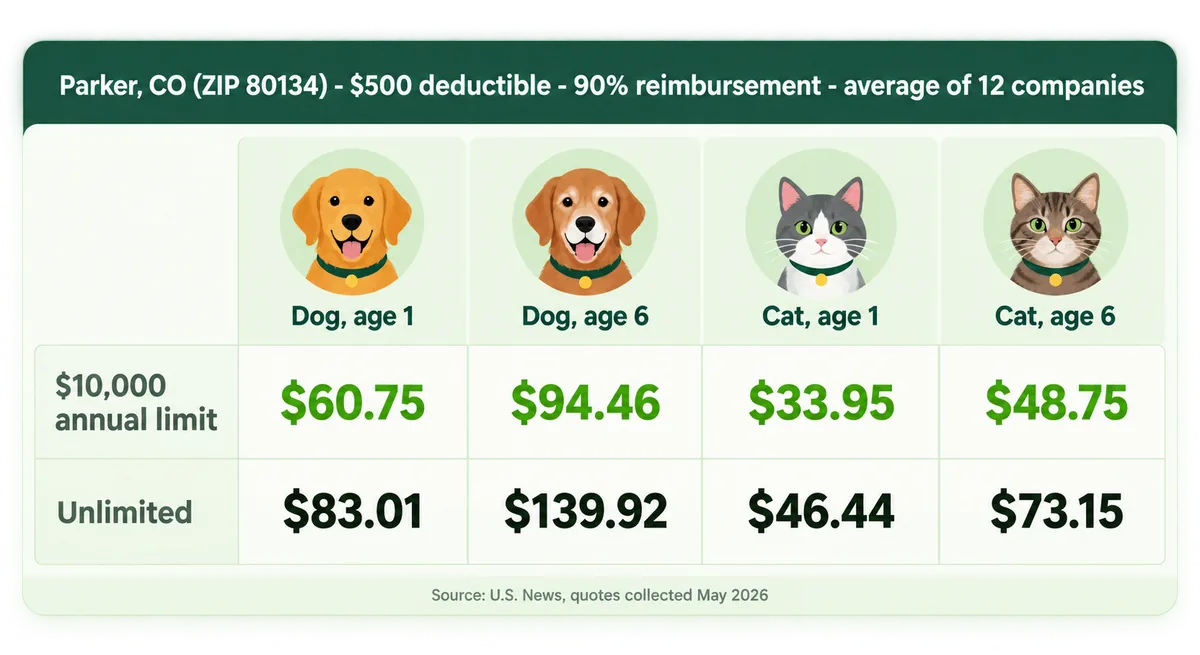
Those quotes were priced in Parker — ZIP 80134, a Douglas County exurb about 25 miles southeast of Denver. Not Denver, and not a statewide average. U.S. News is unusually open about its method — 4,896 quotes from twelve companies, collected in May 2026, though a few carriers were priced at substituted limits.
Three settings drive every figure here. The annual limit is the most a policy will pay out in a year. The deductible is the amount you absorb yourself. The reimbursement percentage is the share the insurer pays. Carriers do not all apply those last two in the same order, and a deductible can reset every year or attach once per condition — both change what lands in your account on an identical bill. The waiting-periods section below works it out. Lifting the limit from $10,000 to unlimited adds about $22 a month on that one-year-old dog, and $45 on the six-year-old.
Other publishers quote Colorado at other settings, and the settings explain most of the gap between them:
- $77 dog / $40 cat — a six-year-old Labrador and a seven-year-old Ragdoll at $5,000 / $500 / 80% (MoneyGeek, updated 3 August 2026).
- $63.23 dog / $32.71 cat — five-year-old pets at an unlimited annual limit, $500 deductible and 80% reimbursement (Pawlicy Advisor).
- $42 dog / $22 cat — one carrier's own averages at a $10,000 limit, $300 deductible and 80% reimbursement, for the year to 30 June 2025 — though the page never says the underlying sample is Colorado-only (Fetch).
For scale, the pet-insurance industry association NAPHIA, in its 2026 report, covering 2025, puts the national accident-and-illness average at $836 a year for dogs — about $70 a month — and $435 for cats, about $36.
So before you set one quote beside another, write down what made it. The three plan settings: limit, deductible, reimbursement. And the pet and place it was priced for: species, age, breed, ZIP code. Two "Colorado averages" that differ by 80% are usually not disagreeing about Colorado at all. Be warier still of any table that changes breed, age and ZIP code between its rows: that is a list of six different pets, not a map of what your town costs. For how each setting moves the number, see our guide to what pet insurance costs.
Is Colorado actually an expensive state?
It depends entirely on which instrument you use — and the answers that put a number on it run from about 7% above the national average to about 25% above.
Start with the whole book. The industry association's 2026 report puts Colorado tenth nationally, at 3.0% of all US insured pets and 3.2% of gross written premium. Those two shares do not match, and the gap is the signal: carrying 3.2% of the premium on 3.0% of the pets works out at roughly 6.7% above the national average per insured pet — our arithmetic on published shares, not a figure the report prints. Both shares are rounded, and they describe association members' book rather than the whole US market.
Colorado's own regulator counts a different pool. The Division of Insurance's statutory filings put the state's pet line at $171,821,989 of written premium in the year to 31 December 2025 — every insurer reporting Colorado pet business, and every product written on that line, not just the accident-and-illness policies most people shop for. That is a complete state tally, not a slice of the association's book, so dividing it by NAPHIA's pet count would put one population's money over another's animals. Same state, two measurements, two different questions.
MoneyGeek lands much higher, modeling Colorado 25–26% above national and ranking it 48th of 50 for affordability. But that is a standardized-profile model — a six-year-old Labrador and a seven-year-old Ragdoll at a fixed $5,000 limit, $500 deductible and 80% reimbursement — and MoneyGeek says as much, calling its figures modeled benchmarks rather than quotes.
Do not split the difference. An aggregate of every in-force policy, a statutory premium filing and a model of two particular pets are three different measurements. Averaging them produces a number that describes nothing.
Whichever pool you count, Colorado buys a lot of pet insurance. That 3.0% of America's insured pets live in a state holding about 1.8% of its people — roughly 1.7 times over-indexed, again our own arithmetic.
What Colorado vet care and emergencies actually cost
Colorado has exactly one veterinary teaching hospital — Colorado State University's, in Fort Collins — and it publishes its prices, which almost nothing else in the state does. That makes it the best window available into what serious care here actually costs.
Here is what it publishes. The visit fees are the door charge, before a single test; dentistry is the bill most owners meet first.
| Item | Published price | Status |
|---|---|---|
| Emergency visit fee, dogs and cats | $175 | Live |
| Emergency visit fee, exotic pets | $250 | Live |
| Environmental cleaning and safety fee, each visit | $15 | Live |
| Dentistry consultation / recheck | $237 / $93 | Live |
| Teeth cleaning | from $2,050 | Live |
| Extractions | from $2,678 | Live |
| Root canal | from $3,090 | Live |
| Jaw fracture or maxillofacial trauma | from $4,120 | Live |
| Cruciate repair (TPLO) | $4,500 | Archived October 2025 |
| Total hip replacement | $8,800 | Archived October 2025 |
The dentistry prices are minimums, not averages — but they are all-in, covering lab work, anesthesia, imaging, the procedure itself, take-home medication and recovery. The two orthopedic figures are the ones to handle with care: CSU no longer publishes orthopedic prices and quotes individually now, so read them as a last known marker rather than today's rate.
One thing worth knowing before you assume the university is the cheap option: it isn't, and it says so. CSU states it is regulated by a state "fair competition" clause and that its fees are "comparable to those of regional specialty private clinics." Referral-level care costs referral-level money wherever in Colorado you get it.
Paying before you're reimbursed
Here is the part that catches people out: pet insurance reimburses you. It does not, in the ordinary case, pay your vet. So the first question is not which policy to buy — it is whether you could put the bill on a card this afternoon and wait.
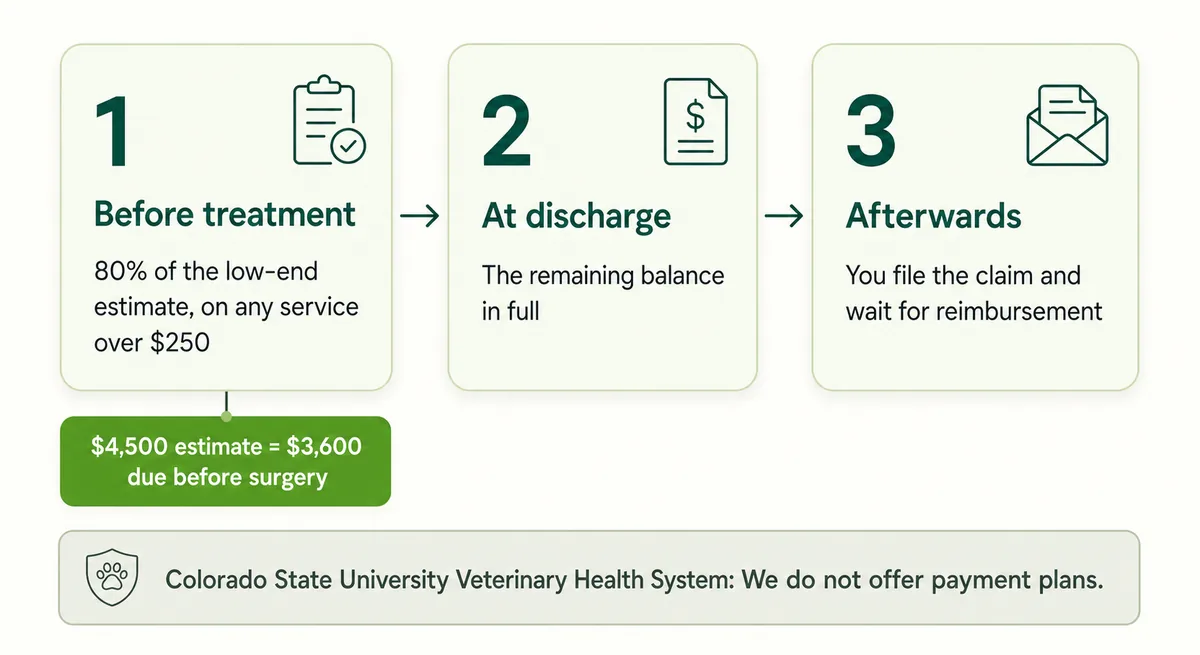
Colorado's teaching hospital is blunt about it. CSU's payment policy reads: "Payment is required at the time of service. 80% of the low-end estimate is due prior to any services being provided over $250, and final payment is due at the time of discharge." And, in the same breath: "We do not offer payment plans; speak to your veterinarian about financial hardships you may experience paying for services."
Read those two sentences together and the shape of the problem appears. The deposit is a share of the low end of the estimate, and the trigger is any service over $250 — not just surgery. CSU's archived orthopedic page (October 2025) puts the surgical version plainly: a deposit of "80% of the estimate prior to surgery," balance at discharge. The estimate is the one written for your pet after its consultation, not a list price. On one the size of the $4,500 cruciate repair CSU last published, 80% is roughly $3,600 on the counter before the operation — and that figure left out pre-operative screening, go-home medication and a $300 large-breed surcharge, so a real estimate runs higher. Your insurer's share arrives weeks later, if the condition is covered at all.
Two details worth knowing. The bill is not final at discharge — CSU can revise charges for up to seven days afterwards. And it accepts CareCredit — a credit card, not a payment plan; the balance is simply owed to someone else.
One lever changes that sequence, with a condition attached. Trupanion advertises that "up to 90% of your vet bill can be paid right at checkout," adding that "even if your vet doesn't have our software, nearly 2 out of 3 invoices are processed in less than 24 hours." The condition sits in the fine print at the foot of that page: the software has to be running at your hospital.
Trupanion names no Colorado practice and publishes no state list, pointing readers to a national lookup instead — so check yours there, before you need to. Otherwise the default holds, as West Denver Veterinary Hospital puts it: "payment is due when services are rendered and then your insurance company will reimburse you if applicable."
So budget for the gap, not just the premium. A policy at a $500 deductible and 90% reimbursement gives you most of your money back. It is not a way to avoid handing the hospital most of the bill first. The sequence is set by the hospital, not the state.
What Colorado law gives you — and what it doesn't
Colorado has adopted no pet-insurance statute, and none of the insurance regulators' model act for the line. Four primary records establish exactly that.
The void, in the primary records
The NAIC keeps a state-by-state chart of who has adopted its Pet Insurance Model Act (#633). In the Summer 2025 edition, the Colorado row reads, in full: NO CURRENT ACTIVITY. The official 1,112-page printout of Title 10 (Insurance) of the Colorado Revised Statutes, 2024 edition returns zero occurrences of "pet insurance" — and zero of the word "pet." That is the copy we quote from; the current 2026 edition leaves every section quoted here unchanged.
The General Assembly's 2026 Digest of Bills and its 2025 predecessor return zero occurrences of "pet insurance." So do the insurance regulations at 3 CCR 702-5 and 702-1. There is no pet line of authority in C.R.S. §10-2-407(1); the Division of Insurance's public complaint tool offers only six policy types — auto, home, health, annuity, life and HMO — and its FY2024-25 complaint report returns zero occurrences of "pet." So no Colorado pet-complaint index exists.
What the missing law would have given you
Sixteen states appear on that chart as having adopted Model #633 — Washington among them. Colorado has adopted none of it. Two terms it would have governed decide most claims: a waiting period is the stretch after a policy starts when a claim of that kind is not yet payable; a pre-existing condition is one your pet showed signs of before that stretch ended. So Colorado has no statutory free look, no 30-day cap on illness or orthopedic waiting periods, no ban on accident waiting periods, no rule putting the burden of proving a pre-existing-condition exclusion on the insurer, no bar on re-applying a waiting period at renewal or on requiring an exam to renew, no rule keeping wellness programs from being marketed as insurance, and no pet-specific producer training.
Every one of those is contract, not entitlement. Where a carrier gives you one anyway — a 30-day free look at Healthy Paws (gone once you submit a claim), a 30-day trial at Pets Best (gone once a claim is paid), a 30-day cancellation window at ASPCA and Spot, which run the same Independence American form word for word — it is a promise you can hold them to, not a state floor. Read the wording.
The one statute that does bite
Colorado owners are not unprotected. C.R.S. §10-3-1115(1)(a) says a person "engaged in the business of insurance shall not unreasonably delay or deny payment of a claim for benefits owed to or on behalf of any first-party claimant." Under §10-3-1116(1), a claimant unreasonably delayed or denied "may bring an action in a district court to recover reasonable attorney fees and court costs and two times the covered benefit." The test, at §10-3-1115(2), is whether the insurer acted "without a reasonable basis."
The statute carves out four things: workers' compensation, title insurance, life insurance, and payments delayed by the child-support mechanism at §26-13-122.7. Pet insurance is not among them.
Three limits decide whether it helps:
- It reaches a "covered benefit." It does not make an excluded condition payable, and it does not override a waiting period or a pre-existing-condition exclusion.
- You are the claimant — not your vet. §10-3-1115(1)(b)(II) excludes "a nonparticipating provider performing services."
- Only subsection (1) is yours. §10-3-1116(2) is written for policies offering health or disability benefits, and (3) for claims of health, life or disability benefits.
One honest caveat: we found no Colorado case applying this statute to a pet claim. It reaches pet insurance on the face of the text — a different thing from a court having said so. This is general information, not legal advice.
Rates, and what still reaches your claim
Rates are set by open competition. C.R.S. §10-4-401(3)(b) sweeps the line into "Type II" insurance through a residual "all other kinds of insurance" clause — pet insurance is never named — and §10-4-401(4) says prior approval of rates "shall not be required." There is no Colorado rate cap, and no pet-insurance bill appears in either enacted Digest or the 2026 introduced-bill roster.
Open competition is not the absence of oversight. The same subsection still makes Type II insurers "file rating data … with the commissioner," puts the rate filing summary "on the division's website in order to provide notice to the public," and preserves the commissioner's ability to find a rate "excessive, inadequate, or unfairly discriminatory" — the test §10-4-403(1) sets. Nobody approves your premium in advance; the filing is still on the record.
Other rules still reach a Colorado pet claim. 3 CCR 702-5-1-14-4 requires the insurer to decide within 60 days of receiving a valid and complete claim, absent a reasonable dispute. And for the 2026 data year Colorado participates in the NAIC's market-conduct data collection, where Pet is a collected line at a $0 premium threshold — so any insurer writing any Colorado pet premium files pet data with the state, statute or no statute.
Why premiums jump at renewal
Start with the driver this guide already priced: your pet got older. At identical settings the grid above moves a dog from $60.75 a month at age one to $94.46 at age six. The Colorado numbers below sit on top of that.
No Colorado law caps a renewal increase — the renewal terms here are contractual — and the state's own filings show a book with room to reprice.
The Division of Insurance publishes what every carrier writes here. On the pet line, direct written premium went from $145,242,296 in 2024 to $171,821,989 in 2025 — up 18.30%. That is the whole Colorado book growing, six more carriers included, not one owner's renewal.
Incurred losses rose far more slowly, $93,757,727 to $99,626,682, against earned premium of $138,288,504 and then $165,382,722. Measured against earned premium, the loss ratio fell from 0.68 to 0.60, and the number of companies reporting Colorado pet business rose from 29 to 35. (The DOI's Line 9.2 detail page divides by written premium instead and prints 0.58; 0.60 is the like-for-like figure.)
A falling loss ratio means claims ate a smaller share of premium in 2025. That says nothing about what carriers spend on commissions and overhead — but it does tell you the market had that room. It does not justify any particular renewal letter, and it does not predict yours.
The competitive picture is concentrated. Independence American took first place in 2025 with $36.9 million (21.49%), just ahead of American Pet at $36.7 million (21.34%), with National Casualty third at $29.5 million (17.15%). Those three write 59.98% of Colorado's pet premium between them.
What owners describe is the other half of the story, and it is anecdote rather than market data. In an archived October 2024 thread on the Colorado Springs subreddit, an owner kept a policy "until our dog was like 8 or 9", when it "went up SIGNIFICANTLY to where we'd be paying like multiple thousands per year."
Owner-quoted monthlies in those October 2024 threads:
- About $35 — one cat, MetLife, 90% reimbursement, $10,000 limit
- About $80 — two dogs and a cat together
- About $100 — an 11-year-old dog
Tiny samples, and every one of them is somebody's specific pet, breed, age and plan. So price the renewal years, not the first one.
Can an insurer refuse an older pet?
It can. Nothing in Colorado law stops a carrier setting an age limit, so this is contract, not entitlement. Only one carrier available here publishes an age ceiling we could verify in its own enrollment flow: Trupanion enrolls pets up to 14 years old. Treat any other "no age limit" claim as unverified until you see it in your own quote.
The bigger wall, though, is written as coverage, not eligibility. Healthy Paws serves Colorado its countrywide policy form LD-50812 (07/18), with no Colorado endorsement attached.
That form applies a 12-month waiting period to illness related to hip dysplasia — and for a pet enrolled at six or older, it says "no coverage shall apply for illness related to hip dysplasia." That is not a long wait. It is permanent — and it applies to a pet the company will still sell you a policy on. Being accepted and being covered are two different things.
The same form requires an enrollment exam, on an age tier: under six, an exam in the previous 12 months or within 15 days after enrolling; six or older, within 30 days before or 15 days after. Failure to produce the pet for it "may void the policy."
So book that exam inside the window. Missing it can void the policy outright, and without records the waiting-period clock is re-dated to the exam — though none of that turns an excluded condition into a covered one. And no coverage question is ever a reason to put off care your pet needs now.
Best pet insurance in Colorado by situation
The right policy here comes down to one mechanic, and which one depends on your pet. Four situations, each anchored to something you can check in a form.
A new puppy or kitten with a clean record. The clocks are the whole game, and enrolling while the record is clean is the surest way to beat them. A second lever exists: Embrace's Canine Orthopedic Examination Report can cut its six-month orthopedic wait to two days for accidents, 14 for illness, and Figo's waiver can lift its six-month orthopedic wait — but only if the exam happens within 7 days of the pet's original start date and the form goes back the same day. Both waivers shorten a clock; neither clears anything already in the record. None of which is a reason to postpone an exam your pet needs.
An older or newly adopted pet. This is the Healthy Paws wall from the last section, seen from the buying side: the policy sells, the hip-dysplasia cover does not. The trigger is enrollment age — at six or older that form excludes hip-dysplasia illness outright, not for a year. Its enrollment exam has an age-tiered window too; missing it can void the policy. Read the exclusions and the exam deadline before the premium.
Budget first. Identical quotes are not identical products. Exam fees are covered on some Colorado forms and excluded on others — Trupanion's sample excludes them outright (form V10.201902, archived March 2024 — confirm yours), and the table in the next section has the rest. Carriers also differ on whether the deductible comes off before or after the percentage — same bill, different payout. The waiting-periods section below has the arithmetic.
Catastrophe first. Look at the ceiling — the annual limit, the most a policy will pay out in a year. Pets Best's Colorado booklet sells a No Annual Limit option; Trupanion's sample publishes no payout cap, but runs its deductible per condition for life rather than per year.
Self-insurance is a fair answer, and Colorado owners argue both sides. A Boulder owner, posting in June 2026, puts $200 a month into a brokerage account, $100 per dog. A Denver owner, in an October 2024 thread, tried that and when the emergency came "didn't have nearly enough". Two owners, not evidence either way.
So run the CSU deposit against your own account. If 80% of a low-end estimate could leave it this week without anything else breaking, saving is on the table. If not, the question is which of these four mechanics decides your claim.
Provider comparison
Six brands publish a Colorado document you can actually read, and four run on the same underwriter — the company that carries the risk and pays your claim. Here is what each serves: form number, edition, and the clocks it starts.
| Brand | Underwriter (NAIC #) | Colorado document served | Form / edition | Illness / orthopedic wait | Exam fees |
|---|---|---|---|---|---|
| ASPCA / Hartville | Independence American (26581) | Countrywide base, no Colorado endorsement — "Colorado" appears zero times | PET-P-20000-1024 (10/2024) | 14 days / 14 days | Covered |
| Pets Best | Independence American (26581) | A real Colorado file — byte-identical to Texas, Illinois and New York, where Oklahoma's copy carries a real amendatory endorsement | IAIC-PB10001-ILL, no edition date printed | 14 days / 6 months (cruciate) | Add-on, chosen at enrollment |
| Figo | Independence American (26581) | Colorado maps to the countrywide "Default" sample | (Default) | 14 days / 6 months | Add-on |
| AKC / PetPartners | Independence American (26581) | Colorado-pathed, but an old edition | IAIC PPI AI POL 007 1120 (11/2020) | — | — |
| Healthy Paws | Westchester Fire (10030) | Two countrywide files, no Colorado endorsement | LD-50812 (07/18) + PIM-52552 (08/19) | 15 days / 12 months (hip dysplasia) | Excluded |
| Embrace | American Modern Home (23469) | A genuine Colorado state-terms page — read from an August 2025 archive; the live page blocks automated access | None published | 14 days / 6 months (canine) | Covered |
Dashes mean we read that document for its edition, not its full schedule; Pets Best's form ID renders as IAIC-PBI0001-ILL under some encodings. Here is how we research these comparisons.
Now look at the edition dates — that column is the whole argument. In the states that adopted Model #633, the forms were refiled: Figo's Ohio, Pennsylvania and Vermont policies are stamped August, April and June 2024, and AKC/PetPartners refiled Ohio and Pennsylvania on January 2024 editions. Colorado enacted nothing, nothing prompted a refile, and the Colorado sample AKC/PetPartners still publishes is stamped November 2020. That is what "no state law" looks like on a form.
That second column matters too — only three of the ten pages ranking for this search name an underwriter at all. Four of these six brands are the same one: Independence American, Colorado's largest pet writer. Shopping ASPCA against Pets Best against Figo is not shopping three companies; it is three products from one.
One reassuring finding to close on. Every mainstream Colorado pet brand here sits on admitted paper — licensed by Colorado, which puts it inside the Colorado Insurance Guaranty Association: it covers "all kinds of direct insurance" bar a named list — life, title and surety among them — that does not include pet, and pays each covered claim up to $300,000 if a member insurer fails. Surplus-lines paper is not state-licensed and has no such backstop; in the Division's 2025 pet table the only surplus-lines writers are two companies with $84,824 between them.
Pre-existing conditions and waiting periods here
Colorado sets no pet-specific waiting-period or pre-existing-condition rules, so every clock in your policy is the carrier's own choice. ASPCA and Pets Best — two of the Independence American brands from the last section — set their knee clocks thirteen times apart.
The countrywide form ASPCA serves Colorado, PET-P-20000-1024, runs a flat 14-day wait covering accidents, illnesses and ligament and knee conditions. But it calls knee conditions illnesses, and "bilateral conditions and related, regardless of cause" — one side affects both. Tear one cruciate and the other knee is the same condition for life.
Pets Best's Colorado booklet (IAIC-PB10001-ILL) runs three days for accidents and 14 for illness — then six months for any cruciate ligament event, which it calls "always considered medical Conditions, as opposed to a Condition caused by an Accident or injury." So a dog tearing its ACL on day 30 never reaches the three-day clock; the claim goes against the six-month wait. Get the knee treated anyway — the wait decides reimbursement, not what your vet can do.
Embrace runs one 180-day clock for dogs, and Part IV of the terms Colorado buyers get makes it an exclusion, not a wait: cruciate ligament disease, IVDD (spinal disc disease), patellar luxation (a slipping kneecap) and hip dysplasia that occur or show clinical signs in the first 180 days are "excluded and are Pre-existing Conditions for the life of the policy." A wait ends; this does not. Healthy Paws waits 15 days for accident and illness, 12 months for hip dysplasia — and never covers it at all if you enroll at six or older.
The deductible order nobody quotes you on
Two policies advertising "80% with a $250 deductible" can pay differently:
| Order of operations | Carriers | Pays on a $1,200 bill | Same bill, $1,000 deductible |
|---|---|---|---|
| Deductible first, then 80% | Embrace, ASPCA / Spot | $760 | $160 |
| 80% first, then deductible | Healthy Paws, Pets Best | $710 | $0 |
| Lifetime deductible per condition — paid once, not each year | Trupanion | Not comparable | — |
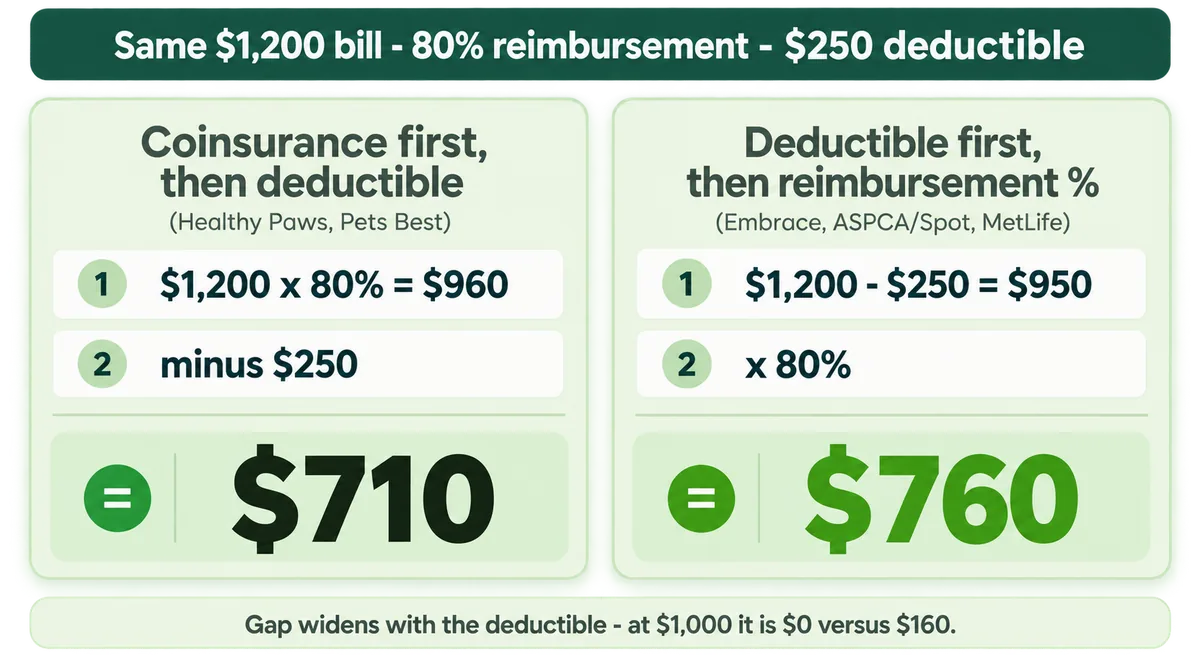
Nothing in Colorado law requires either order, or requires anyone to disclose it.
Dental, where the exclusions meet a real bill
At CSU a cleaning starts at $2,050, extractions at $2,678. Embrace sub-limits dental illness at $1,000 a year, Pets Best excludes prophylaxis — the routine cleaning itself — "at any time or for any reason", and Healthy Paws covers teeth only after an accident.
Which clock matters depends on your pet: the cruciate wait and bilateral definition for a young large-breed dog; the dental sub-limit and hip-dysplasia cut-off for an older pet or cat. If two quotes look identical, ask which order each applies.
Free and low-cost help in Colorado
Colorado has a few published low-cost routes: humane-society clinics in Denver and Boulder, a hospital fund, and two financing rails. None are free — they make the bill smaller, or let you spread it.
Humane Colorado, at CSU Spur in Denver, runs urgent care with an exam that "starts at $48", plus a weight-banded spay/neuter schedule — $215 for a dog spay in the lightest band, $80 for a cat spay. Urgent care only — no critical emergencies, overnight stays or chronic-disease management.
The Humane Society of Boulder Valley publishes a schedule plus a SHARE discount of "45% off the prices listed" for income-qualified Boulder and Broomfield families. That list is dated October 2023 — call first.
CSU's Fort Collins teaching hospital names a Companion Care fund for emergency costs, but publishes no eligibility criteria, award size or process. Ask directly.
For financing, Sploot advertises Scratchpay instalments and VRCC in Englewood names both it and CareCredit. Neither is a hospital payment plan — both are consumer credit, and both can be applied for from home in advance rather than decided at the counter. Neither reduces the bill; with interest you repay more than it. CareCredit's standard purchase APR is 32.99%, and its promotional offers are deferred interest — miss the payoff window and interest is charged back to the purchase date. Scratchpay quotes 0–36% APR, so the rate you are offered is the whole question.
One move costs nothing: ask your own vet what they want before treatment, and whether they bill any insurer directly. Price a policy against that answer, not the premium.
Frequently Asked Questions
What is the average cost of pet insurance in Colorado?
At a $500 deductible and 90% reimbursement, U.S. News puts a one-year-old dog at about $60.75 a month and a six-year-old at $94.46. That is a Parker, Colorado sample rather than a statewide average, and every published figure moves with species, breed, age, deductible, reimbursement percentage and annual limit. Compare quotes only at identical settings, or you are not comparing anything.
Is it really worth it to get pet insurance?
It depends on whether you could absorb the loss — and on whether you could front the bill first. Reimbursement is the default, not a universal rule: Trupanion can pay your hospital directly at checkout where its software is installed; otherwise you pay, then claim. CSU requires 80% of the low-end estimate written for your pet before any service over $250, so against the $4,500 cruciate figure CSU published and has since withdrawn — archived October 2025, before pre-op screening or take-home medication — the deposit lands near $3,600. What a policy changes is how much comes back, weeks later. If losing that money permanently would break something, that recovery is what you are buying.
What is the best pet insurance for dogs in Colorado?
There is no single best, and usually one mechanic decides it. For a young large-breed dog it is the orthopedic clock — six months for cruciate events at Pets Best, and a 180-day window at Embrace that turns four joint conditions pre-existing for life. For an older dog it is the exclusions, not the price. On a tight budget it is exam-fee treatment and the order the deductible is applied in.
Is Costco offering free pet insurance?
No — it is a member discount, not free cover, and Costco does not underwrite it. Costco's own page says members "may be eligible to receive an exclusive discount" on plans through Figo Pet Insurance, so eligibility and the size of the discount are conditions to check rather than a given. The policy itself is a Figo policy, which in Colorado is written on Independence American paper — the same insurer behind ASPCA, Pets Best and AKC here. Read the form before you read the discount.
Does Colorado have a pet insurance law?
No. The NAIC's Summer 2025 state-adoption chart lists Colorado as "NO CURRENT ACTIVITY" on its Pet Insurance Model Act, and search the state's insurance code — the 1,112-page Title 10, Colorado Revised Statutes 2024, the edition we read — and the word "pet" appears zero times. So the free look, waiting-period cap and accident-wait ban other states legislated are contractual here, not guaranteed. Colorado's general bad-faith statute still reaches pet insurance on the face of its text.
What can I do if my Colorado pet insurance claim is denied?
Ask the insurer in writing which policy clause it relied on — a denial you cannot name is one you cannot appeal. If the answer does not hold up, the Colorado Division of Insurance takes complaints through its consumer portal (303-894-7490, or 800-930-3745 outside Denver). C.R.S. §10-3-1116(1) also lets a first-party claimant — you, not your vet — recover attorney fees and twice the covered benefit for an unreasonable denial, though we found no Colorado case applying it to a pet claim. General information, not legal advice.
Sources
- Best Pet Insurance in Colorado for 2026 — U.S. News & World Report
- Pet Insurance Model Act — state adoption chart (Summer 2025) — National Association of Insurance Commissioners
- Colorado Revised Statutes 2024, Title 10 — Insurance — Colorado General Assembly, Office of Legislative Legal Services
- Hospital Policies — payment and financial policy — Colorado State University Veterinary Health System
- How Much Does Pet Insurance Cost in Colorado? — MoneyGeek
- Pet Insurance in Colorado — Pawlicy Advisor
- Pet Insurance Coverage in Colorado — Fetch Pet Insurance
- State of the Industry Report 2026 — Highlights (2025 data year) — North American Pet Health Insurance Association
- Colorado Insurance Industry Statistical Report — data as of December 31, 2025 (published August 2026) — Colorado Division of Insurance
- QuickFacts: Colorado; United States — population estimates, July 1, 2025 (V2025) — U.S. Census Bureau
- Emergency and Critical Care — visit fees — Colorado State University Veterinary Health System
- Dentistry and Oral Surgery — pricing — Colorado State University Veterinary Health System
- Orthopedic Surgery pricing (archived capture, 11 October 2025) — Colorado State University Veterinary Teaching Hospital, via the Internet Archive
- Pet Insurance in Colorado — direct pay at checkout — Trupanion
- Pet Insurance & Payment Options — West Denver Veterinary Hospital
- 2026 Digest of Bills — Colorado General Assembly
- 2026 Market Conduct Annual Statement — Participation Requirements — NAIC
- Pet Insurance Model Act (#633) — NAIC
- Annual Complaint and Recoveries Report, FY 2024-25 — Colorado Division of Insurance
- 3 CCR 702-5 — Property and Casualty — Colorado Secretary of State
- Insurance Complaint Ratio Report — Colorado Division of Insurance (DORA)
- Colorado Policy Documents — Healthy Paws Pet Insurance
- Colorado Accident & Illness Policy Booklet (sample), form IAIC-PB10001-ILL — Pets Best
- Colorado Insurance Industry Statistical Report (as of December 31, 2024) — Colorado Division of Insurance
- What pet insurance do you guys use, if any? (r/ColoradoSprings, October 2024) — Reddit
- Pet insurance/vet options (r/Denver, October 2024) — Reddit
- Sample policy, form LD-50812 (07/18) (Westchester Fire Insurance Company) — Healthy Paws Pet Insurance
- Get a Quote — enrollment flow — Trupanion
- Colorado accident & illness sample policy pages, form PET-P-20000-1024 — ASPCA Pet Health Insurance / Hartville
- Waiting period waiver form IAIC FPI WP-WAIVER_UW 12.4 — Figo Pet Insurance / Independence American
- Orthopedic waiting periods by state — Embrace Pet Insurance
- Vet and pet insurance recommendations (r/boulder, June 2026) — Reddit
- Sample policy, form TRU (D) 00001 V10.201902 — Trupanion
- Colorado accident & illness sample policy, form IAIC PPI AI POL 007 1120 (11/2020) — AKC Pet Insurance / PetPartners
- Colorado Eligible Nonadmitted Insurers Writing Surplus Lines, 2025-26 — Colorado Division of Insurance
- State documents and sample policies — Figo Pet Insurance
- Colorado state terms (archived 2025-08-13) — Embrace Pet Insurance
- Spay/neuter information and SHARE program (pricing effective October 2023) — Humane Society of Boulder Valley
- Give — Companion Care fund — Colorado State University Veterinary Health System
- Pet Urgent Care — Humane Colorado
- Spay/Neuter Clinic pricing — Humane Colorado
- Service pricing and financing options — Sploot Veterinary Care
- Pay online — financing options — VRCC Veterinary Specialty & Emergency Hospital
- File a Complaint — consumer portal — Colorado Division of Insurance
- Pet Insurance — Costco member program through Figo — Costco Wholesale
- State documents and sample policies — PetPartners (AKC Pet Insurance)
- 2026 CRS Titles for Download — Colorado Revised Statutes — Colorado General Assembly, Office of Legislative Legal Services
- Sample policy, form PET-P-20000-1024 (Money Back Guarantee clause) — Spot Pet Insurance
- Pet health insurance policy terms V6 — Part IV Exclusions — Embrace Pet Insurance (underwritten by American Modern Home Insurance Company)
- Apply for the CareCredit credit card — rates and terms — CareCredit (Synchrony Bank)
- Scratchpay — payment plans for veterinary care (APR 0–36%) — Scratchpay (Scratch Financial, Inc.)
- Direct payments — paying the hospital at checkout — Trupanion