
Since January 22, 2025, Ohio has had a pet-insurance law of its own. Almost nothing written for Ohio buyers mentions it.
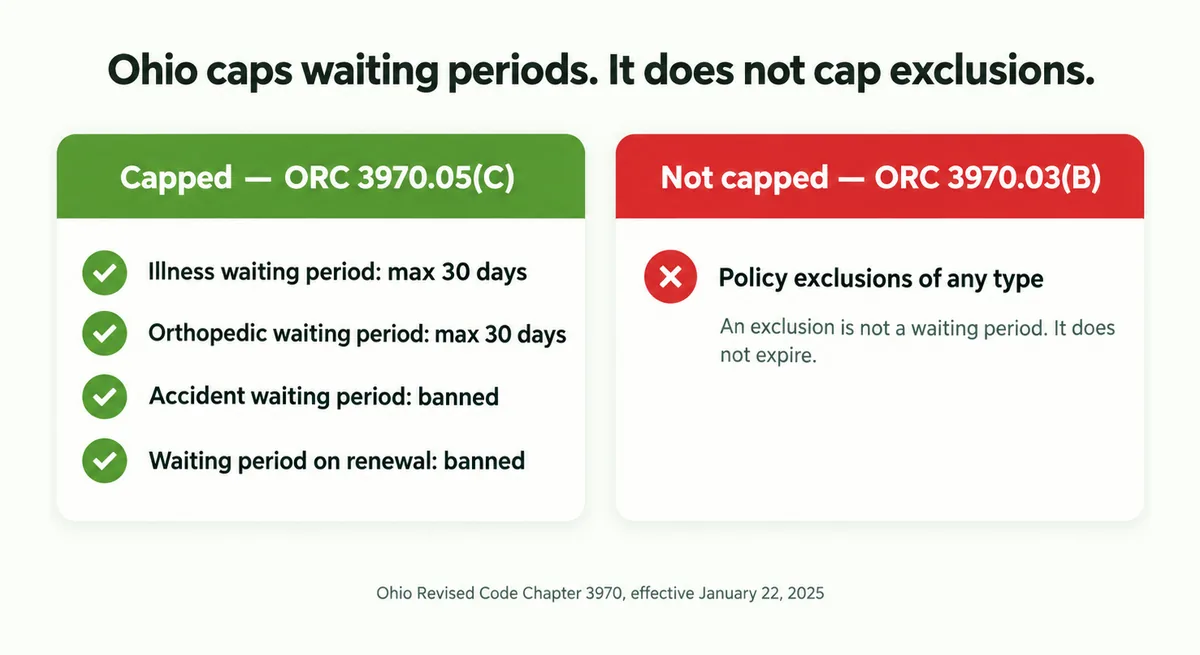
It is not a small law. Ohio Revised Code § 3970.05 says a waiting period "shall not exceed thirty days for illnesses or orthopedic conditions not resulting from an accident," that it "shall not apply to an accident," and that the insurer — not you — "has the burden of proving that the preexisting condition exclusion applies." Ohio also wrote its own definition of an orthopedic condition, and § 3970.01 puts "ruptured cranial cruciate ligaments" inside it. The six-month knee wait that is ordinary in other states does not belong on an Ohio policy.
Then the same chapter adds a sentence that does most of the quiet work: § 3970.03 "does not prohibit or limit the types of exclusions a pet insurer may use." A cap on waiting periods is not a cap on exclusions. That gap is where an Ohio buyer can still lose, and it is the single most useful thing to understand before you compare a single quote.
Here is the Ohio picture: what coverage costs at settings you can reproduce, what the law reaches and what it leaves alone, what a hospital wants before it admits your pet, and which owners here should pick what.
Table of Contents
- What pet insurance costs in Ohio
- What Ohio's pet-insurance law actually gives you
- Waiting periods and exclusions on Ohio policies
- Paying before you're reimbursed
- What vet care costs across Ohio — and who is open
- Buying through an employer or association in Ohio
- Which Ohio owners should pick what
- Frequently Asked Questions
- Sources
What pet insurance costs in Ohio
At a $500 deductible and 90% reimbursement, U.S. News averages the twelve companies it rates at $47.30 a month for a one-year-old neutered mixed-breed dog and $25.14 for a one-year-old domestic shorthair cat, on a $10,000 annual limit in Hamilton (ZIP 45011). That is an average of a sample at one setting — not a statewide rate.
| Hamilton, OH 45011 — $500 deductible, 90% reimbursement, average of 12 companies | Dog, 1 yr | Dog, 6 yr | Cat, 1 yr | Cat, 6 yr |
|---|---|---|---|---|
| $10,000 annual limit | $47.30 | $75.83 | $25.14 | $37.03 |
| Unlimited annual limit | $56.03 | $96.05 | $31.78 | $49.81 |
Two dials move that number, and here they do not move it equally. Aging the same dog from one to six adds about 60% at the $10,000 limit — $47.30 to $75.83. Lifting the limit to unlimited adds about 18%. The cat runs the same way: roughly 47% for age against 26% for the limit.
Who you buy from moves it further than either dial. At those identical Hamilton settings, the same page prices Lemonade at $22.61 and Pets Best's Essential tier at $20.95 for that one-year-old dog — under half the twelve-company average. Matching the deductible, reimbursement and limit does not make two policies the same product, though: one of those is expressly a named tier, and benefits, definitions and exclusions still vary. Quote several carriers at one configuration, then compare what each actually covers.
It is also why published "Ohio averages" disagree — mostly, they are answering different questions. WSJ Buyside puts Ohio at $42 a month for dogs and $21 for cats, at a $5,000 limit with a $500 deductible and 80% reimbursement, sourced to Wag. Fetch gives an Ohio average of $34 for dogs and $18 for cats with no deductible, limit or reimbursement attached at all. Lemonade's Ohio guide gives a four-city band — Akron $20 to $25, Cleveland $40 to $45 — from internal data stamped October 2024. ASPCA publishes Ohio ZIP samples at a $5,000 limit, 80% reimbursement and a $250 deductible, on rates stamped 4/21/24. None is wrong. None is comparable.
For a frame that is not a quote engine: NAPHIA's 2026 industry report puts Ohio at 2.6% of insured U.S. pets but 2.2% of gross written premium, against national accident-and-illness averages of $836 a year for dogs and $435 for cats. Ohio's share of premium sits below its share of insured pets — that comparison is our arithmetic on NAPHIA's two published columns, not a figure NAPHIA states, and the data do not explain why. Species mix, pet ages, local prices and the plans people choose could each account for it.
What Ohio's pet-insurance law actually gives you
Yes, Ohio has one. Ohio Revised Code Chapter 3970 — sections 3970.01 through 3970.08 — took effect January 22, 2025 under Senate Bill 175 of the 135th General Assembly. It sets required disclosures, a 30-day free look, a 30-day ceiling on illness and orthopedic waiting periods, and it puts the pre-existing burden of proof on the insurer.
The insurer has to prove a pre-existing exclusion applies. Section 3970.05(A) lets a policy exclude pre-existing conditions, then adds that "the pet insurer has the burden of proving that the preexisting condition exclusion applies to the condition for which a claim is made." That reframes a denial: you are not obliged to disprove a link the insurer asserts — the insurer has to establish it.
A covered condition cannot become pre-existing at renewal. The next line, 3970.05(B), says a condition covered under the policy "shall not be considered a preexisting condition under any renewal of that policy." Your dog developing a chronic condition in year two does not get reclassified as a pre-existing condition in year three. That is all it does: everything else — whether the policy renews at all, the limits, the premium and the other terms — is still governed by your contract.
Thirty days to change your mind. Section 3970.04(B)(1) lets the purchaser cancel "within thirty days after the purchaser first receives the associated policy," with a full refund — "so long as no claim has been made." That last clause is the catch, before you file anything in month one.
Five things the policy has to tell you. Section 3970.04(A) requires disclosure of whether the policy excludes pre-existing conditions, hereditary disorders, congenital anomalies and chronic conditions; whether it excludes coverage "for any reason other than those listed" — and if it does, the policy must carry the sentence "Other exclusions may apply. Please refer to the exclusions section for more information."; whether it limits coverage "through a waiting period, affiliation period, deductible, coinsurance, or an annual or lifetime policy limit"; whether the insurer "reduces coverage or increases premiums based on the insured's claim history, the age of the covered pet, or a change in the geographic location of the insured"; and — the one nobody expects — "whether the underwriting company differs from the brand name used to market and sell" the policy.
And there is a document you can simply ask for. Section 3970.04(H) requires every pet insurer to put a summary of all of it in a separate document titled "Insurer Disclosure of Important Policy Provisions," link it from the main page of its website, and hand it to you at delivery "in at least twelve point font." If you read one thing before buying in Ohio, read that — and the law requires the company to give it to you.
What the 30-day cap does not reach
Here is the part that decides real claims. Section 3970.03(B) states plainly that the chapter "does not prohibit or limit the types of exclusions a pet insurer may use or apply to a pet insurance policy."
So Ohio caps how long a company can make you wait. It does not cap what a company can permanently exclude. Those are different mechanisms with very different consequences: a waiting period ends, and an exclusion does not. A carrier that cannot make you wait six months for a knee can still write a policy that never covers that knee at all, and nothing in Chapter 3970 stops it.
One more piece of context on the weight the chapter carries day to day. Section 3970.08 says the superintendent of insurance "may adopt rules" to administer and enforce the chapter, "which may include penalties for violations." Not shall — may. That is a statement about rulemaking specifically, not about the Department's wider authority over insurers, and it does not say whether rules have since been adopted. The rights above are written into statute and they are real. It is still worth checking a policy against the statute yourself before you buy — and taking anything that looks wrong to the Ohio Department of Insurance.
Waiting periods and exclusions on Ohio policies
On an Ohio policy, a waiting period "shall not exceed thirty days for illnesses or orthopedic conditions not resulting from an accident," and it "shall not apply to an accident" at all. That is § 3970.05(C). And because § 3970.01(D) writes "ruptured cranial cruciate ligaments," hip dysplasia, elbow dysplasia, disc degeneration and patellar luxation into the definition of an orthopedic condition, the long knee clock is inside the cap.
You can watch that land. Pets Best publishes its waiting periods by state; its Ohio entry gives policies bought on or after 1/19/2025 0 days for accidents, 14 for illnesses, 30 days for cruciate ligament conditions. Now look at the states across Ohio's borders on the same page.
| Same carrier, same product | Accident | Illness | Cruciate ligament |
|---|---|---|---|
| Ohio (policies from 1/19/2025) | 0 days | 14 days | 30 days |
| Michigan, Indiana, Kentucky, West Virginia | 3 days | 14 days | 6 months |
That is the law visible in one row: on these terms, an Ohio dog becomes eligible for an otherwise-covered cruciate claim roughly five months earlier than one across the border. Eligibility is not payment — deductibles, limits and exclusions still apply — but the clock is five months shorter.
So check the carrier, not the review. U.S. News still tells Ohio readers that Pets Best's Ohio waiting periods are "three days for accidents, 14 days for illnesses and six months for cruciate ligament conditions" — the carrier's own page says otherwise. Rankings go stale; the disclosure document § 3970.04(H) makes the company hand you does not.
Now the part the cap does not touch. Embrace's orthopedic page lists OH among the states where four canine conditions — cruciate ligament disease, IVDD, patellar luxation and hip dysplasia — that "occur or show Clinical Signs during the first 180 days after the Pet Original Start Date are excluded and are Pre-existing Conditions for the life of the policy."
Read the wording carefully, because the label is doing a lot of work. A waiting period of 180 days would exceed what § 3970.05(C) allows. Embrace does not present this as a waiting period — it presents it as an exclusion and a lifelong pre-existing condition — and § 3970.03(B) does not limit exclusions. Whether a 180-day trigger written that way sits genuinely outside the waiting-period rule, or is a waiting period wearing another name, is not something we found settled by any Ohio filing, rule or decision. The two labels carry very different consequences — put the question to the carrier in writing before you buy.
So the question to ask is not "how long is the waiting period." It is: is this a waiting period or an exclusion, and what happens to my dog's knees on day 181? If a wait does apply, § 3970.05(C)(3) requires the contract to let you waive it by completing a vet exam after purchase — you pay for the exam unless the policy says the insurer does.
Paying before you're reimbursed
Pet insurance ordinarily reimburses you rather than paying your vet. Some insurers offer direct pay, but it depends on the carrier's requirements and your veterinarian agreeing to them, so plan around the default: you settle the bill, file the claim, and the money comes back afterward. Which means the question that decides your night at an emergency hospital is not what your policy covers. It is what you can put on a card before anyone treats your dog.
Ohio's referral hospital publishes exactly what it wants. The Ohio State University Veterinary Medical Center states that "a minimum deposit equal to 75% of the high end of the estimate range provided is required for all inpatient (hospitalized) cases prior to admission," and gives its own worked example: on a $1,200–$1,400 estimate, "you would be asked to leave a $1050 deposit."
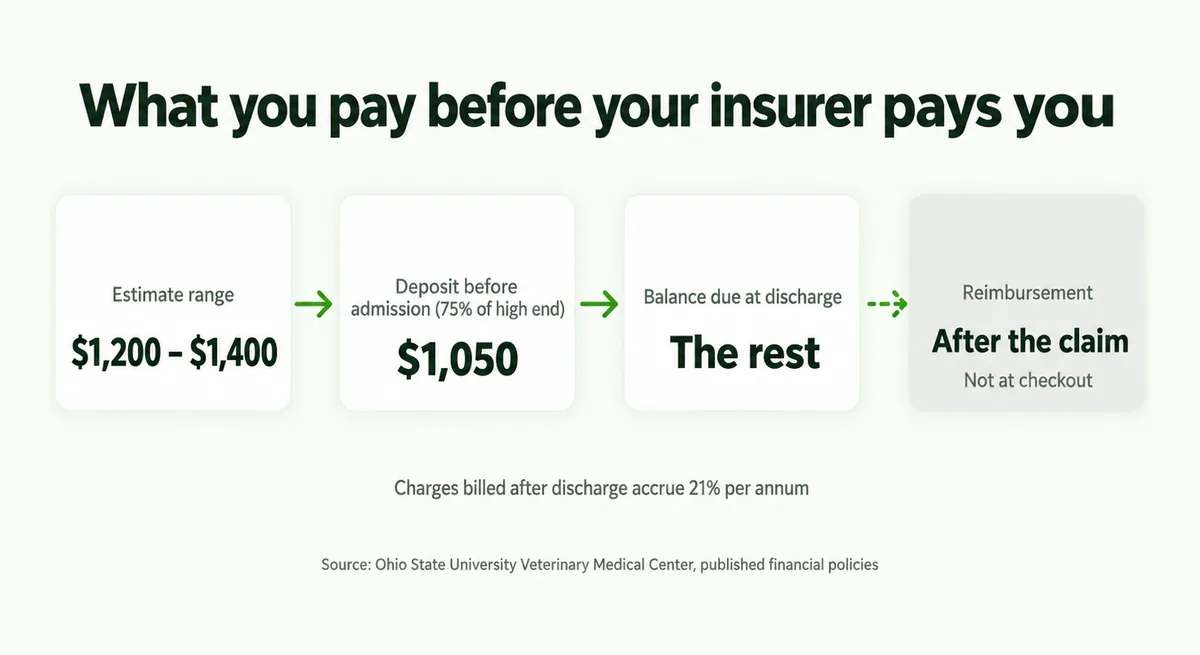
Read that mechanic again: it is not a percentage of the bill. It is 75% of the top of the range — the number you were hoping not to hit. Outpatient care is simpler: the hospital "operates on a payment-at-time-of-service basis" for office visits, elective surgeries, prescriptions and lab work.
Three details worth knowing before you are standing there:
- The deposit "may be higher based on the current estimate, your credit history, the urgent nature of your case, and other extenuating circumstances."
- Charges that post after discharge are billed by mail, due in 30 days, and "21% per annum interest will apply."
- The hospital does not take cash. It accepts checks and the major cards, offers a reverse ATM to convert cash to a payment card, and accepts CareCredit.
And here is the sentence that should shape how you plan: on that entire financial-policies page, the word "insurance" does not appear once. Not a mention of direct billing, not an insurer name, no claim assistance. The only third-party payment mechanism named anywhere on it is CareCredit. Your policy is an arrangement between you and your insurer; the hospital's arrangement is with you.
Direct pay does exist on the carrier side — Pets Best, for one, offers a Vet Direct Pay option in which your vet signs and submits a form — but whether any particular Ohio hospital takes part is decided hospital by hospital and almost never published. If direct pay matters to you, ask your regular vet and your nearest emergency hospital by name, before you need either.
None of this is a reason to wait. If your pet needs care tonight, get the care. It is a reason to know your ceiling in advance — what you could actually produce at a counter at 2 a.m. — and to treat that number, not the monthly premium, as the thing your policy has to work around.
What vet care costs across Ohio — and who is open
Before anyone examines your pet, an Ohio emergency hospital charges you to walk in. On one published Ohio referral list, that entry fee spans $100 to $350 depending on which door you choose. Rascal Unit, a nonprofit Ohio clinic, publishes the list it gives its own clients, with fees, hours and addresses. It is undated and it is not a statewide survey, so treat every figure below as a sample to verify rather than a current quote.
| Hospital | Emergency / exam fee | Hours |
|---|---|---|
| Stark County Veterinary Emergency Clinic, Canton | $100 | 24 hours |
| MedVet Cleveland | $126 | 24 hours |
| OSU Veterinary Medical Center at Dublin | $130 | Urgent care only, evenings |
| Grady Veterinary Hospital, Cincinnati | $140 | 24 hours |
| MedVet Dayton (Moraine) | $148 | 24 hours |
| Central Ohio Veterinary Emergency, Delaware | $150 | 24 hours |
| MedVet Hilliard, Diley Hill and Cincinnati | $189 | 24 hours |
| OSU Veterinary Medical Center, Columbus | $350 | Daily, 8 a.m. to midnight |
Two things in that table are worth more than the numbers.
On this list, the teaching hospital is the most expensive front door — and it is not shown as round-the-clock. OSU's Columbus center appears at a $350 exam and emergency fee with daily hours ending at midnight; its Dublin site appears as urgent care only, on evening hours. Confirm both with the hospital before you rely on them. If your emergency starts at 2 a.m., the places listed as open are the private hospitals — and the cheapest of those on this list, in Canton, charges under a third of what Columbus does.
Some of Ohio is referred out of state. The same list routes Trumbull and Jefferson county clients to BluePearl in Pittsburgh at a $220 fee. For northeast Ohio, the nearest 24-hour option can be across a state line.
This is where owners get caught. Ohio owners on Reddit describe not being able to tell which hospitals are genuinely open around the clock versus merely on call — one built a statewide map after a 3 a.m. scare because listed hours were unreliable. The table shows why: "urgent care," "24 hours" and "daily until midnight" sit side by side.
Treat these figures as a starting point, not a quote. Look up your two nearest options now — the fee, the hours, and whether they take direct pay — and put the numbers in your phone before you need them.
Buying through an employer or association in Ohio
You may not have to shop at all. Search "pet insurance Ohio" and three of the ten results on the first page are not buying guides — they are benefit pages: a hospital system's employee perks site, a university HR page, and the Ohio Bar Liability Insurance Company's member coverage list. That is a real Ohio distribution channel, and no shopper content explains it.
What a group offer typically buys you is price and convenience. OhioHealth's benefits page, for instance, describes pet insurance "provided by MetLife" with "special group rates" and the option to have premiums payroll deducted. OBLIC routes its members to MetLife Pet Insurance too — worth noticing, because it means an Ohio employer plan and an Ohio bar-association plan can land you on the same carrier by different doors.
What a group offer does not buy you is different law. Every protection in Chapter 3970 attaches to the policy, not to how you found it. The 30-day free look, the 30-day ceiling on illness and orthopedic waiting periods, the accident-wait ban, the insurer's burden of proof, and the "Insurer Disclosure of Important Policy Provisions" document all apply to a policy sold through your workplace exactly as they do to one you buy yourself.
So compare it like anything else. Ask for that disclosure document, and check whether any orthopedic limit is written as a waiting period or as an exclusion. Then get one or two direct quotes at the same deductible, reimbursement percentage and annual limit, and see whether the group rate really is the better deal.
It often will be. But a discount on a policy with a permanent exclusion is still a policy with a permanent exclusion, and payroll deduction is a convenience, not a coverage feature. Ask your benefits contact what happens to the policy if you change jobs.
Which Ohio owners should pick what
There is no single best policy in Ohio, but there is usually one mechanic that decides yours. Find your situation and start there.
A new puppy or kitten. You are in the best position anyone gets: nothing is on the chart yet. Buy while a clean record is still a clean record, and spend your attention on the orthopedic wording rather than the price. Ohio's thirty-day ceiling is on your side; an exclusion written into the same policy is not.
An older pet. Expect the number to hurt: on the Hamilton figures above, the same dog costs about 60% more at six than at one. Compare carriers rather than trimming the annual limit, and check what a policy says about age at enrollment before you fall in love with a quote.
An adopted pet with an incomplete chart. You may well still be able to buy a policy, though eligibility and underwriting rules vary by carrier. Being issued a policy is not the same as having what your pet already has covered — the two questions are separate, and only the second one matters at claim time. The useful thing here is that Ohio puts the burden of proving a pre-existing exclusion applies on the insurer, so ask, in writing, what records they are relying on.
A multi-pet household. Price each animal at the same deductible, reimbursement percentage and annual limit before you look at any multi-pet discount. A discount on the wrong configuration is not a saving.
You need the vet paid directly. Sort this before you buy. Direct pay needs both the insurer offering it and your hospital supporting it, and Ohio hospitals rarely publish whether they do — call your regular vet and your nearest emergency hospital and ask.
You are renewing. A condition covered under your policy cannot be treated as pre-existing when that policy renews. That protection follows the policy — weigh it before you let one lapse.
You are switching. This is where people get hurt. The renewal protection above applies to your existing policy; it does not travel to a new insurer. A new Ohio policy can impose fresh waiting periods — none for accidents, up to thirty days for illness and qualifying non-accident orthopedic conditions — but your pet's record goes with them. If anything is already on the chart, price the switch as if that condition will not be covered.
Whichever you are: ask for the "Insurer Disclosure of Important Policy Provisions" and read the exclusions before the price. It answers most of this in a page.
Frequently Asked Questions
What is the best pet insurance in Ohio?
There is no single best, and in Ohio one mechanic usually decides it. For a young large-breed dog it is the orthopedic wording — whether a knee limit is written as a waiting period, which § 3970.05(C) caps at thirty days, or as an exclusion, which Ohio does not cap. For an older pet it is the exclusions and the age rules. For anyone who cannot front a large bill, it is whether your hospital takes direct pay. Compare each carrier's "Insurer Disclosure of Important Policy Provisions," not the star ratings.
Is it really worth it to get pet insurance?
It depends on whether you could absorb the loss — and, separately, whether you could front it. Almost every policy reimburses you after you pay, so insurance changes how much comes back, not what the hospital asks for tonight. Ohio State's veterinary hospital requires a deposit of 75% of the high end of its estimate before admitting an inpatient. If losing several thousand dollars permanently would break something, that recovery is what you are buying.
What is the cheapest but best pet insurance?
Cheapest only means something at a stated configuration. At a $500 deductible, 90% reimbursement and a $10,000 limit in Hamilton, Ohio, U.S. News prices Lemonade at $22.61 and Pets Best's Essential tier at $20.95 for a one-year-old dog, against a $47.30 twelve-company average. Matching those three settings does not make two policies the same product, though — compare the exclusions before the premium.
Is $50 a month a lot for pet insurance?
In Ohio it depends almost entirely on the animal. Against the Hamilton sample above — $500 deductible, 90% reimbursement — $50 a month is roughly the going rate for a one-year-old dog at a $10,000 limit, where the twelve-company average is $47.30. For a one-year-old cat, at an average of $25.14, it is about double. For a six-year-old dog, at $75.83, it would be cheap. Age moves the number here more than the annual limit does.
Does Ohio have a pet insurance law?
Yes. Ohio Revised Code Chapter 3970, sections 3970.01 through 3970.08, took effect January 22, 2025 under Senate Bill 175 of the 135th General Assembly. It requires specific disclosures, gives you thirty days to cancel a new policy for a full refund if no claim has been made, caps illness and orthopedic waiting periods at thirty days, bans waiting periods on accidents, and puts the burden of proving a pre-existing exclusion on the insurer.
Do Ohio vets require a deposit up front?
At least one major Ohio hospital does, and the amount is large. Ohio State's Veterinary Medical Center publishes a minimum deposit of "75% of the high end of the estimate range" before admission — on a $1,200–$1,400 estimate, a $1,050 deposit. It also charges 21% per annum on balances billed after discharge and does not accept cash. Policies vary by facility, so ask your nearest emergency hospital before you need it.
Does a past vet visit make a condition pre-existing in Ohio?
It can, but Ohio shifts who has to prove it. Under § 3970.05(A), a policy may exclude pre-existing conditions, and "the pet insurer has the burden of proving that the preexisting condition exclusion applies." If a claim is denied on that basis, ask in writing which records the insurer relied on. One thing never to do: delay a vet visit to keep something off the chart. Get your pet the care.
Sources
- Section 3970.05 — Policy conditions — Ohio Revised Code
- Section 3970.01 — Definitions — Ohio Revised Code
- Section 3970.03 — Limitations and exclusions — Ohio Revised Code
- Best Pet Insurance in Ohio for 2026 — U.S. News & World Report
- Best Pet Insurance in Ohio 2026 — WSJ Buyside
- Pet Insurance in Ohio — Fetch Pet Insurance
- Pet Insurance in Ohio — Lemonade
- Ohio Pet Insurance — ASPCA Pet Health Insurance
- State of the Industry Report 2026 — Highlights — NAPHIA
- Chapter 3970 — Pet Insurance — Ohio Revised Code
- Section 3970.04 — Disclosures — Ohio Revised Code
- Section 3970.08 — Rules — Ohio Revised Code
- What are waiting periods? — Pets Best
- Embrace Orthopedic Waiting Periods — Embrace Pet Insurance
- Financial Policies and Requirements — Ohio State University Veterinary Medical Center
- Emergency Vet Services for RU clinics (Ohio referral list) — Rascal Unit
- Pet Insurance — employee benefit — OhioHealth
- Pet Insurance — member coverage — Ohio Bar Liability Insurance Company