


Maryland has a pet-insurance law. Most states do not — and the ten pages currently ranking for this search are written as though Maryland does not either.
It is House Bill 647, approved by the Governor as Chapter 740, with an effective date of 1 January 2025. Two of its provisions change things immediately. A Maryland waiting period "may not exceed 30 days" for an illness or orthopedic condition that does not result from an accident — and where the condition does result from an accident, an insurer "may not impose a waiting period" at all. And when a claim is refused as pre-existing, the statute puts the burden of proving it on the insurer, not on you.
None of that appears anywhere in the top ten results — including on the Maryland Insurance Administration's own consumer page, which sits near the top of them.
What follows is the Maryland-specific picture: what coverage costs at settings you can reproduce, why the cheapest published Maryland figure is a different product from the rest, what the law gives you and the places it stops short — and what a Maryland emergency hospital wants at the door before it treats.
Table of Contents
- What pet insurance costs in Maryland
- Why the cheap Maryland number is a different product
- What Maryland law actually gives you
- Waiting periods and exclusions on Maryland policies
- Paying before you're reimbursed
- What vet care costs across Maryland — and who is open
- Which Maryland owners should pick what
- Frequently Asked Questions
- Sources
What pet insurance costs in Maryland
The most reproducible Maryland figure published anywhere is U.S. News's Baltimore sample. At a $250 deductible and 90% reimbursement, averaged across the eleven carriers it rates, a two-year-old medium mixed-breed dog in ZIP 21201 runs $51.55 a month on a $5,000 annual limit, and a two-year-old domestic shorthair cat $29.16.
| Baltimore 21201 — 11-carrier average, $250 deductible, 90% reimbursement | Dog, 2 yrs | Dog, 6 yrs | Cat, 2 yrs | Cat, 6 yrs |
|---|---|---|---|---|
| $5,000 annual limit | $51.55 | $80.37 | $29.16 | $42.63 |
| Unlimited annual limit | $83.23 | $133.35 | $43.92 | $68.08 |
Read across the row before you read down the column. Four years of age adds 56% to that dog and 46% to that cat — but lifting the annual limit from $5,000 to unlimited adds more to the young dog, 61%, than aging four years does. The single largest lever in that table is a setting you choose, not a fact about your pet.
One more thing the table shows: ASPCA, the carrier U.S. News names best overall in Maryland, prices above the eleven-carrier average at the identical configuration — $54.94 for the two-year-old dog and $84.15 at six. Best and cheapest are different questions here, and the page answers both without saying so.
A second number is worth having because it is built differently. Insurify's one-year rolling medians through the end of May 2026 put Maryland at $50 a month for dogs and $25 for cats, against a national $43 and $23 — about 16% and 9% above. But that median blends annual limits from $2,500 to unlimited across its whole quote database, so there is no configuration behind it to match. It tells you roughly where Maryland sits. It is not a quote you can reproduce.
Regulatory filings cannot give you a Maryland market total. The Insurance Administration's FY2025 annual report, on data as of 31 December 2024, lists premium written in Maryland company by company — and exactly one pet brand's underwriter writes nothing else. American Pet Insurance Company, Trupanion's carrier, wrote $20,406,726 in Maryland against $1,092,862,454 nationally. Every other pet underwriter on that list is multi-line, so its Maryland column sweeps in business that has nothing to do with pets. The industry's own trade body gets closer: NAPHIA puts Maryland at 2.3% of US gross written premium, which against its $5.7 billion national total is roughly $131 million — our arithmetic on NAPHIA's published shares, not a figure anyone reports for Maryland directly.
Which leaves one question before any of these numbers mean anything: whether two quotes are even selling the same thing.
Why the cheap Maryland number is a different product
Two Maryland prices, same carrier, same species, same age, same annual limit. WSJ Buyside puts an ASPCA policy for a two-year-old medium mixed-breed dog at $30 a month. U.S. News, in the table above, puts the same thing at $54.94. Neither is wrong.
Two disclosed settings separate them: WSJ prices at a $500 deductible and 80% reimbursement, U.S. News at $250 and 90% — buying back $250 of deductible and ten points of reimbursement for 83% more a month. The two publishers also sampled on different dates from different data sources, so read 83% as the scale of the confusion rather than an exact price for those two dials. What it is not is Baltimore, and it is not the carrier: both are held constant.
The bigger trap is coverage type, because the word "average" hides it. NAPHIA, whose data covers roughly 99% of US pet-insurance premium, puts the 2025 average annual premium for a dog at $836 for accident and illness and $190 for accident-only. Same industry, same year, 4.4× apart — because NAPHIA's accident-only category covers things like lacerations, poisoning, foreign-body ingestion and ligament tears, while accident-and-illness adds cancer, infections and digestive disease. Those are category examples, not your contract — what a given policy actually pays turns on its own definitions and exclusions. The two are also drifting apart: across five years accident-and-illness went $625 → $836 while accident-only went $192 → $190.
So before you set two Maryland quotes side by side, make each one state nine things: species, breed, age, ZIP code, annual limit, reimbursement percentage, deductible, coverage type, and the date the rate was collected. A number missing the last two is a headline, not a price.
The date matters more than it sounds. MoneyGeek's two Maryland pages both now redirect to national ones, so a Maryland figure quoted from either points at a page that no longer exists. Its current data puts Maryland at $49 a month, 3% above the national average and in its middle tier of states. Whatever else is true here, Maryland is not a pricing outlier.
What Maryland law actually gives you
The law is Title 19, Subtitle 11 of the Insurance Article — sections 19-1101 through 19-1107 — enacted as Chapter 740 of 2024 and approved by the Governor on 16 May 2024. It applies to every pet policy "issued, delivered, or renewed in the State on or after January 1, 2025." Because it bites on renewal, it has by now reached essentially every in-force Maryland policy, including one bought years earlier.
Four things in it change what an insurer can do to you.
1. Waiting periods are capped, and sometimes banned. A waiting period "may not exceed 30 days for an illness or orthopedic condition that does not result from an accident", and where the condition does result from an accident, an insurer "may not impose a waiting period" at all. On top of that, any insurer that uses a waiting period must write into the policy a provision letting you waive it by getting a medical exam — that is not a courtesy, it is required by § 19-1105(b)(2).
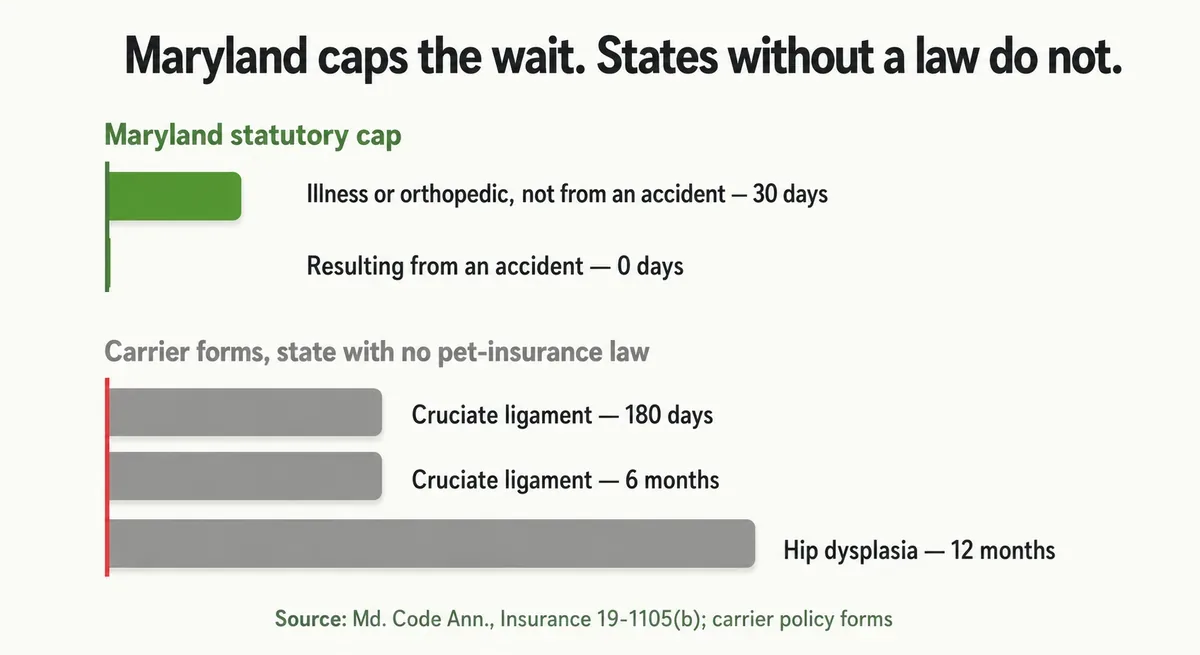
2. "Orthopedic condition" is defined broadly, and that is the point. Section 19-1101(e) defines it as any condition "affecting the bones, skeletal muscle, cartilage, tendons, ligaments, or joints," and then says it includes elbow dysplasia, hip dysplasia, intervertebral disc degeneration, patellar luxation and ruptured cranial cruciate ligaments. Only cancer and metabolic, hemopoietic or autoimmune disease are carved out. Those five are exactly what carriers gate behind long clocks elsewhere — and you can watch the cap work. Healthy Paws' countrywide form, LD-50812 (07/18), excludes "illness related to hip dysplasia that occurs or recurs within the first twelve (12) months." In Maryland, U.S. News reports the same carrier's hip-dysplasia wait as 30 days. Twelve months compressed to one, by statute.
3. The insurer has to prove a pre-existing condition, not you. Section 19-1105(a)(2): "The pet insurer has the burden of proving that the preexisting condition exclusion applies to the condition for which a claim is made." And the definition is finite — a condition counts as pre-existing only if, before your policy started or during a waiting period, a veterinary practitioner gave medical advice, the pet received treatment, or "based on information from verifiable sources, the pet had signs or symptoms directly related to the condition." A records review can establish the first two — records are where advice and treatment are written down. What it cannot do is put an inference in place of one of the three.
4. A covered condition cannot be reclassified at renewal. A pre-existing condition "does not include, for a renewal of a pet insurance policy, a condition for which coverage was afforded on the previous policy" (§ 19-1101(g)(2)). The definition of "waiting period" reinforces it — it exists only in a new policy. And § 19-1105(d) forbids requiring a medical exam as a condition of renewal. So the chronic condition your policy covered last year cannot quietly become an exclusion this year. That does not freeze your premium or the rest of the terms — read the renewal papers — but the condition itself is protected.
There is also a document you can read tonight. Section 19-1104(h) requires your insurer to hand you a separate paper, in at least 12-point type, titled "Insurer Disclosure of Important Policy Provisions" containing every § 19-1101 definition, and to publish it "through a clear and conspicuous link on the main page" of its website. Section 19-1104(a)(4) makes it name the underwriting company where that differs from the brand — how you learn your policy is written by Independence American or American Pet, not by the name on the ad. Section 19-1104(i) puts the Insurance Administration's address, toll-free number and website in 12-point boldface at issuance. Two more: a "wellness" benefit written into the policy contract is insurance (§ 19-1106(c)), and eligibility to buy cannot be made to depend on joining a separate wellness program (§ 19-1105(f)).
Where Maryland stopped short of the model
The NAIC files Maryland in the strictest column of its Pet Insurance Model Act chart — "MODEL ADOPTION," citing §§ 19-1101 to 19-1107 (2024). That is true and it is not the whole story. Three things Maryland did not take.
The free look is shorter and cheaper. The model gives you 15 days and "the full amount of any premium paid." Maryland gives you 10 days and a pro rata premium for the unexpired term, and you forfeit even that if you have made a claim (§ 19-1104(b)). The Insurance Administration's Bulletin 24-25 softens it slightly: pro rata "establishes the minimum amount that the insurer is required to refund … but does not prohibit the insurer from refunding the full premium amount." So ask.
Producer training was dropped. The model's Section 7 requires pet-specific training before an agent can sell. The word "training" appears zero times in enrolled Chapter 740.
Penalties and rulemaking were struck before passage. The bill as drafted carried a § 19-1108 (civil penalties of $250, or $1,000 for a willful violation, plus suspension of an insurer's certificate of authority) and a § 19-1109 letting the Commissioner adopt regulations. Neither is in the code — the subtitle stops at 19-1107, which is why the NAIC's own citation stops there too.
One wording difference is worth watching. The model says flatly that "waiting periods for accidents are prohibited." Maryland's version bans a waiting period for an illness or orthopedic condition that results from an accident — narrower on its face, though carriers appear to be applying it broadly: U.S. News reports Healthy Paws as having no accident waiting period at all in Maryland.
If your claim is denied
Your strongest card is the burden of proof. If the denial says "pre-existing," the insurer — not you, and not your vet — has to show that one of the three statutory triggers was met before your policy started. Ask, in writing, which trigger it is relying on and what verifiable source it came from. A denial that cannot name one is a denial worth escalating.
Escalate to the Maryland Insurance Administration, whose details the statute already requires on your policy in boldface: 200 St. Paul Place, Suite 2700, Baltimore MD 21202, toll-free 1-800-492-6116. Know what this subtitle did and did not build, though. With § 19-1108 struck, it carries no pet-specific penalty and no cause of action of its own. What it left standing is § 19-1103(b) — "All other applicable provisions of this article apply to pet insurance …" — and that matters here: § 19-1101(f) defines a pet insurance policy as a property insurance policy, and the Administration's own complaint page tells first-party property-and-casualty claimants they "may file an action under Section 27-1001 of the Insurance Article" where an insurer failed to act in good faith. The remedies sit elsewhere in the code, not in this law. General information, not legal advice — if a denial is worth fighting, take advice on it.
Waiting periods and exclusions on Maryland policies
The statute sets a floor; your contract sets the rest. Maryland requires every policy that uses a waiting period to contain a provision letting you waive it by getting a medical exam, and says the insurer's conditions on that exam must not "unreasonably restrict a policyholder's ability to waive the waiting period." The right is real. The window is narrow, and nobody will chase you about it.
Read a live one. Figo's waiver form on Independence American paper, IAIC FPI WP-WAIVER_UW 12.4, requires the exam within 7 days of your pet's original start date and the form "returned to us on the day you obtain the examination." Twenty listed conditions disqualify the waiver outright — allergies, arthritis, dental disease, IVDD, ligament and knee conditions among them. You pay for the exam: costs "are not eligible expenses." The decision comes within 30 days.
Nationwide's gives you 14 days but also wants "medical records from all veterinarians who have treated your pet in the past 12 months," and warns that "any conditions found during the exam or in the records submitted showing an onset prior to your policy effective date may be considered pre-existing."
That warning is not incidental — it is the exact risk § 19-1104(f) makes insurers disclose: examination documentation "may result in a preexisting condition exclusion." Figo's form is blunter still. Anything you write into its Section B will not cost you the waiver, but "will be considered Pre-Existing Conditions under your policy and will be ineligible for coverage." The document that shortens your wait can narrow what it covers. Whether that trade is worth taking depends on what is already in your pet's records, and on how long the exclusion runs under your policy — which is exactly what to ask before you book the exam.
One caution about the forms on carrier websites. The Maryland sample AKC publishes, form IAIC PPI AI POL 007 MD 1120, imposes a 180-day waiting period for IVDD and another 180 days for cruciate ligament conditions, and contains no waiver-on-exam provision at all. Both conditions sit inside Maryland's statutory orthopedic definition. But that form code is a November 2020 edition, published four years before the law took effect, and the word "Maryland" appears nowhere in its text. We could not obtain the currently filed Maryland form, so treat it as a posted sample that has not caught up, not as evidence about the policy you would be issued — and check the "Insurer Disclosure of Important Policy Provisions" your insurer is required to publish, which will be current.
Practically: if you want the waiver, book the exam in your first week, and ask the insurer in writing what its window is before you buy.
Paying before you're reimbursed
In most of the country, reimbursement-first is simply how the market works. In Maryland it is written into the law. Section 19-1105(c) says a pet insurer "shall require that an insured submit a claim under the pet insurance policy after submitting payment to the veterinary practitioner." The NAIC model contains no such clause — Maryland added it.
It is not a ban on direct pay, and the regulator has said so. Bulletin 24-25: "The Administration does not interpret this provision as prohibiting the insurer from directly paying the veterinary practitioner for covered expenses." So direct pay is possible here — it depends on your hospital and carrier, not your policy wording.
Which makes the number that matters the one the hospital asks for at the door. Maryland's hospitals publish theirs:
- Animal Emergency Hospital, Bel Air — a $150 exam fee, then "a signature to approve the estimate and a full deposit of the low end of the estimate." No checks. But it does accept Trupanion DirectPay: "you only have to pay your deductible, we take care of the rest."
- Pet+E.R., Cockeysville — "a payment deposit consisting of the entire low end of the estimated treatment amount … if the estimate range is $500 to $1000, you will be asked to leave payment of $500."
- MASH, Huntingtown — "a deposit equal to 50% of the high end of the fee estimate … at the time of admission. We do not offer a billing service."
- Maryland Veterinary Surgical Services — will help with your claim but "does not accept payment directly from the insurance company," and offers no payment plans.
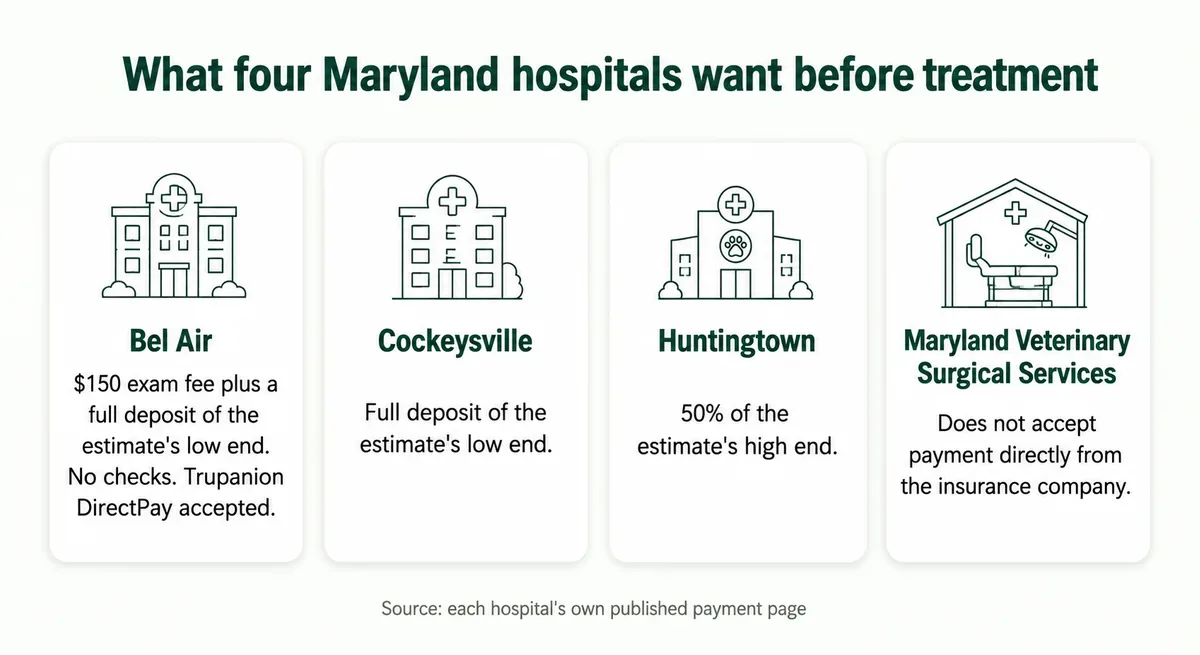
Two of those four take the low end, one the high. On the same $2,000–$6,000 estimate, that is $2,000 at one door and $3,000 at another.
The sharpest example is planned, not emergency. Jarrettsville Veterinary Center asks for a $4,000–$4,500 deposit no less than two weeks before a TPLO — roughly the whole cost of the surgery, up front. The word "insurance" does not appear anywhere on that page.
So the gap your policy has to bridge is not the premium. It is the few thousand dollars that leaves your account first — of which only the eligible part comes back, after your deductible and coinsurance, and only as fast as your insurer processes it. Ask your own emergency hospital, before you need it: what deposit do you take, and do you bill any insurer directly? Price the policy against those answers.
What vet care costs across Maryland — and who is open
Very few Maryland hospitals publish prices. Jarrettsville Veterinary Center, in Harford County, publishes a full list: routine annual exam $55, sick visit $65, same-day fit-in $75 for an established client and $95 if you are new, emergency $100, one digital radiograph $120, ultrasound $300, canine dental cleaning "starts at $400," and a TPLO at $3,800–$4,500 with about $450 of pre-op diagnostics on top. Treat those as one practice's posted prices, not a state average — but they are real numbers you can hold a quote against.
The harder Maryland problem is not price. It is distance. The state's own Veterinary Hospitals dataset — rows last updated 22 July 2025 — lists 578 licensed facilities, and they are not spread evenly: Montgomery County has 98, while Garrett has 4, Kent 3 and Somerset 2. On our arithmetic the six Baltimore-area jurisdictions hold 47.2% of them; all nine Eastern Shore counties together hold 10.6%.
Emergency capacity is thinner still, and it moved recently. Pet+E.R. announced in its own words that "Pet+ER Columbia will be closing our doors permanently on September 29th, 2025. Our hospital in Hunt Valley will remain open." That surviving Cockeysville site now describes itself as the only certified veterinary emergency and critical care center in the state. On the Lower Shore, Pets ER in Salisbury posts hours of 6:00pm–7:00am Monday through Thursday — meaning the region's referral ER is shut through the working day, and only round-the-clock from Friday evening to Monday morning.
And Maryland has no veterinary teaching hospital of its own. The University of Maryland states it plainly: "we do not offer clinical services to sick animals" at College Park, and "our main veterinary hospital is in Blacksburg, Virginia."
Why that belongs in an insurance article: you are rated on a Maryland ZIP code but may end up buying treatment at Washington, Virginia or Pennsylvania prices, against the same deductible and the same annual limit. How often that happens is not something anyone publishes — but the annual limit you choose is the part of the policy it lands on. Check what your own policy says about care outside the state before you need it; territorial and provider terms vary, and nothing in Maryland law makes coverage portable by default.
Which Maryland owners should pick what
There is no best policy here, only a mechanic that decides each case. Six cover most Maryland buyers.
A new puppy or kitten. The 30-day cap does the heavy lifting. In a state without this law the same brands run 180-day orthopedic clocks; here that exposure cannot exceed a month. So spend your attention on the annual limit instead — the setting that moved a young dog's premium more than four years of aging did.
An older pet, or one with things already on its chart. Your card is the burden of proof: the insurer must show a statutory trigger, and "based on information from verifiable sources" is a higher bar than a hunch. But keep two questions apart: the law governs what an insurer may exclude, not whether anyone must sell you a policy, or sell it cheaply. Get the exclusions in writing before you judge the price.
If paying up front would break something. Chase direct pay in the right order: call your own emergency hospital, ask who it bills directly, then shop the carriers that answer. Only one Maryland ER above publishes that it accepts a named insurer's direct pay. It is a property of your hospital, not a feature of a policy.
Two or more pets. Every waiting period and every waiver window runs per pet, from that pet's own start date. Enroll two on the same day and you have two exams to book inside the same seven- or fourteen-day window, not one.
Facing a renewal. You are better protected than you think. No exam may be required as a condition of renewal, and a condition covered last year cannot be relabeled pre-existing this year.
Thinking of switching. This is where those protections stop. The statute defines a renewal as a policy from the same insurer or an affiliate, on substantially similar terms. Move to an unaffiliated carrier and you have a new policy: the permitted waiting periods can be applied over again, and any condition meeting the statutory definition can be excluded — the same three triggers, still with the burden on the insurer. For a pet with history that can quietly cost you coverage you already had, so compare the written exclusions before you compare the premiums.
Whatever you pick, find out who underwrites it. Maryland requires your insurer to say so when the underwriting company differs from the brand on the advert — and that company, not the brand, is the one on the hook.
Frequently Asked Questions
Is it really worth it to get pet insurance?
It depends on whether you could front the bill, not just absorb it. Maryland writes reimbursement into the statute — § 19-1105(c) requires you to pay your vet before you claim. Against a $4,000–$4,500 knee-surgery deposit taken two weeks ahead, what a policy changes is how much comes back, weeks later. If losing that permanently would break something, that recovery is what you are buying.
What is the cheapest but best pet insurance?
Those are two different questions, and Maryland shows it. U.S. News names ASPCA best overall in Maryland — and prices it above its own eleven-carrier Baltimore average at the same $250 deductible and 90% reimbursement, $54.94 against $51.55 for a two-year-old dog. Cheapest moves with your pet's age and your settings. Decide which question you are asking first.
Is $50 a month a lot for pet insurance?
For a Maryland dog it is about typical; for a cat it is high. Insurify's rolling medians through May 2026 put Maryland at $50 a month for dogs and $25 for cats. But the figure means nothing without its settings — the same Baltimore dog runs $51.55 at a $5,000 limit and $83.23 with no limit at all.
Is Costco offering free pet insurance?
No. It is a member discount, and Costco does not underwrite it. Costco's own page says members "may be eligible to receive an exclusive discount" on plans through Figo Pet Insurance — so eligibility and the size of the discount are things to check, not givens. In Maryland the Figo paperwork is issued on Independence American Insurance Company forms. Read the policy before the discount.
Does Maryland have a pet insurance law?
Yes — one of sixteen states listed in the model-adoption column of the NAIC's Summer 2025 chart, on our count. Insurance Article §§ 19-1101 to 19-1107, passed as Chapter 740 of 2024 and applying to every policy issued, delivered or renewed since 1 January 2025. It caps waiting periods, puts the burden of proving a pre-existing exclusion on the insurer, and requires a standalone disclosure document. It has no pet-specific penalty section — that was struck before passage.
How long can a waiting period be in Maryland?
Thirty days at most for an illness or orthopedic condition that does not result from an accident, and none at all where the condition does result from one. "Orthopedic condition" is defined broadly and expressly includes hip and elbow dysplasia, IVDD, patellar luxation and cruciate rupture. Any policy that imposes a waiting period must also offer a waiver on completion of a medical exam — but the deadline and the paperwork are the insurer's to set. The two forms quoted above allow 7 and 14 days, and one wants the form back the same day. Check yours the day you buy.
Sources
- HB 647 (2024) — Property and Casualty Insurance: Pet Insurance: Regulation; approved as Chapter 740, effective 1 January 2025 — Maryland General Assembly
- Md. Code Ann., Insurance § 19-1105 — waiting periods, pre-existing conditions and claim submission — Maryland General Assembly
- Best Pet Insurance in Maryland for 2026 — Baltimore ZIP 21201 sample rates at a $250 deductible and 90% reimbursement — U.S. News & World Report
- Average Pet Insurance Rates as of June 2026 — one-year rolling medians by state through end of May 2026 — Insurify
- Maryland Insurance Administration Annual Report FY2025 — premium written in Maryland by company, as of December 31, 2024 — Maryland Insurance Administration
- The Best Pet Insurance in Maryland 2026 — sample Maryland rates at $5,000 annual coverage, $500 deductible, 80% reimbursement — WSJ Buy Side
- State of the Industry Report 2026 (2025 calendar year) — average annual premiums by product type, United States — North American Pet Health Insurance Association (NAPHIA)
- Average Pet Insurance Cost (2026 Report) — cost by state table, updated 27 August 2026 — MoneyGeek
- Md. Code Ann., Insurance § 19-1101 — definitions (orthopedic condition, preexisting condition, waiting period) — Maryland General Assembly
- Md. Code Ann., Insurance § 19-1103 — scope; all other provisions of the Insurance Article apply — Maryland General Assembly
- Md. Code Ann., Insurance § 19-1104 — required disclosures, the 10-day free look, and the Insurer Disclosure of Important Policy Provisions — Maryland General Assembly
- Md. Code Ann., Insurance § 19-1106 — wellness programs; coverage described as a wellness benefit is insurance — Maryland General Assembly
- Chapter 740 (HB 647), 2024 Laws of Maryland — enrolled text, applicability to policies issued, delivered or renewed on or after 1 January 2025 — Maryland General Assembly
- Bulletin 24-25: Pet Insurance (5 December 2024) — pro rata refund is the minimum an insurer must return — Maryland Insurance Administration
- Pet Insurance Model Act (#633) state adoption chart, Summer 2025 — Maryland listed under Model Adoption — National Association of Insurance Commissioners
- Pet Insurance Model Act (#633) — Section 4 free look (15 days, full refund) and Section 7 producer training — National Association of Insurance Commissioners
- Healthy Paws sample policy LD-50812 (07/18) — 12-month waiting period for illness related to hip dysplasia — Healthy Paws / Westchester Fire Insurance Company
- Waiting Period Waiver Form IAIC FPI WP-WAIVER_UW 12.4 — 7-day exam window, same-day return, 20 disqualifying conditions — Figo Pet Insurance / Independence American Insurance Company
- Waiting Period Waiver Form (ref 26PRD10767) — 14-day exam window plus 12 months of prior records — Nationwide / National Casualty Company
- AKC Pet Insurance Maryland sample policy, form IAIC PPI AI POL 007 MD 1120 — 180-day IVDD and cruciate waiting periods — PetPartners / Independence American Insurance Company
- Frequently Asked Questions — $150 emergency exam fee; signature plus a full deposit of the low end of the estimate; no checks; Trupanion DirectPay accepted — Animal Emergency Hospital, Bel Air
- About Us — hospitalization deposit equal to the entire low end of the estimated treatment amount — Pet+E.R., Cockeysville
- The Cost of Care — deposit equal to 50% of the high end of the fee estimate at admission; no billing service — Mid-Atlantic Animal Specialty Hospital (MASH), Huntingtown
- Financial Information — does not accept payment directly from the insurance company; no internal financing or payment plans — Maryland Veterinary Surgical Services
- TPLO Surgery Information — $4,000–$4,500 deposit no less than two weeks prior to surgery — Jarrettsville Veterinary Center
- Services & Pricing — posted price list (routine exam $55, sick visit $65, emergency $100, canine dental from $400, TPLO $3,800–$4,500) — Jarrettsville Veterinary Center
- Veterinary Hospitals — licensed facility registry by county, rows last updated 22 July 2025 — Maryland Open Data Portal
- Emergency Fees & Services — posted hours, 6:00pm–7:00am Monday through Thursday — Pets ER, Salisbury
- Contact — no clinical services at College Park; main veterinary hospital is in Blacksburg, Virginia — University of Maryland, Virginia-Maryland College of Veterinary Medicine
- Pet Insurance — Costco members may be eligible for an exclusive discount on plans through Figo Pet Insurance — Costco
- File a Complaint — first-party claimants may file an action under § 27-1001 of the Insurance Article for failure to act in good faith; MIA contact block — Maryland Insurance Administration