


Trupanion and MetLife are not the same kind of policy, so neither wins. A recurring or chronic condition favors Trupanion's per-condition deductible; several unrelated claims or a tight budget favor MetLife's annual deductible; a condition your current policy already covers, plus employer access, points to MetLife's group plan, once its waiver is confirmed in writing.
Five things decide it:
- Who actually insures you: American Pet Insurance Company for Trupanion, Metropolitan General Insurance Company for MetLife.
- Five doors versus two: "Trupanion" is sold five ways on three contract structures; "MetLife" is retail or employer group.
- The deductible unit: per-condition versus annual moves $450 either way on the same $6,000 of care.
- Who pays the vet: MetLife pays you by contract; Trupanion can pay a participating hospital at checkout.
- The employer-only bridge: MetLife's pre-existing waiver exists only through employer plans with unbroken coverage; Trupanion has no retail equivalent.
Table of Contents
- The short answer, split by buyer situation
- Who actually insures you
- “Trupanion” is five doors, “MetLife” is two
- The deductible unit is the money
- Exam fees, and why they recur
- Claim day: who pays the vet
- Pre-existing conditions, bilateral clauses, and the one employer-only bridge
- What changes at renewal
- Decisions with a clock on them
- When your state changes the answer
- Multiple pets, and pets neither will insure
- What the medical record decides
- Frequently Asked Questions
- How we compared
- Sources
The short answer, split by buyer situation
Which to buy depends on your situation, not a score. Each verdict rests on one clause and points to the section proving it.
New puppy or kitten: pick the deductible unit
Trupanion charges its deductible once per condition (the 2019 form: once met "for a specific Illness or Injury," it pays "all future losses" for it); MetLife's is annual and "applies to the Policy as a whole." One long illness favors Trupanion; scattered problems favor MetLife. Then lock deductible and payout percentage inside Trupanion's 30-day windows.
Older pet: you can enroll, but will it pay?
MetLife's "no upper age restrictions" is a purchase fact, not a coverage promise: its footnote warns "coverage options may be limited for certain ages," and it reads 12 months of records at your first claim, when the chart decides what is paid. Direct Trupanion excludes exam fees "of any kind," which MetLife covers: a recurring line on chronic care.
Already insured: usually stay
Nothing earned transfers: a Trupanion per-condition deductible already met stays behind, and a condition either policy now covers becomes pre-existing on the next one. MetLife rewards staying: a claim-free year cuts the deductible by $50 at renewal, and "any change to Your plan upon renewal" forfeits the automatic limit increase. Exception: a clean chart, no claims.
Switching after symptoms: benefits don't travel
A charted symptom is pre-existing at either carrier, and MetLife says symptom-free time does not reopen one: "MetLife Pet doesn't offer this for pre-existing chronic conditions." See the vet now; the record is what later proves a new episode "unrelated." Switch only on a clean chart, using our switching guide.
Multi-pet household: pooling cuts both ways
MetLife's Family Plan puts up to three pets on one deductible and one policy limit. In our worked example, pooling saves $500 of deductible but adds $7,100 of exposure when two pets each need $10,000 under a $10,000 shared limit; it also stops at dogs 12 and cats 14, forfeiting the multi-policy discount. Trupanion pools nothing and insures cats and dogs only.
Employer access: the nearly decisive case
If your pet has a covered condition and your employer offers MetLife, it is nearly decisive: on a group policy MetLife may "continue coverage for pre-existing conditions already covered by another provider," what owners call "no loss, no gain." The fence: bought "as part of an employer group benefit offering," with "active pet insurance coverage" (no gap); and whether it outlives the job is unaddressed in any primary document. Get the waiver confirmed in writing, for your pet's named condition, before the old policy lapses.
For either carrier alone, see our Trupanion review or MetLife review.
Who actually insures you
Neither brand is your insurer: American Pet Insurance Company (APIC) underwrites Trupanion, and Metropolitan General Insurance Company (MetGen) underwrites MetLife Pet today. The brand sells the policy, a licensed administrator services it, and the risk-bearing insurer — a state-regulated company — owes you the claim.
| Trupanion | MetLife | |
|---|---|---|
| Risk-bearing insurer | American Pet Insurance Company (APIC) | Metropolitan General Insurance Company (MetGen) |
| NAIC code | 12190 | 39950 |
| Domicile (regulator) | New York (NYDFS) | Rhode Island (DBR) |
| Administrator | Trupanion Managers USA, Inc. | MetLife Pet Insurance Solutions LLC |
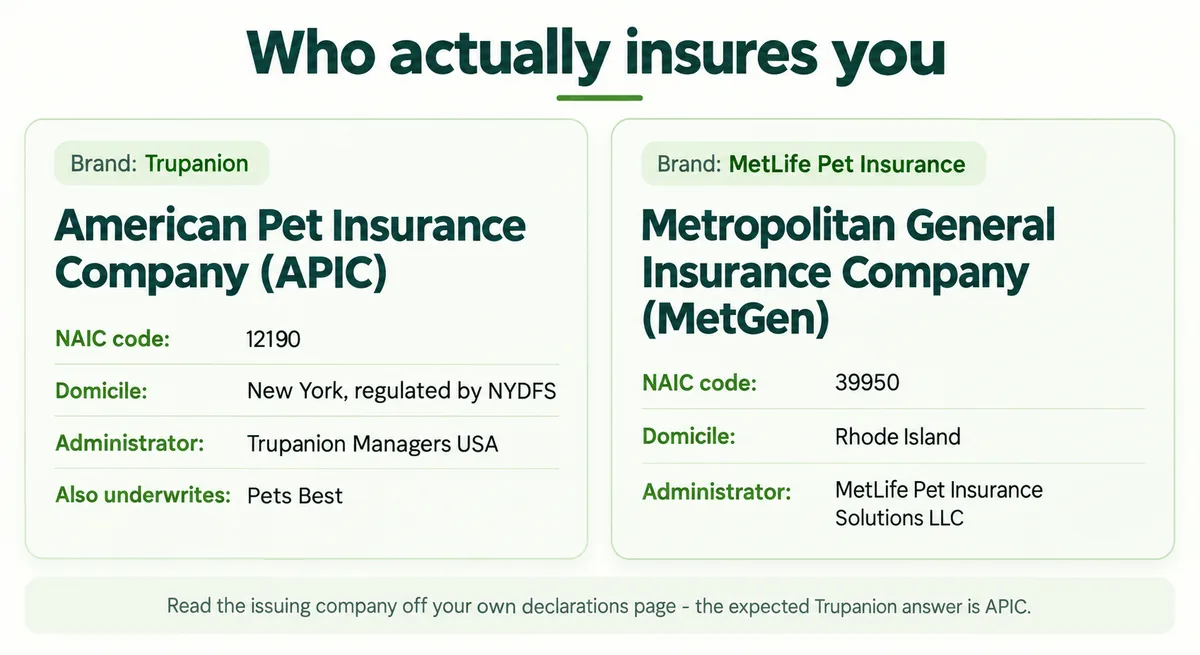
Your declarations page prints the issuing company. Trupanion's filed 2022 form says "American Pet Insurance Company or ZPIC Insurance Company," but ZPIC "has not yet begun underwriting activity," so expect APIC.
APIC also underwrites Pets Best (through the third quarter of 2028), so a Pets Best owner "switching to Trupanion" may keep the same insurer on a different contract.
APIC holds a Demotech Financial Stability Rating of A′ (A Prime); MetGen holds AM Best's A+ (Superior) / "aa-", affirmed April 1, 2026. Different agencies and scales: neither outranks the other.
Paperwork naming PetFirst or Independence American is a legacy contract with a different insurer, parent and regulator (Independence American is not a MetLife subsidiary), and nothing here describes it.
“Trupanion” is five doors, “MetLife” is two
“Trupanion” is sold five ways (direct, via a State Farm agent, as Chewy CarePlus, and as two Aflac worksite plans), carrying three different contracts. “MetLife” is sold two ways, retail or through an employer, on one policy. The door, not the brand, sets your deductible unit, payout limit and exam fees.
| Door | Deductible unit | Payout limit | Exam fees |
|---|---|---|---|
| Trupanion direct | Per condition, for life | None (lifetime “No limit”) | Excluded |
| State Farm agent | Direct contract, by referral | As direct | Excluded |
| Chewy CarePlus (2024 forms) | Annual, resets every 12 months | None stated | Essential: excluded · Complete: covered |
| Aflac worksite Unlimited (2023 form) | Per condition, for life | None | Excluded |
| Aflac worksite Basic (2023 form) | Annual, resets each renewal | Annual limit | Excluded |
| MetLife retail | Annual, whole policy | $500–$25,000 or unlimited | Covered |
| MetLife employer group | As retail, plus the group-only pre-existing waiver | As retail | Covered |
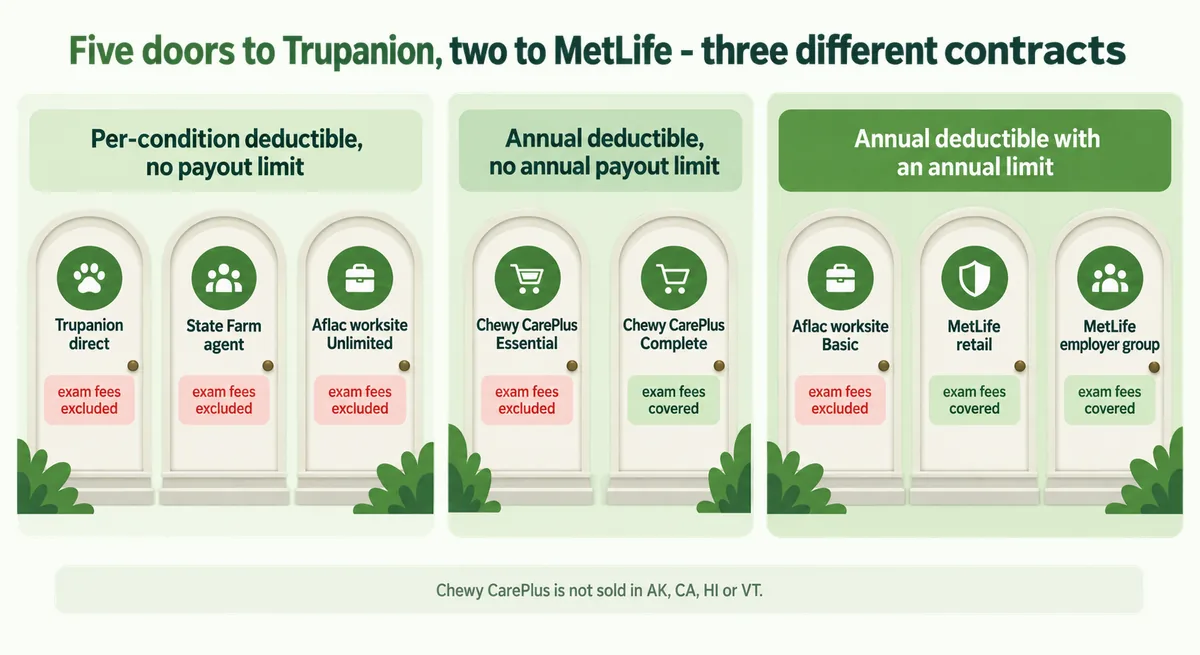
Three structures hide there: per-condition, no payout limit (direct, State Farm, Aflac Unlimited); annual deductible with an annual limit (Aflac Basic, MetLife’s shape); annual deductible, no annual limit (Chewy CarePlus: a hybrid, not a MetLife clone). State Farm “neither offer[s] nor [is] financially responsible” for it and its agents “cannot file or process a claim for you”; the Aflac rows are all we could verify of the worksite program.
MetLife’s employer version adds a 10% group discount and a pre-existing waiver MetLife restricts to coverage bought “as part of an employer group benefit offering”; retail, on the same Metropolitan General paper, gets neither.
Is Chewy CarePlus just Trupanion?
Same insurer, opposite contract. Read the direct and CarePlus rows (per condition versus annual, exam fees excluded “of any kind” versus covered on Complete), then add the payout order: direct Trupanion applies your percentage before the deductible; CarePlus takes the deductible first. “Choosing Trupanion” at Chewy buys the reverse product. Essential becomes Complete only within 30 days of enrollment; CarePlus is not sold in Alaska, California, Hawaii or Vermont; and Chewy also sells Lemonade-underwritten plans and two Trupanion-offered wellness plans (the direct product excludes wellness), so “Chewy pet insurance” is not a synonym for Trupanion. One owner in a July 2026 Reddit thread had settled on Trupanion, then “stumbled upon the Chewy Trupanion plan that has the once-a-year deductible instead of a per condition deductible” and asked what they were missing; the replies turned on the annual deductible and the exam-fee coverage, not on the shared insurer.
The deductible unit is the money
A like-for-like Trupanion-versus-MetLife quote cannot be built: the two policies do not share a unit of account. What you can compare is your cost on a stated claim pattern: on the same $6,000 of care, it swings $450 either way.
Why no matched quote exists
The deductible unit, what one deductible is charged against, differs: direct Trupanion charges it once per condition, for the pet's life; MetLife charges it once a year against "the Policy as a whole." Nor is the limit axis shared: MetLife sells $500 to $25,000 a year, or unlimited; Trupanion's filed declarations page prints a lifetime "No limit" and no annual field. Any paired monthly price averages two different contracts under one label. MoneyGeek shows the trap: it scores both "with a $500 deductible, $5,000 annual limit and 80% reimbursement rate," yet its own Trupanion column reads "per condition for the lifetime of the pet," "Unlimited," "90%": three of its four settings do not exist on the Trupanion side.
The $450 swing
WhiskerCover worked examples from the filed terms, not carrier figures: $250 deductible, 90% reimbursement, deductible first on both sides (isolating the unit), all charges eligible, no limit binding, exam fees ignored, premiums excluded; add those separately.
| $6,000 of care | Per condition (Trupanion direct) | Annual (MetLife) | Gap |
|---|---|---|---|
| A. One condition, $2,000/yr for 3 years | 1 deductible: pays $5,175, you $825 | 3 deductibles: pays $4,725, you $1,275 | Trupanion better by $450 |
| B. Three unrelated conditions, $2,000 each, 1 year | 3 deductibles: pays $4,725, you $1,275 | 1 deductible: pays $5,175, you $825 | MetLife better by $450 |
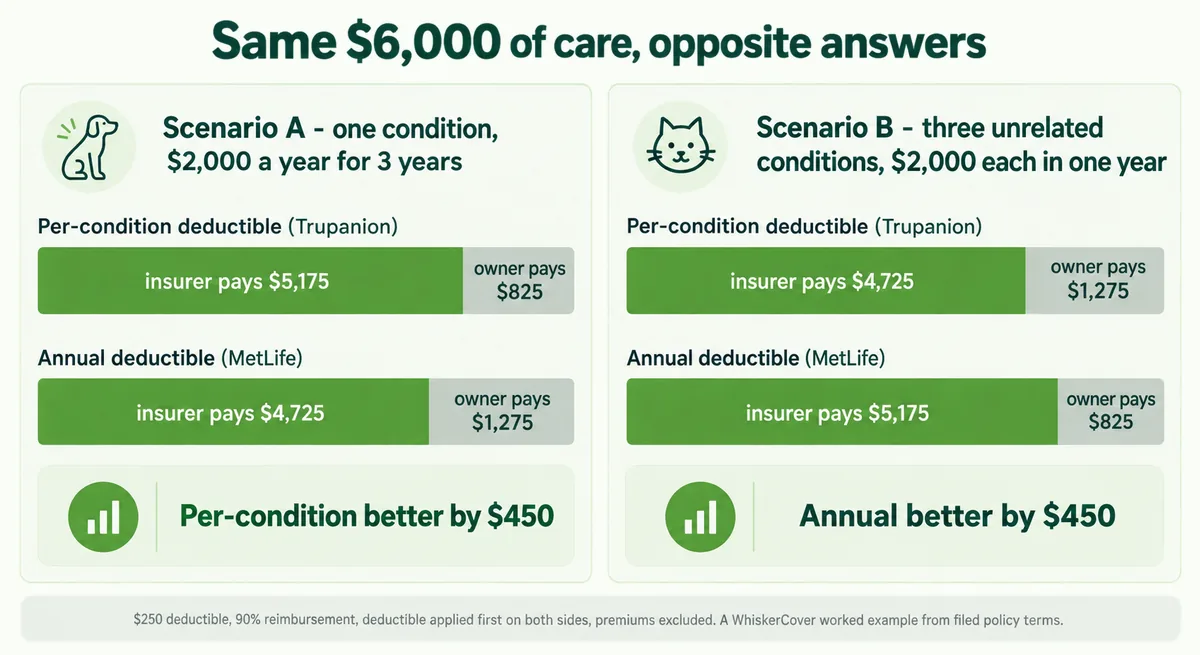
Those are modest inputs: a bigger deductible, more years on a chronic condition or more unrelated conditions grow the swing without bound. Here it is about $225 per extra year or condition, provided each year's bills exceed the deductible; below that it shrinks to tens of dollars.
What counts as one condition?
Owners report scenario B's failure mode, a per-condition deductible paid repeatedly because separate episodes get coded as separate conditions: a $100 deductible paid twice in three months for two foreign-body ingestions, or five years and twelve claims on a $1,000 deductible with nothing ever paid. Unverified single-household reports from a grievance-heavy forum, but the fix they settled on has the right shape: where two episodes are medically related, ask your vet to write that relationship into the chart, and appeal a repeat deductible with that note ("have your vet say if they are related"). Matching wording alone does not make two separate injuries one condition; a documented medical relationship is what an appeal can rest on.
The smaller thing is the payout order: deductible before or after your percentage. Direct Trupanion's Florida and Pennsylvania disclosures (Sept. 2023) work percentage first ("$1,000 x 90% = $900," then "$900 - $250 = $650"), while MetLife and Chewy CarePlus take the deductible first and pay $675. The gap is your uncovered share of the deductible, $25 per condition at $250 and 90% and $75 across three, and it never grows with the bill: $25 on a $1,000 or a $50,000 invoice. Trupanion's own X-ray FAQ, though, works it deductible first ($600 bill, $200 deductible, "90% of the remaining $400, or $360"), which is unresolved, so read the example on your own declarations page. In Mississippi, Nebraska, New Hampshire and Delaware, confirm the unit too: that disclosure omits "per Condition" and prints no example. Keep the proportion: the unit swings $450 and grows; the order swings $25 a condition.
Exam fees, and why they recur
Direct Trupanion never pays the exam fee; MetLife covers it, listed under Diagnostics; on Trupanion's other doors, it depends: Chewy CarePlus Complete covers it, Chewy Essential and both Aflac worksite forms (Unlimited, Basic) exclude it.
"We do not cover Examination fees of any kind," says the 2022 direct form; the 2019 edition lists them first under "what you pay." They recur by definition: both editions count in-hospital exams, office fees and "referral, recheck, or telemedicine consultations" as Examinations, so every specialist consult, ER progress check and chemotherapy recheck is one.
One owner on weekly lymphoma chemotherapy, each visit billed as a recheck, put the uncovered fee plus 10% coinsurance at "around $400 a week"; another counted three exams in one ICU stay under 24 hours (unverified owner reports; the mechanism is contract text).
Our worked example from the filed terms, not carrier figures — $500 deductible, 90%, each product's own payout order, not the $250 scenarios above: one condition at $2,000 a year for three years leaves you $1,100 on direct Trupanion against $1,950 on MetLife, $850 ahead — $23.61 a month of premium headroom over 36 months. Add a $100 eligible exam each year and the lead is $580, or $16.11 a month.
A pricing input, nothing more: a reason to quote CarePlus Complete or MetLife against direct Trupanion, never a reason to space out rechecks. How often your dog or cat is seen is your veterinarian's call; which contract absorbs the fee is yours.
Claim day: who pays the vet
MetLife pays you, never the hospital, by contract: "Any claim that is payable will be paid to You, not the Veterinarian." Because "Your rights under this Policy are not assignable," a hospital cannot take the benefit in your place, and neither its claims page nor its FAQ describes any pre-approval or preauthorization step, only "there's no direct payment between the vet and us"; whether any advance coverage assessment is offered is not something those pages establish.
Trupanion's VetDirect Pay™ is written as three tiers, not two. For enrollments dated 1/1/2023–3/8/2026 (TRU (C) 00001): a portal hospital, where "You pay only Your Share of the bill at checkout"; a non-portal hospital, where you may elect payment to the vet "if We have an arrangement with Your Hospital to do so"; neither, where "You must pay Your Pet's invoice" and claim reimbursement. The 2019 form keyed it to "the treating Veterinarian," and Maine routes enrollments on or after 3/9/2026 to a D-series disclosure, so read your own edition.
Filing clocks differ: 12 months of the visit on Trupanion's live pages (the 2019 form's 90 days is dated text); 90 days of the invoice date at MetLife, which then has up to 30 days from complete proof — "within 5 days" in its body, "5-10 days" in its footnote — and pauses its appeal clock the same way.
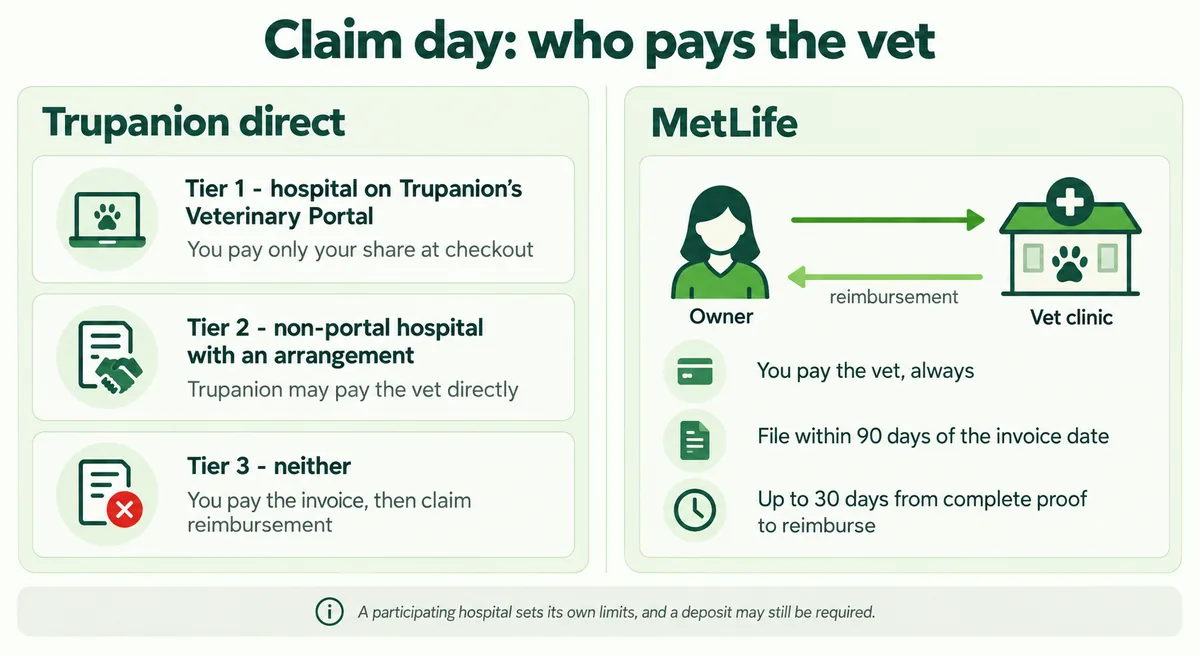
The sharpest documented limit is a participating hospital's own rule: MSPCA-Angell in Massachusetts accepts Trupanion direct payment "for all inpatient visits" and, "regardless of whether or not your insurance company is able," none for outpatient visits. Nor is direct pay a zero-deposit admission: Friendship Hospital for Animals in Washington, DC offers it and separately states "deposits may be required, along with a signed estimate, for hospitalized stays and/or elective surgeries/procedures."
The demand is loud and the awareness thin: on the largest Quora thread we found asking why insurers can't just pay the vet, not one answer we read names Trupanion or VetDirect Pay (a forum observation); one Reddit owner found "in my area there aren't a ton of vets who offer the direct pay option." So before you buy, call your clinic and the emergency hospital you'd actually use at 2 a.m., and ask three things: does it run the Trupanion portal, will it submit direct payment for your policy and this kind of visit (outpatient included), and what deposit it takes while approval is pending.
Pre-existing conditions, bilateral clauses, and the one employer-only bridge
Both contracts refuse conditions that started before coverage, by the same three-part test. What differs is whether the bilateral rule is written down, and whether any route carries an already-covered condition across: MetLife has one, employer-only; Trupanion none at retail.
A condition is pre-existing if, before your effective date, a vet advised on it, your pet was treated for it, or it showed signs, "even if the Condition… has not been diagnosed" (Trupanion's 2022 form, §4.A.I); MetLife's PET21-01-V runs the same test. A bilateral condition can occur on both sides of the body; a bilateral clause excludes the second side once the first shows signs.
| Clause | Trupanion direct (APIC) | MetLife (MetGen) |
|---|---|---|
| Bilateral | Enumerated: 13 conditions with signs "on either side of their body" before the effective date, no lookback (2022 form, enrollments 1/1/2023–3/8/2026); 8 conditions inside 18 months in the 2019 form. | Silent: zero occurrences of "bilateral" in the specimen policy or Florida disclosure; a May 27, 2026 article says it "may not cover" the second side. |
| Cure route | None in any form we read. | A later "unrelated" episode "could be covered"; no symptom-free clock published; not for chronic conditions. |
| Bridge for a covered condition | None at retail. The top worksite tier (Aflac Unlimited form, §1.b) carves in "allergies, dermatitis and otitis" only; the Basic form carves in nothing. | Employer group only. Retail: "We don't cover any charges incurred for a Pre-Existing Condition." |
Don't score the bilateral row: Trupanion's list is broader on its face but legible before you buy; MetLife's silence leaves no enumerated clause to point at, so a second-side decision rests on the general pre-existing definition and the medical evidence rather than on a named rule.
The bridge is MetLife's, and so is the fence, a footnote repeated across its pages: "Pre-existing coverage only available to individuals with active pet insurance coverage that have purchased MetLife Pet Insurance as part of an employer group benefit offering," and only "without a gap in coverage." The endorsement's name, "Pre-Existing Condition Waiver Endorsement," and its proof list for your first claim (an EOB or declarations page from the prior insurer) come from Microsoft's benefits page, not any MetLife document; MetLife does not publish the endorsement.
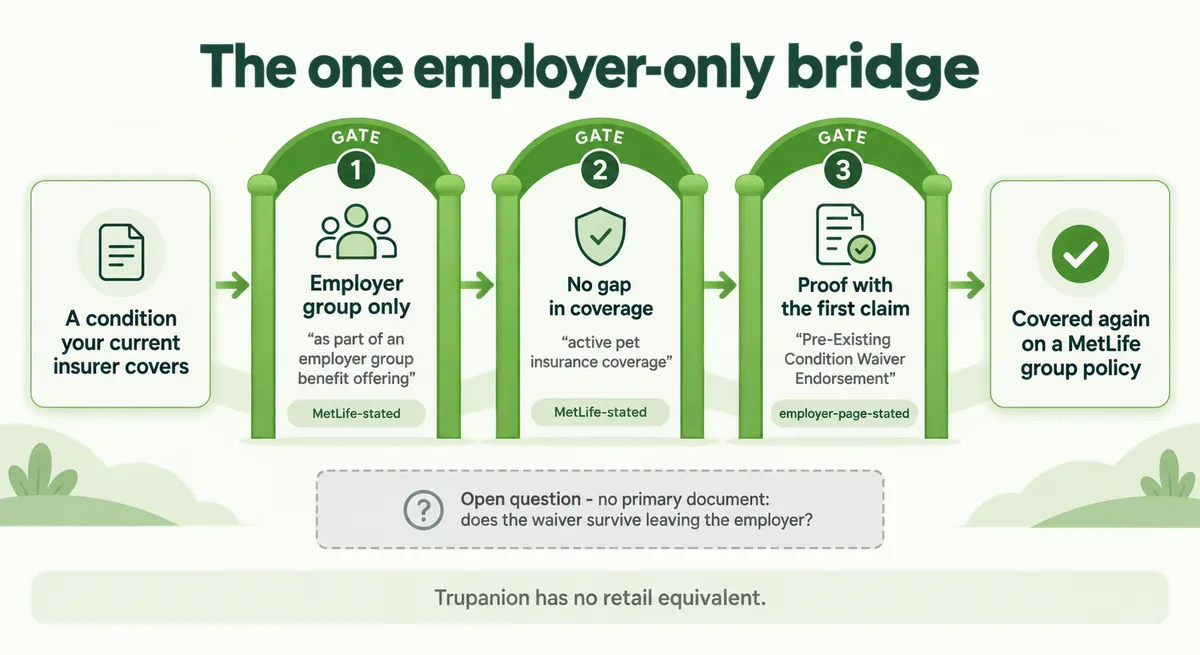
No primary document says whether the waiver survives the job. The University System of Georgia FAQ says the policy is portable, losing only the group discount; one owner reports "NLNG continued" after leaving, a single unverified household. Get it in writing first.
So a covered condition crosses one way only: into MetLife, through an employer, with no lapse. Every other switch puts the condition through the new policy's pre-existing test, which an active or recently treated condition fails on both retail contracts; only the narrow routes this page has named change that (MetLife's unrelated-episode reading, the 18-month lookback that bounds Trupanion's 2019 edition, the Aflac worksite carve-in), and a Trupanion per-condition deductible already met stays behind either way. Calendar decisions about policies are never a reason to put off a vet visit; the chart is what later proves an episode unrelated.
What changes at renewal
Both underwriters have taken repeated approved increases, and neither carrier's filed disclosure prices your pet's own claims. What differs is what each says about age, what California's regulator actually let each one charge, and two renewal rewards that only MetLife writes into its contract.
What California actually approved
California is the one public record with a requested column beside an approved column, and its closed prior-approval list carries both underwriters. These are the Trupanion-program rows for American Pet Insurance Company and the pet rows for Metropolitan General:
| Underwriter (program) | CDI file | Requested | Approved | Closed |
|---|---|---|---|---|
| APIC (Trupanion) | 24-32 | 51.5% | 28.9% | May 15, 2024 |
| APIC (Trupanion) | 24-2461 | 33.1% | 31.7% | May 12, 2025 |
| APIC (Trupanion) | 25-2461 | 28.1% | 19.0% | April 15, 2026 |
| MetGen (MetLife pet) | 23-1508 | 56.0% | 56.0% | March 6, 2024 |
| MetGen (MetLife pet) | 25-180 | 20.0% | 20.0% | July 7, 2025 |
| MetGen (MetLife pet) | 25-2234 | 40.0% | 36.9% | March 24, 2026 |
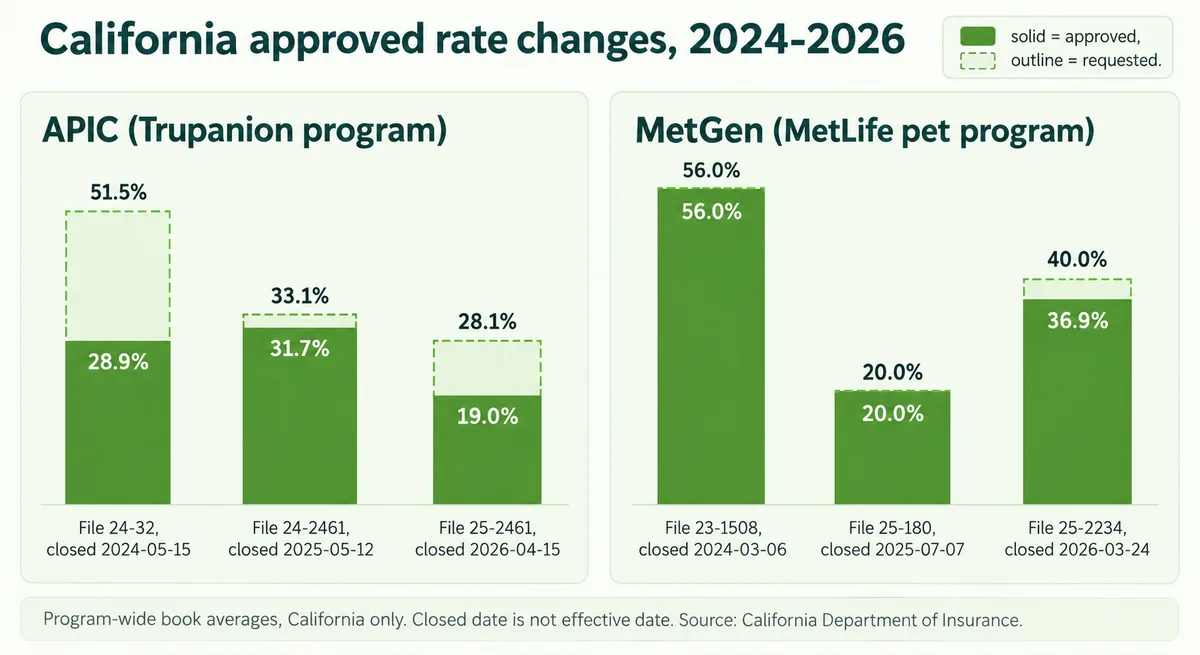
The under-reported part is the gap between the columns. Two of Trupanion's three filings were cut hard, by 22.6 and 9.1 points; MetGen's were granted in full twice and trimmed once. That is a different regulatory posture over the same window. Compounding only the approved figures gives roughly +102% for the Trupanion program and +156% for MetGen, but the filing windows don't line up, so read that as a direction, not a lifetime bill.
Four caveats travel with every one of these percentages:
- Book averages. Each is a program-wide average across every insured pet in the state, not anyone's renewal.
- California only. No other state's requested-and-approved record was obtained, so nothing here transfers to your state.
- Closed is not effective. The closed date is when the regulator finished, not when a premium moved.
- Channel is invisible. MetGen's rows read "PET INSURANCE"; retail and employer group cannot be told apart.
One trap for anyone who opens the workbook: APIC also files for Pets Best. The largest APIC approval on the record, 53.4% in file 26-52 (closed May 26, 2026), is a Pets Best row, and so are 23-3716 and 24-2140. An APIC row is a Trupanion row only when its program cell says so.
Why your renewal letter won't match the state's number
Trupanion's 10-K supplies the timing. Pricing adjustments "generally roll onto our book of insured pets over the succeeding twelve months following any applicable regulatory approval," and regulators "may reduce or disallow our pricing changes." An approval closed in April reaches individual renewals one anniversary at a time over the following year, at whatever a pet's own cohort and ZIP code produce, so your letter and the state's figure differ in size and in date by design. That roll-on sentence is the only carrier-published description of this timing we have; MetGen's filings show the approvals, not how they land.
Does claiming raise your premium, or is it your pet's age?
Owners ask it as one question. The filed disclosures answer it as two, and only in the states where they say anything. MetLife's Florida disclosure (2023 edition): "The Policy does not reduce coverage or increase premiums based on the Pet Parent's claim history," then "Premiums may increase based on: a change in Your address; a change in coverage; or the age of Your Pet, upon renewal." Trupanion's Florida disclosure (September 2023 edition): "Premiums will not increase based on Your claim history or the age of Your covered Pet," followed at once by "Premiums may increase or decrease if You move to a new ZIP code."
| Filed renewal position (Florida editions) | Trupanion direct (TRU (D) 00012 FL, Sept 2023) | MetLife (PET-DISC-2023 FL) |
|---|---|---|
| Your pet's claim history | Not a basis for an increase | Not a basis for an increase |
| Your pet's age at renewal | Not a basis for an increase | A stated basis for an increase |
| Moving | A new ZIP code may raise or lower premium | An address change may raise premium |
Read Trupanion's bullet narrowly. It is Florida's edition: the Pennsylvania edition has no such line, only "If You move, the cost of Your policy may change." And it says premium doesn't rise because of your pet's aging or claims, not that it never rises: the approvals above are book-wide and roll onto every renewal in the state, on top of the ordinary levers of location and plan design. One first-renewal owner in the September 2026 thread reports a 24% increase with no claims and says the ZIP code was the reason given. Whether direct Trupanion reprices attained age outside Florida is something no document we could read settles.
MetLife's two renewal rewards, and the one-way ratchet
MetLife's specimen policy (PET21-01-V, a 2021 edition) writes two rewards into renewal. The Healthy Pet Incentive: for each policy period with no claim payments and no break in coverage, the deductible drops $50 at renewal "until it results in a $0.00 Deductible." A paid claim reverts it to the original amount for the following term and restarts the count, though a preventive-care payment "will not cause the Deductible to revert to its original amount." A $250 deductible reaches $0 after five claim-free renewals; one reimbursed illness in year four puts it back at $250.
The Automatic Policy Limit Increase: a limit of at least $5,000 with $1,000 or more unused at year end grows by $500 at renewal at no added cost, but it "will not apply if You make any change to Your plan upon renewal," is never any amount but $500, and "cannot be stacked": $5,000 becomes $5,500 once, not $6,000 the year after. Employer enrollees describe both in practice, a $5,000 default limit rising $500 and the deductible falling $50, in an unverified owner account.
The ratchet runs the other way. An illness that began under an earlier policy year is paid "up to the policy limit that applied under that Prior Policy," while "a benefit decrease upon renewal will apply to any Illness or Injury… even if the Illness or Injury first manifested itself under a Prior Policy." Raise your limit later and the condition your dog already has keeps its old ceiling; lower it to save premium and the cut reaches back. Nothing in the Trupanion forms we read carries a comparable reward or ratchet; its consequential choices sit in the first 30 days, not at renewal.
The Reddit spread: +$20 in 11 years, +$230 in 3
Owners cannot reconcile their own numbers, and that is the finding. In one September 2026 r/petinsurancereviews thread, a dog insured in January 2013 at $46.10 a month was at $139 a month when she died at 13 ($50 deductible, 90%, unlimited), with years it rose and years it dropped; another owner in the same thread reports "over the past 11 years, my dog's premium has gone up less than $20/month TOTAL" on a $1,000 deductible. In a second thread, an owner who places themself in California reports $170 to $400 a month by the third renewal, with the per-condition deductible raised twice to hold it there. MetLife's reports run the same way: $85 to $130 for two six-year-old dogs through an employer, and one owner raised 80% in a year to $1,600 for an unlimited plan.
Every figure is a single household's unverified report from a forum where several of the most confident voices say they work for insurers or benefits brokers, and no two are matched quotes. But the ledger and the roll-on mechanism are the closest honest explanation: the same brand, different enrollment cohorts, ZIP codes, deductibles and anniversary dates, each catching a different slice of a different year's approval. As one owner put it, "we have to commit to them… they don't have to commit to us." If your renewal jumped, our California renewal-shock playbook shows how to look the approval up, and the next section covers what you can still change and when.
Decisions with a clock on them
On direct Trupanion, in every edition we could read, the choices that shape the policy for the rest of your pet's life lock on day 30; on MetLife, they wait for the renewal date. Both give you 30 days to hand the policy back for a full refund. Owners in the threads we read found Trupanion's windows around month three, after they had closed, so here is the calendar in one place.
| Decision | Trupanion direct (2019 and 2022 form editions) | MetLife (2021 specimen policy) |
|---|---|---|
| Lower the deductible | First 30 days only; raise it any time | Renewal only; raise it any time |
| Raise the payout percentage | First 30 days only; lower it any time | Renewal only; lower it any time |
| Add a rider or raise the limit | Recovery & Complementary Care and Breeding riders: first 30 days only, removable any time. Pet Owner Assistance Package: add or remove any time | A higher limit, or any change that raises the premium: renewal only |
| Change anything at renewal | No renewal reward to forfeit in the forms we read | Forfeits that year's $500 Automatic Policy Limit Increase |
| Return the policy for a full refund | 30 days from receipt, if no claim has been filed; the Medical Record Summary and ID-tag fee is kept | 30 days from receipt, if no claim has been filed; the first policy only, never a renewal |
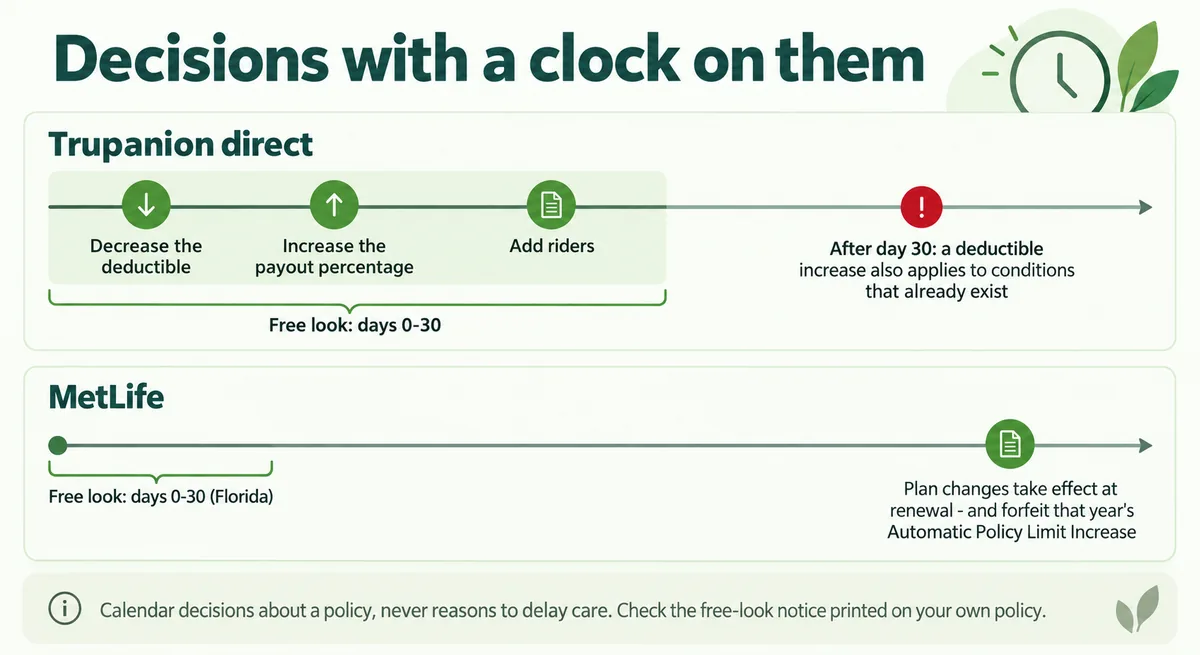
Chewy CarePlus keeps its own 30-day clock: Essential can be upgraded to Complete "at any time up to 30 days after your enrollment date," anything that appears before the upgrade takes effect stays on the plan you started with, and its deductible can be lowered in the first 30 days or, unlike direct Trupanion's, again at each annual renewal.
How a Trupanion change lands, and why raising the deductible reaches backwards
The deductible and rider windows sit in Section 1.B of the 2019 form, "Policyholder-initiated changes," and nothing there is immediate. A new deductible "will become effective 30 days after Your next billing date for Illnesses and 5 days after Your next billing date for Injuries," and a rider added inside the window starts on the same schedule: bill on the 1st, ask on the 10th, and the illness side begins about seven weeks later. The payout-percentage window is 2022-edition text, an increase "only within the first 30 days after You add Your Pet," effective on the next billing date, with a decrease allowed at any time.
Then the clause owners miss: "Claims submitted after a deductible change for the treatment of Illnesses or Injuries that exist at or before the effective date described above will be subject to the higher deductible amount." Raise a $250 per-condition deductible to $500 to trim the premium and a condition your dog already has is charged against the $500; lower it inside the window and a condition that already exists stays at the older, higher figure. Riders follow the same shape, with no rider coverage "for conditions that exist before the effective date."
This is the month-three discovery. One owner whose cat paid a $100 per-condition deductible twice in three months wrote, "I had the option to lower his deductible in the first 30 days but at the time i was not aware i would have to pay the deductible so much," and cannot lower it now because cancelling and re-enrolling would make the condition pre-existing (an unverified single-household report). The rider the same window governs is the one that buys rehabilitation, acupuncture, hydrotherapy, chiropractic and behavioral therapy; another owner reports paying "$34.95 extra per month" for it, having expected those to be standard. Decide on it before day 30, because after that the only route back in is a new policy with a new record review.
MetLife: everything that costs more waits for the anniversary
MetLife's specimen states it in one line, "Benefit Increases are only allowed at Policy renewal," and defines a Benefit Increase as "raising the Policy Limit or Covered Percentage, decreasing the Deductible, or making any change to Your coverage that would cause Your Premium to increase." You may ask to decrease benefits at any time, effective "on a date approved by Us," with the unneeded premium refunded; a policy written on a 30-day policy period allows no mid-period changes at all. An increase taken at renewal reaches only an illness or injury "that first manifests itself after the effective date of the Benefit Increase," while a decrease reaches back, as the renewal section showed. And the price of touching anything at renewal is that year's automatic $500 limit increase, which "will not apply if You make any change to Your plan upon renewal."
The free look, and the fine print under it
Every filed disclosure we read gives 30 days. Trupanion's Maine disclosure: "You have 30 days from the day you receive this policy, certificate or rider to review it and return it to us if you decide not to keep it," as long as no claim has been filed, with the premium refunded within 30 days of the return and the Medical Record Summary and ID-tag fee kept; the September 2023 Florida, Pennsylvania and Mississippi, Nebraska, New Hampshire and Delaware editions carry the same 30 days. MetLife's Florida disclosure gives "30 days from the day You receive Your Policy," a full refund within 30 days of the returned policy arriving, and one limit Trupanion's editions do not print: it "only applies to the initial policy," not to renewals; the 2021 specimen indexes a "30-Day Free Look" on its declarations page. Whether your state or edition prints a different number is settled by the notice on your own policy, and the state section covers where the statutes now diverge. Trupanion's Medical Record Summary is promised "within the first 30 days after Your Effective Date," a window meant to coincide with this one, though the free look counts from receipt and the summary is "to the best of Our ability"; what to do with it comes later.
Two scope notes travel with this table. The deductible and rider windows are February 2019 D-series text (TRU (D) 00001 V10.201902, now more than seven years old); the payout-percentage window and the cancellation terms are June 2022 C-series text, which Trupanion's Maine notice applies to enrollments from January 1, 2023 to March 8, 2026, routing later enrollments to a D-series disclosure; and the current direct edition, TRU (D) 00001.1 (V01.202309), could not be read by any route, so confirm each window against the policy you are issued. And every item here is a calendar decision about a policy. None of them is a reason to move a vet appointment.
When your state changes the answer
Seventeen jurisdictions now have a pet insurance act built on the NAIC's model, by the NAIC's own state-by-state tally (Summer 2026 edition): California, Delaware, Florida, Hawaii, Louisiana, Maine, Maryland, Mississippi, Montana, Nebraska, New Hampshire, New Jersey, Ohio, Pennsylvania, Rhode Island, Vermont and Washington. Maine, Pennsylvania and the Mississippi-Nebraska-New Hampshire-Delaware group whose Trupanion disclosures this page quotes are all on that list. This section reads the three newest: Florida's and Rhode Island's took effect on January 1, 2026, and New Jersey's follows on January 1, 2027. New York, where Trupanion's insurer is domiciled, vetoed its bill on October 16, 2025, and in a state with no act, the free-look and waiting-period notice printed on the policy itself is what you have to read. In the three newest acts the statute sets floors the contract has to meet, and it moves two answers this page has already given: how long the free look runs, and whether a waiting period has to be waivable.
| Provision | Florida (Fla. Stat. §627.71545, in force since Jan. 1, 2026) | Rhode Island (R.I. Gen. Laws ch. 27-83, in force since Jan. 1, 2026) | New Jersey (P.L. 2025, c. 224, in force from Jan. 1, 2027) |
|---|---|---|---|
| Free look | 30 days | 15 days | 30 business days |
| Waiting period for accidents | Prohibited | Prohibited | Prohibited |
| Waiting period for illness or orthopedic conditions | No more than 30 days; "orthopedic" is defined to include cranial cruciate ligament rupture | No more than 30 days | No more than 30 days; "orthopedic" is defined to include ruptured cranial cruciate ligaments |
| Waiver of the wait after a vet exam | The contract must allow it | The contract must allow it (§27-83-4(c)(1)) | Not required; the insurer need only disclose any exam it requires and warn that the exam's findings can become a pre-existing exclusion (§5.f) |
| Coverage must start by | Not specified in the act | 12:01 a.m. on the second calendar day after purchase, with four exceptions | 12:01 a.m. on the second calendar day after purchase, with the same four exceptions |
| Who must prove a pre-existing exclusion applies | The insurer | The insurer | The insurer |
The three acts share a spine, the NAIC's Pet Insurance Model Act (#633), adopted in August 2022, and the parts that read like state consumer wins are the model's baseline: the insurer carries the burden of proving a pre-existing exclusion applies, a condition covered on one policy cannot become pre-existing at renewal, and a waiting period must be waivable after a vet exam. Florida and Rhode Island carried all three; New Jersey dropped the waiver. What diverges is the free look. The model's §4.B(1) gives you 15 days to examine and return the policy, and its 30 days is a separate deadline for the insurer's refund. So Rhode Island's 15 days is the model, Florida's 30 exceeds it, and New Jersey's 30 business days runs longer than either. The 30 days printed in every disclosure the previous section quoted is above the model, not "the standard," and the number you can rely on is the one printed on the first page of your own policy, which in these states cannot be shorter than the act's floor.
One date matters for both carriers' Florida paperwork. MetLife's Florida disclosure is the 2023 edition and Trupanion's is September 2023, while Florida's act was enacted as Chapter 2025-11 and took effect in 2026. Both already print a 30-day free look, so on that point they match the statute; but anything Florida-specific this page quotes from them is older than the law it now sits under, and the packet you are issued, not a 2023 PDF, is what governs.
Trupanion's terms run by enrollment date, not just by state
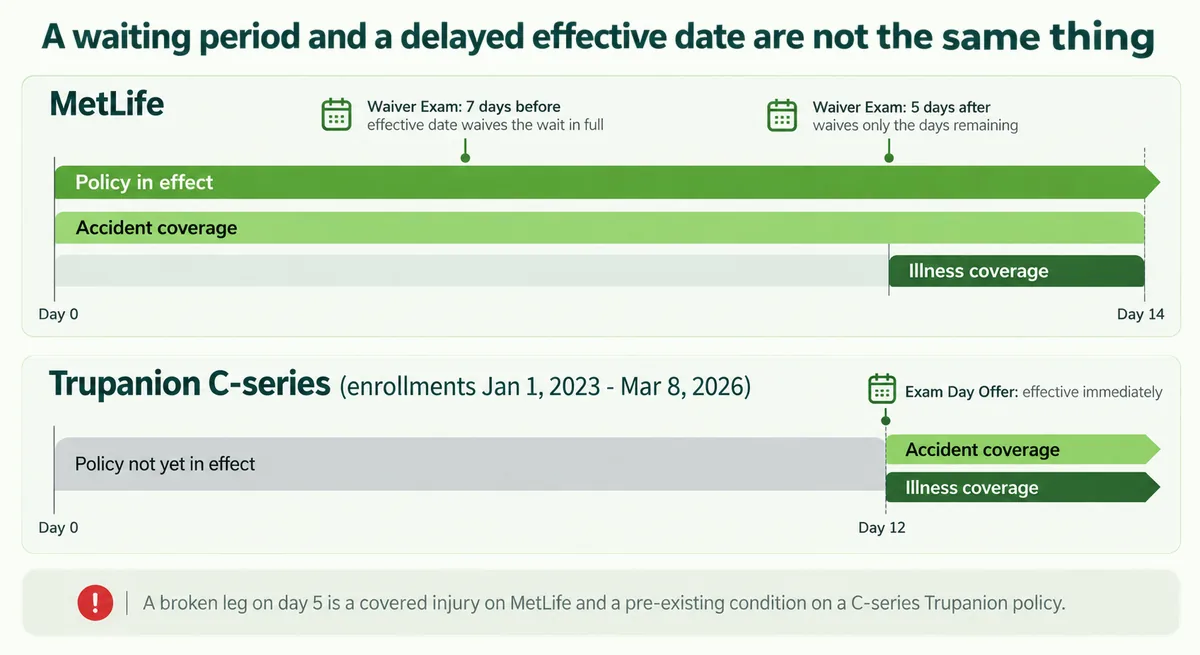
Trupanion's own Maine notice routes policies by when you enrolled, in three buckets. Enrollments from January 1, 2023 to March 8, 2026 take the C-series, whose Maine disclosure reads: "This policy does not have any waiting periods. The policy becomes effective 12 days after you enroll, and your monthly payment will be collected on your effective date. If you enroll with an Exam Day Offer, your policy becomes effective immediately." Enrollments on or after March 9, 2026, and pre-2023 policies renewed since, go to a D-series disclosure that restores "a 30 day Waiting Period for Illnesses" and "a Coinsurance and per Condition Deductible"; the February 2019 forms carried a 30-day illness and 5-day injury wait. There is no single national Trupanion waiting-period rule to quote, and any list of delay states is incomplete: MoneyGeek names ten ("DE, LA, MD, MS, MT, NE, OH, PA, VT and WA: 12-day delayed effective date"), Maine is not among them, and Maine's filing prints the same 12 days.
Is a delayed effective date a waiting period?
Florida defines a waiting period as "the period of time specified in a pet insurance policy which is required to run before some or all of the coverage in the policy may begin." The two carriers build their starts differently, and whether that definition reaches Trupanion's delay is the open question at the end of this section. MetLife's construction is a clock that starts once coverage is in force: coverage starts at midnight on your effective day, injuries are covered from that moment, and illness coverage begins 14 days later. Trupanion's C-series construction defers the start itself. For 12 days after you enroll the policy is not yet in effect, and your first monthly payment is not collected until the effective date; on day 12 a policy with no wait begins, for accidents and illnesses alike.
The difference shows on the calendar. A broken leg five days after MetLife's effective date is a covered injury, subject to the policy's other terms; a broken leg five days after you enroll on a C-series Trupanion policy happened before the effective date, so it is a condition the policy excludes as pre-existing. An illness that first shows in those same five days: on MetLife it began "during any Waiting Period," so it is pre-existing; on Trupanion it predates the effective date, so it is pre-existing too. On illness the two constructions converge; on accidents they do not. The lever that removes Trupanion's delay is the Exam Day Offer, an enrollment certificate under which "your policy becomes effective immediately"; its certificate terms exclude New York and differ in some jurisdictions. Whether a 12-day delay counts as a "waiting period" under Fla. Stat. §627.71545, which bans waiting periods for accidents, has no regulator determination we could find, and we are not going to guess. Rhode Island and New Jersey wrote their answer into the act: a policy with no illness or orthopedic waiting period may set an effectuation date "up to fifteen (15) calendar days after purchase, as long as such policy effectuation date is clearly disclosed and no premium is earned before the policy becomes effective." That is the shape of a 12-day delay, though neither state has said so about Trupanion's, and Florida's act has no such clause.
MetLife's 14 days, and the waiver Rhode Island requires and New Jersey does not
MetLife's Florida disclosure sets "a 14 calendar day period that begins on the date coverage first takes effect," for illness only, not repeated at renewal if coverage is continuous; the 2021 specimen's Ohio declarations print the same 14 days, and MetLife's August 2025 explainer adds no separate orthopedic wait. The waiver is a Waiver Exam "at Your option and expense" covering "all body systems and parts": within 7 calendar days before the effective date it removes the wait in full; within 5 calendar days after, it removes only the days remaining, for illnesses that begin after the exam. Its documentation goes in with your first illness claim, and an illness the exam finds is pre-existing. The 14 days appears in the Florida disclosure and the 2021 specimen; the waiver appears in the Florida disclosure. Nothing we read states either as a nationwide term, and MetLife's own explainer says "Waivers aren't always available." In Rhode Island a contract with a waiting period must carry a waiver clause; in New Jersey it need not. On a C-series Trupanion policy there is no waiting period to waive: the delay is the thing, and the Exam Day Offer is the only lever.
So, by state: in Florida, Rhode Island and, from 2027, New Jersey, read the act's floors against the packet you are issued, and expect the free look to be the one place where a carrier's printed form and the statute may not match. In New York there is no act, so read the free-look and waiting-period terms off the policy itself; for the other fourteen model-act states, and everywhere else, our state-by-state guides cover what applies. Everywhere, these are calendar facts about a policy. A pet that limps on day 5 needs the vet on day 5 under either contract, and the record that visit creates is what the pre-existing section showed protects you later.
Multiple pets, and pets neither will insure
With two or three pets, MetLife offers a structure Trupanion does not: a Family Plan that puts up to three dogs and cats on one policy, with one deductible and one annual limit between them. Whether that helps you depends on which pooled number bites first. The shared deductible saves money in a year of small, scattered problems; the shared limit costs money in the year two pets are seriously ill at once. And if your pet is not a cat or a dog, there is no comparison to make, because Trupanion does not write it.
What MetLife's Family Plan pools
The pooling is contract language, not a marketing flourish. MetLife's Florida disclosure: "If more than one pet is covered under a Policy, the Deductible applies to the Policy as a whole, not per pet," and "The Policy Limit is the maximum dollar amount that We will pay for all pets covered under the Policy during the term of the Policy." The reimbursement percentage is shared too: you set deductible, limit and percentage "for the policy as a whole," a household with more than three pets is split across two or more Family Plans, and claims for pets on the same policy can be filed together. Our multi-pet guide covers the one-policy-or-separate question in general; here it is pairwise.
Two limits travel with the pool. MetLife's own footnote, printed in two employer distributions, the University System of Georgia's 2026 FAQ and Microsoft's benefits page, reads: "Family plan policies are limited to dogs age 12 and under and cats age 14 and under. Multi-policy discount is not available with Family Plans." On the retail Family Plan page that cap sits inside "Restrictions apply"; the employer pages print it in MetLife's words. It is a Family Plan rule, not an enrollment rule: MetLife's FAQ puts no upper age on an individual policy, with the footnote that "coverage options may be limited for certain ages," so a 13-year-old dog is shut out of the pool, not out of MetLife. And the discount cuts both ways: MetLife prices the Family Plan "at a discounted rate" without putting a number on it, while separate policies earn a multi-policy discount the pool forfeits.
The pooling stress test: one deductible saved, $7,100 exposed
WhiskerCover worked examples from the filed terms, not carrier figures, on the deductible section's inputs scaled up: $500 deductible, 90% reimbursement, every charge eligible, one condition per pet, exam fees ignored (Trupanion excludes them), premiums excluded. MetLife takes the deductible first, per the formula in its Florida disclosure; direct Trupanion takes its per-condition deductible percentage-first, per its Florida disclosure. In row 1 the MetLife limit is $10,000 a year, a selection from its $500-to-$25,000 menu, bought once for the pool or once per policy; Trupanion's declarations page prints no annual limit. In row 2 no limit binds.
| Household year | One MetLife Family Plan | Separate MetLife policies | Separate Trupanion direct policies |
|---|---|---|---|
| 1. Two pets, one $10,000 condition each ($20,000 of care); $10,000 MetLife limit | Pays $10,000, the shared limit; you pay $10,000 | Pays $17,100; you pay $2,900 | Pays $17,000; you pay $3,000 |
| 2. Three pets, one $2,000 condition each ($6,000 of care) | Pays $4,950; you pay $1,050 | Pays $4,050; you pay $1,950 | Pays $3,900; you pay $2,100 |
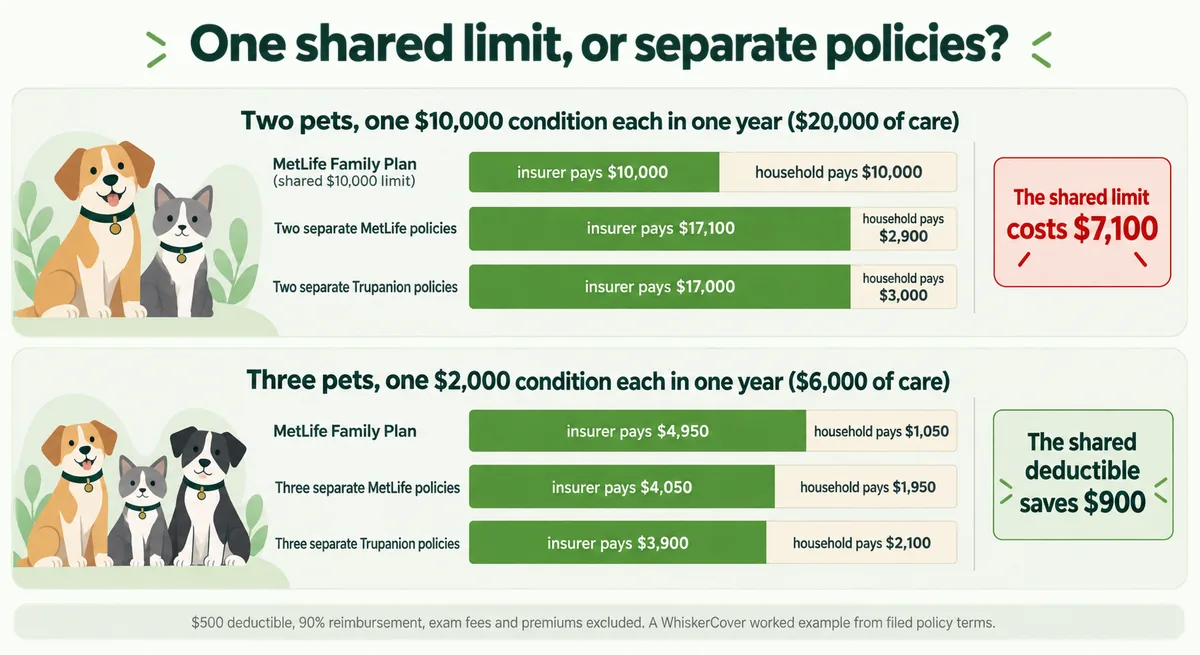
Row 1 is the "family discount" instinct meeting its downside. Pooling saved one $500 deductible, worth $450 of reimbursement at 90%, and the saving never showed up: a $10,000 limit bought with one pet in mind was asked to cover two, and it stopped at $10,000 of the $17,550 the formula would otherwise have paid. Against two separate MetLife policies at the same selections, pooling the limit cost this household $7,100; against two Trupanion policies, $7,000. Row 2 is the favorable half. Three modest, unrelated problems in one year meet one deductible instead of three, and the pool leaves you $1,050 where three MetLife policies leave $1,950 and three Trupanion policies, each charging its own per-condition deductible, leave $2,100.
The rule under both rows: the shared deductible pays off in the scattered year, and the shared limit is the danger in the concentrated one, which is the year insurance is for. If you pool, size the limit for the household, not for one pet. MetLife's menu runs to $25,000 or unlimited, but the unlimited option carries "Restrictions apply" and, in the employer FAQ, is "subject to availability. Pet age restrictions may apply," so confirm at quote which limits a Family Plan can carry.
Three things to settle before you pool
- Which pets qualify. A dog over 12 or a cat over 14 needs a policy of its own beside the pool, at MetLife or elsewhere. Nothing stops a household from mixing structures or carriers; our same-carrier-or-split decision tree walks it.
- What happens when a pet leaves the policy. One June 2026 comment in r/petinsurancereviews warns that when a pet on a Family Plan dies, "the policy gets reset and the deductible gets reset as well." It is a single unverified report, and no MetLife document we read says what happens to a pooled deductible or limit when a pet dies or is removed mid-term. Ask MetLife in writing before you pool.
- What pooling does not touch. Pooling is financial, not medical. Each pet's pre-existing exclusions are still its own, decided from its own records at its first claim; a pooled deductible does not pool the medical history.
Trupanion: one pet per policy, and cats and dogs only
Trupanion's filed declarations page has one row, for one pet (name, species, sex, enrollment age, breed) and a single limit line, "Maximum Lifetime Benefits Payment (Per Pet) — No limit." A second pet is a second policy. Nothing is shared: no pooled deductible to reach sooner, and no pooled limit to run out, because each pet's per-condition deductibles stand alone and the lifetime line reads "No limit" per pet. Whether a second policy is discounted is a quote-screen question that no filed form we read answers, so we do not state one.
Species is the harder edge. The 2022 Maine form (the January 1, 2023 to March 8, 2026 enrollment cohort) defines a Pet as "a domestic cat or dog owned for companionship or as a service dog and not owned for commercial reasons," and Trupanion's FY2025 10-K describes the business as "medical insurance for cats and dogs" in the United States, Canada and parts of continental Europe. There is no Trupanion product for anything else, in any state.
MetLife's exotic program is what fills that gap, and it is a separate product, not a feature. Its plans page says it has "welcomed reptiles, rabbits, ferrets, and birds," footnoted "May not be available in all states," and a MetLife-branded 2024 species list, circulated through an employer benefits site, runs from parrots, chickens and ducks through bearded dragons, snakes and tortoises to rabbits, ferrets, guinea pigs, chinchillas, hedgehogs, hamsters, mini pigs and sugar gliders. It runs on its own disclosure. The Washington edition (PET-DISC-2024-EXOTIC-R) is underwritten by the same Metropolitan General Insurance Company, uses the same deductible-first formula and 14-day illness wait, excludes pre-existing conditions the same way, and prints a 15-day free look where the cat-and-dog disclosures this page has quoted print 30: a different state and a different edition, so read your own. Which states, and on what deductible and limit menu, MetLife does not publish; the page says to call. For an exotic owner, then, this article is a disqualification rather than a comparison: price MetLife's exotic policy against going without, on its own disclosure, and treat every number above as a cat-and-dog number.
So, for the multi-pet household: two or three younger pets with a history of small, scattered claims favor the Family Plan's pooled deductible, provided the shared limit is sized for all of them; two pets who could each have a $10,000 year favor separate policies at either carrier, because the pooled limit is the risk; a dog over 12 or a cat over 14 gets a policy of its own either way; and a pet that is not a cat or dog gets MetLife's exotic policy or nothing, with no Trupanion column to weigh it against. For the single-carrier depth behind the pool, see the Family Plan section of our MetLife review.
What the medical record decides
Both contracts are decided from your pet's chart. What a veterinarian wrote down is what the insurer reads, and what was never examined can still be excluded but can never be defended. The difference between the two is when the chart gets read. Trupanion reads it first: its 2022 form promises a Medical Record Summary "within the first 30 days after Your Effective Date," the same 30 days in which that form refunds 100% on cancellation, so the exclusion list is meant to arrive while you can still hand the policy back. MetLife reads it at your first claim, when it asks for "the last 12 months of veterinary records." Records decide appeals on both sides too, and, whatever the forums say, a thinner chart never helps you on either.
Trupanion reads the chart in the first 30 days
Trupanion's 2022 form (TRU (C) 00001, the January 1, 2023 to March 8, 2026 enrollment cohort) covers "unexpected Illnesses or Injuries not documented as ineligible in Your Medical Record Summary," and promises that summary "completed to the best of Our ability within the first 30 days after Your Effective Date," listing "Any Condition(s) that will not be covered" and confirming that new conditions arising after the effective date "will be eligible for coverage, subject to all other terms." To build it, Trupanion may pull "all available Medical Records that exist for Your Pet" from any hospital, "at the time of enrollment and any time thereafter"; a pet older than a year must have had a Full Physical in the 365 days before enrollment, and if the records do not arrive by the date requested Trupanion "may cancel Your Membership," on 20 days' notice, until the complete history is collected.
That timing is the feature, with one check to make. The two windows are built to coincide: the summary is promised "within the first 30 days after Your Effective Date," and the 2022 form's own 100% refund runs "within the first 30 days from Your Pet's Effective Date." But the promise is "to the best of Our ability," and the Maine disclosure's free look, as the decisions section described, counts 30 days from the day you receive the policy, which can come before the effective date; so when the policy arrives, write both dates down rather than assuming the summary will beat the deadline. Owners worked this out for themselves: a May 2026 thread titled "PSA: Trupanion will give you a list of preexisting condition exclusions in the first 30 days" treats it as a shopping tool, and Trupanion's own FAQ frames it the same way: "Any conditions that are listed on your pet's Medical Record Summary are considered pre-existing and will therefore not be covered."
Two limits travel with it. It is not final: the form says that if records "were missing or withheld, We may revise Your Medical Record Summary," and the FAQ says Trupanion "may alter and reissue your report" if more records surface. And it is not a guarantee in the other direction either: Trupanion's pre-existing FAQ states that "Actual eligibility for any condition cannot be determined until a claim is submitted," and the 2022 form refuses independent review "for pre-approvals." A clean summary tells you what is excluded today; it pre-approves nothing. The February 2019 form has no Medical Record Summary clause at all, and the current direct edition, TRU (D) 00001.1, could not be read, so confirm the clause on the policy you are issued.
MetLife reads it at the first claim
MetLife asks for no exam and no records to enroll, and its July 30, 2026 article says so: "While an exam and vet records aren't needed to enroll in a policy, MetLife Pet does require the past 12 months of vet records when you submit your first claim." The same article explains what they are for: the SOAP notes "may reveal pre-existing conditions." The 2021 specimen policy (PET21-01-V, now about five years old) puts the rule in its proof list, "all Your Pet's medical and adoption records for the twelve-month period prior to the Date of Service (applicable only if this is Your first claim)," and adds that by filing you "agree to obtain or release all medical records We request."
So the review Trupanion delivers in month one arrives from MetLife on the day you first need money back, and it runs on the same test: a condition is pre-existing if, before coverage, a vet advised on it, the pet was treated, or the pet "displayed signs or symptoms consistent with" it, diagnosed or not. Every route the pre-existing section described, the unrelated-episode route and the employer waiver's proof, is decided from those records at that first claim. Our guide to claim-time underwriting covers why that timing catches switchers.
| Records and appeals | Trupanion direct (2022 form) | MetLife (2021 specimen) |
|---|---|---|
| When the chart is read | At enrollment: Medical Record Summary within the first 30 days | At the first claim: the previous 12 months of records |
| What you are told | A written list of excluded conditions, revisable if records were "missing or withheld" | The claim decision; on appeal, a written denial citing the policy provisions |
| Internal appeal | Named ("If You appeal"), with no procedure or deadline in the form | A right: in writing within 90 days; acknowledged within 5 business days; decided within 45 days, plus up to 45 more, with the clock paused while MetLife waits on you; 45 days to answer or the appeal is denied |
| Escalation | Independent Third-Party Veterinarian (ITPV) review, "only... granted if Your concern involves an unusual/nuanced case"; refused where "the language or timing of Our plan specifically excludes coverage" | External review by an impartial veterinarian, on request within 30 days of the first appeal decision |
| Who pays for it | Trupanion: "completed at Our expense" | You: "You will be responsible for the expense of the external review" |
| Who picks the reviewer | Trupanion: "a Trupanion-selected, board-certified, niche specialist," "not otherwise employed by Trupanion" | MetLife: "selected by Us," independent of both sides and not previously on your pet's care team |
| Binding and turnaround | "final and binding for Us"; "4 or more weeks"; you keep your legal remedies | Not stated as binding; decision within ten days of the reviewer's report |
| Arbitration clause | None | None |
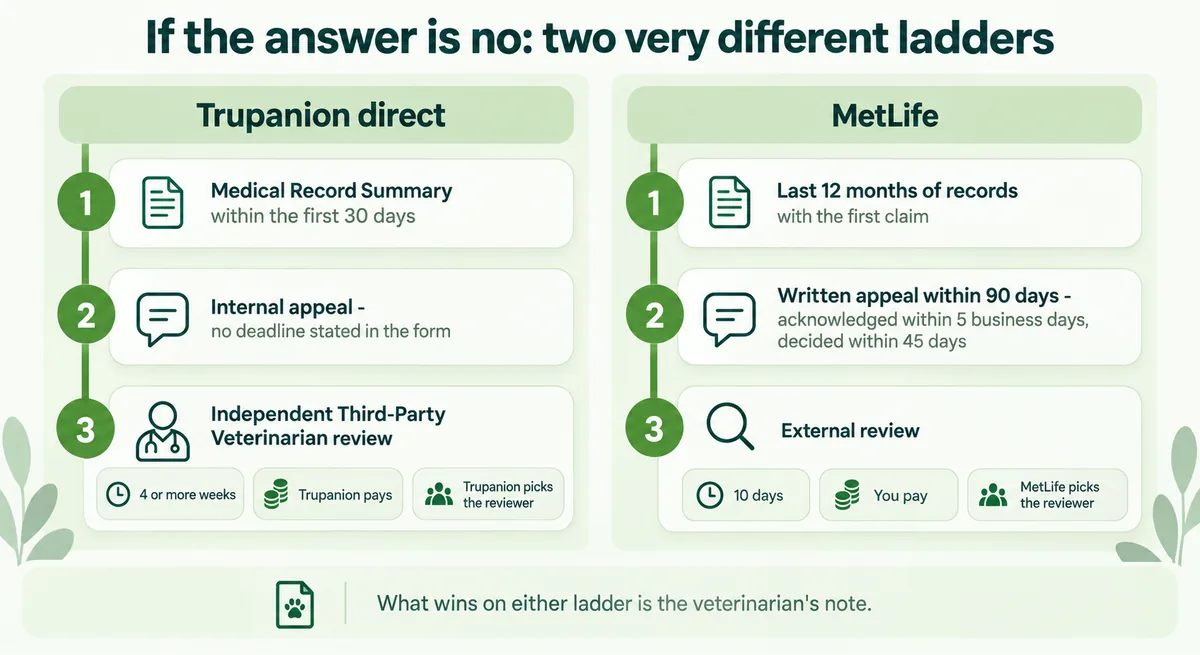
Appeals: a right you pay for, or a review you cannot demand
MetLife's ladder is procedural and yours by right, with the caveats the fine print attaches. You may "submit Written comments, documents, records, or other information," a denial on appeal must state its reasons and cite the clause, and MetLife must give you copies of "documents, records and other information relevant to Your claim" free on request. But the 45-day clock stops whenever MetLife is waiting on information from you, the extension adds 45 more, and the second tier is on your dime with a reviewer MetLife chooses. Its public claims page describes the 90-day appeal and the 45-day decision and never mentions the external review; that step exists only in the policy. The claims section of our MetLife review carries the single-carrier depth.
Trupanion's is medical and discretionary. The 2022 form defines the reviewer as a specialist "who typically works in academia and not otherwise employed by Trupanion," pays for the review and binds itself to the result, but grants it only where the case "requires a niche medical expertise," and refuses it outright where the plan's wording or timing excludes the claim. The 2019 form contains no appeal procedure of any kind. Neither contract sends you to arbitration: the word appears in neither form we read, so a dispute that outlives the ladder goes wherever "remedies under applicable law" take it.
What wins on either ladder is documentation. In a January 2026 thread, a MetLife owner whose nine-month-old puppy was flagged pre-existing on an inconclusive urinalysis taken before the waiting period ended wrote, "I don't even want the reimbursement at this point... My concern is my 9mo puppy having a 'pre-existing condition' flag in her records," and the thread reports that an external veterinary review overturned the flag. In the most-engaged Trupanion thread we read, the fix offered to an owner whose twelve claims had each been booked to a separate condition was "appeal the deductible and have your vet say if they are related." Both are single, unverified owner reports, and both turn on the same thing: a veterinarian's note, not the owner's account.
The AI scribe in the exam room
The newest worry in the threads is about how the chart gets written. Clinics increasingly record the visit and let software draft the note; at the AVMA's 2023 business forum one practice owner described it as "I take out my phone, I hit record, and I put it on the table. It listens and summarizes everything that was said into an easy-to-read SOAP." In July 2026 a Trupanion enrollee posted that a passing remark about a puppy licking had become "Urination abnormal - pollakiuria" on the Medical Record Summary three weeks into the policy; the vet blamed its AI note-taker, Trupanion said people had reviewed the records, and the owner cancelled inside the free look. The thread drew 109 comments.
Read calmly, that is the machinery working, not failing. The remark was in the chart because the visit was recorded; the summary surfaced it in week three rather than at a claim years later; the free look let the owner walk away at no cost. Commenters described the other exits: "They have had no issue amending the record when it happens. I always do a full preview before ever submitting to insurance," and one reported that after a complaint to a state insurance commissioner "Trupanion changed its mind and eliminated the notation from the record." Trupanion's FAQ says a claim specialist reviews the records and invites exactly this: if you "feel that a condition was mistakenly added to your pet's record as pre-existing, please reach out to us." A wrong note is corrected at the source, by the veterinarian who signed it, and then at the insurer; MetLife's appeal accepts "documents, records, or other information" for the same purpose.
Why a thinner chart backfires on both contracts
The same threads carry a tempting inference: if the chart is the problem, keep the chart short. On these two contracts that is exactly backwards, for three reasons written into the forms.
First, an unexamined symptom is still excludable. Trupanion's 2019 form excludes conditions that "would have been observable or reasonably known to be present by You or Your Veterinarian or that are evidenced by the presence of typical signs even if they are not noted in Your Pet's medical records"; its 2022 form says it in fewer words, "even if the Condition is not noted in Your Pet's Medical Records or has not been diagnosed," and counts "signs or symptoms directly related to the Condition" from "verifiable sources." MetLife's test is met by a pet that "displayed signs or symptoms consistent with" the illness, with or without a diagnosis. Silence in the chart does not make a condition new.
Second, the missing exam destroys the evidence that would have helped. Every favorable route in either contract runs on records. MetLife's unrelated-episode route needs a chart showing the later episode is unrelated. Trupanion's own FAQ example covers hip dysplasia years after a sprain on the same side because "the Trupanion claims specialists could find a medical disconnect between it and the old injury," a disconnect that exists only if both visits were written up. The deductible appeal above is a vet's note about relatedness. An episode that was never examined cannot be shown to be unrelated to anything.
Third, both carriers can refuse the claim, or the policy, over withheld history. Trupanion's 2019 form: "Failure or refusal to disclose a complete medical history for Your Pet when requested may result in the denial of Your claim(s) and/or cancellation of Your policy." Its 2022 form: a payout request involving "false, misleading, withheld information" means "We may not pay the payout request, We may cancel Your Membership and coverage for all of Your Pets." MetLife may cancel a policy "obtained through fraud, misrepresentation or concealment in Your application." And the 2022 Trupanion form goes a step further, making your vet's advice a condition of coverage: costs are excluded if you do not "follow Your Veterinarian's advice regarding Your Pet's treatment, diagnostics, and regularly scheduled wellness Exams." Skipping a recommended test to keep it off the chart is, on that wording, its own exclusion.
Treatment decisions belong with the treating veterinarian. Nothing in either contract rewards putting off a visit, and both are written to punish it.
What you can legitimately do with the chart
- Read it. The AVMA's ethics principles make the record "the property of the practice" but oblige a veterinarian "to provide copies or summaries of medical records when requested by the client." Ask for the full SOAP notes, not the discharge sheet; one switcher's advice in the threads was to "ask your vet for the SOAP/exam notes as far back as they can give you" and read them with a highlighter. Do it before you quote either carrier and, on Trupanion, again when the Medical Record Summary arrives, while the free look is open.
- Correct genuine errors at the source. A remark transcribed as a finding, a wrong side, a symptom nobody observed: ask the veterinarian who signed the note to amend it, then send the amended note to the insurer. Trupanion says to call about anything "mistakenly added"; at MetLife it goes into the written appeal with the records attached. Correcting a record means fixing what is untrue in it, never removing what is true.
- Ask for the relationship to be written down. Owners who learned the per-condition deductible the hard way now ask their vet to record a medically related episode under the same diagnosis and to say in writing that it is related; wording alone does not merge two separate injuries, and a note stating the relationship is what an appeal rests on. The deductible section showed why relatedness is money on Trupanion; the unrelated-episode route makes it matter on MetLife too.
- Answer records requests completely and on time. Trupanion can cancel a membership it cannot summarize; a MetLife appeal is denied after 45 days of silence. The fastest claims on either side are the ones where the insurer already holds everything.
One number to keep in its lane: Trupanion's 18 months, in the 2019 form and still on its live FAQ, is a lookback that bounds what counts as pre-existing in that edition, not a limit on how far back records are pulled. Both carriers' reach into the chart is open-ended: Trupanion may obtain "all available Medical Records that exist for Your Pet," MetLife "all records to support the claim." And mind the editions. The Medical Record Summary and the ITPV review are June 2022 C-series text for the January 1, 2023 to March 8, 2026 enrollment cohort; the disclosure sanction and the observable-symptom wording are February 2019 D-series text, more than seven years old; MetLife's ladder is the 2021 specimen. Check your own policy for the edition you hold.
So: for a new, clean-record puppy or kitten the chart is short on either side, and the difference is that Trupanion shows you what it made of it in month one; for a switcher with a chart, Trupanion names the exclusions in the first month and MetLife names them at the first claim, so gather the last 12 months of records before you buy either; for an older or charted pet, the chart is the product, and reading it comes before any quote; and for anyone unsettled by the scribe story, the answer is to go to the vet, read the note afterward and fix what is wrong in it, not to give the note less to say.
Frequently Asked Questions
Why is Trupanion so much more expensive?
Because direct Trupanion sells a different contract: one plan with no payout limit, exam fees excluded, and a deductible charged once per condition for the pet's life. MetLife sells annual limits from $500 to $25,000 or unlimited, covers exam fees, and charges one deductible a year. Paired monthly prices compare two products, so "more expensive" is not a like-for-like finding.
What the public record shows is direction, not level: in California, the one state that publishes requested and approved rate changes side by side, each underwriter took three approved increases closed between 2024 and 2026, book-wide averages for that state rather than anyone's renewal (the renewal section carries the caveats). Which is dearer for your pet takes a quote from each on its own terms.
Is Trupanion actually worth it?
It depends on the claim pattern your pet ends up with, not on the brand. Trupanion's per-condition deductible pays off when one condition runs for years: in our worked example, $2,000 a year for three years costs you $825 on Trupanion against $1,275 on MetLife at a $250 deductible, both sides worked deductible-first to isolate the unit (Trupanion's own percentage-first order adds $25 a condition to its figures). Three unrelated conditions in one year reverse it.
Two things erode that lead. Direct Trupanion never pays exam fees, and on chronic care every "referral, recheck, or telemedicine" visit counts as one; and nothing earned transfers if you leave, because a condition either policy covers becomes pre-existing on the next one. Direct pay at a participating hospital is the other reason owners keep it; for the category question, start with whether pet insurance is worth it at all.
What pet insurance is better than Trupanion?
Nothing is better in the abstract; a policy beats Trupanion for a particular pet when its terms fit that pet's likely claims. For several unrelated problems, any annual-deductible policy is structurally better, MetLife's included; for one long, expensive condition, few are, because Trupanion charges its deductible once per condition and sets no payout limit.
One correction to a forum shortcut: Trupanion's insurer, American Pet Insurance Company, also underwrites Pets Best policies, which produced 30% of Trupanion's 2025 revenue, a relationship the two companies have agreed to end after the third quarter of 2028. A shared insurer does not make two policies "the same thing": the contract, not the underwriter, sets the deductible unit. We compare Trupanion with Pets Best, Embrace and Fetch on their own pages.
Is Pets Best a better option for pet insurance than MetLife?
We haven't put those two head-to-head, so we won't call it. What decides it is what decides Trupanion versus MetLife: the deductible unit, whether exam fees are covered, and whether a condition already covered elsewhere can travel. Of the contracts we read, only MetLife's employer-group plan has that route, bought through an employer with no gap in coverage.
One fact from this page's record matters to a Pets Best owner: American Pet Insurance Company, Trupanion's insurer, also underwrites Pets Best policies through the third quarter of 2028, so moving to Trupanion may keep your insurer, while moving to MetLife changes it to Metropolitan General Insurance Company. For each side's workup, read our Pets Best review, Trupanion vs Pets Best and MetLife review.
Will my premium go up if I claim?
Not because you claimed, according to both carriers' Florida disclosures. MetLife's says the policy "does not reduce coverage or increase premiums based on the Pet Parent's claim history," and Trupanion's says premiums "will not increase based on Your claim history or the age of Your covered Pet." It can still go up.
MetLife names your pet's age at renewal and an address change as reasons it may. Trupanion's line is Florida's edition; the Pennsylvania edition says only that moving may change the cost. And both underwriters take approved, book-wide rate increases that Trupanion says "generally roll onto our book of insured pets over the succeeding twelve months" after approval, so your renewal letter reflects your cohort's share of those, not your claims; the renewal section has California's figures.
Does my vet take Trupanion direct pay?
Only your clinic can tell you; participation is hospital by hospital, not a network. Trupanion's 2022 form defines three cases: a portal hospital, where "You pay only Your Share of the bill at checkout"; a hospital with an arrangement, where you can elect payment to the vet; and neither, where "You must pay Your Pet's invoice" and claim reimbursement (wording varies by enrollment date).
A participating hospital also sets its own limits: MSPCA-Angell in Massachusetts takes Trupanion direct payment for inpatient visits and none for outpatient, and Friendship Hospital for Animals in Washington, DC may still require deposits. MetLife pays "You, not the Veterinarian," by contract. Before you buy, ask your clinic and the emergency hospital you would actually use whether they run the portal, for which visit types, and what deposit they take.
Can I bring my pet's condition to a new insurer?
Usually no. A condition that showed signs before a policy's effective date is pre-existing on it, at Trupanion and MetLife alike, so what your current insurer covers is excluded by the next one. The documented exception is MetLife's employer-group plan, which may "continue coverage for pre-existing conditions already covered by another provider" when bought "as part of an employer group benefit offering" with no gap.
Proof comes at your first claim, an EOB or declarations page from the prior insurer, per one employer's benefits page (not a MetLife document); nothing we read says whether it survives leaving the job. Trupanion has no equivalent, and a per-condition deductible already met stays behind. Switch only on a clean chart, with our switching guide, and never sit on a symptom to protect a switch: the record proves a later episode "unrelated."
Is Chewy CarePlus the same as Trupanion?
Same insurer, different contract. Chewy CarePlus is underwritten by American Pet Insurance Company, like direct Trupanion, but its 2024 forms charge an annual deductible that resets every 12 months rather than one per condition for life, and the Complete plan covers exam fees, which direct Trupanion never does (Essential excludes them).
CarePlus is not sold in Alaska, California, Hawaii or Vermont; Essential can become Complete only within 30 days of enrollment; and Chewy also lists two Trupanion-offered wellness plans, so "Chewy pet insurance" is not one product. If the per-condition deductible and the exam-fee exclusion are what put you off Trupanion, CarePlus Complete is the same insurer selling the opposite terms; our Chewy CarePlus review has the detail, and the five doors section maps every channel.
Which one should I start with, if I can never really switch later?
Start with the contract you would want to be locked into, because a condition that begins under either policy is pre-existing on the next one. One long condition points to Trupanion's per-condition deductible; scattered, unrelated problems, or a chosen limit with exam fees covered, point to MetLife's annual deductible.
A December 2025 thread posed exactly this for a Frenchie puppy, MetLife through an employer now or Trupanion now, and drew thirty replies of premium anecdotes rather than an answer to the lock-in question. Don't plan around that exit unless your employer already offers MetLife: it exists only through an employer group plan with no gap in coverage, and nothing published says it outlives the job. On Trupanion, in the editions we could read, settle deductible, payout percentage and riders inside the first 30 days; on MetLife, increases wait for renewal.
How we compared
We compared the two contracts, not the two brands. Every clause in this article comes from a filed policy form or state disclosure, the California rate record, an SEC filing, a regulator record, a state statute, a hospital's own payment page or a carrier's live page, read edition by edition with the date attached. We pulled no quotes, because no matched quote exists, and we ranked nothing. This section names what we read, how old it is, and what it could not settle, so you can check our work against the policy you are actually issued. Everything here was checked on September 12, 2026, and the load-bearing claims were re-checked against the live sources on September 13, 2026.
The documents, and how old they are
A filed form is the contract as of its edition date, and an edition can be superseded without the public copy changing, so the age of each document is part of the evidence. Ages are as of September 2026.
| Form | Carrier and channel | Edition and age | What it decides in this article |
|---|---|---|---|
| PET21-01-V | MetLife retail (MetGen) | 2021, about five years old; the only specimen MetLife publishes | Paid-to-you clause, appeals ladder, renewal mechanics, records at the first claim |
| PET-DISC-2023 FL | MetLife Florida disclosure | 2023, about three years old | Policy-wide deductible, payout formula, the 7-day/5-day exam waiver, age at renewal |
| TRU (D) 00001 (V10.201902) | Trupanion direct, 2019 generation | February 2019, about seven and a half years old | Per-condition deductible wording, 90-day filing clause, records duties, 18-month lookback |
| TRU (C) 00001 (V02.202206) | Trupanion direct, Maine filing | June 2022, just over four years old, and the middle cohort, not the newest: Maine applies it to enrollments from January 1, 2023 to March 8, 2026 and routes later enrollments to a D-series disclosure | Medical Record Summary, direct-pay tiers, exam-fee exclusion, bilateral list, independent veterinary review |
| TRU (C) 00012 ME (V02.202306) | Trupanion Maine disclosure | June 2023, just over three years old | The 12-day effective-date delay, the 30-day free look |
| TRU (C) 00005 (V01.202206) | Trupanion declaration page, Maine filing | June 2022, just over four years old | The lifetime-limit field, and the absence of an annual-limit field |
| TRU (D) 00012 (V01.202309): Florida, Pennsylvania and MS/NE/NH/DE editions | Trupanion state disclosures | September 2023, three years old | Percentage-first worked example (FL, PA); the age and claims-history sentence (FL only); the missing "per Condition" (MS/NE/NH/DE) |
| TRUCP (D) 00001.2 and 00001.3 (V.03202401) | Chewy CarePlus Essential and Complete (APIC) | March 2024, two and a half years old | Annual deductible, deductible-first order, exam fees covered on Complete only |
| APIC-AFLAC0001 and APIC-AFLAC0002 (V3 2023-10) | Aflac worksite Unlimited and Basic (APIC) | October 2023, nearly three years old | The third contract structure in the Trupanion family; the one narrow pre-existing carve-in |
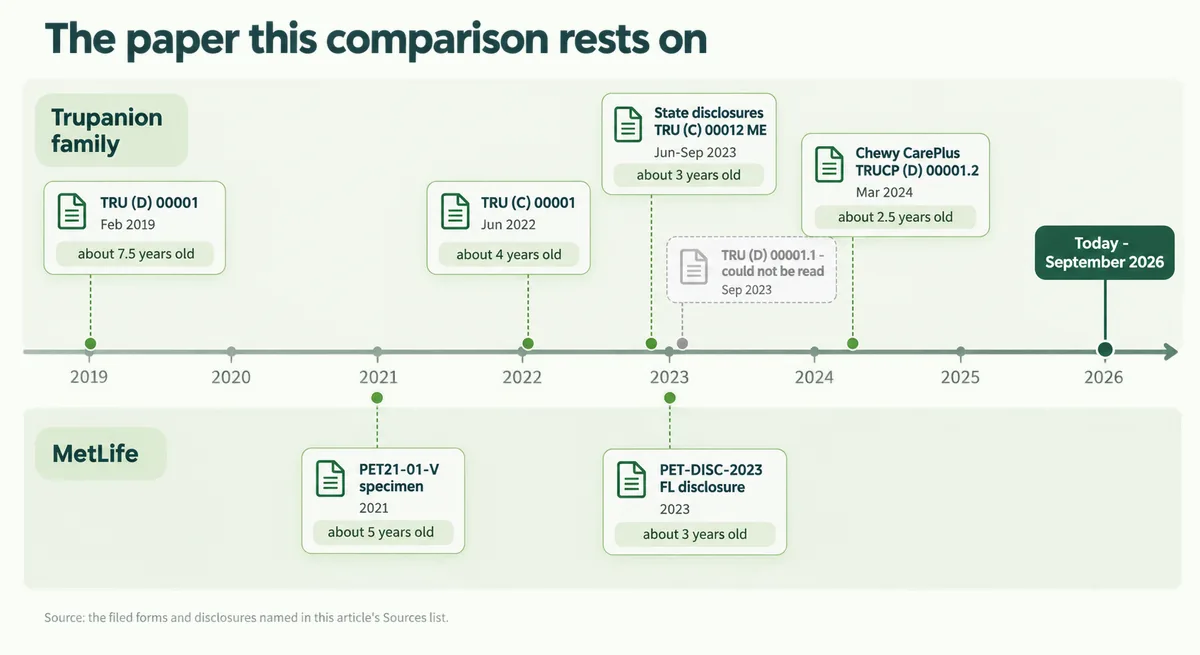
One document is missing from that table on purpose. Trupanion's current direct-retail edition, TRU (D) 00001.1 (V01.202309), could not be read by any route we tried, so no sentence in this article describes its wording. What we say about direct Trupanion is February 2019 and June 2022 form text plus the September 2023 disclosures, scoped that way at each point of use. That is a limit on our access, not a finding about Trupanion, and the fact that MetLife's documents were easier to reach says nothing about either company's transparency.
Where a live page and a filed form disagreed, we printed both rather than picking one. Direct Trupanion's X-ray FAQ applies the deductible before the percentage; its Florida and Pennsylvania disclosures apply the percentage first. The deductible section shows both and sends you to your own declarations page for the answer.
The rate figures, by file number
Every percentage in the renewal section comes from the California Department of Insurance's closed prior-approval lists, three workbooks we downloaded and read row by row. These are the CDI file numbers and SERFF tracking numbers behind each figure, so you can find the same row yourself:
| Underwriter (program) | CDI file | SERFF tracking number | Closed | Approved |
|---|---|---|---|---|
| APIC (Trupanion) | 24-32 | APII-133814084 | May 15, 2024 | 28.9% |
| APIC (Trupanion) | 24-2461 | APII-134256658 | May 12, 2025 | 31.7% |
| APIC (Trupanion) | 25-2461 | APII-134721123 | April 15, 2026 | 19.0% |
| MetGen (MetLife pet) | 23-1508 | META-133594697 | March 6, 2024 | 56.0% |
| MetGen (MetLife pet) | 25-180 | META-134410950 | July 7, 2025 | 20.0% |
| MetGen (MetLife pet) | 25-2234 | META-134710068 | March 24, 2026 | 36.9% |
The four caveats from the renewal section travel with every row: program-wide book averages, California only, closed date is not effective date, channel invisible. The record holds eleven APIC rows and seven MetGen rows in all. APIC also files for Pets Best in the same lists, so we kept an APIC row only when its program cell named Trupanion. And because rate filings are made by the risk-bearing insurer rather than the brand, the record carries no row for MetLife, PetFirst, Chewy or Aflac by name; the legacy PetFirst book's rate history is untrackable here.
What we did not do, and why
- No matched quote. The deductible unit differs, the annual-limit axis is not shared, and Trupanion's reimbursement menu is narrower, so a paired monthly figure would price two different products as if they were one. The deductible section replaces it with owner cost for a stated claim pattern, and the channel map shows which configuration each door actually sells.
- No financial-strength ranking. APIC's Demotech A′ (A Prime) and MetGen's AM Best A+ (Superior), affirmed April 1, 2026, come from different agencies using different scales. The insurer section prints both; it does not score them.
- No complaint comparison. No entity-level pet complaint count with a denominator and a year is obtainable from public data for either insurer. The NAIC's dedicated pet-insurance collection publishes 35 de-identified ratios that name no insurer, and brand-level counts on review sites attach to a brand or a parent and carry no denominator. We looked, could not build one, and did not fake one.
- No enforcement finding, in either direction. We read the New York regulator's examination of APIC, a financial-condition examination as of December 31, 2019 that produced governance and accounting recommendations and, because it did not examine claims handling, says nothing about how claims are paid. We found no published Rhode Island examination of MetGen. We searched no comprehensive multi-state enforcement database. A null search is not a clean record, so we do not write that either carrier has never faced an enforcement action; we write only that we found none.
- No owner report used as a rate. We read 35 Reddit threads for this comparison and used them for how owners phrase things and which mechanics surprise them, never for how often anything happens. They are single-household reports from a forum people post to when they are shopping or angry, and several of the most confident voices there disclose working for an insurer or a benefits broker. Every one we quoted is dated and labelled as unverified.
What we could not establish
These questions are open, not settled. Ask the carrier, in writing, before you rely on any of them.
- Trupanion's current direct-retail wording. TRU (D) 00001.1 (V01.202309) could not be read. Nothing here describes it.
- The deductible amounts and unit on the direct policy you would be issued today. The per-condition unit is February 2019 form text and September 2023 disclosure text; the June 2022 Maine filing set contains no deductible definition, amount or menu at all.
- Trupanion's claim-filing deadline in force. 90 days in the 2019 form, no deadline clause in the 2022 form, "anytime within 12 months of the visit" on a live FAQ. Which governs your policy is a question for your policy.
- Trupanion's maximum enrollment age. Trupanion's FAQ says you can enroll "at any time before their 14th birthday," and that a pet enrolled before then will "continue to receive the same level of coverage" after it turns 14. That is a FAQ statement, not a term we could find in a policy: no form we read contains a maximum-age clause.
- The deductible unit in Mississippi, Nebraska, New Hampshire and Delaware. The shared disclosure drops "per Condition" and prints no worked example.
- Whether direct Trupanion reprices a pet's age at renewal outside Florida. The Florida disclosure says premiums will not increase based on claim history or the pet's age; the Pennsylvania edition has no such sentence; the page that would settle it nationally could not be read.
- MetLife's current form number. Its policy-documents page serves the 2021 specimen. Whatever succeeded PET21-01-V, we have not seen it.
- Who qualifies for MetLife's unlimited annual limit. The carrier's own wording is "unlimited" with "Restrictions apply" and no published rule; in one Reddit thread, owners report they had to call and ask for it. Our sources disagree, and we left it unresolved.
- Where MetLife's exotic-pet policy is sold. The carrier says only that it "may not be available in all states."
- Whether the employer-only pre-existing waiver survives leaving the job. The policy itself is portable, at the loss of the group discount; no document we found says whether the waiver endorsement travels with it.
- Any state's rate record other than California's. None was obtained, so nothing in the renewal section transfers to another state.
- A complaint comparison. Not obtainable from public data, as above.
Where the owner evidence runs out
Quora has no Trupanion-versus-MetLife conversation at all. Three separate searches on September 12, 2026 returned zero results for the head-to-head, and Quora's own message for the first was "We couldn't find any results for 'trupanion vs metlife'." That was a real null, not a broken page: 22 searches ran that day, and the general pet-insurance ones returned dozens of threads. All three MetLife Pet questions Quora does return sit at zero answers, including one asking whether anyone has used the policy, last active September 9, 2024. Trupanion, by contrast, has a modest footprint there, and a much larger one on Reddit.
The honest reading is that MetLife Pet has far less public owner-reported claim history than Trupanion. If you like to read real claim stories before committing, know that on Quora there are none to read for MetLife, and that the MetLife threads we found on Reddit are fewer than the Trupanion ones and lean toward the employer plan, renewal increases and pre-existing flags, with a handful of claim stories among them. Two things not to conclude from that: an absence of complaints is not evidence of good claims handling, and a large volume of Trupanion discussion is not a denial rate. Both are just how much people have written, and neither measures how either insurer pays.
Finally, two pages that rank for this search, on pawlicy.com and danelfin.com, could not be opened from any route we tried. We make no claim about what they cover. Unknown is not failing.
What to do with this
Read the issuing company and the form edition off your own declarations page, and treat that document as the one that governs, because it is. Then put the open questions above to the carrier in writing, especially the deductible unit and amount on the edition you would be issued, the filing deadline, and, for an employer plan, whether the waiver survives a job change. This is how we work on every comparison, and the limits are described in our methodology. The Sources list that follows is what we read; it is not everything that exists, and if you hold a newer edition of either policy than the ones named here, its wording wins, and we would like to see it.
Sources
- Insurer Disclosure of Important Policy Provisions — Florida (TRU (D) 00012 FL v01.202309) — Trupanion
- Trupanion policy form TRU (D) 00001 (V10.201902), 2019 sample policy — Trupanion (2019 sample hosted by The Canine Review)
- Florida Pet Insurance Disclosure (PET-DISC-2023 FL) — MetLife Pet Insurance / Metropolitan General Insurance Company
- Pet Insurance FAQs — MetLife Pet Insurance
- Does Pet Insurance Require an Exam for Enrollment? (July 30, 2026) — MetLife Pet Insurance
- Trupanion policy form TRU (C) 00001 (V02.202206), Maine filing (Exhibit A-1) — Maine Bureau of Insurance
- Coverage and Exclusions — MetLife Pet Insurance
- Switching Pet Insurance Providers: What To Know (July 2, 2025) — MetLife Pet Insurance
- Sample pet insurance policy PET21-01-V — MetLife Pet Insurance / Metropolitan General Insurance Company
- Does Pet Insurance Cover Chronic Conditions? (February 25, 2026) — MetLife Pet Insurance
- Understanding Pet Insurance and Pre-Existing Conditions — MetLife Pet Insurance
- The Family Plan: Pet Insurance for Multiple Pets — MetLife Pet Insurance
- FAQs about MetLife Pet Insurance 2026 (employer benefits distribution) — University System of Georgia
- Form 10-K for fiscal year 2025 (Trupanion, Inc.) — U.S. Securities and Exchange Commission (EDGAR)
- Report on Examination of American Pet Insurance Company (NAIC #12190), as of December 31, 2019 — New York State Department of Financial Services
- Quarterly Statement of the Metropolitan General Insurance Company as of September 30, 2024 (NAIC 39950) — Rhode Island Department of Business Regulation
- Form 10-Q for the quarter ended June 30, 2026 (Trupanion, Inc.) — U.S. Securities and Exchange Commission (EDGAR)
- Financial Stability Rating — American Pet Insurance Company (NAIC 12190) — Demotech, Inc.
- AM Best Affirms Credit Ratings of MetLife, Inc. and Its Life/Health Subsidiaries (April 1, 2026) — AM Best
- Exhibit 21.1 — Subsidiaries of MetLife, Inc. (FY2025 Form 10-K) — U.S. Securities and Exchange Commission (EDGAR)
- Trupanion declaration page TRU (C) 00005 (V01.202206), Maine filing (Exhibit A-3) — Maine Bureau of Insurance
- Pet Insurance (Trupanion referral page and disclaimers) — State Farm
- Chewy CarePlus Complete Accident & Illness Plan, TRUCP (D) 00001.3 (V.03202401) — Chewy Insurance Services / Trupanion Managers USA (APIC)
- Chewy CarePlus Essential Accident & Illness Plan, TRUCP (D) 00001.2 (V.03202401) — Chewy Insurance Services / Trupanion Managers USA (APIC)
- Chewy insurance legal inventory (last updated July 31, 2025) — Chewy Insurance Services
- Aflac Unlimited Accident and Illness Policy, APIC-AFLAC0001-UAI_ML30 (V3 2023-10) — Trupanion Managers USA / Aflac worksite (APIC)
- Aflac Basic Accident and Illness Policy, APIC-AFLAC0002-BAI_ML30 (V3 2023-10) — Trupanion Managers USA / Aflac worksite (APIC)
- Trupanion VS Chewy What Am I Missing (r/petinsurancereviews, July 6, 2026) — owner discussion — Reddit
- Trupanion vs. MetLife Pet Insurance (updated August 27, 2026) — MoneyGeek
- Insurer Disclosure of Important Policy Provisions — Pennsylvania (TRU (D) 00012 PA v01.202309) — Trupanion
- Insurer Disclosure of Important Policy Provisions — Mississippi, Nebraska, New Hampshire, Delaware (TRU (D) 00012 v01.202309) — Trupanion
- Does Pet Insurance Cover X-rays? (pet insurance FAQ) — Trupanion
- just want to share my experiences with trupanion (r/petinsurancereviews, May 15, 2026) — owner discussion — Reddit
- I've had it with Trupanion. Cancelling my subscription. (r/petinsurancereviews, May 2, 2026) — owner discussion — Reddit
- Trupanion exam fees (r/petinsurancereviews, May 17, 2026) — owner discussion — Reddit
- Claims | MetLife Pet Insurance (claims and appeals page) — MetLife Pet Insurance
- How to File a Pet Insurance Claim - MSPCA-Angell (hospital direct-payment policy) — MSPCA-Angell
- New Clients, Forms & Policies - Friendship Hospital for Animals (hospital payment and deposit policy) — Friendship Hospital for Animals (Washington, DC)
- Maine notice — policy edition routing by enrollment date — Trupanion
- Why can't pet insurances just pay the vet directly at the time of service…? — owner discussion — Quora
- Trupanion - covered 7k! (r/petinsurancereviews, March 21, 2026) — owner discussion — Reddit
- Bilateral Conditions and Pet Insurance (May 27, 2026) — MetLife Pet Insurance
- Worksite benefits — Trupanion pet insurance for employers (plan tier comparison) — Trupanion
- Pet Insurance — MetLife Pet Insurance employee benefit page (Pre-Existing Condition Waiver Endorsement and proof requirements; employer distribution, not a MetLife document) — Microsoft US Benefits
- Has anyone switched to a MetLife employer plan? … previously covered conditions (r/petinsurancereviews, August 7, 2026) — owner discussion — Reddit
- Rate Filing Approvals — closed prior-approval list index (Property & Casualty rate filings) — California Department of Insurance
- Approval Closed List YTD 12-31-24 (rate-filing workbook; APIC file 24-32, MetGen file 23-1508) — California Department of Insurance
- Approval Closed List YTD 12-31-25 (rate-filing workbook; APIC file 24-2461, MetGen file 25-180) — California Department of Insurance
- Approval Closed List YTD 8-31-26 (rate-filing workbook; APIC file 25-2461, MetGen file 25-2234, Pets Best file 26-52) — California Department of Insurance
- Trupanion rates (r/petinsurancereviews, September 10, 2026) — owner-reported multi-year premium ladders, unverified — Reddit
- PSA: Trupanion will give you a list of preexisting condition exclusions in the first 30 days (r/petinsurancereviews, May 13, 2026) — owner-reported $170 to $400 renewal trajectory, unverified — Reddit
- MetLife Rate Jump - anyone else? (r/petinsurancereviews, May 6, 2026) — owner-reported renewal increase, unverified — Reddit
- Any reason to NOT switch to PetsBest if it's 57% cheaper than MetLife… (r/petinsurancereviews, July 18, 2026) — owner-reported 80% MetLife increase, unverified — Reddit
- MetLife pet insurance through my work. Worth it? (r/Frenchbulldogs, December 27, 2025) — owner description of the +$500 limit / −$50 deductible renewal mechanics, unverified — Reddit
- How can you assess the value of dog insurance when rate increases are so arbitrary… (r/petinsurancereviews, August 24, 2026) — owner discussion of lock-in and renewal pricing — Reddit
- Insurer Disclosure of Important Policy Provisions — Maine (TRU (C) 00012 ME v02.202306), Maine filing (Exhibit A-2) — Maine Bureau of Insurance
- Fla. Stat. §627.71545 (2026) — Pet insurance; noninsurance wellness programs (the Pet Insurance Act, ch. 2025-11) — Florida Senate (Florida Statutes)
- Laws of Florida, Chapter 2025-11 (enacting chapter for §627.71545) — Florida Department of State (Laws of Florida)
- R.I. Gen. Laws §27-83-3 — Pet Insurance Act: Disclosures (effective January 1, 2026) — Rhode Island General Assembly
- R.I. Gen. Laws §27-83-4 — Pet Insurance Act: Policy conditions (effective January 1, 2026) — Rhode Island General Assembly
- P.L. 2025, Chapter 224 — Pet Insurance Act (approved January 12, 2026; effective January 1, 2027) — New Jersey Legislature
- Senate Bill S5324A (2025–2026 session) — pet insurance; vetoed October 16, 2025 — New York State Senate
- Pet Insurance Model Act (Model #633), adopted August 1, 2022 — National Association of Insurance Commissioners (NAIC)
- Pet Insurance Model Act — State Page (ST-633), Summer 2026 edition (model-adoption citations by jurisdiction) — National Association of Insurance Commissioners (NAIC)
- Exam Day Offer — certificate terms — Trupanion
- MetLife Pet Insurance's No Waiting Period Explained (August 11, 2025) — MetLife Pet Insurance
- Pet Insurance Plans — "Does MetLife Pet cover exotic pets?" (MetLife plans page) — MetLife Pet Insurance
- MetLife Pet Insurance — Exotic Pet Overview and Species/Breed List (2024, employer benefits distribution) — MetLife Pet Insurance (via UPH Total Rewards)
- Disclosure of Important Policy Provisions for Residents of Washington — exotic pet policy (PET-DISC-2024-EXOTIC-R) — Metropolitan General Insurance Company / MetLife Pet Insurance
- Met life Pet Insurance (r/petinsurancereviews, June 2, 2026) — owner comment on a Family Plan resetting after a pet's death (single, unverified report) — Reddit
- What is a Medical Record Summary? (pet insurance FAQ) — Trupanion
- What are pre-existing conditions, and how are they determined? (pet insurance FAQ) — Trupanion
- Principles of Veterinary Medical Ethics of the AVMA (medical records provisions) — American Veterinary Medical Association
- From note taking to scheduling, technology can help veterinary practices in many ways (December 6, 2023) — AVMA News (American Veterinary Medical Association)
- Casual Conversation at the Vet Turned Into a Lifetime Medical Record (Trupanion) (r/petinsurancereviews, July 18, 2026) — owner discussion, unverified — Reddit
- Advice please! Claim appeal (r/petinsurancereviews, January 15, 2026) — owner-reported MetLife external review outcome, unverified — Reddit
- Met Life vs Trupanion premium increases (r/petinsurancereviews, December 15, 2025) — owner discussion of which carrier to start with — Reddit
- Sample Pet Insurance Policy (policy documents page — the single published specimen) — MetLife Pet Insurance
- 2024 MCAS Ratios — Pet Insurance (Scorecard Ratios v1.9; de-identified, no insurer named) — National Association of Insurance Commissioners (NAIC)
- What’s the oldest age a pet can be enrolled? (pet insurance FAQ) — Trupanion
- Has anyone used Metlife Petfirst insurance for your pets and how is it? (unanswered question, latest activity September 9, 2024) — Quora