


If your pet is likely to face one expensive, lifelong condition, Trupanion's deductible structure usually costs you less on the claims themselves. If your pet is more likely to collect several unrelated problems over the years — or if you want vet exam fees covered — Fetch's does. Premiums are a separate question we could not settle, and most of this comparison follows from those two sentences.
One thing to settle first, though: "Trupanion" is really two different products. The policy Trupanion sells directly and the Trupanion-underwritten plan sold through Chewy CarePlus sit on the same insurer but on different contracts, and CarePlus reverses two of the three things people usually cite as Trupanion's defining features.
Here is roughly where each option lands:
- A new pet with a clean record: Trupanion, because its deductible is paid once per condition and never resets. That flips if your pet collects several unrelated one-off problems.
- A pet you expect to have several separate issues: Fetch, because one annual deductible covers all of them that year.
- You want exam fees covered: Fetch, or CarePlus Complete. Direct Trupanion excludes them outright, with no rider that adds them back.
- You could not front a $15,000 emergency bill: Trupanion, but only if your own clinic accepts its direct payment. Fetch reimburses you afterwards, every time.
- You already have one and are shopping the other: slow down. Neither carrier protects an existing condition when you move it to a new insurer.
Below we work through the filed policy forms rather than the marketing pages, and name the form behind each figure — including two things almost no comparison mentions: how each contract orders your deductible, and how differently the same orthopedic diagnosis is treated by state.
Table of Contents
- First, which product are you actually comparing?
- The deductible is the whole argument
- Exam fees: the recurring cost only one of them covers
- Orthopedic coverage depends on your state
- Limits and the emergency you are actually insuring against
- What happens at renewal
- Claim day: who pays the vet
- If you already have one of these
- Who underwrites each policy
- Our recommendation, by situation
- Frequently Asked Questions
- Sources
First, which product are you actually comparing?
There are three products here, not two. Trupanion sells a policy directly, and it also underwrites the Trupanion-branded tiers of Chewy CarePlus — a separate contract family (form TRUCP (D) 00001.x) with an annual deductible rather than Trupanion's lifetime per-condition one, and exam fees covered on its Complete tier.
They also reimburse in different orders. Here is the same $1,000 eligible bill run through each contract's own worked example:
| Product | Order | On a $1,000 bill | Deductible unit | Exam fees |
|---|---|---|---|---|
| Trupanion (direct) | Percentage first | $1,000 × 90% = $900, − $250 = $650 | Lifetime, per condition | Not covered |
| Fetch | Co-pay first | $1,000 − 20% = $800, − $300 = $500 | Annual | Sick visit covered |
| Chewy CarePlus | Deductible first | $1,000 − $250 = $750, × 90% = $675 | Annual | Complete tier only |
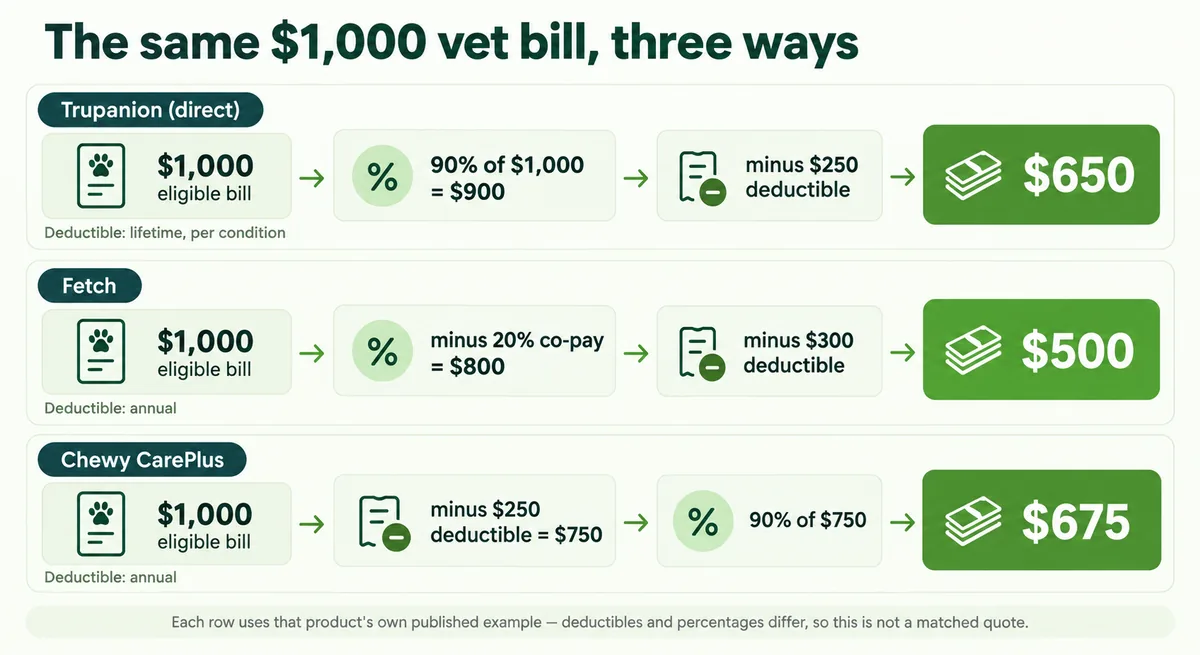
Read that table for the order, not the totals. Each row uses its own contract's published example, so the deductibles and percentages differ — this is not a matched quote, and Fetch's $500 reflects a lower percentage and a higher deductible, not a worse contract.
Two things worth knowing before you shop the Chewy route. Its Trupanion tiers reimburse at 70% or 90% — the 80% option belongs to the Lemonade tiers on the same storefront, and buying "through Chewy" does not tell you which insurer you got, because Chewy's own disclosures name American Pet Insurance Company, ZPIC, or Lemonade. And Chewy publishes no CarePlus sample policy for Alaska, California, Hawaii or Vermont.
The deductible is the whole argument
Trupanion's deductible is per condition, for life. Fetch's is annual. Those are different units, and almost every disagreement about which carrier is "cheaper" traces back to them.
Under Trupanion, once you meet the deductible for a specific illness or injury, the policy pays all future losses for that condition — you never pay it again, even a decade later. But a second, unrelated condition starts its own deductible from zero. Under Fetch, one deductible covers everything in a policy year, then resets each year — and treatment that spans a renewal is subject to a deductible in each policy period.
Here is what that does to real money. Assumptions, which matter: 90% reimbursement and a $500 deductible on both sides, deductible not yet met, annual limits not binding, and ordinary sick-visit exam fees eligible under Fetch but not under direct Trupanion.
| What happens that year | Total bills | You pay — Trupanion | You pay — Fetch |
|---|---|---|---|
| One condition: $3,000 treatment + $200 exam | $3,200 | $1,000 | $820 |
| Three unrelated conditions, each $1,000 + $100 exam | $3,300 | $2,100 | $830 |
| One chronic condition, each of three years $3,000 + $200 exam | $9,600 | $2,000 | $2,460 |
An honest caveat about that table. Setting both deductibles to $500 equalises a lifetime figure against an annual one, which mechanically hands the multi-condition rows to Fetch and the chronic row to Trupanion. The arithmetic is exact; the comparison is not like-for-like. And these are not forecasts — the $1,270 gap in the three-condition row and the $460 gap in the chronic row hold for those bills and no others.
One more mechanic: Trupanion lets you choose a deductible from $0 to $1,000, raise it at any time, but lower it only in your first 30 days.
What counts as one "condition"
This is the part the brochures skip. The per-condition unit is decided claim by claim at intake — Trupanion's claim form asks whether you have claimed for this condition before. Owners report claims filed under the wrong condition name and corrected on a phone call, and appeals, backed by a vet's note that two problems are medically related, that pulled several claims under a single deductible. If you go this route, check the condition label on every explanation of benefits.
Exam fees: the recurring cost only one of them covers
Fetch covers the exam fee for a sick visit. Trupanion does not cover exam fees at all — not with a rider, not under any circumstance.
This is not buried. Trupanion's policy form has a section headed Eligible Claims — What You Pay, and examination fees are the first item on that list, ahead of your deductible, coinsurance and taxes. No add-on changes it.
Fetch treats the sick-visit fee as part of the covered bill, and puts a first-party number on what that is worth: $50 to $250 per appointment. Routine and wellness exams are still excluded on both sides.
This matters more than it looks because it repeats. A single $80 exam fee is noise. A chronic condition monitored every few weeks is not, and neither is a treatment protocol. One Trupanion member being billed weekly through a six-month chemotherapy course described roughly $400 a week in recheck fees and coinsurance — after the deductible for that condition had already been met. That is one owner's account rather than a carrier figure, but the mechanism behind it is in the contract.
To be fair to Trupanion, there is a real underwriting argument here. Insurance prices uncertain events, and a fee you will incur at every single visit is a known cost — covering it mostly moves money in a circle with a markup. Reasonable carriers land on both sides of that.
One exception worth knowing: the Trupanion-underwritten CarePlus Complete tier does cover exam fees. Same insurer, different contract.
Orthopedic coverage depends on your state
Hips, elbows, cruciate ligaments and discs are the most expensive common claims a dog makes — and Fetch handles them under two different rules depending on where you live. Trupanion has no orthopedic clause at all.
Under Fetch's base contract, and in California, any orthopedic condition that arises in the first 180 days is excluded and treated as pre-existing for the life of the policy. The only way out is a vet exam that clears the knees specifically — it does not rescue hips, elbows or discs.
In at least eight states — Washington, Florida, Pennsylvania, Rhode Island, Maine, Montana, New Hampshire and Vermont — the state notice replaces that with a much softer rule: a 30-day orthopedic waiting period and a 30-day knee window. Washington's endorsement deletes the 180-day exclusion outright.
Both versions are current. Neither replaced the other, so any article telling you Fetch's orthopedic window "is 180 days" or "is 30 days" is only right for part of the country. Check your own state's notice before you assume which one applies to you.
One trap worth naming. Fetch removed the waiting period for accidents in 2025, which sounds like it should cover a dog that tears a cruciate ligament jumping off a couch. It does not: the contract classes cruciate disease and intervertebral disc disease as degenerative, so they are not treated as accidents even when the signs appear suddenly.
Trupanion's side is simpler to state and not necessarily kinder. There is no additional orthopedic-specific waiting period and no orthopedic exclusion window — but the ordinary waits still apply. Its California disclosure, for example, sets a 30-day waiting period for illnesses, waivable by a comprehensive exam after purchase — and anything that exam finds becomes pre-existing. What gates these claims instead is its pre-existing rule — which has no "cured" pathway back to coverage — and a named list of bilateral conditions — hips, elbows, patellas, cruciate ligaments, discs, cataracts and glaucoma among them — where signs on one side before your effective date exclude the other.
Limits and the emergency you are actually insuring against
Trupanion has no payout cap of any kind — no annual, lifetime or per-condition limit. Fetch pays up to the maximum annual policy coverage printed on your declarations page, and that number decides a bad year.
Take a $15,000 emergency — say $14,700 of treatment plus a $300 exam fee — with limits not binding. The two land close: about $2,270 out of pocket under Trupanion, which does not cover that exam fee, against $2,000 under Fetch, which does. Put a $10,000 annual cap on the Fetch policy and the identical claim costs you $5,000. The cap, not the coverage, made that decision.
Two cautions on Fetch's numbers. Its seven special coverages — behavioral, telehealth, boarding, lost-pet advertising, theft, death and vacation cancellation — each carry a $1,000 annual sublimit that sits outside your co-pay and deductible and does not raise your annual maximum. Some comparison pages misread that $1,000 as the whole policy limit. And treat any published list of Fetch's annual options carefully: Fetch describes a few standard options — "including" those figures, not limited to them — with an unlimited option available by phone subject to eligibility.
The practical read: a low annual cap is the cheapest thing to buy and the most expensive thing to own. One owner on a $5,000 limit exhausted the entire benefit by March of a cancer year, against roughly $8,784 in bills.
What happens at renewal
Both carriers will raise your premium over your pet's life. Only one of them reserves the right to raise it because you made claims — and both say so in writing, in disclosures California requires them to publish.
Fetch: "Premiums may be increased and coverage may be reduced based on your pet's individual claim history. Premiums are also affected by your geographic location, pet's age, and breed." — California residents notice
Trupanion: "Premiums will not increase based on Your Pet's claim history or the age of Your Pet. Premiums may increase or decrease if You move to a new ZIP code." — California Insurer Disclosure
Note what Fetch's version reserves beyond price: coverage may be reduced, not merely repriced. These are the two carriers answering the same regulator-mandated question in opposite directions, and it is the single best-sourced difference in this comparison. Both notices are California-mandated, so check your own state's disclosure — the table below comes from the carriers' base policy forms.
But "not for claims or age" is not "not large." California regulators approved a 33% average increase for Trupanion in 2025, with most affected policies landing somewhere between 25% and 45%. Trupanion's promise is about why your premium moves, not how far.
| At renewal | Trupanion | Fetch |
|---|---|---|
| What can change | Premium only, once per 12 months, 30 days' notice | Premium, annual maximum, co-pay, deductible and policy terms |
| Can they decline to renew you? | No such right in the filed text | Yes — 60 days' notice for a material change in loss experience |
| Heavy claim use | No claims-frequency lever | Past 50 paid claims, you can lose a promotional discount and be offered lower coverage |
| Raising your coverage later | Payout % up or deductible down only in the first 30 days | Barred entirely once you have submitted any claim |
| If the policy lapses | Monthly membership simply ends | Resets the original inception date — every waiting period and exclusion clock restarts |
Two of those rows deserve a second read. Buying a low annual limit now does not preserve your right to upgrade later — under Fetch a single submitted claim closes that door permanently. And a lapse is not a pause; it is a fresh start, with all the exclusions that implies.
Claim day: who pays the vet
Trupanion can pay your veterinarian directly at checkout — but only at hospitals running its software. Fetch reimburses you afterwards, every time, and its form requires proof of payment showing a zero balance before it pays.
That is a timing difference, not a coverage difference, and on a big bill it is the one you feel. Take the $15,000 emergency from earlier: with an approved direct payment you hand over about $2,270 at the counter. Under reimbursement — Fetch always, and Trupanion wherever the hospital has no portal or approval is still pending — you pay the full $15,000 and wait for most of it to come back.
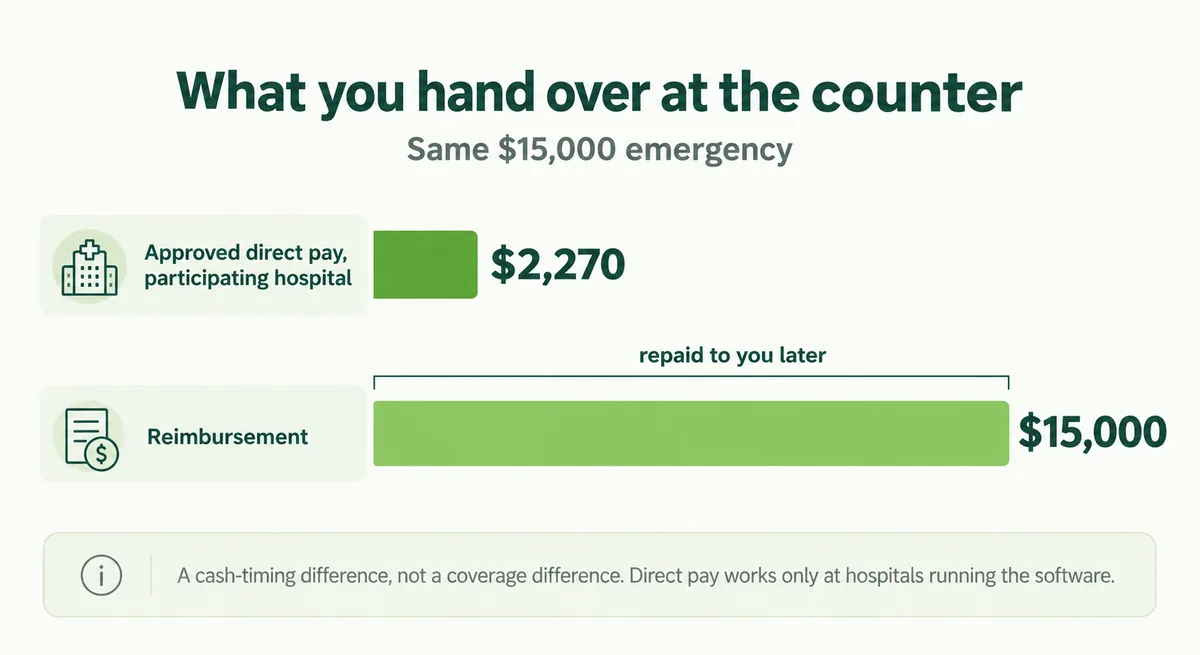
If your practice adds a card-processing fee, the gap compounds. One Seattle hospital publishes a 3% fee; on $15,000 that is $450, against about $68 on $2,270.
Why so many clinics don't do it
It is usually not the carrier saying no. Veterinary staff describe it as an administrative problem: unlike human medicine, most practices have nobody whose job is billing insurers and chasing payment, and integrating a carrier's system is work a small clinic has to absorb. That is how vets describe it rather than a documented carrier charge.
So the useful question is not "do you take Trupanion?" It is: will this location submit and accept direct payment for my policy and this treatment — and what do I pay tonight if approval is still pending? Ask your regular vet and your nearest emergency hospital before you need either.
One more practical note for Fetch customers: pre-authorization exists, but the form says it cannot be arranged by telephone — you have to submit the written pre-authorization request. Worth knowing before a scheduled surgery rather than during one.
If you already have one of these
Both contracts — Trupanion's and Fetch's — promise that a condition they have been covering cannot be called pre-existing at renewal. Read that sentence carefully: it protects you at renewal with the same insurer. It does not travel with you to a new one.
So the test most people apply — "will I have a gap in coverage?" — is the wrong one. A switch can leave you worse off with no uninsured day at all, because the new carrier may look at symptoms that appeared while your old policy was paying and treat them as pre-existing from day one.
That means the real trade is never premium alone. Against the money you would save, put:
- coverage for any condition your current carrier is already paying for;
- a fresh set of waiting periods, including the orthopedic clock for your state;
- a deductible that starts again from zero;
- whatever the new policy covers less generously — exam fees, annual cap, sublimits;
- and how much you would have to front at checkout if the new carrier reimburses rather than pays your vet.
If you do move, owners advise each other to let the new policy start before cancelling the old one. Our guide to switching pet insurance covers the records review in more detail.
To be clear: none of this is a reason to put off a vet visit. If your pet needs to be seen, take them. Timing care around an insurance decision risks something far more expensive than a premium.
Who underwrites each policy
Trupanion owns the company that carries your risk. Fetch does not carry any.
Trupanion's policies are written by American Pet Insurance Company, its own New York-domiciled subsidiary, regulated by the New York Department of Financial Services and rated A′ by Demotech. Fetch is an administrator: your policy is issued by AXIS Insurance Company, rated A by AM Best at group level.
Do not read those ratings as a scoreboard: different agencies, different scales, and neither carrier holds the other's. What matters practically is that complaints, fines and financial strength attach to different legal entities on each side. One wrinkle: the insurer behind Trupanion also underwrites the competitor brand Pets Best.
From Petplan to Fetch
If you remember this product as Petplan, that is not a mistake — Fetch was the US Petplan licensee until it rebranded in 2022, and its carrier changed too. AXIS issues the current filed forms. XL Specialty is legacy paper that still appears in older disclosures. That tells you who writes new business, not who carries every policy already in force — so if you are an existing customer, your declarations page is the only thing that names your insurer.
For the full entity map, complaint records and rating history on either side, see our Trupanion review and Fetch review.
Our recommendation, by situation
There is no overall winner here, and anyone who gives you one is skipping the part that matters. What follows is where each carrier tends to land, and the single fact that would flip it.
| Your situation | Lean toward | What would flip it |
|---|---|---|
| New puppy or kitten, clean records, buying for catastrophe | Trupanion — no payout cap, and the deductible for any condition is paid once for life | A breed prone to lots of small, unrelated problems rather than one big one |
| A breed predisposed to one chronic condition — with no related signs on the pet's record yet | Trupanion — you clear that deductible once and never again, provided the condition is not already noted | Frequent rechecks, where uncovered exam fees quietly become the bigger cost |
| A pet likely to collect several unrelated issues | Fetch — one annual deductible covers all of them | Needing a high or unlimited annual cap, which Fetch only offers on request |
| You want exam fees covered | Fetch, or Trupanion via CarePlus Complete | Living in Alaska, California, Hawaii or Vermont, where Chewy publishes no CarePlus sample — confirm availability before counting on it |
| You couldn't front a five-figure bill tonight | Trupanion, if your clinic takes its direct payment | Your own vet and nearest ER not participating — then it's reimbursement either way |
| Already insured, tempted by the other's price | Stay put until you know what your records say | A genuinely clean chart, no symptoms noted anywhere, and a fresh set of waiting periods you can absorb |
Two things cut across all six rows. Your state changes Fetch's orthopedic terms, and the Chewy channel changes Trupanion's deductible and exam-fee treatment — so pull the sample policy for your state and the exact product you're quoting before you commit. And because we could not obtain a matched quote for both carriers, treat any price you see here or elsewhere as an illustration, not a comparison.
Frequently Asked Questions
Why is Trupanion so much more expensive?
Because you are buying a different product, not a worse deal. Trupanion carries no payout cap at all, reimburses at a high fixed percentage in the states whose disclosures set one, and charges a deductible you pay once per condition rather than every year. It also excludes exam fees, so the premium is doing all the work. Whether that is worth the extra depends on whether your pet has one expensive problem or several small ones — the first case favours Trupanion, the second does not.
Is Trupanion actually worth it?
It is worth it if you are insuring against a catastrophe rather than budgeting for routine bills. The unlimited payout and the once-per-condition deductible are most valuable when a single serious condition runs for years. It is a poor fit if your pet collects several unrelated one-off problems, because each one starts its own deductible, and if your clinic does not accept its direct payment you lose the cash-flow advantage too.
What's better than Trupanion?
Nothing is better in general — it depends on the failure you are insuring against. Against Fetch specifically, Fetch wins if you want exam fees covered, or if your pet is likely to have several unrelated conditions in the same year. Trupanion wins on unlimited payouts, on a single chronic condition, and on paying your vet directly where the hospital participates.
Why do vets recommend Trupanion?
Mostly because of how it pays, not what it covers. Trupanion can settle with the hospital at checkout where the practice runs its software, which means the clinic is paid and the client goes home owing only their share. That removes the awkward conversation about a five-figure bill. It is not universal, though: participation is hospital by hospital, so ask your own vet and your nearest emergency clinic before you rely on it.
Is Trupanion through Chewy the same as Trupanion?
No. Chewy CarePlus is underwritten by Trupanion's insurer but sits on a different contract, and it reverses two of the things Trupanion is known for: the deductible is annual rather than per-condition-for-life, and the Complete tier covers exam fees. Its tiers reimburse at 70% or 90%, and Chewy publishes no CarePlus sample policy for Alaska, California, Hawaii or Vermont — check availability directly for those states. If you are quoting "Trupanion," check which of the two you are actually looking at.
Does Fetch raise your premium if you make claims?
Fetch's California notice says premiums "may be increased and coverage may be reduced based on your pet's individual claim history" — its own words, in a disclosure the state requires. Trupanion's California disclosure says the opposite: premiums "will not increase based on Your Pet's claim history or the age of Your Pet." That is the clearest documented difference between them. It does not mean Trupanion's premiums stay flat; California approved a 33% average increase for Trupanion in 2025.
Which is cheaper, Trupanion or Fetch?
We can't answer that honestly with a single number, and neither can most comparison pages. No matched quote — same pet, same state, same deductible, reimbursement and limit — was available for both carriers, so any side-by-side price you see is comparing different configurations. What we can say is structural: with several unrelated conditions in one year Fetch's annual deductible costs you less, and with one chronic condition running for years Trupanion's once-per-condition deductible does. Run both quotes for your own pet.
Does Trupanion cover exam fees?
No, and there is no rider that adds them. Trupanion's policy form lists examination fees first among the costs the member pays, ahead of the deductible and coinsurance. Fetch treats the sick-visit exam fee as part of the covered bill and puts it at $50 to $250 per appointment. Routine and wellness exams are excluded by both. The one exception on Trupanion paper is the CarePlus Complete tier sold through Chewy.
Can I switch between them without losing coverage?
Not for a condition either carrier is already paying for. The renewal protection in both contracts applies at renewal with the same insurer; it does not follow you to a new one, so a condition being covered today can be treated as pre-existing on day one with the other carrier — even if you never have an uninsured day. Before you move, get your records and read what is noted in them. And never delay a vet visit over an insurance decision.
Is Fetch still Petplan, and who underwrites it?
Fetch was the US Petplan licensee until it rebranded in 2022, and its carrier changed as well. Fetch's current filed forms are issued by AXIS Insurance Company; XL Specialty is legacy paper that still appears in older disclosures. That identifies who writes new business rather than who carries every in-force policy, so check your own declarations page. Fetch itself bears no risk — it administers the policy. Trupanion, by contrast, owns its insurer, American Pet Insurance Company.
Sources
- Insurance disclosures (CarePlus underwriting and administration) — Chewy
- Chewy CarePlus Complete sample policy (form TRUCP (D) 00001.3) — Chewy
- How reimbursement works — Fetch Pet Insurance
- Insurer Disclosure of Important Policy Provisions, Florida (form TRU (D) 00012, V01.202309) — American Pet Insurance Company / Trupanion (via Internet Archive)
- Trupanion policy sample, form TRU (D) 00001.1 (V01.202309) — Trupanion
- What is a pet insurance deductible? — Fetch Pet Insurance
- Deductibles (FAQ) — Trupanion (via Internet Archive)
- Does pet insurance cover exam fees? — Fetch Pet Insurance
- Trupanion exam fees (owner discussion, r/petinsurancereviews) — Reddit
- Pet insurance waiting periods (FAQ) — Fetch Pet Insurance
- State disclosure notices — Fetch Pet Insurance
- Fetch policy sample, form GPTM 050 1125 A — Fetch Pet Insurance / AXIS Insurance Company
- Washington residents notice — Fetch Pet Insurance
- Annual coverage limit (FAQ) — Fetch Pet Insurance
- Fetch nearly doubled my pet insurance premium after my dog got cancer (owner report) — Reddit
- California residents notice — Fetch Pet Insurance
- Insurer Disclosure of Important Policy Provisions, California — American Pet Insurance Company / Trupanion (via Internet Archive)
- Claims — Fetch Pet Insurance
- Payment options (3% card-processing fee) — Seattle Veterinary Associates
- Why can't pet insurers pay the vet directly at time of service? (veterinary-staff answers) — Quora
- Can pet owners switch pet insurance providers and policies? (owner discussion) — Quora
- Trupanion, Inc. Form 10-K, FY2025 — U.S. Securities and Exchange Commission
- American Pet Insurance Company — Financial Stability Rating — Demotech, Inc.
- AXIS Insurance Company — Rule 17g-7 rating disclosure — AM Best
- Trupanion claim form — Trupanion
- Trupanion's 33% California rate increase (approved 2025) — Insurify (via Internet Archive)