


Virginia has no pet-insurance law. Not a weak one — none. The only place pets appear anywhere in the Commonwealth's insurance code is a licensing definition describing who may sell you a policy. The word "veterinary" does not appear in that code at all.
That is not the same as unregulated, and the difference is the whole article. Virginia rate-regulates the carriers writing here, has to approve their policy forms, sets deadlines they must meet once you file a claim, and backs them with a guaranty fund. What it never sets is a rule about waiting periods, about pre-existing conditions, or about what your renewal is allowed to cost. Those are your carrier's own terms — filed with the state, not written by it.
We read all ten pages currently ranking for this search. Not one cites the Virginia State Corporation Commission, the Code of Virginia, or any other Virginia insurance authority. None of them mentions a regulator at all.
So this is the Virginia version. What coverage costs at settings you can actually reproduce, why the published averages contradict each other, what the law does and does not do for you — and what a Virginia veterinary hospital will ask you to pay before any insurer pays anything.
Table of Contents
- What pet insurance costs in Virginia
- Why the published averages don't agree
- What Virginia law actually requires
- The waiting periods and exclusions on Virginia policies
- Paying before you're reimbursed
- What vet care costs across Virginia
- Which Virginia owners should pick what
- Frequently Asked Questions
- Sources
What pet insurance costs in Virginia
At a $250 deductible and 90% reimbursement in Virginia Beach, the honest answer is about $44 a month for a two-year-old dog and $26 for a two-year-old cat — rising to $72.12 and $39.72 — about 64% and 54% more — if you want an unlimited annual payout instead of a $5,000 cap.
Those come from U.S. News, which quoted four standardized pets in ZIP 23464 and averaged the result across the eleven companies it rates:
| Annual limit | Dog, 2 yr | Dog, 6 yr | Cat, 2 yr | Cat, 6 yr |
|---|---|---|---|---|
| $5,000 | $43.90 | $67.46 | $25.81 | $36.93 |
| Unlimited | $72.12 | $113.08 | $39.72 | $59.57 |
Read the column headers, not the dollar signs. Age alone moves a Virginia dog from $43.90 to $67.46 at the same limit, and the limit alone moves it from $43.90 to $72.12. Carrier choice moves it again: on that same page, at that same configuration, ASPCA quotes $40.95 for the two-year-old dog and Pets Best $35.26.
Change the settings and the whole grid moves. Pawlicy prices Virginia at 80% reimbursement, unlimited annual coverage and a $500 deductible — and at those settings breed does more work than city. A six-month Chihuahua in Virginia Beach runs $18–$41 a month; a six-month Golden Retriever in the same city runs $31–$66. Pawlicy's own Virginia averages land at $47.12 for a puppy, $61.54 for a five-year-old dog and $147.61 for a ten-year-old — which is the aging curve doing the work, not the state.
For a national anchor, NAPHIA puts the 2025 U.S. average accident-and-illness premium at $836 a year for dogs and $435 for cats. Virginia holds 3.0% of America's insured pets and 3.1% of its gross written premium. Divide one share by the other and premium per insured pet in Virginia sits roughly 3.3% above the national average — our arithmetic on NAPHIA's two published shares, and a far smaller claim than "Virginia is expensive."
One limit we could not engineer around: every grid above is somebody else's methodology. We could not collect live matched Virginia quotes ourselves, because the mainstream quote engines put a form asking for your name and email in front of the price. Treat these as calibrated starting points, then quote your own pet at identical settings across at least three carriers.
Why the published averages don't agree
Because they are not answering the same question. Published "Virginia average" figures for a dog run from $32.58 a month to $50, and almost none of that gap is a disagreement about Virginia — it is a disagreement about which pet, on which product, at which settings.
| Source | What it actually priced | Virginia dog |
|---|---|---|
| WSJ Buy Side | "Our analysis," sourced to Wag; configuration not disclosed | $32.58 |
| Fetch | No deductible, reimbursement, limit, breed, age or date stated | $38 |
| MarketWatch | Averaged across "more than 20 providers" | $50 |
Not one of those rows tells you enough to reproduce it. And the gap between publishers is the small story — the bigger one sits inside a single table. The U.S. News grid from the previous section, one ZIP and one deductible throughout, runs from $43.90 for a two-year-old dog at a $5,000 limit to $113.08 for a six-year-old at an unlimited one. That is a wider spread than the entire disagreement above, from a source that never contradicts itself — because it changed the pet and the limit, and said so.
Two of these need a closer look before you lean on them.
WSJ Buy Side contradicts itself inside one article. Its Key Takeaways puts Virginia at "$35.85 a month for dogs and $16.59 a month for cats." Its own cost section, further down the same page, says "$32.58 a month for dogs and $15.27." Both are attributed to the same analysis.
MarketWatch publishes a Virginia city table it credits to Lemonade — and the numbers don't match Lemonade's. MarketWatch lists Arlington at $40 to $44 a month and Chesapeake at $44 to $49. Lemonade's own Virginia page lists both at $45 to $50. When a page can't reproduce the source it names, treat the figure as decoration rather than evidence.
The working rule for the rest of your shopping: a premium means nothing without species, age, breed, annual limit, deductible and reimbursement percentage attached to it. A page that won't give you those isn't holding back a better answer — it doesn't have one.
What Virginia law actually requires
Of pet insurers specifically: almost nothing. Virginia has never enacted a pet-insurance consumer-protection statute — no waiting-period cap, no free-look right, no pre-existing rule of its own. The NAIC's Summer 2025 adoption chart for the Pet Insurance Model Act lists Virginia in one line — NO CURRENT ACTIVITY — with nothing recorded in any column.
Which is a strange place for Virginia to end up, because Virginia wrote the thing. The model act's own project history opens its participant list with "Virginia, Chair." The Commonwealth chaired that working group from its March 2019 charge through adoption on August 1, 2022 — and then adopted none of it at home.
The one line about pets is about who sells it
Search the entire Virginia insurance code and the word "pet" appears three times, all inside a single licensing definition. § 38.2-1800 defines "pet accident, sickness and hospitalization insurance authority" as the authority "to sell, solicit, or negotiate" the product — and bundles it with seven unrelated qualifications (home protection, legal services, ocean marine, portable electronics, self storage, travel and mutual assessment) inside a single limited lines property and casualty licence.
The Bureau of Insurance issues that licence on these terms: "No exam required. A non-refundable $15 per qualification per application processing fee required." And § 38.2-1866, which imposes biennial continuing education, lists six licence types — consultant, life and annuities, health, property and casualty, personal lines, title. Limited lines is not among them.
So the person selling you a policy at a shelter adoption desk may have cleared a lower bar than the agent who wrote your car insurance. The product itself is governed by one sentence — "'Animal insurance' means insurance against loss of or damage to any animal resulting from any cause" — last amended in 1986.
Not regulated the same as unregulated
Virginia does regulate these carriers, just not with pet-specific rules:
- Rates are file-and-use. § 38.2-1906 requires insurers to file rates "on or before the date they become effective." Filed, not approved — and no cap.
- Policy forms need written approval, with a catch. § 38.2-317 gives the Commission 30 days to act, extendable once by another 30. A form nobody acts on is "deemed approved."
- Insolvency is backstopped. § 38.2-1606 covers claims up to "an amount not exceeding $300,000 per claimant."
That combination is how your policy's terms became the operative rules. Every waiting period and pre-existing definition in the next section is a carrier's own drafting, filed with Virginia and — in many cases — approved by a clock running out.
If your premium jumps
No Virginia law sets a numerical cap on an increase, and nobody approved yours in advance. There is a substantive standard — § 38.2-1904 requires rates not be "excessive, inadequate, or unfairly discriminatory" — but that is a filing standard, not a ceiling you can point at. What the Commonwealth enforces more concretely is how your claim gets handled. Under 14VAC5-400-60, once you submit a properly executed proof of loss, the insurer has 15 calendar days to accept or deny it — and if it needs longer to investigate, it must tell you why, then update you every 45 calendar days. Animal insurance is not excepted from that chapter.
If a carrier misses those, complain to the Bureau of Insurance — but expect a small piece of friction: its property and casualty complaint form offers Auto, Home and Other. Pet claims go under "Other," which is also why no published Virginia pet-complaint count exists.
The waiting periods and exclusions on Virginia policies
Because Virginia sets no rule here, your waiting period is whatever your carrier wrote and filed. On Virginia-coded paper that produces a startling result: for the same torn knee ligament, the wait runs from 14 days to 180 days depending only on whose form you signed.
Read directly from the forms each brand publishes for Virginia:
- 14 days — ASPCA/Hartville's PET-P-20000-VA-1024: "There is a 14 day waiting period for: diagnosis, treatment or surgery related to accidents, illnesses and ligament and knee conditions."
- 6 months — Pets Best's Virginia booklet (IAIC-PB10001-ILL): "Cruciate Ligament Events and any related Conditions: 6 months."
- 180 days — AKC/PetPartners' IAIC PPI AI POL 007 VA 1120: a two-day wait for injury generally, "except for cruciate ligament related condition, where there is a one hundred and eighty (180)-day Waiting Period."
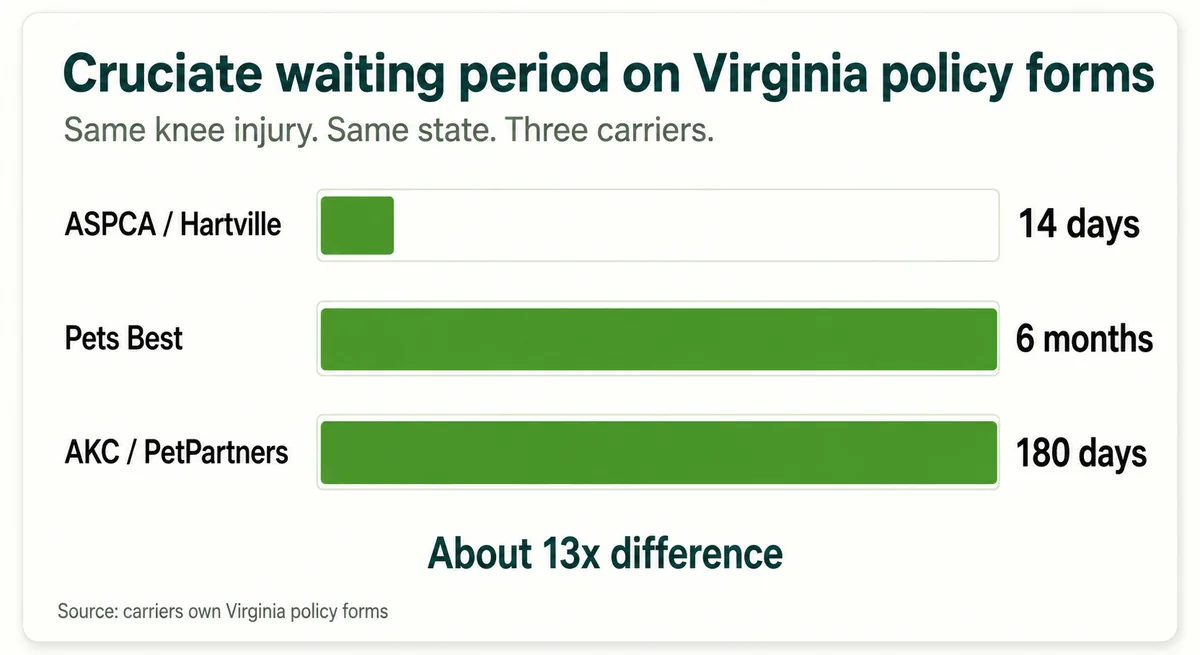
These are the sample forms each brand currently publishes for Virginia, so treat them as illustrative and match the form number on your own quote before relying on any of it. Nothing in Virginia law constrains any of those periods. Note the shape of the AKC form in particular: its ordinary injury wait is two days, one of the shortest anywhere — and knees are carved straight out of it. The same form applies a 180-day wait to intervertebral disc disease, and a 365-day wait before it will cover a pre-existing condition at all.
Here is the part worth knowing about the law Virginia helped write. Model Act §5 would have made waiting-period waivers mandatory, and let the qualifying vet exam happen after purchase. Virginia didn't adopt it, so waivers stay discretionary and on each carrier's terms — Pets Best's Virginia form, for instance, allows a waiver only where the pet's health is certified before coverage is purchased.
One thing to be clear about: a waiting period decides what gets reimbursed, never what your vet can do. If your dog tears a cruciate on day 30, get the knee treated. The clock affects your wallet, not the treatment.
The deductible order nobody quotes you on
Two Virginia policies advertising "80% reimbursement, $250 deductible" can pay you different amounts, because the forms disagree about which one to apply first — and neither quote page mentions it.
ASPCA's Virginia form subtracts "the deductible from covered expenses before applying the reimbursement percentage." Pets Best's Virginia booklet does the reverse: it pays covered expenses "after the application of your chosen Co-insurance, minus your chosen Deductible."
On a $1,200 covered bill at 80% and $250:
- Deductible first (ASPCA): ($1,200 − $250) × 80% = $760
- Reimbursement first (Pets Best): ($1,200 × 80%) − $250 = $710
Fifty dollars on one ordinary claim, from identical advertised terms. The gap widens as the deductible does — so when you compare two Virginia quotes, find this sentence in each form before you decide they're the same offer.
Paying before you're reimbursed
Most pet policies sold in Virginia reimburse you — they do not pay your vet. You settle the bill in full, file a claim, and wait. That gap is the part of pet insurance nobody quotes you on, and at a Virginia referral hospital it can be thousands of dollars wide.
The state's academic referral centre is blunt about it. The Veterinary Teaching Hospital at Virginia-Maryland College of Veterinary Medicine in Blacksburg requires "a prepayment or deposit in the amount of 75% of the 'Estimate of Fees'" before small-animal inpatient care, with "the remaining balance due upon the patient's discharge." On a $6,000 estimate, that is $4,500 up front — while your insurer is still waiting on the invoice.
The college has effectively conceded the point: it now routes clients to CareCredit alongside its own payment channels. When the state's leading referral hospital signposts third-party financing, that is a statement about how often owners cannot pay at the point of care.
Which is worth naming for what it is: financing is credit, not a discount. CareCredit listed a standard purchase APR of 32.99% when we checked in September 2026. Some of its no-interest-if-paid-in-full promotions are deferred-interest offers — clear the balance inside the window and you pay none; miss it, and interest is charged back to the original purchase date. Read the specific offer and card agreement you are shown. It buys you time at the counter, at a price.
The exception is direct pay: where an approved claim runs through a participating clinic, the insurer can pay its share to the hospital and reduce what you advance. You still owe your deductible and co-insurance, plus anything excluded, above your limit, or not approved. Trupanion is the carrier built around this, but it only works where the hospital runs the software — so it is a question about your clinic, not about your policy. Ask before you need it.
A veterinary emergency worker put the whole trade-off plainly in a Virginia thread, and it matches what the forms say: Trupanion "is the best you can get for emergency visits: they pay a portion up front. Everything else operates on reimbursement." That is one practitioner's experience rather than a survey — but the mechanism behind it is real.
So before you choose a policy, make one phone call to the practice you would actually use in an emergency. Ask what they require at check-in, whether they bill any insurer directly, and what a deposit looks like on a serious case. That answer will shape your decision more than a few dollars of monthly premium.
What vet care costs across Virginia
Routine care can cost meaningfully more in Northern Virginia than in the south-west of the state, and you can watch it happen inside a single chain on a single day. Two branches are not a statewide survey — but they are the same company pricing the same services, which strips out most of the usual excuses. Banfield publishes per-hospital pricing, and its Alexandria and Roanoke North pages both carry the same stamp — Last updated: May 14, 2025:
| Service | Alexandria | Roanoke North | Gap |
|---|---|---|---|
| Office visit | $91.95 | $71.95 | +27.8% |
| Professional dental cleaning | $491.95 | $408.95 | +20.3% |
| Spay package (over 6 months, under 50 lb) | $596.95 | $527.95 | +13.1% |
Same company, same services, same week — a routine exam costs a quarter more in Alexandria.
A likely part of the reason is supply rather than greed, though these figures cannot prove causation on their own. Virginia's own licensure survey shows 35% of veterinarians' primary work locations sit in Northern Virginia and 72% in just three regions, while Eastern Virginia holds 1%, Southside 2% and Southwest 4%. Demand concentrates where the vets are, and so does price.
Owners describe the same gradient, and some drive across it. In a Northern Virginia thread, one owner quoted roughly $15,000 for a life-saving surgery locally, called Richmond clinics as a last resort, and found the procedure for "less than half." Others report Fairfax-area cat dental extractions quoted near $2,000 and done for around $800 an hour west. Those are individual accounts, not a price survey — but the direction matches the published data.
What we can't tell you is whether your premium follows. The published evidence is unusually thin. Lemonade puts out a Virginia city table, but its "average monthly premium" column carries an asterisk with no footnote anywhere on the page — no species, age, limit, deductible or date — so there is no way to tell whether those cities differ or the pets behind them do. And the one source that would settle it, the territorial rating factors carriers file with the Commonwealth, is not published in any form we could retrieve.
So treat the care-cost gap as established and the premium gap as open. And note the limits of even that: this corridor is documented between Northern Virginia and Richmond. We found no comparable owner-side evidence for Hampton Roads, Charlottesville, Roanoke, Blacksburg or rural Virginia, and we're not going to invent it.
Which Virginia owners should pick what
There is no best pet insurer in Virginia, and any page that names one is answering a question it didn't ask you. What the Virginia evidence does support is a set of situations, each with a different deciding factor.
A new puppy or kitten with a clean record. This is the only moment you get to choose on mechanics rather than on history, so choose on the clock that will matter. For a large-breed puppy that means the knee: ASPCA's Virginia form applies a 14-day waiting period to ligament and knee conditions, while the AKC Virginia form carves them out of its two-day injury wait and holds them for 180. Clearing a waiting period is not the same as being covered — eligibility still turns on when signs first appeared and on the rest of the policy's terms. Depends on your breed's orthopedic risk — for a cat or a small dog, that gap matters much less.
An older pet, or one already in a medical record. Here the question stops being price and becomes eligibility, and the two are not the same thing. Healthy Paws' Virginia documents say that for a pet "six (6) years of age or greater on the date of enrollment, no coverage shall apply for illness" related to hip dysplasia; the AKC Virginia form covers no pre-existing condition until you have held the policy 365 days. Quotes also scatter hardest here — one owner shopping a 12-year-old cat reported $40 a month through one route, $100-plus from two other carriers, and an outright decline from a third. Depends on what is already written in your pet's file, which is why the medical record matters more than the premium.
If you can't float the bill. Prioritise direct pay over headline price, then confirm your actual emergency hospital supports it. Depends on your clinic's software, not your policy.
Multiple pets. Multi-pet discounts are real, but check the declarations page on each quote for the underwriting company — several familiar brands sit on the same insurer's paper, so three quotes can be less independent than they look. Depends on whether you are genuinely comparing three carriers.
Facing a renewal increase. Virginia caps nothing and pre-approves nothing, so shopping is rational. Get a written offer elsewhere before you cancel anything.
Switching with a condition on file. This is the hard one, and the honest answer is often don't. Your existing policy is the only one that already covers that condition; a new carrier will treat it as pre-existing. As one Virginia owner put it: make sure someone else will insure your pets before cancelling. A new insurer will generally classify anything already in the record as pre-existing, and what happens after that depends entirely on that policy's own terms — get the answer in writing before you cancel anything. And none of this is a reason to postpone care your pet needs now.
Frequently Asked Questions
What is the best pet insurance in Virginia?
There isn't one, and the deciding factor changes with your pet. Because Virginia sets no rules here, carrier forms differ sharply: for a torn knee ligament, ASPCA's Virginia form waits 14 days while AKC's waits 180. For a large-breed puppy that gap decides it; for an older pet, exclusions matter more than price.
Is it really worth getting pet insurance?
It depends on whether you could absorb a four-figure bill — and, separately, whether you could pay it up front. Almost every Virginia policy reimburses you rather than paying your vet, so insurance changes how much comes back, not what you owe at checkout. Virginia-Maryland's teaching hospital requires 75% of the estimate before inpatient care. If losing that money permanently would break something, the reimbursement is what you're buying.
What pet insurance do most vets recommend?
No reliable survey of Virginia veterinarians exists, so treat any page claiming one with suspicion. What clinic staff raise is usually the payment mechanism, not the brand: a veterinary emergency worker in a Virginia thread noted that Trupanion "pay[s] a portion up front" while everything else reimburses afterwards — one practitioner's experience, not a survey. Ask your own practice whether they bill any insurer directly.
Is $50 a month a lot for pet insurance in Virginia?
It's roughly mid-range, but the number is meaningless without its settings. At a $250 deductible, 90% reimbursement and a $5,000 annual limit in Virginia Beach, U.S. News puts a two-year-old dog at $43.90 a month and the same dog at $72.12 with an unlimited limit. So $50 is generous for a young cat, and modest for an older dog on a high limit.
Does Virginia have a pet insurance law?
No. The NAIC's Summer 2025 chart records Virginia as "NO CURRENT ACTIVITY" on the Pet Insurance Model Act — despite Virginia having chaired the working group that wrote it. The one pet-specific line in the state's insurance code, § 38.2-1800, licenses people to sell the product. That isn't the same as unregulated: rates must be filed, policy forms need approval, and claim-handling deadlines still apply.
Can my Virginia pet insurance premium be raised without a cap?
Yes. Virginia rates are file-and-use: § 38.2-1906 requires insurers to file rates "on or before the date they become effective," with no approval prerequisite and no statutory ceiling. Increases at renewal are normal as a pet ages, and a policy you have never claimed against can still be repriced. If you shop afterwards, get a written offer before cancelling — anything already in your pet's record will be pre-existing to the new carrier.
What happens to my coverage if I move out of Virginia?
Expect both the price and the paperwork to change. Location is a rating factor, so your premium is recalculated. More importantly, several carriers issue genuinely state-coded forms — ASPCA's Virginia policy is PET-P-20000-VA-1024 — so a move can put you on different contract terms, not just a different price. Tell your insurer as soon as you know the date, and ask whether your waiting periods or exclusions change.
How do I complain about a pet insurance claim in Virginia?
Through the State Corporation Commission's Bureau of Insurance — Virginia has no "Department of Insurance," whatever other sites say. File under "Other"; the property and casualty form offers only Auto, Home and Other, which is why no Virginia pet-complaint count exists. First, ask your insurer in writing which clause it relied on: under 14VAC5-400-60 it has 15 calendar days to accept the claim, deny it, or tell you in writing that it needs more time to investigate.
Sources
- Pet Insurance Model Act (#633) — State Adoption Chart, Summer 2025 — National Association of Insurance Commissioners
- § 38.2-1800. Definitions (limited lines property and casualty agent; pet accident, sickness and hospitalization insurance authority) — Code of Virginia
- Bureau of Insurance — Virginia State Corporation Commission
- Best Pet Insurance in Virginia for 2026 — U.S. News & World Report
- Best Pet Insurance in Virginia 2026: Compare Top Companies For Dogs & Cats — Pawlicy Advisor
- State of the Industry Report 2026 — Highlights (2025 data year) — North American Pet Health Insurance Association (NAPHIA)
- The Best Pet Insurance in Virginia 2026 — WSJ Buy Side
- Pet insurance in Virginia for dogs and cats — Fetch Pet Insurance
- The Best Pet Insurance in Virginia of 2026 — MarketWatch Guides
- Pet Insurance in Virginia — Lemonade
- NAIC Pet Insurance Model Act (#633) — Project History — National Association of Insurance Commissioners
- § 38.2-116. Animal insurance defined — Code of Virginia
- § 38.2-1866. Continuing education requirements — Code of Virginia
- § 38.2-1906. Filing of rates and supplementary rate information — Code of Virginia
- § 38.2-317. Filing and approval of policy forms — Code of Virginia
- § 38.2-1606. Powers and duties of the Association (claim limits) — Code of Virginia
- 14VAC5-400-60. Standards for prompt, fair and equitable settlements — Virginia Administrative Code
- Lines of Authority & Application Fees — Virginia State Corporation Commission, Bureau of Insurance
- Accident & Illness Policy, Virginia — form PET-P-20000-VA-1024 — ASPCA Pet Health Insurance / Independence American Insurance Company
- Pet Insurance Policy Booklet, Virginia — form IAIC-PB10001-ILL — Pets Best / Independence American Insurance Company
- CompanionCare Accident & Illness Policy, Virginia — form IAIC PPI AI POL 007 VA 1120 — AKC Pet Insurance / PetPartners
- About Your Visit — Small Animal Services (payment and prepayment policy) — Virginia-Maryland College of Veterinary Medicine, Veterinary Teaching Hospital
- CareCredit credit card — apply (rates and terms) — Synchrony Bank
- What pet insurance do my fellow Virginians on Reddit recommend? — Reddit — r/Virginia
- Service pricing — Alexandria, VA (Last updated May 14, 2025) — Banfield Pet Hospital
- Service pricing — Roanoke North, VA (Last updated May 14, 2025) — Banfield Pet Hospital
- Virginia Veterinarians: Workforce Survey Results (2025) — Virginia Department of Health Professions, Healthcare Workforce Data Center
- PSA: If your pet gets quoted a huge surgery bill in NOVA, check Richmond before giving up — Reddit — r/nova
- Pet Owners - Are your pets insured? If so by who and how much do you spend? — Reddit — r/nova
- Make a Payment — Veterinary Teaching Hospital — Virginia-Maryland College of Veterinary Medicine
- Virginia policy documents (sample policy and state endorsements) — Healthy Paws Pet Insurance / Westchester Fire Insurance Company
- § 38.2-1904. Rate standards — Code of Virginia