


If you are comparing Embrace and Trupanion, you are probably not starting from scratch. Most people land on this question holding a renewal notice that jumped more than they expected, or having finally narrowed a long list down to these two names. So here is the honest answer first: neither one wins outright, and the pages that do crown a single winner contradict each other.
That is not a dodge. Embrace and Trupanion are not two prices for the same product — they are two different contracts that handle the same vet bill in genuinely different ways. Embrace subtracts your deductible and then applies your reimbursement percentage; Trupanion does it in the opposite order. Embrace's deductible is annual and resets each policy year; Trupanion's is charged once per condition and then never again for that condition. Those two differences can move more money over a pet's life than the premium gap between the two quotes — though how much depends on what your pet actually claims for, and a wide enough premium gap cancels the advantage.
We wrote this from the current filed policy forms on both sides, not from either company's marketing — including the part almost nobody mentions: Trupanion publishes a different sample policy for 33 states than for the 14 jurisdictions routed to its newest edition, and the two decide claims differently. What follows is which contract you would actually get, what each one does to your money on a real bill, and the single fact that would flip the recommendation for your pet.
Table of Contents
- The short answer, by situation
- First: which contract are you actually buying?
- Who actually insures your pet
- The deductible is a different instrument
- The two payout formulas, worked
- Exam fees
- Waiting periods and pre-existing conditions, by edition
- Claim day: who pays the vet, and what you must front
- What happens at renewal
- If you already hold one of these
- Buying through Chewy or USAA is not the same purchase
- Price: what can and cannot be compared
- How to pick your deductible
- Financial strength, briefly
- Frequently Asked Questions
- Sources
The short answer, by situation
There is no overall winner here, and we are not going to invent one. The question that actually decides it is narrow: is your pet's likely spending one condition claimed over and over, or several unrelated things? Trupanion is built for the first shape, Embrace for the second.
| Your situation | Usually the better fit | What would reverse it |
|---|---|---|
| Your pet develops one chronic condition after coverage starts, and you claim on it year after year | Trupanion — its deductible is charged once for that condition and never resets | A premium gap wide enough to swallow the saving — in our five-year example, about $29 a month. A condition your pet already has is a pre-existing condition at either carrier, so this row is about future illness, not a diagnosis you already hold. |
| Your pet is accident-prone, or you expect several unrelated problems in a year | Embrace — one annual deductible covers all of them | Only one of those problems turning out to be expensive and recurring. |
| You already hold one of these and the other quoted you less | Usually staying put — a switch re-opens your pet's whole medical history | A pet with a genuinely clean chart and no claims yet. |
| You cannot comfortably front a four-figure bill at the counter | Trupanion, if your hospital participates — direct payment depends on an arrangement with that specific clinic | Your hospital not being set up for it. Then Embrace's pre-certification route, which also needs the hospital's agreement, is steadier. |
| You want to dial the policy down to control what you pay | Embrace — it publishes 70%, 80% or 90% reimbursement and limits from $2,000 to unlimited, while Trupanion advertises no annual or payout limits and publishes no comparable menu | Finding that the configuration you want is actually offered in your state — check both quote flows before assuming the menus are fixed. |
Every row rests on one piece of arithmetic, worked in full further down. For either company on its own, see our Embrace review and Trupanion review.
First: which contract are you actually buying?
Not "a Trupanion policy." Trupanion's state selector serves nine different sample policies across 52 jurisdictions, and the two biggest ones decide claims differently.
Thirty-three states are routed to a February 2019 form, TRU (D) 00001 (V10.201902). Fourteen jurisdictions get the September 2023 form, TRU (D) 00001.1 (V01.202309). California, New York, Illinois, Massachusetts and Puerto Rico each get an edition of their own, and Ohio and Pennsylvania get their own 2023-series files. The 2019 and 2023 forms disagree on waiting periods, on how long you have to file a claim, and on how far back a pre-existing condition can reach — which is exactly why comparison sites give four different answers about Trupanion.
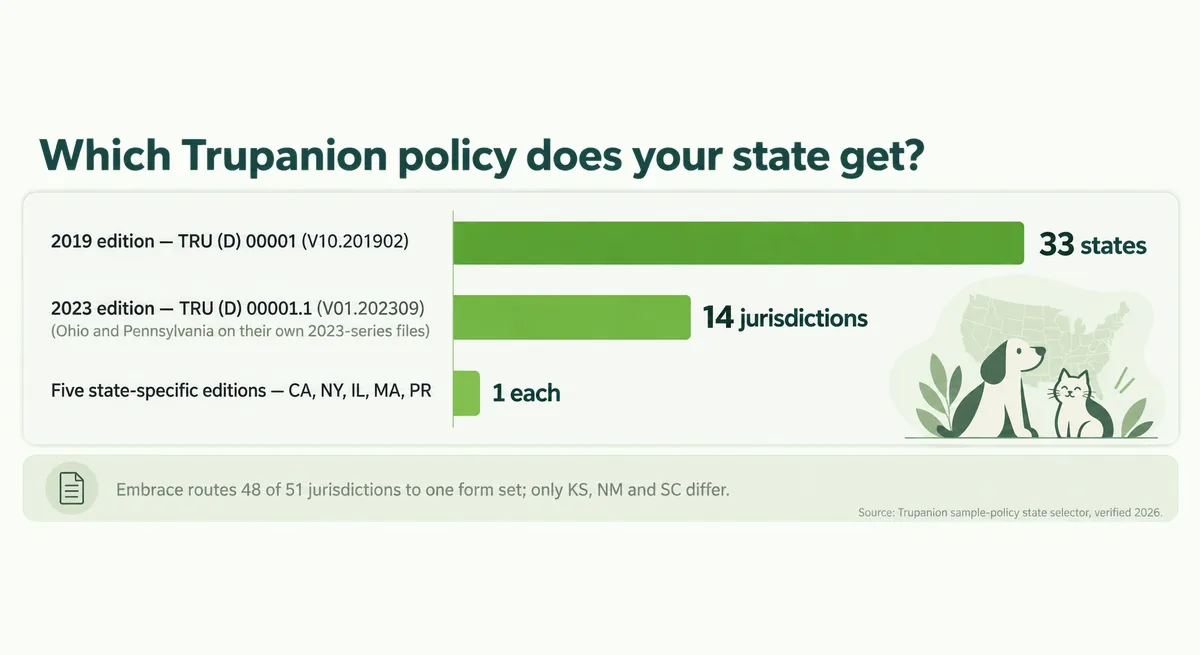
Embrace is far flatter. Forty-eight of 51 jurisdictions take one set of state terms; only Kansas, New Mexico and South Carolina take the older set. Its current documents are policy form PET50 (01/23) and the INDPP (01/23) disclosure.
Three things to hold onto before you compare anything else:
- A published sample is not your policy. That routing shows which sample each state is sent to — not what any individual buyer was actually issued.
- Thirty-three states is not "most buyers." States differ enormously in population, so a jurisdiction count is not a headcount.
- Your contract is the policy plus your declarations page, riders and state endorsements. The 2019 form says so itself.
So the first practical step is not a quote. It is pulling your own state's sample from each carrier and checking the form number printed on it.
Who actually insures your pet
Neither brand is the insurance company. Both are agencies that sell and administer a policy someone else carries the risk on — which matters the moment you want to check financial strength or file a complaint with a regulator.
| Role | Embrace | Trupanion |
|---|---|---|
| Sells and administers | Embrace Pet Insurance Agency, LLC | Trupanion Managers USA, Inc. |
| Carries the risk | American Modern Home Insurance Company (NAIC 23469) — American Southern Home Insurance Company in Florida | American Pet Insurance Company (NAIC 12190), New York |
| Parent of the insurer | Munich Re | Trupanion, Inc. |
Two cautions worth a sentence each. Embrace's agency was acquired in October 2023 by Independence Pet Holdings, a JAB Group company — but ownership is not underwriting, and the risk still sits with American Modern Home. And California's own insurance department still lists Embrace's previous underwriter on its consumer page, which is the best argument we know for trusting the insurer named on your declarations page over any website.
The deductible is a different instrument
Embrace's deductible is annual and starts over every policy year. Trupanion's is charged per condition — once you have met it for your dog's hip dysplasia, you never pay it again for that condition, for the life of the policy. Same word on both quotes, two different instruments.
Which way that cuts depends entirely on the shape of your pet's spending, not on the brand. Here is the same money under both contracts, at 90% reimbursement and a $500 deductible:
| Scenario | Embrace reimburses | Trupanion reimburses | Better by |
|---|---|---|---|
| Three unrelated conditions, $2,000 each, in one year | $4,950 | $3,900 | Embrace, $1,050 |
| One chronic condition, $2,000 a year for five years | $6,750 | $8,500 | Trupanion, $1,750 |
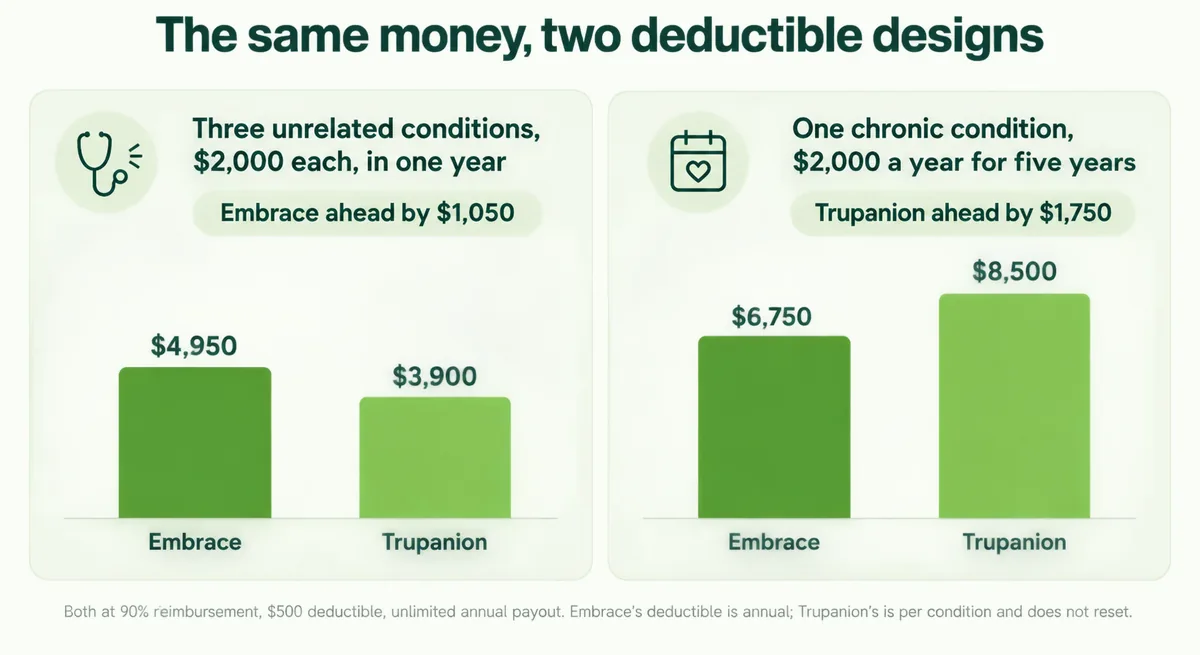
Embrace charges one deductible across all three problems; Trupanion charges three. Reverse it over five years and Trupanion charges the deductible once while Embrace charges it five times. That five-year gap works out to about $29 a month — so if Trupanion quotes you more than roughly $29 above Embrace, the advantage is gone.
Two conditions travel with that table. It assumes unlimited annual payout on both sides — true of Trupanion by construction, true of Embrace only if you bought the unlimited limit. Change that and it flips hard: on a $15,000 bill with $10,000 of Embrace annual limit left, the remaining $5,000 is yours. And the five-year result rests entirely on Trupanion's deductible never resetting for that condition. This is a comparison of deductible mechanics, not a verdict on which company costs less — nothing in the evidence tells us how likely either scenario is for your pet.
What Embrace's deductible actually does in 2026
Google's AI summary for this comparison currently says Embrace's deductible drops by $50 for every claim-free year. That was the Healthy Pet Deductible, and as of September 2026 Embrace's live site documents neither that program nor the premium discount announced to replace it — its discounts page lists only a 10% multi-pet and a 5% military discount. Until you can see a shrinking-deductible benefit named in your own state's documents, price these policies with it valued at zero.
The two payout formulas, worked
Same bill, same deductible, same percentage — different check. Embrace subtracts your deductible first and then applies your reimbursement percentage. Trupanion applies the percentage first and subtracts the deductible from what is left.
On a $1,000 eligible bill at 90% reimbursement with a $250 deductible:
- Embrace: $1,000 − $250 = $750, then × 90% = $675
- Trupanion: $1,000 × 90% = $900, then − $250 = $650
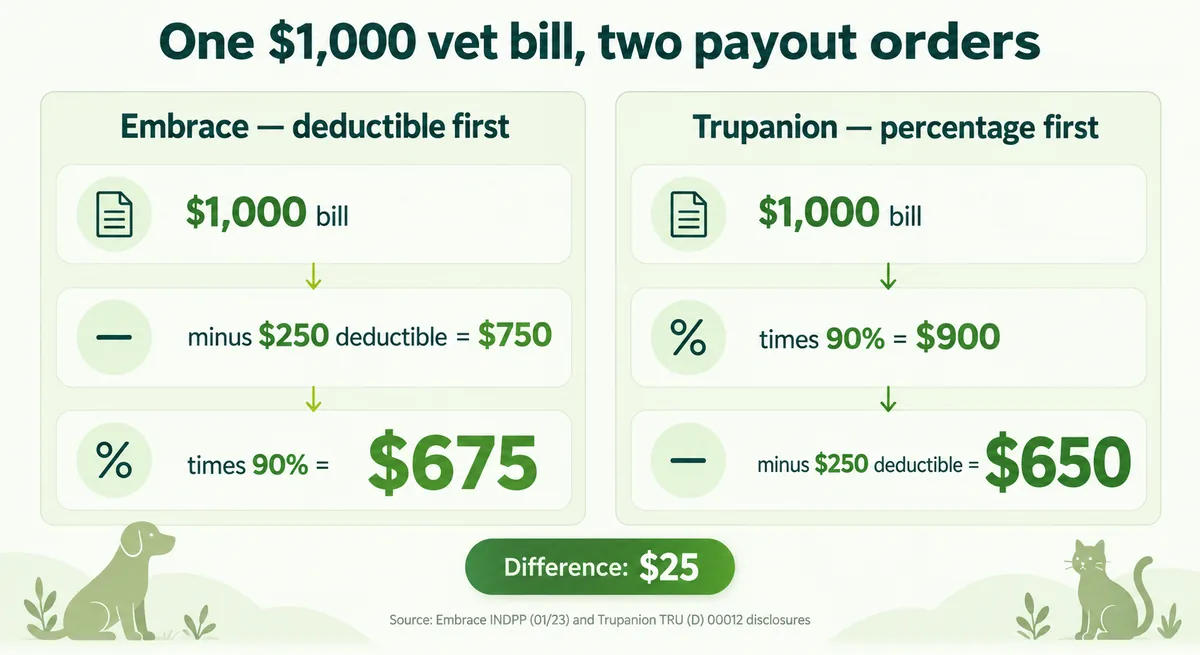
The gap is your deductible multiplied by the share you are not reimbursed: $25 at a $250 deductible, $50 at $500, and nothing at all at 100% reimbursement. It only holds when both deductibles are equally untouched, the bill is large enough to clear both, and no annual limit binds. One practical consequence of Trupanion's order: with a $500 deductible at 90%, nothing pays until the bill passes about $556, where Embrace starts paying above $500.
Two scope notes before you weigh this. The order is not in Trupanion's policy booklet at all — it is spelled out only in its filed state disclosures, and the identical example appears in Florida's 2023 disclosure and in New Hampshire's 2019-era one, so the order holds across both form generations rather than being a state quirk. And every Trupanion disclosure we read works its example at 90%, with no published menu of other reimbursement levels, while Embrace sells 70%, 80% or 90% — so 90% is the only rate at which the two orders can be compared like for like.
Worth knowing, worth checking on your own quote — but this is tens of dollars a claim. The deductible unit above is the part that moves real money.
Exam fees
Every sick visit starts with an exam fee, and it is where these two contracts diverge most visibly. Direct Trupanion excludes them outright — both served editions list exam fees as yours to pay, in identical words, and the 2023 edition widens the definition to sweep in consultations, rechecks, telemedicine and "any type of planning fee," excluded "at any time or for any reason."
Embrace covers them, but as an option — and its own pages disagree on the default. Its coverage FAQ answers "Are vet exam fees covered?" with "Yes," then footnotes that exam fees "are not covered on all policies, it is an optional add-on to your policy." Check what your own quote actually includes rather than trusting the headline answer.
The math is simple. At 90% reimbursement, $300 of eligible exam fees comes back as $270 once your deductible is met — weigh that against what the option adds to your annual premium. Embrace's FAQ also flags that chemotherapy may sit inside optional prescription coverage, so a stripped-down Embrace quote is not the same product as a loaded one.
Waiting periods and pre-existing conditions, by edition
This is where comparison sites contradict each other, and the reason is mundane: they are quoting different Trupanion contracts.
| Contract | Illness | Accident |
|---|---|---|
| Trupanion 2019 form (33 states) | Illnesses arising through 30 days after enrollment are treated as pre-existing | Same rule, through 5 days |
| Trupanion 2023 form (14 jurisdictions) | No waiting period — but the policy does not take effect for 12 days unless you enroll through the exam program | As illness |
| Embrace | 14 days everywhere | Genuinely unsettled across Embrace's own documents |
The 5-day and 30-day figures are not stale marketing — they are the terms of the sample Trupanion currently publishes for 33 states. Which form you actually receive is set by your declarations page and any state endorsements.
Pre-existing: one carrier has a way back, the other doesn't
Embrace's current form, PET50 (01/23), lets a "Temporary Condition" stop counting as pre-existing after 12 consecutive months with no clinical signs and no treatment. Direct Trupanion has no equivalent in either served edition — its exclusion expressly reaches conditions that "occur or reoccur," including ones masked or controlled by medication.
How far back each contract reaches differs too. The 2019 form bounds most of its pre-existing clauses to signs in the 18 months before enrollment; the 2023 form carries no such bound at all. Hip dysplasia and IVDD are unbounded in both — a note anywhere in your pet's charted history can trigger them. Trupanion's public FAQ describes the 18-month rule, which is more generous than what a 2023-form buyer actually receives.
On the orthopedic clock, Embrace runs three regimes: 180 days in most jurisdictions, 30 days in California, Louisiana, New Hampshire, Pennsylvania, Vermont and Washington, and a six-month version reducible by an orthopedic exam in Kansas, New Mexico and South Carolina. Embrace's own pages disagree about New York, North Carolina and Vermont, so confirm yours before you buy. And do not assume cats sit outside this: the IVDD exclusion is written for "any pet."
For the same rules across every major carrier, see our pet insurance fine-print index.
Claim day: who pays the vet, and what you must front
The number that decides this section is not what you eventually get back. It is how much cash you need at the counter before anyone reimburses you — and on an emergency bill, that gap is the whole decision.
Trupanion can pay the hospital directly, and the ability is written into the policy — but conditionally. Your claim can go straight to the vet "if an arrangement to do so exists between Us and the treating Veterinarian." In practice that means the clinic has installed Trupanion's software, which is the practice's decision and not yours. Ask your own hospital before you count on it.
Embrace is a reimbursement insurer by contract: you pay, then claim. But the common line that Embrace never pays the vet is wrong — including where Trupanion's own comparison page says it. Embrace publishes a pre-certification route that can send payment straight to the hospital where the hospital has agreed beforehand. It needs a clinic stamp and about five business days, and no minimum bill is published.
Filing deadlines differ more than you would expect. Trupanion's 2019 form gives you 90 days from the treatment date; the 2023 form gives 365, and pays later claims where the delay caused it no prejudice. Embrace gives your policy term plus 60 days after renewal, and publishes no equivalent late-claim exception.
What happens at renewal
The two companies handle your pet's aging in opposite ways, and this is the difference most people are actually shopping on.
Trupanion says your rate "may adjust for rising costs in care" but "will not increase just because your pet gets older," and that you will "never pay more just for using your coverage." Embrace reprices with age at each renewal — and its current policy form lets more than the premium change at renewal: reimbursement percentage, deductible and terms are all on the table. Both carriers price by geography, and both treat a move as a mid-term trigger.
None of that means Trupanion's price is flat. Every carrier's rates rise with veterinary costs, and rate changes are approved for a whole book of business — an approved percentage is an average across everyone, not a forecast of your renewal.
One question we cannot settle for you: whether claiming raises your Embrace premium. Embrace's countrywide disclosure says premium "may be impacted and could result in a possible increase based on your claim history." That is a disclosure of what the insurer may do, not a statement that it does. The rating manual that would settle it is not public, and the circumstantial evidence points to class rating — everyone in your state moving together. Treat it as unresolved rather than assuming either answer.
If you already hold one of these
If you are insured today, the comparison is not your renewal against the other company's quote. It is what each policy will pay from here — and a switch forfeits two things that never appear on a price table.
Your covered history. A condition your current policy pays for can become excluded under a new one, because the new insurer underwrites your pet's whole record. It is the largest hidden cost of switching, and why owners who ask usually end up staying.
A deductible you have already paid. Meet Trupanion's deductible for a chronic condition and it is met for life; switch and it resets. Embrace's annual deductible resets every year anyway, so this loss lands almost entirely on people leaving Trupanion.
Moving within a brand carries the same risk: Embrace's form resets waiting periods and re-tests pre-existing conditions as of the date you increase coverage, even for things you never claimed. Coverage you drop cannot be added back later.
If you hold Embrace, request a Medical History Review once your illness waiting period has passed, so you learn what is excluded before a claim rather than during one. And keep taking your pet to the vet: both contracts require you to follow veterinary advice, so skipping care to protect a clean record costs coverage rather than saving it.
Our switching guide covers the mechanics; our pre-existing conditions guide covers what carries over.
Buying through Chewy or USAA is not the same purchase
You can buy a Trupanion-underwritten policy at Chewy, and it is not the policy described above. On its Complete Accident & Illness plan, three mechanics we just walked through are reversed:
| Mechanic | Direct Trupanion | Chewy CarePlus Complete |
|---|---|---|
| Deductible | Per condition, never resets | Annual — resets every 12 months |
| Exam fees | Excluded | Covered |
| Payout order (on a $1,000 bill at 90%, $250 deductible) | Percentage first — $650 | Deductible first — $675 |
Same underwriter, opposite arithmetic — and two traps. Exam-fee coverage belongs to the Complete tier, not to Chewy as a channel: the Essential plan excludes them. And Chewy's plan has an enrollment gate direct Trupanion does not — a vet exam in the 12 months before you enroll, unless your pet enrolls before its first birthday. These plans are also not sold in Alaska, California, Hawaii or Vermont.
Do not generalize to "Chewy pet insurance," either: the same storefront also sells Lemonade-underwritten plans on separate terms, so "Chewy pet insurance" describes a shelf, not one contract.
On the Embrace side, USAA refers members to Embrace rather than underwriting anything itself. Whether the member contract, endorsements and deductible incentives match buying direct is something we could not establish — treat it as open and compare your own documents. Both routes get their own write-ups: our Chewy CarePlus review and our USAA review.
Price: what can and cannot be compared
We are not going to hand you a "cheaper" verdict, because the honest version is narrower than that.
Embrace sells annual limits from $2,000 to unlimited. Direct Trupanion sells unlimited only. So there is exactly one configuration where a like-for-like comparison is even possible: unlimited against unlimited, at 90%, same pet, same ZIP, same day. At any capped Embrace limit there is no matching Trupanion product at all — which means a cheaper Embrace quote at $5,000 of annual cover is not a cheaper carrier, it is a smaller policy.
We did not obtain a matched quote pair. Both companies quote through interactive forms that need your pet's details, and we did not complete either checkout. Rather than publish two numbers never taken on the same terms — which most ranking pages for this comparison do — here is the protocol: quote both at unlimited and 90% on the same day, with the same deductible amount, and check whether exam-fee coverage is inside the Embrace figure.
One published figure, for calibration: Embrace's California page lists a two-year-old Yorkshire Terrier in Burbank at "starts from $20.37," with no deductible, limit or reimbursement percentage attached to it. Treat that as an entry point, not a quote.
How to pick your deductible
Because the two deductibles are different instruments, the same number means different things. At Trupanion a higher deductible is paid once per condition and never again, so on a pet with one lasting problem it buys down premium for that condition's life. At Embrace it comes back every policy year, so raising it trades premium for a cost you meet again annually.
One Trupanion rule to know before you choose: you can raise your deductible at any time, but you can only lower it in the first 30 days — and a condition your pet already has stays attached to the higher amount.
How much that moves the premium varies. One owner facing a large increase reported quotes falling from about $230 a month at a $200 deductible to about $102 at $1,000 — one pet, one state, one day, not a rate table.
Financial strength, briefly
You cannot rank these two on a single number, because they are not rated on the same scale. Embrace's insurer, American Modern Home, holds an AM Best rating of A+ (Superior), affirmed in July 2026 — but AM Best rates it as part of the Munich Re group, not on its own balance sheet. Trupanion's insurer holds a Demotech Financial Stability Rating of A′ (A-Prime), affirmed in June 2026, which is the second-highest grade on that scale. We could not retrieve an AM Best rating for it, which is not the same as it having none.
Frequently Asked Questions
Is Embrace considered a good pet insurance?
Yes, with conditions. Embrace's contract has two features that genuinely help: an annual deductible that covers every condition in the same year, and a route back from "pre-existing" for temporary conditions that stay symptom-free and treatment-free for 12 months. Its weaknesses are that it reprices as your pet ages, and that its coverage FAQ answers "yes" on exam fees and then footnotes that they are an optional add-on. It fits multi-problem pets better than chronic ones.
Is Trupanion actually worth it?
It turns on one thing: whether your pet is likely to develop a single condition you claim on for years. Trupanion's deductible is charged per condition and never resets, which compounds in your favor on a chronic illness — in our five-year example it paid $1,750 more than Embrace. On a pet with several unrelated problems in one year, the same design costs you: three separate deductibles instead of one.
Is Trupanion overpriced?
We cannot answer that with a matched quote, because we did not obtain one — and neither did any ranking page we checked. What we can say is that direct Trupanion sells only unlimited annual coverage, so a cheaper competitor quote often reflects a smaller policy rather than a cheaper carrier. Compare both at unlimited and 90% on the same day, and remember that Trupanion excludes exam fees on every visit.
What's better than Trupanion?
For this comparison, the honest answer is: Embrace, for some pets. If your dog or cat is likely to have several unrelated problems in a year, Embrace's single annual deductible pays more. If you want to lower your premium by taking a smaller annual limit or a 70% reimbursement rate, Embrace publishes those options; Trupanion advertises no annual or payout limits and publishes no comparable menu. For one chronic condition claimed year after year, Trupanion's design wins.
Does Embrace pet insurance cover pre-existing conditions?
Not directly, but it has a route back that direct Trupanion does not. Under Embrace's current form, a "temporary condition" stops counting as pre-existing after 12 consecutive months with no clinical signs and no treatment. That excludes anything chronic by definition, since the form defines a chronic condition as one that can be managed but not cured. Four orthopedic conditions — cruciate ligament injury, IVDD, patellar luxation and canine hip dysplasia — are excluded for the life of the policy if they show up before the illness waiting period ends or in the first 180 days. Only hip dysplasia is limited to dogs.
Does Embrace pet insurance cover dental illnesses?
Yes, with a cap: Embrace's disclosure sets a $1,000 annual sub-limit on dental illness. Trupanion takes a different approach — no dental sub-limit, but a maintenance gate. Under its 2019 form your pet's teeth must be examined by a veterinarian at least once every 12 months, and where a dental cleaning is recommended it must be done within the recommended timeframe, or within three months if none is given.
What does Trupanion pet insurance cost?
Trupanion does not publish a rate table, and the price depends on your pet's species, breed, age and where you live — though Trupanion says a rate "will not increase just because your pet gets older". The biggest lever you control is the deductible. One owner facing a large increase reported quotes falling from about $230 a month at $200 to about $102 at $1,000 — one pet, one day, not a rate table.
What are some common complaints about Trupanion pet insurance?
The themes owners raise about both carriers are pre-existing determinations drawn from old records, and renewal increases. On the regulatory record specifically, Washington's insurance commissioner fined Trupanion Managers USA $100,000 in 2019 for producer-licensing failures and for giving pet-care providers referral gifts worth over $100 (Order 19-0249, searchable in the state's enforcement database). A 2026 New York examination of its insurer is "confined to financial statements" and raised no consumer findings — a financial examination does not test market conduct.
Is the Trupanion plan sold through Chewy the same policy?
No. Chewy's Complete Accident & Illness plan is underwritten by the same company but reverses three core mechanics: the deductible is annual rather than per condition, exam fees are covered rather than excluded, and the deductible comes off before the reimbursement percentage rather than after. It also requires a veterinary exam in the 12 months before enrollment unless your pet is under a year old, and it is not sold in every state.
Sources
- Insurer Disclosure of Important Policy Provisions (INDPP 01/23) — Embrace Pet Insurance
- Insurer Disclosure of Important Policy Provisions — Washington (TRU (D) 00012 WA v01.202309) — Trupanion
- View a sample policy (state selector) — Trupanion
- Pre-Certification for Pet Insurance Claims — Embrace Pet Insurance
- Dog Insurance — plan options and coverage — Embrace Pet Insurance
- Embrace Pet Insurance Terms and Conditions (state terms) — Embrace Pet Insurance
- Who underwrites Embrace pet insurance policies — Embrace Pet Insurance
- Report on Examination of American Pet Insurance Company as of December 31, 2024 — New York State Department of Financial Services
- JAB Holdings B.V. Prospectus, 15 May 2025 — JAB Holding Company
- Pet Insurance Companies (consumer list) — California Department of Insurance
- Pet Insurance Discounts — Embrace Pet Insurance
- Insurer Disclosure of Important Policy Provisions — Florida (TRU (D) 00012 FL v01.202309) — Trupanion
- Pet Insurance Coverage FAQ — Embrace Pet Insurance
- Pet Insurance Waiting Periods — Embrace Pet Insurance
- Policy form PET50 (01/23) — Embrace Pet Insurance
- Pre-existing conditions (FAQ) — Trupanion
- Orthopedic waiting period by state — Embrace Pet Insurance
- Pet Insurance Claims — Embrace Pet Insurance
- Our Pricing Promise — Trupanion
- Pet Insurance at Chewy — plans, forms and underwriting disclosure — Chewy
- Pet Insurance in California — Embrace Pet Insurance
- Leaving Trupanion Due to Large Price Increase (owner-reported quotes, r/petinsurancereviews) — Reddit
- AM Best rating disclosure — American Modern Home Insurance Company — AM Best
- American Pet Insurance Company — Financial Stability Rating — Demotech
- Financial Stability Ratings — definitions — Demotech
- Enforcement actions and orders (consumer toolkit) — Washington State Office of the Insurance Commissioner
- Insurer Disclosure of Important Policy Provisions — New Hampshire (TRU (D) 00012 NH v01.201902) — Trupanion
- Pet Insurance Coverage, Redefined — Trupanion