


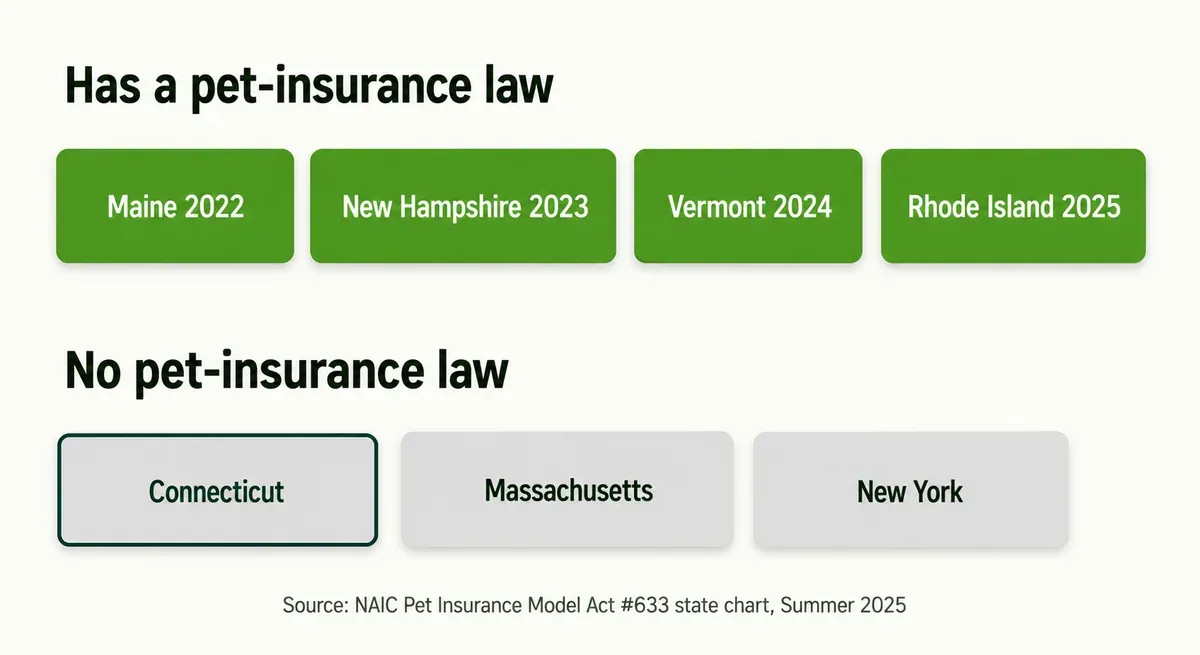
Four of the six New England states have a pet-insurance law. Connecticut is not one of them.
Maine passed one in 2022, New Hampshire in 2023, Vermont in 2024, Rhode Island in 2025. On the NAIC's adoption chart, Connecticut and Massachusetts are the two holdouts — both filed under "NO CURRENT ACTIVITY." And the model those four adopted is not abstract. It caps a waiting period at "30 days for illnesses or orthopedic conditions not resulting from an accident," bans accident waiting periods outright, and puts "the burden of proving that the preexisting condition exclusion applies" on the insurer, not on you. Connecticut law guarantees none of that. An individual policy may still offer some of it — which is exactly why the terms matter more here.
What Connecticut does give you is real, but generic, and it lives in a different part of the code. And because of how the state classifies this product, one more thing follows that nobody says out loud: no Connecticut pet-insurance rate is filed with anyone.
What follows is the Connecticut picture — what coverage costs at settings you can reproduce, why no published Connecticut price can be checked against a filing, what fills the legal gap, what the state's own complaint ledger records, and what a Connecticut hospital wants at the door.
Table of Contents
- What pet insurance costs in Connecticut
- Why no Connecticut price can be audited
- What Connecticut law does and does not give you
- Waiting periods and exclusions on Connecticut policies
- Paying before you're reimbursed
- What vet care costs across Connecticut — and who is open
- Which Connecticut owners should pick what
- Frequently Asked Questions
- Sources
What pet insurance costs in Connecticut
At a $500 deductible and 90% reimbursement, averaged across the twelve carriers it rates, U.S. News puts a one-year-old medium mixed-breed dog in Stamford at $68.72 a month on a $10,000 annual limit, and a one-year-old domestic shorthair cat at $39.70.
| Stamford 06902 — 12-carrier average, $500 deductible, 90% reimbursement | Dog, 1 yr | Dog, 6 yrs | Cat, 1 yr | Cat, 6 yrs |
|---|---|---|---|---|
| $10,000 annual limit | $68.72 | $107.08 | $39.70 | $58.11 |
| Unlimited annual limit | $91.17 | $152.60 | $52.88 | $81.67 |
Two gradients are worth reading off that table before you compare it to anything else. Five years of age adds 56% to the dog and 46% to the cat. Lifting the annual limit from $10,000 to unlimited adds 33% to the young dog — a third more, for a setting you choose in about four seconds.
Forbes Advisor shows the same effect inside its own numbers, which is the cleanest proof available that configuration is doing the work. Holding the deductible at $250 and reimbursement at 80% and changing nothing but the limit, its Connecticut dog goes from $61 at a $5,000 cap to $82 unlimited, and its cat from $29 to $39. Same state, same publisher, same stated deductible and reimbursement — a third more, again.
Which is why the published "Connecticut average" for a dog runs from $48 to $152.60 depending on who you read. Fetch says "Connecticut plans average $48/month for dog insurance" and states no configuration at all. U.S. News's six-year-old dog on an unlimited limit is $152.60. Both are real numbers. Neither is the Connecticut price, and averaging them would produce a figure describing no pet that exists.
The one anchor that is not a single vendor's quote engine comes from the industry's trade body. NAPHIA's 2026 state distribution puts Connecticut at 1.7% of US insured pets but 2.0% of US gross written premium — an index of about 1.18, meaning the average Connecticut policy costs roughly 18% more than the national average policy. That is our arithmetic on NAPHIA's two published columns, not a figure NAPHIA prints.
There is a reason none of these numbers can be checked against anything official, and it is not that nobody has looked.
Why no Connecticut price can be audited
There is a reason those figures cannot be checked against each other, and it is regulatory rather than editorial.
The Insurance Department "categorizes pet insurance as a type of 'inland marine' insurance," in the words of the General Assembly's own Office of Legislative Research. Policy forms get filed. Rates do not. Connecticut's rate statute requires every admitted insurer to submit its manuals, classifications and rating plans to the Commissioner — "except as to inland marine risks which by general custom of the business are not written according to manual rates or rating plans." OLR states the consequence in one sentence: the law "exempts inland marine insurers, including pet insurers, from the requirement to file premium rates with the department… In practice, rates are based on an insured's risk and market competition."
So there is no Connecticut rate filing to inspect, no filed territory table, and no regulator-published Connecticut average. Every quoted price in the section above is a private quote engine's output. Connecticut does not require those premium rates to be filed with the Insurance Department, so no published sample can be checked against a required public rate filing here. (NAPHIA's share figures are the one exception, and they are industry-reported aggregates rather than anything Connecticut collects.)
Which is worth remembering when you read a state page. Insurify's Connecticut page answers "how much does pet insurance cost in Connecticut?" with "starting at $11 for cats and $27 for dogs" — a floor, not an average — and the three sample monthly quotes beside it list deductibles, limits and reimbursement rates as the carrier's available options rather than as the settings those quotes were actually priced at. MoneyGeek's Connecticut page has been folded into a national one, so a Connecticut figure still quoted from it points at a page that no longer exists.
None of that is dishonest. It is simply what happens when a product is sold in a state that has decided not to look at its prices — and it is why the only figures worth carrying into a decision are the ones that arrive with their settings attached.
What Connecticut law does and does not give you
Connecticut's insurance code is Title 38a, and it runs to 33 chapters. The word "pet" does not appear in its chapter index. It does not appear in Chapter 700, which governs property and casualty contracts, across some 320,000 characters. It does not appear in Chapter 701, which governs rate regulation. That is a search we ran rather than an absence we assumed — and the NAIC's Summer 2025 adoption chart puts Connecticut under "NO CURRENT ACTIVITY" alongside Massachusetts. Read it as: as of that chart and the current published code, Connecticut has no pet-insurance act and no pet-specific subtitle for a carrier to comply with.
What you get instead is generic, and it is not nothing. The General Assembly's Office of Legislative Research states that Connecticut law requires pet insurers, like most other inland marine insurers, to give an insured a premium billing notice at least 30 days before renewal and notice of intent not to renew at least 60 days in advance, both under § 38a-323. That statute is worth reading for one clause in particular: the non-renewal notice "shall state or be accompanied by a statement specifying the reason for such nonrenewal." So if a Connecticut insurer refuses to renew, it has to tell you why, in writing, two months ahead. That covers non-renewal specifically, not every route by which cover can end — and it rests on OLR's reading, below. Most owners still do not know they have it.
The same section covers a quieter risk. If an insurer means to renew you on worse terms, it must send a conditional renewal notice "clearly identifying any reduction in coverage limits, coverage provisions added or revised that reduce coverage or increases in deductibles." One caveat, because nobody else states it: that § 38a-323 reaches pet policies specifically is OLR's reading of a statute that never says the word. No published Insurance Department bulletin or court decision confirms it. It is the best authority available — a reading, not a ruling.
What your neighbours get that you don't
Everything else that a pet-insurance act would give you, Connecticut has not enacted — and four of the five other New England states have. On the NAIC's adoption chart, Maine cites its statute at Title 24-A §§ 3151–3161, New Hampshire at §§ 402-P:1 to 402-P:6, Vermont at Title 8 §§ 7151–7159, and Rhode Island by its 2025 bills. Connecticut and Massachusetts sit under "NO CURRENT ACTIVITY."
Concretely, that means no statutory free look, no 30-day ceiling on illness or orthopedic waiting periods, no ban on making you wait after an accident, no rule putting the burden of proving a pre-existing exclusion on the insurer, and no pet-specific training required of the person who sells you the policy. In a state with an act, those are floors nobody can price below. In Connecticut they are whatever your contract says — which is why the next section is about the contract.
If your claim is denied
Here Connecticut has something no other state in this series has offered: the regulator publishes its own pet-insurance complaint file, and anyone can query it. The Insurance Department's complaints dataset carries "Pet Insurance" as its own coverage category. Filtered to Coverage = Pet Insurance, the data extracted on 4 September 2026 contains 341 records across 186 distinct file numbers, opened between 21 September 2021 and 27 August 2026.
What people complain about is overwhelmingly one thing. Claim Handling accounts for 203 of the 341 records, and the single largest sub-reason is Claim Denial at 105. Underwriting is a distant second at 97, led by Premium & Rating at 55.
What happens next is worth knowing before you file, with one caveat about how to read it. The Department publishes records, and 341 of them map to 186 file numbers — so a single complaint can appear more than once, and everything below is counted at record level rather than per complaint. Of the 341, 263 carry a recorded disposition; the rest are blank, presumably still open. Among those 263 the company's position was substantiated 186 times and overturned 21, with another 47 settled. Read as records, that is roughly nine substantiated for every one overturned. Total consumer recovery across all 341 records, over five years, is $64,395.47.
Two carriers dominate the file: National Casualty Company (Nationwide's pet underwriter) with 118 records and Westchester Fire Insurance Company (behind Healthy Paws) with 68, together just over half. Read that as complaint volume, not as a quality score — a bigger book generates more complaints, and this dataset does not normalise for market share.
And one thing the Department cannot do for you. Its External Review Program — the process that lets a consumer force an independent second opinion on a denial — is a health-plan program. The word "pet" does not appear on that page. A denied pet claim gets the complaint process, not external review.
If you need them: the Insurance Department's Consumer Affairs Division is on (860) 297-3900, toll-free (800) 203-3447, or insurance@ct.gov. From 8 September 2026 its office is at 280 Trumbull Street, Floor 7, Hartford. General information, not legal advice.
Waiting periods and exclusions on Connecticut policies
With no state act, the contract is the whole story — so the thing to read first is not the waiting period. It is the order in which the policy does its arithmetic, because two Connecticut forms written by the same insurer do it in opposite directions, and nothing in Connecticut requires either of them to point that out.
ASPCA's Connecticut form (PET-P-20000-1024) takes the deductible off first: "We subtract that deductible from covered expenses before applying the reimbursement percentage." Pets Best's Connecticut booklet (IAIC-PB10001-ILL) does the reverse, defining the deductible as what you pay "after the application of your selected Co-insurance amount." Both are underwritten by Independence American Insurance Company. Same paper, same state, opposite math.
Pets Best publishes the worked example, so the difference is checkable rather than theoretical. On a $2,000 invoice with $100 of ineligible charges, at 80% reimbursement and a $250 deductible: $1,900 eligible × 80% = $1,520, less the $250 deductible = $1,270 paid. Run the identical claim through ASPCA's order and you get $1,900 − $250 = $1,650, × 80% = $1,320. Fifty dollars more, for the same bill on the same day.
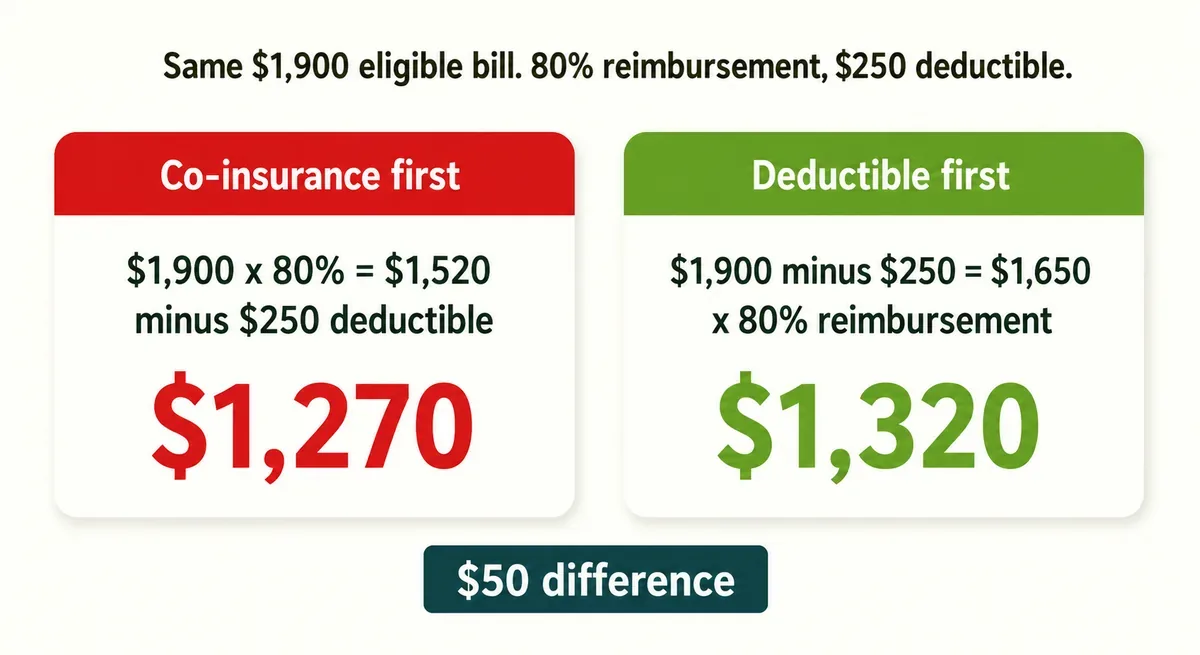
That gap is not a rounding artefact and it does not shrink on bigger claims. It is fixed at your deductible × (1 − your reimbursement percentage), every time you satisfy a deductible: $25 at 90% reimbursement, $50 at 80%, $75 at 70%, $125 at 50%. Choose a higher deductible or a lower reimbursement percentage and the penalty for being on the wrong order grows.
Waiting periods work the same way here — whatever the form says, it says. There is no 30-day ceiling to appeal to, no ban on making you wait after an accident, and no statutory waiver right. What you can do is ask two questions in writing before you buy, because both answers are in the policy and neither is on the quote page: in which order do you apply the deductible and the reimbursement percentage, and what are the waiting periods for orthopedic conditions specifically?
A carrier that answers both plainly is telling you something useful about how it will behave later.
Paying before you're reimbursed
The most common thing Connecticut owners ask about pet insurance is which vet "takes" it. On a Stamford thread, the top-voted reply does the correcting: "there isn't a 'do you take my insurance' thing like human healthcare, you can get care at any licensed veterinarian." Most reimbursement plans work that way: no human-health-style network, and payment to the hospital before the claim. Eligible-provider and geographic terms still vary by policy, so check yours.
Which makes the number that matters the one the hospital asks for at the door — and it makes the exception worth hunting for, because a handful of Connecticut hospitals can bill one insurer directly.
VCA's referral and emergency center in Norwalk puts it in one line: "Our hospital works with Trupanion and can assist you with your pet insurance claim filing needs. We accept Trupanion payment at checkout." Central Hospital, in North Haven and Guilford, has been "a Trupanion Certified Hospital as of January 2025," which it explains means it has "integrated Trupanion's vet portal into our practice."
Now the part that shows how confusing this is even for the people selling it. Central's pet-insurance page tells you that "currently, all pet insurance plans are general reimbursement plans meaning you pay the hospital bill and the insurance company reimburses you once the claim is filed" — and then, further down the same page, describes its own Trupanion "seamless direct payments." Its payments page runs the identical sentence with one word changed: "currently, most pet insurance plans are general reimbursement plans." One hospital, one website, two answers.
So treat direct pay as something the hospital and the insurer have to support between them, not as a policy feature. The order to work in is: ring the emergency hospital you would actually drive to, ask whether it bills any insurer directly and which one, and only then shop carriers against that answer. Without it, a policy still reimburses an eligible claim — you just carry the bill in the meantime.
And if the answer is no — which it will usually be — the question becomes whether you can float the bill for the weeks it takes a claim to come back. That is the real reason to insure, and it is why the next thing worth knowing is what Connecticut care costs and who is open when you need them.
What vet care costs across Connecticut — and who is open
The good news first, because the Reddit threads make Connecticut sound worse than it is: the state has real 24-hour capacity, and it is not all in one corner. Cornell University Veterinary Specialists at 880 Canal Street in Stamford runs emergency and intensive care "24 hours per day, 365 days per year," with three board-certified critical care specialists, and is "designated as a Certified Level I Emergency and Critical Care Facility by the Veterinary Emergency & Critical Care Society" — the society's highest tier. Elsewhere in the state there are referral and emergency centers too — VCA's in Norwalk and Central Hospital on the New Haven side among them. Check each one's own current hours page before you rely on it overnight; only the Stamford figures above are verified here as round-the-clock.
What Connecticut does not have is a veterinary school. The AVMA's list of accredited colleges has no Connecticut entry at all. The nearest are Tufts, in North Grafton, Massachusetts, and Cornell, in Ithaca, New York. Worth saying plainly: neither Rhode Island, Vermont, New Hampshire nor Maine has one either, so this is a New England fact rather than a Connecticut failing — and the Stamford hospital above is Cornell's Connecticut presence, which softens it considerably for Fairfield County.
Still, the practical shape is that ordinary emergencies are handled in state, while the rarest tertiary work can route to Massachusetts or New York. That has one consequence for your policy and it is easy to check before you need it: ask whether your policy pays the same way for treatment received outside Connecticut, and what your annual limit is. Referral-level care is where limits get tested — and in the Stamford table, lifting the limit added about a third to a young dog's premium.
On price, Connecticut publishes very little. Practices post fees inconsistently, there is no state fee survey, and — as section two explained — no filed rate to compare anything against. Treat any single quoted Connecticut vet price as one practice on one day, and get your own estimate in writing before you agree to a procedure.
Which Connecticut owners should pick what
There is no best policy in a state with no floor, only a mechanic that decides each case. Six cover most Connecticut buyers.
A new puppy or kitten. Connecticut's missing law tends to cost you least here — a young pet usually has fewer documented issues for a carrier to exclude, though only the records and the policy wording decide that. Put the attention on the annual limit: in the Stamford table it added a third to a young dog's premium, and it is what gets tested if you ever need referral care out of state.
An older pet, or one with history on its chart. This is where the missing law costs most. In a state with an act, the insurer would carry the burden of proving a pre-existing exclusion applies. Here it carries whatever the contract gives it. So get the exclusions in writing before you judge the price, and treat a carrier that will not put them in writing as having answered you.
If fronting the bill would break something. Work in this order: ring the emergency hospital you would actually drive to, ask whether it bills any insurer directly and which one, then shop carriers against that answer. Direct pay needs both the hospital and the insurer to support it, so confirm participation before you buy rather than at 2am.
Two or more pets. Waiting periods and any waiver window run per pet, from each pet's own start date. Enrolling two on the same day means two sets of dates to track, not one.
Facing a renewal. Your card is § 38a-323. If the insurer means to drop you it owes you 60 days' notice with the reason stated; if it renews you on worse terms, the notice must identify the reduced limits, narrowed coverage or raised deductible. Read that letter properly — it is the one document Connecticut law guarantees you.
Thinking of switching. Nothing in Connecticut protects you here. A new policy means new waiting periods and a fresh look at the records, with no statutory rule on what the new carrier may call pre-existing. For a healthy young pet that is usually a fine trade. For a pet with history, compare the written exclusions before you compare the premiums.
And whichever you pick, ask the question from section four in writing: in which order do you apply the deductible and the reimbursement percentage? It is worth real money every year, it is in the policy, and it is on no quote page in the state.
Frequently Asked Questions
What is the average cost of pet insurance in Connecticut?
Only with the settings attached. U.S. News, averaging twelve carriers in Stamford at a $500 deductible and 90% reimbursement, puts a one-year-old dog at $68.72 a month on a $10,000 limit and a cat at $39.70. Published Connecticut dog figures run from $48 to $152.60 depending on age and limit — and no Connecticut rate is filed with the state, so none of them can be audited.
Which company offers the best pet insurance in Connecticut?
No page can honestly name one for you, because Connecticut sets no floor for carriers to clear. U.S. News picks Lemonade as both best overall and best budget in the state; Forbes picks Pets Best. Rather than adopt someone's winner, ask any carrier the question that costs real money and appears on no quote page: in which order do you apply the deductible and the reimbursement percentage?
Is it really worth it to get pet insurance?
It depends on whether you could absorb the loss — but in Connecticut, note what insurance does not do. Almost every policy reimburses after you pay, and only a handful of Connecticut hospitals bill an insurer directly, so a policy transfers part of an eligible loss rather than lending you the money at the counter. If fronting a large bill is the problem, confirm direct-pay eligibility with your own hospital and insurer first, and look at financing separately.
What is the cheapest but best pet insurance?
Those are two different questions, and cheap Connecticut numbers usually hide a setting. Insurify answers the Connecticut cost question with "starting at $11 for cats and $27 for dogs" — a floor, not an average. Compare quotes only at identical species, age, annual limit, deductible and reimbursement percentage, or you are not comparing anything.
Does Connecticut have a pet insurance law?
No. The word "pet" appears nowhere in the chapter index of Title 38a, nor in the chapters governing property-casualty contracts or rate regulation. Maine, New Hampshire, Vermont and Rhode Island all have pet-insurance acts; Connecticut and Massachusetts do not. What you do get is generic: § 38a-323's 60-day non-renewal notice, which must state the reason.
What happens if I can't pay my Connecticut vet bill?
Pet insurance does not decide this — a policy reimburses you, it does not set your hospital's payment terms, and those vary by practice. We did not find an answer in Connecticut insurance law or Insurance Department materials, but other bodies of law can bear on unpaid bills and we have not surveyed them, so treat this as a question for the practice and, if it matters, for a lawyer. The useful moves all happen before treatment: get the estimate and payment terms in writing, ask whether the hospital bills any insurer directly, and ask what deposit it takes. General information, not legal advice.
Sources
- Pet Insurance Model Act (#633) state adoption chart, Summer 2025 — Connecticut and Massachusetts listed NO CURRENT ACTIVITY; Maine (2022), New Hampshire (2023), Vermont (2024), Rhode Island (2025) under Model Adoption — National Association of Insurance Commissioners
- Pet Insurance Model Act (#633) — Section 5: 30-day waiting-period cap, accident waiting periods prohibited, insurer bears the burden on preexisting-condition exclusions — National Association of Insurance Commissioners
- Best Pet Insurance in Connecticut for 2026 — Stamford 06902 sample rates, 12-carrier average at a $500 deductible and 90% reimbursement — U.S. News & World Report
- Best Pet Insurance In Connecticut — state averages at $5,000 and unlimited annual coverage, $250 deductible, 80% reimbursement — Forbes Advisor
- Pet Insurance in Connecticut for Dogs & Cats — stated Connecticut averages — Fetch Pet Insurance
- State of the Industry Report 2026 — Pets and GWP Distribution by State (2025): Connecticut 1.7% of insured pets, 2.0% of gross written premium — North American Pet Health Insurance Association (NAPHIA)
- Pet Insurance Regulation (2020-R-0215) — the Insurance Department categorizes pet insurance as inland marine; inland marine insurers, including pet insurers, are exempt from filing premium rates — Connecticut General Assembly, Office of Legislative Research
- Conn. Gen. Stat. Chapter 701 — rate filing requirement, excepting inland marine risks not written according to manual rates or rating plans (§ 38a-676) — Connecticut General Assembly
- Best Pet Insurance in Connecticut (2026) — cost answer stated as a starting-at floor; sample quotes listed without the settings they were priced at — Insurify
- Conn. Gen. Stat. Title 38a — Insurance, chapter index (33 chapters; no pet-insurance chapter) — Connecticut General Assembly
- Conn. Gen. Stat. Chapter 700 — § 38a-323: 60-day nonrenewal notice stating the reason, conditional-renewal disclosure, 30-day premium billing notice — Connecticut General Assembly
- Insurance Company Complaints — filtered to Coverage = Pet Insurance; extracted 4 September 2026 — Connecticut Insurance Department via data.ct.gov
- External Review — the Insurance Department's independent-review programme for health plans — Connecticut Insurance Department
- Connecticut Insurance Department — Consumer Affairs contact — Connecticut Insurance Department
- ASPCA Pet Health Insurance Connecticut sample policy, form PET-P-20000-1024 — deductible subtracted before the reimbursement percentage is applied — ASPCA Pet Health Insurance / Independence American Insurance Company
- Pets Best Connecticut policy booklet, form IAIC-PB10001-ILL — deductible applied after co-insurance, with the $2,000 worked example paying $1,270 — Pets Best / Independence American Insurance Company
- Veterinarian recommendation that takes pet insurance? — top reply correcting the network misconception — r/StamfordCT
- VCA Veterinary Referral and Emergency Center, Norwalk — "We accept Trupanion payment at checkout" — VCA Animal Hospitals
- Payments — Trupanion Certified Hospital, integrated vet portal, "seamless direct payments" — Central Hospital for Veterinary Medicine (North Haven / Guilford)
- Pet Insurance — states that all pet insurance plans are general reimbursement plans, on the same page that describes its own Trupanion direct payments — Central Hospital for Veterinary Medicine
- Emergency & Critical Care — 24 hours a day, 365 days a year; VECCS Certified Level I facility; 880 Canal St, Stamford — Cornell University Veterinary Specialists
- Accredited veterinary colleges — no Connecticut entry; nearest are Tufts (North Grafton, MA) and Cornell (Ithaca, NY) — American Veterinary Medical Association