


North Carolina knows exactly how large its pet-insurance market is. Its Department of Insurance publishes the number company by company — $133,522,443 written in 2025, across 31 companies — up 19.49% on its 2024 table, on our arithmetic.
What the state does not do is tell those companies how to treat you. North Carolina has no pet-specific insurance law. The General Assembly's own bill-text search returns zero results for "pet insurance" across three consecutive sessions, and the insurance regulator's property-and-casualty rules never use the word "pet" at all.
That is not the same as unregulated, and the distance between those two things is most of this article. Every policy form sold here needs the Commissioner's approval first, rates are filed with the state before they can be charged, and a guaranty fund stands behind your claim if a licensed insurer fails. What nobody sets is your waiting period, your pre-existing definition, or what your renewal may cost beyond the rates your insurer has already filed.
So this is the North Carolina version: what coverage costs at settings you can reproduce, why the published averages disagree, and the deposit a Raleigh hospital wants before any insurer pays.
Table of Contents
- What pet insurance costs in North Carolina
- Why the published averages don't agree
- What North Carolina law actually does
- Waiting periods and exclusions on North Carolina forms
- Paying before you're reimbursed
- What vet care costs across North Carolina
- The risks that actually drive North Carolina claims
- Which North Carolina owners should pick what
- Frequently Asked Questions
- Sources
What pet insurance costs in North Carolina
At a $500 deductible, 90% reimbursement and a $10,000 annual limit, U.S. News puts a one-year-old mixed-breed dog in Raleigh at $50.87 a month and a one-year-old domestic shorthair cat at $29.28, averaged across the twelve companies it rates. At age six, the same policy runs $78.95 and $42.01.
That is one Raleigh ZIP code, not a statewide average. The full grid:
| Raleigh (27610) — $500 deductible, 90% reimbursement | Dog, age 1 | Dog, age 6 | Cat, age 1 | Cat, age 6 |
|---|---|---|---|---|
| $10,000 annual limit | $50.87 | $78.95 | $29.28 | $42.01 |
| Unlimited annual limit | $64.65 | $106.69 | $37.72 | $57.31 |
Change those settings and the number moves further than your ZIP code moves it. MoneyGeek models North Carolina at $46 a month ($551 a year) — but for a six-year-old Labrador and a seven-year-old Ragdoll, at a $5,000 limit, a $500 deductible and 80% reimbursement, drawn from more than 67,000 pet profiles across 18 insurers. Different pets, different limit, different reimbursement rate. That is not a contradiction, and the next section is about telling the two apart.
North Carolina prices below the national average
This one runs against the reflex. NAPHIA's 2026 industry report puts North Carolina at 2.7% of insured U.S. pets but 2.5% of gross written premium. On our arithmetic that is roughly 7% below the national premium per insured pet — and because both shares are rounded to a tenth of a point, the honest band is about 4% to 11% below.
Two independent estimates agree on the direction and argue about the size. MoneyGeek puts North Carolina 3% below the national average, 24th of 51 for affordability. Insurify quotes $61 a month for dogs and $32 for cats against national figures of $71 and $37 — about 14% below.
So: confident on direction, banded on size. For an absolute anchor, NAPHIA's national accident-and-illness averages are $836 a year for dogs and $435 for cats; the national cost picture is its own guide.
Why the published averages don't agree
Four sources price North Carolina at $30, $42, $46 and $61 a month. None of them is wrong. They priced different pets on different policies.
| Source | North Carolina | What was actually priced |
|---|---|---|
| Fetch | $30 dog / $20 cat | Its own NC book, July 2024 to June 2025, at $10,000 / $300 / 80% |
| MarketWatch | $42 | Quotes from "nearly two dozen providers" for 10 sample pets; no ZIP |
| MoneyGeek | $46 | A six-year-old Labrador and a seven-year-old Ragdoll at $5,000 / $500 / 80% |
| Insurify | $61 dog / $32 cat | Blended across four limits, three deductibles, three reimbursement rates |
Fetch's is the most honestly labeled — a real book average with its limit, deductible, reimbursement rate and period all stated. What it cannot tell you is what your pet costs: it averages every breed and age on its books.
So before comparing two quotes, check that nine things match: species, breed, age, ZIP code, annual limit, reimbursement percentage, deductible, add-ons, and the date the price was pulled. A quote that differs on any of them is not a cheaper policy — it is a different question.
Two things worth knowing about the numbers you will meet
Some "North Carolina" prices are not North Carolina prices. Spot's North Carolina page advertises dog plans from $15 a month, then footnotes that figure to a two-year-old dog in ZIP 32009 — Bryceville, Florida. Its cat footnotes use 32009 and 33801, Lakeland, Florida. No North Carolina ZIP appears. U.S. News prices Raleigh under two ZIPs — 27610 in its twelve-company table, 27160 in its carrier examples — and 27160 resolves to no place in the U.S. postal dataset.
Even the direction is contested. NAPHIA's premium shares, MoneyGeek and Insurify all put North Carolina below the national average. MarketWatch puts it slightly above — $42 against a national $40. The weight of evidence sits with "below", but that is our reading of four sources, not a settled fact.
What North Carolina law actually does
It regulates the companies. It does not regulate the policy.
North Carolina has never adopted the insurance regulators' Pet Insurance Model Act. On the NAIC's Summer 2025 state chart, the North Carolina row reads "NO CURRENT ACTIVITY" — nothing adopted, nothing pending. Search the General Assembly's own bill-text index for "pet insurance" and it returns zero results in the 2021–22, 2023–24 and 2025–26 sessions, while the bare word "insurance" returns hundreds in each. Chapter 58 — the entire state insurance code — never uses "pet" as a word, and the regulator's property-and-casualty rules contain no "pet", no "animal" and no "veterinar".
So your waiting period, your policy's definition of "pre-existing", and whether you get a free look are all your carrier's own drafting — contract terms the Commissioner approved, not a floor the state set.
Four things the state does do, and they are not nothing:
- Every form is approved before it is sold. G.S. 58-3-150(a) makes it "unlawful for any insurance company licensed and admitted to do business in this State to issue, sell, or dispose of any policy … until the forms of the same have been submitted to and approved by the Commissioner." A companion provision, G.S. 58-41-50(a), adds a 90-day deemer: filed and approved, or 90 days pass without disapproval.
- Rates are filed before they are charged. G.S. 58-40-30(a) requires insurers to file "all rates and all changes and amendments thereto … prior to the time they become effective."
- Nobody sets those rates collectively. The North Carolina Rate Bureau promulgates rates for residential property, private passenger auto and workers' compensation. Animal insurance is nowhere in its remit, so every pet insurer files its own numbers.
- A guaranty fund stands behind your claim. G.S. 58-48-10 covers "all kinds of direct insurance" through a list of exclusions that does not include animal insurance. If a licensed insurer fails, G.S. 58-48-35 has the Association pay a covered claim above $50 and below $500,000, plus up to $10,000 of unearned premium.
A fifth is almost never used: G.S. 58-2-40(6) requires the Commissioner, "upon a proper application by any citizen of this State," to "give a statement or synopsis of the provisions of any insurance contract offered or issued to the citizen." You can ask the regulator for a statement or synopsis of your own policy's provisions.
Where does a pet policy sit? Chapter 58 has no "pet insurance." The closest fit is G.S. 58-7-15(11) — "'Animal insurance,' meaning insurance against loss of or damage to any domesticated or wild animal resulting from any cause." Two things support reading your policy into that line: the neighboring property definition carves out disease "of such property other than animals," and the Department books pet insurance on its own statutory line. But the statute never says so. Treat it as a well-supported inference, not settled law — the next question turns on it.
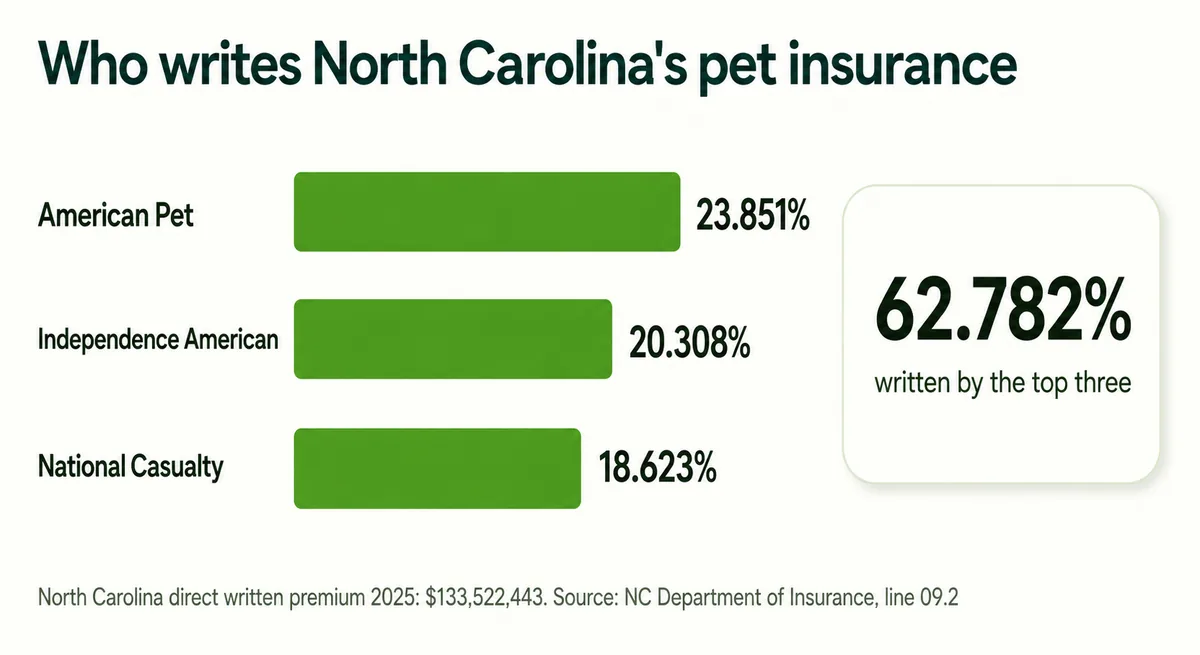
The market itself, the state measures precisely. In 2025 North Carolina insurers wrote $133,522,443 of pet premium, earned $128,142,280 and incurred $84,493,659 in losses — a 65.94% loss ratio on our arithmetic, since the Department publishes the dollars but no ratio. Thirty-one companies reported. Three of them wrote 62.8% of the book: American Pet Insurance Company, which backs Trupanion, at 23.851%; Independence American at 20.308%; and National Casualty, behind Nationwide, at 18.623%.
If your premium jumps
This is the loudest complaint owners have, and North Carolina's answer is a genuine maybe.
Article 41 of Chapter 58 sets real protections. G.S. 58-41-20(d) says that whenever an insurer "lowers coverage limits or raises deductibles or premium rates other than at the request of the policyholder," it must give "written notice of such change at least 30 days in advance." Subsection (b) requires 45 days' notice before nonrenewal, subsection (e) says that notice "must state the precise reason for nonrenewal," and subsection (a) makes any nonrenewal that does not comply "not effective."
Article 41's scope reaches animal insurance. G.S. 58-41-10(a) applies it to "all kinds of insurance authorized by G.S. 58-7-15(4) through (14)" — and animal insurance is (11).
The same subsection then excludes "personal inland marine insurance." And inland marine is where pet insurance is coded for filing: the NAIC product coding matrix gives it its own sub-type, "09.0004 Pet Insurance Plans", underneath "09.0 Inland Marine" — alongside a separate "09.0006 Other Personal Inland Marine" code. Whether a consumer pet policy is therefore personal inland marine is exactly the unresolved step. The Department's own personal inland marine filing checklist is blunt about what that means. Under "Cancellation & Nonrenewal" it reads: "Does not apply — This line of business is not subject to Article 41 of North Carolina General Statute. Policy provisions prevail."
So the whole thing turns on one unresolved question: does Article 41's personal-inland-marine exclusion reach a consumer pet policy? If it does not, you get 30 days' warning before a price rise. If it does, you get whatever your policy says. We could find no Department document resolving it, and we are not going to guess for you. Do not assume the 30-day notice applies to your policy.
What you can rely on today is the contract. Read the cancellation and nonrenewal terms on your own declarations page — that is the number that will actually be honoured either way.
If your claim is denied
Three routes, and one door that is closed.
G.S. 58-63-15(11) lists what counts as an unfair claim settlement practice — failing to acknowledge communications promptly, refusing to pay without a reasonable investigation, not attempting "in good faith to effectuate prompt, fair and equitable settlements" where liability is clear. Useful language. But read the proviso in the same sentence: "no violation of this subsection shall of itself create any cause of action in favor of any person other than the Commissioner." It is a standard the regulator enforces, not a claim you can bring.
The private route runs through the state's unfair-trade-practices law instead — G.S. 75-1.1 declares unfair or deceptive acts in commerce unlawful, and G.S. 75-16 makes damages mandatory-treble where it applies. Whether North Carolina courts extend it to an insurer's handling of your own claim is a question we did not research, so take that as a route worth asking a lawyer about, not a promise.
The closed door is external review. North Carolina's independent review program, SmartNC, is built for health coverage: G.S. 58-50-75(b) applies it to "all insurers that offer a health benefit plan." A denied pet claim cannot go there.
Which leaves the Department's consumer complaint process — and one gap worth knowing. North Carolina's prompt-payment clock, G.S. 58-3-225, is written for health benefit plans, so it does not reach a pet claim; we found no pet-specific decision deadline in its place. The claim-filing deadline printed on your own policy is the one you can rely on.
Waiting periods and exclusions on North Carolina forms
The state sets no floor, so these clocks are pure product design — and on the North Carolina forms they run from two days to a year.
| Brand (North Carolina form) | Accident | Illness | The long clock |
|---|---|---|---|
| AKC Pet Insurance — IAIC PPI AI POL 007 NC 0421 | 2 days | 14 days | 180 days for cruciate ligament; 180 days for IVDD |
| ASPCA and Spot — PET-P-20000-1024 | 14 days | 14 days | None — ligament and knee conditions sit inside the same 14 days |
| Pets Best — APIC-PBI0001-ILL (12/2015) | 3 days | 14 days | 6 months for any cruciate ligament event |
| Healthy Paws — LD-50812 (07/18) + NC endorsement | 15 days | 15 days | 12 months for hip dysplasia |
Read the last column first. For a young large-breed dog the cruciate clock decides whether year one is worth anything — 180 days at AKC, six months at Pets Best, no separate clock at ASPCA. And a wait ending is not a claim being paid: exclusions, limits and pre-existing rules still apply.
Two clauses deserve naming.
AKC's 365-day door. Its North Carolina form says pre-existing conditions — anything your pet has shown a sign or symptom of before cover began, whether or not anyone diagnosed it — "are only eligible after three hundred and sixty-five (365) days of continuous coverage." That is unusual and valuable — but it is a door with a condition, not coverage from day one. Drop the policy and the clock restarts.
Healthy Paws' age-six line. Enroll a pet at six or older and the form reads: "no coverage shall apply for illness related to hip dysplasia." Not a waiting period — a permanent exclusion. Healthy Paws also requires a clinical exam — within twelve months before the effective date under age six, thirty days before it at six or over, or, either way, within fifteen days after it — and warns that failing to produce one "may void the policy."
The clearest proof that these are choices, not rules, sits in one company's own paperwork. Independence American sells the same AKC product in Nebraska, a state that has adopted the model act. The Nebraska edition runs to twelve numbered sections against North Carolina's nine, and the extra ones are the interesting bit: a Waiting Period Waiver section, and a right to examine and return the policy — "You have 30 days from the day You receive this Policy to review it and return it." Neither appears on the North Carolina form. That Nebraska policy is administered from a PO box in Raleigh.
One last mechanic that changes the money at identical terms: Pets Best's North Carolina booklet pays "after the application of your chosen Co-Insurance, minus your chosen Deductible" — coinsurance first, then the deductible. Other forms subtract the deductible first. Same "80% with a $500 deductible", different check.
Note the vintages: the North Carolina samples these carriers publish today are a 2021 AKC edition, a 2015 Pets Best booklet and a 2018 Healthy Paws form. With no state act forcing a refile, an old edition can sit on the shelf a long time — check the edition on the declarations page you are offered.
Paying before you're reimbursed
Almost every pet policy works by reimbursement. You pay the hospital first — and at North Carolina's referral hospital, "first" comes with a number attached.
NC State Veterinary Hospital in Raleigh charges a $292 emergency exam fee ($386 for exotics), and puts initial emergency stabilization at $600 to $900 before any diagnostics. If your pet is admitted, its billing policy is explicit: clients are "to leave a minimum deposit prior to admission that is equal to 100% of the estimate range's low end. For example, if your estimate is $2,000-$4,000, you would be asked to leave a $2,000 deposit."
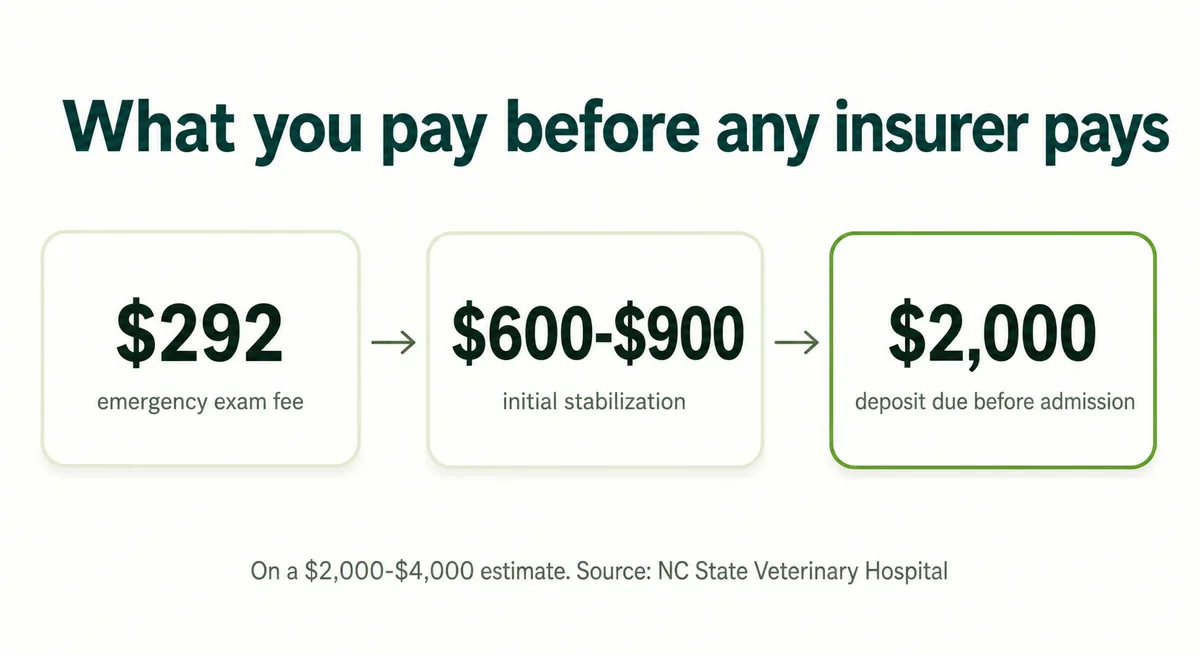
The deposit "may be higher based on the current estimate, your credit history, urgency of care and other extenuating circumstances." The balance falls due when your pet is released, and an itemized bill for whatever remains arrives after a review period of 10 to 30 days.
Now the part that matters for insurance: the word "insurance" appears nowhere on that billing page. No direct-billing statement, no claim-form assistance, no reimbursement guidance. What the page does say is that the hospital accepts CareCredit — whose published purchase APR is 32.99%, and whose "no interest if paid in full" promotions are deferred interest: miss the payoff window and interest is charged back to the purchase date.
Direct pay does exist, but it is an arrangement between a particular hospital and a particular insurer — not something your policy guarantees. BluePearl, which runs emergency hospitals in the Triangle, states the split plainly: "If you have Trupanion, we work directly with them for payment when you visit one of our hospitals … If you have another type of pet insurance, you'll pay up front for your pet's care."
So before you choose on premium alone, ask the hospital you would actually drive to at 2am two questions: what deposit will you ask for, and do you bill my insurer directly? Price the policy against those answers rather than against a monthly figure.
And if your pet needs treatment, get the treatment. Ask the hospital what it will want and what payment routes it takes — financing is not guaranteed and comes with its own conditions, but a delayed emergency is the one thing you cannot undo later.
What vet care costs across North Carolina
Published dollar figures are scarce. Beyond NC State, most North Carolina emergency hospitals publish a payment policy rather than a price: a deposit is required, the amount unstated.
The most specific terms we found belong to Animal Emergency PLLC in Raleigh, and they show what "we offer payment plans" actually costs. A deposit of at least 25% of the final total, or of the estimate's high end, is required up front. Financing then adds a service fee scaled to that deposit — 25% down carries an 8% fee on the balance, and the fee falls as you put more down. Financing runs to $5,000 with no credit check, and anything above that is due at the time of service; a soft credit check raises the ceiling to $10,000, with a deposit the hospital puts at 25% to 75%. Its installment route adds a non-refundable $85 fee plus $25 at signing.
Against terms like those, the question owners actually ask — does where I live in North Carolina change what I pay? — has no settled answer.
Pawlicy publishes the only matched North Carolina city table, holding species, breed, age, limit, reimbursement and deductible constant at 80% reimbursement, unlimited annual coverage and a $500 deductible. Across all eight rows the floor is identical in every city and only the ceiling moves — and the ceiling always runs in the same order: lowest in Greensboro, then Charlotte, then Raleigh. A five-year-old Golden Retriever tops out at $72 a month in Greensboro against $116 in Raleigh, about 61% higher.
Lemonade's own book ranks the same cities the same way, but in a far narrower band: Greensboro $35–$40 a month, Charlotte $40–$45, Durham and Raleigh $50–$55. Those are averages across the pets it actually insures rather than matched quotes, and the footnote dates them to October 2024 while the page text says 2025.
So: two sources, same direction, very different magnitudes. The filings that would settle it are not public. North Carolina's SERFF filing-access pages returned 404, and the service's front door now redirects to an NAIC login. We could not retrieve a filed North Carolina pet rate — which is not the same as saying none exists.
The risks that actually drive North Carolina claims
Not snakes. Parasites — and the rate that matters is your county's, not the state's. The figures below are test positivity among dogs actually tested, which is the best local health indicator published; they are not claim rates, and no insurer publishes those by state.
Across 2025, CAPC recorded canine heartworm in 12,865 of 999,297 North Carolina dogs tested: 1.29%, against 0.94% nationally. The state average hides an enormous spread. In Robeson County it was 662 of 4,628 dogs — 14.30%. In Buncombe County, 181 of 40,761 — 0.44%. Two well-tested counties, roughly thirty-two times apart. (Percentages are ours, computed from CAPC's counts.)
Two tick-borne diseases run the other way. North Carolina's Lyme positivity is 2.32% against 4.16% nationally, and anaplasmosis 1.39% against 6.11% — both well below average. They concentrate hard, too: Alleghany County's Lyme rate is 30.64%, about twenty-six times Mecklenburg's 1.16%.
The snakebite story, meanwhile, does not survive North Carolina's own evidence. The only copperhead study from a North Carolina institution — 52 dogs treated at NC State's veterinary college between 2004 and 2011 — found that "no dogs in this study required the use of antivenin and all survived to discharge," and concluded that envenomation in dogs is "largely self-limiting and responsive to supportive care." It is a 2014 paper with no newer North Carolina replacement, so treat it as the best local evidence rather than the last word.
Here is the awkward part for buyers: routine parasite prevention is excluded from most accident-and-illness policies. North Carolina's dominant risk is largely a wellness or out-of-pocket cost — worth knowing before you buy coverage aimed at something else.
Which North Carolina owners should pick what
There is no single best North Carolina policy. There are situations — and in each one, a single mechanic decides more than the premium does.
- A new puppy or kitten. The orthopedic clock is what you are actually buying. ASPCA's North Carolina form folds ligament and knee conditions into its ordinary 14 days, while AKC waits 180 days and Pets Best six months. For a large-breed puppy, that difference is the policy.
- An older pet, or one with a chart. Read the enrollment rules before the price. Healthy Paws requires a clinical exam once your pet is six — within 30 days before the effective date, or 15 days after it — and excludes hip-dysplasia illness outright for pets enrolled at that age. And keep the two questions apart: a carrier will usually still sell you a policy. Whether it covers the condition you are worried about is another matter entirely.
- You need the hospital paid directly. This needs both sides: your insurer has to offer it and your hospital has to participate. Ask the emergency hospital you would actually use which insurers it bills directly, confirm the same with the insurer, then shop inside that answer.
- Several pets. Multi-pet discounts are real but modest. The bigger lever is that pets of different ages and species rarely belong on the same configuration — nothing obliges you to buy one policy for all of them.
- Facing a renewal increase. Check the notice term on your declarations page, and remember the open question: the 30-day statutory notice may or may not reach a pet policy.
- Switching. This one has a trap in it. Anything your pet has already shown a sign or symptom of — diagnosed or not — will usually be pre-existing to the next insurer. Get the quotes — but price the exclusions, not the premium.
Whichever fits, check one more thing: who actually carries the risk. The North Carolina forms name it on the document itself — Healthy Paws' North Carolina endorsement is issued by Westchester Fire Insurance Company, the Pets Best booklet by American Pet Insurance Company, and the AKC form by Independence American. Pets Best writes under several insurers and says so plainly: "Please refer to your declarations page to determine the underwriter for your policy." The State Employees' Credit Union route is Liberty Mutual paper administered by Companion Protect Agency.
The brand on the website is not always the company on the hook — and the company on the hook wrote the form you are buying.
Frequently Asked Questions
What is the average cost of pet insurance in North Carolina?
There isn't one — there are prices at configurations. At a $500 deductible, 90% reimbursement and a $10,000 annual limit, U.S. News puts a one-year-old mixed-breed dog in Raleigh at $50.87 a month and a cat at $29.28, averaged across twelve companies; at six, $78.95 and $42.01. Published state averages for dogs run from $30 to $61; the cat figures are lower.
What is the best pet insurance in North Carolina?
It depends which clock matters to your pet, because North Carolina sets none of them. For a large-breed puppy the cruciate wait decides it: ASPCA's North Carolina form sets no separate orthopedic clock, leaving knee conditions inside its ordinary 14 days, while AKC waits 180 days and Pets Best six months. A wait ending is not a promise to pay — exclusions and pre-existing rules still apply. Enrolling at six or older? Healthy Paws' permanent hip-dysplasia exclusion outweighs any premium.
Is it really worth it to get pet insurance?
It depends whether you could absorb the bill — and whether you could front it, since almost every policy reimburses. NC State Veterinary Hospital asks for a deposit equal to 100% of its estimate's low end before admission: on a $2,000–$4,000 estimate, $2,000. Insurance changes how much comes back, not what you need at the counter.
What is the cheapest but best pet insurance?
Those two rarely name the same policy, because price and waiting periods are set independently and North Carolina constrains neither. Compare only at identical settings — species, breed, age, ZIP, limit, reimbursement, deductible — then read what each form excludes for six months. A policy $8 cheaper that excludes cruciate injuries for half a year is not cheaper for a young retriever.
Does North Carolina have a pet insurance law?
No. North Carolina has never adopted the NAIC Pet Insurance Model Act — its row reads "NO CURRENT ACTIVITY" — and the General Assembly's bill-text search returns zero results for "pet insurance" across three sessions. That is not the same as unregulated: forms need the Commissioner's approval, rates are filed before use, and the state guaranty association may cover qualifying claims, within statutory limits, if a licensed insurer becomes insolvent.
Can my pet insurance premium go up without notice in North Carolina?
Possibly — it turns on an unresolved question. If Article 41 applies, your insurer must give 30 days' written notice before raising your premium and 45 days before nonrenewal. Animal insurance sits inside Article 41's scope, but the same subsection excludes personal inland marine — and whether that reaches a pet policy is unsettled. Check your declarations page.
Sources
- Pet Insurance Plans Business, For the Year Ended December 31, 2025 (statutory line 09.2) — North Carolina Department of Insurance
- Bill Text Search — North Carolina General Assembly
- 11 NCAC Chapter 10 — Property and Casualty Division rules — North Carolina Office of Administrative Hearings
- Best Pet Insurance in North Carolina for 2026 (updated Aug. 21, 2026) — U.S. News & World Report
- How Much Does Pet Insurance Cost? — state cost table (updated Aug. 27, 2026) — MoneyGeek
- State of the Industry Report 2026 — Highlights (2025 data year) — North American Pet Health Insurance Association (NAPHIA)
- Best Pet Insurance in North Carolina (updated May 31, 2026) — Insurify
- Pet Insurance in North Carolina — coverage and average premiums — Fetch Pet Insurance
- The Best Pet Insurance in North Carolina (2026), updated May 8, 2026 — MarketWatch
- North Carolina Pet Insurance — advertised premium footnotes — Spot Pet Insurance
- Pet Insurance Model Act — state adoption chart, Summer 2025 (North Carolina: NO CURRENT ACTIVITY) — NAIC
- Chapter 58 — Insurance (full chapter text) — North Carolina General Assembly
- G.S. 58-3-150 — Forms to be approved by Commissioner — North Carolina General Assembly
- G.S. 58-40-30 — Filing of rates — North Carolina General Assembly
- G.S. 58-36-1 — North Carolina Rate Bureau created — North Carolina General Assembly
- G.S. 58-48-10 — Guaranty Association: scope — North Carolina General Assembly
- G.S. 58-2-40 — Duties of Commissioner — North Carolina General Assembly
- G.S. 58-7-15 — Kinds of insurance authorized — North Carolina General Assembly
- G.S. 58-41-20 — Notice of nonrenewal, premium rate increase, or change in coverage required — North Carolina General Assembly
- G.S. 58-41-10 — Article 41 scope — North Carolina General Assembly
- G.S. 58-63-15 — Unfair methods of competition and unfair or deceptive acts — North Carolina General Assembly
- G.S. 58-50-75 — External review scope — North Carolina General Assembly
- G.S. 75-16 — Civil action by person injured; treble damages — North Carolina General Assembly
- Personal Inland Marine filing checklist (Cancellation & Nonrenewal: not subject to Article 41) — North Carolina Department of Insurance
- Property & Casualty Product Coding Matrix (09.0 Inland Marine → 09.0004 Pet Insurance Plans) — NAIC
- AKC Pet Insurance CompanionCare — North Carolina sample policy, form IAIC PPI AI POL 007 NC 0421 — Independence American Insurance Company / PetPartners
- Accident & Illness Policy, North Carolina sample pages, form PET-P-20000-1024 — ASPCA Pet Health Insurance / Independence American Insurance Company
- Pet Health Insurance Policy Accident & Illness — North Carolina sample, form APIC-PBI0001-ILL (12/2015) — Pets Best / American Pet Insurance Company
- Pet Health Insurance Policy, form LD-50812 (07/18) — Healthy Paws / Westchester Fire Insurance Company
- CompanionCare Terms and Conditions — Nebraska edition, form IAIC PPI AI POL 007 0124 NE — Independence American Insurance Company / PetPartners
- Emergency and Critical Care — emergency service fees — NC State Veterinary Hospital
- Billing and payment policies — admission deposit — NC State Veterinary Hospital
- CareCredit FAQs — purchase APR and deferred-interest promotions — CareCredit
- Pet Owner FAQs — 'Do you accept pet insurance?' — BluePearl Pet Hospital
- Payment options — deposit tiers, service fees and financing limits — Animal Emergency PLLC, Raleigh
- Best Pet Insurance in North Carolina 2026 — matched city premium table (80% / unlimited / $500) — Pawlicy Advisor
- North Carolina pet insurance guide — average monthly premium by city — Lemonade
- Parasite Prevalence Maps — 2025 canine data, North Carolina and United States — Companion Animal Parasite Council (CAPC)
- Copperhead (Agkistrodon contortrix) envenomation of dogs: 52 cases (2004-2011). J Am Anim Hosp Assoc. 2014;50(5):338-44 — Pritchard JC, Birkenheuer AJ, Hanel RM, Wood MW — NC State College of Veterinary Medicine
- Pet Insurance — underwriting and administration disclosure (Liberty Mutual / Companion Protect Agency) — State Employees' Credit Union
- State Terms and Conditions — 'refer to your declarations page to determine the underwriter for your policy' — Pets Best
- Amendatory Endorsement – North Carolina, form LD-51382 (Westchester Fire Insurance Company) — Healthy Paws
- Pet Insurance Plans Business, For the Year Ended December 31, 2024 (statutory line 09.2) — North Carolina Department of Insurance
- G.S. 58-48-35 — Guaranty Association: powers and duties (claim limits) — North Carolina General Assembly
- G.S. 58-41-50 — Policy form and rate filings (90-day deemer) — North Carolina General Assembly
- G.S. 75-1.1 — Methods of competition, acts and practices regulated; legislative policy — North Carolina General Assembly