


Spot vs Trupanion comes down to how your pet gets sick: Spot Pet Insurance's policy, with one annual deductible subtracted before the reimbursement percentage is applied, usually pays more when a dog or cat has several unrelated problems in one year; Trupanion's policy, with the percentage applied first and a deductible charged once per condition for life, usually pays more when a single condition keeps costing money year after year; and Trupanion can also pay its share to a participating hospital at checkout.
These are opposite contract designs, not two quotes for the same coverage, and the same run of vet bills can finish ahead on one and behind on the other. A cat with a urinary blockage in March and a broken tooth in September is the first pattern; a dog whose allergies flare every year is the second. Premiums are a separate question, and the price section says what the public numbers can and cannot settle.
One identity check first: the policy Trupanion sells directly and the Trupanion-underwritten plan sold through Chewy are different contracts, and the Chewy version handles the deductible differently. This page compares Spot bought direct with Trupanion bought direct.
And if your dog or cat is already insured and has a medical history, read the switching section before you price anything. Whichever direction you move, the new policy starts from your pet's record, not from the old policy's promises, and a cheaper quote can cost you coverage you already have.
If you searched Trupanion vs Spot, you have probably already priced both. The question underneath is which policy you will be glad to be holding once your pet is older and has a chart, so the rest of this page shows the work — the contract behind each quote, the same bills run through both formulas, where your pet's record and your hospital's payment setup change the result — and ends with a verdict by situation that names the fact that would flip it.
Table of Contents
- Spot vs Trupanion: the short answer
- Side-by-side comparison
- First, which policies are you actually comparing?
- How Spot and Trupanion pay the same bill
- Pre-existing conditions, Spot's 180-day rule and knees
- Claim day: who pays the vet, and your filing deadline
- Price: what the numbers can and can't tell you
- Wellness, limits and multi-pet households
- Switching between Spot and Trupanion
- Which should you choose?
- Frequently Asked Questions
- Sources
Spot vs Trupanion: the short answer
Neither is better for every pet. Spot Pet Insurance fits a dog or cat likely to have several unrelated problems in a year, and pets enrolling at 14 or older. Trupanion fits a pet with one condition that will cost money for years, or an owner who can't front an emergency bill, provided the hospital accepts its direct pay.
Here is the same answer by situation. Each line is a fact you can check in the section that proves it, and each names what would flip the call.
- Several unrelated claims a year → Spot, set to 90% and an unlimited annual limit, if its matched premium is competitive. Spot subtracts one annual deductible before applying the reimbursement percentage; Trupanion applies 90% first, then charges its deductible once for each separate condition. At a $500 deductible and 90% on both, three unrelated $1,000 conditions in one year cost the Spot owner $750 and the Trupanion owner $1,800 (worked in how the two policies pay the same bill). Flips if Trupanion quotes your pet much cheaper (the price section explains why no published average settles that), if one of those problems turns chronic, or if your nearest emergency hospital pays through Trupanion at checkout.
- Can't front an emergency bill → Trupanion bought direct, only if your ER actually accepts VetDirect Pay. Trupanion pays its share to the hospital at checkout only where the hospital runs Trupanion's software and has approved direct billing; anywhere else you pay the invoice and claim it back. Spot's standard workflow is pay the vet, then file; you can ask on the claim form for the reimbursement to go to your veterinarian, but you remain responsible for the bill, and it is not a checkout payment. On the $12,000 emergency worked in claim day (same settings, with a $200 exam fee in the bill), an approved direct-pay checkout leaves the Trupanion owner owing about $1,880 instead of fronting the whole invoice. Flips if the hospital isn't on the software, asks for a deposit anyway, or the claim needs review first.
- Already on Trupanion with a covered recurring condition → stay. Once you have met Trupanion's deductible for a condition, the policy pays all future eligible costs of that condition at 90% with no further deductible, for life. Move to Spot and that condition arrives as pre-existing: Spot's forms exclude any condition that showed signs before the new policy's effective date (Vermont's only within the 180 days before it;California's form also counts anything a vet advised on or treated), a condition still flaring up or being treated can't meet the 180-day cure test, and one managed rather than cured is excepted from it as chronic on most state forms. Flips if the renewal becomes unaffordable, or if the premium you would save by moving outgrows the reimbursements you would give up on that condition; switching works that arithmetic for an allergy dog and covers both directions.
- Aged 14 or older → Spot, because Trupanion won't enroll. Trupanion enrolls pets "any time before their 14th birthday" (a pet already on Trupanion keeps its coverage after 14); Spot sets no upper age limit. Two things the sale doesn't change: whatever is already in your pet's chart is still pre-existing at Spot, and Spot re-rates its premium on your pet's current age at each renewal. Between these two carriers nothing reverses this row; it is the one situation with a plain answer.
- A resolved one-off in the history → Spot may re-cover it after 180 symptom- and treatment-free days, but not knees and not chronic conditions. Spot treats a condition that has been "cured and free from treatment and symptoms for a period of 180 days" as a new occurrence, with exceptions that depend on your state's form: the countrywide form, like most state editions, bars chronic and ligament/knee conditions; twelve state forms, including California's, Washington's and Vermont's, also bar congenital, hereditary and orthopedic illness; New York's 2020 form and the July 2023 edition still served in Georgia, Maryland and Virginia name only ligament and knee conditions. Trupanion has no cure clause, and its FAQ says a condition diagnosed before enrollment stays excluded "even if they've gone years between showing signs". Flips if your pet's condition falls into an excepted category, or if the record doesn't show the 180 clean days. The form-by-form table is in pre-existing conditions and knees.
- A prior knee problem → don't presume either covers it. Spot's forms treat ligament and knee conditions as "bilateral and related, regardless of cause", so a problem in one knee before the policy excludes both knees going forward, and knees are barred from the cure clause on every Spot state form we checked. Trupanion's FAQ counts cruciate problems "on the same leg or the opposite leg" in the 18 months before the policy as pre-existing, and its September 2023 policy form, used in 14 states, sets no time limit: signs on either side at any time before coverage count. Only a written determination from the insurer, made on your pet's actual records, reverses this; ask for it before you budget a second surgery around either policy.
These six are the calls most owners are actually making. The full nine-row verdict matrix in which should you choose? adds multi-pet households, owners who want exam fees and wellness included, and owners who prize premium stability, each with the fact that reverses it.
Side-by-side comparison
Spot Pet Insurance and Trupanion disagree on almost every term that decides what a claim pays: who bears the risk, whether the deductible is annual or per condition, whether the deductible or the percentage is applied first, whether exam fees count, how long you have to file, and who pays the hospital. The table below sets those terms side by side, each one taken from the document linked in that cell — a policy form or state disclosure where one exists, the company's own published statement where it doesn't.
Scope first: this compares Spot Pet Insurance bought direct from spotpet.com with Trupanion bought direct from trupanion.com. The Trupanion-underwritten CarePlus plan sold through Chewy is a different contract, with an annual deductible and covered exam fees, and belongs in neither column; the next section explains why. If you want these same terms for other carriers, our pet insurance fine-print index lays them out carrier by carrier.
Every cell was checked against the linked document in September 2026, and the table names the form or edition behind each term, because Spot's terms change with the state form and Trupanion's with the edition your state is routed to. The policy you are actually issued, and its declarations page, govern over any sample.
| Term | Spot Pet Insurance (direct) | Trupanion (direct) |
|---|---|---|
| Insurer and administrator | Sold by Spot Pet Insurance Services, LLC; administration and claims adjudication by PTZ Insurance Agency, Ltd. (claim form CF-07/2025); underwritten by Independence American Insurance Company on most current state sample forms and by United States Fire Insurance Company on the New York and Washington forms. Spot's own instruction: "refer to your policy forms to determine the underwriter for your policy". | Sold and administered by Trupanion Managers USA, Inc.; underwritten by American Pet Insurance Company, which "underwrites all of our policies in the U.S." (Form 10-Q for the quarter ended June 30, 2026). |
| Deductible unit | Annual — one deductible per policy period (California form, Oct 2024 edition); choices of $100, $250, $500, $750 or $1,000 (Spot, updated June 25, 2026). | Per condition, for the pet's life — once met for a condition, the policy "will pay out all future losses for that specific Illness or Injury" (California disclosure TRU (D) 00012 CA); chosen "anywhere between $0 and $1,000" (Trupanion). |
| Payout order | Deductible first: "We subtract that deductible from covered expenses before applying the reimbursement percentage" (California form, p.7). | Percentage first: Trupanion's own example is $1,000 × 90% = $900, then $900 − $250 deductible = $650 (California disclosure; the same example is in the Florida disclosure, Sept 2023 edition). |
| Reimbursement and limit | 70%, 80% or 90%; annual limit of $2,500, $3,000, $4,000, $5,000, $7,000, $10,000 or unlimited (Spot, updated June 25, 2026). | 90% only (Florida disclosure, Sept 2023 edition); no annual payout limit (Trupanion). |
| Exam fees | Covered for covered conditions: "examinations, consultations and laboratory tests" are listed as veterinary treatment (California form). | Excluded, along with taxes: "Vet exam fees & taxes" are "not included in your policy" (Trupanion exclusions page). |
| Waiting periods | Varies by state form. Countrywide form: 14 days for "accidents, illnesses and ligament and knee conditions" (Oct 2024 edition). The California, Washington and ten other state forms: 14 days for illness only, no accident wait. Florida policies issued on or after January 1, 2026: no accident wait, by Fla. Stat. §627.71545. Details in the state notes. | Varies by state. Trupanion's published disclosures for twelve states (Sept 2023 editions; Louisiana's is Jan 2023) say there are "no Waiting Periods" for new policyholders but a delayed effective date unless you enroll on an Exam Day Offer — 12 days where a length is stated (Washington, Louisiana). The California and New Hampshire disclosures keep a 30-day illness wait. Most other states are routed to Trupanion's Feb 2019 sample policy, which sets 5 days for accidents and 30 days for illness. Details in the state notes. |
| Cure pathway | Yes. A condition "cured and free from treatment and symptoms for a period of 180 days" is a new occurrence (California form). The exceptions depend on the form: ligament and knee conditions on all 51 state samples; chronic conditions added on the countrywide form and most state editions; five categories (chronic, congenital, hereditary, ligament/knee, orthopedic) on twelve state forms, including California's, Washington's and Vermont's; ligament and knee only on New York's Sept 2020 form and the July 2023 edition served in Georgia, Maryland and Virginia. Form-by-form table in pre-existing conditions and knees. | None. Nothing re-covers a condition once it counts as pre-existing, and Trupanion's FAQ says one diagnosed before enrollment stays excluded "even if they've gone years between showing signs" (Trupanion FAQ). |
| Knees and bilateral conditions | Ligament and knee conditions "are considered bilateral and related, regardless of cause" — a problem in one knee before the policy excludes the other as well (California form), and the category is excepted from the cure clause on every form we read. | Cruciate problems "on the same leg or the opposite leg" are pre-existing: within the 18 months before the effective date under the FAQ and the Feb 2019 form; at any time before it under the Sept 2023 base form (14 states), whose either-side list also adds hip dysplasia and intervertebral disc disease. |
| Filing window | 270 days "from the date of service" (California form); the claim form says "within 270 days of treatment". | 12 months from the date of service is advertised for invoices you submit yourself (claims page); the policy says 90 days (Feb 2019 form, most states) or 365 days (Sept 2023 form, 14 states). Check your own policy. |
| Enrollment age | 8 weeks and older; "no upper age limit" (Spot, updated June 25, 2026). | "Any time before their 14th birthday" (Trupanion FAQ); a pet already enrolled keeps its coverage after 14. |
| Renewal pricing rule | "Premiums are based on the current age of your pet" and "may increase due to the age of your pet at renewal"; the premium may also change with your home address (Spot underwriting disclosure). No increase for filing a claim (Spot FAQ). | "Premiums will not increase based on Your claim history or the age of Your covered Pet" (Florida disclosure, Sept 2023 edition). The rate "may adjust for rising costs in care" (pricing promise) and can change with your ZIP code. |
| Wellness | Optional preventive endorsements, July 2023 edition forms: Gold at $9.95 a month, with line-item maximums that add up to $250 a year (Gold endorsement); Platinum at $24.95 a month for "a total annual benefit of $450" (Platinum endorsement). | None: "Wellness & routine care" fall outside coverage (exclusions page). |
| Multi-pet | 10% off each pet after the first (Spot); 5% per pet in Washington (Spot's quote site). | "We do not offer multi-pet discounts" (Trupanion FAQ). |
| Vet payment | You pay first — "Pay the Vet Bill Upfront" (Spot, updated June 25, 2026); Spot pays the veterinarian only "if you so indicate on your claim form", and you remain financially responsible to the vet (California form). | VetDirect Pay at checkout where the hospital runs Trupanion's software and has approved direct billing (claims page); otherwise reimbursement by check or direct deposit (payment FAQ). |
Three rows do most of the work on the money: the deductible unit, the payout order and the exam-fee rule. Together they decide whether a year of vet bills finishes ahead on one policy or the other, and the same bills are run through both formulas in how Spot and Trupanion pay the same bill. Nothing in this table is a price; premiums are handled separately in the price section, because no published figure compares these two at matched settings.
Two rows change with where you live and which edition you are issued — waiting periods and the filing window — and one changes with your pet's chart: the cure pathway. Read those with your own state's sample policy open. If you want to know how we read the forms and what "checked in September 2026" means in practice, our methodology explains it.
First, which policies are you actually comparing?
Spot Pet Insurance bought on spotpet.com, and Trupanion bought on trupanion.com, each on the policy form your state is issued. Neither "Spot" nor "Trupanion" is an insurance company: each is a brand in front of a producer, an administrator and a risk-bearing insurer, and the state form or the sales channel can change the terms you are pricing.
So treat this section as a verification step. Four things on your quote can change the matchup: your state, the channel you buy through, the form edition, and the insurer named in your policy forms. Here is how to read each one.
Spot Pet Insurance: one brand, one administrator, two insurers
Spot Pet Insurance Services, LLC is the producer, the company that sells you the policy. Administration and the decisions on your claims (the form's term is "claims adjudication") belong to PTZ Insurance Agency, Ltd., named on claim form CF-07/2025, which does business as PIA Insurance Agency in California.
The risk sits with one of two insurers. Spot's underwriting disclosure names Independence American Insurance Company (NAIC company code 26581) and United States Fire Insurance Company (NAIC 21113). Which one you get depends on the form: of the 51 sample policies Spot publishes, one for each state and DC, 49 are Independence American forms (we opened all 51 in September 2026), and United States Fire appears on the New York form (Sept 2020 edition) and the Washington form (Jan 2024 edition).
That split describes the forms Spot publishes for new business as of September 2026. A policy issued earlier on a United States Fire form may still be in force, which is why Spot's own instruction is to "refer to your policy forms to determine the underwriter for your policy". Your policy forms, not the brand name on the app, tell you which insurer owes your claim.
Ownership is a dated fact that gets one sentence: Independence Pet Holdings took a majority interest in Spot in June 2024 and, per that announcement, already handled Spot's underwriting, customer service and claims. We note it so the names above make sense, not as an argument for or against the policy.
The June 2026 notices. In r/SpotPetInsurance, a company-branded subreddit where Spot's own account posts regularly, owners reported letters titled "Notice of Cancellation or Nonrenewal" and read them as being dropped; the original poster feared a sick cat was being singled out while a healthy one was not, and a second owner received the notice for only one pet because renewal dates differ. A reply from Spot's own account said that policies in certain states are moving from United States Fire to Independence American, with the same coverage and no lapse.
Those are owner reports plus a company reply on a forum, not a filing, and nothing in the thread documents how a condition covered under the old paper carries over to the new insurer. If you receive one of these letters, ask Spot to confirm in writing, before your renewal date, that every condition currently covered stays covered on the replacement policy. Whether an already-covered condition stays covered is the question that matters most in any change of insurer, so get the answer on paper rather than assuming it.
Spot also reaches buyers through discount routes: Sam's Club members (July 2025 launch terms), employer groups and a multi-pet discount. Those change what you pay; the form and the insurer are still set by your state. The terms are in wellness, limits and multi-pet households.
Owners on Reddit often describe Spot, ASPCA Pet Health Insurance and Pumpkin as the same coverage from the same underwriter, an owner claim we did not test here; our ASPCA Pet Health Insurance review and Pumpkin review take each contract on its own terms. Financial-strength ratings, complaint counts and regulatory history for Spot's two insurers are covered in our Spot Pet Insurance review; none of them changes a term in the table above.
Trupanion direct vs Chewy CarePlus: same name, different contract
Direct Trupanion is simpler on paper. Trupanion Managers USA, Inc. sells and administers the policy, and American Pet Insurance Company (APIC; NAIC 12190, domiciled in New York) bears the risk. Trupanion's Form 10-Q for the quarter ended June 30, 2026 states that APIC "underwrites all of our policies in the U.S." and that its second insurer, ZPIC Insurance Company, "has not yet begun underwriting activity" even though its statutory capital is funded.
Trupanion's website footers still say policies are underwritten by "American Pet Insurance Company or ZPIC Insurance Company" and tell members to consult the declarations page to verify the underwriter. Do that, and as of that filing expect it to say APIC.
The complication is the channel. The "Trupanion" sold on Chewy is the CarePlus Complete accident-and-illness plan, sold by Chewy Insurance Services, LLC with Trupanion Managers USA on form TRUCP (D) 00001.3, a 2024 edition that Chewy still links. It is Trupanion-underwritten, and it is a different contract: the deductible is annual and is subtracted before the reimbursement percentage; exam fees are covered; the waiting periods vary by form; a vet exam within the 12 months before enrollment is required unless the pet is enrolled before its first birthday; and it is not sold in Alaska, California, Hawaii or Vermont.
The first two of those terms are the exact opposite of direct Trupanion's per-condition deductible and excluded exam fees, so a Chewy quote belongs in neither column of this comparison. Our Chewy CarePlus review compares it as its own product.
Trupanion's own contract also changes with your state. Its sample-policy selector routes most states to the February 2019 form, TRU (D) 00001 (V10.201902), and, on our September 2026 read, 14 jurisdictions (Delaware, Florida, Hawaii, Louisiana, Maine, Maryland, Mississippi, Montana, Nebraska, Ohio, Pennsylvania, Rhode Island, Vermont and Washington) to the September 2023 base form, TRU (D) 00001.1 (V01.202309); California, New York, Illinois, Massachusetts and Puerto Rico get their own editions. The routing has changed before and can change again, so open your own state's link.
The two base forms disagree on three terms that matter later on this page: the claim-filing window (90 days on the 2019 form, 365 days on the 2023 form), the pre-existing look-back (an 18-month bound for most conditions on the 2019 form, none on the 2023 form) and the list of conditions excluded if signs appeared on either side of the body. That is why every Trupanion term quoted here carries its edition. A sample is not an issued policy; your declarations page and policy wording govern.
Put together, that is the verification. Your state changes Spot's cure-clause exceptions and waiting periods (detailed in pre-existing conditions and knees) and Trupanion's form edition; the channel inverts Trupanion's two headline differences; and the insurer behind a Spot policy depends on the form you were issued. None of that tells you which policy pays more, but it does tell you which contract you are actually pricing. The next section runs the same bills through both.
How Spot and Trupanion pay the same bill
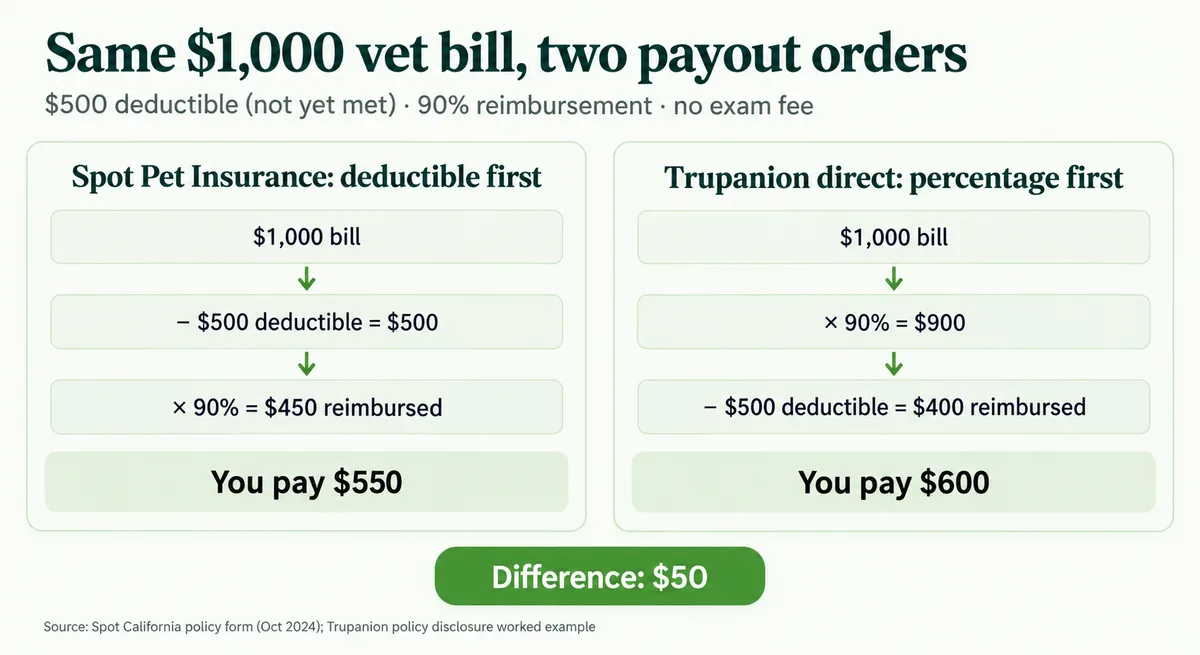
Spot Pet Insurance subtracts whatever is left of your annual deductible from the eligible bill, then pays 90% of the remainder. Trupanion pays 90% of the eligible bill first, with exam fees and taxes taken out before the 90% is applied, and then subtracts whatever is left of the deductible for that condition. On a $1,000 bill at a $500 deductible, that is $450 back from Spot and $400 from Trupanion; over three years of one chronic condition, the same two formulas reverse and Trupanion finishes $850 ahead.
In plain words, with both policies set to 90%:
- Spot pays 90% × (eligible bill − remaining annual deductible). Its California form spells out the order: "We subtract that deductible from covered expenses before applying the reimbursement percentage" (PET-P-20000-CA-IAIC-1024, Oct 2024 edition, p.7). The exam fee for a covered condition is part of the eligible bill, because the same form lists examinations, consultations and laboratory tests as veterinary treatment.
- Trupanion pays (90% × eligible bill) − remaining deductible for that condition, and its eligible bill leaves out "Vet exam fees & taxes" (Trupanion exclusions page). Trupanion's own worked example, printed in its California disclosure TRU (D) 00012 CA and repeated in the Florida disclosure (Sept 2023 edition), is $1,000 × 90% = $900, then $900 − $250 deductible = $650.
The deductible unit behind those formulas (Spot's starts over every policy year and is shared by every condition; Trupanion's is charged once per condition for the pet's life) is explained in the per-condition vs annual deductible section of our comparison hub and at more length in our Trupanion review. This section only runs the bills.
One picture of how easily Trupanion's formula gets misread: an answer on Quora from about eight years ago, by an insurance agent explaining why he chose Trupanion for his own puppy, says that after the $250 deductible Trupanion pays the rest. That is a forum observation, not a policy term, and it leaves out the 10% you keep paying on every bill for that condition. The deductible is paid once; the 90% is never 100%.
The gap between the two orders is also smaller than it looks on small bills. At a $500 deductible, the full $50 difference appears only once the eligible bill reaches about $556 (the deductible divided by 0.9). At or below $500 both policies pay $0, so a $100 invoice against an unmet deductible is yours under either order, and in between the gap is 90% of whatever the bill exceeds $500 by.
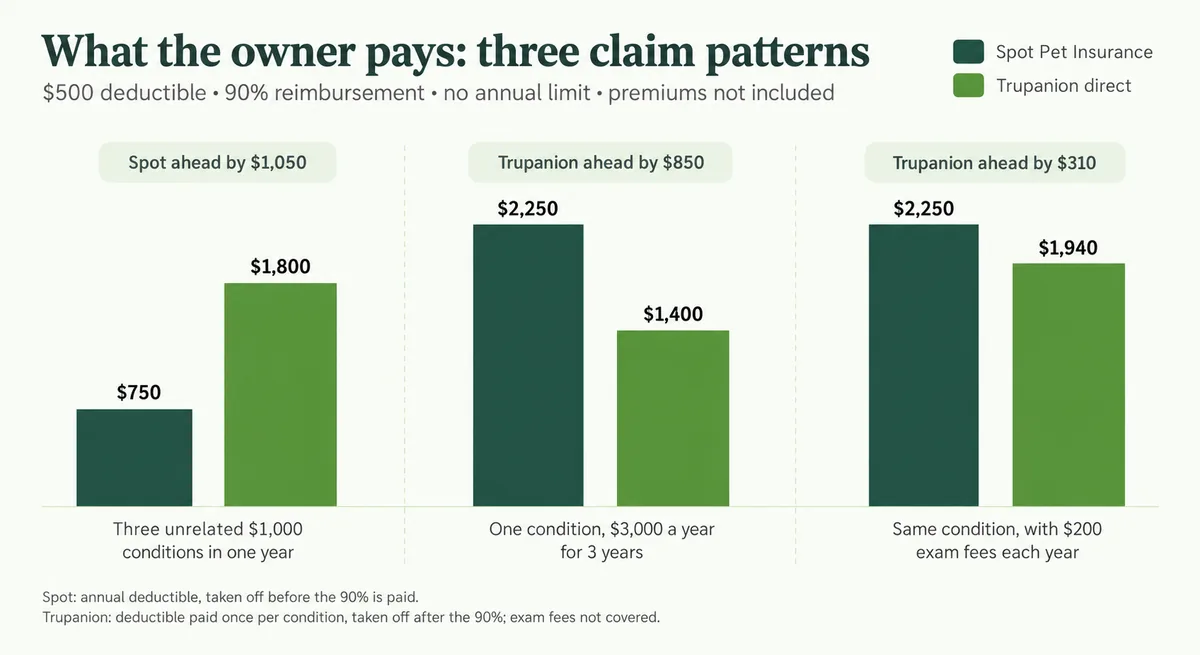
Assumptions for every row below: a $500 deductible on both policies; 90% reimbursement on both; an unlimited annual limit on Spot, matched to Trupanion's no-payout-limit policy; deductibles unmet at the start; every invoice eligible unless the row says otherwise; and premiums left out entirely. The dollar figures are our arithmetic from the two formulas above, rechecked in September 2026, and "owner pays" is the part of the vet bill you are left with after reimbursement.
| Scenario | Spot owner pays | Trupanion owner pays | What decides it |
|---|---|---|---|
| One $1,000 claim, no exam fee | $550 | $600 | Payout order alone ($50) |
| Three unrelated $1,000 conditions in one year | $750 | $1,800 | One annual deductible vs three condition deductibles ($1,050) |
| One condition, $3,000 a year for three years | $2,250 | $1,400 | Trupanion's deductible is paid once ($850) |
| Same, with $200 of exam fees in each year's bill | $2,250 | $1,940 | Excluded exam fees cut Trupanion's edge to $310 |
| One condition: $1,000 before and $1,000 after Spot's renewal | $1,100 | $700 | Spot's deductible resets each policy year |
| $12,000 emergency including a $200 exam | $1,650 | $1,880 | Exam eligibility and payout order ($230) |
Read the rows as patterns, not predictions. Several unrelated problems in one year is Spot's pattern, and its edge on three of them is $1,050 in a single year. One condition that keeps costing money, a cat managed for kidney disease or a dog whose allergies flare every year, is Trupanion's pattern, and its edge builds from the second year because the deductible is not charged again.
The calendar matters too. The second-to-last row is the same $2,000 of treatment for one condition, split across Spot's policy anniversary: the Spot owner pays $400 more than the Trupanion owner only because the annual deductible started over.
Break-evens, as thresholds. On the three-year chronic case, Trupanion can cost up to $850 more in premiums over those 36 months, about $23.61 a month, before its structural edge is gone; once $200 of exam fees sits in each year's bill, the room shrinks to $310, about $8.61 a month. On three unrelated conditions in a year, Spot starts $1,050 ahead.
These are thresholds, not forecasts: they say nothing about how often a pet gets sick, what either premium will be at renewal, or how long a condition lasts. Premiums are not in the table, and the price section explains why no published figure fills that gap at matched settings.
The eligibility caveat. Every row assumes the condition is covered. An excluded knee pays $0 at either company, whichever formula applies: on a $6,000 surgery, the $4,950 Spot would otherwise reimburse and the $4,900 Trupanion would both become nothing if the knee is pre-existing under that policy's rules, which are set out in pre-existing conditions and knees.
Two smaller consequences follow from the same point. Money spent on anything a policy excludes earns no deductible credit, so an excluded condition at either company, or the exam fees and taxes on a Trupanion invoice, never brings the deductible closer to met. And the table matches unlimited to unlimited on purpose: a Spot policy bought with a $5,000 annual limit would cap the $12,000 emergency at $5,000 reimbursed, so match the limit before you compare a catastrophic bill.
What excluded exam fees do
Exam fees are why Trupanion's $850 edge on the chronic case falls to $310. With $200 of exam fees inside each $3,000 year, Spot's eligible bill is still $3,000; Trupanion's drops to $2,800, so it reimburses $180 less each year (90% of $200), $540 over three years, and $850 − $540 = $310. The same mechanism produces the $230 in the emergency row: $180 of it is the exam fee, and $50 is the payout order.
On a single general-practice visit the exam fee is a small line. Recurring rechecks are where it stops being trivial, and this part is owner-reported rather than contract text: in r/petinsurancereviews, one owner describes dermatology visits about every six weeks at around $300, and a commenter in another thread recalls an owner whose chemotherapy appointments each carried an uncovered specialist exam fee, often enough to become a hardship. Each of those visits carries an exam fee that sits outside Trupanion's eligible bill, so the $310 in the table is the shape of the problem, not its ceiling. Two forum accounts are anecdotes, not a rate; the arithmetic they point at is in the form.
None of this is a reason to skip a recheck. A recheck your veterinarian schedules is care your pet needs, and both policies leave you paying for part of every visit anyway. It is a reason to price the visit pattern your pet is likely to have before you choose a formula, and to look at the $12,000 row again on claim day, where the question stops being who pays $230 less and becomes who has to produce $12,000 at the front desk.
Pre-existing conditions, Spot's 180-day rule and knees
A resolved condition can come back into coverage at Spot Pet Insurance and never does at Trupanion. Spot's forms treat a pre-existing condition that has been cured and free of treatment and symptoms for 180 days as a new occurrence, with exceptions that depend on your state's form and always include knees; Trupanion has no such clause, but it asks for your pet's records when you enroll, so you can often see what it treats as pre-existing before your first claim instead of at it.
Both companies will sell a policy for a dog or cat that already has a chart. Buying the policy is not the same as having the condition in that chart covered, and this section is about the second question. It also keeps two different mechanisms apart: Trupanion's look-back is a test applied at enrollment, and Spot's cure clause is a path back to coverage afterwards. Owners who blur them expect Trupanion to forgive an old diagnosis, or Spot to forgive a chronic one, and neither happens.
Spot's cure clause by state form
All 51 of Spot's state samples carry the same sentence: if your pet's pre-existing condition "is curable and has been cured and free from treatment and symptoms for a period of 180 days it is a new occurrence" (PET-P-20000-CA-IAIC-1024, Oct 2024 edition). What differs from form to form is the list of conditions the sentence does not apply to.
| Spot form (insurer) | Where it's published | Exceptions to the cure clause |
|---|---|---|
| Countrywide PET-P-20000-1024 (Independence American), Oct 2024 edition | Arizona and 21 other states; 13 state editions, Florida's among them, print the same exceptions | Chronic conditions; ligament and knee conditions |
| PET-P-20000-CA-IAIC-1024 (Independence American), Oct 2024 edition | California; the Delaware, Louisiana, Maine, Mississippi, Montana, Nebraska, New Hampshire, Ohio and Pennsylvania editions list the same five (Spot's selector) | Chronic, congenital, hereditary, ligament/knee, orthopedic |
| PET-P-20030-0124-USFWA (United States Fire), Jan 2024 edition | Washington | The same five categories as California |
| PET-P-20000-NY-0920 (United States Fire), Sept 2020 edition | New York | Ligament and knee conditions only |
| PET-P-20000-0723 (Independence American), July 2023 edition | Georgia, Maryland and Virginia | Ligament and knee conditions only |
| PET-P-20000-VT-1024 (Independence American), Oct 2024 edition | Vermont | Chronic, congenital, hereditary, ligament/knee, orthopedic; also a 180-day pre-existing look-back |
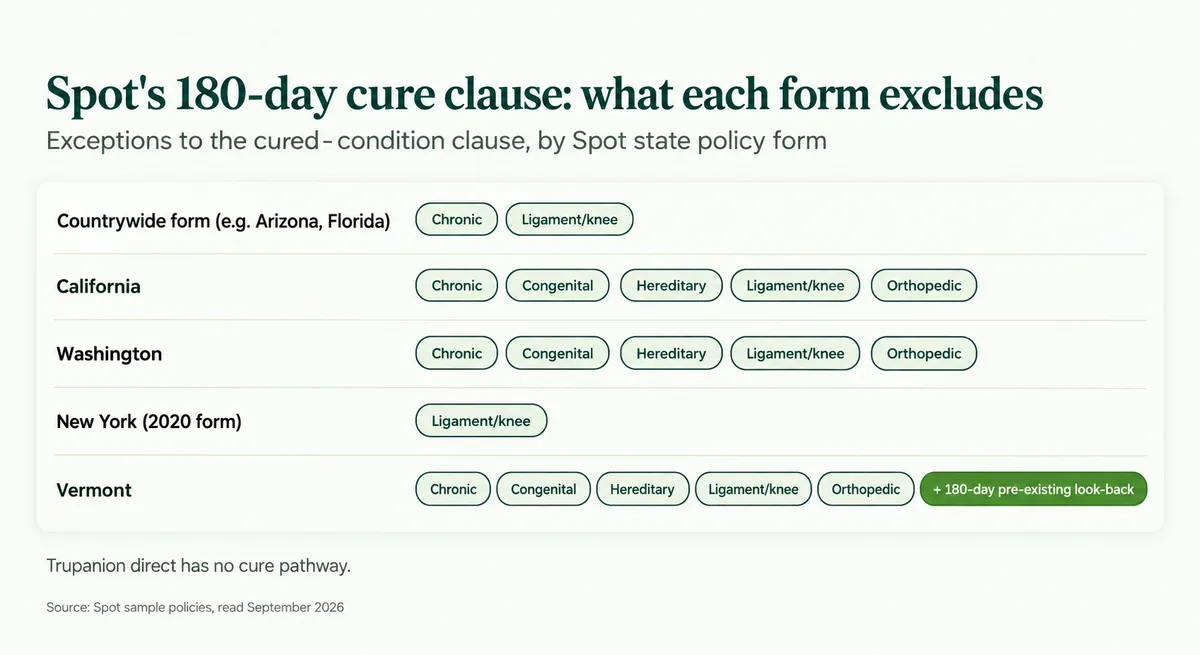
Three cautions on that table. First, Spot publishes 51 samples, one for each state and DC, and we checked the cure clause on every one in September 2026; a sample is still not your policy, so your own issued form governs.
Second, Spot's California notice page describes the 180-day provision with a single exception, ligament and knee conditions, while the California form it links lists five; the issued form governs, and the notice is the less restrictive of the two.
Third, the exception that matters most is the first word on most rows: the California form defines a chronic condition as one "that can be treated or managed, but not cured", so the clause does not rescue allergies, periodontal disease or anything your vet manages rather than cures.
In r/petinsurancereviews, a Trupanion member with an allergy dog, tempted by Spot's exam-fee coverage, names an expected allergy exclusion at Spot as one reason not to move (June 2026 thread; owner reports, not an insurer's determination).
Trupanion has no cure pathway at all. Its FAQ's own example is a dog diagnosed with allergies as a puppy and symptom-free for years: the condition "is not eligible for coverage — even if they've gone years between showing signs". Vermont is the one state whose Trupanion disclosure limits the look-back to a short fixed window, and it is still a look-back rather than a cure clause: its Vermont disclosure (Sept 2023 edition) counts only advice, treatment or signs "within 180 days prior to the Effective Date of a Pet Insurance policy or during any applicable Waiting Period", the same 180-day test Spot's Vermont form applies before its cure clause even comes into play.
Knees and bilateral conditions
At Spot, a knee problem on one side is a knee problem on both. The forms define ligament and knee conditions as "orthopedic illnesses involving a ligament, patella, meniscus or soft tissue disorder of the knee" and say they "are considered bilateral and related, regardless of cause; meaning an occurrence on one side of the body affects both sides of the body" (California form; the countrywide form says the same, calling them "bilateral conditions and related, regardless of cause").
The exclusion follows: ligament and knee conditions are out "if any ligament and knee condition occurred prior to the first effective date of the applicable coverage or during a waiting period", and the category is barred from the cure clause on every form in the table above. A dog that had a left TPLO (a common cruciate-repair surgery) before enrolling cannot insure the right knee at Spot, however long ago the surgery was and whatever caused it.
Trupanion reaches the same place by a different route, and the route depends on the edition. Its FAQ says that cruciate problems "on the same leg or the opposite leg" in the 18 months before the effective date are pre-existing. Its February 2019 policy form, still linked and routed to most states, lists the either-side conditions: luxating patella, glaucoma, entropion, ectropion, elbow dysplasia, cataracts, cherry eye and cranial cruciate ligament disease, excluded if signs appeared on either side from 18 months before enrollment through 30 days after it.
Two conditions on that form have no 18-month cutoff at all: hip dysplasia is excluded on "any sign or evidence of the potential manifestation of the Condition any time prior to the Policy Enrollment Date", and intervertebral disc disease on signs "in any part of the spine" before it.
The September 2023 base form, TRU (D) 00001.1, routed to 14 states on our September 2026 read, drops the time bound entirely: its listed conditions are excluded "if signs or evidence presented on either side or any location on Your Pet prior to the policy Effective Date or during any applicable Waiting Periods", and the list adds hip dysplasia and intervertebral disc disease.
So "18 months" is the FAQ's rule and the 2019 form's, not Trupanion's everywhere; the state disclosures, Vermont's aside, define a pre-existing condition with no time window at all, and Trupanion's California base policy was not obtained, so its either-side list there is unverified. If your dog has had one cruciate repair, our guide to dog ACL surgery covers what the second one costs; then ask either insurer for a written determination on your pet's records before you budget around a policy.
When each company reads your pet's records
Trupanion reads the chart first. Its pre-existing conditions FAQ says it "will request your pet's medical records from all veterinarians, hospitals, or specialists" at enrollment, and its Medical Record Summary FAQ says it makes "every effort to create a Medical Record Summary"; "Any conditions that are listed on your pet's Medical Record Summary are considered pre-existing and will therefore not be covered", and "if additional medical records are uncovered after we issue your Medical Record Summary, we may alter and reissue your report".
Two limits on that. The summary is not a coverage guarantee, because "Actual eligibility for any condition cannot be determined until a claim is submitted", and a condition missing from an incomplete summary is not thereby covered.
In r/petinsurancereviews, a May 2026 thread posted as a public-service announcement describes the per-pet exclusion list arriving inside the first 30 days, with replies saying other carriers do this only on request; that is one thread of owner reports, not a published service standard.
Spot's own pages describe records handling at claim time. No exam is required to enroll (the form's Waiting Period Health Assessment is something "You may elect at your cost to pursue", and it only shortens the waiting period), and Spot's claims FAQ says "If we do need medical records, we'll contact your veterinarian directly".
We found no Spot page describing a records review at enrollment, which is not the same as Spot never doing one; what owners report is the first claim triggering the request. In the same subreddit, Spot policyholders describe a first claim followed by a request for one to two years of pre-policy history, and the Trupanion member above names the first-claim review as the second thing holding them back from switching. Owner reports, self-selected, and heaviest among rescues and fosters with patchy records.
Put those together and you have the asymmetry no ranking page mentions: with Trupanion the records review starts at enrollment, so the exclusion list can arrive while you can still get your money back; with Spot you may not see one until a claim, which can come months after the free look has closed. That is why the money-back wording matters, and it differs.
- Spot. The California form refunds the premium if you cancel within 30 days of your first effective date "if no covered expenses have been applied to your deductible or reimbursed" (Oct 2024 edition). Spot's web copy is inconsistent by state: its FAQ says the 30-day guarantee is "not available in NY or ME", while a homepage footnote says "15-day money back guarantee in ME, LA and WA. Not available in NY". Your form governs.
- Trupanion. Its site footer says the "30-Day Money-Back Guarantee [is] not available in the state of NY, or if a claim has been paid within the first 30 days"; its California and Florida disclosures word the free look more narrowly, allowing a return "as long as You have not filed a claim". Under the disclosure wording a claim filed but not yet paid may forfeit the refund, so if the summary shows an exclusion you can't live with, decide before you file anything.
So pull your pet's complete records before you buy either policy: every clinic, the emergency visit, the shelter or breeder intake notes. Then read them the way an adjuster will. Both definitions run on signs, not diagnoses: Spot's covers any condition for which "the pet displayed signs or symptoms consistent with the stated condition" before the effective date or during a waiting period (California form; Spot's Vermont form limits that test to the 180 days before the effective date), and Trupanion's 2023 form reaches signs or evidence that "existed prior to the policy Effective Date" (TRU (D) 00001.1). A "rule out" line or an incidental note can be enough.
Should you keep a symptom out of the chart until the waiting period has passed? No. Withholding a known problem from an insurer is concealment: Spot's form says that if you "intentionally misrepresent or conceal any material fact, we may deny any related claim" and "cancel, invalidate or rescind coverage" (Oct 2024 edition), and Trupanion's summary is reissued when more records surface.
A symptom that was never examined is still excludable the moment it appears in a later record, because the test is signs, not diagnoses. And a skipped exam destroys the one document that could later prove two episodes were unrelated: a dated note of what your vet found and ruled out.
Disputes turn on what the record shows, so a gap in it doesn't help you: in a February 2026 thread, one commenter's claims, denied while Spot said it was "waiting for records", were reprocessed and paid after the owner escalated, and another commenter warns that concealment is fraud. If your dog or cat has a symptom, get it examined now, and sort the insurance timing out around the record, not the other way round.
Waiting periods and effective dates by state
A waiting period is a stretch after your policy's effective date during which anything that first shows signs is treated as pre-existing; a delayed effective date, which Trupanion's newer state disclosures use instead, simply starts the policy later. Trupanion waives the delay when you enroll on an Exam Day Offer, activated within 24 hours of a veterinary examination (pets up to 14; not offered in New York), and conditions found at that exam can still be pre-existing. Spot's optional, paid Waiting Period Health Assessment can shorten its wait, but the form is explicit that the waiver "does not alter the pre-existing conditions exclusion".
Nothing we read at either carrier credits coverage you already hold elsewhere (the switching section covers what that costs a switcher). In every row below, the issued form governs.
| State | Spot | Trupanion |
|---|---|---|
| California | 14-day wait for illness only; no accident wait (state law); optional Waiting Period Health Assessment (Oct 2024 form) | 30-day illness wait, waivable through its exam program (activation within 24 hours of a full exam) (California disclosure); by law, coverage starts by 12:01 a.m. on the second day |
| Florida | Policies issued on or after Jan 1, 2026: no accident wait (Fla. Stat. §627.71545), though the linked Oct 2024 sample still prints 14 days | No waiting periods; a delayed effective date (length unstated) unless enrolled on an Exam Day Offer (Sept 2023 disclosure) |
| Washington | 14-day wait for illness only (US Fire form, Jan 2024 edition) | No waiting periods; 12-day delayed effective date unless enrolled on an Exam Day Offer (Sept 2023 disclosure) |
| Louisiana | 14-day wait for illness only (state sample, via Spot's selector) | No waiting periods; effective date 12 days after enrollment (Jan 2023 disclosure) |
| PA, MT, RI, DE, MD, MS, NE, OH | 14-day wait for illness only on the PA, MT, DE, MS, NE and OH samples; the RI and MD samples also wait 14 days for accidents and knees (Spot's selector) | No waiting periods; a delayed effective date (length unstated) (Pennsylvania, Montana, Rhode Island and multi-state disclosures, Sept 2023 editions) |
| Vermont | 14-day wait for illness only; 180-day pre-existing look-back (Oct 2024 form) | No waiting periods; delayed effective date; 180-day pre-existing look-back (Sept 2023 disclosure) |
| New York | 14 days for accidents, illnesses and knees (US Fire 2020 form) | No New York disclosure is published, and Trupanion's selector routes New York to its own policy edition, which we did not obtain; no Exam Day Offer in NY |
| New Hampshire | 14-day wait for illness only (state sample) | 30-day illness wait (older v01.201902 disclosure) |
| Other states | 14 days for accidents, illnesses and knees on every remaining state sample, as on the Arizona sample, except Maine's, which waits 14 days for illness only (all 51 checked in September 2026) | Most are routed to the 2019 form (5-day accident, 30-day illness); Hawaii and Maine are routed to the September 2023 base form, and Illinois, Massachusetts and Puerto Rico to their own editions; confirm in your policy |
Florida deserves one more sentence, because the form and the law disagree. Spot's still-linked Florida sample is an October 2024 edition that prints a 14-day accident wait; Florida's statute, effective January 1, 2026, says a pet insurer "may not issue a policy imposing a waiting period for accidents", and the form's own conformity clause bends any term that "conflicts with the statutes of the state in which this policy is issued" to state law. So a Florida Spot policy issued this year should carry no accident wait, and its 14-day illness wait sits inside the statute's 30-day cap; we found no post-2026 Florida edition, so check the declarations you are sent.
The practical reading of the whole table: for a healthy new pet, the differences are a matter of days, and a Trupanion Exam Day Offer or a Spot health assessment can shrink them further; for a pet with a chart, nothing in the table moves a pre-existing exclusion. Where the two policies part ways on the day something goes wrong, who pays the hospital and how long you have to file, is claim day.
Claim day: who pays the vet, and your filing deadline
If your hospital runs Trupanion's software and approves direct payment, Trupanion pays its share of the invoice at checkout and you pay only your part. With Spot Pet Insurance, and at any hospital without Trupanion's direct pay, the standard route is to pay the whole bill first and be reimbursed once the claim is processed.
The filing deadlines differ as well. Spot gives you 270 days; Trupanion advertises 12 months, while the policy forms we read say 90 or 365 days, depending on the state. File every invoice promptly, and go by the number in your own policy.
Who pays the hospital at checkout
Whether Trupanion pays at checkout depends on the hospital and the claim, not on anything you choose in your policy. Its claims page sets the condition: "Trupanion software required at the veterinary hospital with veterinarian-approved direct bill pay". Where that is in place, the hospital submits the invoice, Trupanion pays its share, and you pay the rest before you leave.
Pre-approval is optional. In Trupanion's words, "No pre-authorization is required, but your vet can submit a pre-approval request to Trupanion if specific circumstances call for it" (Trupanion blog, Nov 24, 2025). The same post said that as of October 2025 "nearly 11,500 clinics across the U.S., Canada, and Australia are already set up", and that the software "is available to all 28,000 veterinary hospitals in the U.S., with roughly 1/3 already using it".
Both figures are Trupanion's own, and the first covers three countries. Neither tells you whether your emergency hospital is one of them.
Trupanion's hospital locator marks participating practices "Direct payment available! Please confirm directly with the hospital." When we searched it around one San Diego ZIP code on September 13, 2026, several general practices and a specialty group carried that flag, and an emergency and referral hospital in the same results did not. A flag is a listing rather than a promise, and a missing flag is not a refusal, so the phone call below is what settles it.
Spot Pet Insurance works the other way round. Its guide to paying the vet lists "Step 3: Pay the Vet Bill Upfront" and says "You pay the full bill at checkout, just as you would without insurance" (Spot, updated June 25, 2026).
Spot can still pay your vet, but not at the counter. Its claim form (CF-07/2025) has a "Send payment to" line with boxes for "Me" and "Veterinarian", and the California policy says "If you so indicate on your claim form, we can pay the veterinarian directly" (PET-P-20000-CA-IAIC-1024, Oct 2024 edition, p.8).
That payment follows the claim, and the same claim form has you declare: "I understand that I am financially responsible to my veterinarian for the entire treatment." It spares you the up-front bill only if your hospital agrees to wait for Spot's payment.
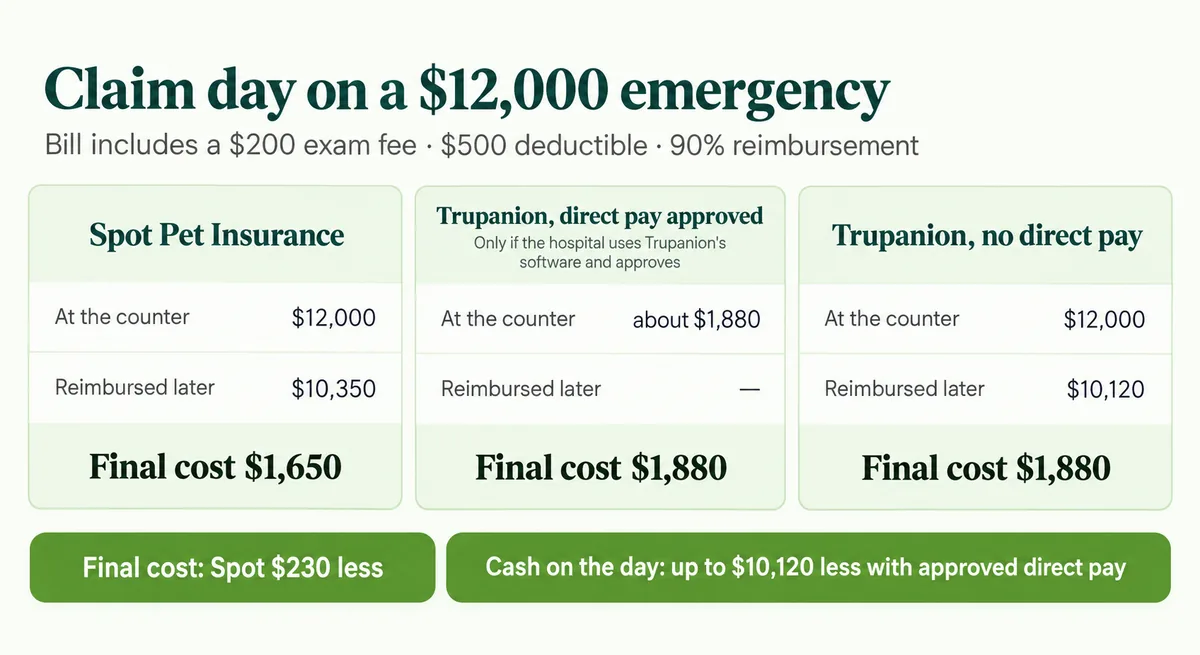
Run the $12,000 emergency from the payout table through both routes: a $500 deductible and 90% on both policies, no annual limit, a $200 exam fee inside the bill, and premiums left out. The dollar figures are our arithmetic from the two payout formulas.
| Claim-day route | You pay at checkout | Reimbursed to you later | Your final cost |
|---|---|---|---|
| Spot Pet Insurance, standard route | $12,000 | $10,350 | $1,650 |
| Trupanion, direct pay approved at checkout | About $1,880 | Nothing; Trupanion pays the hospital $10,120 | $1,880 |
| Trupanion, no direct pay (hospital not on the software, or claim still pending) | $12,000 | $10,120 | $1,880 |
Trupanion pays $230 less on this bill, because it leaves out the exam fee and takes its deductible off after the 90%. An approved direct-pay checkout, though, removes a $10,120 temporary funding need: the difference between producing $12,000 at the front desk and producing about $1,880.
If you could cover the whole invoice and wait for the reimbursement, the $230 is the difference that remains. If you couldn't, the checkout is the difference that matters, and it exists only where the hospital takes direct pay.
How long you would wait for that reimbursement rests on company statements at both, not guarantees. Spot publishes three: "Standard claims are processed in 5-7 business days, while preventive care claims take just 2 business days" (claims guide, updated July 17, 2026); "Most claims are processed within 48 hours after you've submitted all required documents" (claims-process post, updated June 25, 2026); and an average claim reimbursement turnaround of 3.28 days in 2025 (Spot release, Feb 17, 2026).
Trupanion's claims page says "over 70% of claims are paid within 24 hours" and "over 60% of direct payments made within 60 seconds"; the second is a share of direct payments, not of all claims. A reimbursement to you goes by check, the "standard method", or by direct deposit "usually within 1-2 business days after approval" (Trupanion payment FAQ).
Owner reports show how those conditions play out; they are individual accounts, not rates. In a June 2026 r/petinsurancereviews thread, an owner phoning clinics on Trupanion's participating list was told by one office that it takes Trupanion, but not a policy bought through Chewy. The thread never established why, and several replies thought the office was mistaken; in the same thread, a California owner said none of their three regular vets took direct pay, only emergency and specialty hospitals.
A veterinary practice owner, answering on Quora about three years ago under the older name Trupanion Express, described owners at a clinic that uses it usually paying only their share at checkout, but said claims that need more review can still mean paying up front. On the other side, a commenter at a surgical specialty practice reports, in a January 2026 thread, direct pay never taking more than five minutes.
The call to make before you need it
If direct pay is part of why you're choosing Trupanion, confirm it now, while nothing is wrong, so that on the day the only question is your pet's treatment. Call the emergency hospital you would use and the specialty hospital you'd most likely be referred to, and ask:
- "Will you submit and accept direct payment for this policy?" Name the policy exactly: Trupanion bought direct, or a Trupanion-underwritten plan bought through Chewy.
- Does that hold for an overnight or weekend emergency admission? The locator can't tell you, and we have not confirmed after-hours acceptance by phone at any hospital.
- If a claim needs review, will you still ask for a deposit or the full bill at checkout?
With Spot Pet Insurance the question is different: will the hospital wait for a payment Spot sends after the claim, or does it expect the full bill at checkout? Either way, you'll know before the day which row of the table above you're in.
How long you have to file
Spot Pet Insurance gives you 270 days. The California policy says "You must submit your claim within 270 days from the date of service" (Oct 2024 edition), the claim form says to send it "within 270 days of treatment", and the policy lets your veterinarian's office submit the claim on your behalf if you choose.
Trupanion's deadline depends on which document you read. Its claims page advertises "a full 12 months from the date of service" and adds that "The 12-month window applies to invoices you submit yourself."
Its policy forms put it differently. The February 2019 form, still linked and routed to most states by Trupanion's sample-policy selector, requires claims "within 90 days of the treatment date". The September 2023 base form, routed to 14 states, allows "within 365 days of the treatment date", pays a later claim "only if We are not prejudiced by the delayed notice", and sets an outer limit of 1,095 days.
We found no endorsement tying the advertised 12 months to either form, and Trupanion's 2025 claim form prints no deadline at all. California, New York, Illinois, Massachusetts and Puerto Rico are routed to their own editions, which we did not read for this term.
Here is where the difference shows. An invoice you find in a drawer 300 days after the visit is outside Spot's 270 days; at Trupanion it is inside the advertised 12 months and the 2023 form's 365 days, but far outside the 2019 form's 90.
So file each invoice as soon as you have it, and until Trupanion confirms in writing which window your policy carries, treat the one printed in your own policy as the deadline. At a direct-pay checkout the hospital submits the invoice for you, so these windows matter most for the bills you send in yourself.
If a claim comes back reduced or denied, the routes differ. Spot's California policy asks for the appeal in writing and promises "a written decision from the Appeals Resolution Team within 30 days from the date all information necessary to investigate and review your appeal is received"; a second appeal needs "additional veterinary documentation not previously reviewed" (Oct 2024 edition). Trupanion's pre-existing conditions FAQ tells members who "feel that a condition was mistakenly added to your pet's record as pre-existing" to contact the company, and we found no formal appeal window on any Trupanion page we read.
What each policy costs to hold, and what the published numbers can't settle, is the subject of the price section.
Price: what the numbers can and can't tell you
No published number tells you whether Spot Pet Insurance or Trupanion will cost less for your pet. We did not obtain matched same-day quotes for this page, and every public price we found either prices a different amount of insurance, averages across other pets and plans, or is one owner's bill.
What the published documents do settle is how each company can change your premium once you hold the policy, and there the two contracts differ. The evidence quoted in this matchup comes in four kinds that answer different questions: prices the companies advertise, sample-quote tables on comparison sites, rate changes that state regulators approved, and owners' reports of their own renewals. We keep them apart below, because none of them is a quote for your dog or cat.
Why $5,000/80% comparisons don't describe a Trupanion policy
Trupanion's direct policy has one payout percentage and no annual cap. Its Florida disclosure says "90% Coinsurance, or payout percentage, applies to claim payments under this policy" (Sept 2023 edition), and the policy has no annual payout limit.
So a "same settings" table that prices both companies at 80% reimbursement with a $5,000 annual limit is pricing a Trupanion policy that isn't for sale. The Spot plan in that table is real, but it reimburses 80% instead of 90% and stops paying for the policy year at $5,000, which is less insurance than the Trupanion policy you could actually buy.
Spot's own starting prices are built on settings like these. Its dog insurance page says plans "can start as low as $15 per month", a figure its footnote dates to June 27, 2025 and bases on 80% reimbursement, a $500 annual deductible and a $5,000 annual limit for a 2-year-old small mixed-breed dog in a Florida ZIP code. The same page's "$9/mo" starting price for cats assumes 80%, a $750 annual deductible and a $2,500 annual limit for a 2-year-old mixed cat (Spot, read September 2026). Both are starting prices for those exact settings, not a price for a Spot policy set up the way Trupanion's is.
The deductible can't be matched either. At Spot, a $500 deductible is annual and shared by every condition in the policy year (California form, Oct 2024 edition, p.7); at Trupanion, a $500 deductible is charged once for each condition, for the pet's life (California disclosure TRU (D) 00012 CA). A matched quote can hold the amount constant but never the unit, which is why the method below runs both payout formulas instead of treating the two numbers as the same.
How to get a matched quote
If your pet is already insured and has a medical history, read the switching section before you quote a replacement. Otherwise, open your state's sample policy at Spot and at Trupanion first, since the form sets the waiting periods, exclusions and filing window you would be buying. Our comparison hub covers the general rules for comparing pet insurance quotes fairly; this is the version for this pair:
- The same pet and ZIP code, quoted on the same day. Enter species, breed and age exactly as your vet's records show them. Trupanion enrolls pets "any time before their 14th birthday" (Trupanion FAQ), so a pet who is already 14 has no Trupanion quote to match.
- Spot set to 90% reimbursement with an unlimited annual limit. Spot offers both (Spot, updated June 25, 2026), and it is the only combination that matches what Trupanion sells.
- The same deductible amount at both. Spot's annual deductible comes in $100, $250, $500, $750 or $1,000 (Spot), and Trupanion's per-condition deductible can be set "anywhere between $0 and $1,000" (Trupanion), so any of Spot's amounts can be matched. The unit will still differ; step 5 handles that.
- Add-ons off at both, or matched in scope. Spot's preventive-care endorsements have nothing to match at Trupanion, whose policy excludes "Wellness & routine care" (Trupanion). In the other direction, Trupanion sells acupuncture, hydrotherapy, rehabilitative therapy and behavioral modification as an optional Recovery and Complementary Care rider (Trupanion FAQ), while Spot's base form lists alternative therapy and treatment for behavioral problems among covered expenses (California form, p.5). The next section sets out both.
- Both payout formulas, run on the claims your pet is likely to have. Use the payout table, then set the difference in monthly price against the break-even thresholds printed under it.
- The fees, which the monthly price doesn't show. Spot charges a non-refundable installment "transaction fee listed on the declarations page", which is "waived if you pay annually" (California form, p.9); its countrywide and Florida forms also charge new customers an enrollment fee, again "listed on the declarations page", but not for additional pets (countrywide form, Oct 2024 edition, p.8; Florida form, Oct 2024 edition, p.8). Trupanion's annual report describes its sign-up fee as "a one-time charge to some new members collected at the time of enrollment" (Form 10-K for 2025). None of these documents prints an amount, so ask each company before you buy.
- Each company's renewal rule, written next to its price. A first-year price is where a premium starts, and what moves it afterwards is different at each company, as the next part explains.
Even a perfectly matched quote compares only the first year. A price gap at enrollment is not a lifetime cost gap: the payout formulas decide what each policy pays back, and the renewal rules decide how each premium moves.
Renewals: age-rated vs cost-of-care
Spot's premium can rise as your pet gets older. Trupanion's can't rise for that reason, but it can rise with the cost of care and with your ZIP code. Neither one is a fixed price.
Spot, in its own words. "Premiums are based on the current age of your pet. Premium may increase due to the age of your pet at renewal", and "Premium may change based on your home address" (Spot underwriting disclosure).
Claims aren't one of the reasons: "Your premium will not increase due to filing a claim" (Spot FAQ). The policy adds that "Coverage and rates are subject to change at renewal" and that "You accept these changes by renewing your policy" (California form, p.8). A Spot quote for a 2-year-old is the price at 2, and we found no published age curve showing where it goes from there.
We also found no approved rate filing that names a Spot program, either on California's rate-filing approval lists for 2023 through August 2026 or in the state round-ups cited below.
The closest document is a request, not an approval. In April 2026, a Spot policyholder in New Jersey posted the notice that state requires: Independence American Insurance Company had asked New Jersey's Department of Banking and Insurance for an average increase of 18.595% on its pet health insurance plans, a request that "may not be approved or may not be approved for the full amount requested" (r/petinsurancereviews, April 2026). The notice names the insurer, not Spot, and in the replies one owner reports the same email from Pumpkin and another a similar one from ASPCA.
Trupanion, in its own words. "Premiums will not increase based on Your claim history or the age of Your covered Pet", and "Premiums may increase or decrease if You move to a new ZIP code" (Florida disclosure, Sept 2023 edition). Its pricing promise adds that the rate "may adjust for rising costs in care". Trupanion's own 2024 shareholder letter, published in April 2025, states the limit of that promise plainly: "Age at enrollment pricing doesn't mean a monthly rate remains locked in" (Trupanion shareholder letter).
Here are the 2026 rate changes regulators approved for Trupanion in three states, as Insurify reported them from the state filings. We did not read the filings themselves, though California's requested and approved percentages also appear on the state's own approval list.
| State | Approved change | How it spreads | Takes effect |
|---|---|---|---|
| California | 19% overall, against 28.1% requested (California Department of Insurance approval list, file 25-2461) | 94,326 policyholders; individual changes "from less than 5% to as high as 70%" (Insurify, Apr 23, 2026) | July 19, 2026 |
| Georgia | 9.5% overall (Insurify, published Mar 4, 2026; byline Mar 5) | 17,465 policyholders; 5,037 face 5%–10%, 6,284 face 10%–15% and 2,172 face 15%–30% | May 1, 2026 |
| Florida | 12.9% for Trupanion's rates (Insurify, Nov 24, 2025) | Applies to all new and renewing policies | Feb 1, 2026 |
An approved average summarizes a spread; it isn't a forecast of your renewal. The California approval that averaged 19% lands on individual policies anywhere from under 5% to 70%. A request isn't an approval either: Trupanion's insurer, American Pet Insurance Company, asked California for 28.1% and was allowed 19%, which is why a notice like New Jersey's tells you the direction of travel, not your number.
What owners report. These accounts come from r/petinsurancereviews, where people tend to post after a renewal shock, so they show what can happen rather than what usually happens, and none of the posts establishes why the price rose:
- Spot, California: up 20% at a dog's first renewal, at age 4 (January 2026).
- Spot, California: up 58% for each of two 10-year-old dogs at their first renewal (August 2026).
- Spot: up 27% for two cats aged four and a half, with no claims that year; the owner says they got three different explanations on one call (July 2026).
- Trupanion, California: a dog enrolled at 4 and now nearly 16 went from $128 to about $250 a month over three years, after increases of 46.7% and 33.7% (March 2026).
- Trupanion: a terrier mix enrolled at 3 in 2022 went from about $90 a month to $188, then to $235 after, the owner says, the company found an old address on file; the only claim was $25, in 2022 (June 2026).
So the renewal question is which pressure you would rather carry. At Spot, the premium can climb as your pet ages, on top of any change in rates. At Trupanion, age alone won't move it, but an approved cost-of-care increase or a new ZIP code can, and for some policies by far more than the statewide average.
Wellness, limits and multi-pet households
Only Spot Pet Insurance sells wellness coverage and a multi-pet discount; Trupanion offers neither, and it has no annual limit for you to choose. The settings here that deserve the most care are the ones each company restricts once you're enrolled: Spot's annual limit, and Trupanion's deductible and therapy rider.
Gold and Platinum: a fixed schedule, not a wellness budget
Spot's wellness options are two endorsements, printed amendments that add scheduled benefits to the base policy. (Trupanion's optional add-on, further down, is called a rider: a different word for the same idea, extra coverage you choose on top of the base policy.) Spot's FAQ prices Platinum at $24.95 a month for "a total annual benefit of $450", and its dog insurance page footnotes the other tier, Gold, at $9.95 a month. Both are written on form PET-AE-20000-0723 (Gold, Platinum), a July 2023 edition: dated, but the one Spot links today.
Neither works like a budget you can spend. Each reimburses "up to the lesser of the allowable maximum amount or the amount charged for the covered procedure", and only for the services on the option you picked, so every line has its own yearly cap and money left unused on one line can't pay for another. Spot's FAQ adds that you don't have to satisfy your deductible before these benefits pay. Here are the maximums printed on each endorsement, with the totals and a year's premium worked out by us:
| Service line, as printed | Gold | Platinum |
|---|---|---|
| Dental Cleaning (Platinum: Dental Cleaning or Spay/Neuter) | $100 | $150 |
| Annual Exam | $50 | $50 |
| Heartworm/Flea Prevention | $0 | $25 |
| Deworming | $20 | $25 |
| Health Certificate | $0 | $25 |
| Canine Heartworm or Feline FELV (test) | $20 | $25 |
| Urinalysis | $0 | $25 |
| Blood Test | $0 | $25 |
| Fecal Test | $20 | $25 |
| Canine Bordetella or Feline FELV (vaccination) | $0 | $25 |
| Canine DHLPP or Feline FVRCP | $20 | $25 |
| Canine Rabies and/or Canine Lyme, or Feline FIP | $20 | $25 |
| Most it can pay in a year | $250 | $450 |
| Most without the dental cleaning (or spay/neuter) line | $150 | $300 |
| A year of premiums | $119.40 | $299.40 |
The best case is narrow. Gold's is $250, $130.60 more than a year of premiums, and it needs a dental cleaning: without one, Gold tops out at $150, $30.60 ahead. Platinum's best case is $450, $150.60 ahead, and it hangs on the $150 dental cleaning or spay/neuter line: use the other eleven lines to their maximums and it returns $300, 60 cents more than you paid. All of that assumes your vet charges at least each line's maximum.
So the add-on is easy to misread in both directions. It doesn't cover wellness visits in full, because each service stops at its cap. Nor is it a poor buy by definition: a year with a dental cleaning, or on Platinum a spay or neuter alongside the usual vaccines and tests, can come out ahead. Price the services your pet will actually get at your own vet against the lines above.
Judge it over the whole year, because you can't try it for a month. The endorsement lets you cancel it "at renewal", says "During the policy period, you will not be able to cancel this endorsement unless your base policy is also cancelled", and makes a move between Gold and Platinum a renewal choice too. Trupanion has nothing to set against either tier: its exclusions page puts "Wellness & routine care", including parasite prevention, spaying and neutering, and vaccinations, outside coverage.
Therapy and behavior: built in at Spot, a 30-day decision at Trupanion
Spot's base policy covers two kinds of care that Trupanion sells as an extra. Its California form lists "Alternative Therapy, when performed by a veterinarian or at a facility with a supervising veterinarian on staff, or through referral to an individual certified in veterinary rehabilitation", and treatment for behavioral problems by a veterinarian or on a veterinarian's written referral to a credentialed animal behaviorist, among the expenses it pays (Oct 2024 edition, p.5), subject to the policy's usual exclusions.
At Trupanion, acupuncture, behavioral modification, hydrotherapy and rehabilitative therapy come through the optional Recovery and Complementary Care rider, which pays 90% for them. Trupanion's rider FAQ gives you "30 days after signing up with Trupanion to add extra coverage", and says the treatments aren't covered when the condition being treated is pre-existing. So the decision falls in your pet's first month, long before you know whether an injury or a behavior problem will ever call for it.
Annual limits: compare unlimited with unlimited
Trupanion's policy has no annual payout limit. Spot makes you pick one, from $2,500 up to unlimited, and its form makes every reimbursement "subject to the annual limit listed on your declarations page" (California form). Set Spot to unlimited before you compare the two on a large bill.
The payout section showed a $5,000 limit capping the $12,000 emergency at $5,000 reimbursed. In what you pay, that is $7,000 instead of the $1,650 an unlimited Spot policy leaves you with, at the same $500 deductible and 90% (our arithmetic).
Owners with a chronic condition in the house feel that gap. In a January 2026 r/petinsurancereviews post, an owner insured with Spot since 2021 at a $5,000 limit says they spent more than $10,000 in one year on a 6-year-old cat's recurring constipation and paid everything past the limit themselves. That is one owner's account, not a rate.
Decide these up front: settings that are hard to undo
Spot's limit. Spot's policy says "Any change is subject to underwriting and our approval" and "Certain changes may result in a new enrollment, which would terminate your existing policy and will not be considered continuous coverage". A new enrollment "will result in new waiting periods", and conditions that occurred before it "will be considered pre-existing" (California form, p.9). The form doesn't say which changes count.
Owners believe a higher limit is one of them. In a January 2026 thread, one commenter told a Spot cat owner on a $5,000 limit that they didn't believe Spot would let the limit be raised without starting a new policy, which would leave the cat's existing conditions uncovered. In the thread above, a Spot owner with a dog diagnosed with cancer writes that they "didn't realize you could never increase the max"; another commenter there, on an unlimited Spot plan, asked whether the original poster had checked with Spot about upgrading.
Those are owner beliefs, not a Spot rule, and Spot's FAQ sends questions about "upgrading or downgrading your policy" to its customer service team. So before you count on raising a limit later, ask Spot in writing whether that change would be a new enrollment, and consider setting the limit at checkout to the level you would want in a bad year.
Trupanion's deductible and rider. Trupanion's deductible FAQ gives you "30 days after you enroll to lower your deductible", and conditions that showed signs before a decrease still need the higher amount. You "can increase your deductible at any time", but any condition present before the increase "will need to meet the new, higher deductible", so a later increase reaches the conditions your pet already has, not just new ones. With the rider's own 30-day window, the first month is when to settle both.
Multi-pet households: a discount, not a shared deductible
Only Spot discounts extra pets. Its underwriting disclosure says "10% multi-pet discount is available on all pets after the first", its quote site adds "5% on each pet in WA", and Trupanion's FAQ says "we do not offer multi-pet discounts".
The first pet pays full price, so the saving on the household bill is smaller than the headline. With equal premiums, 10% off the second pet takes 5.0% off the combined total; 10% off the second and third takes 6.67% (our arithmetic).
Nor does the discount pool anything. Spot says you buy "an independent policy for each pet" and can choose "different annual coverage amounts, deductibles and reimbursement levels" for each (Spot's multi-pet page), so every dog or cat carries its own annual deductible and limit, and two pets with unrelated problems in one year meet two deductibles. For the household question itself, one company for every pet or a split, our guide to insuring multiple pets works through the options.
For a large household, the premium can decide it before any claim does. In an April 2025 thread, a commenter insuring 9 cats and 2 dogs with Spot, the cats at a $250 deductible, a $4,000 limit and 80%, says they can't afford Trupanion "for my entire menagerie" (r/petinsurancereviews). That is one household's budget, at a limit well below the unlimited match this page uses, not a price comparison.
Discount routes. Sam's Club's July 2025 launch notice, whose discount terms were revised on Aug. 22, 2025, offers members "a 15% insurance discount for every insured pet" through Spot, except 10% in California, North Dakota and New York and 5% in Washington, with no discount in Tennessee or Puerto Rico, plus "an additional 10% multi-pet discount on all added pets after the first". The notice is more than a year old and doesn't say how the two discounts combine or what happens if a membership lapses, so confirm the current terms with Spot before you count on either.
Through an employer, Spot's site advertises a "20% employee discount", footnoted as "up to 10% group discount plus up to 10% multi-pet discount on 2nd+ pets" and "Not available in all states" (Spot). For a one-pet household, that is up to 10%.
Dental illness: covered at both, on different conditions
Spot's FAQ says its accident-and-illness plans "cover treatments for dental illnesses". The policy excludes "Dental cleanings unless used to treat a covered illness or covered by an applicable endorsement", along with cosmetic, endodontic and orthodontic work such as crowns, fillings and root canals (California form, p.6), so a routine cleaning is what the wellness line above is for.
Trupanion's dental illness coverage depends on a recent exam. Its California disclosure requires your pet's teeth to be "Examined by a Veterinarian at least once every 12 months"; the Florida, Pennsylvania and Washington disclosures (Sept 2023 editions) say every 365 days. If the teeth weren't examined in that window before the policy began, dental coverage starts only at the first dental exam afterwards, and "any Illnesses or Injuries found at such an Examination or signs prior to such an Examination will not be eligible for dental coverage".
So before you compare the two on dental coverage, look in your pet's record for a dental exam in the past year, and keep up the yearly dental checks your vet recommends; at Trupanion, the coverage is conditional on them.
These settings leave the payout formulas alone. They change what routine care costs you, how far a bad year can reach, and what you can still adjust once a policy is running; moving a pet from one company to the other, the biggest adjustment of all, is covered in switching.
Switching between Spot and Trupanion
For a dog or cat with a clean record, moving between Spot Pet Insurance and Trupanion mostly means sitting out a new waiting period or a delayed start date. For a pet with a medical history, a switch in either direction costs coverage: anything already in the chart can count as pre-existing under the new policy, and only Spot has a clause that can bring a resolved condition back.
Getting the new policy is rarely the hard part; getting it to cover what your pet already has usually is. So work out what a switch would cost you in coverage before you look at what it would save you in premium.
The question often arrives with a renewal notice, as in these two owner reports from r/petinsurancereviews. Both are individual accounts, not rates.
- Tempted to leave Trupanion. In a June 2026 thread, an owner whose dog has been on Trupanion since the day he came home says the premium, now $140 a month at a $250 per-condition deductible, has gone up $56 a month in two years. The dog, now 2, takes daily allergy medication that the owner puts at almost $300 every two months, and at Trupanion "is covered for life on anything allergy related"; earlier diarrhea, wound and bleeding claims all resolved more than 180 days ago. Spot's included exam fees and therapies are the draw. Most replies say stay, one pointing out that the allergy deductible is already met for life.
- Tempted to leave Spot. In an August 2026 thread, a California owner with two 10-year-old dogs on Spot accident-and-illness plans reports a 58% increase for each at the first renewal. In that first year, one dog's ear-infection claim was denied as an allergic reaction, pre-existing because of an earlier flea-allergy shot, and its dental surgery was denied because of a previous one; the other dog's dental surgery was approved. The owner can't decide between staying and leaving, and is worried about the dental and allergy history.
Both owners are weighing a price against coverage they already hold, and for the first one the arithmetic is lopsided. At the owner's figure, the allergy medication comes to about $1,800 a year. If it stays covered at Trupanion's 90%, as the owner describes, staying costs the $1,680-a-year premium plus about $180 of that medication, or $1,860; a Spot policy that excludes the allergy leaves the full $1,800 with the owner, so it would have to cost less than $60 a year to come out ahead on the allergy alone (our arithmetic).
The second owner's case is closer. The allergy and dental history Spot has already denied sits in the same chart any new insurer would read, as the owner acknowledges, so a move is unlikely to get it covered. What leaving would put at risk is future coverage for what Spot has accepted, such as the second dog's dental treatment.
California, where that owner lives, also ties a protection to the policy itself: a condition for which coverage is afforded on a policy "shall not be considered a preexisting condition on a renewal of the policy" (Cal. Ins. Code §12880.7), and Florida's statute says the same. That protection comes from renewing the policy you hold; a new policy from the other company applies its own pre-existing test.
What doesn't travel with your pet
Each direction leaves something different behind. The per-form detail behind the first three rows is in pre-existing conditions and knees.
| What changes | Leaving Trupanion for Spot | Leaving Spot for Trupanion |
|---|---|---|
| Conditions already in the record | Pre-existing if the condition "first occurs or shows symptoms before coverage is effective or during a waiting period" (countrywide form, Oct 2024 edition); California's form also counts anything a vet advised on or treated (p.3). That takes in whatever began, and was covered, during the Trupanion years. Spot's Vermont form counts only the 180 days before coverage. | Pre-existing under Trupanion's test, whose reach depends on the document: 18 months back for most conditions under its FAQ and Feb 2019 form; no time limit under the Sept 2023 base form used in 14 states; 180 days under its Vermont disclosure. |
| A condition that has cleared up | Becomes a "new occurrence" only if it is curable, has been "cured and free from treatment and symptoms for a period of 180 days", and isn't on your form's exception list (California form, p.5). | Nothing brings it back once it counts as pre-existing under the test in the row above: Trupanion has no cure clause, and its FAQ keeps a condition diagnosed before the policy out of coverage "even if they've gone years between showing signs" (Trupanion FAQ). Whether an old, resolved condition counts at all depends on how far back that test reaches, so get the Medical Record Summary's answer. |
| Knees | A ligament or knee problem on either side before coverage excludes both knees, "regardless of cause" (California form, p.3), and knees are excepted from the cure clause on every Spot form we read. | Cruciate problems on either leg are pre-existing: in the 18 months before coverage under the FAQ, at any time before it under the Sept 2023 form. |
| The deductible | A deductible you have met for a condition is lost. At Trupanion, meeting it meant the policy "will pay out all future losses for that specific Illness or Injury" at 90% (California disclosure TRU (D) 00012 CA); at Spot, one annual deductible starts over each policy year (California form). | Each condition Trupanion covers carries its own new deductible, paid once for that condition (California disclosure). |
| Exam fees | Covered, for conditions the Spot policy covers (California form). | Excluded, along with taxes (Trupanion exclusions page). |
| Age | No upper age limit (Spot, updated June 25, 2026). | Enrollment only "any time before their 14th birthday" (Trupanion FAQ). |
| Choices that are hard to change later | The annual limit. Spot's form says "Certain changes may result in a new enrollment" without listing them (California form, p.9), so set the limit you'd want in a bad year at checkout (see the limits section). | The Recovery and Complementary Care rider must be added within "30 days after signing up with Trupanion" (rider FAQ), and a lower deductible chosen within "30 days after you enroll" (deductible FAQ). |
| When you find out what's excluded | Spot's FAQ describes contacting your veterinarian for records when a claim needs them (Spot FAQ), and owners report the review coming at the first claim. | At enrollment: Trupanion requests records "from all veterinarians, hospitals, or specialists" and issues a Medical Record Summary (Trupanion FAQ), though eligibility is settled only when a claim is submitted (pre-existing FAQ). |
Run the first owner's dog through the "Leaving Trupanion for Spot" column. An allergy still treated every day can't be "free from treatment and symptoms" for 180 days, so no Spot form's cure clause reaches it. The resolved diarrhea, wound and bleeding claims are the kind of history the clause can bring back, if the record shows 180 clean days and the form doesn't except them, and on owners' reports the answer may not come until a claim.
The owner's fallback, raising the deductible to $500 to save about $37 a month, has a catch of its own. Trupanion's deductible FAQ says conditions present before an increase "will need to meet the new, higher deductible", which on that wording reaches the allergy too.
Before you cancel anything: the safe-switch checklist
- Count the coverage, not the premiums already paid. Those premiums are gone whichever way you go. List each condition in your pet's chart and what the current policy pays on it, and assume the new policy pays nothing on any of them until the company tells you otherwise in writing.
- Get the answer before you cancel. Moving to Trupanion, read the Medical Record Summary before you file any claim, while Trupanion's 30-day money-back guarantee may still apply (not in New York; the records section sets out its two refund wordings). Moving to Spot, ask in writing how it would treat each charted condition; we found no Spot page offering that review before a claim, so if no clear answer comes, budget as though each one is excluded.
- Disclose fully, and never hold records back. Spot's form says it may "cancel, invalidate or rescind your coverage" over a concealed material fact, and that "This may include rescission backdated to the original policy period effective date" (California form, p.9). If you had already cancelled the old policy, your pet would be left with no policy at all.
- Overlap the policies; don't leave a gap. Keep the old policy until the new one is past its waiting period or delayed effective date, which vary by state (state table); nothing we read at either company shortens those, or the pre-existing test, for a pet arriving with coverage elsewhere. If your pet needs care during the overlap, get it: covering that stretch is the point of keeping the old policy. Tell each company about the other, and don't expect to be paid twice; Spot's form makes its policy "excess of all other valid and collectible insurance" (California form, p.9).
- Cancel for a set date, in writing. Spot's form asks for "the future date when this policy is to cancel" and refunds premium already paid "for any period after your last date of coverage" (California form, p.8); our Spot Pet Insurance review walks through the cancellation steps. Whichever company you leave, keep written confirmation of the date.
- Treat a change that looks like paperwork as a switch. Moving from a Trupanion-underwritten Chewy CarePlus plan to Trupanion direct is a move to a different contract. In June 2026, owners also reported notices moving some Spot policies from United States Fire to Independence American, described in a reply from Spot's own forum account as the same coverage with no lapse (more in which policies you're comparing). We found no document showing how an already-covered condition carries across either move, and nothing we read says that brands sharing an insurer or parent company carry coverage from one policy to another, so get it in writing first.
If the numbers say stay, what you can and can't adjust inside the policy you hold is in wellness, limits and multi-pet households. For the wider playbook, including which pets are usually safe to move, see our guides to switching pet insurance and what happens to coverage when you switch providers. The verdict that follows gives a Trupanion member with a covered recurring condition its own row; a Spot policyholder weighing a renewal should work through the checklist above.
Which should you choose?
Choose by situation, not by brand. Find the row below that describes your pet and your finances: the middle column is where we lean, and the last column is the fact that would reverse that lean, so check it before you buy. If your pet has a knee problem, recurring symptoms or daily medication in its history, the honest answer for that history is neither: don't count on either company to cover it until the insurer puts its decision in writing.
Each lean is our reading of the Spot Pet Insurance and Trupanion contracts quoted on this page, not a promise that a claim will be paid. Your issued policy and the insurer's decision on your pet's actual records govern, and a company that will sell you a policy has not agreed, by selling it, to cover what is already in your pet's chart.
| Owner situation | Leans toward | Fact that reverses it |
|---|---|---|
| Young, clean-record pet; owner can front a large bill; several unrelated problems a year would strain the budget | Spot Pet Insurance at 90% with an unlimited annual limit, if its matched premium is competitive. Its one annual deductible is subtracted before the reimbursement percentage and met once a policy year, however many conditions your pet has (worked in the payout table). | A much cheaper Trupanion quote; a nearby hospital that takes Trupanion's direct pay; a condition that turns chronic |
| Owner cannot front a large emergency bill | Trupanion bought direct, only if the emergency or specialty hospital you would use actually accepts VetDirect Pay, which takes Trupanion's software at the hospital and the vet's approval of direct billing. | The hospital isn't on the software; it asks for a deposit anyway; the claim needs review before Trupanion pays; the treatment is excluded (see claim day) |
| Existing Trupanion member with a covered recurring condition and the deductible met | Stay. With that deductible met, the policy "will pay out all future losses for that specific Illness or Injury" at 90%. | The renewal becomes unaffordable, or the premium you would save by leaving outgrows the reimbursements you would lose on that condition. Don't expect Spot to cover the condition itself: one still flaring up or being treated can't meet its 180-day cure test, and one managed rather than cured is excepted as chronic on most state forms (see switching). |
| New applicant aged 14 or older | Spot Pet Insurance, which has "no upper age limit". Trupanion enrolls pets only "any time before their 14th birthday". | None, between these two companies |
| Resolved, one-off, non-chronic, non-orthopedic history | Spot Pet Insurance, which may cover it again as a new occurrence once it has been "cured and free from treatment and symptoms for a period of 180 days". Trupanion has no cure clause. | The condition is classed as chronic (managed rather than cured, so the clause can't reach it) or as a knee problem, both excepted on the countrywide form; or, on the California, Washington and Vermont and nine other state forms, as congenital, hereditary or orthopedic; or a record that doesn't show the 180 clean days |
| Prior knee problem, recurring symptoms or ongoing medication | Neither should be presumed to cover it. Spot's forms treat knee conditions as "bilateral and related, regardless of cause", and a condition still under treatment can't meet their 180-day test. Trupanion counts earlier cruciate problems on either leg as pre-existing: within 18 months under its FAQ, at any time under its September 2023 form. | A written determination from the insurer, made on your pet's records |
| Several pets with unrelated claims | Spot Pet Insurance: "an independent policy for each pet", each with one annual deductible, and a 10% discount on every pet after the first (5% in Washington). Trupanion offers no multi-pet discount. | Trupanion's actual combined premium for your pets; a pattern of long-running conditions |
| Wants exam fees, wellness and customization | Spot Pet Insurance, which covers exam fees for covered conditions, sells Gold and Platinum preventive-care endorsements, and lets you choose 70%, 80% or 90% and an annual limit from $2,500 to unlimited. Or, outside Alaska, California, Hawaii and Vermont, Chewy's Trupanion-underwritten CarePlus Complete plan, which covers exam fees, compared as its own product. | A preference for Trupanion's structure: 90% with no annual limit, a per-condition deductible, and direct pay where the hospital takes it |
| Prizes premium stability as the pet ages | Trupanion, whose premiums "will not increase based on Your claim history or the age of Your covered Pet", accepting that its rate "may adjust for rising costs in care". | An individual increase in the tail: California's 2026 approval for Trupanion was 19% overall, with individual changes "from less than 5% to as high as 70%", as Insurify reported |
Plenty of pets fit two rows. When one of them is about coverage, let it decide: a 14-year-old adoptee with a knee problem in its records can be enrolled only at Spot, of these two companies, and Spot's forms will still exclude both of its knees. In a household with several pets, read the table once for each pet. A dog already covered at Trupanion for a recurring condition and a new kitten are separate decisions, and they don't have to end at the same company.
Older pets: the 14th birthday vs age-rated renewals
Spot's age rules are built around access, and Trupanion's around the long run. Spot Pet Insurance will enroll a pet however old it is and then prices each renewal on how old the pet is at the time; Trupanion stops enrolling new pets at the 14th birthday, and it never raises a covered pet's premium for age.
Spot enrolls pets from 8 weeks old with "no upper age limit", and its underwriting disclosure says "Premiums are based on the current age of your pet." Trupanion's FAQ allows enrollment "any time before their 14th birthday" and says a pet enrolled by then keeps the same level of coverage after it turns 14; that is an FAQ statement, not policy wording. Trupanion's premiums won't rise for age or claims, but they can rise with the cost of care and your ZIP code, as the price section shows.
If you're adopting a senior, your pet's age settles part of the choice before price does.
- Already 14 or older. Only Spot will take a new application, so the choice narrows to one policy and two questions: what it will exclude, judged from whatever shelter, rescue or previous-owner records exist, and what its premium does at each renewal as your pet keeps aging. The pre-existing conditions section sets out what those records can and can't bring back into coverage.
- Not yet 14. Both companies will enroll, but Trupanion only until the 14th birthday. Enrolled there in time, a 13-year-old cat stays covered past 14 with no premium increases for age; at Spot, the same cat's premium starts from its current age and can be re-rated at every renewal. If Trupanion is on your shortlist, note the birthday: after it, Trupanion won't sell your pet a new policy.
- Already on Trupanion and past 14. Treat cancelling as a one-way door. On the FAQ's enrollment rule, a pet that leaves after its 14th birthday can't be enrolled again, so weigh that before a renewal notice pushes you toward a switch.
If you're insuring a young pet you expect to keep for life, the 14th birthday never comes into play: both companies enroll puppies and kittens, and Trupanion keeps covering a pet past 14. What differs is how many renewals each age rule gets to act on.
- At Spot, the first quote is priced on your pet's age today, and every renewal after it on your pet's age at the time, for as long as you keep the policy. The first price is a price for that age, not for the years after it.
- At Trupanion, none of those renewals can raise the premium for age, and a no-age-increase rule is worth more the more renewals it covers. The same long run also means more years of cost-of-care increases, which that promise doesn't prevent.
A young pet also has the least in its chart for either company to exclude. And neither company can tell you today what your premium will be when your dog or cat is 10, so the younger your pet and the longer you plan to keep it, the more each company's renewal rule deserves a place beside its first-year price.
Whichever row fits your pet, the next step is the same. If you're comparing prices, quote both at 90% and unlimited for your pet and ZIP, with the same deductible amount, after reading your state's sample policy (Spot's selector, Trupanion's selector); the steps are in the price section. If your pet is already insured, re-read the switching section first.
Frequently Asked Questions
Is there a better pet insurance than Trupanion?
Not for every pet. Whether another policy beats Trupanion depends on how your dog or cat is likely to get sick and whether you could pay a large bill before being reimbursed. Against Spot Pet Insurance, Spot's one annual deductible usually pays more for several unrelated problems in a year, and Trupanion's per-condition deductible usually pays more for one long-running condition. Our verdict table sorts that by situation and names the fact that would change each call. For Trupanion against other carriers, see Embrace vs Trupanion, Trupanion vs Pets Best, Trupanion vs Fetch and Trupanion vs MetLife.
Why do vets recommend Trupanion?
Individual vets have their own reasons, but two parts of how Trupanion works happen in the clinic itself. Where a hospital runs Trupanion's software and has approved direct billing, Trupanion pays its share of the invoice at checkout, so the owner pays only their part; Trupanion said in November 2025 that roughly a third of the 28,000 US veterinary hospitals already use its software. It also enrolls pets from the exam room: a policy activated on an Exam Day Offer, within 24 hours of a veterinary exam, can start without the delay its newer state disclosures otherwise impose (pets up to 14; not in New York). Direct pay varies by hospital, so ask yours before relying on it.
Is Spot Pet Insurance good?
It suits some pets and owners better than others. Spot Pet Insurance is strongest on choice and inclusions: you pick 70%, 80% or 90% reimbursement and an annual limit up to unlimited, exam fees are covered for covered conditions, and there is no upper age limit to enroll. Its policy form can also cover a resolved condition again after 180 days free of treatment and symptoms, though never a knee problem and, on most state forms, not a chronic one. Its weak spots: you normally pay the vet up front, and your premium is priced on your pet's current age at each renewal. For claims experience and complaints, see our Spot Pet Insurance review.
Is Trupanion worth it?
It can be, depending on how your pet gets sick and how you would pay a big bill. Trupanion's design favors a pet with one condition that needs treatment for years: once you meet that condition's deductible, the policy keeps paying 90% of its eligible bills without charging the deductible again. It also suits an owner who couldn't front an emergency bill, if their hospital takes Trupanion's direct pay. It's a weaker fit for a pet with several unrelated problems a year, because each condition carries its own deductible, and exam fees and taxes aren't covered. For Trupanion's financial strength and complaint record, see our Trupanion review.
Does Trupanion cover exam fees?
No. Trupanion bought direct excludes "Vet exam fees & taxes", so you pay the exam charge at every visit, even for a covered condition, while Spot Pet Insurance covers exam fees for covered conditions. With frequent rechecks, that difference adds up. Take one condition costing $3,000 a year for three years, at a $500 deductible and 90% on both policies: $200 of exam fees in each year's bill cuts Trupanion's $850 advantage to $310 (worked in the payout table). Chewy's Trupanion-underwritten CarePlus Complete plan does cover exam fees, but it is a different contract.
Does Spot Pet Insurance pay the vet directly?
Only if you ask, and not at checkout. Spot Pet Insurance's standard route is to pay the whole bill at the vet, then file a claim. Its claim form lets you send the reimbursement to your veterinarian instead, but that payment follows the claim. The form also has you confirm that you remain financially responsible to your vet for the entire treatment, so it spares you the up-front bill only if your hospital agrees to wait for Spot's payment. Trupanion works differently: at hospitals that run its software and approve direct billing, it can pay its share at checkout.
Will Spot Pet Insurance cover a condition after 180 symptom-free days?
Only if three things are true. The condition must be curable; it must have been "cured and free from treatment and symptoms for a period of 180 days", so an allergy kept quiet by daily medication doesn't qualify; and it can't be on your state form's list of exceptions. Ligament and knee conditions are on every list we read. Chronic conditions are on most, including the countrywide form, and twelve state forms, among them California's, Washington's and Vermont's, add congenital, hereditary and orthopedic illness. Your pet's records need to show the 180 clean days. Trupanion has no such clause.
Does Trupanion raise premiums as a pet ages?
Not because of age, but its premiums can still rise. Trupanion's disclosures say premiums "will not increase based on Your claim history or the age of Your covered Pet", though they can change if you move to a new ZIP code, and its pricing promise says the rate "may adjust for rising costs in care". Those cost-of-care increases are real: the regulator-approved increases that took effect in 2026 were 9.5% overall in Georgia, 12.9% in Florida and 19% overall in California, where individual changes ran as high as 70%, as Insurify reported. Spot Pet Insurance, by contrast, prices each renewal on your pet's current age.
Is Spot Pet Insurance the same as ASPCA and Pumpkin?
Not as far as this comparison can show: we compared Spot Pet Insurance with Trupanion, not with ASPCA or Pumpkin. What we verified is Spot's own chain. Independence Pet Holdings took a majority interest in Spot in June 2024, and PTZ Insurance Agency, Ltd. handles administration and decides claims for Spot's policies. Owners on Reddit often describe the three brands as the same coverage from the same underwriter; that is their claim, not something we tested, and nothing we read says coverage carries over if you move between brands. Our Spot, ASPCA and Pumpkin reviews look at who owns and underwrites each one.
How long do I have to file a claim with Trupanion?
File as soon as you can, and go by your own policy, because Trupanion's documents disagree. Its claims page advertises "a full 12 months from the date of service" for invoices you submit yourself. Its policy forms say 90 days on the February 2019 form, which Trupanion routes most states to, and 365 days on the September 2023 form used in 14 states. That 2023 form pays a later claim only if Trupanion isn't prejudiced by the delay, and never after 1,095 days. We found nothing tying the 12 months to either form. For comparison, Spot Pet Insurance allows 270 days from the date of service.
Sources
- Spot sample policy, California, PET-P-20000-CA-IAIC-1024 (Oct 2024 edition) — Spot Pet Insurance Services, LLC / Independence American Insurance Company
- Trupanion Insurer Disclosure of Important Policy Provisions, California, TRU (D) 00012 CA (v01.202001) — Trupanion Managers USA, Inc. / American Pet Insurance Company
- Trupanion claims page: VetDirect Pay and filing a claim — Trupanion
- Does pet insurance pay the vet bill directly? (updated June 25, 2026) — Spot Pet Insurance
- Trupanion FAQ: What is the oldest age a pet can be enrolled? — Trupanion
- Best age to insure your pet (updated June 25, 2026) — Spot Pet Insurance
- Spot underwriting and discount disclosures — Spot Pet Insurance Services, LLC
- Spot sample policy, countrywide form PET-P-20000-1024 as served for Arizona (Oct 2024 edition) — Spot Pet Insurance Services, LLC / Independence American Insurance Company
- Spot sample policy, Washington, PET-P-20030-0124-USFWA (Jan 2024 edition) — Spot Pet Insurance Services, LLC / United States Fire Insurance Company
- Spot sample policy, Vermont, PET-P-20000-VT-1024 (Oct 2024 edition) — Spot Pet Insurance Services, LLC / Independence American Insurance Company
- Spot sample policy, New York, PET-P-20000-NY-0920 (Sept 2020 edition) — Spot Pet Insurance Services, LLC / United States Fire Insurance Company
- Trupanion FAQ: Pre-existing conditions — Trupanion
- Trupanion FAQ: Cruciate surgeries — Trupanion
- Trupanion base policy TRU (D) 00001.1 (V01.202309), September 2023 edition — Trupanion
- Spot claim form CF-07/2025 (July 2025 edition) — Spot Pet Insurance Services, LLC / PTZ Insurance Agency, Ltd.
- Spot sample policies by state (51 jurisdictions) — Spot Pet Insurance
- Trupanion: View a sample policy (state selector) — Trupanion
- Trupanion, Inc. Form 10-Q for the quarter ended June 30, 2026 — U.S. Securities and Exchange Commission (EDGAR) / Trupanion, Inc.
- Deductibles in pet insurance (updated June 25, 2026) — Spot Pet Insurance
- Trupanion vs Spot (Trupanion comparison page) — Trupanion
- What is an annual limit in pet insurance? (updated June 25, 2026) — Spot Pet Insurance
- Trupanion Insurer Disclosure of Important Policy Provisions, Florida, TRU (D) 00012 FL (V01.202309) — Trupanion Managers USA, Inc. / American Pet Insurance Company
- Trupanion: What doesn't pet insurance cover? — Trupanion
- Florida Statutes §627.71545, Pet insurance (effective January 1, 2026) — Florida Senate (Florida Statutes)
- Trupanion Insurer Disclosure of Important Policy Provisions, Washington, TRU (D) 00012 WA (V01.202309) — Trupanion Managers USA, Inc. / American Pet Insurance Company
- Trupanion Insurer Disclosure of Important Policy Provisions, Louisiana, TRU (D) 00012 LA (V01.202301) — Trupanion Managers USA, Inc. / American Pet Insurance Company
- Trupanion Insurer Disclosure of Important Policy Provisions, New Hampshire, TRU (D) 00012 NH (v01.201902) — Trupanion Managers USA, Inc. / American Pet Insurance Company
- Trupanion sample policy TRU (D) 00001 (V10.201902), February 2019 edition — Trupanion Managers USA, Inc. / American Pet Insurance Company
- Spot FAQs — Spot Pet Insurance
- Trupanion pricing promise — Trupanion
- Spot dog insurance (plan price footnotes) — Spot Pet Insurance
- Spot Gold preventive care endorsement PET-AE-20000-0723 (July 2023 edition) — Spot Pet Insurance Services, LLC / Independence American Insurance Company
- Spot Platinum preventive care endorsement PET-AE-20000-0723 (July 2023 edition) — Spot Pet Insurance Services, LLC / Independence American Insurance Company
- Spot quote site (multi-pet discount terms) — Spot Pet Insurance
- Trupanion FAQ: Multi-pet discount — Trupanion
- Trupanion FAQ: Payment once a claim is approved — Trupanion
- Independence Pet Holdings acquires majority interest in Spot Pet Insurance (June 5, 2024) — Insurance Journal
- Spot is dropping coverage for my sick cat but not my healthy one (June 13, 2026) — Reddit (r/SpotPetInsurance)
- A new Sam's Club member perk for your pets: pharmacy and pet insurance from Spot Pet Insurance (July 9, 2025) — Walmart Inc. (Sam's Club corporate newsroom)
- ASPCA vs Pumpkin vs Spot: Same Underwriter, Same Coverage, Different Price (June 25, 2026) — Reddit (r/petinsurancereviews)
- Docket 21-032-I: Trupanion Managers USA, Inc. and American Pet Insurance Company stipulation and consent order (2021) — Vermont Department of Financial Regulation
- Chewy insurance disclosures (last updated July 31, 2025) — Chewy, Inc.
- Chewy CarePlus Complete accident and illness sample policy TRUCP (D) 00001.3 (V.03202401, 2024 edition) — Chewy Insurance Services, LLC / Trupanion Managers USA, Inc.
- Insurance advice needed, narrowed down some options — Reddit (r/petinsurancereviews)
- For people with Trupanion, do you believe that the per-issue deductibles… (June 26, 2026) — Reddit (r/petinsurancereviews)
- Have you used pet insurance, namely Figo or Nationwide? What brand do you prefer and why? — Quora
- Spot sample policy, Florida, PET-P-20000-FL-1024 (Oct 2024 edition) — Spot Pet Insurance Services, LLC / Independence American Insurance Company
- Spot California notice — Spot Pet Insurance
- Spot homepage (money-back guarantee footnote) — Spot Pet Insurance
- Trupanion FAQ: Medical Record Summary — Trupanion
- Trupanion pet insurance FAQ (site footer terms) — Trupanion
- California SB 1217 (Chapter 612, Statutes of 2024), adding Insurance Code §12880.7 — California Legislative Information
- Trupanion Insurer Disclosure of Important Policy Provisions, Pennsylvania, TRU (D) 00012 PA (V01.202309) — Trupanion Managers USA, Inc. / American Pet Insurance Company
- Trupanion Insurer Disclosure of Important Policy Provisions, Montana, TRU (D) 00012 MT (V01.202309) — Trupanion Managers USA, Inc. / American Pet Insurance Company
- Trupanion Insurer Disclosure of Important Policy Provisions, Rhode Island, TRU (D) 00012 RI (V01.202309) — Trupanion Managers USA, Inc. / American Pet Insurance Company
- Trupanion Insurer Disclosure of Important Policy Provisions, multi-state edition for Delaware, Maryland, Mississippi, Nebraska and Ohio, TRU (D) 00012 (V01.202309) — Trupanion Managers USA, Inc. / American Pet Insurance Company
- Trupanion Insurer Disclosure of Important Policy Provisions, Vermont, TRU (D) 00012 VT (V01.202309) — Trupanion Managers USA, Inc. / American Pet Insurance Company
- PSA: Trupanion will give you a list of preexisting condition exclusions in the first 30 days (May 13, 2026) — Reddit (r/petinsurancereviews)
- SPOT insurance, claim denials? (2026) — Reddit (r/petinsurancereviews)
- Currently Trupanion… switch to Spot? (June 16, 2026) — Reddit (r/petinsurancereviews)
- Spot Pet Insurance is Horrible (February 24, 2026) — Reddit (r/petinsurancereviews)
- VetDirect Pay vs reimbursement (Trupanion pet blog, November 24, 2025) — Trupanion
- Trupanion veterinary hospital locator — Trupanion
- How to submit a pet insurance claim: step-by-step guide (updated July 17, 2026) — Spot Pet Insurance
- Spot's claims process: fast, simple, and built for pet parents (updated June 25, 2026) — Spot Pet Insurance
- Spot Pet Insurance reaches one million customers nationwide (February 17, 2026) — PR Newswire / Spot Pet Insurance Services, LLC
- Trupanion claim payout request form PCF018-0825 (2025 edition) — Trupanion Managers USA, Inc.
- Vet accepts Trupanion insurance but not if purchased through Chewy (June 4, 2026) — Reddit (r/petinsurancereviews)
- PumpkinNow vs Trupanion Vet Direct? (January 29, 2026) — Reddit (r/petinsurancereviews)
- Are there any pet medical insurance that you do not pay the whole bill upfront and get reimbursed? — Quora
- Trupanion FAQ: Recovery and Complementary Care — Trupanion
- Trupanion, Inc. Form 10-K for the fiscal year ended December 31, 2025 — U.S. Securities and Exchange Commission (EDGAR) / Trupanion, Inc.
- Rate filing approval lists (California Department of Insurance) — California Department of Insurance
- SPOT: Looking to substantially raise their rates in NJ (April 14, 2026) — Reddit (r/petinsurancereviews)
- Trupanion 2024 Shareholder Letter (published April 30, 2025) — Trupanion, Inc.
- Pet insurance costs heating up for nearly 300K California pet parents this summer (April 23, 2026) — Insurify
- Georgia pet insurance rate hikes (published March 4, 2026) — Insurify
- Florida pet insurance rate hikes (November 24, 2025) — Insurify
- Spot insurance increased by 20% in one year (January 17, 2026) — Reddit (r/petinsurancereviews)
- Spot Pet Insurance increase after 1st year (August 20, 2026) — Reddit (r/petinsurancereviews)
- Spot Pet Insurance: premium increase (July 31, 2026) — Reddit (r/petinsurancereviews)
- Trupanion 33.69% price increase in pet insurance 2026 and 46.7035% in 2025 (March 5, 2026) — Reddit (r/petinsurancereviews)
- Need to leave Trupanion, unsure where to go (June 3, 2026) — Reddit (r/petinsurancereviews)
- Trupanion FAQ: Can I change my deductible at any time? — Trupanion
- Covered by SPOT Pet Insurance and want to end membership and find different coverage (January 21, 2026) — Reddit (r/petinsurancereviews)
- My experience with Spot Pet Insurance so far (January 7, 2026) — Reddit (r/petinsurancereviews)
- Insurance for multiple pets (Spot) — Spot Pet Insurance
- Advice: Spot vs Trupanion for cat (April 23, 2025) — Reddit (r/petinsurancereviews)
- Spot sample policy, Georgia, PET-P-20000-0723 (July 2023 edition) — Spot Pet Insurance Services, LLC / Independence American Insurance Company
- Spot sample policy, Maine, PET-P-20000-ME-1024 (Oct 2024 edition) — Spot Pet Insurance Services, LLC / Independence American Insurance Company
- Chapter 2025-11, Laws of Florida (House Bill 655), approved April 18, 2025, effective January 1, 2026 — Florida Department of State (Laws of Florida)