

Pet insurance for a healthy one-year-old dog in Philadelphia averages about $53 a month across twelve carriers at a $10,000 annual limit, a $500 deductible and 90% reimbursement — and roughly $32 for a cat. Moving to an unlimited limit takes those to about $64 and $39.
Your own quote will differ, and it will differ mostly because of those settings rather than because of where in Pennsylvania you live. It is why published Pennsylvania averages run from $17 to $68 a month for a dog — nearly four times the spread, for the same species in the same state.
Two things on this page are not on the pages ranking above it. Pennsylvania passed a pet-insurance law in 2024 that bans accident waiting periods outright and gives you thirty days to return a policy — and no competing page mentions it, including the Insurance Department's own. And before any of that matters, a Pennsylvania emergency hospital will want money first: Penn Vet asks for half the estimate at admission.
Table of Contents
- How much pet insurance costs in Pennsylvania
- Does where you live in Pennsylvania change the price?
- What Pennsylvania vet care actually costs
- Paying before you're reimbursed
- Pennsylvania pet insurance law: what Act 19 changed
- Best pet insurance in Pennsylvania by situation
- Provider comparison
- What your premium will look like in five years
- Pre-existing conditions and waiting periods here
- Pennsylvania health risks that actually drive claims
- Free and low-cost help in Pennsylvania
- Frequently Asked Questions
- Sources
How much pet insurance costs in Pennsylvania
There is no single Pennsylvania average, and anyone publishing one is quietly hiding the settings that produced it. Here are the current published Pennsylvania figures with the configuration each was measured at — all dog figures except the Lemonade row, which covers dogs and cats together. Read the middle column first.
| Monthly | Configuration, as the publisher states it | Publisher & date |
|---|---|---|
| $68.00 | 6-year-old Labrador; $5,000 limit / $500 deductible / 80% reimbursement | MoneyGeek, updated 3 Aug 2026 |
| $56.87 | 5-year-old dog; unlimited / $500 / 80%; statewide average | Pawlicy, 2026 |
| $52.91 | 1-year-old medium mixed breed; $10,000 / $500 / 90%; Philadelphia ZIP 19124; 12-carrier average | U.S. News, 2026 |
| $43 | Statewide dog average; $5,000 / $500 / 80% | WSJ Buy Side, 29 Jan 2026 |
| $40–$45 | All dogs and cats, all configurations, in-force book | Lemonade, rate basis October 2024 |
| $17.27 | 3-year-old small mixed breed; $5,000 / $1,000 / 70% | Embrace, examples from May 2025 |
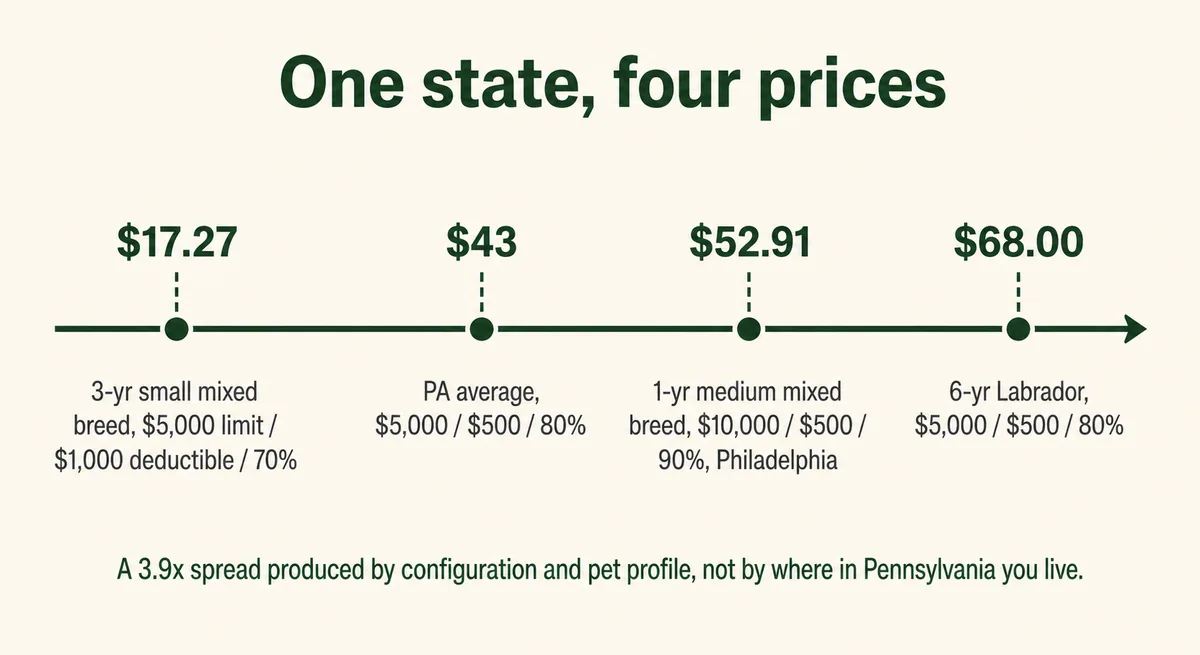
Top to bottom that is a 3.9× spread, and almost none of it is geography. It is age, breed, annual limit, deductible and reimbursement percentage — plus different publishers, dates and methods. For what location alone does, see the next section. The cheapest row buys a $1,000 deductible and 70% reimbursement on a small three-year-old; the dearest buys a six-year-old Labrador at 80%. Cats follow the same pattern, from $15.96 at Embrace's configuration to $37 at MoneyGeek's.
The national benchmark makes the point sharper. NAPHIA's 2025 industry data puts the average US accident-and-illness premium at $836 a year for a dog — about $70 a month — and $435 for a cat. Every dog figure above sits below it. That is not because Pennsylvania is cheap; it is because the sample specifications are cheaper than the average policy people actually own.
On the industry's own numbers Pennsylvania is a big, ordinary-priced market: 4.5% of all US insured pets and 4.6% of the premium, sixth in the country on both. Work the two shares against each other and the blended premium per insured pet lands near $835 against roughly $817 nationally — about 2% above, which is to say indistinguishable.
So write down all five settings before you look at any monthly figure, and only compare quotes that match on every one.
Does where you live in Pennsylvania change the price?
Less than the map suggests, and the honest answer has two halves that both happen to be true.
The one genuinely matched comparison holds coverage constant — 80% reimbursement, an unlimited annual limit and a $500 deductible — across Philadelphia, Pittsburgh and Harrisburg. At the top of each quoted range, Philadelphia runs 33% to 40% above Harrisburg: a five-year-old golden retriever tops out at $110 against $81, a Chihuahua puppy at $56 against $41, a domestic shorthair kitten at $35 against $25.
At the bottom of those same ranges the gap vanishes. The cheapest quote is identical in four of the eight rows — $17, $13, $15 and $21 in both cities — and in the other four Philadelphia is a dollar cheaper. So the spread lives entirely at the expensive end of the carrier distribution. If you shop, geography barely touches you; if you take the first quote you are offered, it can cost you a third.
Which is really a point about carriers, not cities. Inside a single Philadelphia ZIP code, with the same pet and the same $500 deductible and 90% reimbursement at a $10,000 limit, Lemonade quotes $30.28 and Pets Best $31.00 against a twelve-carrier average of $52.91 — both roughly 40% below it. That single decision moves more money than the whole width of the state.
One caveat: outside those three cities the published evidence thins out fast. The only Lehigh Valley figure anyone publishes is Lemonade's own Allentown band of $35 to $40, from its internal book as of October 2024 and unmatched to any pet profile. A signal, not a quote.
What Pennsylvania vet care actually costs
Pennsylvania is an ordinary-priced state for routine care, and every emergency hospital here that publishes a fee charges above the national benchmark. That split is the whole reason to think about insurance here.
For a check-up, CareCredit's 2025–26 cost study puts the Pennsylvania average at $64 for a dog and $66 for a cat — near the bottom of a national range that runs to about $130. Nothing alarming.
The emergency door is different, and Pennsylvania hospitals publish their entry fees:
| Hospital | Emergency exam fee |
|---|---|
| PETS, Lancaster | $150 |
| Valley Central, Whitehall | $185 |
| Avets, Monroeville | $210 |
The national benchmark for the same visit is $135 for a dog and $143 for a cat. All three clear the dog benchmark — Lancaster by 11%, Whitehall by 37%, Monroeville by 56%. And that is the fee to walk through the door: diagnostics, treatment and medication are all additional.
Penn Vet's Ryan Hospital, the state's academic referral centre, publishes no exam fee — its appointment page says only that one applies. Owners on Reddit report $180 in early 2023 and $250 by December 2024: a direction of travel, not a published price.
Paying before you're reimbursed
Almost every pet insurance policy pays you back after you have paid. Pennsylvania's referral hospitals want money before they start. That gap is the single most under-explained thing about buying a policy here, and it is where owners who did everything right still get stuck.
Here is what four of them publish, in their own words:
| Hospital | What it asks for before treatment |
|---|---|
| Penn Vet Ryan Hospital, Philadelphia | "50% of the estimated cost is required at admission as a deposit" |
| Metropolitan Veterinary Associates, Norristown | "a deposit equal to half of the high end of your estimate" |
| Veterinary Referral Center, Malvern | "75% of the estimate … is due at the time the estimate is given" |
| Valley Central, Whitehall | "a deposit of 100% of the high end of that estimate" |
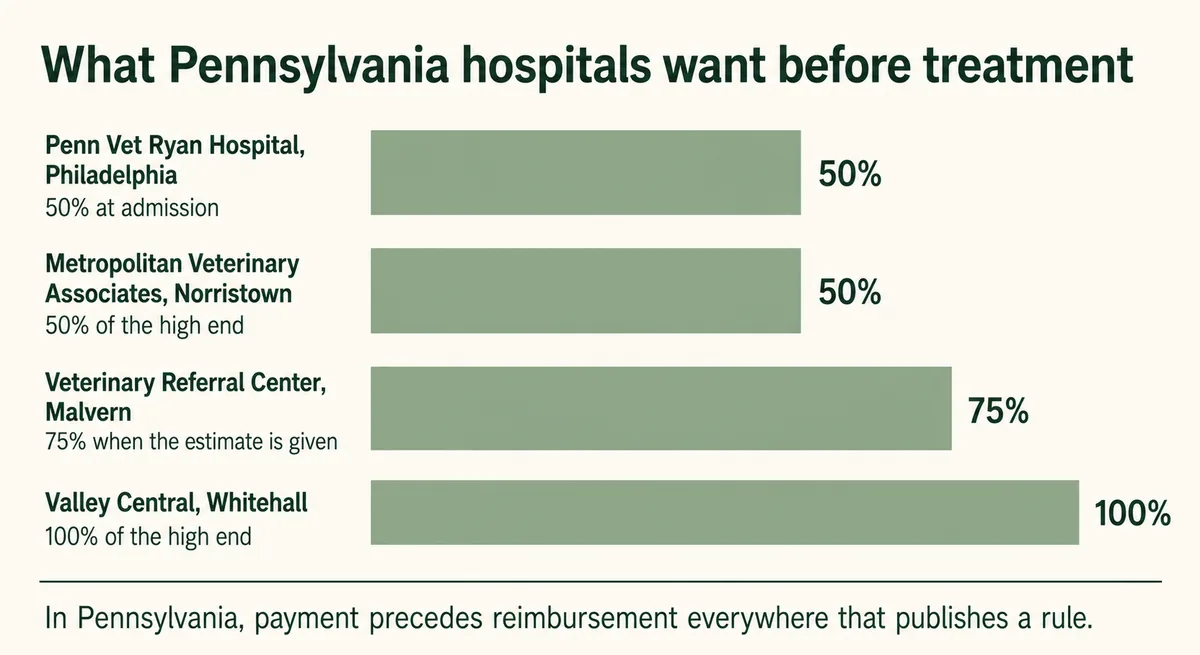
On a $6,000 estimate that is $3,000 at Penn Vet and the whole $6,000 in Whitehall, payable before the work begins. And the payment plans people assume exist mostly do not: Penn Vet says it accepts CareCredit but "do not offer other payment plans", and Shores in Harrisburg is blunter still — payment in full at the time of service, and "we do not offer payment arrangements of any kind."
The line that matters most comes from Avets in Monroeville, which requires "all payments to be rendered at the time of service, even when the pet is insured." Having a policy does not change when you pay. It changes who pays you back afterwards — and how much, once the deductible, the reimbursement percentage and the limits are applied.
The one exception, and its catch
BluePearl, which runs seven Pennsylvania hospitals, states the position plainly: with Trupanion "we work directly with them for payment," and with any other insurer "you'll pay up front for your pet's care." That is the clearest direct-pay commitment published by a Pennsylvania operator.
The catch is in Trupanion's own footnote: direct payment needs its software installed at your hospital, and it tells you to check yours first. So treat direct pay as a bonus two parties have to agree to — not as how it usually works. Plan to front the bill, keep a reserve or a pre-approved line of credit, and find out what your own emergency hospital asks for before the night you need it.
Pennsylvania pet insurance law: what Act 19 changed
Buy a policy in Pennsylvania and no carrier may make you wait out an accident. The policy still has to be in force and its ordinary exclusions still apply — but the waiting period itself is banned. The statute says so in one sentence: "A waiting period under a pet insurance policy for an accident is prohibited." That is state law, not an industry courtesy — and almost nothing written about pet insurance here mentions it.
The law is Act 19 of 2024, which added Chapter 47 to Title 40 of the Pennsylvania statutes. It passed 201–0 in the House and 50–0 in the Senate and was approved on 10 June 2024. Four things in it change what a Pennsylvania resident can be sold.
Accident waits are gone. Not shortened — prohibited outright.
Illness and orthopedic waits are capped at 30 days. A waiting period is permitted only for an "illness or orthopedic condition not resulting from an accident," and it "may not exceed 30 days." The cap gets its reach from the statutory definition of an orthopedic condition, which expressly includes elbow dysplasia, hip dysplasia, intervertebral disc degeneration, patellar luxation and ruptured cranial cruciate ligaments. A six-month cruciate wait, ordinary elsewhere, has nowhere to sit in a policy written under this chapter.
You get 30 days to change your mind. The free look lets you return the policy, get the premium back, and have it treated as "void as if it had never been issued." The national model act it was drawn from asks 15 days; Pennsylvania doubled it. One catch — the free look disappears the moment you file a claim.
The insurer has to prove a pre-existing condition, not you. The burden of proving that exclusion applies sits with the carrier.
All of it is supposed to arrive in a document with a fixed name — "Insurer Disclosure of Important Policy Provisions", in at least 12-point type, linked from the insurer's main page. Twelve items must appear in it, including "the name of the underwriting company if it differs from the brand name." It is the most useful page a Pennsylvania buyer can open.
One caveat on timing: the act says only that it takes effect "in 180 days," and no Pennsylvania government source states the resulting date. Day 180 is Saturday 7 December 2024, and because state law omits a Saturday that lands on the last day, the better reading is Monday 9 December 2024. MetLife's own Pennsylvania disclosure uses a third date, "December 6, 2024." Read it as early December 2024 and check your own policy.
There is a plain reason nobody told you this. The Pennsylvania Insurance Department's own consumer page on pet insurance contains the words "Act 19," "Chapter 47," "free look" and "waiting period" nowhere at all, and its complaint comparison tool has no pet insurance line to search. The rights exist; the state is not advertising them.
Some published forms have not caught up
Two Pennsylvania documents on carriers' own websites still describe terms the statute does not permit. Nationwide's Pennsylvania modular form, edition 9-24, applies "a 14-day waiting period" to all coverages with no accident carve-out. The booklet served under Pets Best's Pennsylvania link is word-for-word identical to its Ohio booklet, listing a three-day injury wait and a six-month cruciate wait.
These are discrepancies in what is published, not proof of what any individual policy does — an endorsement issued with the contract may correct them, and no enforcement action against either carrier exists. It is still a good reason to read the disclosure document for the policy you are offered, and to ask in writing what your accident waiting period is.
Best pet insurance in Pennsylvania by situation
The accident waiting period is the one thing you do not have to shop for: Act 19 bans it outright and caps illness and orthopedic waits at 30 days. Illness waits still differ inside that cap, so compare them — but Act 19's floor is what makes the other axes decisive: the annual limit, the price at your ZIP, whether exam fees are included, and who pays the hospital first.
A new puppy or kitten
Usually the cheapest moment, and the likeliest to have nothing pre-existing on record — though signs a vet already noted still count. Buy for the limit rather than the monthly price: the surgery is probably years away, and a low cap chosen now is what will bind. Cats follow the same logic for less: at ZIP 19124, on $10,000/$500/90%, a one-year-old cat averaged $31.56 a month against $52.91 for a dog.
An older or recently adopted pet whose history you don't have
The honest hard case. Your binding constraint is the pre-existing exclusion, not the waiting period — and here Pennsylvania quietly helps, because the insurer carries the burden of proving that exclusion applies. Get the exam done, collect what records exist, and price the reality: the same policy on a six-year-old dog averaged $82.70.
Buying on price
Carrier choice beats geography, and it is not close. Same pet, same ZIP, same $10,000/$500/90%: Lemonade quoted $30.28 and Pets Best $31.00 against a twelve-carrier average of $52.91. Get three quotes at one written-down configuration. One caution — Lemonade's Pennsylvania terms could not be confirmed from any Lemonade document, so price it freely but read its disclosure first.
Buying against the worst case
If catastrophe is the point, the annual limit is the product. Trupanion sells no annual or lifetime cap in Pennsylvania, and Pets Best offers a "No Annual Limit" tier. For scale: two Philadelphia dogs sit in NAPHIA's ten largest North American dog claims of 2025, at $66.6K and $56.7K — selected extremes, nothing like a typical year, but they clear every capped tier sold here. The trade-off: Trupanion deliberately excludes exam fees and wellness care, which you pay at every visit.
Provider comparison
Because Act 19 bans accident waits and caps the rest at 30 days, a Pennsylvania comparison has to weigh more than headline waiting periods. Every row below comes from that carrier's own Pennsylvania document.
| Carrier (Pennsylvania document) | Waiting periods, as published | How the claim is calculated | Rates on claim history? | Underwriter in Pennsylvania |
|---|---|---|---|---|
| Fetch | None for accidents; 15-day illness, 30-day orthopedic | Co-pay, then deductible, then limit | Yes — premium and coverage | AXIS Insurance Company |
| MetLife | None for injuries; 14-day illness | Deductible first | No on claims; yes on age, address, coverage | Metropolitan General Insurance Company |
| Healthy Paws | None for accidents; 15-day illness, 30-day hip dysplasia | Coinsurance first | Not stated | A Chubb company; the PA entity is not named |
| Spot | 14-day illness, orthopedic included | Deductible first | No | Independence American |
| Pumpkin | 14-day illness, orthopedic included | Deductible first | Yes | Independence American |
| Pets Best | Published as 3-day injury, 14-day illness, 6-month cruciate | Coinsurance first | Not stated | Independence American |
| Trupanion | None stated | Coinsurance first, then a per-condition deductible | Not stated | American Pet Insurance Company |
| Nationwide | Published as 14 days, all coverages | Per-item allowances, not a flat percentage | Yes — 18-month look-back | National Casualty Company |
Two of those rows — Pets Best and Nationwide — carry published wording that does not line up with Act 19, as covered above. Editions vary too: Nationwide's form is dated 9-24, Trupanion's disclosure 2023, and an endorsement issued with your contract can override any of it. Read the table as what each carrier publishes, then check the document you are issued.
The column nobody else prints
"How the claim is calculated" sounds like bookkeeping and is worth money. Take a $1,200 bill at 90% reimbursement with a $250 deductible. Deductible first: subtract $250, then pay 90% of $950 — $855. Coinsurance first: pay 90% of $1,200, then subtract $250 — $830. Same headline numbers, $25 apart — and the gap widens with the deductible. Pennsylvania forms must spell this out; almost nobody reads it.
Who actually underwrites your policy
Four of the brands sold here name the same risk-bearer outright: Spot, Pumpkin, Figo and Pets Best are underwritten by Independence American. AKC and ASPCA name it as one of two possible underwriters, so only your declarations page settles it. Same paper, still not the same policy: Spot's Pennsylvania document says it "will not reduce coverage or increase premium due to claims history," while Pumpkin's says premiums "may increase or decrease due to claims history." Identical paper, opposite answers. That is the whole reason the disclosure document exists.
One more thing worth checking on Pets Best. Its Pennsylvania endorsement offers a 15-day window to cancel where the statute gives 30, its Pennsylvania booklets carry no edition date at all, and a 2015 booklet from a different underwriter is still downloadable beside the current one. Check which document you were actually issued.
What your premium will look like in five years
Higher. The useful question is what is fixed and what is not.
Three things Pennsylvania guarantees at renewal: no new waiting period may be imposed, a condition already covered cannot be reclassified as pre-existing, and no carrier may require a fresh veterinary exam. Renewal here is not re-underwriting.
The price is what moves. Act 19 sets no rate cap, and although the Insurance Department approves pet insurance rates, approval is not a ceiling. For scale, the one audited figure available: Trupanion's monthly revenue per pet ran $65.26 in 2023, $72.98 in 2024 and $80.79 in 2025, with Q2 2026 running 9.4% above Q2 2025. That is one carrier's own SEC-filed revenue per pet: not a Pennsylvania rate, and not the same as the renewal increase on a fixed policy, since the mix of pets and products shifts underneath it. Still, a book compounding at 9% to 12% a year sits well above veterinary-services inflation of 4.7%.
Which is why today's choice counts. Switching at year five starts a new pre-existing baseline, so anything diagnosed between now and then can follow you as an exclusion, subject to whatever curable-condition rule the new carrier offers. Buy the limit and terms you would still want then — the table above shows which forms rate on your claim history.
Pre-existing conditions and waiting periods here
Pennsylvania's pre-existing definition reaches into the waiting period, not just up to your start date. It catches advice a vet gave, treatment received, or — the one nobody expects — signs or symptoms "directly related to the condition for which a claim is being made." Something noted in week two of a 30-day wait can land on the wrong side of the line.
Act 19 does not standardise how long a cured condition follows you. Fetch's Pennsylvania terms run 365 days, then a second 365 if it recurs — and a recurrence inside that second window excludes the condition for life. ASPCA works on 180 days cured and symptom-free, and its Pennsylvania sample policy permanently carves out chronic conditions, congenital anomalies or disorders, hereditary disorders, ligament and knee conditions, and orthopedic conditions.
Then the trap. Every Pennsylvania policy must offer an exam-based waiver — but MetLife's own disclosure warns that whatever the waiver exam finds "will be considered a Pre-Existing Condition for which there is no coverage." The exam that shortens your wait can create an exclusion in the same visit.
That is an argument for timing the paperwork, never the care. A condition your vet has already seen does not become insurable by going unrecorded; the burden of proof is the insurer's. More in our pre-existing conditions guide.
Pennsylvania health risks that actually drive claims
Pennsylvania is a tick state, and the exposure runs opposite to the price map. In 2025, 9.2% of dogs tested here came back positive for Lyme exposure and 14.1% for anaplasmosis — roughly 2.2 and 2.3 times the national rates. Heartworm and ehrlichiosis both run below national norms, so the Gulf-Coast framing you will read elsewhere has this state backwards.
Inside Pennsylvania the gradient inverts the premium map. Rural Armstrong County ran 25.7% for Lyme exposure and Clarion 54.8% for anaplasmosis, against Philadelphia's 4.1% and 6.8%. Philadelphia sits at the top of the matched premium comparison earlier on this page and at the bottom of this exposure range; the rural counties run the other way. Nobody publishes matched quotes for Armstrong or Clarion, so read that as a contrast in exposure, not a discount.
Read these as exposure, not illness: they are antibody results from dogs a vet had reason to test, not a survey of all Pennsylvania dogs. And no Pennsylvania policy read for this article addresses tick-borne disease — worth asking your carrier in writing.
Free and low-cost help in Pennsylvania
Three routes, each checked against the provider's own page:
- PSPCA, 350 E. Erie Ave., Philadelphia — walk-in, first come first served: physical exam $45, technician appointment $20, follow-up $28, with treatments and testing extra.
- PAWS Philadelphia — $40 clinic visit plus any tests or medication; vaccine appointments from a $15 visit fee; spay/neuter $80 for cats, $175–$275 for dogs by weight.
- PSPCA Danville, central Pennsylvania — spay/neuter packages at $125 for cats and $200–$250 for dogs, vaccines and microchip included.
Both Philadelphia clinics say plainly that they do not handle emergencies — the limit worth knowing: low-cost clinics answer planned care, not the night your dog is admitted. We found nothing comparable published for Pittsburgh.
Frequently Asked Questions
How much is pet insurance in PA?
At a $10,000 annual limit, $500 deductible and 90% reimbursement in Philadelphia's ZIP 19124, the twelve-carrier average is $52.91 a month for a one-year-old dog and $31.56 for a cat. Published Pennsylvania estimates run from $17.27 to $68.00 depending on age, breed and configuration, so compare like for like. Nationally, accident-and-illness policies average $836 a year for dogs and $435 for cats.
Which company offers the best pet insurance in Pennsylvania?
There isn't one, and Act 19 is much of the reason. The statute bans accident waiting periods and caps illness and orthopedic waits at 30 days, so the differentiator most pages lead with is bounded here — though illness waits still vary inside the cap. What's left: the annual limit, whether the form rates on your claim history, exam-fee coverage, and the order the claim math runs in. A page naming one winner for every owner is describing its own commercial arrangements.
What is the cheapest but best pet insurance?
Cheapest and best are closer together than people expect — once the configuration is fixed. At ZIP 19124 on $10,000/$500/90%, Lemonade quoted $30.28 and Pets Best $31.00 against a twelve-carrier average of $52.91 — roughly 40% below it, for the same pet. Price three carriers at one written-down configuration, then read each disclosure before deciding on price alone.
Is pet insurance really worth the money?
Sometimes genuinely not. At a $500 deductible and 80% reimbursement, a $3,000 emergency still costs you around $1,000 — and seven years of premiums can approach the bill itself. If your pet is healthy and you could absorb $3,000 to $5,000 without borrowing, self-insuring is a defensible choice. Insurance earns its cost when that bill would otherwise go on a credit card, or when it would change the answer to "can we treat this?"
Does Pennsylvania have a pet insurance law?
Yes. Act 19 of 2024 has applied since early December 2024. It prohibits accident waiting periods, caps illness and non-accident orthopedic waits at 30 days, gives you 30 days to return a policy for a full refund if you have not filed a claim, and puts the burden of proving a pre-existing exclusion on the insurer. The Insurance Department's own consumer page mentions none of it.
What is the waiting period for pet insurance in Pennsylvania?
None at all for accidents — the statute prohibits them. For an illness or an orthopedic condition not caused by an accident, no more than 30 days, and every policy must offer to waive even that after a veterinary exam. One caution: whatever the exam finds can itself become an excluded pre-existing condition, so read the disclosure first.
Can I still get coverage after my pet has been diagnosed?
You can usually still buy a policy; it is the diagnosed condition that gets excluded, at least at first. Pennsylvania's definition reaches into the waiting period as well as before it, so no paperwork timing helps — and delaying care never protects insurability. Some carriers will cover a condition again once it has been cured and symptom-free for a set window — 180 days at ASPCA, whose Pennsylvania form permanently bars chronic, congenital, hereditary, orthopedic, and ligament and knee conditions from that window; a year at Fetch.
Do I still have to pay the vet up front in Pennsylvania?
Almost always. Penn Vet asks 50% of the estimate as a deposit at admission, and others here ask between half and the full high end before treatment. A policy reimburses you afterwards; it does not change when you pay. Direct payment to the hospital exists but is limited, and needs both carrier and hospital set up for it.
Sources
- Best Pet Insurance in Pennsylvania for 2026 — U.S. News & World Report
- How Much Does Pet Insurance Cost? — Embrace Pet Insurance
- Pennsylvania Pet Insurance Cost — MoneyGeek
- Act 19 of 2024 (HB 660) — 40 Pa.C.S. Ch. 47, Pet Insurance — Pennsylvania General Assembly
- Appointments and payment information — Penn Vet Ryan Veterinary Hospital
- Best Pet Insurance in Pennsylvania 2026 — Pawlicy Advisor
- The Best Pet Insurance in Pennsylvania 2026 — WSJ Buy Side
- Pet Insurance in Pennsylvania — Lemonade
- State of the Industry 2026 — Highlights (2025 data year) — NAPHIA
- Veterinary Care Costs — 2025-2026 Synchrony Average Procedural Cost Study — CareCredit (Synchrony)
- Pet Emergency Hospital — fees and payment — Pet Emergency Treatment and Specialties (PETS), Lancaster
- Frequently Asked Questions — Valley Central Veterinary Referral & Emergency Center, Whitehall
- Pet Owners — fees, deposits and payment — Avets, Monroeville
- Frequently Asked Questions — deposits and payment — Metropolitan Veterinary Associates, Norristown
- Payment Policy — Veterinary Referral Center, Malvern
- About Our Clinic — payment policy — Shores Veterinary Emergency Center, Harrisburg
- Pet Owner FAQs — payment and pet insurance — BluePearl Pet Hospital
- Pet Insurance in Pennsylvania — Trupanion
- 40 Pa.C.S. § 4706 — Policy conditions — Pennsylvania General Assembly
- 40 Pa.C.S. § 4702 — Definitions — Pennsylvania General Assembly
- 40 Pa.C.S. § 4704 — Right to examine and return pet insurance policy — Pennsylvania General Assembly
- 40 Pa.C.S. § 4705 — Policy disclosures — Pennsylvania General Assembly
- House Bill 660, Regular Session 2023-2024 — Pennsylvania General Assembly
- Pet Insurance Model Act (#633) — National Association of Insurance Commissioners
- For Residents of Pennsylvania — Policy Disclosure — MetLife Pet Insurance
- Pet Insurance — consumer guidance — Pennsylvania Insurance Department
- Consumer Complaint Comparison Tool — Pennsylvania Insurance Department
- Modular Pet Insurance Coverage Form VS-G-15-PA (9-24), sample — Nationwide / National Casualty Company
- Pennsylvania policy booklet IAIC-PB10001-ILL, sample — Pets Best / Independence American Insurance Company
- What a Trupanion policy covers — Trupanion
- Pennsylvania Residents Notice — Fetch Pet Insurance / AXIS Insurance Company
- Pennsylvania Insurer Disclosure of Important Policy Provisions — Healthy Paws / Chubb
- Pennsylvania Policy Provisions — Spot Pet Insurance / Independence American Insurance Company
- Notice to Pennsylvania Residents (PET-PA-Notice-1125-PUMPKIN) — Pumpkin / Independence American Insurance Company
- Insurer Disclosure of Important Policy Provisions — Pennsylvania, TRU (D) 00012 PA — Trupanion / American Pet Insurance Company
- IDIP-MPI-PA (9-24) — My Pet Protection Pennsylvania disclosure, sample — Nationwide / National Casualty Company
- Pennsylvania accident-only booklet IAIC-PB10001-ACC + PA amendatory endorsement, sample — Pets Best / Independence American Insurance Company
- Legacy Pennsylvania booklet APIC-PBI0001-ILL (12/2015), sample — Pets Best / American Pet Insurance Company
- Pet Insurance — consumer one-pager — Pennsylvania Insurance Department
- Form 10-K for fiscal year ended December 31, 2025 — Trupanion, Inc. (SEC EDGAR)
- Q2 2026 Earnings Results — Trupanion, Inc.
- CPI series CUUR0000SS62054 — Veterinarian services, US city average — U.S. Bureau of Labor Statistics
- Parasite Prevalence Maps — canine Lyme disease and anaplasmosis, 2025, Pennsylvania — Companion Animal Parasite Council (CAPC)
- Veterinary Clinic — fees, hours and services — Pennsylvania SPCA
- Clinic Services — spay/neuter, clinic and vaccine pricing — PAWS Philadelphia
- PSPCA Danville Spay & Neuter Clinic — package pricing — Pennsylvania SPCA
- State Documents and Sample Policies — pre-existing condition and underwriter disclosures — ASPCA Pet Health Insurance / PTZ Insurance Agency
- Complete Coverage sample policy PET-P-20000-PA-0425 (Pennsylvania accident and illness) — ASPCA Pet Health Insurance / Independence American Insurance Company
- Figo Pet Insurance — underwriting disclosure — Figo Pet Insurance / Independence American Insurance Company
- AKC Pet Insurance — underwriting disclosure — AKC Pet Insurance / PetPartners
- 1 Pa.C.S. § 1908 — Computation of time — Pennsylvania General Assembly