

If you have narrowed your shortlist to Embrace and Fetch, the honest answer is that neither one wins outright — and the reason is more useful than a verdict. The two contracts pay the same vet bill differently, include different things as standard, and gate orthopedic conditions in ways that reverse depending on what your dog is actually diagnosed with.
One quick disambiguation first: this is Fetch Pet Insurance, the pet insurer. It is not the Fetch rewards app that scans receipts. Search results for this comparison genuinely mix the two, so if you arrived expecting points and gift cards, that was the other one.
We read both companies' current policy contracts, the filed state forms behind them, and the regulatory records naming who actually carries the risk. That matters, because almost nothing else comparing these two brands does it. When we captured the ten pages ranking for this comparison in September 2026, not one named the insurer on both sides, cited a policy form number, or explained why an identical $1,000 bill reimburses $400 at Embrace and $300 at Fetch.
So this page does three things. It shows you the mechanics that actually separate the two carriers, it tells you which one fits your situation — a new puppy, an older cat, a switcher with a condition already on the chart — and it names the single fact that would flip each of those calls. Where we could not establish something, we say so rather than filling the gap with a guess.
Table of Contents
- The short answer — and why it depends
- Which is right for your pet
- Who actually underwrites each brand
- The payout order: why the same bill pays differently
- What's included vs what costs extra
- Waiting periods and the 180-day orthopedic gate
- Does your state change the answer?
- Claims day: who pays the vet first
- Renewal and what each carrier can change
- What switching actually costs
- Matched quotes, with every parameter disclosed
- What we could not establish
- Frequently Asked Questions
- Sources
The short answer — and why it depends
Embrace and Fetch differ in three ways that change what you get paid: Embrace subtracts your deductible first, then applies the reimbursement percentage, while Fetch applies its co-pay first; Fetch includes exam fees and prescriptions as standard where Embrace's main contract sells them separately; and their 180-day orthopedic rules catch different conditions.
None of those three makes one carrier better than the other. What they do is make the better carrier depend on your pet — on what a claim is likely to cost, on which state issued the policy, and on whether anything is already written in the medical chart.
Change any one of those and the answer can move, which is why a flat winner would mislead you here. The rest of this page works through each mechanic with the contract wording behind it, then splits the recommendation by situation at the end.
Which is right for your pet
Here is where we land for each of the five situations owners usually arrive in. Every row also names the fact that would change our answer, and on this matchup most of them realistically can.
| Your situation | Where we lean | What would flip it |
|---|---|---|
| New pet, clean record | Fetch, on scope. Sick-visit exam fees and take-home prescriptions are standard in the Fetch contract; in most states Embrace sells both separately. | If you would buy those two options at Embrace anyway, Embrace's deductible-first arithmetic returns more while you are still meeting the annual deductible. |
| Older dog | Fetch, if enrollment itself is the question — it covers pets of every age from 6 weeks, while Embrace's dog pages cap accident-and-illness enrollment at 14 and route dogs 15 and over to accident-only. | Being able to buy a policy is not the same as having a condition covered. If your dog already has a chart, neither carrier is a fix. |
| Already insured, facing a renewal increase | Look at downgrading before you shop. Under both contracts, reducing coverage triggers no new waiting period, while increasing it does — though less coverage is still less protection. | At Fetch, once you have filed a claim your coverage cannot be increased again at all, so a downgrade there is one-way. |
| Switching with a condition already on the chart | Neither, yet. Renewal protection follows the policy, not you: a condition your current carrier pays for becomes pre-existing on day one at the other one. | Nothing in the price changes this. Get the exclusions in writing first — see what switching actually costs. |
| Multi-pet household | Embrace, narrowly, for the published 10% multi-pet discount. | The discount cuts premiums, not deductibles: each pet still meets its own, and a pet added mid-term pays a full one for a partial year. |
That multi-pet caveat is worth spelling out, because the word "household" oversells it. Embrace puts every pet in the household on one policy, but the discount is not a shared deductible — each pet still meets its own. And a pet added part-way through the term pays a full annual deductible against a partial year, because the new pet inherits the existing renewal date rather than getting twelve fresh months.
Embrace's enrollment ages come from its consumer pages rather than the policy contract, and we verified them for dogs only; we could not confirm the equivalent rule for cats.
Who actually underwrites each brand
Neither brand carries the risk itself. Both are agencies that sell and service the policy while a separate insurance company stands behind the claims — and on financial strength, the ranking runs opposite to how most people rate these two brands.
| Embrace | Fetch | |
|---|---|---|
| Consumer brand | Embrace Pet Insurance | Fetch Pet Insurance |
| Agency / administrator | Embrace Pet Insurance Agency, LLC | Fetch Insurance Services, LLC |
| Risk-bearing insurer | American Modern Home Insurance Company (NAIC 23469) in every state except Florida; American Southern Home Insurance Company (NAIC 41998) in Florida only | AXIS Insurance Company (NAIC 37273), an Illinois corporation |
| Ultimate parent | Munich Re | AXIS Capital Holdings |
| AM Best rating | A+ (Superior), affirmed 23 July 2026 | A (Excellent), affirmed 4 September 2026 |
Two caveats keep that comparison honest. Both are group ratings covering everything each insurer writes, not a verdict on its pet book. And no AM Best rating exists for American Southern Home itself, so if you live in Florida you are on different paper from the rest of the country and cannot read Embrace's A+ as your own.
It is worth knowing this simply because almost nobody publishes it. Across the ten pages ranking for this comparison, not one named the insurer on both sides. Older write-ups also still credit Fetch to XL Specialty, the carrier from its Petplan era; the current filed forms name AXIS alone.
The payout order: why the same bill pays differently
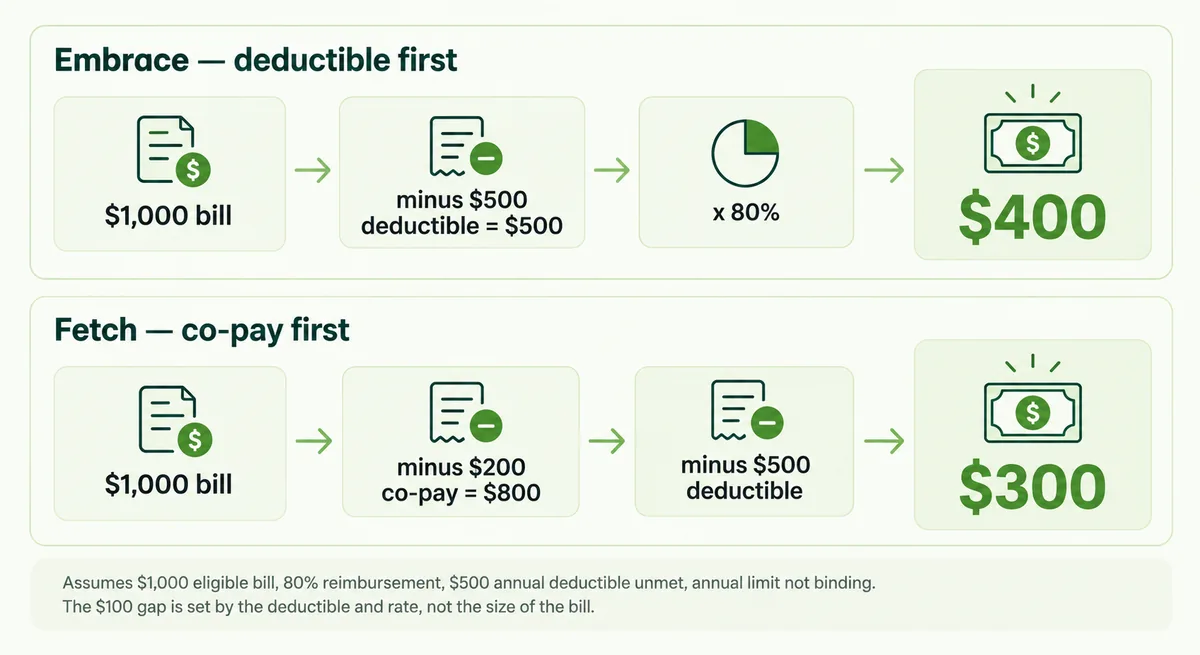
Both carriers use the same two numbers — a deductible and a reimbursement percentage — and apply them in opposite orders. Embrace subtracts the deductible first, then applies your percentage to what is left. Fetch takes its co-pay first, then subtracts the deductible from the remainder.
Run one identical claim through both — a $1,000 eligible bill, 80% reimbursement, a $500 annual deductible not yet met, and an annual limit that is not binding:
| Step | Embrace | Fetch |
|---|---|---|
| Eligible bill | $1,000 | $1,000 |
| First | − $500 deductible → $500 | − $200 co-pay → $800 |
| Then | × 80% | − $500 deductible |
| You get back | $400 | $300 |
That is not our inference. Fetch's own published claim example works the same way: a $4,085 invoice, an $817 co-pay taken first, then a $300 deductible, paying out $2,968.
Two things follow. The gap is set by your deductible and rate rather than the size of the bill: it is the deductible multiplied by your co-pay share, so $100 at $500 and 80%, on a $1,000 bill and a $10,000 one alike. And Fetch's order lifts the point at which any money moves at all: at 80% the bill has to clear $625 before Fetch pays a cent, against $500 at Embrace. It is also a once-a-year difference rather than a per-claim one. Both deductibles are annual, so once yours is satisfied the two formulas converge and the same bill pays the same at either carrier.
The advantage is real, but it is conditional — two ordinary situations cancel it. If your annual limit binds, it vanishes: on a $10,000 emergency with $5,000 of coverage left, both carriers pay $5,000. And if the eligible amounts differ, it reverses. On a $1,000 visit that includes a $200 exam fee, with Embrace's exam-fee option not selected, Embrace reimburses $240 and Fetch $300 — because Fetch counted the exam fee and Embrace did not.
What's included vs what costs extra
Fetch's contract includes two things as standard that Embrace, in most of the country, sells as options: sick-visit exam fees and take-home prescriptions. Under Embrace's V6 contract — the version used in 47 states and DC — each is covered only if it is shown on your Pet's Schedule of Insurance.
That is why the "no add-ons" price comparisons you have seen are not neutral. Quoting both carriers without options strips two benefits from the Embrace side while leaving them on the Fetch side, so the cheaper column is also the thinner one. And because neither company publishes what those options cost, no genuinely like-for-like price comparison can be built from public information at all.
Three states are the exception. In Kansas, New Mexico and South Carolina, Embrace still issues its older V5 contract, which grants examination and medication coverage outright, with no Schedule of Insurance condition attached. If you live in one of those three, the paragraph above does not describe your policy.
Embrace's own pages also disagree with each other here. Its FAQ describes exam fees as an optional add-on, while its prescription-drug page says the cover is "available with every policy" — which reads as included. "Available with" is not "included in", and the contract is what pays claims.
One more trap, and it is the expensive one. Adding either option later counts as increasing your coverage, which under V6 resets the illness waiting period and re-runs the pre-existing determination from the date of the change. They are cheap to decline at enrollment and costly to add afterwards. One owner on r/petinsurancereviews reported finding both switched on at renewal and accounting for most of a large increase — a single unverified account, but a good reason to read your own Schedule of Insurance.
Waiting periods and the 180-day orthopedic gate
Here is the finding that inverts the usual comparison: the orthopedic gate is common ground, not a difference. On their base forms, both contracts bar canine orthopedic conditions for the first 180 days and treat the conditions each one names as pre-existing for the life of the policy. Three states get a different Fetch rule altogether, which the next section covers. On ordinary waits they are near-identical too. Neither imposes an accident waiting period, and illness coverage starts after 14 days at Embrace and 15 at Fetch.
What differs is which conditions each one catches, and that is where the ranking flips.
Embrace: four named conditions, no way out
V6 names exactly four — cruciate ligament disease, intervertebral disc disease, patellar luxation and hip dysplasia. There is no waiver, no exam that shortens the window, no reduction procedure of any kind. The older V5 contract did have one; V6 removed it.
Fetch: a wider net, with one way out
Fetch's filed form reaches orthopedic conditions generally rather than a named list — a broader bar. But it carves out two things Embrace does not: conditions resulting from an accident are exempt, and knees are rescued if a vet examines your dog inside the 180 days and the record notes no existing knee problems.
So which contract is harsher depends on the diagnosis. For a cruciate tear, Fetch is the softer one, because that knee carve-out exists and Embrace has no equivalent. For an orthopedic problem outside Embrace's four — elbow dysplasia is the common example — Embrace is softer, because its list does not reach it and Fetch's general wording does. Neither "Fetch is stricter" nor "Embrace is stricter" survives reading both forms.
One clarification, because it is easy to conflate: V6 does let an examination after your start date bring illness coverage forward during the 14-day wait. That opt-out has no effect on the 180-day orthopedic exclusion, which sits in a separate part of the contract entirely.
This wording moves real decisions. One owner on r/petinsurancereviews cancelled within a month of enrolling purely because of how the cruciate clause read — and neither brand's own comparison page mentions orthopedic conditions anywhere.
Does your state change the answer?
Yes — on both sides, and more than most comparisons admit. Embrace issues two different contracts depending on where you live, and Fetch files a separate policy form for each state.
For Embrace the split is small but sharp. V6 applies in 47 states and DC, while Kansas, New Mexico and South Carolina still receive the older V5. Florida is its own case again: it is the one state where Embrace's policies sit with a different insurance company.
Fetch's orthopedic rule splits three ways across the 42 current editions we read:
- 34 jurisdictions — the 180-day exclusion only.
- Maine, Montana, New Hampshire, Vermont and Washington — a 30-day orthopedic waiting period and the 180-day exclusion, simultaneously.
- Florida, Pennsylvania and Rhode Island — a 30-day wait replacing the exclusion.
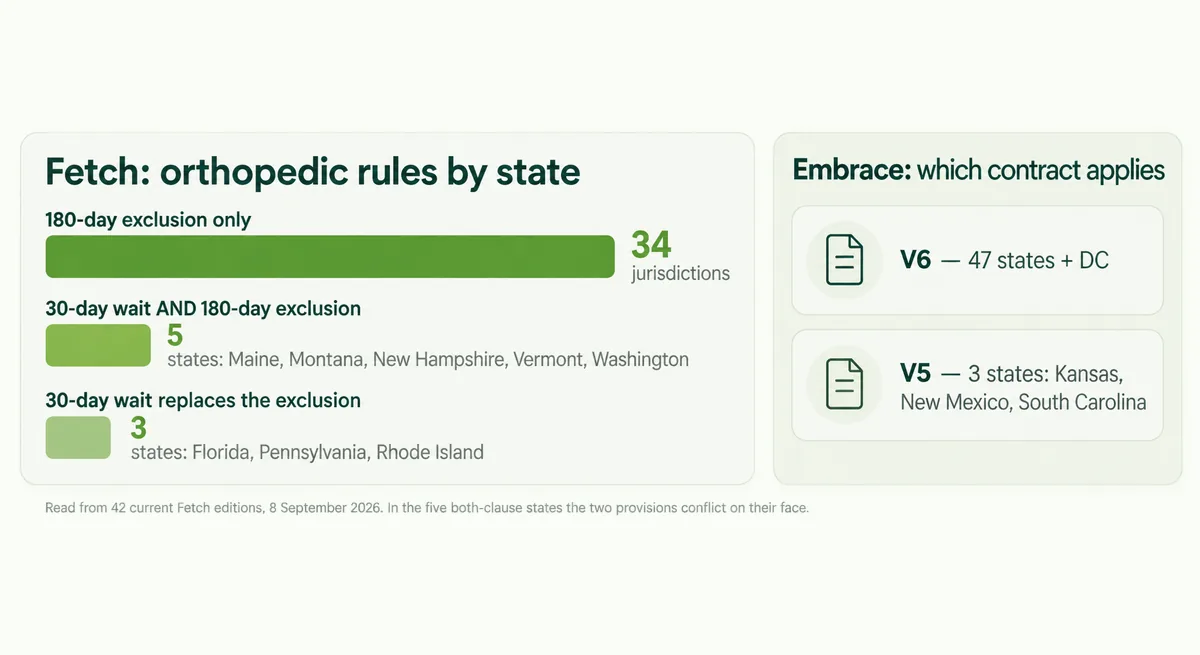
In those five both-clause states the two provisions contradict each other on the page, and the form does not say which governs. We flag that as an open question, not an answer.
California deserves a specific question to your agent. SB 1217 caps illness and orthopedic waiting periods at 30 days, yet Fetch's California form, filed after that law took effect, still carries the 180-day orthopedic exclusion. We could not establish how that cap applies to a provision the contract labels an exclusion rather than a waiting period. Ask your carrier to put its position in writing rather than assuming an answer either way.
Two states have new pet-insurance laws worth knowing about — Florida's took effect on 1 January 2026, and New Jersey's arrives on 1 January 2027. Similar bills in New York and Washington did not become law.
Claims day: who pays the vet first
You do, in almost every case. Embrace has one narrow route to getting the hospital paid directly; Fetch reimburses you after the fact and does not offer an equivalent.
| Embrace | Fetch | |
|---|---|---|
| Before treatment | Optional pre-certification, suggested above $1,000, never required; usually five business days or less | Written pre-authorization form, by request or through your online account; never by telephone |
| Payment to the vet | Possible through pre-certification, and only if the hospital has agreed to it beforehand | Reimbursement to you |
| Proof required | Invoice plus records | Receipt or invoice showing a zero balance |
| Claim deadline | Policy term plus 60 days | 90 days from treatment |
| Duty after loss | — | Vet visit within 48 hours of first noticing clinical signs |
Two of those deserve a flag. Fetch's 48-hour rule is a contractual duty most owners will never read, and the clock starts when you notice signs, not at diagnosis. And Fetch's pre-authorization is written-only: the form says it cannot pre-authorize or guarantee a claim by telephone, so a phone call to check coverage will not bind anyone. Ask for the form.
With Embrace, check which page you are reading. Its claims page allows 14 days from the decision to appeal and says the letter must come from your veterinarian. Its help article allows 60 days from your renewal and says nothing specific is required. Both are live, the claims page also disagrees with itself on processing time, and the policy contract settles none of it — so confirm any Embrace claims deadline with your own adjuster rather than trusting a web page.
One step is worth taking early. Embrace's medical history review is "completely optional", so you have to ask for it, and it needs detailed records covering the 12 months before your policy began — or since your pet came home, for a puppy, kitten or recent adoption. Requesting it tells you what is excluded before a claim does.
Renewal and what each carrier can change
Renewal is where owners get caught out, and age is the driver they most often describe. Premiums get repriced as your pet gets older, and that lands hardest at exactly the point most people bought the policy for.
Two owner reports give the shape of it, each a single unverified account: an Embrace policy on a 16-year-old dog going from $140 to $226 a month, and a Fetch policy going from $189 to $364 after a cancer diagnosis. Read those as illustrations of the mechanism, not as typical outcomes — the forum they come from selects heavily for bad news.
On claims history the two are not equally clear. Fetch answers it plainly on its own claims page: filing claims can raise your premium at renewal, although it says it will not cancel a policy over claims history. Embrace's position cannot be pinned down — two documents it currently links contradict each other on the point, and both are more than two years old. We could not resolve it.
What both contracts reserve is broader than most buyers expect: each can change the premium, annual limit, co-pay, deductible and terms at renewal. Fetch goes further — once you have filed a claim your coverage cannot be increased again at all, and after 50 paid claims it reserves the right to offer you lower coverage.
The protection you do have is narrower than it sounds. A condition your policy has been covering cannot be reclassified as pre-existing when you renew, and that is the whole of the promise: it does not fix your price, your limit or your benefits. Note the asymmetry too: reducing coverage triggers no new waiting period, while increasing it resets one. That makes a downgrade safe on waiting periods — but it is still less protection, and at Fetch it can be one-way, because coverage cannot be increased again once you have filed a claim.
What switching actually costs
The protection you have built up does not travel with you. Both contracts promise a condition they have been covering will not be reclassified as pre-existing at renewal — but that promise belongs to the policy, not to you. Cancel Embrace for Fetch and any condition your dog has already shown signs of, or been treated for, is pre-existing at Fetch from day one; the same applies in reverse. A clean vaccination history is not the problem — a charted condition is, and each carrier's curable-condition rules are a slow route back, not a transfer of the protection you had. For a clean-record pet that costs nothing; for a pet with a chart it can cost more than the premium you were trying to save.
Both carriers also require an enrollment exam, which sets up the same catch-22: the exam that validates your coverage is the exam that documents what gets excluded. The penalties differ. At Fetch, anything recorded at that first exam is excluded permanently. At Embrace, missing the exam downgrades you to accident-only — recoverable, but only going forward: the illness waiting period moves to the later exam date, and pre-existing conditions can be assessed from then too.
None of that is a reason to put off care your pet needs. Records do affect coverage; get the treatment, then plan around what the chart says.
The useful move before switching is to find out what is already excluded, in writing. Embrace's medical history review does exactly that, on request. Owners sometimes suggest enrolling with a third carrier just for its record review and canceling inside the refund window — asking your existing carrier answers the same question without it. Our guide to switching pet insurance covers the wider decision.
One cost nobody models: a Fetch policyholder who moved states reported their policy being reissued and the deductible reset, leaving them to meet three separate $500 deductibles in 85 days mid-treatment. One unverified account — but worth asking what a move does to your policy.
Matched quotes, with every parameter disclosed
Only one published comparison we found runs genuinely matched quotes — the same ZIP, breed, age, sex, annual limit, reimbursement percentage and deductible on both sides. Here it is, at a $5,000 annual limit and a $500 deductible with no optional coverages selected, as published by Canine Journal and checked on 8 September 2026:
| Pet | Embrace 90% | Fetch 90% | Embrace 70% | Fetch 70% |
|---|---|---|---|---|
| 6-month male French Bulldog, San Diego CA (92121) | $84.33 | $71.46 | $67.47 | $52.77 |
| 2-year female Labrador, Buffalo NY (14211) | $46.95 | $52.42 | $37.56 | $39.14 |
| 4-year male Golden Retriever, Tampa FL (33604) | $50.54 | $80.95 | $40.43 | $59.13 |
There is no directional winner. Fetch is clearly cheaper on the French Bulldog, Embrace on the Labrador, and Embrace by a wide margin on the Golden Retriever. Which carrier quotes lower depends on the pet in front of you.
Three caveats matter more than the numbers themselves. "No add-ons" is not a neutral basis — it strips exam-fee and prescription coverage out of the Embrace column while leaving both standing in the Fetch column, so the two sides are not buying the same policy. The publisher is a Fetch partner, a relationship Fetch discloses in its own page footnotes. And a fourth row in that same table, for a cat, quotes the two carriers at a $400 deductible against the dogs' $500, so we have left it out rather than present it as matched. One gap we cannot close: the source states no billing period and no date for when the quotes were pulled, so read 8 September 2026 as the day we checked the page, not the day these prices were generated.
Read these as evidence that the ranking flips by pet, not as your quote. Run both yourself with the limit, deductible, reimbursement percentage and add-on scope held identical.
What we could not establish
Five questions we could not answer from public sources. Each is worth putting to an agent before you buy.
- What Embrace's exam-fee and prescription options cost. Neither price is published anywhere, which is precisely why no truly like-for-like comparison of the two carriers exists.
- Whether California's 30-day cap reaches Fetch's 180-day exclusion. The statute reads both ways, and no regulator has ruled.
- Embrace's real appeal deadline. Two of its own live pages give different answers and the policy contract settles neither.
- Whether buying Embrace through USAA changes the contract. USAA publishes up to 15% off, rising to a maximum of 25% for military members and multi-pet households — but those are USAA's figures, and its page says nothing about whether the policy terms differ from buying direct.
- Enrollment and transaction fees at either carrier. Reported by third parties, published by neither company.
We would rather leave these open than fill them with a plausible guess.
Frequently Asked Questions
Is Embrace considered a good pet insurance?
On the measures we could verify, yes — with one caveat about how it is sold. Its underwriter, American Modern Home Insurance Company, holds an AM Best rating of A+ (Superior), affirmed in July 2026, and its deductible-first payout order returns more on a typical claim than Fetch's order does. The caveat is that in 47 states exam fees and prescriptions are optional extras, so a base Embrace quote buys less than it appears to.
Is Fetch considered a good pet insurance?
Also yes, and it is the more complete policy out of the box. Sick-visit exam fees and take-home prescriptions are standard rather than optional, and it publishes a filed policy form number for every state, which makes its terms checkable in a way Embrace's sample pages are not. Its underwriter, AXIS Insurance Company, is rated A (Excellent). The trade-offs are reimbursement-only claims and a tighter 90-day claim deadline.
Is Embrace better than Lemonade?
That is a different comparison with different trade-offs, and it deserves its own answer rather than a line here. Lemonade generally competes on price and app-based claim speed, while Embrace competes on payout mechanics and configurability. If Lemonade is genuinely on your shortlist alongside these two, start from our comparison hub rather than extrapolating from this page.
Do Embrace or Fetch cover pre-existing conditions?
No — neither covers a condition your pet already has, and their definitions are close to identical. The difference is in what can be un-excluded later. Embrace treats a temporary condition as no longer pre-existing after 12 months clear of signs and treatment. Fetch runs a 365-day clock that reaches back a year before your policy started, requires a dated vet exam to restore coverage, and excludes the condition for life if it recurs during a second such period. See how pre-existing conditions work.
How do I know which Embrace contract applies in my state?
Embrace issues two: V6 covers 47 states and Washington DC, while Kansas, New Mexico and South Carolina still receive the older V5. It matters, because V5 grants exam-fee and medication coverage outright where V6 makes both optional, and the two handle orthopedic conditions differently. Embrace's terms index shows which applies where; your own policy documents in MyEmbrace are the authority.
Does Embrace cover dental illness, and does Fetch?
Both cover dental disease, but Embrace caps part of it. Its V6 contract applies a $1,000 annual sub-limit to dental illness specifically; endodontic work for dental injuries sits outside that cap but is limited to certain adult teeth. Fetch applies no dental sub-limit at all. Routine cleaning is excluded by both.
Do Embrace and Fetch cover exam fees?
Fetch includes sick-visit exam fees as standard. Embrace covers them only if the option appears on your Schedule of Insurance — which is the single most common reason an Embrace quote looks cheaper than a Fetch one. In Kansas, New Mexico and South Carolina, Embrace's older contract includes them without that condition. Neither company publishes what the Embrace option costs, so you will only see it in a live quote.
Is wellness or routine care included with either?
Neither includes it, and the two add-ons are not the same kind of product. Embrace's Wellness Rewards is a non-insurance membership — it is not a regulated insurance benefit and is unavailable in Rhode Island. Fetch's wellness coverage is added to the policy as an insurance endorsement. Compare them on the services and allowances each actually pays, not on the monthly price, because they are legally different things.
How do I cancel a Fetch policy?
Owners consistently report that canceling requires speaking to someone by phone rather than switching it off in an account portal, and several describe that taking more than one attempt. We could not verify a self-service cancellation route. Confirm the current process directly with Fetch, ask for written confirmation of the effective date, and check whether your coverage runs to the end of the billing cycle before you arrange a replacement policy.
Will my premium go up if I make a claim?
At Fetch, it can — the company states plainly on its claims page that filing claims can raise your premium at renewal, while adding that it will not cancel a policy over claims history. Embrace's position could not be established: two documents it currently links contradict each other, and both are more than two years old. Age is also a driver of renewal pricing, and the owner reports we cite cannot establish which factor caused any particular increase.
Sources
- Pet Insurance Coverage FAQ — Embrace Pet Insurance
- Pet Insurance Reimbursement Examples — Fetch Pet Insurance
- Embrace Pet Insurance Policy Terms (V6) — Embrace Pet Insurance
- Fetch Pet Insurance Policy Form GPTM 050 1125 A (sample) — Fetch Pet Insurance
- Pet Insurance Coverage — Fetch Pet Insurance
- Dog Insurance — Embrace Pet Insurance
- Pet Insurance Discounts — Embrace Pet Insurance
- Who Underwrites Embrace Pet Insurance — Embrace Pet Insurance
- Partner Disclosure — Embrace Pet Insurance
- Terms & Conditions (state policy forms) — Fetch Pet Insurance
- AM Best Rating Disclosure — American Modern Home Insurance Company — AM Best
- AM Best Rating Disclosure — AXIS Insurance Company — AM Best
- Embrace Pet Insurance Policy Terms (V5) — Embrace Pet Insurance
- Prescription Drug Coverage — Embrace Pet Insurance
- Owner discussion: Embrace renewal increase (r/petinsurancereviews) — Reddit
- Owner discussion: regret picking Embrace or Fetch (r/petinsurancereviews) — Reddit
- Policy Terms & Conditions (state selector) — Embrace Pet Insurance
- SB 1217 — Pet insurance (Chapter 612, 2024) — California Legislature
- Fetch Policy Form GPTM 050 CA 0325 A (California sample) — Fetch Pet Insurance
- HB 655 — Pet Insurance (Chapter 2025-11) — Florida Senate
- P.L.2025 c.224 — Pet Insurance Act — New Jersey Legislature
- Pet Insurance Claims — Embrace Pet Insurance
- How do I appeal a claim decision? — Embrace Pet Insurance
- Medical History Review — Embrace Pet Insurance
- Pet Insurance Claims — Fetch Pet Insurance
- Owner discussion: Fetch premium increase after cancer diagnosis (r/petinsurancereviews) — Reddit
- Embrace vs Fetch Pet Insurance comparison (matched quotes) — Canine Journal
- Pet Insurance (member discount structure) — USAA
- Pet Dental Insurance Coverage — Fetch Pet Insurance
- Claim Pre-Certification — Embrace Pet Insurance
- Dog Insurance — Fetch Pet Insurance