


In South Carolina, the vet bill usually comes before the insurance check, and your policy form, not a state law, decides what gets covered. Those two facts shape everything below: what you'll owe at the counter, what you can claim back later, and which plan fits your pet.
What it costs. Averaged across the insurers U.S. News quoted at one Charleston ZIP code (29401) in May 2026, a plan with a $10,000 annual limit, a $500 deductible and 90% reimbursement cost $47.84 a month for a 1-year-old neutered medium mixed-breed dog and $27.93 for a 1-year-old neutered domestic shorthair cat (page updated Sept. 11, 2026; a few insurers were quoted at slightly different settings). That's one ZIP code, not a state average.
What the law does. Unlike some states in our state-by-state pet insurance guide, South Carolina has no pet-insurance statute. When we checked on Oct. 2, 2026, the General Assembly's own search found no bill mentioning "pet insurance" in the 2021–2026 sessions, and the National Association of Insurance Commissioners' Summer 2026 chart lists South Carolina as "NO CURRENT ACTIVITY" on its Pet Insurance Model Act.
No pet law doesn't mean no rules. The state Department of Insurance treats pet insurance as inland marine coverage and reviews and approves its rates, policy forms must be filed and approved before they're used, and South Carolina's general insurance law still reaches a pet claim.
What the counter expects. Every South Carolina emergency hospital we found that publishes a payment rule expects payment before or at discharge — Charleston Veterinary Referral Center asks for a 75% deposit before hospitalization or a diagnostic workup. Most policies reimburse you afterward. A few hospitals can take an insurer's share at checkout, and we explain which kinds of "direct pay" exist in paying the vet in South Carolina.
Do vets take it? Pet insurance generally has no network: you can use any licensed vet, pay the bill and claim afterward. A clinic that says it doesn't "take" insurance usually means you pay it and file the claim yourself.
One South Carolina warning. Heartworm treatment is excluded on the sample policies five carriers link for South Carolina buyers, in a state where 1.63% of dogs tested for heartworm were positive in 2025. Read that clause before you enroll, especially if you're adopting a dog.
Which plan fits depends on your situation, not on a single winner. Here's what decides it in seven common South Carolina cases, each unpacked in best pet insurance in South Carolina, by situation:
- You can't front an ER deposit: whether your hospital can take an insurer's payment at checkout.
- You're adopting a dog: the heartworm wording, and when a positive test would count as pre-existing.
- You live far from 24/7 care: the claim window, and whether the policy's territory covers the out-of-state hospital you'd drive to.
- Your pet is older: enrollment age limits, and whether a past condition can ever become eligible again.
- You have a Boykin Spaniel or another sporting dog: the hereditary and knee terms.
- You're a military household: coverage at bases overseas, and military discounts.
- Price comes first: the lowest quote for the same pet, ZIP code and coverage settings, read alongside what that plan leaves out.
Table of Contents
- What pet insurance costs in South Carolina (2026)
- Paying the vet in South Carolina: deposits, direct pay and the 24/7 map
- South Carolina pet insurance laws: what exists and what doesn't
- What South Carolina pet insurance policies actually say
- South Carolina risks, by evidence, and what policies do about them
- Best pet insurance in South Carolina, by situation
- Renewals, moving and military reassignment
- Frequently Asked Questions
- Sources
What pet insurance costs in South Carolina (2026)
Pet insurance in South Carolina averaged $47.84 a month for a 1-year-old neutered medium mixed-breed dog and $27.93 for a 1-year-old neutered domestic shorthair cat across the insurers U.S. News quoted at Charleston ZIP code 29401 in May 2026, with a $10,000 annual limit, a $500 deductible and 90% reimbursement. It's the most fully described South Carolina price we found, and it's one ZIP code, not a state average.
| Monthly premium, Charleston 29401 ($500 deductible, 90%; exceptions below) | $10,000 annual limit | Unlimited* |
|---|---|---|
| Dog, 1 year old | $47.84 | $63.75 |
| Dog, 6 years old | $76.80 | $107.91 |
| Cat, 1 year old | $27.93 | $36.63 |
| Cat, 6 years old | $41.19 | $57.49 |
*U.S. News's averages mix a few settings. It quoted Healthy Paws only at unlimited, MetLife only at $10,000, and Fetch at $15,000 in place of unlimited, with a $400 deductible on all of Fetch's cat quotes; one more insurer, priced individually below, went into the unlimited column at $100,000. So the columns don't average quite the same insurers or settings. Dogs are neutered medium mixed breeds and cats neutered domestic shorthairs, and the quotes came from each insurer's own online estimator (page updated Sept. 11, 2026).
Within that one table, price moves the way you'd expect. Going from age 1 to age 6 adds 60.5% for the dog and 47.5% for the cat at the $10,000 limit. Moving from $10,000 to unlimited adds 33.3% for the young dog and 39.6% for the older cat, a gap that partly reflects which insurers each column includes. Breed, ZIP code and the settings you choose move a quote too; our guide to what drives the price of pet insurance walks through each one.
The same page prices two insurers individually in Charleston, at the same $10,000, $500 and 90% settings. In U.S. News's Charleston rows, Pets Best's Essential tier costs $22.81 for the young dog, $34.64 for the older dog, $14.58 for the young cat and $20.65 for the older cat, and Lemonade costs $26.13, $41.09, $17.01 and $23.02. Both sit well under the Charleston average, and both come in below their own national figures on the same page: about 22% to 23% lower for Pets Best and 13% to 15% lower for Lemonade, by our arithmetic.
Before you read those rows as the cheap answer, compare like for like. Both base policies leave the vet's exam fee to an optional add-on (Pets Best's South Carolina sample policy; Lemonade's FAQ), so price them with that add-on before setting them against a plan that includes exams.
Why South Carolina "averages" don't agree
You'll find other South Carolina figures online, and they rarely match, because each measures something different. Here they are one source per row. Don't average across rows.
| Source | South Carolina figure (per month) | What it measures |
|---|---|---|
| NerdWallet (data from Wag!) | Dogs $47, cats $30 | $5,000 limit, 80%, $250–$500 deductible; no pet profile, ZIP code or data date. Updated July 10, 2026. |
| Forbes Advisor | Dogs $40 at $5,000; $61 unlimited | $250 deductible, 80%. Page audited and verified Oct. 1, 2026. |
| Insurify (data from Fletch) | Dogs $59, cats $30 | One-year rolling medians of Fletch quotes; Insurify's sample quotes use a 2-year-old pet at 80%, $500 and "$5,000 or more." May 31, 2026. |
| Compare.com (data from Fletch) | Dogs $36, cats $17 | Pooled limits from $2,500 to unlimited, $250–$1,000 deductibles and 70–90% reimbursement; rolling medians. May 31, 2026. |
| Pawlicy Advisor (a broker) | 6-month-old Golden Retriever: $23–$77 in Charleston and Mount Pleasant, $27–$85 in Columbia | 80%, unlimited, $500; no carrier or quote date attached to either end of the range. Undated. |
| Lemonade (its own policies) | "Roughly $35 to $40"; Mount Pleasant $40–$45 | No species or settings given; the footnote dates the rates "as of October, 2024." Carrier marketing. |
| Fetch (its own policies) | Dogs $29, cats $19 | $10,000 limit, $300 deductible, 80%, July 1, 2024, to June 30, 2025; a second footer says the averages "are based on U.S. annual premiums," so it's unclear whether these are South Carolina figures. Carrier marketing. |
Insurify and Compare.com draw on the same Fletch database, on the same date, and both describe their figures as rolling medians, yet they land $23 apart for dogs. Treat them as one source family that disagrees with itself, not as two sources confirming each other.
The sources agree on direction more than on level. Where a publisher gives a national figure on the same basis, South Carolina dogs come in at or below it: Forbes Advisor's $5,000 dog row is about 29% under its national $56, Pawlicy puts South Carolina's combined vet-care and insurance costs "13.14% lower for dogs", and the two U.S. News carrier rows run 13% to 23% under their own national averages. For cats, Pawlicy puts South Carolina 5.39% higher. That's a tendency, not a South Carolina price.
What nobody has published matters as much. We found no price with its setup stated for Greenville, Spartanburg, Anderson, Myrtle Beach, Hilton Head, Aiken, Florence or any rural South Carolina ZIP code. The two city-level sources even disagree on direction: Lemonade puts Mount Pleasant above Charleston, while Pawlicy puts Columbia above Charleston. Nothing we found supports a "coastal surcharge." Carriers do rate by address — Trupanion groups pets by "the local cost of veterinary care (down to the zip code)", and Embrace's South Carolina page says "Premium may change based on your home address" — but no one has shown which way South Carolina ZIP codes move.
Some "South Carolina" prices aren't South Carolina prices at all. Spot's "$15/mo" dog and "$9/mo" cat are footnoted to Florida ZIP codes, and so are Nationwide's "Starting at" $15, $5 and $37 (Orlando's 32837). MetLife's "starts at $7 per month for cats and $16 per month for dogs" is based on "select plans and coverages." And the unconfigured South Carolina "averages" circulating online, including in search summaries, can't be compared with a quote, so we leave them out.
Vet prices themselves keep climbing. Nationally, the consumer price index for veterinarian services rose 5.7% in the 12 months to August 2026. We found no South Carolina or Southern version of that index, and it isn't a pet-insurance rate increase.
How we sourced these prices. Every price above comes from the publisher or insurer named beside it, with that source's own pet, settings and date; where we compare figures, the arithmetic is ours. None is a WhiskerCover quote, and we never blend one source's number with another's. We didn't submit quote forms, so there's no same-day map of matched quotes across South Carolina ZIP codes. We read or re-checked each page on Oct. 2 or 3, 2026, and our methodology explains how we choose and check sources.
Fees, discounts and the military channel
A few costs sit outside the premium. MetLife's application agreement carries a South Carolina block with an "installment fee of $3.00 per month" if you pay monthly and a one-time $12.00 enrollment fee for first-time enrollees. On a $50 monthly premium, that makes year one $648 rather than $600, about 8% more, assuming the quoted premium excludes the fees. South Carolina's Department of Insurance requires policy-level fees to be part of the insurer's rate filing, and optional service fees to be "disclosed to and accepted by the insured in advance", so look for them on the application before you pay.
Discounts can move the other way. Embrace offers a 5% military discount (not available in New York or Tennessee); MetLife a military discount of 10%, with combined discounts capped at 30%; and Fetch 10% for veterans and active military. U.S. News reports that pet insurance bought through USAA is placed with Embrace and that USAA members "qualify for 15% off their pet's premium automatically"; we haven't read USAA's own wording.
How to get a like-for-like quote
Ask every insurer to price the same pet (same species, breed and age) at the same ZIP code, annual limit, deductible and reimbursement rate. Then check three things the premium doesn't show.
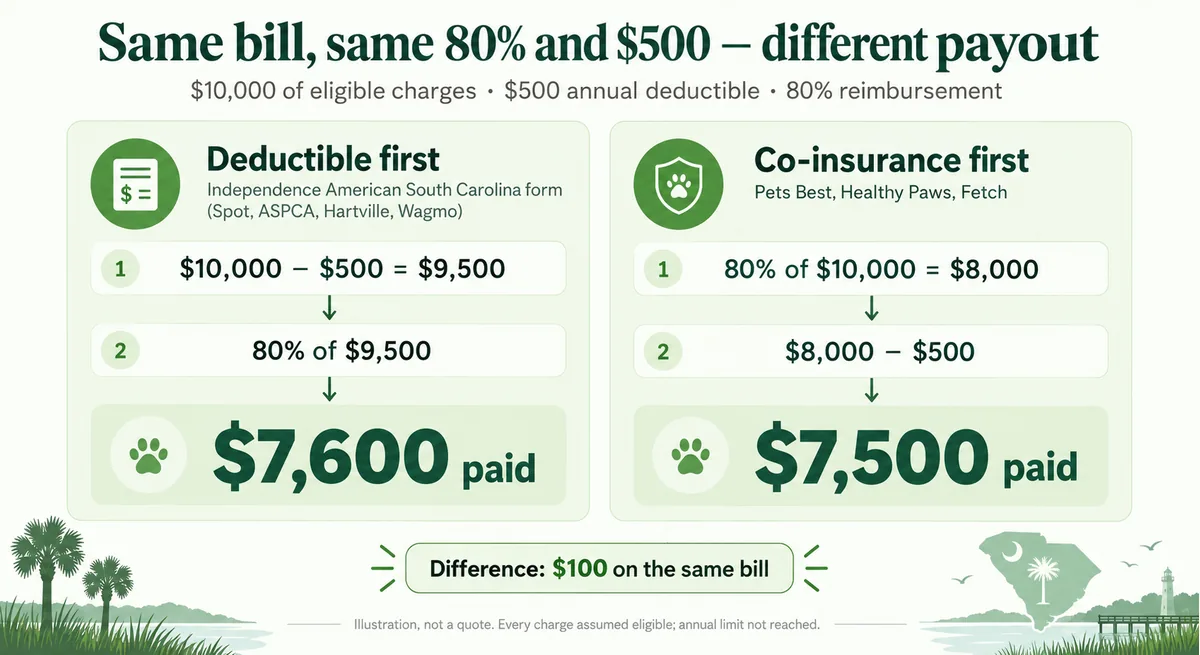
1. Does the deductible come off first? On a $10,000 bill with every charge eligible, 80% reimbursement and a $500 deductible, a policy that subtracts the deductible first pays $7,600: ($10,000 − $500) × 80%. That's the order in the Independence American South Carolina form that Spot, ASPCA, Hartville and Wagmo use ("We subtract that deductible from covered expenses before applying the reimbursement percentage"). A policy that takes the 80% first pays $7,500, and that's the order in Pets Best's South Carolina booklet, Healthy Paws' base policy and Fetch's South Carolina form ("Once the co-pay has been applied, the deductible will be applied"). Two policies advertising the same "80% and $500" can pay $100 apart on the same bill, so check the order in the policy, not the sales page.
2. Exam fees. An emergency visit starts with an exam fee, and some South Carolina policy documents pay it in the base policy while others need an add-on or never pay it. What South Carolina policies actually say shows which is which.
3. The claim window. Most of the South Carolina documents we read give you 90 to 270 days after treatment to file, which matters when the bill comes from a referral hospital in Augusta or Raleigh.
Once you have two or three quotes built the same way, the prices are comparable. The policies still aren't identical: exclusions, waiting periods and what the base plan covers differ, which is what the forms section is for. A premium is still only one of three numbers, though. What you'd keep paying on a claim, and the cash a hospital wants before treatment, can matter more — and that cash comes first.
Paying the vet in South Carolina: deposits, direct pay and the 24/7 map
In South Carolina you'll usually pay the hospital first and claim the money back later. A handful of hospitals can take Trupanion's share at checkout, and the emergency hospitals that publish a payment rule want a deposit or full payment before or at discharge. So the real question at the counter isn't whether your policy is "accepted." It's how much cash the hospital needs tonight, and when your insurer pays. (Our guide to how pet insurance works walks through reimbursement step by step.)
"Direct pay" means four different things
Insurers use "direct pay" for four different arrangements, and only the first one pays at checkout:
- At checkout: Trupanion, at hospitals running its software. Trupanion says that at a software-enabled hospital, "payment is made, often before you even leave the exam room". Landrum Veterinary Hospital in the Upstate documents it: "Trupanion can pay us directly for their portion of the invoice at checkout." BluePearl's chain FAQ says "If you have Trupanion, we work directly with them." You still pay the exam fee, the deductible, your share of the bill and anything ineligible. Charleston Veterinary Referral Center says it accepts "Most pet insurance options… included Trupanion", but it doesn't say it takes direct payment.
- By advance request: Healthy Paws. You can ask it to pay your benefit to the vet, but the request has to come "in advance of the treatment", and "Approval for direct payment does not mean a claim will be covered, and you will remain responsible for all amounts due."
- After the claim is processed: Pets Best and the Independence American family. Pets Best's Vet Direct Pay sends "any eligible reimbursement amount straight to your vet's office" once the claim is processed, and the South Carolina form behind Spot, ASPCA, Hartville and Wagmo says "If you so indicate on your claim form, we can pay the veterinarian directly." Both help only if the hospital agrees to wait for the insurer, and that's the hospital's call: Pets Best's release says the hospital's "decision to extend credit … is made without any such warranty or promise".
- Only after you've paid: Figo. Figo needs "A paid invoice showing a zero balance" before it processes a claim.
Fetch, MetLife and Lemonade reimburse you rather than the vet. MetLife's sample policy, an Ohio edition, says claims are "paid to You, not the Veterinarian", and Fetch's South Carolina form asks for an "invoice showing zero balance due"; Lemonade's FAQ says "You pay treatment costs up front, before you file a claim." None of these routes guarantees help with a deposit, so confirm any arrangement with both your insurer and the hospital before you rely on it.
South Carolina's 24/7 emergency hospitals and what they ask at the counter
These are the emergency hospitals whose own pages say they're open around the clock, with the payment rule each one publishes:
| Region | Hospital | Published payment rule |
|---|---|---|
| Charleston | Charleston Veterinary Referral Center | "A 75% deposit will be required prior to hospitalization or diagnostic workup"; balance at discharge, any excess refunded; CareCredit, Scratch Pay and Affirm accepted |
| Mount Pleasant | VEG Mount Pleasant | None published |
| Mount Pleasant and Summerville | BluePearl Mount Pleasant and Summerville | Chain FAQ: works directly with Trupanion; with "another type of pet insurance, you'll pay up front" |
| Greenville | VEG Greenville; Fetch Specialty & Emergency (no relation to Fetch Pet Insurance) | None published |
| Columbia | CVETS Emergency & Specialty | A deposit on admission; "your pet's total balance must be paid in full at the time of checkout. After that, you can submit a claim" |
| Columbia | South Carolina Veterinary Specialists & Emergency (Thrive) | None published |
| Rock Hill | Carolina Veterinary Specialists | "For all emergency/urgent exams, a deposit payment is required." |
| Hardeeville (Beaufort and Jasper counties) | New River Veterinary Specialists | "payment in full is expected at the time of service" |
We read each hospital's own pages on Oct. 2, 2026. This is the set we could verify, not a census, and most of these hospitals publish no exam fee or deposit amount. Hours and policies change, so call ahead.
Partial hours and urgent care
Several places that handle emergencies aren't open around the clock, and that matters at 2 a.m.:
- Upstate Vet Emergency & Specialty, Greenville: its ER runs weekdays 8 a.m. to 2 a.m. and weekends 8 a.m. to midnight; "Our ER is operating under limited hours." Its live registration form lists exam fees of $220 (emergency) and $265 (specialist).
- Oasis Animal Hospital, Greenville: open daily 8 a.m. to midnight, with an emergency exam "Starting at $185" and "No initial deposit required."
- Animal Emergency Hospital of the Strand, Myrtle Beach: nights and weekends only, with no weekday daytime intake; it's "unable to offer payment plans," and payment is due when services are rendered.
- Animal Emergency Hospital of the Pee Dee, Florence: nights and weekends.
- CVETS Urgent Care, West Columbia: "open until 10PM daily", with a portal that lets it process Trupanion pre-approvals and claims. That's claim processing, not a stated checkout payment.
- Urgent care: UrgentVet in Greenville, Spartanburg and Fort Mill, and PriorityPet Urgent Care in Aiken.
One more distinction: a hospital that keeps patients overnight with round-the-clock staff isn't necessarily taking new emergencies around the clock. Ask about intake, not just hours.
Where the gaps are
We found no 24/7 emergency hospital in Spartanburg, Anderson, Florence, Myrtle Beach or Aiken. The Grand Strand is the largest gap: outside the Strand ER's nights-and-weekends hours, the nearest verified 24/7 hospitals from Myrtle Beach are in Mount Pleasant: VEG, about 88 road miles away, and BluePearl, about 92. (We didn't check options in Wilmington, North Carolina.) From Florence it's about 73 miles to CVETS Emergency & Specialty in Columbia, and from Dillon about 100. Aiken-area owners use BluePearl Augusta, about 30 miles away — a Georgia hospital, not a South Carolina one.
Clemson won't fill these gaps soon. Its Harvey S. Peeler Jr. College of Veterinary Medicine admitted its first class in Fall 2026, and its veterinary services page is "Coming Soon" for ambulatory livestock and horse care. As of Oct. 2, 2026, neither page describes a small-animal teaching or referral hospital, and we found none announced; its inaugural students are the Class of 2030.
For university-level referral care, South Carolina owners go out of state. The UGA Veterinary Teaching Hospital in Athens, Georgia, says its small-animal emergency service "is typically open 24/7, 365 days a year" and asks you to "Please call ahead"; it's about 81 road miles from Anderson and 249 from Charleston. NC State Veterinary Hospital in Raleigh lists "An emergency exam fee is $292" and asks hospitalized patients for a deposit "equal to 100% of the estimate range's low end" — North Carolina prices, about 152 miles from Florence. If you cross into Charlotte or head to Raleigh, our North Carolina pet insurance guide covers that side of the line.
All distances here are free-flow road miles from open routing data (OpenStreetMap), computed and spot-checked between Sept. 30 and Oct. 3, 2026. They're model estimates, not drive times in traffic.
What a 75% deposit means in cash
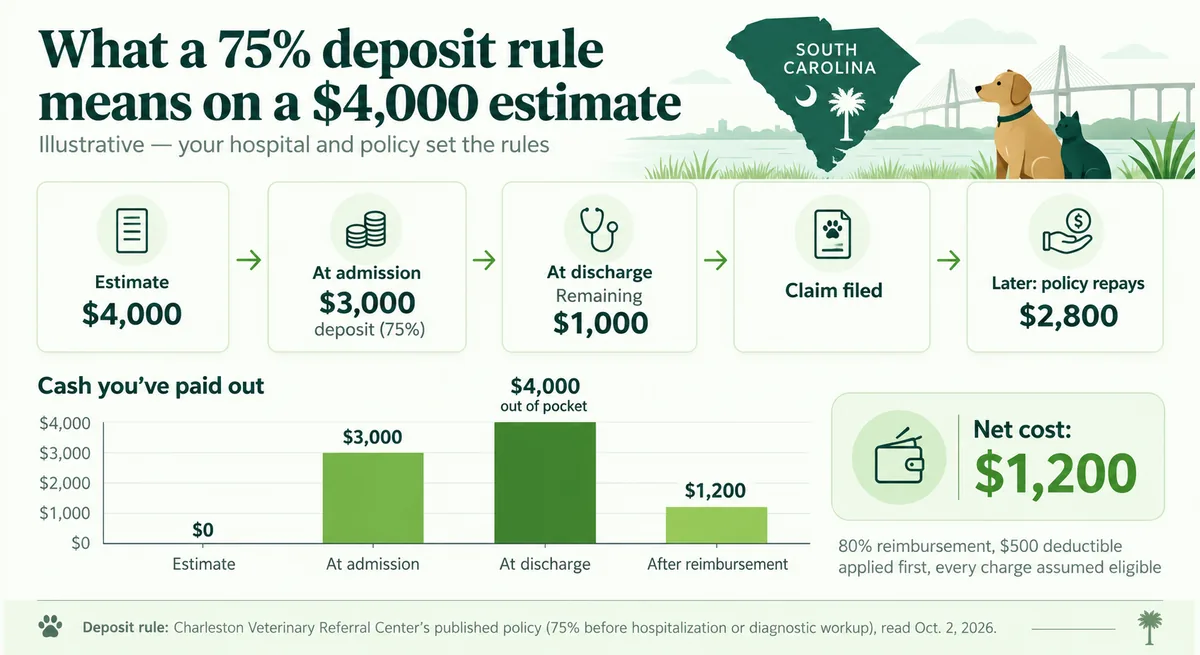
As an illustration, with our arithmetic: on a $4,000 emergency estimate, a 75% deposit rule like Charleston Veterinary Referral Center's means $3,000 at admission and the remaining $1,000 at discharge. That $3,000 is about 51.9% of South Carolina's median monthly household income of roughly $5,777 ($69,324 a year in the Census Bureau's 2020–2024 estimate).
If every charge is eligible, a policy paying 80% with a $500 deductible taken first later repays $2,800, so the visit nets out at $1,200. Insurance lowers what the visit finally costs you. It doesn't lower what the hospital needs tonight.
Financing isn't insurance
Nearly every hospital above takes CareCredit, Scratchpay, Cherry or Affirm. Those are credit: if you're approved for enough, they can cover a deposit, and you repay them whatever happens to your claim.
Charity help exists but rarely at the counter. Pet Helpers' Levi's Legacy fund gives "grants of $250 or more … issued directly to the veterinarian," but only to Lowcountry residents using approved Lowcountry vets, and "We work on a pre-approval basis and do not fund treatments that have already occurred." It says it's "not equipped to respond to emergency situations."
Owners describe the same squeeze. One Greenville owner reported putting "$1000 down" to leave an epileptic dog overnight, with the actual charge about $600 and the rest refunded (October 2025). A Charleston owner wrote in 2024, "I cannot afford a $1500+ bill right now." These are single anecdotes, not prices.
If you're reading this with an estimate in hand, three questions get you furthest. How does the hospital take payment: a deposit, at discharge, or in full at the time of service? Does it work directly with your insurer, and how? And which financing does it accept if the deposit is more than you have today?
South Carolina pet insurance laws: what exists and what doesn't
South Carolina has no law written for pet insurance, and no bill to create one. What a South Carolina owner can rely on instead is the general insurance code, which still regulates how a pet policy is priced, filed and paid, plus the policy itself. The records below show what exists.
No pet statute, no bill, no model act
- The national model. The National Association of Insurance Commissioners' Pet Insurance Model Act chart, Summer 2026 edition, lists South Carolina as "NO CURRENT ACTIVITY." North Carolina and Georgia read the same; Florida is listed as having adopted the model.
- The legislature. On Oct. 2, 2026, the General Assembly's own search returned "There are NO matches for the query "pet insurance"" for legislation in the 2025–2026, 2023–2024 and 2021–2022 sessions, and no matches in the Code of Laws or the state regulations. The same search does find other bills, so the empty result isn't a broken search.
- The insurance code. The online index of Title 38, which is "now current through the 2025 Session," ends at Chapter 103, paid family leave insurance, with no pet chapter. The 2026 act adding Chapter 105, "Wellness Reimbursement Programs" (H.4305, Act No. 215), covers human medical-expense arrangements, not pet wellness plans.
- Is pet insurance required? No. No South Carolina statute requires it, and none even mentions it.
The regulator's pet-insurance article, "Is Pet Insurance Worth It?", is consumer guidance, not law. It summarizes a 2018 Consumers' Checkbook investigation and is openly skeptical, warning that "A leading complaint to regulators is claims being rejected for conditions or treatments not covered by the policy."
How the Department of Insurance classifies and approves pet insurance
- It's inland marine. No statute names pet insurance, but NAIC's line-of-business matrix lists South Carolina's "9.2 Pet Insurance Plans — Marine (SC 38-5-30)", and the department told a House oversight committee in 2025 that its property and casualty division "reviews and approves the rates for personal lines products," listing "Inland Marine – (pet insurance, travel coverage, boatowners)."
- Rates and forms are approved in advance. Chapter 73 requires prior approval of rates (§38-73-910), and no policy form may be used until it's filed and approved (§38-61-20), which the department has 30 days to review and may extend by up to 60 more.
- Fees are regulated. Policy fees belong in the rate filing, and optional service fees must be disclosed and accepted in advance (Bulletin 2006-08; Bulletin 2013-11).
- It isn't health insurance. By our reading of the definitions in §38-1-20, accident-and-health insurance covers people, so rules written for human health plans don't carry over.
- Who can sell it. South Carolina has no pet-insurance limited license, so, by inference, sellers need a property, casualty or personal-lines license. WhiskerCover is a licensed agency in South Carolina; our licenses page lists it.
- The regulator is the South Carolina Department of Insurance, led by Director Michael Wise.
The general South Carolina law that still reaches a pet claim
These rules weren't written for pets, but their words or their logic reach a pet policy. Each comes with its limits.
- Improper claim practices (§38-59-20). The section covers insurers doing "marine insurance" and lists practices such as misrepresentation, unreasonable investigation standards and failing to settle in good faith, when "committed without just cause and performed with such frequency as to indicate a general business practice." One bad claim isn't a violation by itself. The department enforces it, with penalties for an insurer of up to $15,000 per violation, or $30,000 if wilful. In Masterclean v. Star Insurance (2001), the state Supreme Court called a related trade-practices section "an administrative remedy and not a private right of action" and held that third parties can't sue under §38-59-20.
- Attorney fees after a 90-day refusal (§38-59-40). If an insurer refuses to pay a claim "within ninety days after a demand" and the judge finds the refusal was "without reasonable cause or in bad faith," the insurer pays your reasonable attorney fees, capped at one-third of the judgment. The section isn't limited by line of insurance, so on its words it reaches a covered pet claim. It doesn't make every claim unpaid after 90 days payable; a judge has to make that finding.
- Bad faith. Under Nichols v. State Farm (1983), an insured who proves "bad faith or unreasonable action" can recover consequential damages in a separate tort claim, and punitive damages if the conduct was willful or reckless. The court said the fee statute (the predecessor of §38-59-40) "applies only to a breach of contract cause of action," so the fee rule and a bad-faith recovery are different routes.
- Three years to sue. Contract claims have a three-year limit (§15-3-530), and under §15-3-140 a policy clause setting a shorter period can't bar the suit. The Independence American South Carolina form's 24-month clause itself defers to "a longer period" where state law requires one, so by our reading the three years govern.
- Small claims. Magistrate court hears civil claims where the amount "does not exceed seven thousand five hundred dollars" (§22-3-10), which covers most vet bills.
- If an insurer fails. The state's property and casualty guaranty association defines ocean marine to exclude "inland marine" (§38-31-30(8)), so, by our reading, pet policies filed as inland marine fall within the fund when the insurer was licensed in South Carolina. It pays the part of a covered claim between $250 and $300,000 (§38-31-60), with residency and filing-deadline conditions, so it's a backstop, not a guarantee.
- The insurer proves the exclusion. Once you show a loss is covered, South Carolina courts construe exclusions "most strongly against the insurance company, which also bears the burden of establishing the exclusion's applicability" (Owners Ins. Co. v. Clayton, citing a 1979 decision). That's a general insurance rule, not a pet-specific pre-existing-condition standard.
- No prompt-pay deadline. South Carolina's clean-claim payment rules are written for "human illness, injury, or physical disability" (§38-59-210), so their deadlines and interest rule don't apply to a vet claim, and we found no other statutory deadline for paying one.
- No statutory free look. South Carolina's insurance code gives a return-the-policy right for life insurance (§38-63-220) and long-term care insurance (§38-72-60), among a few others, but not for pet policies. Any pet free look comes from the contract, and some South Carolina forms don't have one.
- Cancellation and nonrenewal. Whether the cancellation chapter for property and casualty policies (Chapter 75, Article 9) reaches pet policies, which are filed as marine, is an open legal question. If it does, nonrenewal needs at least 60 days' notice year-round. The older 60- and 90-day seasonal rule was repealed in 2021 and now survives only in some carriers' South Carolina endorsements, which promise more than the statute.
Complaining to the Department of Insurance, and what it can't do
The department's consumer page is direct about its limits: "We have no authority to resolve civil, factual or contractual (policy) disputes" and "no authority to compel the payment of any claim." It does make insurers answer. It says it strives to resolve issues within 7–10 days, and insurers must respond to its inquiries "within seven calendar days" unless it allows longer (§38-13-70). We found no pet or inland-marine category in its published complaint summaries.
If a claim is denied, a practical order is:
- Ask the insurer to state the denial and the policy language it relies on in writing.
- Appeal with your vet's records, including anything that dates when symptoms started.
- File a complaint with the Department of Insurance if the answer still doesn't hold up.
- For $7,500 or less, consider magistrate court; for more, or to pursue §38-59-40 fees or a bad-faith claim, you may want to talk to a lawyer.
By the numbers. Pet insurers wrote $60.36 million of premium in South Carolina in 2025, with a 65.80% loss ratio: claims incurred against premium earned, a figure that leaves out insurers' expenses and doesn't measure how fairly individual claims are handled. In the NAIC's 2025 market conduct data, 29.40% of South Carolina pet claims closed without payment. That's not a denial rate: it counts every claim closed without a payment for any reason, including claims that fell under the deductible or were withdrawn.
Moving to Florida? It's a Model Act state
If you're moving south, the rules change. Florida's Pet Insurance Act, §627.71545, took effect Jan. 1, 2026. Under it, an insurer "may not issue a policy imposing a waiting period for accidents"; illness and orthopedic waiting periods may "not exceed 30 days" and can be waived after a vet exam; you get a 30-day return with a full refund if you haven't filed a claim; "The pet insurer has the burden of proving" a pre-existing-condition exclusion applies; and insurers must disclose whether claims history, the pet's age or a move changes the premium or coverage.
By our reading, two South Carolina terms wouldn't be allowed there: the Independence American South Carolina form's 14-day accident wait, and Healthy Paws' deletion of its free look in its South Carolina endorsement. South Carolina isn't empty-handed, though: its courts already put the burden of proving an exclusion on the insurer, as above. Our Florida pet insurance guide covers the Act in full, and North Carolina, which shares South Carolina's "no current activity" status, is covered in our North Carolina guide.
Two things this isn't. Pet health insurance doesn't cover liability: a dog-bite claim against you is usually a matter for homeowners or renters liability coverage. And searches for "South Carolina pet laws" usually mean dangerous-dog, wolf-hybrid or landlord rules, which are a different subject from pet insurance.
What South Carolina pet insurance policies actually say
Several carriers send South Carolina buyers to an older or state-specific policy document, and that document, not the carrier's national marketing page, sets your waiting periods, exclusions and claim deadline. With no pet-insurance statute to set a floor, the differences below are contract terms, and they're worth reading before you need them.
We found each document through the carrier's own state picker or state data file and read it at the operative clause. These are samples, not your policy: your declarations page and the policy issued to you are the final word. If the terms are new to you, our guide to pet insurance fine print explains them.
Waits, past conditions and heartworm (waits run accident / illness / knee or orthopedic):
| Brand and South Carolina document | Insurer on the document | Waits | Can a past condition be covered later? | Heartworm treatment |
|---|---|---|---|---|
| Spot, ASPCA, Hartville, Wagmo: PET-P-20000-SC-1024 with SC amendatory (Spot's copy; the same forms appear in Hartville's and Wagmo's SC samples) | Independence American | 14 days / 14 days / 14 days (knees); no waiver | Yes, after 180 days free of treatment and symptoms; not chronic or knee conditions | No exclusion found |
| Pets Best: IAIC-PB10001-ILL SC booklet | Independence American | 3 days / 14 days / 6 months (cruciate), reducible if a participating vet certifies health | No cure path | Conditional on giving recommended prevention |
| Figo: generic "Default" sample (2023) | Independence American | 1 day / 14 days / 6 months (orthopedic), waivable with an exam form | Yes, after 12 months free; not knee conditions | Excluded |
| AKC: SC "Custom" form (11/20) | Independence American or Independence Pet | 2 days / 14 days / 180 days (cruciate and IVDD) | Yes: pre-existing conditions can become eligible after 365 days of continuous coverage; other exclusions still apply | Excluded |
| Fetch: base form with SC endorsement | AXIS | None for unexpected-event accidents / 15 days / orthopedic signs in the first 180 days excluded for life (not accident-caused ones) | After 365-day curable periods and an annual exam (the form contradicts itself on relapses) | Excluded |
| Embrace: V5 terms (served only to KS, NM and SC) | American Modern Home | 2 days / 14 days / 6 months (orthopedic), shortened with an exam report | Temporary conditions, after 12 months free | No exclusion found |
| Trupanion: 2019 sample (default routing) | American Pet Insurance Co. (SC page: American Pet Insurance Company or ZPIC Insurance Company) | Injuries in the first 5 days and illnesses in the first 30 are "deemed pre-existing" | No cure path; 18-month look-back | Excluded |
| Healthy Paws: 2018 base with SC amendatory | Westchester Fire (Chubb) | 15 days / 15 days / 12 months for hip dysplasia (no hip dysplasia cover if enrolled at 6 or older) | After 365 days free, per its FAQ; not cruciate or chronic | Excluded by name |
| MetLife: Ohio sample (PET21-01-V OH) | Metropolitan General | None* / 14 days* / — | — | Listed as covered |
| Nationwide: form for new SC buyers unresolved | National Casualty | On VS-G-15: 14 days; cruciate addable 12 months after the policy starts | VS-G-15 reviews conditions cured at least 6 months; not chronic | No clause found* |
Exams, deductible order, claims and where your pet is covered:
| Brand | Exam fees | Deductible order | Claim window | Pays the vet? | Territory |
|---|---|---|---|---|---|
| Spot, ASPCA, Hartville, Wagmo | Covered | Deductible first | 270 days | On claim-form request, after processing | US, territories and Canada* |
| Pets Best | Add-on | Co-insurance first | 180 days | Vet Direct Pay, after processing | Includes military bases abroad |
| Figo | Rider | Co-insurance (and any per-incident copay) first | 180 days, plus a zero-balance paid invoice | Only on a zero-balance paid invoice; can be directed to the vet | Anywhere in the world |
| AKC | ExamPlus add-on | Deductible first* | 180 days* | May be directed to the vet* | US, territories and Canada* |
| Fetch | Covered | Co-pay first | 90 days, plus a zero-balance invoice | No | US and Canada* |
| Embrace | Covered, plus prescriptions | Deductible first* | During the policy term or within 60 days after it ends | No | Anywhere in the world |
| Trupanion | You pay them | Per-condition deductible, once per condition for life | 90 days | At checkout, at software-enabled hospitals | US, Puerto Rico, Canada, Australia and military bases abroad |
| Healthy Paws | Excluded | Co-insurance first | 90 days (FAQ) | By request, in advance | US, or temporarily in Canada |
| MetLife | Covered* | Deductible first* | 90 days | No | 50 states, DC and US military bases |
| Nationwide | — | VS-G-15 deductible first; VS-G-16 co-insurance first | VS-G-15: notice in 90 days, void after 12 months; VS-G-16: 180 days | — | — |
*From our reading of the same sample, not separately re-checked for this update; confirm it on your policy. A dash means we couldn't establish the term. These are the sample documents each carrier's state picker or state data file links for South Carolina (MetLife publishes a single Ohio sample), read Oct. 2–3, 2026; your declarations page governs. We found no South Carolina form for Lemonade; Odie links only its national form; Kanguro publishes no sample; and Pumpkin's South Carolina routing couldn't be established, so none of the four gets a row. Trupanion's South Carolina underwriter (American Pet Insurance Co. or ZPIC Insurance Co.) is something only your declarations page settles.
What stands out in the South Carolina documents
- Embrace's South Carolina terms aren't its national terms. Embrace's terms selector sends South Carolina to its V5 terms, which have a 2-day accident wait and cover the physical exam and prescribed medications. "No accident waiting period" and "exam fees as an add-on" describe the V6 terms most states get.
- Healthy Paws deletes its free look here. Its South Carolina amendatory deletes the base policy's 30-day free-look clause, and South Carolina law gives no statutory one. Other South Carolina documents do offer a contractual version: the Independence American form's "Money Back Guarantee" refunds premium if you cancel "within the first 30 days from your first effective date" and nothing has been applied to your deductible or reimbursed; Embrace's V5 terms refund premium on notice within 30 days if you've made no claim; and MetLife's Ohio sample lists a "30-Day Free Look" section.
- Healthy Paws' start date depends on exam records. Its claims endorsement asks for a vet exam within 12 months before or 15 days after enrollment for pets under 6, and within 30 days before or 15 days after for pets 6 and older, so "coverage starts after 15 days" is only part of the rule.
- AKC's form has the broadest path back for past conditions. Its South Carolina form says "Pre-Existing Conditions are only eligible after three hundred and sixty-five (365) days of continuous coverage", which can include a knee that was already injured. It's a path for later treatment, not coverage of bills you already have, and the same form excludes hip and elbow dysplasia, luxating patella and diabetes, among other conditions, unless you buy its HereditaryPlus option. Our guide to pre-existing conditions explains how the look-back works.
- Fetch's South Carolina form has three timing duties. Orthopedic conditions that show up in the first 180 days are excluded "for the life of the policy," with an exception if a vet examines the knees; you're asked to "Visit a veterinary clinic within forty-eight (48) hours after first noticing clinical sign(s)"; and if your pet hasn't had a first exam within 12 months before or 30 days after the policy starts, "Failure to have a first exam may reduce coverage."
- Upgrading a Pets Best policy can restart the clock. Its South Carolina booklet says adding a supplemental benefit or raising the annual limit requires "the cancellation of your current policy and the issuance of a new policy," with new waiting periods and the pre-existing exclusion applied at the new start date. If your pet has symptoms, read that clause before you upgrade.
- The second knee is handled three ways. The Independence American form treats knee conditions as bilateral but excludes them only if a knee condition "occurred prior to the first effective date … or during a waiting period", so a first tear after the wait doesn't by itself bar the second knee. Trupanion's 2019 form applies its pre-existing rules to a list of conditions, including cranial cruciate disease and luxating patella, wherever there were "signs or evidence presented on either side of Your Pet." Embrace's V5 terms exclude the "other side" when signs showed on one side before coverage. Our guide to dog ACL surgery covers what the surgery itself costs.
- Some South Carolina endorsements promise more notice than the law. The Independence American, Fetch and Healthy Paws South Carolina endorsements still give 60 days' nonrenewal notice for November through May and 90 days for June through October, the seasonal rule the state repealed in 2021. Fetch's adds that nonrenewal "will not be made based on a pet's medical history or claims activity."
- "90% coverage" isn't 90% of the bill. Trupanion's South Carolina page features a Greenville dog whose $6,220.66 invoice drew a $4,959.00 payment on a plan with 90% of eligible costs and a $500 deductible. By our arithmetic that's 79.7% of the invoice: the deductible and about $210 of charges that weren't eligible, consistent with the owner-paid exam fees on Trupanion's 2019 form, came out first.
South Carolina risks, by evidence, and what policies do about them
Heartworm is South Carolina's best-documented pet-health risk, and it's also where South Carolina policy documents differ most. For everything else, from snakebites to hurricanes, whether you're covered depends on your policy's wording, not on how common the risk is. No insurer, industry group or regulator publishes how often each cause shows up in South Carolina claims, so what follows is context, not claim frequency.
Heartworm: the split that matters most here
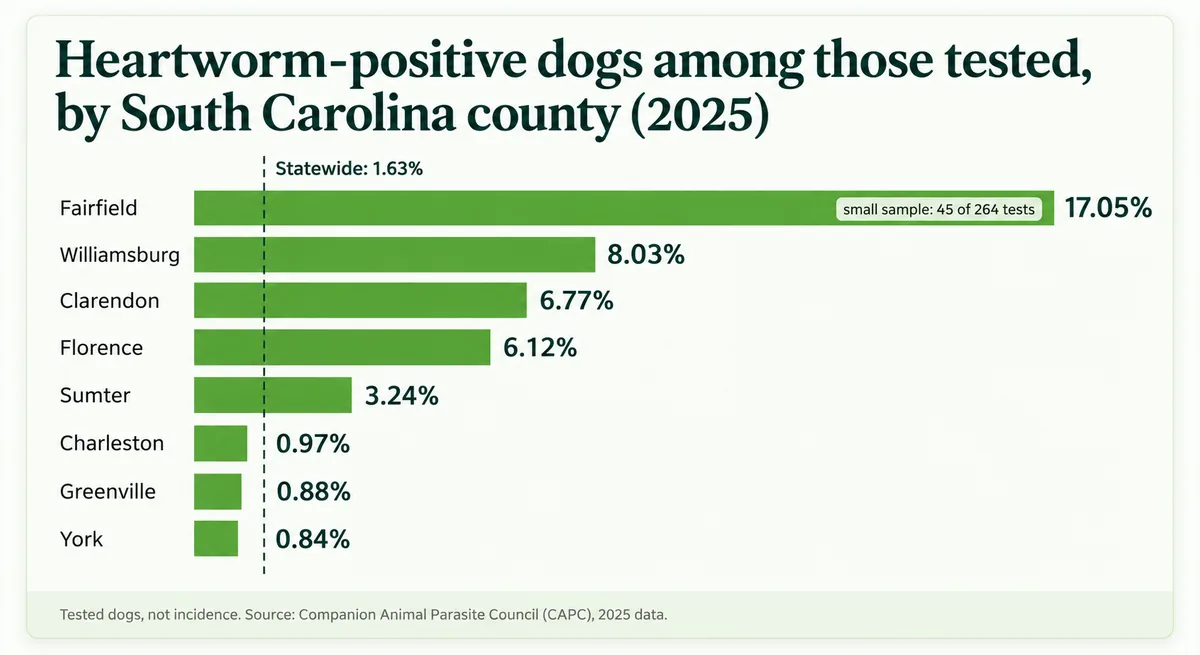
In the Companion Animal Parasite Council's tested-dog data, 1.63% of South Carolina dogs tested in 2025 were heartworm antigen-positive (7,092 of 434,039), the 8th-highest rate of 51 jurisdictions by our count from the same data, and 1.56% tested positive from January through August 2026. For cats, the feline heartworm antigen rate was 0.42%. The American Heartworm Society's survey of 2025 testing, which counts cases per reporting clinic rather than a rate, found that "Texas topped the list … followed closely by Louisiana, Arkansas, Mississippi and South Carolina."
The county pattern runs inland, not along the coast. In 2025, setting aside one county with only four tests, the highest tested-dog rates were in Fairfield (17.05%, on a small sample of 264 tests), Williamsburg (8.03%), Clarendon (6.77%), Florence (6.12%) and Sumter (3.24%), while Charleston (0.97%), Greenville (0.88%) and York (0.84%) came in below the state rate. These are dogs that were tested, not a measure of how many dogs are infected, and testing volume differs by county.
Whether a policy pays to treat it depends on the document your carrier links for South Carolina:
- Excluded: Fetch, AKC, Figo, Trupanion (parasites "for which there are readily available preventive treatments") and Healthy Paws ("such as heartworm").
- Conditional: Pets Best requires you to give preventive medication as your vet recommends, and "Failure to do so could result in denied claims."
- No exclusion found: the Independence American form used by Spot, ASPCA, Hartville and Wagmo, and Embrace's V5 terms. By our reading, treatment of a new infection after the waiting period appears payable, but that rests on a missing clause, and pre-existing rules still apply. Both documents also have general care clauses (the Independence American form excludes illness from "failure to perform actions commonly accepted as responsible pet care," and Embrace's terms exclude "persistent neglect"), so keep prevention current.
- Listed as covered: MetLife's coverage page names "Treatment of heartworm, parasites, and Lyme disease."
Two things hold on every accident-and-illness policy. Prevention itself isn't covered, except through a separate wellness add-on where one is sold. And a dog that tests positive before enrollment has a pre-existing condition. Treatment isn't cheap: PetMD's vet-reviewed guide puts the total cost of treating heartworm in dogs at "around $600 to more than $3000."
If you're adopting, especially from a high-positivity inland county, have your dog tested as your vet advises and keep up prevention. Choose the policy on its heartworm wording, not by timing the test: your dog needs the test and the care either way.
Snakebites, alligators and the accident-wait gap
South Carolina has 38 snake species, six of them venomous: the coral snake, pigmy rattlesnake, cottonmouth, copperhead, canebrake (timber) rattlesnake and eastern diamondback (SCDNR's venomous-snake guide). No South Carolina data count dog snakebites.
For insurance, the issue is timing. Accident waiting periods on the South Carolina documents we read run from none for Fetch's "unexpected event" accidents, through one to five days at several carriers, to 14 or 15 days on the Independence American form, on Nationwide's VS-G-15 form and at Healthy Paws. So a bite in the first two weeks after you enroll is the practical gap, depending on your carrier.
Fetch's South Carolina page lists average costs to treat from its claims data, without saying they're South Carolina-only: a venomous snakebite at $1,357, of which Fetch pays back $921, and an alligator attack at $1,275 ($847), at 90% reimbursement with a $300 deductible. Those are a carrier's marketing figures, not measured South Carolina claim causes. The much higher figures you may see quoted, "ranging from $8,000 to $50,000 per case," come from a 2026 review article in Frontiers in Veterinary Science citing Texas A&M and NC State medical records for envenomated dogs and cats, not from typical South Carolina bills.
Alligators are real but unmeasured as a claim cause. The state Department of Natural Resources removes "Approximately 300-350 alligators" a year through its nuisance program, for animals that may threaten "humans or pets," and a Myrtle Beach backyard attack on a dog was reported in July 2026. On a policy, an alligator bite is an accident like any other, subject to the same accident wait.
Hurricanes and boarding
The state's emergency agency tells owners to "Evacuate with your pet outside of the evacuation zone," and its pet-planning page notes that "Most emergency shelters will not accept pets (with the exception of service animals)." Owners remember the logistics: one Myrtle Beach owner recalled a kennel that moved boarded dogs inland during Hurricane Florence and hotels full as far as Charlotte (an anecdote from 2018).
Pet insurance doesn't solve that part. None of the South Carolina policy documents we read pays for evacuation boarding. Boarding is paid only when you're hospitalized, or, at MetLife and Nationwide, when someone in your household is:
- Fetch: if you're hospitalized at least 96 hours, up to a "$1,000 annual sublimit".
- MetLife: "Up to $500 per Policy Period" if "You or a member of Your household is hospitalized for more than 48 hours" (Ohio sample).
- Nationwide's VS-G-16 form: up to $500 a year when you or a family member is hospitalized, and nothing for stays under 48 hours.
Embrace's V5 terms and the Independence American South Carolina form exclude boarding, and Figo excludes it unless you buy its optional Boarding Fees Coverage, whose terms aren't in its sample. Trupanion sells an optional owner-assistance package with a boarding benefit, but we couldn't establish that it's available in South Carolina. An evacuation order alone triggers none of these, so budget pet-friendly lodging or boarding as an out-of-pocket cost in your storm plan.
Rabies quarantine
Rabies is rare in South Carolina pets, but its rules are expensive. Of 101 laboratory-confirmed rabid animals in 2025, none were dogs and 14 were cats. If your pet is exposed, state law requires an inoculated pet to be revaccinated and quarantined for "not less than forty-five days", and "An uninoculated pet must be quarantined for a period of not less than one hundred eighty days" (§47-5-110).
Public health guidance allows that confinement at "the animal owner's/custodian's premises" as well as at a shelter, vet or boarding facility, and "The animal owner/custodian is responsible for all boarding costs." Since the South Carolina documents we read pay boarding only when an owner is hospitalized, quarantine boarding is yours to pay. A current rabies vaccination is the cheapest protection you can buy: it cuts the minimum quarantine from 180 days to 45.
Three more, briefly
- Ticks: in CAPC's 2025 tested-dog data, 1.16% of South Carolina dogs had Lyme antibodies, against 4.85% positive for hookworm. In this data, South Carolina is a heartworm-and-hookworm state, not a Lyme state.
- Leptospirosis: the CDC says "Almost every dog is at risk of leptospirosis, whether they live in the country, suburbs, or city." We found no South Carolina canine case data.
- Boykin Spaniels: in the Orthopedic Foundation for Animals' registry, 25.3% of 6,917 Boykin hip evaluations were dysplastic, against 14.2% across all breeds, from voluntary submissions. If you have a Boykin or another sporting dog, the hereditary-condition rider, the orthopedic wait and any working-use exclusion matter more than the headline price.
Best pet insurance in South Carolina, by situation
There's no single best pet insurance in South Carolina. The right policy depends on three things: whether you can front an emergency deposit, which documented terms your situation needs (heartworm wording, knee rules, age limits, territory), and the price at your own settings. Here's what to look at, situation by situation.
Each row points you to a document to read, not a policy to buy. The terms come from the South Carolina documents in what South Carolina policies actually say.
| Your situation | The feature that matters | Where to look | The catch |
|---|---|---|---|
| You can't front an ER deposit | Payment at checkout | Trupanion, at hospitals running its software | Healthy Paws' advance request is conditional; financing is a loan |
| You're far from 24/7 care, or use out-of-state hospitals | Claim window; territory | The Independence American form (270 days to claim); Embrace V5 (anywhere in the world) | Your premium follows your address, not your vet's |
| You're adopting a dog, especially from an inland county | Heartworm wording; pre-existing timing | Pets Best (conditional on prevention); the Independence American form and Embrace V5 (no exclusion found); MetLife (listed as covered) | A positive test before enrollment is pre-existing everywhere |
| Your pet is older, or you're retiring to the coast with one | Age limits; paths back for past conditions | AKC's 365-day path; Embrace enrolls dogs in accident-and-illness cover up to age 14; Figo has "no upper age limits"; Trupanion enrolls before the 14th birthday | Premiums climb with age: +60.5% for the dog from age 1 to 6 in the Charleston table |
| You have a Boykin Spaniel or another sporting dog | Hereditary and knee terms | The Independence American form's 14-day knee wait vs. six months at Embrace V5, Pets Best and Figo; AKC covers hip dysplasia only with HereditaryPlus | Healthy Paws excludes conditions from working pets' racing, breeding, law enforcement, guarding or commercial use |
| You want exam fees covered | The exam-fee clause | The Independence American form, Embrace V5, MetLife, Fetch | Excluded or an add-on elsewhere |
| You're a military household | Territory; discounts | Embrace V5 (worldwide); Pets Best and Trupanion (military bases abroad); the USAA channel to Embrace (our USAA review) | Lemonade covers US treatment only; military status alone doesn't waive a waiting period |
| You worry about renewals | Renewal wording | Carriers stating that your own claims don't raise your premium: Spot, Healthy Paws and the Pets Best South Carolina booklet | That's not a price lock; premiums still rise with age |
| You're switching | What resets | The new form's path back for past conditions (our guide to switching pet insurance) | At Pets Best, adding a benefit or raising the limit issues a new policy |
| Price comes first | The lowest matched quote | Pets Best Essential and Lemonade, the two insurers U.S. News prices individually in Charleston | One ZIP code, one configuration, and both leave exam fees to an add-on |
We couldn't establish which policy document Pumpkin routes to South Carolina, so it doesn't appear above.
Which way to lean, by where you're starting
- A young pet with a clean record: you have the widest choice, so compare waiting periods, the knee rules and the heartworm wording before price. Enrolling early, before any condition appears, keeps the pre-existing list short.
- Switching carriers: illnesses, injuries or signs that showed up before the new policy starts can count as pre-existing under its definition and look-back period, unless that form has a path back for them. Price a switch only after you've checked what you'd lose, and keep your current policy until the new one's waiting periods have passed.
- Renewing: compare your renewal against a matched new quote, but weigh it against conditions your current policy already covers. A cheaper new policy that excludes them may cost more.
- An older pet or one with a history: you can usually still buy a policy; the question is what it will cover. Look for a path back: AKC's 365 days of continuous coverage (other exclusions still apply), Embrace's 12 months free for temporary conditions, or the Independence American form's 180 days for non-chronic, non-knee conditions.
Whichever row fits you, the method is the same: quote the same pet, ZIP code, limit, deductible and reimbursement with two or three candidates, read each carrier's South Carolina sample form for the terms in your row, and ask your nearest ER how it takes payment. That's the comparison that tells you what you'll actually get.
Renewals, moving and military reassignment
On most policies your premium rises as your pet ages, and on any policy it can change for other reasons. A move or a set of orders can change both the price and the contract. Below is what carriers and the state actually put in writing.
Why renewals go up
South Carolina's Department of Insurance tells shoppers to price a policy forward, for "the 10 or 12 ensuing years," not just year one. The Charleston table in our cost section shows the scale: a 6-year-old dog is quoted 60.5% more than a 1-year-old.
Carriers explain renewals in their own words, and these are their statements, not guarantees:
- Embrace: when a statewide filed rate changes, "All premiums in your state increase by the same percentage," and "All rates are filed and approved by each state's department of insurance."
- Lemonade: premium changes are "proposed and filed by our team, and approved by state regulators."
- Spot: your "premium will be affected by your pet's age each year" and "will not increase due to filing a claim."
- Healthy Paws: rates reflect state filings and claims experience in your region, and "Premium increases are not based on your individual claim submissions."
- Pets Best: its South Carolina booklet says "Your premium will not change based on your Pet's individual claim experience."
- Trupanion: its South Carolina page says it has no "birthday pricing," but the cost can still change.
State law limits how often an insurer can raise its base rates: no approved increase for the same line within 12 months of the last one (§38-73-920), unless the insurer shows that waiting could threaten its solvency; by our reading this reaches filed pet programs. It doesn't cap the step your own pet's premium takes as it ages. We couldn't obtain any South Carolina pet rate filing, so no renewal increase can be described as approved at a given percentage.
Two South Carolina owner reports, both anecdotes: one Trupanion customer reported an April 2025 change "from $66.55 to $81.74" at a $1,000 deductible, up 22.8% by our arithmetic, and an Easley reviewer said her dog's Pets Best premium "almost doubled" with one claim in five years (June 2026). Neither is a statewide rate, and neither says why.
Moving in or out of South Carolina
Your price follows where your pet lives, not where it's treated. MetLife says "a change in address can affect your premium"; Spot says "premiums may change based on the new zip code" and asks you to contact it if you're moving to a new state; and Trupanion prices by "the local cost of veterinary care (down to the zip code)."
A move can also change the contract. Embrace lists "Current coverage is not available if you have moved across state lines" among the reasons an address may not validate, and its terms selector puts South Carolina on V5 while North Carolina, Georgia and Florida get V6, so a move to a neighbor likely means a different version of the contract; we couldn't confirm how the transfer works. Lemonade says that moving to a state it doesn't serve means "you will need to cancel your policy." For every carrier, whether a same-company move resets your deductible or restarts waiting periods is something to confirm in writing before you move.
If you're moving a pet into South Carolina from an area with New World screwworm cases, Clemson's Livestock-Poultry Health office lists the inspection and permit requirements, in effect since June 15, 2026.
Military households and PCS orders
South Carolina's major installations, by the figures their own pages publish:
- Joint Base Lindsey Graham (the former Joint Base Charleston, renamed Aug. 10, 2026): Military OneSource lists "Active Duty Strength: 11,500" (estimated). Its "serves more than 90,000" figure includes families, reservists, civilians and contractors.
- Fort Jackson (Columbia): "An estimated 3,500 active-duty personnel and their 12,000 military family members."
- Shaw Air Force Base (Sumter): more than 8,200 active-duty members and 12,000 family members, as of 2024.
- Parris Island and MCAS Beaufort: about 19,000 recruits train at Parris Island each year, and its veterinary facility "no longer has a permanent veterinarian"; the page recommends that you "seek care off post" and names Fort Stewart and Joint Base Lindsey Graham as the closest military vets.
Before orders arrive, check two things on your policy. First, territory: on the documents we read, Embrace's V5 terms cover your pet "anywhere in the world" as long as it lives at the address on your declarations, Pets Best and Trupanion's 2019 form include military bases abroad, and Lemonade says "treatments for your pet outside of the U.S. would not be covered"; the forms table has the rest. Second, the claim window, which matters when you're paying a vet in another state or country and filing later. Military status alone doesn't waive a waiting period or guarantee your policy continues after a move, so ask your carrier how it handles a PCS before you go.
Frequently Asked Questions
What is the best pet insurance in South Carolina?
There isn't one best policy for every South Carolina owner. The right choice depends on whether you can front an emergency deposit, which documented terms your pet needs (heartworm wording, knee rules, age limits, territory) and the price for your pet at your own ZIP code and settings. Our by-situation table shows which South Carolina policy document to read for each case, so you can compare two or three candidates on the terms that matter to you.
How much is pet insurance in South Carolina?
Averaged across the insurers U.S. News quoted at Charleston ZIP code 29401 in May 2026, a plan with a $10,000 annual limit, a $500 deductible and 90% reimbursement cost $47.84 a month for a 1-year-old dog and $27.93 for a 1-year-old cat. That's one ZIP code, not a state average. Other published South Carolina figures use different settings and can't be compared with it, as our cost section shows.
Is pet insurance required or regulated in South Carolina?
No South Carolina law requires pet insurance, and no statute or bill even mentions it; the NAIC's Summer 2026 chart lists the state as "NO CURRENT ACTIVITY" on its Pet Insurance Model Act. It's still regulated. The Department of Insurance treats it as inland marine coverage and approves rates and policy forms in advance, and general insurance law reaches claims, as our law section explains.
Do vets in South Carolina accept pet insurance?
Pet insurance generally has no network, so any licensed vet can treat your pet: you pay the bill and the insurer reimburses you. The main exception is Trupanion, which can pay its share at checkout at hospitals running its software. Emergency hospitals that publish a rule want payment before or at discharge; Charleston Veterinary Referral Center asks for a 75% deposit before hospitalization or a diagnostic workup. See paying the vet in South Carolina.
Is pet insurance worth it in South Carolina?
It's most worth it if one large vet bill would be hard to pay, and less so if you could cover a $3,000 emergency deposit from savings. Insurance exists for the rare big bill: across South Carolina in 2025, pet insurers' claims came to about 66% of the premium they earned. The state's Department of Insurance suggests pricing a policy forward for "the 10 or 12 ensuing years," not just year one. Our guide to whether pet insurance is worth it walks through the math.
What is the cheapest pet insurance in South Carolina?
In U.S. News's Charleston rows at a $10,000 limit, $500 deductible and 90% reimbursement, Pets Best's Essential tier was the lower of the two insurers priced individually, at $22.81 a month for a 1-year-old dog and $14.58 for a 1-year-old cat, against Lemonade's $26.13 and $17.01. Both leave exam fees to an add-on, and that's one ZIP code. The cheapest policy for you is the lowest matched quote for your pet; our guide to cheap pet insurance covers what to check.
Does pet insurance cover heartworm treatment in South Carolina?
It depends on the policy. On the sample policies carriers link for South Carolina, heartworm treatment is excluded by Fetch, AKC, Figo, Trupanion and Healthy Paws; conditional on giving recommended prevention at Pets Best; not excluded by name on the Independence American form used by Spot, ASPCA, Hartville and Wagmo or in Embrace's V5 terms; and listed as covered by MetLife. Prevention itself isn't covered, except through a wellness add-on where one is sold, and a positive test before enrollment is pre-existing. See South Carolina risks.
Will pet insurance cover a snakebite?
Usually yes, as an accident, once the accident waiting period has passed. On the South Carolina documents we read, that wait runs from none for Fetch's "unexpected event" accidents to 14 days on the Independence American form and 15 at Healthy Paws, so a bite in the first two weeks after you enroll may not be covered. After that, the bill is paid subject to your deductible, reimbursement rate and annual limit, as the forms table shows carrier by carrier.
Will pet insurance pay for boarding during a hurricane evacuation?
No South Carolina policy document we read pays for evacuation boarding. A few pay boarding only when you, or under some policies a household or family member, are hospitalized: Fetch after 96 hours (up to $1,000 a year), MetLife after more than 48 hours (up to $500), and Nationwide's VS-G-16 form (up to $500 a year). Most emergency shelters won't accept pets, so the state tells owners to "Evacuate with your pet outside of the evacuation zone." Plan lodging or boarding as an out-of-pocket cost.
What happens to my pet insurance if I move out of South Carolina or get PCS orders?
Your premium will likely change, because carriers price by where your pet lives, and your contract may change too: Embrace sells South Carolina its V5 terms, while North Carolina, Georgia and Florida get V6. Lemonade requires cancellation if you move to a state it doesn't serve. For overseas orders, check territory: Embrace's V5 terms cover your pet "anywhere in the world," Pets Best and Trupanion include military bases abroad, and Lemonade covers US treatment only. See renewals, moving and military reassignment.
How do I complain about a denied pet insurance claim in South Carolina?
Start with the insurer: ask for the denial and the policy language behind it in writing, then appeal with your vet's records. If that fails, file a complaint with the South Carolina Department of Insurance. Insurers must answer its inquiries within seven calendar days unless the director allows longer, but it says it has "no authority to compel the payment of any claim." For larger amounts, magistrate court hears claims up to $7,500, or you may want to talk to a lawyer.
Can I buy pet insurance after my pet is diagnosed?
Usually yes, but the diagnosed condition will be excluded as pre-existing. A few South Carolina forms offer a path back: AKC's lets pre-existing conditions become eligible after 365 days of continuous coverage, with its other exclusions still applying; Embrace's V5 terms stop counting temporary conditions after 12 months free of signs and treatment; and the Independence American form treats a non-chronic, non-knee condition as new after 180 days free. That covers later treatment, not bills you already have, so get your pet the care it needs now either way.
Sources
- Best Pet Insurance in South Carolina for 2026 (updated Sept. 11, 2026; May 2026 quotes, Charleston ZIP 29401) — U.S. News & World Report
- Legislation search for "pet insurance", 126th session (2025–2026), with the same search run for the 124th and 125th sessions — "There are NO matches" (run Oct. 2, 2026) — South Carolina General Assembly
- Pet Insurance Model Act (#633) state page, ST-633 (Summer 2026 edition; checked Oct. 2, 2026) — National Association of Insurance Commissioners (NAIC)
- South Carolina Department of Insurance — House Legislative Oversight Committee online meeting packet (Sept. 23, 2025) — South Carolina House Legislative Oversight Committee
- S.C. Code Title 38, Chapter 61 — Policies Generally, including §38-61-20 (Code current through the 2025 session) — South Carolina General Assembly
- Billing and payment policy — 75% deposit before hospitalization or diagnostic workup (read Oct. 2, 2026) — Charleston Veterinary Referral Center
- Parasite Prevalence Maps — South Carolina canine heartworm antigen, 2025 and Jan.–Aug. 2026 (read Oct. 2, 2026) — Companion Animal Parasite Council (CAPC)
- Pets Best accident & illness policy booklet, South Carolina sample, form IAIC-PB10001-ILL (PDF modified Sept. 12, 2026; read Oct. 2, 2026) — Pets Best Insurance Services / Independence American Insurance Company
- Lemonade Pet Insurance FAQ (updated Sept. 1, 2026) — Lemonade
- How Much Does Pet Insurance Cost? — state table, data from Wag! (updated July 10, 2026) — NerdWallet
- How Much Does Pet Insurance Cost? — state rows (page audited and verified Oct. 1, 2026) — Forbes Advisor
- Best Pet Insurance in South Carolina — data from Fletch (May 31, 2026) — Insurify
- Pet Insurance in South Carolina — data from Fletch (May 31, 2026) — Compare.com
- Pet Insurance in South Carolina (undated; read Oct. 2, 2026) — Pawlicy Advisor
- South Carolina Pet Insurance Guide (rates footnoted "as of October, 2024"; read Oct. 2, 2026) — Lemonade
- Pet Insurance in South Carolina — average premiums for July 1, 2024–June 30, 2025 and claim examples (read Oct. 2, 2026) — Fetch
- Veterinary FAQ — how Trupanion prices by "the local cost of veterinary care (down to the zip code)" (read Oct. 2, 2026) — Trupanion
- Pet Insurance in South Carolina (undated; read Oct. 2, 2026) — Embrace Pet Insurance
- South Carolina pet insurance page — starting prices footnoted to Florida ZIP codes (read Oct. 2, 2026) — Spot Pet Insurance
- What's covered in South Carolina — "Starting at" prices footnoted to ZIP 32837 (read Oct. 2, 2026) — Nationwide
- Pet Insurance in South Carolina (read Oct. 2, 2026) — MetLife Pet Insurance
- Consumer Price Index news release, August 2026 (released Sept. 11, 2026), Table 2 — veterinarian services — U.S. Bureau of Labor Statistics
- Application agreement — South Carolina fee block (read Oct. 2, 2026) — MetLife Pet Insurance
- Bulletin 2006-08, policy and service fees (Aug. 4, 2006; in force) — South Carolina Department of Insurance
- What discounts could I get for my Embrace policy? (read Oct. 2, 2026) — Embrace Pet Insurance
- Pet insurance discounts (Sept. 8, 2026) — MetLife Pet Insurance
- Military pet insurance discount FAQ (read Oct. 2, 2026) — Fetch
- USAA Pet Insurance Review for 2026 (updated Oct. 1, 2026) — U.S. News & World Report
- Independence American Insurance Co., South Carolina sample policy PET-P-20000-SC-1024 with amendatory PET-AE-20000-SC-0723 (PDF created June 27, 2025; linked by Spot for SC) — Independence American Insurance Company
- Healthy Paws sample policy, Westchester Fire Insurance Co., form LD-50812 (07/18) — Healthy Paws Pet Insurance
- Fetch sample policy GPTM 050 (v2) 0125 A with South Carolina endorsement GPTM 100 SC 0124 A (sample dated Oct. 15, 2025) — Fetch / AXIS Insurance Company
- Vet direct pay vs. reimbursement (Nov. 24, 2025) — Trupanion
- Payment options — Trupanion direct pay at checkout (July 13, 2026) — Landrum Veterinary Hospital
- Pet owner FAQs — insurance and payment (read Oct. 2, 2026) — BluePearl Pet Hospital
- Frequently asked questions — direct pay, claims and cure period (read Oct. 2, 2026) — Healthy Paws Pet Insurance
- Vet Direct Pay (read Oct. 2, 2026) — Pets Best Insurance Services
- Vet Direct Pay release form (2021) — Pets Best Insurance Services
- Figo sample policy (dog), base form IAIC FPI POL 0320 — the "Default" document Figo's state data routes to South Carolina (2023 PDF) — Figo Pet Insurance / Independence American Insurance Company
- MetLife sample pet insurance policy, form PET21-01-V OH (Ohio edition; the sample MetLife publishes for all states) — MetLife Pet Insurance / Metropolitan General Insurance Company
- Emergency — "ALWAYS open" 24/7/365 (read Oct. 2, 2026) — Charleston Veterinary Referral Center
- South Carolina locations — VEG Mount Pleasant and VEG Greenville, "OPEN 24/7" (read Oct. 2, 2026) — Veterinary Emergency Group (VEG)
- BluePearl Pet Hospital, Mount Pleasant, SC — hours (read Oct. 2, 2026) — BluePearl Pet Hospital
- BluePearl Pet Hospital, Summerville, SC — hours (read Oct. 2, 2026) — BluePearl Pet Hospital
- Fetch Specialty & Emergency, Greenville, SC (read Oct. 2, 2026) — Fetch Specialty & Emergency
- CVETS Emergency & Specialty, Columbia — "Open 24/7/365" (read Oct. 2, 2026) — CVETS
- Emergency vet care — deposit on admission, balance at checkout (page dated Aug. 13, 2026) — CVETS
- South Carolina Veterinary Specialists & Emergency, Columbia (read Oct. 2, 2026) — Thrive Pet Healthcare
- Carolina Veterinary Specialists, Rock Hill — patient information and deposit policy (read Oct. 2, 2026) — Carolina Veterinary Specialists
- New River Veterinary Specialists — pet owner information and payment policy (read Oct. 2, 2026) — New River Veterinary Specialists
- Emergency services — hours and "limited hours" notice (read Oct. 2, 2026) — Upstate Vet Emergency & Specialty
- New client information form — emergency and specialist exam fees (read Oct. 3, 2026) — Upstate Vet Emergency & Specialty
- Emergency vet in Greenville — hours, exam fees and deposit policy (read Oct. 2, 2026) — Oasis Animal Hospital
- FAQ — hours and payment policy (read Oct. 2, 2026) — Animal Emergency Hospital of the Strand
- Hours (read Oct. 2, 2026) — Animal Emergency Hospital of the Pee Dee
- CVETS Urgent Care, West Columbia — hours and Trupanion portal (read Oct. 2, 2026) — CVETS
- UrgentVet Greenville, SC — hours (read Oct. 2, 2026) — UrgentVet
- PriorityPet Urgent Care, Aiken — walk-in hours (read Oct. 2, 2026) — PriorityPet Urgent Care
- BluePearl Pet Hospital, Augusta, GA — 24/7 emergency (read Oct. 2, 2026) — BluePearl Pet Hospital
- Admissions — Harvey S. Peeler Jr. College of Veterinary Medicine (read Oct. 2, 2026) — Clemson University
- Veterinary Services — "Coming Soon" (read Oct. 2, 2026) — Clemson University
- History in the making: Clemson welcomes its inaugural class of veterinary students (Aug. 31, 2026) — Clemson News
- Small-animal emergency and critical care (read Oct. 2, 2026) — University of Georgia Veterinary Teaching Hospital
- Emergencies — "Please call ahead" (read Oct. 2, 2026) — University of Georgia Veterinary Teaching Hospital
- Emergency services — exam fees (read Oct. 2, 2026) — NC State Veterinary Hospital
- Billing — deposit policy for hospitalized patients (read Oct. 2, 2026) — NC State Veterinary Hospital
- Open Source Routing Machine (OSRM) — free-flow road routing on OpenStreetMap data (routes computed Sept. 30 and spot-checked Oct. 2, 2026 on the public OSRM router) — Project OSRM
- QuickFacts: South Carolina and United States — median household income (ACS 2020–2024) (read Oct. 2, 2026) — U.S. Census Bureau
- Levi's Legacy emergency fund — eligibility and pre-approval rules (read Oct. 2, 2026) — Pet Helpers
- r/greenville thread on Greenville specialty and emergency vet costs (Oct. 2, 2025; owner anecdote) — Reddit
- r/Charleston thread "Emergency Vet?" (Jan. 28, 2024; owner anecdote) — Reddit
- South Carolina Code of Laws, Title 38 — Insurance, chapter index (read Oct. 2, 2026) — South Carolina General Assembly
- South Carolina Code of Laws — "current through the 2025 Session" (read Oct. 2, 2026) — South Carolina General Assembly
- H.4305, Wellness Reimbursement Programs (2026 Act No. 215; effective May 19, 2026) — South Carolina General Assembly
- Is Pet Insurance Worth It? (undated consumer page summarizing a 2018 Consumers' Checkbook investigation; read Oct. 2, 2026) — South Carolina Department of Insurance
- UCAA line-of-business matrix — South Carolina, "9.2 Pet Insurance Plans — Marine" (undated; read Oct. 2, 2026) — National Association of Insurance Commissioners (NAIC)
- S.C. Code Title 38, Chapter 73 — Property, Casualty, Title and Surety Insurance Rates, including §§38-73-20, -310, -910 (Code current through the 2025 session) — South Carolina General Assembly
- Bulletin 2013-11, installment and NSF fee benchmarks (Oct. 30, 2013) — South Carolina Department of Insurance
- S.C. Code Title 38, Chapter 1, §38-1-20 — definitions (Code current through the 2025 session) — South Carolina General Assembly
- S.C. Code Title 38, Chapter 43 — Agents, Brokers, Adjusters and Producers (Code current through the 2025 session) — South Carolina General Assembly
- About Us — Agency Director Michael Wise (read Oct. 2, 2026) — South Carolina Department of Insurance
- S.C. Code Title 38, Chapter 59 — Claims Practices, including §§38-59-20, -40 and -210 (Code current through the 2025 session) — South Carolina General Assembly
- S.C. Code Title 38, Chapter 2 — Penalties, §38-2-10 (Code current through the 2025 session) — South Carolina General Assembly
- Masterclean, Inc. v. Star Insurance Co., 347 S.C. 405 (2001) — CourtListener (Free Law Project)
- Nichols v. State Farm Mutual Automobile Insurance Co., 279 S.C. 336 (1983) — CourtListener (Free Law Project)
- S.C. Code Title 15, Chapter 3 — Limitations of Civil Actions, §§15-3-140 and 15-3-530 (Code current through the 2025 session) — South Carolina General Assembly
- S.C. Code Title 22, Chapter 3 — Magistrates' civil jurisdiction, §22-3-10 (Code current through the 2025 session) — South Carolina General Assembly
- S.C. Code Title 38, Chapter 31 — South Carolina Property and Casualty Insurance Guaranty Association, §§38-31-30 and -60 (Code current through the 2025 session) — South Carolina General Assembly
- Owners Insurance Co. v. Clayton, Opinion No. 25986 (S.C.) — South Carolina Judicial Branch
- S.C. Code Title 38, Chapter 75, Article 9 — cancellation and nonrenewal of property and casualty policies (Code current through the 2025 session) — South Carolina General Assembly
- H.3585 (2021 Act No. 13), amending §38-75-740 nonrenewal notice (effective April 12, 2021) — South Carolina General Assembly
- Consumers — what the Department can and cannot do (read Oct. 2, 2026) — South Carolina Department of Insurance
- S.C. Code Title 38, Chapter 13, §38-13-70 — responses to Department inquiries (Code current through the 2025 session) — South Carolina General Assembly
- 2025 Market Share Reports for Property/Casualty Groups and Companies — line 09.2 Pet Insurance, South Carolina (PDF modified Sept. 1, 2026) — National Association of Insurance Commissioners (NAIC)
- Market Conduct Annual Statement (MCAS) pet insurance scorecard, 2025 data year (xlsx) — National Association of Insurance Commissioners (NAIC)
- Fla. Stat. §627.71545, Pet insurance (ch. 2025-11, HB 655; effective Jan. 1, 2026) — Florida Legislature
- AKC Pet Insurance South Carolina "Custom" sample policy, form IAIC PPI AI POL 007 1120 (11/20) — AKC Pet Insurance / Independence American Insurance Company
- Embrace V5 policy terms — the version Embrace's selector serves to Kansas, New Mexico and South Carolina (© 2026; read Oct. 2, 2026) — Embrace Pet Insurance / American Modern Home Insurance Company
- Trupanion sample policy TRU (D) 00001 (V10.201902), 2019 — the default document its state script serves to South Carolina — Trupanion / American Pet Insurance Company
- South Carolina policy documents — base LD-50812 (07/18), SC amendatory LD-50791 (09/18), claims endorsement PIM-52552 (08/19) (read Oct. 2, 2026) — Healthy Paws Pet Insurance
- Coverage and exclusions — "Treatment of heartworm, parasites, and Lyme disease" (read Oct. 2, 2026) — MetLife Pet Insurance
- Policy forms index — National Casualty Company forms by state (read Oct. 2, 2026) — Nationwide
- Nationwide modular pet insurance coverage form VS-G-15 (9-24), National Casualty Company — Nationwide / National Casualty Company
- Nationwide My Pet Protection Plus coverage form VS-G-16 (6-24), National Casualty Company — Nationwide / National Casualty Company
- Embrace policy terms selector — South Carolina routed to V5 (read Oct. 2, 2026) — Embrace Pet Insurance
- Embrace V6 policy terms — the version served to 48 states (© 2026; read Oct. 2, 2026) — Embrace Pet Insurance
- Healthy Paws South Carolina amendatory statement LD-50791 (09/18) — Healthy Paws Pet Insurance / Westchester Fire Insurance Company
- Healthy Paws claims process endorsement PIM-52552 (08/19) — Healthy Paws Pet Insurance / Westchester Fire Insurance Company
- Pet Insurance in South Carolina — underwriters and a Greenville claim example (read Oct. 2, 2026) — Trupanion
- News release: heartworm incidence survey of 2025 testing (April 7, 2026) — American Heartworm Society
- How much does heartworm treatment cost for dogs? (DVM-reviewed; updated April 29, 2025) — PetMD
- Snakes of South Carolina (read Oct. 2, 2026) — South Carolina Department of Natural Resources
- Review article on snakebite envenomation in animals, citing Texas A&M and NC State medical records for dogs and cats (Frontiers in Veterinary Science; published Jan. 21, 2026), PMC12867852 — PubMed Central (National Library of Medicine)
- "Modern-day dinosaurs" alligator handout, including the nuisance alligator program (modified Aug. 2025) — South Carolina Department of Natural Resources
- Report of an alligator grabbing a dog from a Myrtle Beach Golf and Yacht Club backyard (July 31, 2026) — ABC News 4 (WCIV)
- Hurricane preparedness for pets (read Oct. 2, 2026) — South Carolina Emergency Management Division
- r/MyrtleBeach thread on inland plans for a major hurricane (Aug. 29, 2025; owner anecdote about Hurricane Florence, 2018) — Reddit
- Pet Owner's Assistance Package FAQ (read Oct. 2, 2026) — Trupanion
- Rabies positives by animal and county, 2002–2025 (workbook, Feb. 2026) — South Carolina Department of Public Health
- S.C. Code Title 47, Chapter 5 — Rabies Control, including §47-5-110 (Code current through the 2025 session) — South Carolina General Assembly
- Rabies exposure management flowchart for domestic animals (Feb. 2025) — South Carolina Department of Public Health
- Leptospirosis in pets (Feb. 10, 2026) — U.S. Centers for Disease Control and Prevention
- Disease statistics — hip dysplasia by breed (read Oct. 2, 2026) — Orthopedic Foundation for Animals (OFA)
- Dog insurance — enrollment ages (read Oct. 2, 2026) — Embrace Pet Insurance
- FAQ: policy basics — eligibility and age limits (read Oct. 2, 2026) — Figo Pet Insurance
- The oldest age a pet can be enrolled (read Oct. 2, 2026) — Trupanion
- FAQs — premiums, age and claims (read Oct. 2, 2026) — Spot Pet Insurance
- Why did my premium change? (read Oct. 2, 2026) — Embrace Pet Insurance
- r/petinsurancereviews thread "How much are you paying for Trupanion?" — South Carolina owner comment (Dec. 5, 2025; owner anecdote) — Reddit
- Pets Best customer reviews — Easley, S.C., review (June 22, 2026; owner anecdote) — ConsumerAffairs
- MetLife Pet Insurance FAQs — address changes and premium (read Oct. 2, 2026) — MetLife Pet Insurance
- Moving? What happens to your pet insurance (Aug. 3, 2025) — Spot Pet Insurance
- How do I update my address in the system? (read Oct. 2, 2026) — Embrace Pet Insurance
- New World screwworm — animal movement requirements (read Oct. 2, 2026) — Clemson University Livestock-Poultry Health
- Additional interstate movement health requirements for animals imported from states affected with NWS cases (June 15, 2026) — Clemson University Livestock-Poultry Health (regulatory blog)
- Joint Base Charleston renamed Joint Base Lindsey Graham (press release; effective Aug. 10, 2026) — Joint Base Lindsey Graham Public Affairs
- Joint Base Lindsey Graham (formerly Joint Base Charleston) — in-depth overview (read Oct. 2, 2026) — Military OneSource
- Fort Jackson — in-depth overview (read Oct. 2, 2026) — Military OneSource
- Shaw Air Force Base — in-depth overview (figures as of 2024; read Oct. 2, 2026) — Military OneSource
- MCRD Parris Island — in-depth overview (read Oct. 2, 2026) — Military OneSource
- MCAS Beaufort — shipping pets and veterinary services (read Oct. 2, 2026) — Military OneSource
- Legislation search for "pet insurance", 125th session (2023–2024) — "There are NO matches" (run Oct. 2, 2026) — South Carolina General Assembly
- Legislation search for "pet insurance", 124th session (2021–2022) — "There are NO matches" (run Oct. 2, 2026) — South Carolina General Assembly
- S.C. Code Title 38, Chapter 63 — Life Insurance, including §38-63-220 (return of policy) (Code current through the 2025 session) — South Carolina General Assembly
- S.C. Code Title 38, Chapter 72 — Long-Term Care Insurance, including §38-72-60 (right to return) (Code current through the 2025 session) — South Carolina General Assembly
- Hartville South Carolina accident & illness sample policy (V47), forms PET-P-20000-SC-1024 and PET-AE-20000-SC-0723 — Hartville Pet Insurance / Independence American Insurance Company
- Wagmo South Carolina accident & illness sample policy (Sample_PolicyPages_SC_AccidentandIllness_47) — Wagmo / Independence American Insurance Company
- Hours — nights, weekends and holidays (read Oct. 3, 2026) — Animal Emergency Hospital of the Strand
- Venomous snakes of South Carolina — identification guide (PDF; read Oct. 3, 2026) — South Carolina Department of Natural Resources
- Pet planning — emergency shelters and pets (read Oct. 3, 2026) — South Carolina Emergency Management Division